Deutsch
  English
  简体中文
简体中文  Español
  Français
  Italiano
  日本語
日本語  한국어
한국어  Polski
  Português
  Русский
  Türkçe
  Nederlands
  Tiếng Việt
  ไทย
ไทย 
Industrial lighting plays a critical role in modern factories, warehouses, and manufacturing environments. It is no longer limited to basic illumination. Instead, it directly impacts operational efficiency, worker safety, production accuracy, and long-term energy costs.
Unlike commercial lighting used in offices or retail stores, industrial environments are far more demanding. These spaces often involve dust, moisture, vibration, chemicals, and extreme temperatures. Because of this, lighting systems must be engineered with high durability, stable performance, and strict compliance with safety standards.
Traditional lighting technologies such as metal halide and fluorescent fixtures are increasingly being replaced by LED systems. The reason is clear: LED industrial lighting provides higher luminous efficiency, longer lifespan, better light quality, and compatibility with smart control systems.
This guide is designed as a complete industrial lighting engineering resource. It covers system types, lighting calculations, performance standards, real-world applications, and how to design and select the right lighting solution for different industrial scenarios.
Based on years of experience in industrial LED lighting manufacturing and real-world project implementation, proper lighting system design is essential for achieving long-term performance, energy efficiency, and safety compliance.
schnelle Antwort
Industrial LED lighting is a high-performance lighting system designed for factories, warehouses, and harsh environments, offering energy efficiency, durability, and controlled illumination for safety and productivity.
Schlüssel zum Mitnehmen
- Industrial lighting must be designed based on lux levels, environment, and application
- LED systems provide 60–70% energy savings compared to traditional lighting
- Proper lighting design improves worker performance and safety
- IP65+ and IK08+ ratings are essential for industrial durability
- Smart systems (DALI, sensors) can reduce energy consumption significantly
- ROI for LED upgrades is typically achieved within 12–24 months
What is Industrial LED Lighting
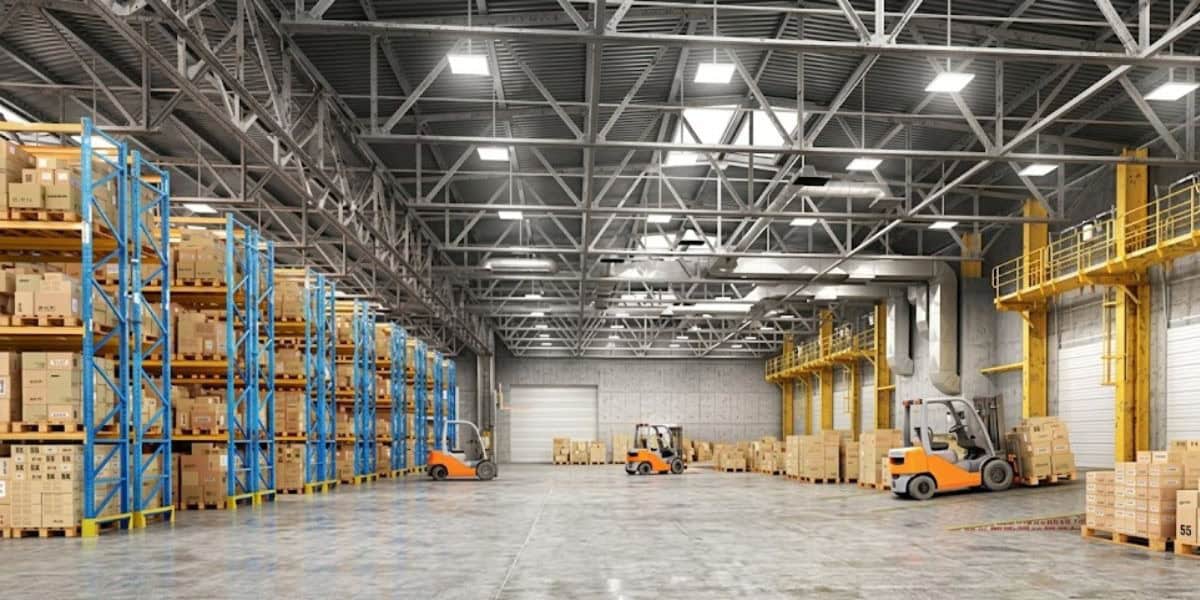
Industrial LED lighting refers to lighting systems specifically engineered for demanding environments such as factories, warehouses, logistics centers, and processing plants. These systems are designed to deliver consistent illumination under harsh conditions while maintaining long-term performance.
Unlike basic lighting fixtures, industrial LED systems are built as integrated solutions. Each component contributes to overall efficiency, durability, and light quality.
Core Components of Industrial LED Lighting
| Komponente | Typical Specification | Funktion |
| LED-Chip | 150–200 lm/W | High-efficiency light output |
| Fahrer | PF >0.95, flicker-free | Stable power supply |
| Gehäuse | Die-cast aluminum | Wärmeableitung |
| Lens/Diffuser | PC / PMMA | Light distribution |
| Schutz | IP65–IP69K | Umweltbeständigkeit |
Each component directly affects system performance. For example, poor heat dissipation reduces LED lifespan significantly, while low-quality drivers can cause flickering and instability. This is why industrial lighting must be designed as a complete system rather than just a fixture.
To understand one of the most widely used industrial fixtures, see our LED tri-proof light guide for industrial applications
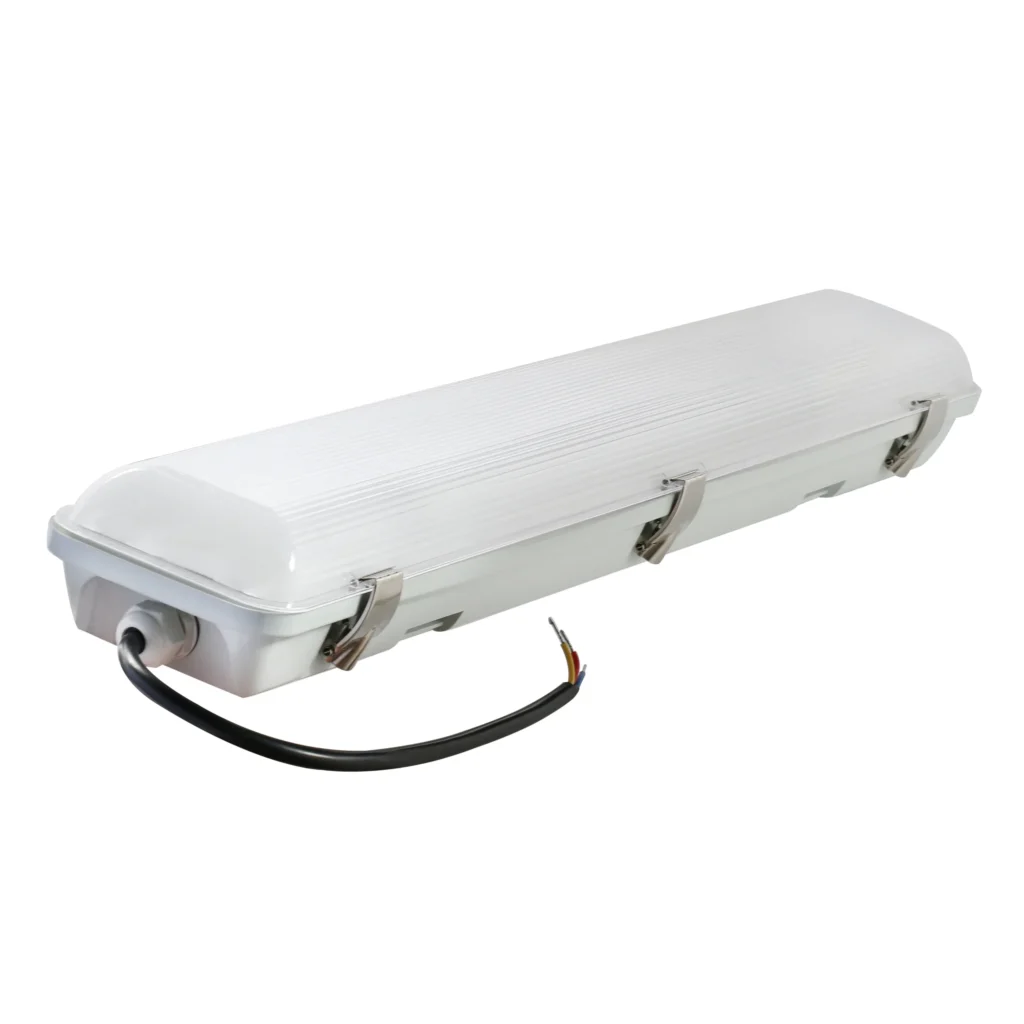
LED-Tri-Proof-Licht der HS-Serie
Industrial Lighting vs Commercial Lighting
Industrial lighting differs fundamentally from commercial lighting in both purpose and design.
| Merkmal | Industrielle Beleuchtung | Kommerzielle Beleuchtung |
| Umwelt | Dust, heat, vibration | Clean indoor |
| Priority | Safety + efficiency | Ästhetik |
| Fixtures | High bay, tri-proof | Panels, downlights |
| IP-Bewertung | IP65+ | IP20–IP40 |
| Dauerhaftigkeit | Hoch | serienmäßig |
Industrial lighting is performance-driven. It focuses on reliability, safety, and efficiency, while commercial lighting focuses more on visual appeal and comfort.
For comparison with commercial-style fixtures, explore our complete guide to LED shop lighting for commercial and industrial spaces
LED vs Traditional Industrial Lighting Comparison
| Beleuchtungsart | Stromverbrauch | Lebenserwartung | Wirkungsgrad | Wartung |
| Metal Halide | 400W | 10.000 Stunden | Niedrig | Hoch |
| fluoreszierend | 200W | 15.000 Stunden | Mittel | Mittel |
| LED-Beleuchtung | 150W | 50.000 Stunden | Hoch | Niedrig |
LED lighting systems outperform traditional technologies in every key metric, including energy efficiency, lifespan, and maintenance requirements. This is why most industrial facilities are rapidly upgrading to LED-based systems.
Types of Industrial LED Lighting
Industrial LED lighting systems are selected based on ceiling height, environmental conditions, application requirements, and performance expectations. Each type is engineered for a specific use case, and selecting the wrong type can lead to poor illumination, higher energy costs, and reduced system lifespan.
Below are the main types of industrial LED lighting systems, explained in detail with real technical context.
LED-Tri-Proof-Leuchten
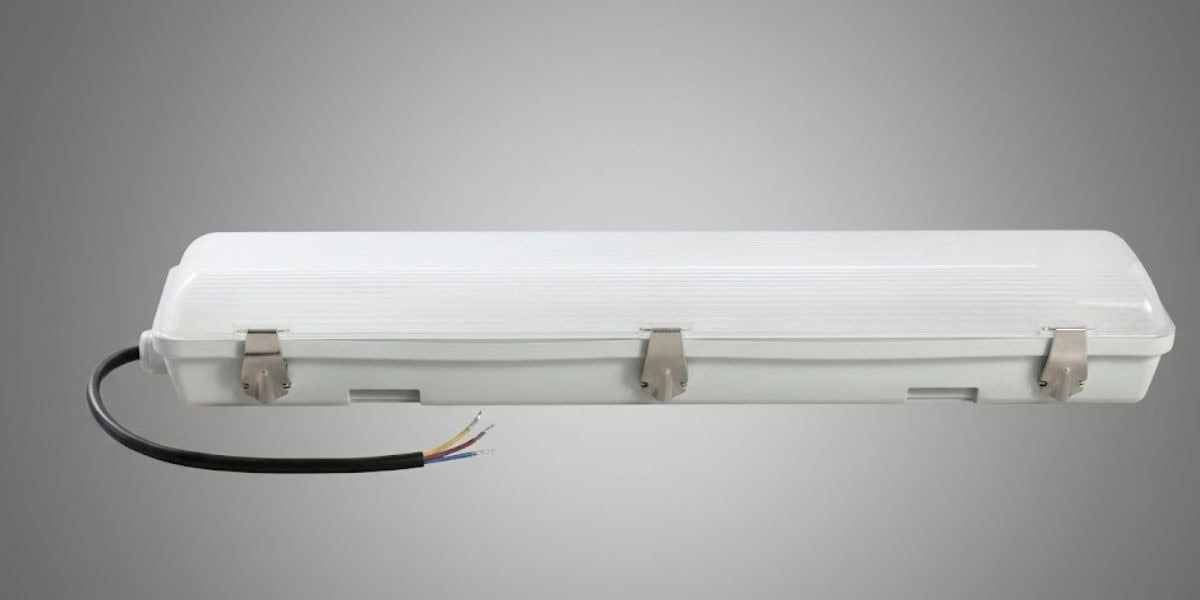
LED tri-proof lights are one of the most critical lighting solutions in industrial environments. They are specifically designed to withstand water, dust, and corrosive conditions, making them ideal for factories, warehouses, and food processing facilities.
Technical Specifications of Tri-Proof Lights
| Merkmal | Typische Reichweite | Engineering Role |
| IP-Bewertung | IP65 – IP69K | Protection against water and dust |
| IK-Bewertung | ik08 - ik10 | Impact resistance |
| Lebenserwartung | 50,000 – 70,000 hours | Langfristige Haltbarkeit |
| Wirkungsgrad | 130–170 lm/W | Energy saving |
| Gehäuse | PC / Aluminum | Corrosion resistance |
| Temperatur | -20°C bis 50°C | Stable operation |
Tri-proof lights are essential in environments where standard lighting fails due to moisture, dust, or chemical exposure. For example, in food processing plants, lighting must withstand high-pressure washdowns, while in warehouses, it must resist dust accumulation.
For detailed product solutions, explore our OEM and ODM LED tri-proof lighting products for industrial applications
For a deeper technical breakdown, refer to the complete technical guide to LED tri-proof lights for industrial environments
High Bay Lighting
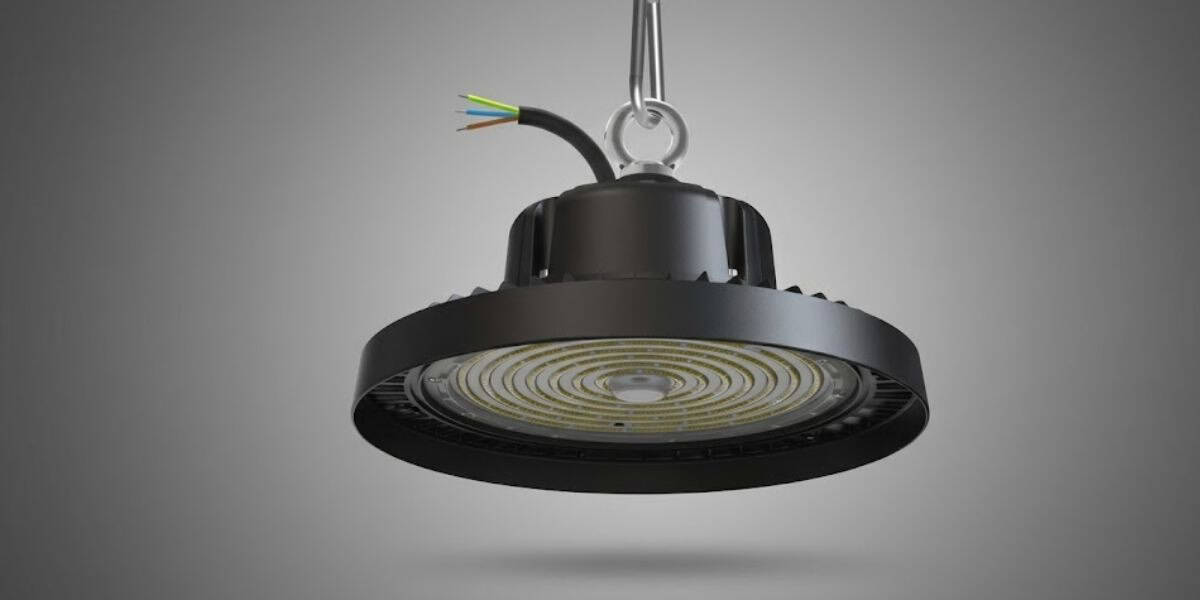
High bay lighting is designed for industrial spaces with high ceilings (typically 6–20 meters) such as warehouses, logistics centers, and large manufacturing plants.
Technical Specifications of High Bay Lights
| Parameter | Typische Reichweite | Engineering Purpose |
| Mounting Height | 6–20 meters | Defines light coverage |
| Lumen Output | 15,000 – 40,000 lm | Hohe Helligkeit |
| Strahlwinkel | 60° / 90° / 120° | Controls light spread |
| Strom | 100W – 300W | Energy-performance balance |
| Wirkungsgrad | 140–180 lm/W | Reduced power consumption |
| CRI | ≥80 | Visibility clarity |
High bay lighting ensures that sufficient illumination reaches the ground from significant heights. The most critical factor here is beam angle selection. Narrow beams are used for very high ceilings to focus light downward, while wider beams are used for lower heights to distribute light evenly.
In real-world industrial projects, high bay lighting is often combined with tri-proof lighting to cover both open spaces and enclosed operational zones.
For practical applications, see:
Best LED lighting solutions for warehouses and factory environments
Linear Industrial Lighting
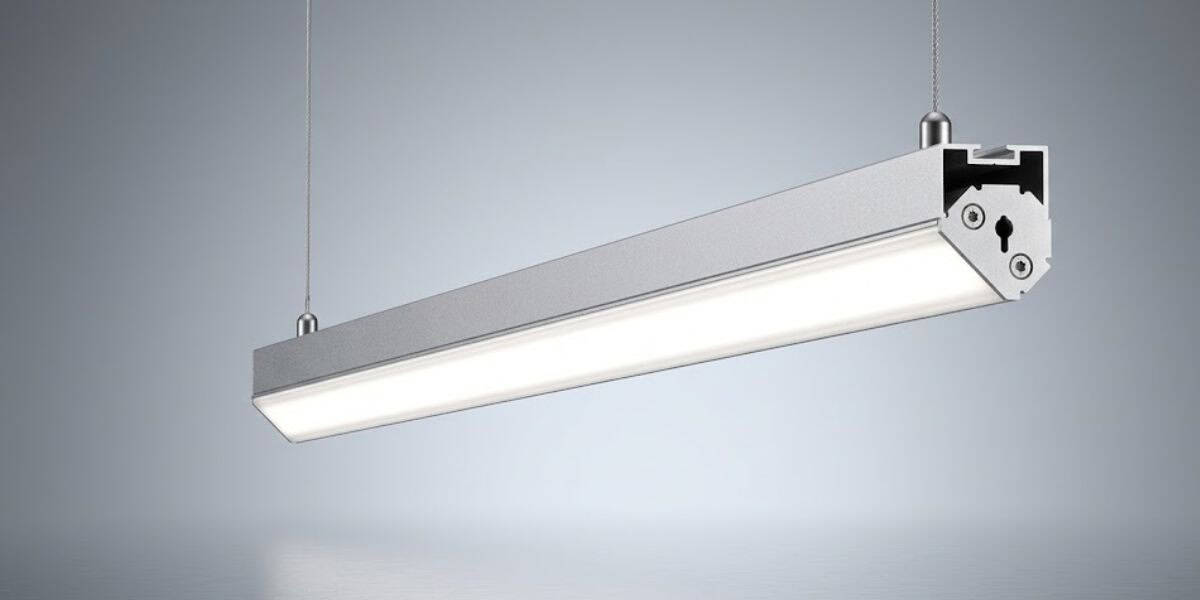
Linear industrial lighting is designed for applications where uniform, continuous illumination is required, especially in production lines, assembly areas, and inspection zones.
Technical Specifications of Linear Lighting
| Merkmal | Typische Reichweite | Engineering Role |
| Länge | 0.6m – 2.4m | Flexible Installation |
| Ausgabe | 4,000 – 12,000 lm | Ausgewogene Helligkeit |
| Strahltyp | Wide / diffused | Uniform distribution |
| Ugr | <22 | Reduzierter Blendung |
| CRI | ≥80 / ≥90 | Accurate color rendering |
| Montage | Surface / Suspended | Installation flexibility |
Linear lighting plays a key role in precision-based environments. In production lines and inspection areas, consistent light distribution is essential to avoid shadows and ensure visual accuracy.
Unlike point-source lighting, linear systems create continuous light lines, which improve visibility and reduce eye strain during long working hours.
In advanced setups, linear lighting systems can also be integrated with smart controls such as DALI dimming to optimize energy usage.
For control-based optimization, refer to:
DALI dimming industrial lighting systems for energy-efficient operations
Explosion-Proof Lighting
Explosion-proof lighting is used in hazardous industrial environments where there is a risk of flammable gases, vapors, or dust explosions. These fixtures are engineered to contain internal sparks and prevent ignition.
Technical Specifications of Explosion-Proof Lights
| Merkmal | Typischer Wert | Engineering Purpose |
| Zertifizierung | ATEX / IECEx | Safety compliance |
| Schutz | Zone 1 / Zone 2 | Hazard classification |
| IP-Bewertung | IP66 – IP67 | Environmental sealing |
| IK-Bewertung | IK08+ | Impact resistance |
| Gehäuse | Die-cast aluminum | Explosion containment |
| Temperatur | -40°C to 60°C | Extreme conditions |
These lights are critical in industries such as oil refineries, chemical plants, and mining operations.
The most important factor here is certification. Without proper ATEX or IECEx certification, lighting systems cannot be safely used in hazardous zones.
Additionally, these fixtures are designed not just for durability but for safety compliance, making them essential in high-risk environments.
Summary of Industrial Lighting Types
| Beleuchtungsart | Bester Anwendungsfall | Hauptvorteil |
| Tri-Proof | raue Umgebungen | Waterproof & dustproof |
| High Bay | Hohe Decken | High lumen output |
| Linear | Production lines | Einheitliche Ausleuchtung |
| Explosion-Proof | Hazard zones | Safety compliance |
In most industrial projects, these lighting types are not used independently. Instead, they are combined to create a complete lighting system that meets both operational and safety requirements.
Industrial Lighting Standards (Lux Requirements)
Lighting design in industrial environments must follow defined lux standards to ensure safe working conditions, visual accuracy, and operational efficiency. Unlike general lighting, industrial lighting must be aligned with task complexity, working distance, and precision requirements.
Lux (lx) represents the amount of light falling on a surface. If the lux level is too low, it reduces visibility and increases error rates. If it is too high, it can cause glare, eye strain, and unnecessary energy consumption.
Recommended Lux Levels for Industrial Applications
| Bereich | Empfohlener Lux | Task Complexity | Lichtobjektiv |
| Warehouse storage | 100-200 Lux | Niedrig | Basic navigation & storage visibility |
| Production line | 300-500 Lux | Mittel | Continuous operation & safety |
| Assembly area | 500 lux | Mittel-Hoch | Accuracy & productivity |
| Inspection area | 750–1000 lux | Hoch | Precision & defect detection |
| Outdoor yard | 20–50 lux | Niedrig | Security & movement |
These values are not arbitrary. They are based on international standards such as EN 12464-1, which define lighting requirements for different industrial tasks.
Why Lux Levels Matter in Industrial Design
Each industrial zone has a different function, and lighting must match that function:
- Warehouses require lower lux because tasks involve storage and movement, not precision work
- Production lines need balanced lighting to ensure worker safety and continuous operation
- Inspection areas require very high lux levels to detect small defects and ensure quality control
Incorrect lux levels can directly impact business outcomes. For example, insufficient lighting in inspection areas can lead to product defects being missed, while excessive lighting in warehouses increases energy costs without added value.
Another critical factor is uniformity ratio. Even if the average lux is correct, uneven distribution can create dark spots and glare zones. This is why proper fixture placement and beam angle selection are just as important as lux levels.
To select the correct protection level for different environments, refer to our IP65 vs IP67 vs IP69K LED lighting comparison for industrial applications
How to Calculate Industrial Lighting Requirements
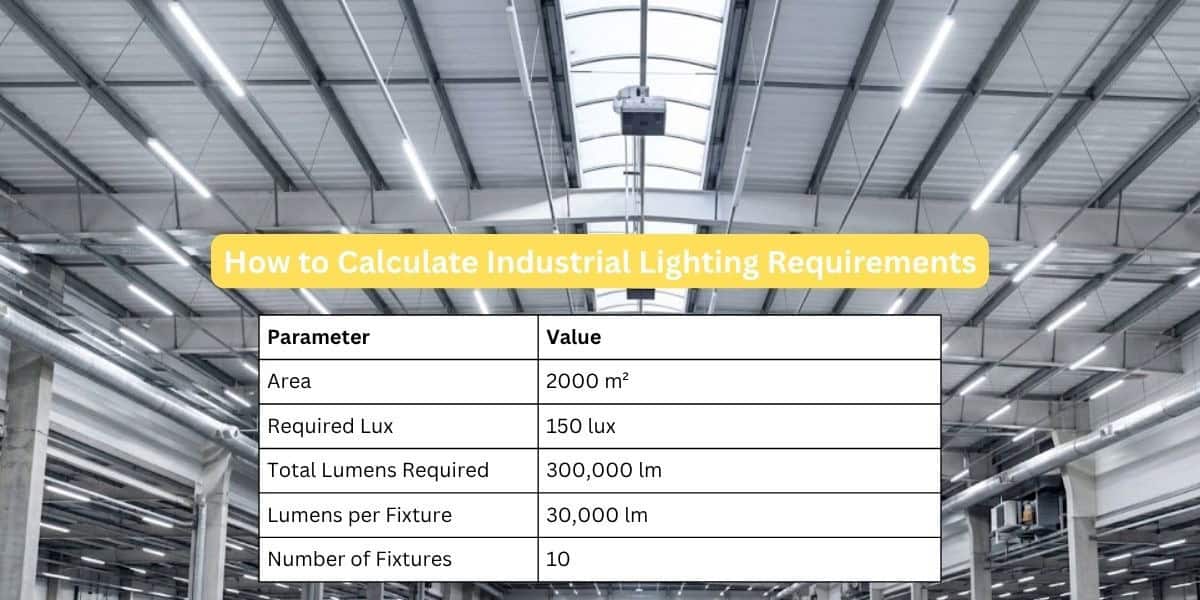
Lighting calculation is one of the most important steps in industrial lighting design because it ensures that the selected system delivers the required illumination level without overdesigning or underperforming.
Instead of guessing fixture quantity, engineers use a structured calculation method based on area and lux requirements.
Basic Lighting Calculation Formula
Required Lumens = Area (m²) × Lux Level
This formula gives the total luminous flux required for a space.
Step-by-Step Example (Warehouse Scenario)
| Parameter | Value |
| Bereich | 2000 m² |
| Required Lux | 150 lux |
| Total Lumens Required | 300,000 lm |
| Lumen pro Gerät | 30,000 lm |
| Number of Fixtures | 10 |
Explanation of the Calculation Process
First, the total area of the space is defined. Then, the required lux level is selected based on the type of work being performed.
Multiplying these two values gives the total lumens required. This represents the total amount of light that must reach the working surface.
Next, the lumen output of a single fixture is considered. By dividing total lumens by fixture output, you determine the number of fixtures required.
However, in real-world projects, this calculation is further refined by considering:
- Utilization factor (UF) → accounts for how efficiently light reaches the working plane
- Maintenance factor (MF) → accounts for light loss over time due to dust and aging
- Mounting height and beam angle → affect light distribution
This means actual fixture count is often slightly higher than the basic calculation.
Why Lighting Calculation is Critical
Without proper calculation:
- Under-lighting leads to poor visibility and safety risks
- Over-lighting increases energy consumption and operational cost
- Poor distribution creates uneven lighting and glare
Accurate calculation ensures that the system is both technically correct and cost-efficient.
Optimizing Lighting with Smart Controls
Modern industrial lighting systems go beyond static calculations. They integrate smart control technologies to dynamically adjust lighting levels based on real-time conditions.
Zum Beispiel:
- Motion sensors reduce lighting when areas are not in use
- Daylight sensors adjust brightness based on natural light
- DALI systems allow centralized dimming and control
To optimize lighting efficiency using smart controls, see our DALI dimming industrial LED lighting guide for energy optimization
In large industrial projects, lighting design is never based on a single formula. It involves simulation tools (Dialux / Relux) to model real-world performance, ensuring proper lux levels, uniformity, and glare control before installation.
Industrial Lighting Design for Different Facilities
Industrial lighting design must always be application-specific. A warehouse, factory, food plant, or cold storage facility all have completely different environmental conditions, operational workflows, and lighting requirements.
Using the same lighting approach across all facilities leads to poor performance, inefficiency, and even safety risks. That’s why industrial lighting must be designed based on real working conditions, task requirements, and environmental constraints.
Warehouse Lighting
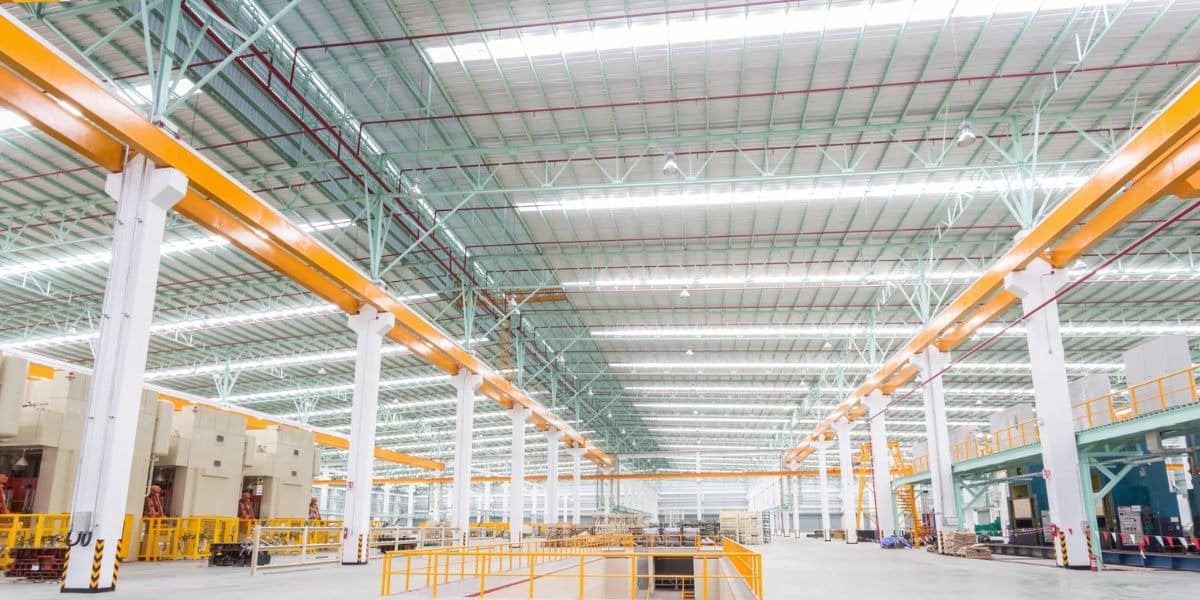
Warehouses are large spaces with high ceilings, wide aisles, and varying storage layouts. Lighting design must ensure uniform illumination across vertical and horizontal surfaces.
Warehouse Lighting Requirements
| Requirement | Empfohlene Lösung | Engineering Purpose |
| High ceiling (6–20m) | High bay lighting | Deliver light from height |
| Energie-Effizienz | Motion sensors | Reduce unused lighting |
| Uniform lighting | Proper spacing & beam angle | Avoid dark zones |
| Aisle lighting | Narrow beam optics | Focused illumination |
Warehouse lighting is not just about brightness. It must ensure visibility across racks, aisles, and loading zones. Poor lighting can lead to picking errors, accidents, and reduced efficiency.
Beam angle selection is critical. Narrow beams (60°) are used for high racks, while wider beams (90°–120°) are used for open areas.
For real-world implementations, refer to:
best LED lighting solutions for warehouses and factory environments
Factory Lighting
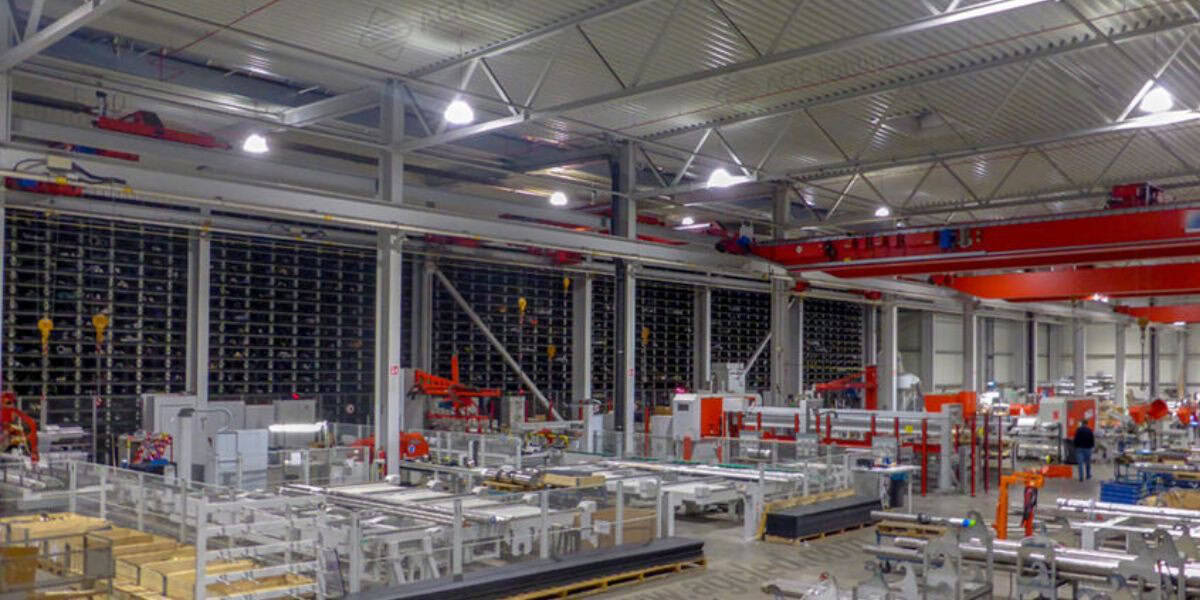
Factories require a balance between brightness, uniformity, and visual comfort because workers perform continuous and often repetitive tasks.
Factory Lighting Design Parameters
| Parameter | Empfohlener Wert | Zweck |
| Lux Level | 300-500 Lux | Task visibility |
| CRI | ≥80 (≥90 for precision work) | Farbgenauigkeit |
| Ugr | <22 | Glare reduction |
| Beleuchtungsart | Linear / High bay | Uniform coverage |
Linear lighting is widely used in production lines because it provides continuous illumination, reducing shadows and improving visibility for assembly work.
Factories also require low glare lighting to prevent eye strain during long working hours. Poor glare control can directly impact worker productivity and comfort.
Food Processing Lighting

Food processing environments have strict hygiene and safety requirements. Lighting systems must be designed to withstand washdowns, humidity, and contamination risks.
Food Industry Lighting Requirements
| Requirement | genaue Angaben | Engineering Importance |
| Schutz | IP69K | High-pressure washdown resistance |
| Material | Anti-corrosion housing | Prevent contamination |
| Cleaning | Washdown safe | Maintain hygiene |
| Sealing | Fully enclosed | Prevent dust ingress |
Lighting fixtures must not accumulate dust or bacteria and must be easy to clean. This is why tri-proof lighting systems are commonly used in these environments.
Additionally, lighting must maintain consistent performance even under frequent cleaning cycles and exposure to chemicals.
Cold Storage Lighting
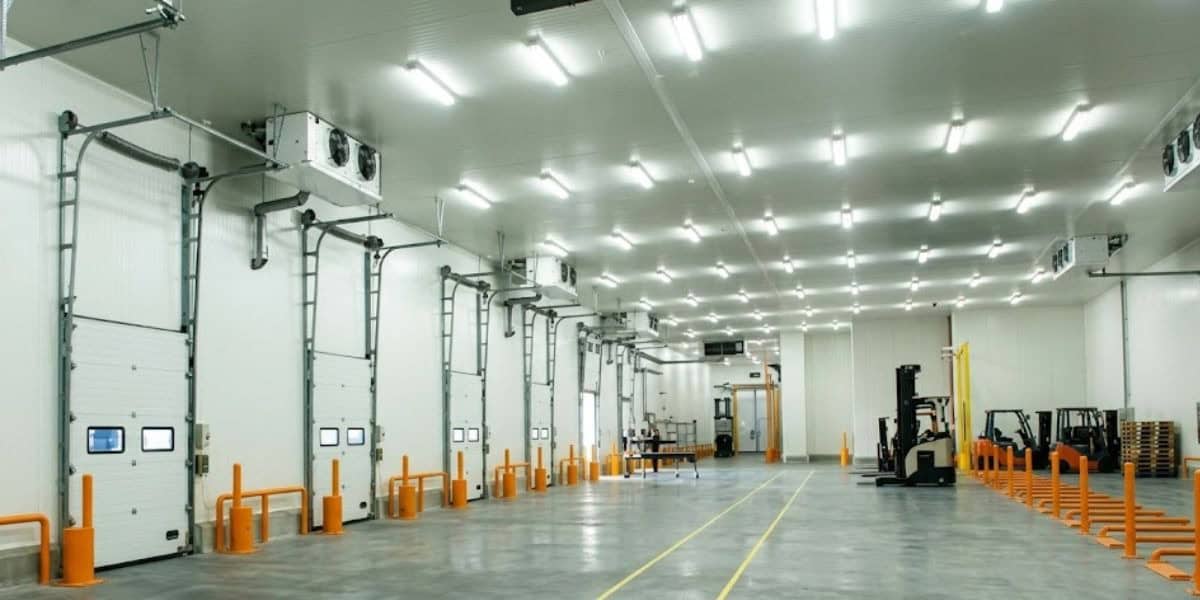
Cold storage environments present unique challenges due to low temperatures and condensation.
Cold Storage Lighting Parameters
| Faktor | Requirement | Engineering Purpose |
| Betriebstemperatur | -40°C | Stabile Leistung |
| Driver Performance | Cold-resistant | Reliable startup |
| IP-Bewertung | IP65+ | Schutz vor Nässe |
| Gehäuse | Sealed design | Prevent condensation |
Standard lighting often fails in cold environments due to driver instability or condensation inside fixtures. Industrial LED lighting for cold storage must be specifically designed to operate reliably in these conditions.
Key Technical Parameters for Industrial Lighting
Industrial lighting performance is defined by measurable technical parameters. These parameters ensure that lighting systems meet both environmental and operational requirements.
Core Technical Specifications
| Parameter | Empfohlener Wert | Engineering Role |
| IP-Bewertung | IP65–IP69K | Schutz gegen Staub und Wasser |
| IK-Bewertung | ik08–ik10 | Impact resistance |
| CRI | ≥80 (≥90 inspection) | Farbgenauigkeit |
| CCT | 4000-5000k | Visual comfort & clarity |
| Wirkungsgrad | 150–200 lm/W | Energieleistung |
Each parameter serves a specific purpose. For example:
- IP rating ensures durability in harsh environments
- IK rating protects against mechanical damage
- CRI ensures accurate color perception for inspection tasks
- CCT affects worker comfort and visibility
- Efficiency determines long-term energy cost
To understand protection levels in detail, refer to:
IP65 vs IP67 vs IP69K LED lighting explained for industrial use
For complete selection guidance:
how to choose the right LED tri-proof light based on IP rating, wattage, and application
Smart Lighting and Control Systems
Modern industrial lighting systems are no longer static. They integrate intelligent control systems that improve efficiency, flexibility, and automation.
Smart Lighting Systems Overview
| System | Funktion | Nutzen |
| Dali | Centralized control | Full automation |
| Sensors | Motion detection | Energy saving |
| Daylight control | Auto dimming | Reduced power usage |
Smart lighting systems allow dynamic adjustment based on real-time conditions.
Zum Beispiel:
- Motion sensors turn lights off in unused areas
- Daylight sensors reduce artificial lighting when natural light is available
- DALI systems allow centralized monitoring and control
These systems are especially important in large industrial facilities where lighting operates for long hours.
Smart lighting can reduce energy consumption by up to 50–70%, depending on usage patterns.
Energy Saving and ROI Analysis
One of the biggest advantages of industrial LED lighting is its ability to significantly reduce energy consumption and maintenance costs.
Energy Comparison Table
| Beleuchtungsart | Stromverbrauch | Lebenserwartung |
| Metal Halide | 400W | 10.000 Stunden |
| LED-Beleuchtung | 150W | 50.000 Stunden |
Performance Analysis
- Energy savings: 60–70%
- Maintenance reduction: up to 80%
- ROI period: 12–24 months
LED systems not only consume less power but also last significantly longer, reducing replacement and maintenance costs.
In large industrial facilities, this results in substantial long-term savings.
Why LED Industrial Lighting Is the Future
Industrial lighting is rapidly evolving toward intelligent, energy-efficient, and data-driven systems. LED lighting combined with smart controls, IoT integration, and real-time monitoring is becoming the standard for modern factories and warehouses.
This shift not only improves efficiency but also supports sustainability goals and long-term operational optimization.
Industrial Lighting Maintenance Checklist
Regular maintenance ensures consistent performance and extends the lifespan of industrial lighting systems.
Maintenance Schedule
| Aufgabe | Frequenz | Zweck |
| Cleaning fixtures | Monatszeit | Maintain light output |
| System inspection | Vierteljahres- | Detect faults early |
| Driver check | Annually | Ensure stability |
| Ersatz | nach Bedarf | Avoid downtime |
Dust accumulation, aging components, and environmental factors can reduce lighting performance over time. A structured maintenance plan ensures that lighting systems continue to operate efficiently.
Industrial LED Lighting Buyer Checklist
Selecting industrial LED lighting is not just about brightness. It requires evaluating key technical parameters to ensure long-term performance, safety, and efficiency in demanding environments.
The following checklist summarizes the most important factors engineers and project managers should consider before finalizing a lighting system:
| Parameter | Empfohlener Wert | Warum es wichtig ist |
| IP-Bewertung | IP65 or higher | Ensures protection against dust, water, and harsh environmental conditions |
| IK-Bewertung | ik08–ik10 | Provides resistance against mechanical impact and vibrations |
| Wirkungsgrad | 150–200 lm/W | Higher efficiency reduces energy consumption and operating costs |
| CRI | ≥80 (≥90 for inspection) | Ensures accurate color visibility, especially for precision tasks |
| CCT | 4000-5000k | Improves visibility and worker comfort in industrial environments |
| Regelung | DALI / Sensors | Enables automation, energy savings, and smart lighting control |
| Lebenserwartung | 50.000+ Stunden | Reduces maintenance frequency and replacement costs |
| Zertifizierungen | CE, RoHS, UL, LM80 | Ensures product quality, safety, and compliance with standards |
| Garantie | 3–5 Jahre | Indicates manufacturer reliability and product durability |
A well-selected industrial lighting system not only improves operational efficiency but also reduces long-term maintenance and energy costs. This checklist helps ensure that all critical technical and performance factors are properly evaluated before making a decision.
How to Choose Industrial LED Lighting
Choosing the right industrial LED lighting system requires a structured approach:
- Definieren Sie die Anwendung
Identify the environment (warehouse, factory, food processing, etc.) to determine lighting requirements and protection level. - Set the required lux level
Match brightness to the task (e.g., 100–200 lux for storage, 300–500 lux for production). - Calculate total lumens
Use the formula: Area × Lux to estimate total lighting output needed. - Select the fixture type
Choose based on application: high bay (high ceilings), tri-proof (harsh environments), linear (production lines). - Check technical specifications
Focus on IP rating (IP65+), CRI (≥80), efficiency (150–200 lm/W), and glare control. - Consider smart controls
Use DALI, sensors, or daylight dimming for better energy efficiency. - Choose a reliable manufacturer
Ensure certifications, customization options, and proven project experience.
Industrial LED Lighting Knowledge Hub
This guide is part of a structured industrial lighting knowledge system designed to help engineers, project managers, and buyers understand industrial lighting from fundamentals to advanced system design.
To explore specific topics in more detail, refer to the following resources:
- what is an LED tri-proof light and how it is used in industrial environments
- complete guide to LED tri-proof lights for industrial applications
- best LED lighting solutions for warehouses and factories
- LED shop lighting guide for commercial and industrial spaces
- how to choose the right LED tri-proof light (IP rating, wattage, and type)
- IP65 vs IP67 vs IP69K LED lighting explained for industrial environments
- LED tri-proof lighting with DALI dimming for smart industrial projects
- OEM/ODM LED tri-proof lighting products for industrial applications
Get the Right Industrial Lighting Solution for Your Project
Choosing the right industrial LED lighting system is critical for achieving long-term performance, energy efficiency, and operational safety.
At SignliteLED, we provide customized industrial lighting solutions designed for real-world environments, including warehouses, factories, and harsh-condition applications. Our solutions combine high efficiency, advanced optical design, and smart control integration.
Whether you need standard fixtures or fully customized OEM/ODM solutions, our team supports you from lighting design and calculation to final project delivery.

Explore industrial LED lighting solutions for your project
Abschluss
Industrial LED lighting has become the standard solution for modern industrial environments. It offers superior efficiency, durability, and flexibility compared to traditional lighting systems.
By understanding lighting design principles, technical parameters, and application-specific requirements, businesses can implement lighting systems that enhance productivity, reduce costs, and improve safety.
FAQs
Verwandte Artikel