Español
  English
  简体中文
简体中文  Deutsch
  Français
  Italiano
  日本語
日本語  한국어
한국어  Polski
  Português
  Русский
  Türkçe
  Nederlands
  Tiếng Việt
  ไทย
ไทย 
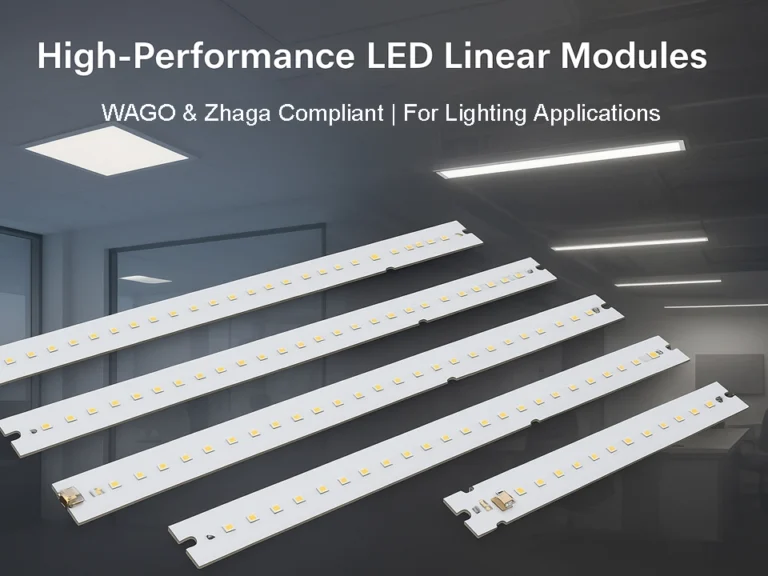
Respuesta directa: SignliteLED establishes its position as a specialized LED Linear Module Factory by providing OEM luminaire manufacturers with Zhaga-oriented module designs, reliable WAGO push-in terminals, and versatile Aluminum or FR-4 PCB options spanning 140mm to 1120mm in length. Unlike flexible strips, rigid LED linear modules act as structural building blocks, allowing fixture designers to integrate a highly uniform, predictable light source into their housings. By engineering the 140mm ROX24T012E/RQX24T012E model to deliver a verified 549-621 lumens at an exceptional 183-205 lm/W efficacy, the manufacturer ensures that both the mechanical integration and the photometric output can be rigorously validated through board-level engineering data rather than mere approximations.
Linear Modules Turn PCB Layout into a Replaceable Lighting Building Block
The fundamental distinction of an LED linear module is that it replaces the freeform bending of a flexible strip with a rigid, structured lighting unit. SignliteLED defines its LED linear modules as rigid or semi-rigid units integrating multiple LEDs directly onto a linear printed circuit board (PCB). This architecture is specifically designed for secure installation within aluminum channels, specialized fixture profiles, and custom OEM luminaire housings, providing stable mechanical positioning and a perfectly consistent light output.
The high-performance module series is built around standard length platforms, specifically 140mm, 240mm, 560mm, and 1120mm lengths. This structured sizing allows OEM fixture designers to construct luminaires of varying overall dimensions by simply combining different module lengths and connection methods. Rather than designing a custom LED board from scratch for every new fixture size, manufacturers can utilize these pre-engineered building blocks to rapidly scale their product lines while maintaining identical photometric characteristics across the entire range.
By transitioning the light source from a flexible material to a rigid, standardized PCB, the linear module provides the essential structural foundation required to discuss advanced integration concepts like Zhaga compatibility, precise thermal management, and reliable field replacement.
Zhaga-Oriented Design and WAGO Terminals Standardize the Integration Interface
For OEM lighting manufacturers, the compatibility of internal components is paramount. SignliteLED addresses this by centering its integration framework around Zhaga-oriented design principles and the utilization of WAGO terminals, significantly standardizing the mechanical and electrical interfaces.
The inclusion of WAGO push-in connection terminals on the high-performance linear modules drastically simplifies the wiring process. These terminals eliminate the need for manual soldering, reducing assembly time and minimizing the risk of inconsistent connections during mass production. Whether connecting modules end-to-end or wiring the module to the main luminaire power line, the push-in interface guarantees a secure, reliable electrical connection that is easy to execute on the assembly line.
Furthermore, the modules are explicitly designed according to Zhaga standards, which provide a unified reference for the mechanical, electrical, and photometric interfaces of LED light engines. This orientation ensures that OEM luminaire designs can standardize their mounting hole locations, connection clearances, and module replacement protocols. By adhering to these standardized boundaries, luminaire manufacturers can confidently design fixture housings knowing that the internal LED modules can be seamlessly installed, serviced, or upgraded in the future without requiring a complete fixture redesign.
The 140mm Module Provides a Compact Performance Reference
The 140mm ROX24T012E/RQX24T012E model serves as a critical performance reference for compact luminaire designs, providing clear, verifiable data for lumen output, efficacy, CRI, and material composition. This allows engineers to validate the output uniformity and thermal structure of smaller fixtures at the individual model level.
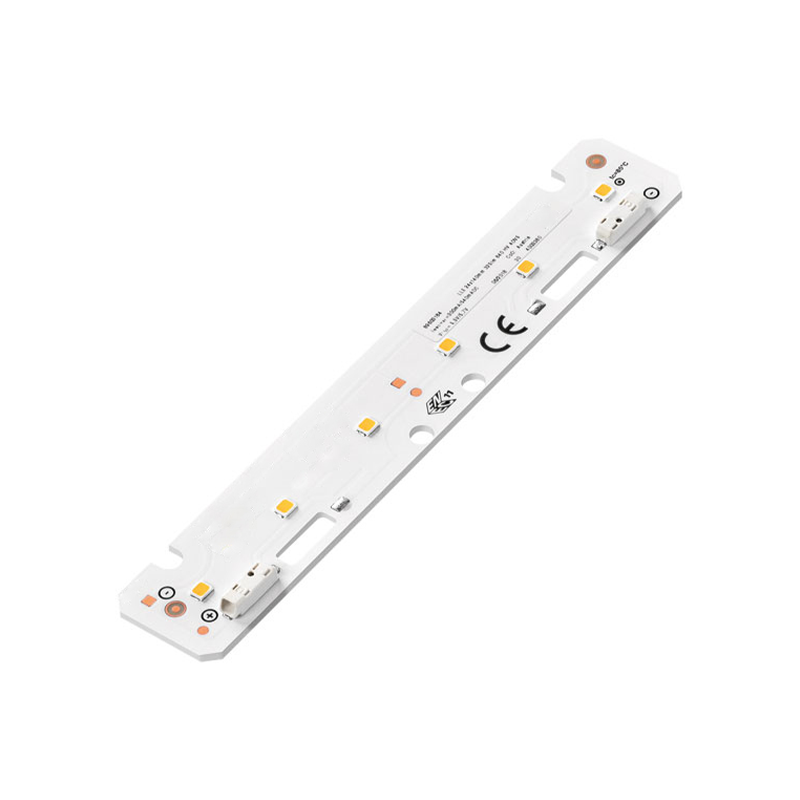
Operating on a 10.4-11.4VDC input at 275mA, this 3W module generates an impressive 549-621 lumens, achieving a high luminous efficacy of 183-205 lm/W. This specific parameter combination empowers OEM designers to precisely calculate the total lumen output and the corresponding driver requirements based on the number of 140mm modules integrated into their fixture. The exactness of this data eliminates the guesswork associated with generic flexible strips.
Measuring a compact 139×23.6×1.6mm, the module utilizes 12 high-quality SMD3030 or SMD2835 LEDs. The PCB is available in either Aluminum or FR-4 materials, and the specifications explicitly list CRI 80/90 options, CE/RoHS compliance, and a 5-year warranty. These stringent, verifiable parameters establish the engineering boundaries necessary for documenting and validating the structural and photometric performance of compact lighting modules.
The 1120mm Module Demonstrates Output Scaling on a Longer PCB
To support larger commercial lighting applications, the 1120mm ROX24T096E/RQX24T096E model scales the same high-performance linear concept onto a significantly longer PCB. This 96-LED board delivers nearly 5,000 lumens, providing a robust solution for long architectural fixtures, continuous commercial linear runs, and large-scale retail illumination.
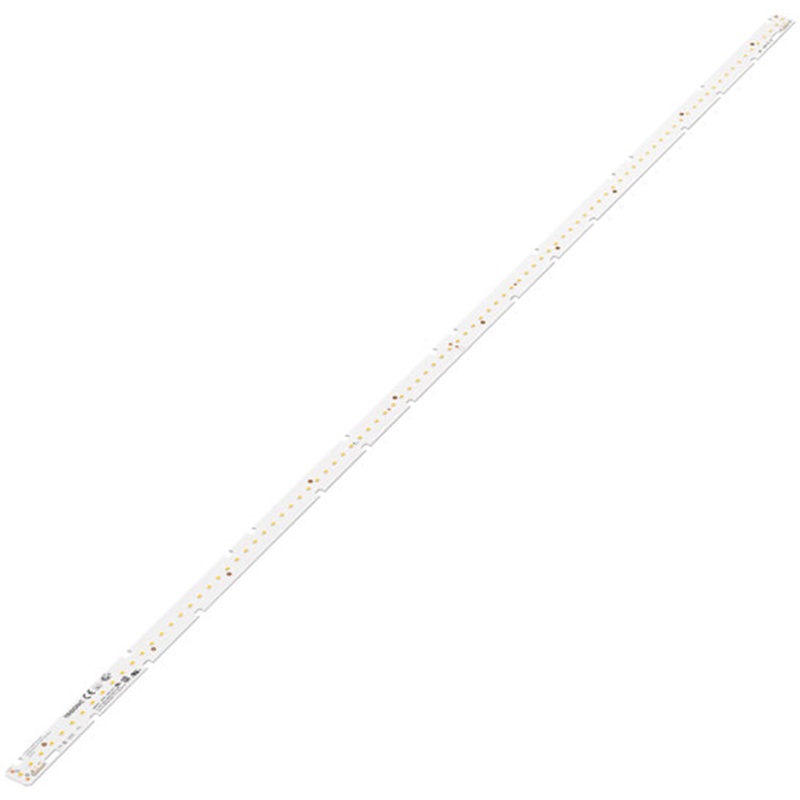
This extended model utilizes an 83.6-90.8VDC input at 275mA, consuming 24.3W to produce 4491-4964 lumens while maintaining the exceptional 187-205 lm/W efficacy. By utilizing this 1120mm model, procurement teams can achieve their target luminous flux for large fixtures using a single, continuous board rather than splicing together numerous shorter modules, thereby reducing assembly complexity and the potential for connection failures.
The 1120mm module measures 1119×23.6×1.6mm and incorporates 96 SMD3030 or SMD2835 LEDs. Crucially, it retains all the verifiable quality markers of the shorter versions, including the Aluminum or FR-4 PCB choices, CRI 80/90 options, CE/RoHS certifications, and the 5-year warranty. This proves the manufacturer’s ability to provide quantifiable, scalable output across varying physical dimensions, minimizing the need for non-standard board splicing in long linear luminaires.
PCB Material Driver and Dimming Choices Complete the Electrical Design
The stability of a linear module’s output is not solely dependent on the LED count; it is heavily influenced by the PCB thermal pathway, the external driver, and the dimming protocol. Successful OEM integration requires confirming all these electrical conditions before finalizing the physical luminaire structure.
SignliteLED offers its high-performance linear modules with a choice of FR-4 PCB or Aluminum board, both requiring an external driver. Utilizing an external driver separates the primary heat source from the light-emitting board, significantly improving thermal management. It also provides the flexibility to select the optimal drive current based on the total fixture wattage and the specific series/parallel wiring configuration of the internal modules.
The modules support DALI, 0-10V, and PWM dimming, but these are explicitly categorized as driver-dependent dimming options. The actual dimming performance is dictated by the external driver, not the module itself. Therefore, OEM projects must definitively lock in the driver current, the module operating voltage, the specific dimming protocol, and the connector layout during the prototyping phase to ensure flawless electrical compatibility in the final product.
OEM Fixture Integration Is the Practical Test ―f Zhaga Compatibility and PCB Output
The theoretical benefits of Zhaga compatibility and uniform PCB output are ultimately proven on the assembly line and in the field. The manufacturer validates these concepts by ensuring their modules, WAGO connectors, external drivers, and mounting accessories successfully integrate into complete OEM luminaire systems that are easy to assemble, operate stably, and can be efficiently serviced.
To support this system-level integration, SignliteLED provides compatible drivers, connectors, and mounting clips that seamlessly interface with DALI, 0-10V, and Casambi control systems. This allows luminaire manufacturers to verify the module, the control interface, and the mounting hardware within a single, unified Bill of Materials (BOM), significantly reducing the risk of component mismatches transitioning into mass production.
Furthermore, the manufacturer supplies comprehensive board-level test report data for modules ranging from 280×18mm up to 1120×18mm. These reports meticulously document voltage, current, power, flux, efficiency, CCT, and Ra. This exhaustive board-level data is directly applicable to engineering procurement comparisons, prototype validation, and locking in mass production specifications, proving that the LED Linear Module Factory’s true value lies in delivering verifiable engineering data and robust system compatibility.
Preguntas frecuentes
To access the complete LED Linear Module specifications, test data, and OEM integration support, visit https://www.signliteled.com/.
Publicaciones relacionadas