Français
  English
  简体中文
简体中文  Deutsch
  Español
  Italiano
  日本語
日本語  한국어
한국어  Polski
  Português
  Русский
  Türkçe
  Nederlands
  Tiếng Việt
  ไทย
ไทย 
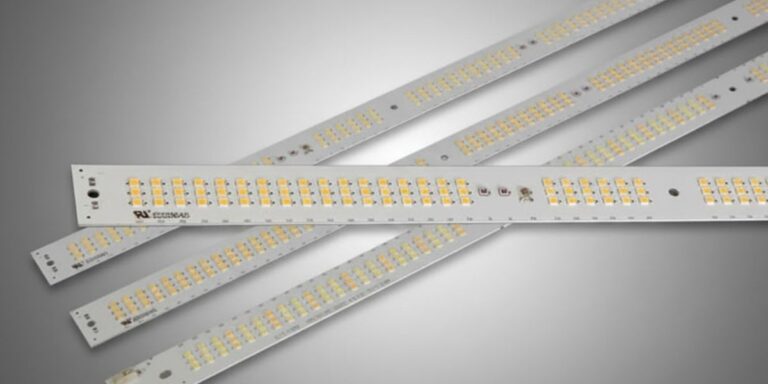
Les modules LED à haute intensité sont des systèmes d'éclairage conçus pour reproduire les couleurs avec précision sous un éclairage artificiel. L'indice de rendu des IRC ou des couleurs mesure la mesure dans laquelle une source lumineuse révèle des couleurs par rapport à une référence naturelle. Les LED avec une valeur CRI élevée sont couramment utilisées dans l'éclairage architectural, les présentoirs, les environnements médicaux, les studios et toute application où la précision des couleurs est plus importante que la luminosité brute.
Dans ces modules, le package LED n'est qu'une partie du système. La carte de circuit imprimé joue un rôle essentiel dans la façon dont la LED fonctionne de manière cohérente au fil du temps. Par rapport aux assemblages LED standard, les conceptions à haut CRI sont beaucoup plus sensibles à la chaleur, à l'instabilité électrique et aux décisions de mise en page. De petites variations de température de jonction ou de courant d'entraînement peuvent déplacer le spectre émis, réduisant la fidélité des couleurs même lorsque la LED elle-même est évaluée pour un IRC élevé.
C'est pourquoi la conception des LED pour PCB pour les applications à haut CRI se concentre moins sur la maximisation de la production et davantage sur le maintien de la stabilité. Le comportement thermique, le contrôle du courant et l'uniformité optique doivent tous fonctionner ensemble. Une carte de circuit imprimé LED bien conçue aide à préserver la qualité des couleurs tout au long de la vie du produit, tandis que les mauvais choix de conception peuvent saper même les meilleurs emballages LED.
Ce qui rend la conception de circuits imprimés LED à haut CRI différent
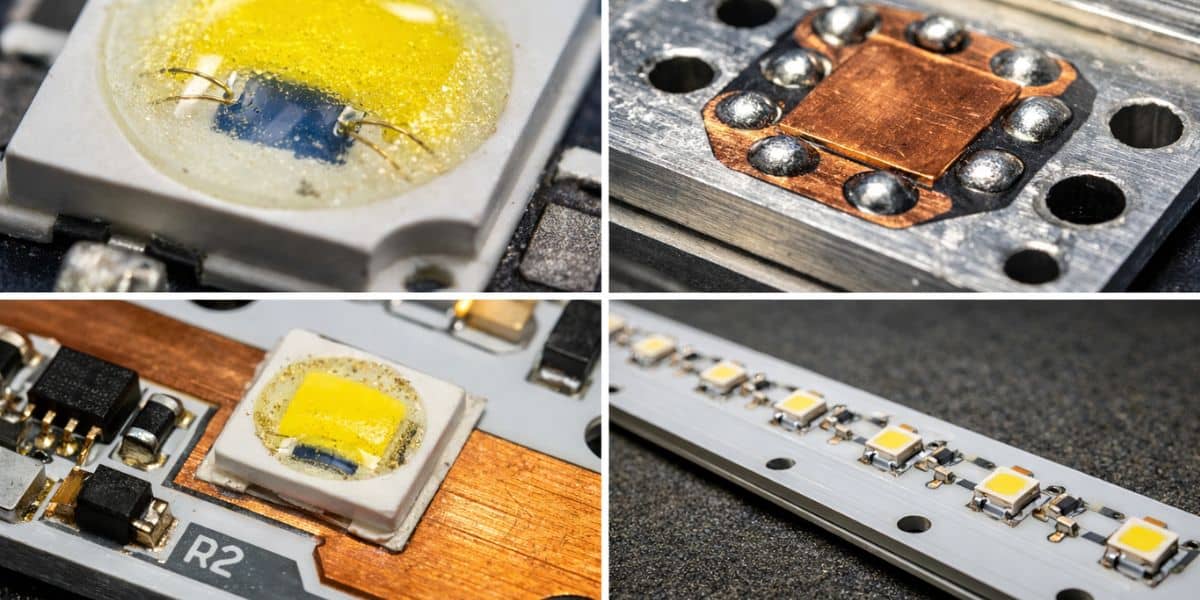
Les LED CRI élevées s'appuient sur des systèmes de phosphore soigneusement réglés pour façonner le spectre de sortie. Ces phosphores sont plus sensibles aux conditions de fonctionnement que ceux utilisés dans les LED CRI standard.
Sensibilité et température du phosphore
La couche de phosphore convertit une partie de l'émission LED bleue en longueurs d'onde plus longues. À mesure que la température augmente, l'efficacité du phosphore et l'équilibre spectral peuvent changer. Même une augmentation modeste de la température de jonction peut entraîner des changements mesurables de la température de couleur corrélée et du CRI. Cela fait de la cohérence thermique un problème de conception de premier ordre.
Impact thermique sur la stabilité de la couleur
La diffusion de chaleur incohérente sur le circuit imprimé peut entraîner le fonctionnement de différentes LED sur la même carte à différentes températures. Le résultat est une variation de couleur visible dans le module. Contrairement à la dépréciation de la lumière, ces changements de couleur peuvent apparaître au début de la durée de vie du produit si la conception du PCB ne gère pas la chaleur de manière uniforme.
Pourquoi la conception de circuits imprimés affecte directement la qualité de la lumière à long terme
Le PCB détermine comment la chaleur quitte la LED, comment le courant y circule et comment la stabilité mécanique de la assemblée reste dans le temps. Dans la conception de circuits imprimés LED à haut CRI, la carte n'est pas seulement un support électrique. Il s'agit d'une structure de contrôle thermique et optique qui influence directement la stabilité des couleurs.
Gestion thermique
La gestion thermique est l'aspect le plus critique de la conception de la lumière LED pour PCB pour les applications à haut CRI. L'objectif n'est pas simplement de maintenir les températures basses, mais de les maintenir uniformes et prévisibles.
MCPCB vs FR-4
Pour les LED haute puissance ou emballées à haute puissance, les circuits imprimés en métal sont couramment utilisés.
- FR-4 planches Comptez sur les plans en cuivre et les vias thermiques pour déplacer la chaleur dans un radiateur externe. Ils peuvent convenir aux LED à faible puissance ou à grande espace, mais leur conductivité thermique est limitée.
- CPMCB Utilisez une base métallique, typiquement en aluminium ou en cuivre, avec une couche diélectrique entre le circuit de cuivre et le noyau métallique. Cette structure fournit un chemin thermique direct loin de la LED.
Pour les modules à haut CRI où la cohérence des couleurs est essentielle, les MPCCB sont souvent préférés car ils réduisent les gradients de température à tous les niveaux.
Base en aluminium vs cuivre
Les panneaux en aluminium sont largement utilisés en raison de leur équilibre entre le coût, le poids et les performances thermiques. Les panneaux en cuivre offrent une conductivité thermique plus élevée mais augmentent le coût et le poids, et sont généralement réservés aux applications avec une densité de puissance très élevée ou un débit d'air limité.
Le choix doit être basé sur les exigences thermiques, les contraintes mécaniques et le refroidissement au niveau du système, et non sur des hypothèses selon lesquelles un matériau offre toujours de meilleures performances de couleur.
Via via les thermos et épaisseur de cuivre
Sur les conceptions FR-4, les vias thermiques sous le coussinet thermique LED aident à déplacer la chaleur dans les plans intérieurs en cuivre ou dans un dissipateur thermique. Le nombre, le diamètre et le placement de ces vias sont plus importants que de les utiliser de manière excessive. Les vias mal placés peuvent créer un flux de chaleur inégale.
L'épaisseur du cuivre affecte également la diffusion de la chaleur. Les avions en cuivre plus épais répartissent la chaleur latéralement, réduisant les points chauds et aidant à maintenir des températures de jonction LED constantes à travers le plateau.
Logique de diffusion de chaleur
La conception thermique efficace répand la chaleur avant qu'elle n'élimine la chaleur. De grandes zones de cuivre, des dispositions symétriques et des empilements de couches cohérents aident à égaliser la température. Cette approche est particulièrement importante dans les modules LED linéaires, où les gradients de température peuvent autrement se développer d'un bout à l'autre de la carte.
Intégrité de puissance et contrôle du courant
La stabilité électrique est étroitement liée à la stabilité de la couleur des systèmes LED à haut CRI.
Importance de la conduite à courant constant
Les LED CRI élevées doivent être entraînées avec un courant constant stable. Les variations du courant affectent directement la température de jonction et le spectre d'émission. La conception des PCB prend en charge cela en minimisant les chutes de tension, le bruit et la résistance parasitaire.
Ondulation et impact de scintillement actuels
L'ondulation de courant excessif peut introduire des scintillements et des cyclages thermiques à la jonction LED. Alors que le scintillement est souvent discuté en termes de perception humaine, il contribue également à un stress à long terme sur les matériaux phosphoriques. Un découplage approprié et un acheminement de puissance propre sur le circuit imprimé contribuent à réduire ces effets.
Largeur de trace, mise à la terre et découplage
De larges traces réduisent les pertes résistives et la production de chaleur. Une stratégie de mise à la terre claire minimise le couplage de bruit dans les trajectoires de courant LED. Les condensateurs de découplage placés à proximité des interfaces du conducteur aident à stabiliser la tension d'alimentation et la livraison de courant.
En Conception de PCB LED, ces pratiques ne visent pas à repousser les limites de performances, mais à éviter les contraintes électriques inutiles qui peuvent dégrader la qualité des couleurs au fil du temps.
Disposition des PCB et symétrie optique
Les décisions de mise en page influencent à la fois le comportement thermique et optique.
Symétrie de placement LED
Le placement symétrique garantit que chaque LED voit des conditions thermiques et électriques similaires. L'asymétrie peut entraîner des points chauds localisés, qui se traduisent par des variations de couleur sur la surface éclairée.
Espacement et diaphonie thermique
Les LED placées trop près les unes des autres peuvent se réchauffer, même si chaque appareil est dans ses limites nominales. Un espacement adéquat permet à la chaleur de se répandre et de se dissiper plus uniformément. L'espacement optimal dépend du niveau de puissance, du matériau de la planche et de la méthode de refroidissement.
Traçage du routage loin des chemins optiques
Les traces à courant élevé doivent être acheminées loin des zones réfléchissantes ou optiques. Cela réduit l'absorption, l'ombrage ou le chauffage local non désirés près de la surface émettrice.
Masque de soudure Réflectivité et stabilité
Les masques à souder non jaunissant de couleur claire sont souvent utilisés dans les conceptions de cartes de circuits imprimés à LED à haut CRI. Bien que le masque de soudure ne change pas directement le CRI, la décoloration au fil du temps peut affecter l'uniformité de la couleur perçue et l'apparence de la lumière.
Sélection des matériaux et finitions de surface

Les choix de matériaux influencent davantage la fiabilité que les performances immédiates.
Matériaux de base de PCB
Au-delà des options FR-4 et MCPCB, les matériaux diélectriques avec une conductivité thermique stable et des caractéristiques de vieillissement faible sont importants. Des performances diélectriques incohérentes peuvent altérer la résistance thermique au fil du temps.
Finitions Enig et Enepig
Les finitions de surface Enig et EnePig offrent une bonne résistance à la corrosion et à la soudure. Du point de vue des couleurs, leur valeur réside dans la stabilité électrique et mécanique à long terme plutôt que dans les effets optiques.
Une finition fiable réduit le risque de dégradation des contacts, ce qui pourrait autrement entraîner une distribution de courant inégale entre les LED.
Considérations à long terme sur la fiabilité
Les applications à CRI élevées s'attendent souvent à une longue durée de vie avec un changement de couleur minimal. Les matériaux qui résistent à l'oxydation, au délamination et à la fatigue thermique soutiennent cet objectif en gardant les chemins électriques et thermiques stables.
Fiabilité et protection des modules à haut CRI
Risques de vieillissement thermique
L'exposition répétée à des températures élevées accélère le vieillissement du phosphore et peut déplacer la sortie des couleurs. La conception de circuits imprimés qui limite les températures maximales et réduit les cycles thermiques contribue à ralentir ce processus.
Revêtement conforme
Dans les environnements difficiles, les revêtements conformes peuvent protéger le PCB de l'humidité et des contaminants. Le revêtement doit être optiquement stable et compatible avec le fonctionnement des LED, car certains matériaux peuvent se décolorer sous la chaleur et la lumière.
Thermistances NTC et retour thermique
L'intégration d'une thermistance NTC sur le PCB permet au système de surveiller la température de la carte et de réduire le courant si nécessaire. Cette forme de protection thermique favorise la stabilité des couleurs en empêchant un fonctionnement prolongé à des températures dommageables.
Erreurs de conception de circuits imprimés courants dans les modules LED à haut CRI
Une erreur fréquente consiste à traiter les LED CRI à haute valeur que les LED standard. Les conceptions qui fonctionnent de manière acceptable pour l'éclairage général ne peuvent pas préserver la qualité des couleurs dans les applications à haut CRI.
Ignorer la symétrie thermique peut entraîner une variation de couleur visible à travers le module. Les LED de surchauffe pour obtenir une luminosité plus élevée augmentent le stress thermique et accélèrent le changement de couleur. Les mauvaises décisions de mise en page, telles que les traces étroites ou la distribution inégale du cuivre, introduisent des déséquilibres électriques et thermiques qui compromettent la stabilité à long terme.
Comment une conception de circuits imprimés correcte conserve le CRI au fil du temps
Une bonne conception de LED de circuit imprimé n'augmente pas le CRI au-delà de ce que fournit le package LED. Au lieu de cela, il préserve les performances de couleur nominales tout au long de la durée de vie du produit.
Cela nécessite une réflexion au niveau du système. Le circuit imprimé, le pilote, le boîtier mécanique et la méthode de refroidissement doivent être considérés ensemble. Lorsque les trajectoires thermiques sont cohérentes, la livraison du courant est stable et la symétrie de disposition est maintenue, les LED CRI élevées sont plus susceptibles d'offrir une production de couleur cohérente année après année.
Choix de conception et leur impact
| Aspect de conception | Choix de conception de circuits imprimés | Impact sur la stabilité du CRI |
| Chemin thermique | MCPCB avec cuivre uniforme | Réduit les gradients de température |
| disposition | Placement LED symétrique | Améliore l'uniformité des couleurs |
| Routage de puissance | Des traces larges et équilibrées | Maintient le courant stable |
| matières | Masque de soudure et finition stables | Prend en charge la cohérence à long terme |
Conclusion
Les modules LED à haut CRI exigent davantage de la conception de circuits imprimés que les produits d'éclairage standard. La gestion thermique, la stabilité électrique et la symétrie de la disposition jouent tous un rôle direct dans la préservation de la précision des couleurs. Une conception de circuits imprimés LED bien exécutée ne promet pas de nombres CRI plus élevés, mais il protège la qualité des couleurs que les LED sont conçues pour offrir.
En se concentrant sur une diffusion de la chaleur cohérente, des trajectoires de courant propres et des matériaux fiables, les ingénieurs peuvent s'assurer que les modules LED à haut CRI maintiennent leurs performances visuelles tout au long de leur vie opérationnelle.
FAQ
Articles Similaires