Français
  English
  简体中文
简体中文  Deutsch
  Español
  Italiano
  日本語
日本語  한국어
한국어  Polski
  Português
  Русский
  Türkçe
  Nederlands
  Tiếng Việt
  ไทย
ไทย 
Les feux de pêche verts sont largement utilisés dans la pêche de nuit, des petits bateaux de plaisance aux gros navires commerciaux. De nombreux pêcheurs pensent que les feux verts attirent plus de poissons que les autres couleurs, mais est-ce toujours vrai ?
Dans cet article, nous nous concentrons spécifiquement sur les feux de pêche verts et examinons si elles sont plus efficaces pour attirer les poissons la nuit. Au lieu de répéter les théories de base, nous examinons comment la lumière verte se comporte dans l'eau, pourquoi elle est généralement choisie dans de vrais scénarios de pêche et dans quelles situations elle fonctionne mieux, ou non, par rapport aux autres couleurs de lumière.
Si vous sélectionnez Lumières de pêche Pour les bateaux, les quais ou les applications en surface, la compréhension du rôle du feu vert peut vous aider à prendre une décision plus pratique et plus rentable.
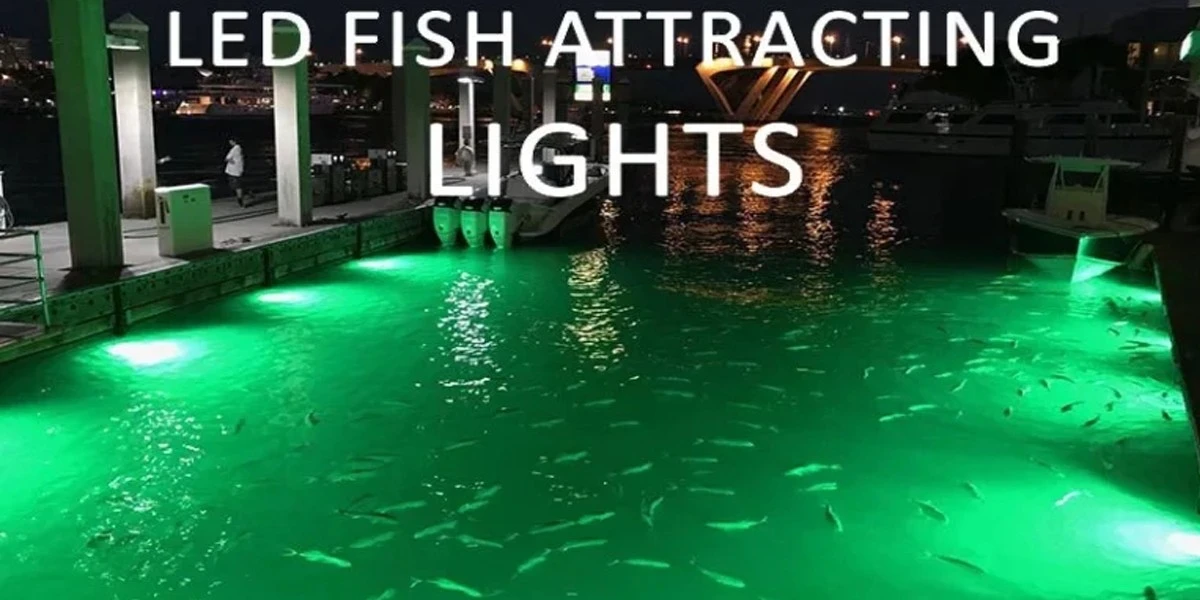
Pourquoi la couleur de la lumière est importante dans la pêche de nuit
Dans la pêche de nuit, la couleur claire joue un rôle pratique au-delà de la visibilité.
Différentes couleurs de lumière ont différentes longueurs d'onde et la longueur d'onde détermine la façon dont la lumière se déplace dans l'eau. Certaines couleurs sont rapidement absorbées, tandis que d'autres se propagent plus loin et conservent une zone éclairée plus claire. Cela affecte directement la qualité de la pêche à la lumière d'une zone de pêche la nuit.
Étant donné que les poissons qui attirent les lumières fonctionnent en formant une zone d'activité visible plutôt qu'en augmentant simplement la luminosité, la sélection des couleurs devient un facteur important. Dans de nombreux cas, le choix de la bonne couleur de lumière a un impact plus important sur les résultats de pêche que l'augmentation de la puissance de sortie seule.
Comprendre pourquoi la couleur claire est importante aide à expliquer pourquoi certaines couleurs sont utilisées plus fréquemment dans la pêche de nuit et jette les bases de la comparaison des feux verts avec d'autres options.
Comment les poissons réagissent au feu vert la nuit
Les poissons ne réagissent pas à la couleur, mais au comportement de la lumière
Les poissons ne sont pas attirés par la lumière de la même manière que les humains.
Ils ne « voient » pas le vert comme un choix de couleur, mais répondent à la façon dont la lumière se comporte sous l'eau.
La nuit, la vision repose davantage sur le contraste et la luminosité que sur la reconnaissance précise des couleurs. C'est pourquoi la performance physique de la lumière dans l'eau est plus importante que son apparence visuelle.
Pourquoi le feu vert est-il plus facile à détecter pour les poissons la nuit
Le feu vert fonctionne dans une plage de longueurs d'onde que de nombreuses espèces de poissons peuvent détecter plus efficacement dans des environnements de faible luminosité.
Par rapport à la lumière rouge ou jaune, la lumière verte reste visible sur de plus longues distances sous l'eau et forme une zone éclairée plus stable. Cela permet aux poissons de sentir plus facilement les changements de leur environnement sans stimulation soudaine.
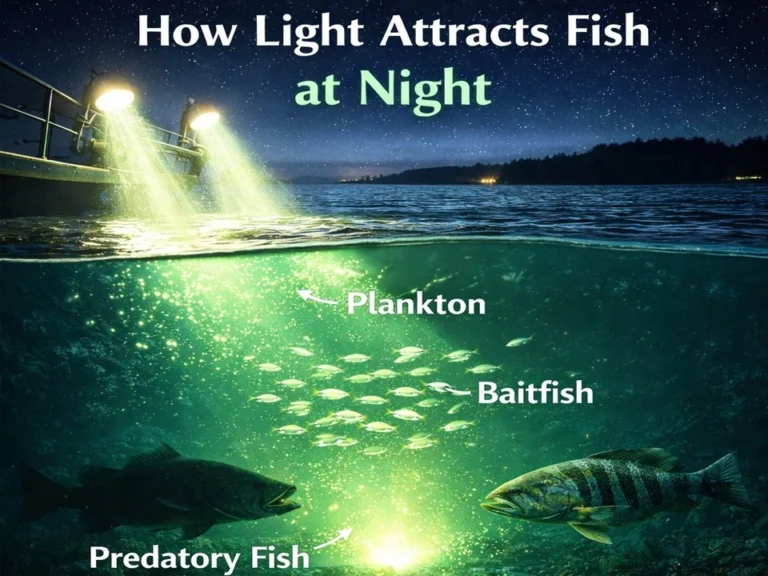
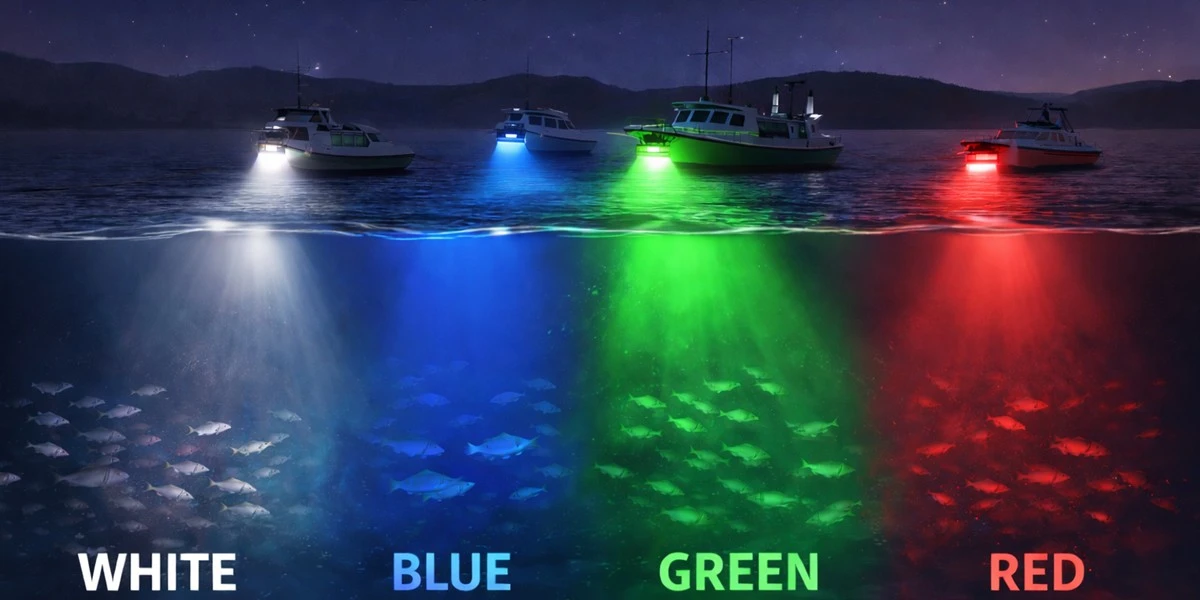
La réaction en chaîne : du plancton au poisson prédateur
Les lampes de pêche n'attirent pas directement les gros poissons.
Le processus suit généralement une réponse en couches :
- La lumière attire d'abord le plancton et les organismes microscopiques
- Petits poissons-appâts se rassemblent pour se nourrir
- Les poissons prédateurs plus gros suivent le poisson-appât
Pourquoi le feu vert fonctionne bien dans la pêche de nuit pratique
D'un point de vue pratique, la lumière verte offre un équilibre entre la luminosité et la perturbation.
Il est suffisamment fort pour activer l'activité sous-marine, mais pas trop dur ou stressant pour les poissons. Dans de nombreuses situations de pêche de nuit, cela rend les feux de pêche verts plus faciles à contrôler et plus cohérents en termes de performances.
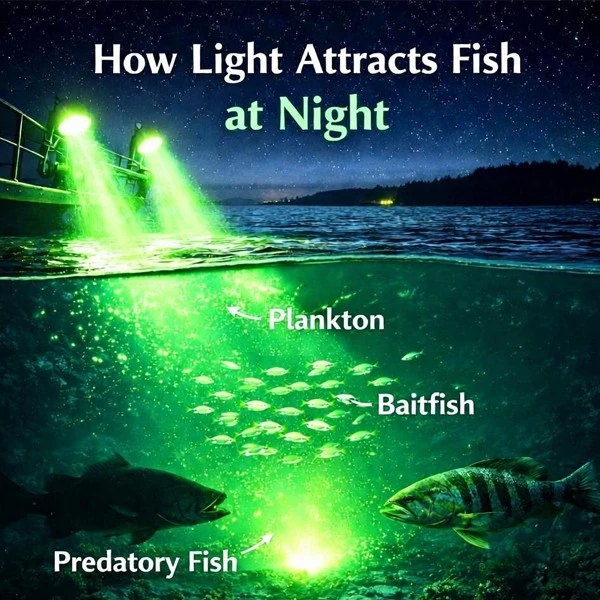
Vert vs bleu vs rouge vs cyan vs blancs de pêche - quelle est la différence ?
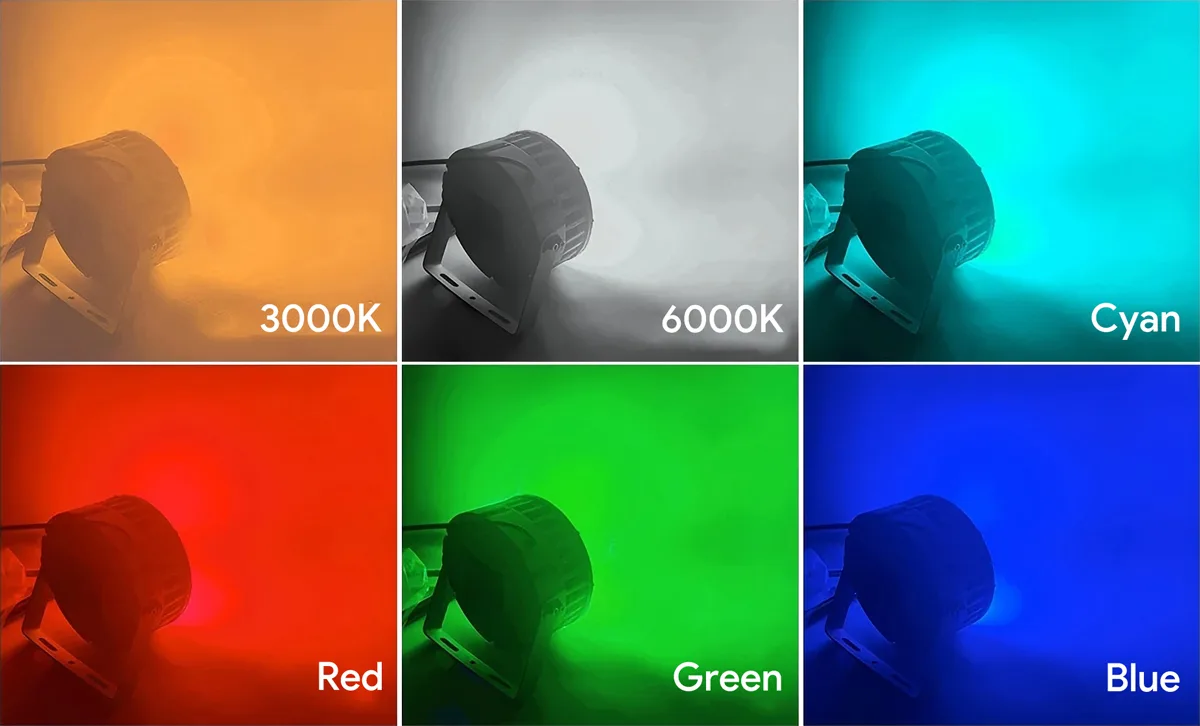
Le choix de la bonne couleur de lumière de pêche pour 2026 dépend de votre cible et de vos conditions d'eau. Chaque couleur a une longueur d'onde différente qui affecte la profondeur de sa pénétration et la vie marine spécifique qu'elle attire.
Tableau de comparaison rapide
| Couleur | le mieux pour | efficacité |
| Vert | Universel / Meilleur dans l'ensemble | Attrend le plancton le plus efficacement; fonctionne dans l'eau douce et salée. |
| Bleu | eau salée profonde | Pénètre au plus profond de l'eau salée claire; attire les appâts et les crabes d'eau salée. |
| Blanc | Eau peu profonde / Crevette | Haute intensité mais peu profonde; attire les poissons-appâts plus gros (mais moins). |
| cyan | Taux de capture commerciale | Prouvé sur le blanc/vert surpassé pour des espèces spécifiques comme le calmar (Coleoidea). |
| Rouge | Vision/Vision nocturne | N'attire pas les « insectes » ou effraye les poissons timides ; préserve votre vision nocturne. |
Vert : le gagnant tout-terrain
Vert (env. 520nm) est considéré comme la norme d'or pour attirer la vie marine, car il stimule efficacement le plancton, la fondation de la chaîne alimentaire sous-marine.
- Eau douce : C'est le meilleur choix pour les lacs et les rivières, en particulier pour cibler des espèces comme la marigane et l'achigan.
- Le feu vert de l'eau trouble offre un contraste élevé, ce qui rend l'eau plus claire, ce qui aide les poissons-appâts à trouver la source de lumière.
Bleu : spécialisé en eau profonde
La lumière bleue (environ 470nm) est hautement spécialisée pour les environnements d'eau salée et présente des avantages uniques.
- Performances en mer : elle pénètre plus profondément dans l'eau de mer claire que les autres couleurs, ce qui la rend idéale pour la pêche hauturière.
- Avertissement d'eau douce : la lumière bleue a tendance à échouer à attirer les poissons-appâts dans l'eau douce, et peut même les surprendre.
- Espèces cibles : particulièrement efficaces pour attirer les crabes de natation bleus et les espèces pélagiques offshore spécifiques.
Blanc : intense et peu profond
La lumière blanche est couramment utilisée pour sa haute intensité, mais elle a des limites en termes de pénétration en profondeur.
- Grand appât : Alors que le vert attire plus de petits poissons-appâts, la lumière blanche attire des poissons-appâts individuels plus gros.
- Limites : la lumière blanche se dissipe rapidement dans l'eau et ne pénètre pas efficacement dans les eaux profondes. Il est idéal pour les zones peu profondes à proximité du bateau ou du quai.
Cyan : le choix « commercial »
Cyan Light (430-600nm) gagne en popularité en 2026 pour ses avantages uniques, comblant le fossé entre le bleu et le vert.
- Meilleurs rendements : Il a été démontré que le cyan attire des espèces comme le calmar (coleoidea), les crevettes (Penaeus merguiensis) et les sardines plus efficacement que la lumière blanche.
- Déplacement plus profond : Il a un coefficient d'atténuation plus faible que la lumière blanche dans l'eau de mer, ce qui lui permet de voyager plus loin et d'atteindre des profondeurs plus importantes.
Rouge : l'option furtive
La lumière rouge n'est généralement pas utilisée pour attirer les poissons, mais sert plusieurs objectifs fonctionnels qui profitent aux pêcheurs.
- Cécité nocturne : la lumière rouge permet aux pêcheurs de voir leur équipement sans ruiner leur vision nocturne naturelle.
- Espèces timides : il est idéal pour attirer des espèces de poissons prudentes comme le poisson-chat ou le snook qui peut être effrayé par des lumières plus vives.

Comment choisir le bon feu de pêche vert
Le choix d'une lumière verte de pêche ne consiste pas simplement à sélectionner une couleur spécifique. Pour obtenir une attraction de poisson cohérente la nuit, plusieurs facteurs pratiques doivent être pris en compte ensemble. La compréhension de ces bases permet d'éviter les configurations surpuissantes tout en assurant une couverture efficace dans des conditions de pêche réelles.
Tout d'abord, considérez la clarté de Dans une eau relativement claire, la lumière verte se déplace efficacement et maintient une forte visibilité sur une vaste zone, ce qui le rend idéal pour Lampes de pêche montées en surface sur des bateaux ou des quais. Dans une eau plus trouble ou riche en plancton, le feu vert fonctionne toujours bien, mais une distribution uniforme du faisceau devient plus importante que la luminosité brute.
Deuxièmement, la lumière du rendement doit correspondre à l'environnement de pêche. Une puissance plus élevée ne signifie pas automatiquement de meilleurs résultats. Dans de nombreux scénarios de pêche de nuit, un éclairage stable et uniformément distribué attire plus de poissons-appâts qu'un faisceau étroit et trop intense. C'est pourquoi de nombreux opérateurs préfèrent les projecteurs de pêche vertes pour la couverture des zones, tandis que les projecteurs de pêche verte sont mieux adaptés pour diriger la lumière vers une zone spécifique.
Troisièmement, faites attention au contrôle du faisceau et à la stabilité de la lumière. Un angle de faisceau contrôlé aide à concentrer la lumière là où une activité de poisson est attendue, tandis que la stabilité électrique assure une production constante tout au long des opérations nocturnes. La lumière scintillante ou instable réduit l'efficacité, quelle que soit la couleur.
Enfin, tenez compte de la hauteur de montage et de l'objectif de l'éclairage dans le cadre du processus de sélection. Les lumières montées au-dessus de la ligne de flottaison devraient fournir une propagation suffisante pour éclairer la surface et les couches supérieures sans éblouissement. L'objectif n'est pas d'inonder l'eau de lumière, mais de créer une zone d'alimentation stable et attrayante vers laquelle les poissons reviennent à plusieurs reprises.
En vous concentrant sur les conditions d'eau, le type de faisceau et la stabilité de sortie, pas la couleur, vous pouvez sélectionner une lampe de pêche verte qui offre des performances fiables dans différentes situations de pêche de nuit.
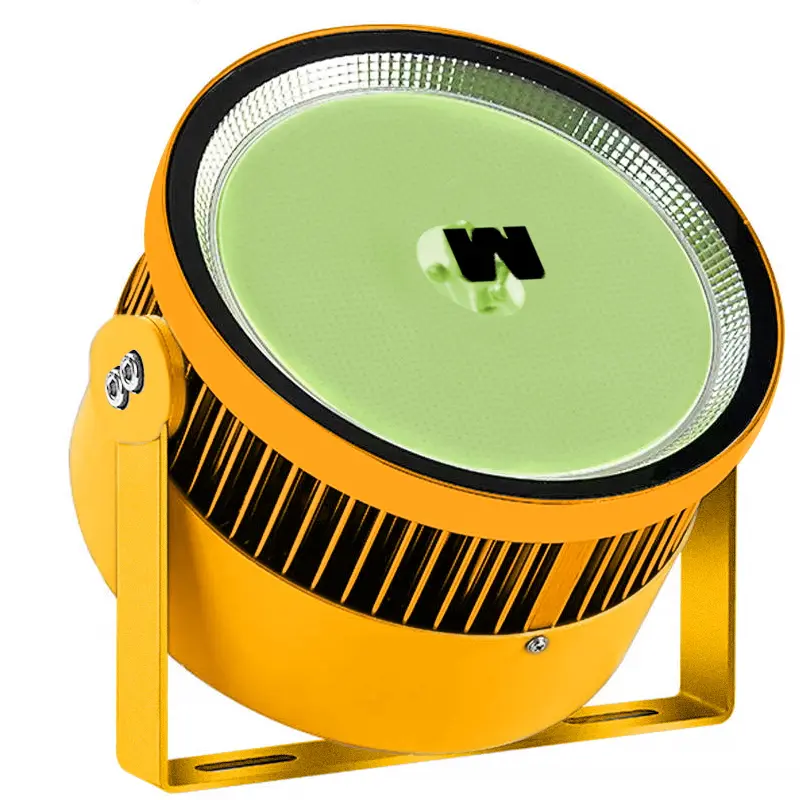
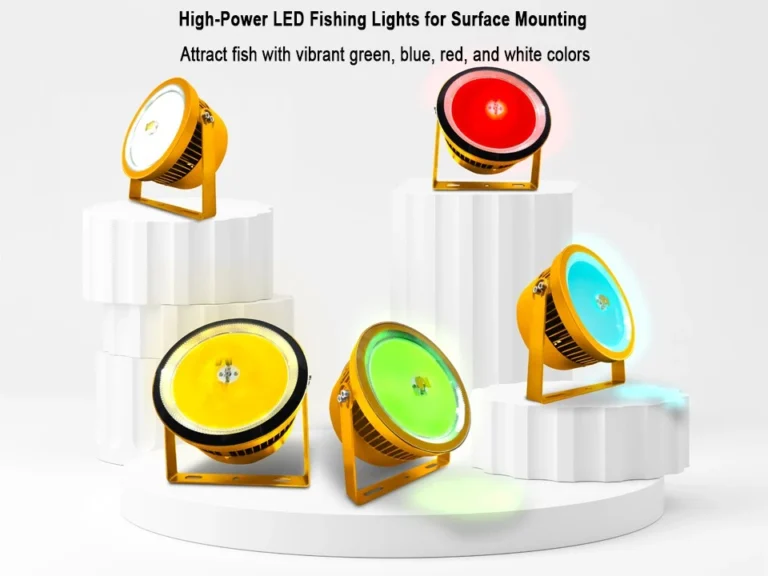
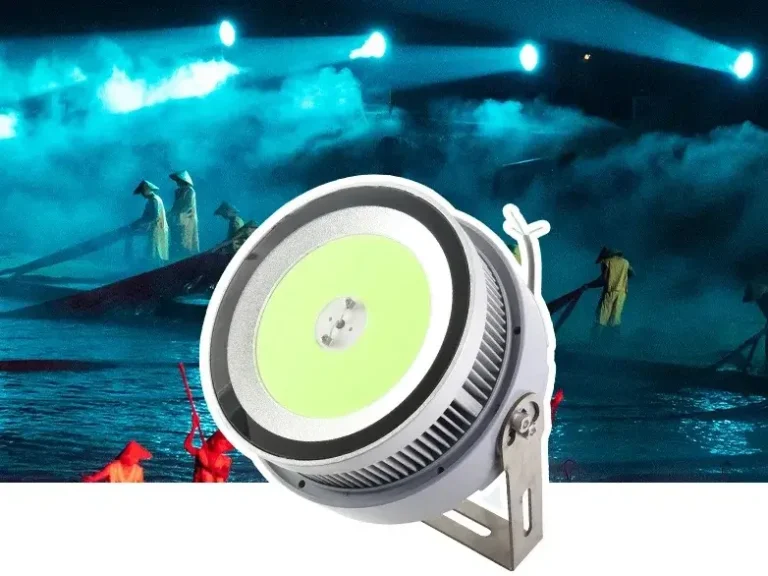
ÉCLAIRAGE DE POISSONS EN ÉPI À HAUTE PUISSANCE
Numéro de modèle. : Type rond
Tension d'entrée: AC100-320V
Surtension: 10000V
Watt/pcs : 800W/1000W/1200W
Type de LED: COB
Taille (mm) : Φ230 × 140
Couleur: 3000K / 4000K / 5000K / 6000K/ Rouge / Vert / Bleu / Violet
IRC : >80@3000K / 4000K / 5000K / 6000K/
Lumen: >120lm/w@3000K / 4000K / 5000K / 6000K/
Classe IP: IP67
Où les feux de pêche verts sont couramment utilisés
Les feux de pêche verts sont largement adoptés dans différents scénarios de pêche de nuit, car ils offrent une combinaison équilibrée de pénétration, de couverture et de confort visuel. Plutôt que de se limiter à une seule utilisation, les feux verts prennent en charge une attraction de poissons cohérente dans plusieurs environnements.
1. Pêche de nuit montée sur bateau
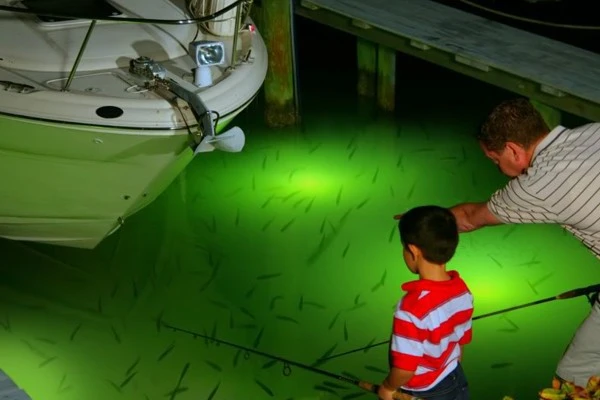
navires de pêche. Ces lumières éclairent la surface et les couches supérieures de l'eau, formant une zone d'alimentation stable qui attire les poissons-appâts et les espèces prédatrices plus grandes. Cette configuration est largement utilisée à la fois dans les bateaux de pêche commerciale et dans la pêche de nuit récréative.
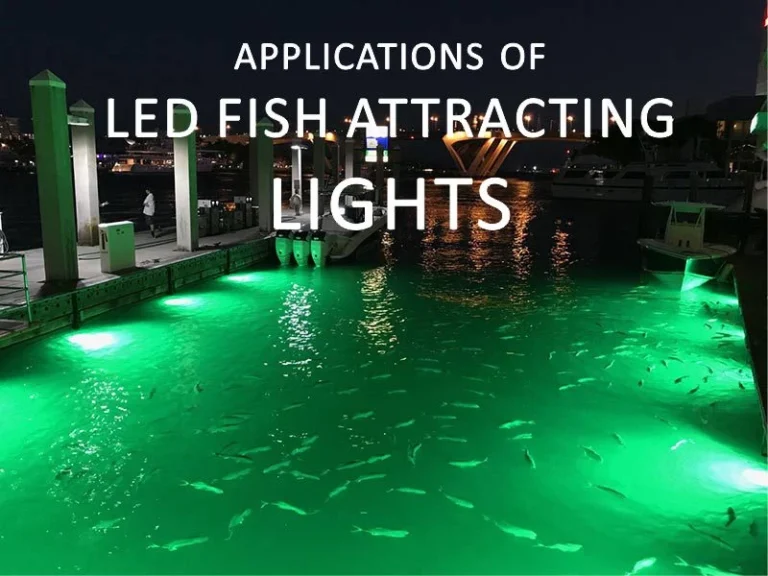
2. Quai et zones de pêche de la jetée
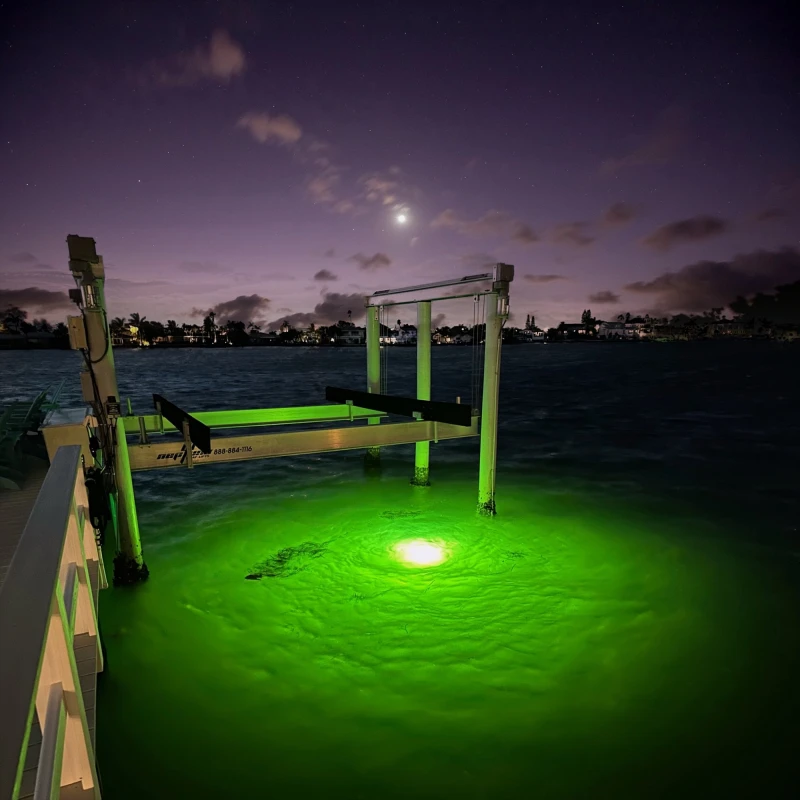
Les feux de pêche verts sont également largement utilisés pour l'éclairage des quais et des jetées. Lorsqu'ils sont montés le long des quais ou des jetées, ils étendent la lumière dans l'eau environnante, encourageant le plancton et les poissons-appâts à se rassembler près de la structure. Au fil du temps, cela crée un lieu de pêche fiable sans éblouissement ni perturbation.
3. Pêche de nuit côtière et côtière
Dans les milieux côtiers et côtiers, les feux de pêche verts améliorent la visibilité nocturne et l'activité des poissons dans les eaux peu profondes. Leur propagation de faisceau contrôlée les rend adaptés à la pêche à la ligne, aux petits ports et aux opérations nocturnes côtières où un éclairage précis est préférable.
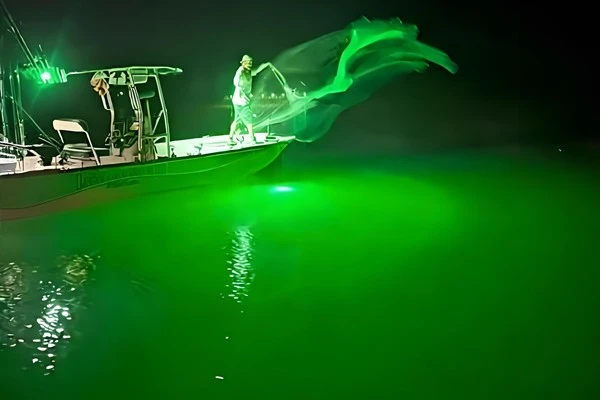
4. Opérations de pêche offshore et commerciale
Pour la pêche offshore et commerciale, les feux de pêche verts font souvent partie de systèmes d'éclairage plus grands. Le rendement lumineux constant et le placement équilibré sur le navire sont plus importants que l'intensité de la lampe individuelle, ce qui contribue à maintenir la concentration des poissons lors des longues séances de pêche nocturne.
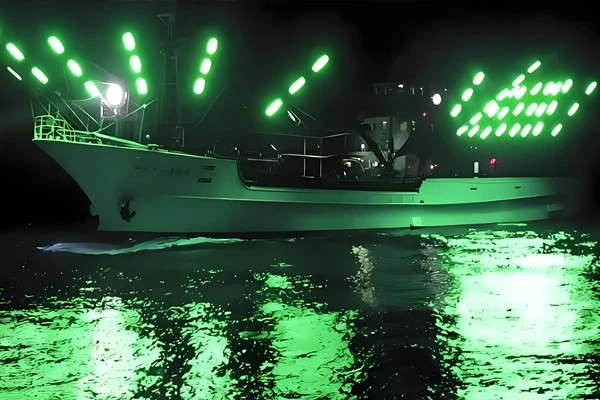
Ces applications expliquent pourquoi les feux de pêche verts restent un choix standard dans les bateaux, les quais et les environnements de pêche côtière dans le monde. Pour plus de détails sur la performance de ces lumières dans différents paramètres, consultez Les principales applications des poissons LED attirant les lumières sur les bateaux, les quais, les étangs et les projets offshore.
Conclusion
Les feux de pêche verts sont largement utilisés dans la pêche de nuit, car ils offrent un équilibre fiable entre la pénétration de l'eau, la couverture du faisceau et la stabilité visuelle. Dans la plupart des conditions nocturnes, le feu vert crée une zone d'alimentation claire et efficace sans surcharger l'environnement environnant.
Cependant, la couleur seule ne détermine pas l'attraction des poissons. Le rendement lumineux, le contrôle du faisceau et le bon placement jouent souvent un rôle plus important que la luminosité ou le choix de couleur par lui-même. Comprendre ces facteurs permet d'obtenir des résultats cohérents tout en évitant la consommation d'énergie inutile.
Si vous prévoyez une configuration de pêche de nuit pour bateaux ou quais, le choix de la bonne lampe de pêche verte n'est que la première étape. L'exploration des types de faisceaux, des options de montage et de la conception globale du système vous aidera à créer une configuration de pêche de pêche plus efficace et stable.
Foire aux questions (FAQ)
Articles Similaires