Français
  English
  简体中文
简体中文  Deutsch
  Español
  Italiano
  日本語
日本語  한국어
한국어  Polski
  Português
  Русский
  Türkçe
  Nederlands
  Tiếng Việt
  ไทย
ไทย 
oui, Éclairage acoustique Cela peut valoir l'investissement dans les espaces commerciaux lorsque les performances d'éclairage et le contrôle acoustique sont nécessaires dans le même système de plafond. En combinant l'éclairage et l'absorption acoustique dans un seul appareil technique, les organisations peuvent réduire la réverbération, améliorer la clarté de la parole et minimiser le besoin de panneaux acoustiques séparés. Dans les bureaux et les environnements collaboratifs, des réductions mesurables du temps de réverbération peuvent améliorer la concentration et l'efficacité de la rencontre. Du point de vue du cycle de vie, l'intégration de l'éclairage et du traitement acoustique peut également réduire la complexité de l'installation et les coûts de coordination à long terme.
Cet article évalue le coût, le retour sur investissement, la valeur à long terme et lorsque l'éclairage acoustique est financièrement logique pour les acheteurs commerciaux. L'accent est mis strictement sur la logique d'investissement, l'impact sur la performance et la valeur opérationnelle pour les architectes, les concepteurs, les gestionnaires d'installations et les équipes d'approvisionnement.
Quels sont les acheteurs commerciaux qui paient
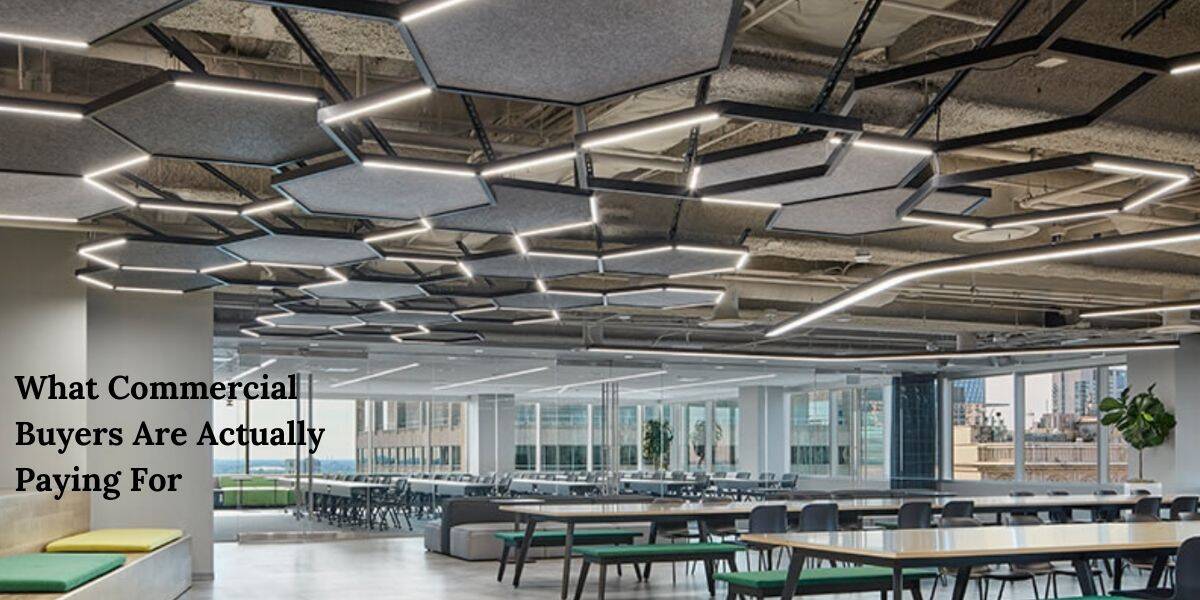
Lorsque les équipes d'approvisionnement évaluent Éclairage acoustique, l'investissement va bien au-delà d'un luminaire avec une couverture en feutre. Les systèmes de qualité commerciale sont des ensembles conçus pour répondre aux normes d'éclairage, aux objectifs d'absorption acoustique et aux codes de sécurité simultanément.
La structure de coûts comprend généralement :
- Matériau acoustique technique
La plupart des systèmes utilisent du feutre pour animaux de compagnie à haute densité ou un matériau d'absorption équivalent. Densité, épaisseur, performance NRC (coefficient de réduction du bruit) et indice de tir influent tous les coûts. Les spécifications commerciales nécessitent souvent des valeurs de feu de classe A et des données de performances acoustiques vérifiées. - Système LED intégré
Contrairement aux pendentifs décoratifs, les véritables luminaires acoustiques comprennent les modules LED de qualité commerciale, les pilotes, la gestion thermique, la vérification de la sortie de lumière et le rendu des couleurs cohérent. Les cotes de durée de vie se situent généralement entre 30 000 et 50 000 heures. - Conception structurelle à double fonction
Le luminaire est conçu pour absorber le son tout en conservant une distribution optique. Cela nécessite des chicanes internes, des cavités acoustiques ou des géométries de feutre qui augmentent la surface. - Suspension et matériel de montage
Des systèmes de suspension appropriés garantissent une hauteur optimale pour l'absorption acoustique et la distribution de l'éclairage. La planification de l'installation est légèrement plus impliquée que les troffons de surface. - Intention de test acoustique
Les systèmes commerciaux sont généralement développés avec la modélisation acoustique à l'esprit. L'objectif est la réduction de la réverbération mesurable, pas seulement l'amortissement du son esthétique.
Lampes décoratives en feutre vs systèmes d'éclairage acoustiques
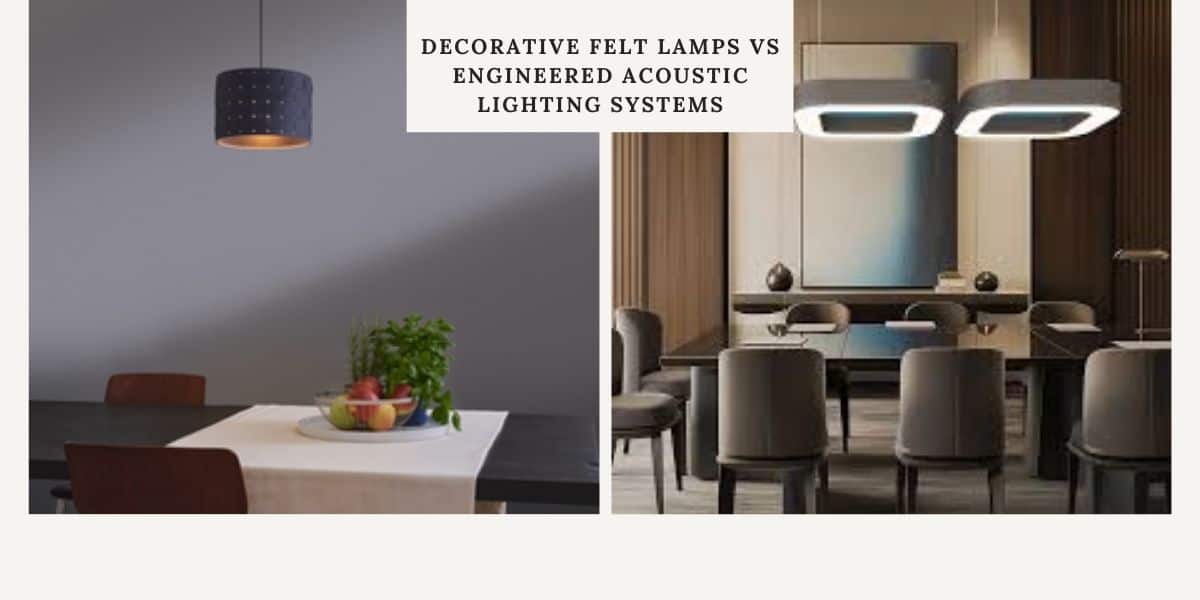
Un risque d'approvisionnement clé est de confondre l'éclairage décoratif en feutre avec de véritables systèmes d'éclairage acoustique.
Lampes décoratives en feutre :
- Principalement est
- Tests acoustiques limités
- Surface minimale pour l'absorption
- Non conçu pour une contribution mesurable du CNRC
Véritables systèmes d'éclairage acoustique :
- Conçu pour fonctionner comme des luminaires acoustiques
- Fournir des valeurs d'absorption quantifiables
- Prend en charge les normes de performance de l
- Contribuer à la stratégie acoustique à l'échelle du plafond
Par exemple, les systèmes spécialement conçus par des fabricants professionnels illustrent comment l'éclairage et le contrôle du son sont conçus ensemble plutôt que de les traiter après coup. Ces systèmes sont conçus avec une intention acoustique vérifiée, une bonne distribution de la lumière et un support structurel intégré au lieu de simplement emballer un luminaire décoratif dans du feutre.
D'un point de vue commercial, cette distinction affecte directement le retour sur investissement.
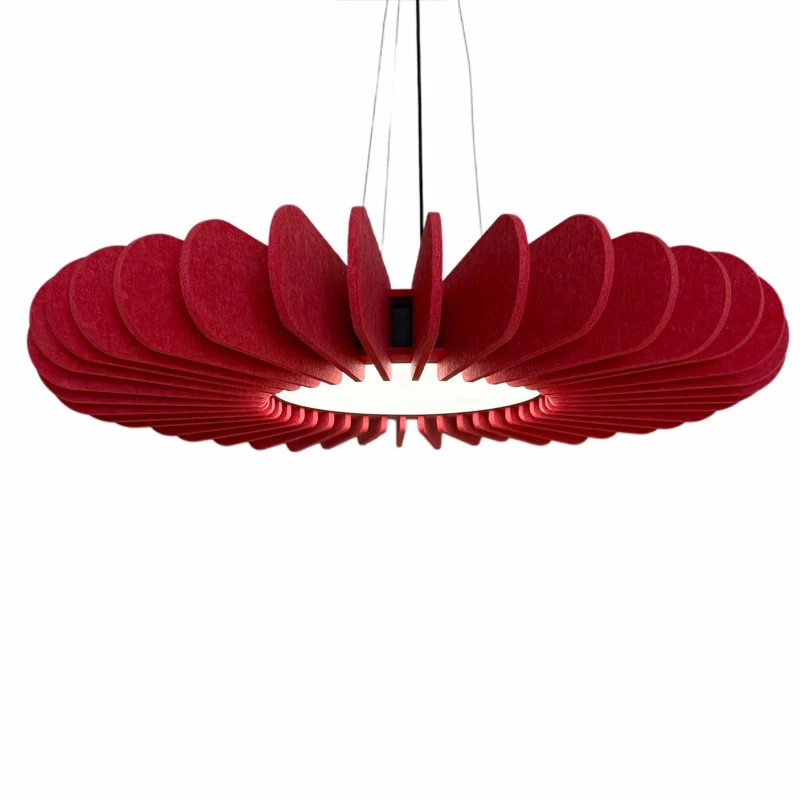
Suspension LED ultrafine et fine acoustique ronde
- Tension d'entrée: AC100-277V / AC220-240V,50-60Hz
- Taille du boîtier : 120 mm
- Direction émettrice : vers le bas
- Taille DH : 500*80mm
- CCT : 3000K/4000K/6000K
- Puissance : 15 W
- Flux lumineux : 100-110lm/W
- CRI : > 90 ra
- PF : > 0,90
- Fllicker gratuit : oui
- Angle du faisceau : 120°.
- Classe IP : IP20
- Garantie : 5 ans
- Option de couleur de panneau acoustique : rouge / vert / bleu / gris plus de 48 couleurs
Répartition des coûts clair
L'éclairage acoustique coûte plus cher que les luminaires LED commerciaux standard. Cependant, le prix du luminaire à lui seul ne représente pas le coût total du projet.
Vous trouverez ci-dessous une comparaison de coûts réaliste pour les systèmes de qualité commerciale :
| Catégorie de coûts | Éclairage acoustique | Éclairage LED commercial standard |
| Coût unitaire | $400–$1 200+ par luminaire | $120–$450 par luminaire |
| Installation | Légèrement plus élevé (suspension + positionnement) | étalonnage |
| Panneaux acoustiques supplémentaires nécessaires | Souvent réduit ou éliminé | Généralement requis |
| Cycle de vie (LED) | 30 000 à 50 000 heures | 30 000 à 50 000 heures |
Pourquoi l'éclairage acoustique coûte plus cher à l'avance
La prime de prix est tirée par :
- Matériau en feutre pour animaux de compagnie
- Augmentation du volume de matériaux
- Support structurel intégré
- ingénierie acoustique
- Géométries personnalisées
- Frais d'expédition et de manutention plus
Dans de nombreux projets, les appareils d'éclairage acoustique coûtent environ 1,5 à 3 fois plus par unité que les appareils à LED standard.
Cependant, cette comparaison devient incomplète lorsque des panneaux acoustiques sont requis en parallèle.
Les panneaux de plafond ou les déflecteurs suspendus typiques de l'acoustique peuvent coûter :
- $25–$60 par pied carré installé
- $300–$900 par élément acoustique au plafond, selon la taille
Si un projet nécessite à la fois un éclairage et un traitement acoustique, la séparation des systèmes peut augmenter considérablement le coût total d'installation.
Lorsque l'éclairage et l'absorption sont combinés, le projet peut réduire :
- Craquement de plafond
- Coordination de la main-
- Nombre total d'éléments suspendus
- Systèmes de suspension redondants
Pour les équipes d'approvisionnement, l'évaluation réelle doit avoir lieu au niveau du projet plutôt qu'au niveau du montage.
ROI et impact commercial
Le retour sur investissement de l'éclairage acoustique est lié à la performance du lieu de travail et à l'efficacité opérationnelle plutôt qu'aux seules économies d'énergie.
Dans les bureaux commerciaux, une réverbération excessive réduit la clarté de la parole et augmente la distraction. Les études montrent de manière cohérente que les environnements acoustiques médiocres réduisent la productivité et augmentent la fatigue cognitive. Dans les bureaux à aire ouverte, les temps de réverbération non contrôlés peuvent dépasser les seuils recommandés, en particulier dans les espaces avec des plafonds en béton ou dur.
L'éclairage acoustique contribue à :
- Temps de réverbération inférieur
- Amélioration de l'intelligibilité de la
- Distraction réduite
- Zones de collaboration plus efficaces
Voici un résumé structuré de l'impact sur la valeur :
| Zone de valeur | impact |
| Réduction du bruit | Réverbération et écho plus faibles |
| clarté de la | Efficacité de collaboration améliorée |
| Efficacité spatiale | Moins de panneaux acoustiques séparés requis |
| Entretien à long terme | Le système à double usage réduit la complexité |
Logique financière derrière le retour sur investissement
- Réduction des coûts de rénovation
Si les performances acoustiques sont corrigées lors de la construction initiale à l'aide de systèmes intégrés, des rénovations coûteuses peuvent être évitées. La mise à niveau des panneaux de plafond après l'occupation implique souvent des interruptions opérationnelles. - Rencontres gains d'efficacité
Une meilleure clarté de la parole peut raccourcir les temps de réunion et réduire les mauvaises communications. Bien que difficile à quantifier précisément, cela contribue à une amélioration mesurable de la productivité. - Coordination simplifiée du plafond
Les systèmes intégrés réduisent la coordination entre les métiers électriques et acoustiques. - Confort et rétention des employés
Des environnements acoustiques confortables améliorent la qualité perçue du lieu de travail, ce qui favorise indirectement la rétention des talents.
La période de récupération dépend fortement du type d'espace. Dans les bureaux ouverts à haute densité, le retour sur investissement peut être réalisé grâce à des installations de panneaux acoustiques évitées dans le budget initial de construction plutôt qu'à l'économie opérationnelle.
Quand l'éclairage acoustique vaut l'investissement
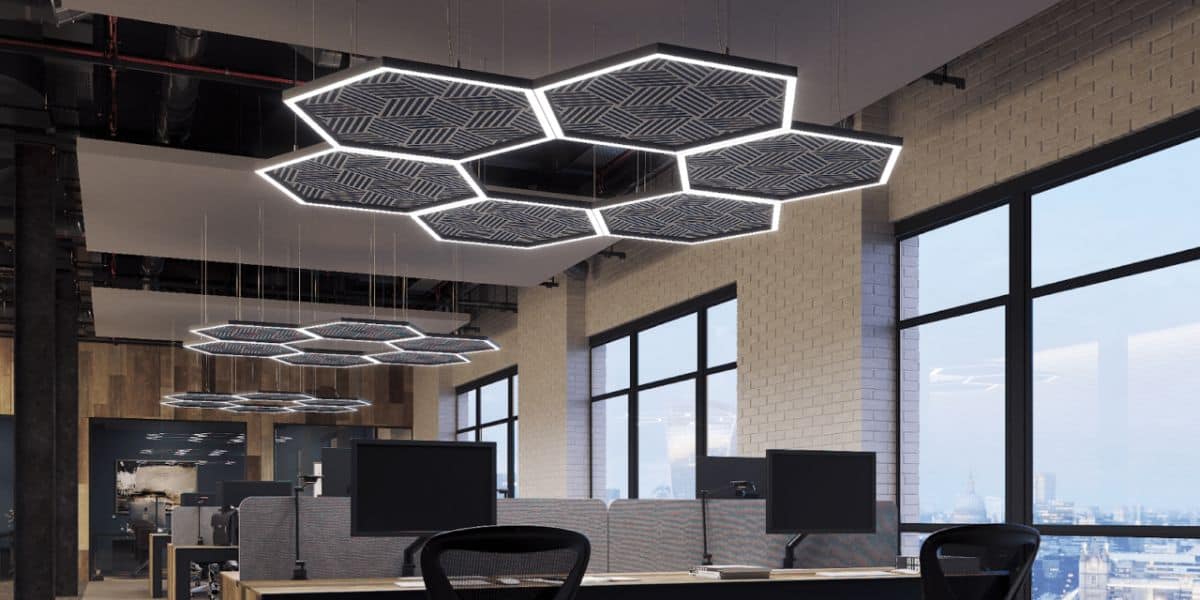
L'éclairage acoustique vaut l'investissement lorsque :
- Bureaux ouverts avec une activité de parole élevée
- Plafonds réfléchissants durs (béton, terrasse exposée)
- Espaces de collaboration hybrides
- Salles de formation et espaces de conférence
- Projets déjà budgétisés pour le traitement acoustique
Dans ces environnements, alliant éclairage et Appareils acoustiques Prend en charge les objectifs de performance mesurables.
Il n'est peut-être pas justifié financièrement :
- Petits bureaux fermés avec faible occupation
- Chambres moquette avec de nombreux ameublements
- Espaces déjà traités avec des dalles de plafond acoustiques
- Applications d'éclairage strictement décoratives
La décision doit s'aligner sur les objectifs de performance acoustique, et non sur les tendances esthétiques.
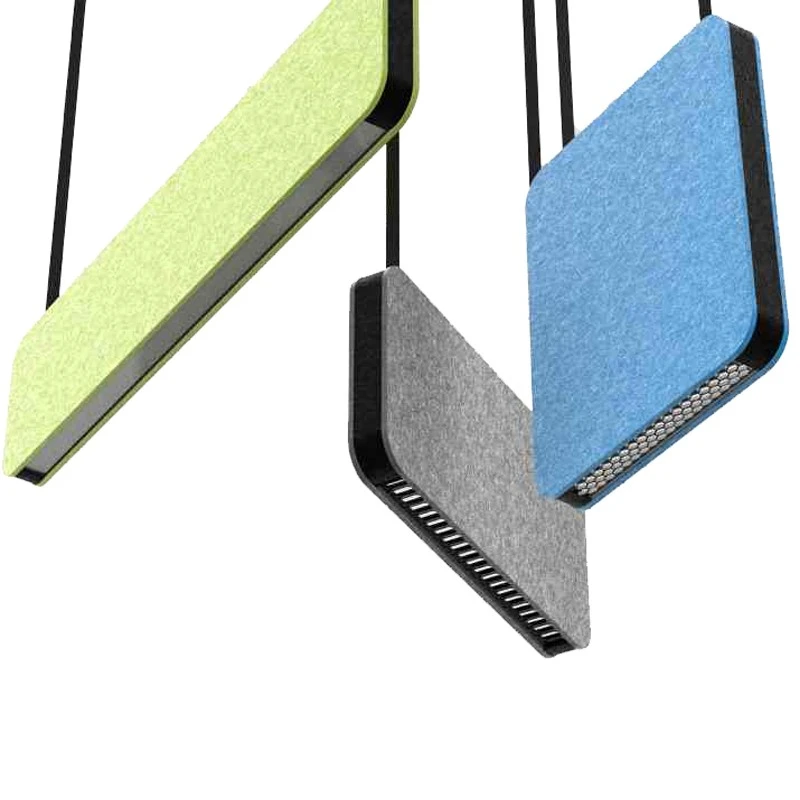
Lumière linéaire LED super mince
- Tension d'entrée: AC100-277V / AC220-240V,50-60Hz
- Direction émettrice : vers le bas
- Taille: 121836400mm
- CCT : 3000K/4000K/6000K
- Puissance : 30W
- Flux lumineux : 100-110lm/W
- CRI : > 80 ra
- PF : > 0,90
- Fllicker gratuit : oui
- Angle du faisceau : 120°.
- Classe IP : IP20
- Garantie : 5 ans
- Couleur de la planche acoustique en feutre : rouge / vert / bleu / gris plus de 48 couleurs
Entretien à long terme et coût du cycle de vie
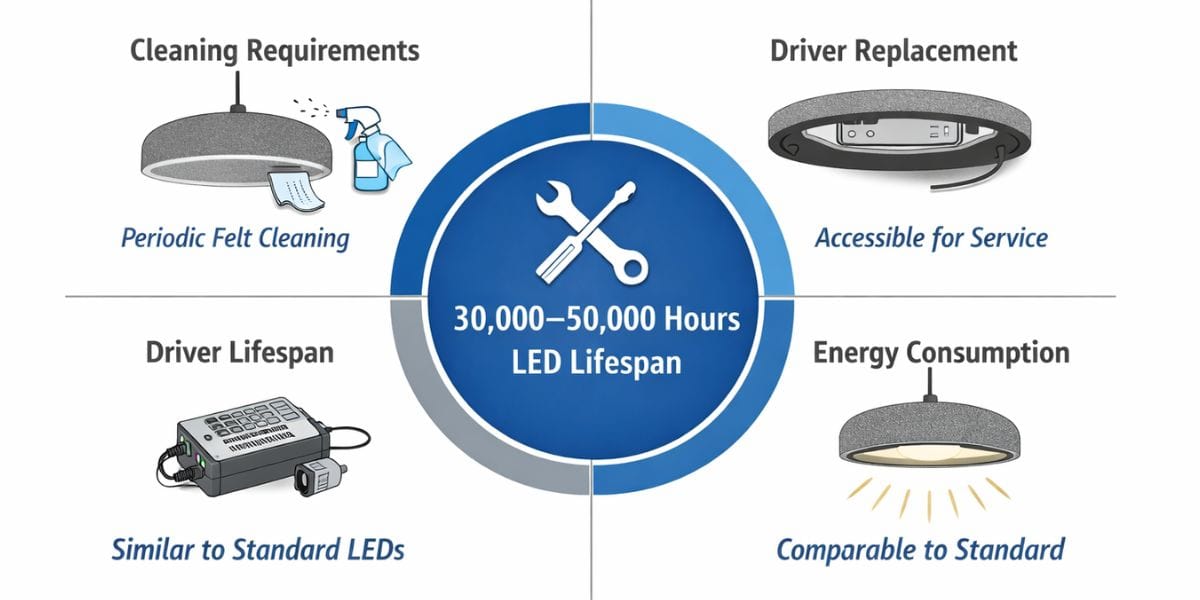
D'un point de vue opérationnel, l'éclairage acoustique fonctionne de la même manière que les systèmes LED standard en termes de consommation d'énergie.
Durée de vie des LED
Les modules LED commerciaux durent généralement entre 30 000 et 50 000 heures. La durée de vie du conducteur peut varier, mais est généralement comparable à celle des luminaires standard.
Exigences de nettoyage
Les matériaux en feutre pour animaux de compagnie attirent moins de poussière que les tissus d'ameublement, mais nécessitent un nettoyage occasionnel des surfaces. Dans les applications à haut plafond, la fréquence de maintenance est minimale.
Remplacement du pilote
L'accès aux pilotes LED doit être pris en compte lors des spécifications. Des systèmes de haute qualité offrent des compartiments conducteurs accessibles pour réduire la main-d'œuvre de maintenance.
Impact des coûts opérationnels
La consommation d'énergie reste comparable à Luminaires LED standard avec une sortie de lumens équivalente. La différence réside dans les performances acoustiques, et non les économies d'énergie.
Au fil du temps, les systèmes intégrés peuvent réduire la complexité de la maintenance car moins de pièces de plafond séparées nécessitent un entretien.
Évaluation des risques pour les acheteurs commerciaux
Les acheteurs commerciaux doivent évaluer soigneusement l'éclairage acoustique pour éviter les sous-performances.
Les principaux risques comprennent :
- Sélection de luminaires décoratifs sans test acoustique vérifié.
- Installer des appareils sans calcul de couverture acoustique appropriée.
- Faible hauteur de suspension, réduisant l'efficacité d'absorption.
- Ignorer la conformité au niveau du feu.
- Sous-estimer la zone de couverture requise.
L'éclairage acoustique doit être intégré à une stratégie acoustique globale plutôt qu'à une installation aléatoire.
Le défaut d'évaluer les exigences de couverture peut entraîner une réduction insuffisante de la réverbération, réduisant la valeur perçue de l'investissement.
Résumé des investissements stratégiques
L'éclairage acoustique n'est pas une mise à niveau décorative. Il s'agit d'une décision fonctionnelle de système de plafond qui intègre deux éléments de performance du bâtiment.
L'investissement doit être évalué au niveau du projet, en considérant :
- Coût d'éclairage total
- Coût total du traitement acoustique
- Coordination de l
- Efficacité opérationnelle à long terme
Dans les projets qui nécessitent à la fois l'éclairage et le contrôle acoustique, les systèmes à double fonction peuvent réduire la complexité globale et réduire le coût total d'installation par rapport aux solutions distinctes.
La logique financière de base est simple : la combinaison de deux systèmes de performance en un seul luminaire peut réduire la redondance, les coûts de coordination et la congestion du plafond.
Conclusion
L'éclairage acoustique vaut l'investissement dans des espaces commerciaux où l'éclairage et le contrôle acoustique sont nécessaires. Il peut réduire le besoin de luminaires séparés, simplifier les systèmes de plafond et favoriser une efficacité opérationnelle à long terme.
Le coût initial plus élevé est justifié lorsqu'il est évalué au niveau du projet plutôt qu'au niveau du luminaire. Dans les environnements à forte activité de parole et à surfaces réfléchissantes, l'éclairage acoustique intégré permet d'améliorer les performances et de valeur stratégique.
Pour les acheteurs commerciaux, la décision doit être basée sur des objectifs acoustiques, le coût total d'installation et les performances des bâtiments à long terme plutôt que sur le prix d'un agencement.
FAQ
Articles Similaires