Français
  English
  简体中文
简体中文  Deutsch
  Español
  Italiano
  日本語
日本語  한국어
한국어  Polski
  Português
  Русский
  Türkçe
  Nederlands
  Tiếng Việt
  ไทย
ไทย 
L'éclairage à bande LED est devenu une solution standard pour les projets architecturaux, commerciaux et résidentiels. Cependant, même avec des bandes LED de haute qualité et canaux en aluminium, de nombreuses installations souffrent encore de taches de lumière visible, d'éblouissement ou d'éclairage irrégulier. Dans la plupart des cas, la cause profonde n'est pas la bande LED elle-même, mais le couvercle du diffuseur.
Un diffuseur LED n'est pas un simple accessoire esthétique. Il s'agit d'un composant optique critique qui affecte directement l'uniformité de la lumière, le confort visuel, l'efficacité et l'apparence professionnelle globale d'un système d'éclairage. Alors que les canaux LED en aluminium fonctionnent principalement comme des dissipateurs de chaleur pour protéger la durée de vie des LED, le diffuseur détermine la perception de la lumière.
Ce guide se concentre sur les trois options de diffuseurs les plus courantes utilisées dans les canaux de bandes LED : les couvertures claires, laitières et noires. En comprenant leurs différences, les matériaux, les compromis de performance et les considérations d'installation, vous pouvez prendre des décisions éclairées qui correspondent à la fois aux exigences techniques et aux attentes visuelles.
Qu'est-ce qu'un diffuseur de canaux LED et pourquoi c'est important
Un diffuseur de canaux LED (également connu sous le nom de couverture ou de lentille) est le composant en polycarbonate ou PMMA qui s'enclenche sur un profil LED en aluminium. Son objectif principal est de disperser la lumière des bandes LED pour éliminer les points chauds, protéger les LED de la poussière et du contact physique et contrôler l'angle du faisceau pour une finition professionnelle.
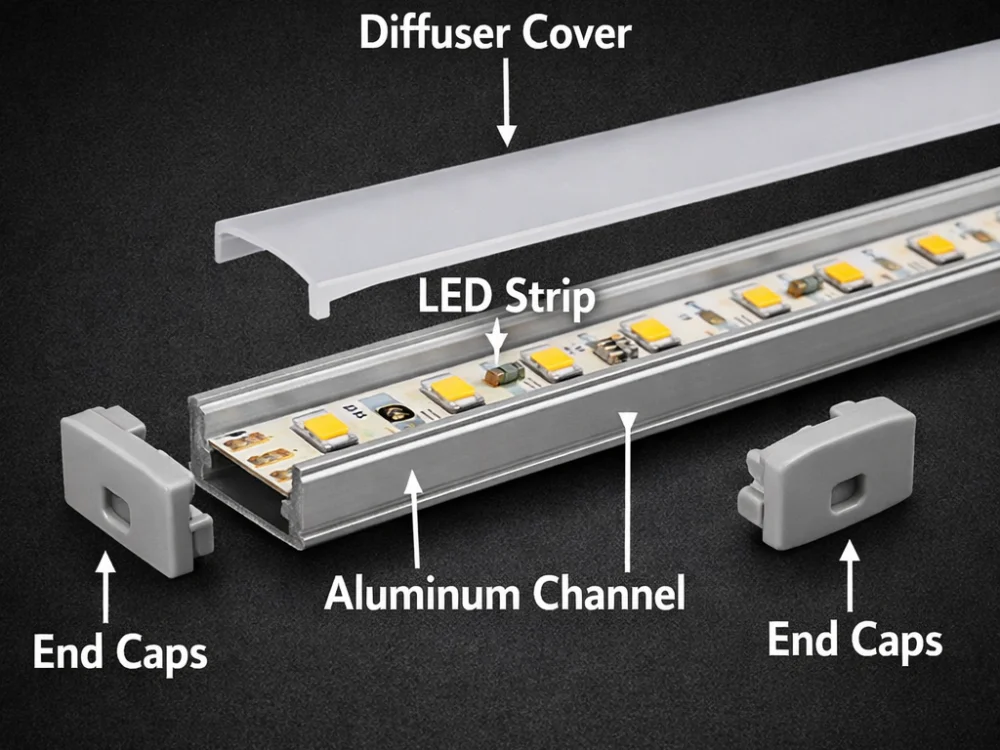
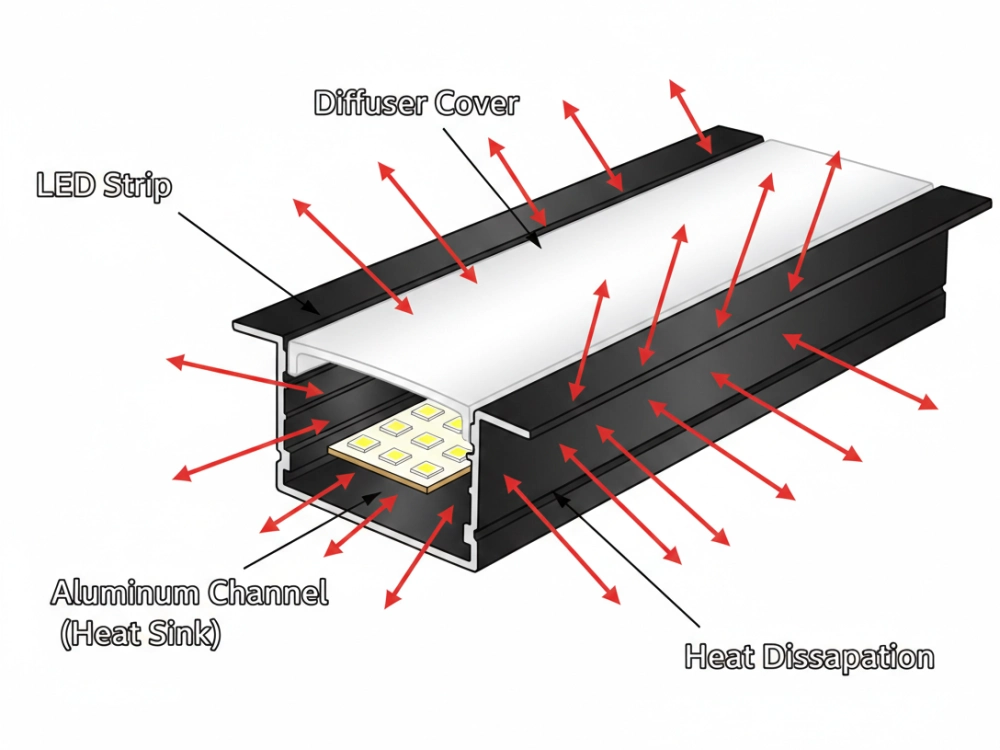
Dans un système de canal de bande LED complet, le profilé en aluminium et le diffuseur de bandes LED fonctionnent ensemble. Le canal en aluminium dissipe la chaleur, stabilisant la température de jonction LED et prolongeant la durée de vie. Le diffuseur, quant à lui, gère la distribution de la lumière et le contrôle de l'éblouissement. Négliger l'un ou l'autre des éléments entraîne souvent une mauvaise qualité d'éclairage ou une défaillance prématurée.
D'un point de vue optique, le diffuseur influence trois facteurs fondamentaux :
- Légère uniformité et visibilité des points
- Réduction de l'éblouissement et confort visuel
- Aspect esthétique lorsque la lumière est allumée et éteinte
La compréhension de la sélection des diffuseurs est donc essentielle pour les concepteurs d'éclairage et les acheteurs de projets.
Matières : PMMA vs polycarbonate vs PVC
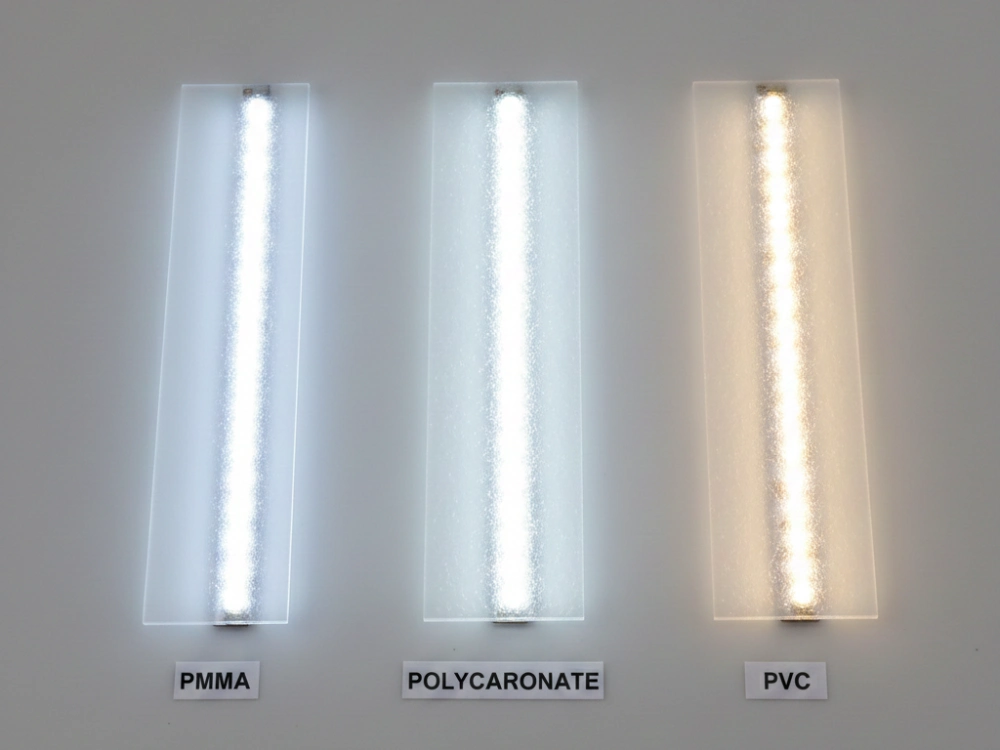
Les performances d'un diffuseur de canaux LED dépendent fortement du matériau utilisé. Alors que de nombreux diffuseurs se ressemblent à première vue, leur comportement à long terme peut différer de manière significative.
Matrice de comparaison des performances des matériaux
| Caractéristique matérielle | PMMA (acrylique) | Polycarbonate (PC) | PVC (standard) |
| transmission lumineuse | Élevé (~92%) | Élevé (~88%) | Moyen (~80%) |
| Résistance aux UV | Excellent (non jaunissant) | Bon (stabilisants nécessaires) | Pauvre (jaunes en 1 à 2 ans) |
| Résistance aux chocs | Moyen | extrêmement élevé | Faible |
| Meilleure application | Architecture / Commerce | Espaces publics / Extérieur | Budget / Temporaire |
Le PMMA, communément appelé acrylique, est largement considéré comme le meilleur matériau pour la clarté optique. Il offre une excellente transmission de la lumière et une forte résistance au jaunissement induit par les UV, ce qui le rend idéal pour l'éclairage architectural et de vente au détail où la cohérence visuelle est importante au fil du temps.
Le polycarbonate offre une résistance supérieure aux chocs et est souvent choisi pour les espaces publics ou les installations où la durabilité mécanique est essentielle. Cependant, le PC nécessite généralement des stabilisateurs UV pour une utilisation en extérieur et une clarté optique légèrement inférieure à celle du PMMA.
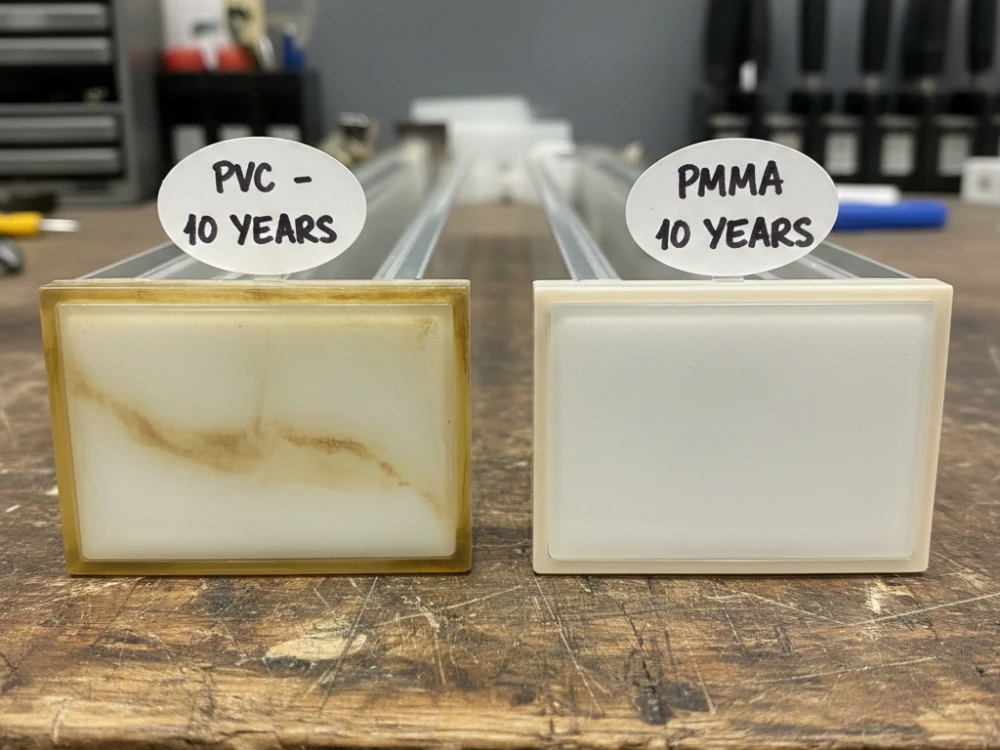
Les diffuseurs en PVC sont principalement des solutions axées sur les coûts. Bien qu'il soit acceptable pour des projets temporaires ou à petit budget, le PVC non traité a tendance à se dégrader sous l'exposition aux UV, ce qui entraîne un jaunissement visible et une qualité de la lumière réduite.
Selon les données de la recherche sur l'industrie des plastiques, le PMMA peut maintenir une clarté optique pendant plus de dix ans, tandis que le PVC non traité peut présenter une décoloration importante dans les deux ans suivant l'exposition aux UV.
Couvertures de diffuseurs transparents : luminosité maximale, points de lumière visible
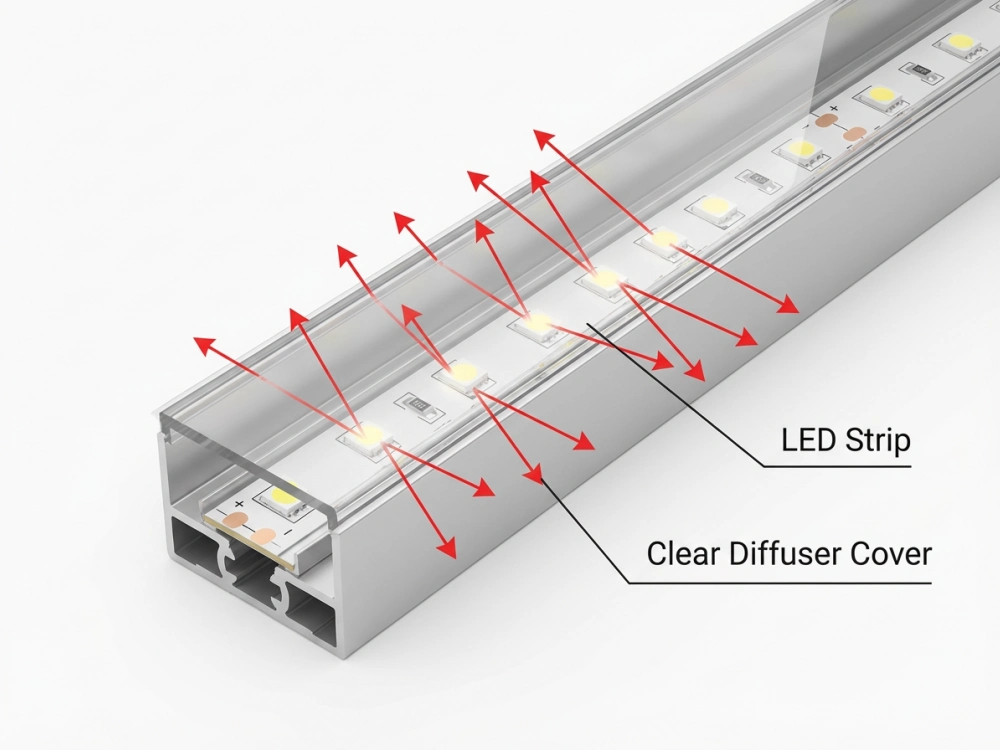
Les couvercles de diffuseur LED transparents sont conçus pour préserver le plus de lumière possible. Ils introduisent une interférence optique minimale et sont souvent sélectionnés lorsque la luminosité est l'objectif principal.
Quand utiliser la LED claire Bande diffuseurs
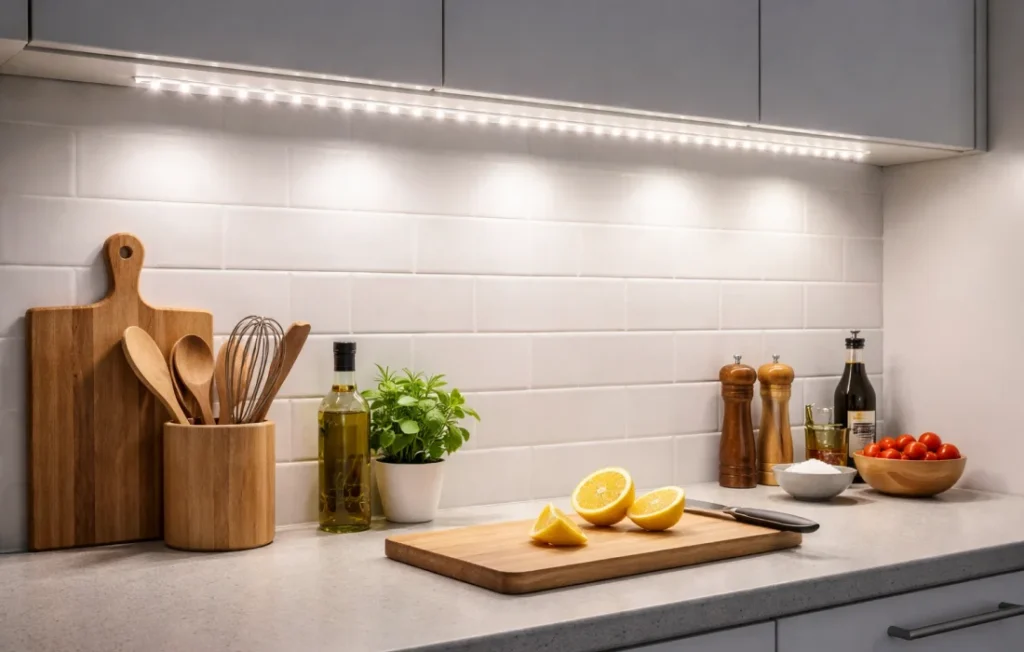
Les diffuseurs transparents sont les mieux adaptés aux applications où l'efficacité de la lumière l'emporte sur la douceur visuelle. Les cas d'utilisation typiques comprennent l'éclairage fonctionnel, l'éclairage de tâches et l'éclairage de l'écran lorsque les points LED sont acceptables ou même souhaitables.
Avec une perte de lumière estimée inférieure à dix pour cent, les couvertures transparentes fournissent la plus grande puissance de lumen parmi tous les types de diffuseurs.
Avantages et inconvénients des couvertures de diffuseur transparent
Les avantages incluent une efficacité élevée, un éclairage net et une perte de transmission minimale. Cependant, les diffuseurs transparents ne masquent pas les points LED individuels, en particulier lorsqu'ils sont utilisés avec des bandes de LED à faible densité ou des canaux peu profonds. L'éclat peut également devenir un problème dans les installations à vue directe.
Les organisations de normes d'éclairage soulignent que la perte de transmission est un facteur critique dans la conception de l'éclairage, ce qui explique pourquoi les diffuseurs clairs sont préférés lorsque la production de lumens brut est prioritaire.
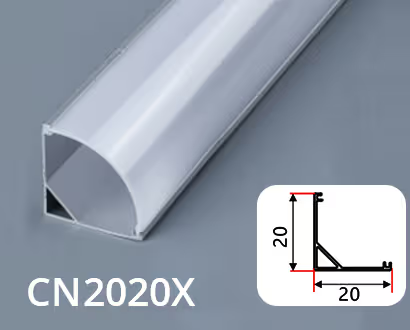
Profilés d'angle en aluminium
Poids : 0.087KG
Épaisseur : 0,8 mm
Couleur du PC : clair
Taille : L1000*L20*H20mm
Embouts/Clips : 1 paire/m
Couleur de l'aluminium : argent/noir
Pour un éclairage de travail sous l'armoire où la luminosité est la clé, utilisez un diffuseur clair avec notre Canaux en forme de V en coin Pour diriger la lumière exactement là où vous travaillez.
Couvre-diffuseur laiteux : le meilleur choix pour un éclairage sans points
Les diffuseurs à bande LED laiteuses sont l'option la plus couramment utilisée pour les canaux de bandes LED, en particulier dans l'éclairage architectural et décoratif. Leur principal avantage réside dans leur capacité à diffuser la lumière et à réduire les points chauds visibles.
Pourquoi laiteux LED Dscarpent Cexcès sont préférés pour les canaux de bande LED
Milky couvre la diffusion et l'efficacité de la lumière d'équilibre. En dispersant la lumière dans la cavité du canal, ils adoucissent le faisceau et réduisent considérablement la visibilité des points. Cela les rend idéaux pour l'éclairage indirect, les criques, les plafonds et les applications architecturales linéaires.
Cependant, le diffuseur seul ne garantit pas une apparence impeccable. La profondeur des canaux et la densité des LED jouent des rôles tout aussi importants.
Le secret impeccable : le rapport de profondeur à la densité de LED
L'éclairage sans points dépend de la relation entre le pas de la bande LED et la distance de diffusion. Plus la distance entre la source LED et la surface du diffuseur est grande, plus la lumière peut se répandre uniformément.
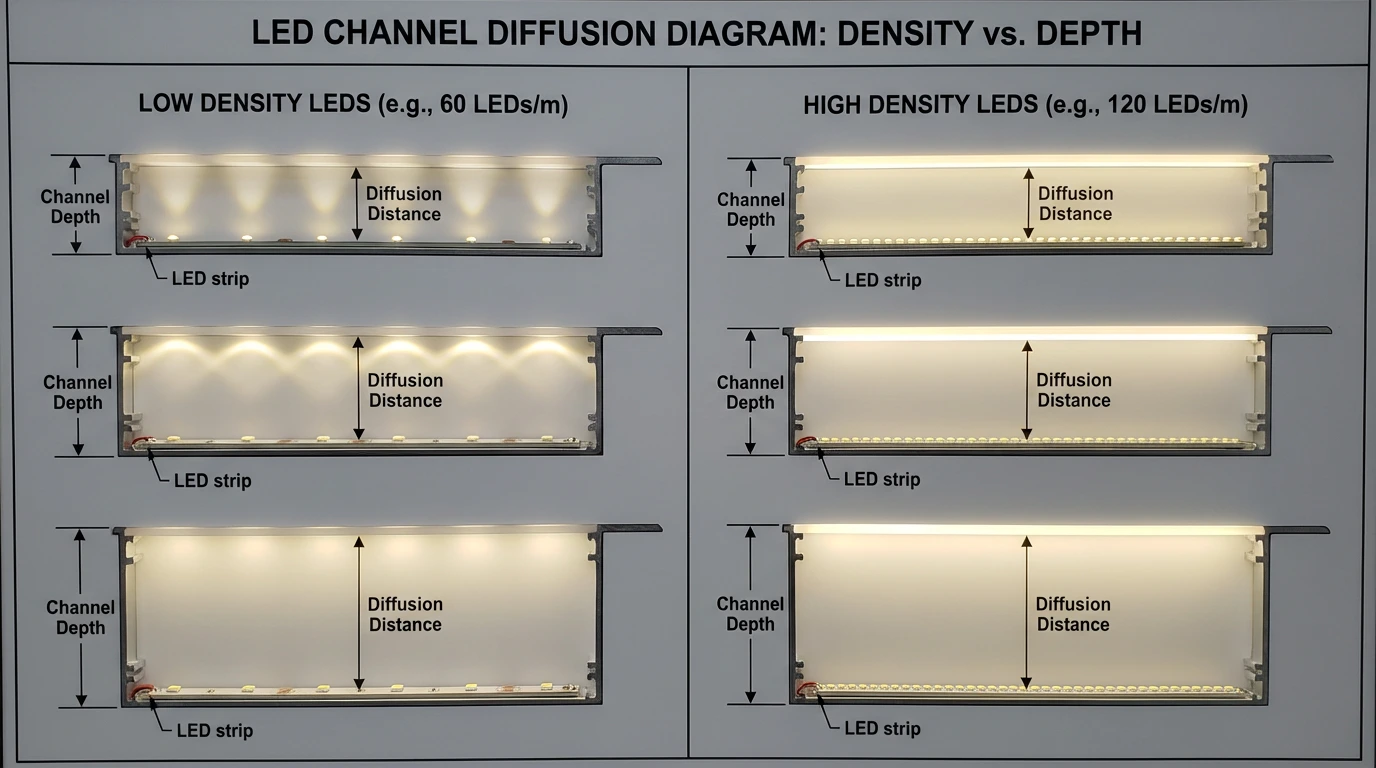
Tableau de référence de distance sans tache
| Densité de bande LED | Type | au paris Profondeur de canal pour un effet impeccable (couverture laiteuse) |
| 30 LED/m | Standard SMD | > 20 mm (encastré profond) |
| 60 LED/m | Standard SMD | > 12–15 mm |
| 120 LED/m | SMD haute densité | > 7–10 mm |
| Bande LED COB | puce-à bord | > 3–5 mm |
Ce tableau explique pourquoi les bandes LED COB sont de plus en plus populaires en matière d'éclairage linéaire. Leur densité de LED extrêmement élevée permet un éclairage uniforme, même dans les canaux ultra-fins.
Diffuseur laiteux et bandes LED COB : une combinaison idéale
Lorsqu'ils sont associés à des bandes LED COB, les diffuseurs laiteux peuvent obtenir une ligne lumineuse continue de type néon avec une profondeur de canal minimale. Cette combinaison est largement utilisée dans les projets résidentiels, d'accueil et commerciaux haut de gamme où le confort visuel est essentiel.
Couvertures de diffuseur noir : lorsque l'esthétique est plus importante que la luminosité
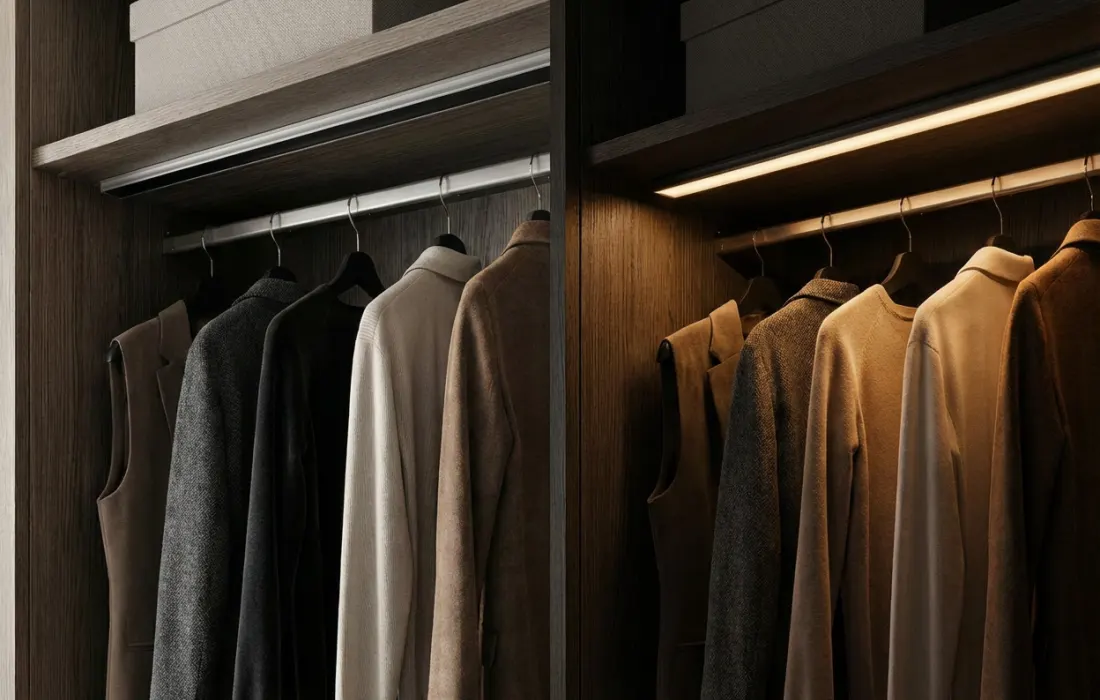
Les housses de diffuseur noir ont un objectif différent. Plutôt que de maximiser la production de lumière, ils se concentrent sur l'intégration visuelle et l'atmosphère.
Qu'est-ce qu'une LED noire Lumière Couverture de diffuseur
Les diffuseurs noirs semblent sombres ou opaques lorsque la lumière est éteinte, permettant au canal de se fondre parfaitement dans les plafonds ou les murs. Lorsqu'il est éclairé, ils émettent une lueur douce et contrôlée plutôt qu'un faisceau linéaire brillant.
Applications de diffuseurs noirs dans l'éclairage architectural
Les couvertures noires sont couramment utilisées dans les hôtels, les commerces de luxe, les bars et les intérieurs résidentiels modernes. Ils sont idéaux pour l'éclairage d'ambiance, l'éclairage d'accentuation et les espaces où les luminaires doivent rester visuellement discrets.
Bien que la perte de lumière puisse atteindre 60 à 70 %, ce compromis est intentionnel et s'aligne sur les objectifs d'éclairage ambiant.
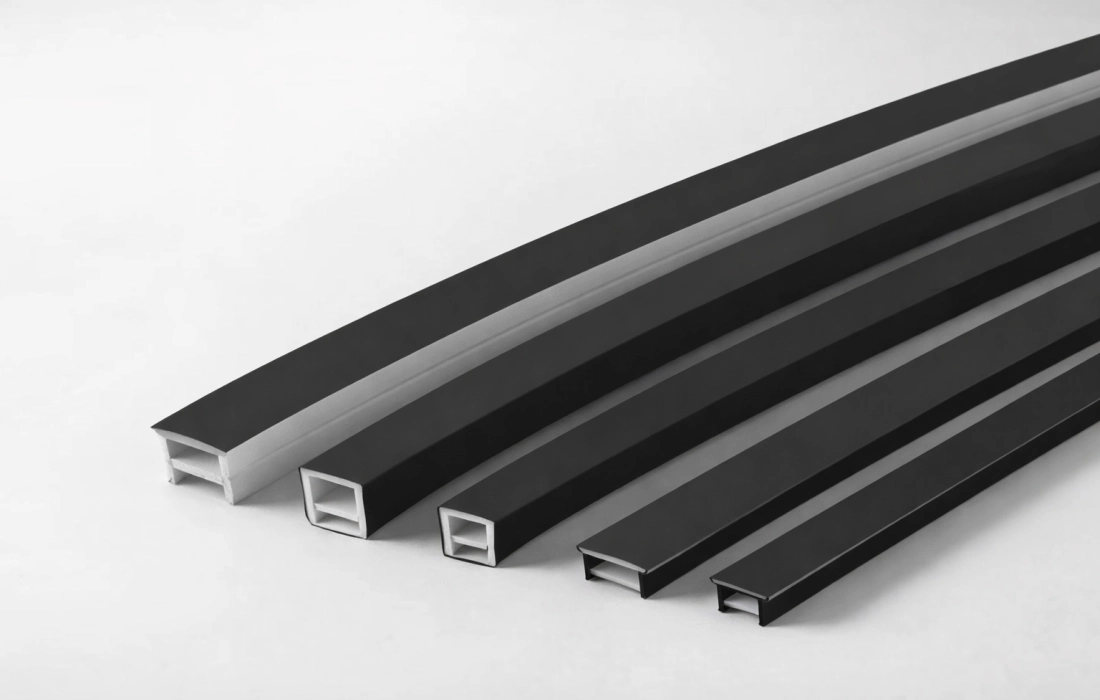
Canal encastré de bandes LED flexibles
Longueur totale : 1m/3m/5m
Direction lumineuse : Lumière frontale
Nombre de LED : 30 LED/m et plus
Couleur : Noir
Taille de la section : T1212/T1616/T2010/T2014/T2020/T2520
Largeur de circuit imprimé : 7 mm – 20 mm
Angle du faisceau : 120 degrés
Matériau : Silicone
Étanchéité : IP65/IP67/IP68
Source lumineuse : SMD2835/5050, bande LED COB
Pour les salles de cinéma ou les intérieurs sur le thème sombre, les chaînes argentées standard peuvent être gênantes. notre Profils d'édition noire disparaître en arrière-plan lorsqu'il est éteint.
Clear vs Milky vs Black Diffusers : comparaison côte à côte
La matrice de comparaison ultime
Le choix de la bonne couverture est un compromis entre la sortie de lumen (luminosité) et la diffusion de la lumière (lisse). Utilisez ce tableau pour trouver votre solde :
| Fonctionnalité | Diffuseur clair (transparent) | Diffuseur laiteux (opale/givré) | Diffuseur noir (fumé) |
| transmission lumineuse | 90% – 95% | 70% – 85% | 30% – 40% |
| Visibilité des points | Élevé (puces LED entièrement visibles) | Faible ou rien (selon la profondeur) | Zéro (complètement caché) |
| Changement de température de couleur | Aucun (CCT original) | Léger réchauffement (-100K à -200K) | assombrissement important |
| contrôle des reflets | minimal | Excellent (amortit la lumière) | Éclairage élevé (éclairage d'ambiance) |
| Esthétique (hors état) | Bande interne visible | Nettoyer la surface blanche | Finition noire furtive |
| Meilleure application | Sous-armoire, éclairage de l'âne, utilitaire indirect | Lignes architecturales, Vision directe, Bureau | Cinéma, bar, décor sur le thème sombre |
Analyse des effets visuels
Couvertures claires (The Efficiency King) : Meilleur pour Applications d'éclairage indirect où la source de lumière est cachée, comme à l'intérieur d'une crique ou au-dessus d'une armoire. Comme vous ne voyez pas directement l'appareil, la pixellisation n'a pas d'importance et vous obtenez un maximum de niveaux de lux.
Couvre laiteux (la norme universelle) : Ceux-ci agissent comme un homogénéisateur léger. En diffusant le faisceau lumineux, ils augmentent l'angle du faisceau (souvent jusqu'à 120 degrés) et réduisent la fatigue oculaire. Il s'agit de la norme pour les luminaires linéaires où le canal est exposé.
Couvertures noires (au choix du concepteur) : bien qu'elles réduisent l'efficacité lumineuse de manière considérablement, ils sont inégalés pour le contraste et le style. Parfait pour l'esthétique des «lumières éteintes» où le canal doit se fondre dans les plafonds ou les murs sombres.
Types d'installation : diffuseurs encliquetables ou enfichables
Avant d'acheter, vous devez prendre en compte alors que Vous installez le canal. Le mauvais type de couverture peut rendre l'installation impossible.
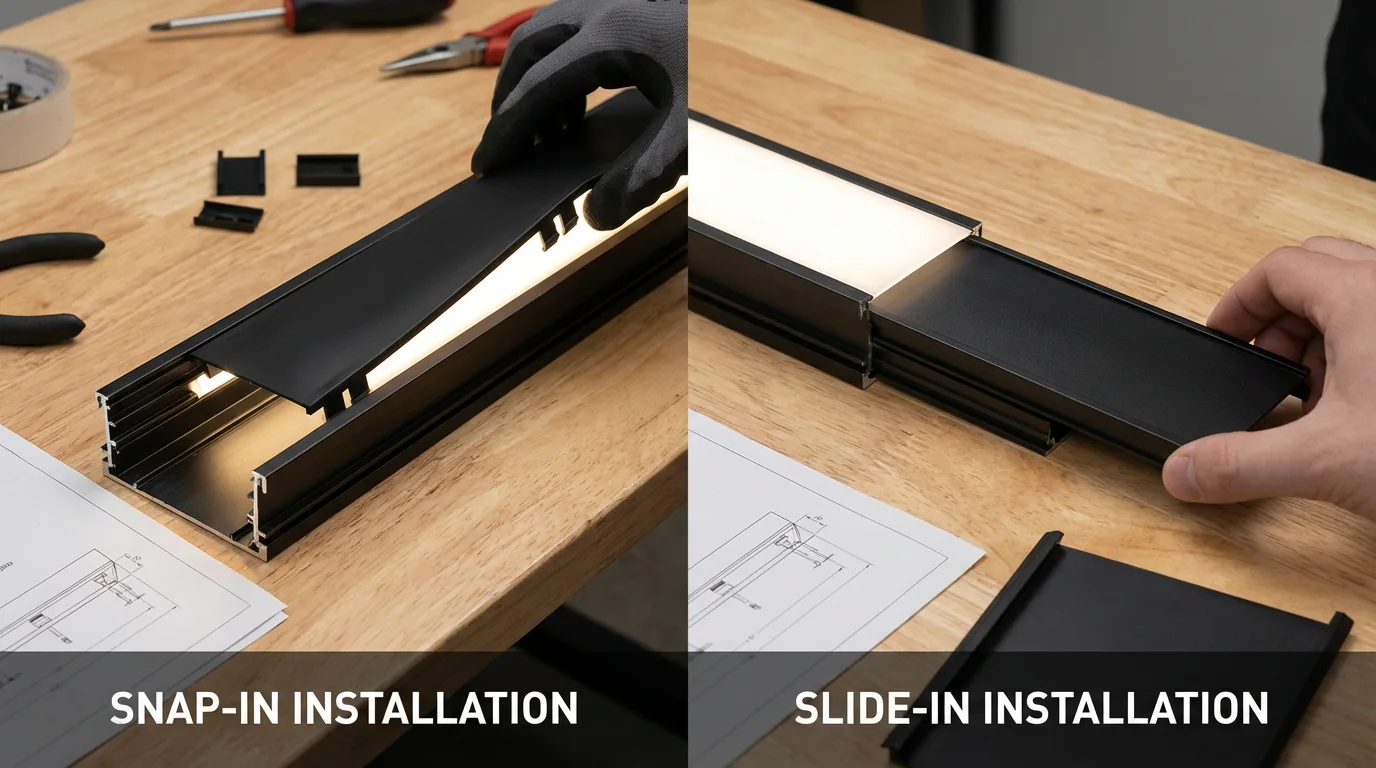
Diffuseurs encliquetables (click-on) : le choix convivial
Aussi connus sous le nom de couvercles de pression, ceux-ci sont conçus pour être pressés sur le canal en aluminium par l'avant.
- Idéal pour : les installations ou les rainures encastrées (comme dans les armoires ou les cloisons sèches) où les extrémités du canal sont bloquées.
- Avantages : entretien facile. Si une bande LED échoue, vous pouvez simplement enlever le couvercle sans retirer tout le luminaire.
- Mécanisme : utilise de petites crêtes pour "cliquer" en toute sécurité dans les bords du profil.
Diffuseurs coulissants : la prise en main sécurisée
Ceux-ci doivent être insérés à partir de l'extrémité ouverte du profilé en aluminium et glissés sur toute la longueur.
- Idéal pour : un éclairage suspendu ou des zones à fortes vibrations. La structure est souvent plus serrée et plus résistante à la sortie.
- Le hic : vous avez besoin d'espace de dégagement aux extrémités. N'utilisez pas de couvercles coulissants pour les fentes encastrées de mur à mur, sinon vous ne pourrez jamais insérer la lentille !

Comment choisir le bon diffuseur pour votre canal de bande LED
à Choisissez le bon diffuseur pour les canaux LED, suivez ces cinq étapes :
- Vérifiez la densité de vos LED et votre type de bande. Les bandes de haute densité ou d'épis s'associent mieux avec les diffuseurs laiteux.
- Définissez votre objectif visuel. Choisissez Clear pour la luminosité, laiteux pour l'uniformité ou noir pour l'atmosphère.
- Mesurez la profondeur du canal. Les canaux plus profonds améliorent la diffusion et réduisent les points chauds.
- Sélectionnez le bon matériau. Le PMMA offre une longévité, le PC offre une durabilité et le PVC doit être évité pour les projets à long terme.
- Décidez du type d'installation. Les housses de fixation simplifient la maintenance, tandis que les objectifs coulissants offrent une finition plus propre.
Diffuseurs extérieurs et imperméables : considérations particulières
Les installations extérieures de canaux de bandes LED nécessitent plus que le simple choix d'un diffuseur avec de bonnes performances optiques. Ils exigent également une prise en compte attentive de la protection de l'environnement, des cotes d'étanchéité et des types de bandes LED correspondants. Un diffuseur LED bien sélectionné aidera à atténuer les reflets et les points chauds, mais dans les environnements extérieurs ou humides, la cote de protection IP du système d'éclairage et le type de bande LED que vous associez sont tout aussi critiques pour une fiabilité à long terme.
Lors de la planification d'une configuration de canal LED extérieur, assurez-vous d'abord que la bande LED elle-même convient aux conditions extérieures. Différents types de bandes LED ont des degrés variables d'imperméabilisation et de résistance à l'environnement, et le choix du bon maintient à la fois les performances et la durée de vie. Vous pouvez consulter les différences entre les variantes de bandes de LED et leur relation avec les scénarios d'utilisation dans ce Quels sont les types de bandes LED Page de référence.
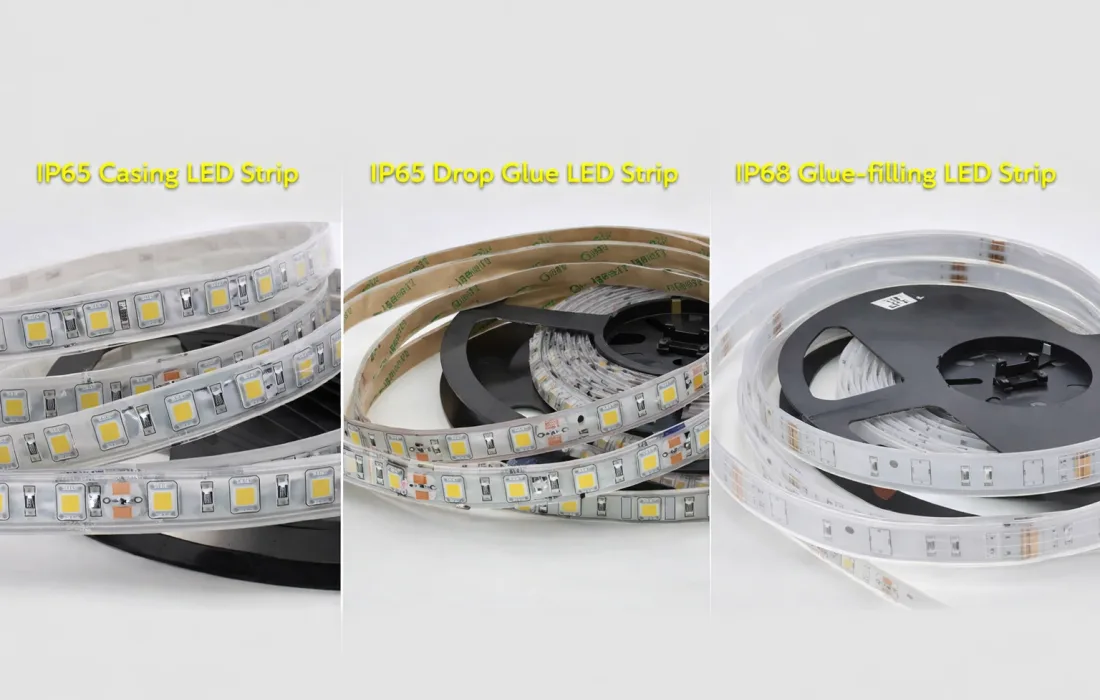
En termes de protection contre l'eau et la poussière, les bandes et diffuseurs LED doivent idéalement respecter les cotes IP65 ou supérieures. selon le Guide d'étanchéité des bandes lumineuses à LED (indice IP), les cotes IP65 protègent contre les jets d'eau à basse pression et les pluies légères, ce qui les rend adaptés à la décoration extérieure générale et aux installations semi-exposées; IP67 offre une protection contre l'immersion jusqu'à 1 mètre pendant de courtes durées; et les cotes IP68 prennent en charge une utilisation sous-marine prolongée, comme dans les piscines ou les fontaines.
Pour les diffuseurs de canaux et les bandes LED travaillant ensemble à l'extérieur, soyez conscient de la façon dont l'étanchéité affecte la dissipation thermique. Un système étanche complètement fermé peut entraver la fuite de chaleur, ce qui à son tour impacte la température de jonction LED et la longévité. L'intégration des canaux en aluminium avec des diffuseurs étanches appropriés aide à équilibrer la protection et la gestion thermique.
En pratique, envisagez de combiner des bandes LED imperméables avec des diffuseurs robustes et des canaux adaptés aux conditions extérieures. L'association de bandes extérieures avec des diffuseurs IP65+ à l'intérieur de canaux en aluminium correctement scellés empêche non seulement la pénétration d'humidité, mais également des performances constantes dans les conditions météorologiques changeantes.
Erreurs courantes lors du choix du diffuseur LED recouvrement
Match #1 : le piège « hotspot » (précision faible + faible densité)
En utilisant un profil de surface peu profond (par exemple, 6 mm de hauteur) avec une bande standard de 60 LED/m, vous garantirez des points visibles, même avec une couverture laiteuse.
Correction : Utilisez des bandes LED COB ou un profil profond (min. 15 mm de profondeur) pour vous assurer que les faisceaux lumineux se chevauchent avant de toucher la lentille.
Erreur #2 : ignorer la dégradation des UV (l'effet « jaunissement »)
L'achat du diffuseur le moins cher signifie généralement qu'il est fabriqué en plastique générique sans stabilisateurs UV. À l'intérieur, près des fenêtres ou à l'extérieur, ceux-ci deviendront cassants et jaunes en quelques mois.
Correction : Spécifiez toujours les couvertures en PMMA (acrylique) ou en polycarbonate stabilisées aux UV pour la longévité.
Erreur #3 : Oublier les tolérances du clavement des extrémités
Les diffuseurs peuvent se dilater et se contracter avec la chaleur (expansion thermique). Couper le diffuseur à la même longueur que le canal en aluminium peut parfois provoquer un flambage.
Correction : Laissez un écart de 1 à 2 mm ou assurez-vous que les embouts sont conçus pour contenir le diffuseur spécifiquement.
Options de diffuseur personnalisées pour les canaux de bandes LED en aluminium
Les longueurs standard d'un mètre ou de 2 mètres ne suffisent pas toujours pour les projets professionnels. C'est là que le partenariat avec un fabricant spécialisé comme Signiteled ajoute de la valeur.
Nous proposons des solutions sur mesure pour les besoins d'éclairage commercial et architectural :
- Longueurs personnalisées : Besoin d'un parcours continu de 3 mètres ou plus sans coutures ? Signiteled peut extruder des longueurs personnalisées pour minimiser les fuites de lumière et les points de connexion.
- Opacité sur mesure : pour les projets OEM, nous pouvons ajuster le mélange de diffusion de nos couvertures PMMA, créant ainsi l'équilibre parfait entre la dissimulation des points LED et la maximisation de la transmission de la lumière pour votre bande LED spécifique.
- Sélection de matériaux : choisissez entre le polycarbonate (PC) à fort impact (PC) pour les passerelles publiques ou le PMMA optique de qualité pour pour une clarté de qualité musée.
- Correspondance complète du système : ne devinez pas si la couverture s'adapte. Signiteled fournit des systèmes entièrement intégrés, garantissant que le dissipateur thermique en aluminium, la lentille diffuseur et les accessoires de montage fonctionnent en parfaite harmonie.
FAQ
Réflexions finales
La sélection des diffuseurs est l'un des aspects les plus sous-estimés de la conception d'éclairage à bande LED. En comprenant les différences entre les couvertures claires, laiteuses et noires, ainsi que la science des matériaux, la profondeur des canaux et les méthodes d'installation, vous pouvez obtenir des résultats d'éclairage à la fois visuellement raffinés et techniques.
Un diffuseur bien choisi transforme un canal de bande LED d'un simple boîtier en une solution d'éclairage professionnelle qui répond aux normes architecturales modernes.
Articles Similaires