Français
  English
  简体中文
简体中文  Deutsch
  Español
  Italiano
  日本語
日本語  한국어
한국어  Polski
  Português
  Русский
  Türkçe
  Nederlands
  Tiếng Việt
  ไทย
ไทย 
La différence entre l'absorption acoustique et l'insonorisation est simple mais souvent mal comprise. L'absorption du son gère le comportement du son à l'intérieur d'un espace en réduisant les réflexions et la réverbération, tandis que l'insonorisation empêche le son d'entrer ou de quitter un espace à travers des barrières structurelles. La confusion des deux conduit à des budgets gaspillés, car les gens investissent dans les traitements de surface lorsqu'ils ont réellement besoin de changements de construction, ou s'attendent à des solutions décoratives pour résoudre les problèmes de bruit structurel. Ce malentendu est particulièrement fréquent lorsque l'éclairage acoustique est impliqué, lorsque les attentes dépassent souvent la solution de la solution.
Cet article explique clairement la distinction, pourquoi la confusion persiste et où s'ajuste de manière réaliste, sans battage médiatique ni hypothèse.
Qu'est-ce que l'absorption acoustique ?

L'absorption acoustique est le contrôle du son réfléchi dans une pièce. Il se concentre sur le comportement du son après sa production, et non sur l'arrêt du son de voyager entre les espaces.
Que fait l'absorption acoustique
L'absorption acoustique réduit les échos, les battements et la réverbération excessive en permettant à l'énergie sonore de se dissiper lorsqu'elle entre en contact avec des surfaces d'absorption. Au lieu de rebondir à plusieurs reprises sur des surfaces dures, le son est ramolli et contrôlé.
Quel problème cela résout
Le principal problème que l'absorption du son est le problème de la clarté acoustique. Dans les espaces non traités, la parole devient plus difficile à comprendre, la musique semble boueuse et le bruit de fond s'accumule. L'absorption contribue à améliorer l'intelligibilité de la parole et le confort acoustique général.
Où l'absorption acoustique est utilisée
L'absorption acoustique est utilisée dans les bureaux, les salles de réunion, les studios, les salles de classe, les restaurants et autres environnements intérieurs où la clarté et le confort sont importants. Il est généralement appliqué à travers les plafonds, les panneaux muraux et d'autres éléments intérieurs conçus pour gérer les réflexions.
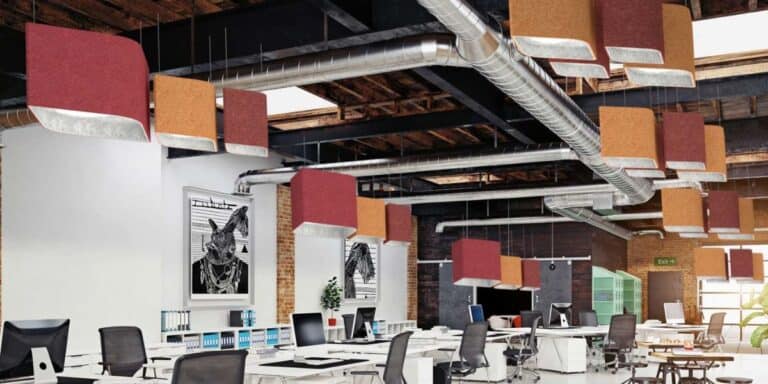
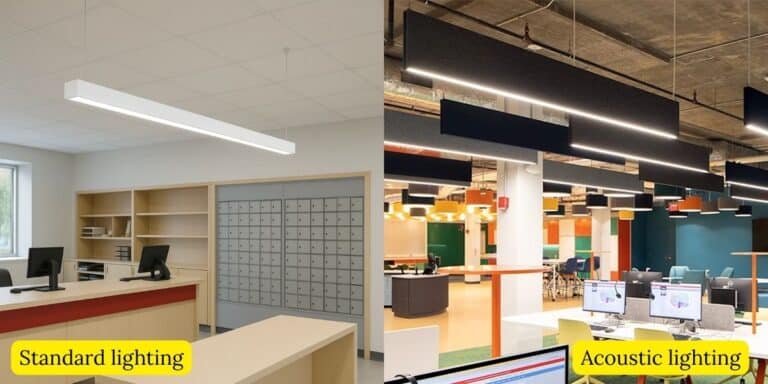
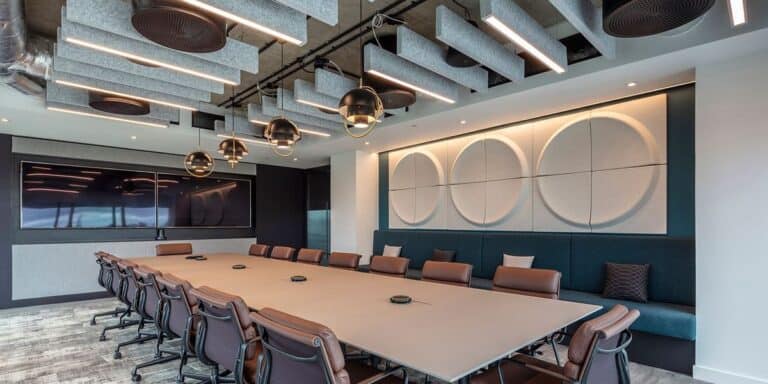
L'éclairage acoustique appartient à cette catégorie. Il est conçu pour contribuer à l'absorption acoustique tout en fournissant un éclairage, en particulier dans les applications de plafond.
Qu'est-ce que l'insonorisation ?

L'insonorisation est la prévention de la transmission sonore entre les espaces. Il aborde la façon dont le son se déplace à travers les murs, les plafonds, les sols et les lacunes structurelles.
Que fait l'insonorisation
L'insonorisation limite la quantité de sons qui passe d'une pièce à l'autre. Il se concentre sur le blocage, l'isolement ou le découplage des chemins de son à travers les systèmes de construction.
Quel problème cela résout
L'insonorisation résout les problèmes liés à la confidentialité et aux fuites de bruit. Cela inclut d'empêcher les conversations d'être entendues à côté, d'empêcher la musique de voyager entre les pièces ou de réduire l'intrusion de bruit externe.
Pourquoi l'insonorisation est structurelle, pas décorative
L'insonorisation dépend de la masse, de la construction hermétique, de la séparation et des détails structurels. Il s'agit généralement de murs, de sols, de plafonds et de pénétrations. Pour cette raison, il ne peut être réalisé grâce à des produits montés en surface ou décoratifs seuls. Les luminaires, les panneaux d'absorption et les éléments de plafond ne remplacent pas les systèmes d'insonorisation structurelle.
Pourquoi les gens confondent-ils l'absorption du son et l'insonorisation ?
La confusion vient de la façon dont les problèmes sonores sont vécus et de la commercialisation ou de la méconnaissance des solutions.
Symptômes similaires, causes différentes
Dans de nombreux bureaux et studios, les gens éprouvent du bruit et supposent que le son est « fauché ». En réalité, la question est souvent une réflexion interne, où le son se construit et devient écrasant. L'absorption aide dans ces cas, mais cela n'empêche pas le son de se déplacer dans d'autres pièces.
Exemples réels
Dans les bureaux ouverts, les employés peuvent se plaindre du bruit et de la confidentialité. L'ajout de plafonds d'absorption améliore le confort mais n'empêche pas les conversations d'être entendues dans les pièces adjacentes.
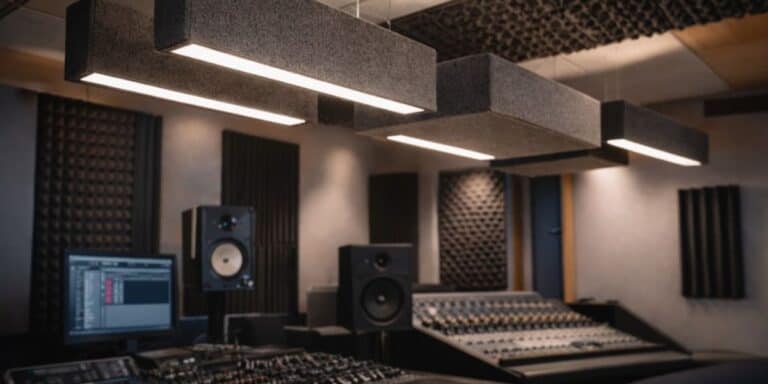
Dans les studios, les réflexions peuvent empêcher les enregistrements de sonner, tandis que le bruit externe entre toujours parce que la structure elle-même n'est pas isolée. Traiter un problème ne résout pas l'autre.
Comment les hypothèses erronées gaspillent
Lorsque l'absorption est confondue avec l'insonorisation, les budgets sont consacrés à des produits qui ne peuvent pas fournir le résultat attendu. À l'inverse, lorsque l'insonorisation est installée là où l'absorption aurait été suffisante, les projets deviennent inutilement complexes et coûteux. Le coût n'est pas seulement financier mais aussi opérationnel, car les attentes ne sont pas satisfaites.
Où s'intègre l'éclairage acoustique

Éclairage acoustique est souvent pris au milieu de cette confusion. Comprendre son rôle empêche clairement les attentes irréalistes.

Lampe à LED acoustique fine anti-éblouissante
- Tension d'entrée : AC100–277V / AC220–240V, 50–60Hz
- Taille du logement : W58 × H200 mm / L58 × H300 mm
- Direction émettrice : vers le bas
- Options de longueur : 1218 mm / 1220 mm / 1288 mm
- Température de couleur corrélée (CCT): 3000K / 4000K / 6000K
- Puissance : 30 W / 32 W
- Flux lumineux : 100–110 lm/w
- IRC : > 90 RA
- Facteur de puissance (pF): > 0,90
- Flicker sans scintillement : Oui
- Angle du faisceau : 36°
- Indice de protection IP : IP20
- Garantie: 5 ans
- Options de couleur de la carte acoustique en feutre : Rouge / Vert / Bleu / Gris (plus de 48 options de couleur)
Le rôle de l'éclairage acoustique dans l'absorption acoustique
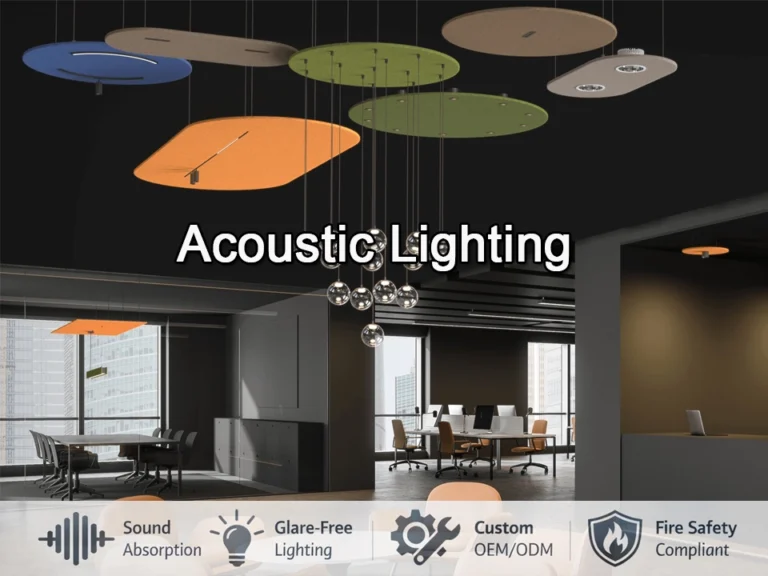
L'éclairage acoustique intègre la livraison de la lumière avec des éléments insonorisants. Il est conçu pour soutenir le confort acoustique en réduisant le son réfléchi des zones de plafond tout en répondant aux exigences d'éclairage. Son objectif est l'intégration fonctionnelle, et non l'isolation phonique.
Pourquoi l'éclairage acoustique au plafond affecte les réflexions et non l'isolation
Les plafonds jouent un rôle majeur dans la réflexion sonore. L'éclairage acoustique au plafond permet de gérer ces réflexions en combinant des surfaces d'absorption avec des luminaires. Cependant, il n'ajoute pas de masse, d'étanchéité à l'air ou de séparation. Pour cette raison, cela n'empêche pas le son d'entrer ou de quitter un espace.
Comment les solutions d'éclairage acoustique intégrées aident à gérer les plafonds
Dans les intérieurs modernes, les plafonds doivent s'adapter à l'éclairage, à l'acoustique et aux services sans être encombré. Les solutions d'éclairage acoustique permettent aux concepteurs de traiter ensemble l'absorption et l'éclairage acoustiques, ce qui simplifie la coordination tout en maintenant des objectifs acoustiques réalistes.
Selon la catégorie de produits référencées, ces systèmes sont conçus comme des éléments de plafond intégrés qui combinent l'éclairage avec un support acoustique. Toute attente au-delà de l'absorption tomberait en dehors de leur utilisation prévue.
Absorption acoustique vs. Insonorisation : une comparaison claire

| Aspect | absorption acoustique | insonorisation |
| Objectif | Améliorer le confort acoustique dans un espace | Réduire la transmission du son entre les espaces |
| méthode | Gérer les réflexions sonores | Bloquer ou isoler les trajectoires sonores |
| Matériaux typiques | Surfaces et traitements absorbants | Assemblages et barrières structurels |
| Ce qu'il peut résoudre | Problèmes d'écho, de réverbération, de clarté | Fuite de bruit, problèmes de confidentialité |
| Ce qu'il ne peut pas résoudre | Son voyageant à travers les murs ou les plafonds | Mauvaise acoustique interne |
Cette distinction est essentielle lors de la sélection des solutions et de la définition des attentes.
Comment le malentendu a un impact sur les décisions de projet
Conséquences de conception-stage
Lorsque l'absorption et l'insonorisation ne sont pas clairement séparées, les décisions de conception sont mal alignées. Les traitements décoratifs sont spécifiés pour les problèmes qu'ils ne peuvent pas résoudre, tandis que les besoins structurels sont négligés.
Risques budgétaires et de rénovation
Résoudre le problème d'abord en premier lieu conduit à des rénovations. Cela augmente les coûts et perturbe les opérations. Dans de nombreux cas, le problème initial aurait pu être résolu correctement avec un diagnostic approprié.
Attentes des parties prenantes
Les architectes, les concepteurs et les gestionnaires d'installations sont souvent confrontés à la pression pour "réparer le bruit". Une communication claire sur ce que chaque solution fait aide à gérer les attentes et à éviter l'insatisfaction après l'installation.
Conclusion
La différence entre l'absorption acoustique et l'insonorisation entraîne des erreurs coûteuses. L'absorption améliore le confort acoustique en gérant les réflexions, tandis que l'insonorisation s'attaque à la transmission du son par des moyens structurels. En traiter un comme un substitut aux autres résultats en matière de budgets inutiles et d'attentes non satisfaites.
L'éclairage acoustique s'inscrit clairement dans la catégorie d'absorption acoustique. Il aide à gérer le son réfléchi tout en fournissant un éclairage, en particulier dans les applications de plafond. Il n'est pas conçu pour bloquer le bruit ou remplacer les systèmes d'insonorisation structurelle.
Des définitions claires et des attentes réalistes sont le fondement de décisions acoustiques efficaces. Choisir la bonne solution commence par comprendre quel problème vous essayez réellement de résoudre.
FAQ
Articles Similaires