Français
  English
  简体中文
简体中文  Deutsch
  Español
  Italiano
  日本語
日本語  한국어
한국어  Polski
  Português
  Русский
  Türkçe
  Nederlands
  Tiếng Việt
  ไทย
ไทย 
L'éclairage acoustique est le meilleur lorsqu'il est installé directement au-dessus des zones d'activité sonore primaires telles que les postes de travail, les tables de conférence, les zones de collaboration et les sièges ouverts. Le placement au plafond est essentiel car le plafond agit comme une surface de réflexion majeure pour la parole. Un espacement, une hauteur et une distribution appropriés déterminent l'efficacité avec laquelle l'appareil réduit la réverbération et améliore la clarté de la parole.
Cet article explique les zones de placement optimales, les considérations de hauteur, la logique de contrôle de la réflexion, les stratégies de type pièce et les erreurs d'installation courantes. L'accent est mis sur la performance de placement afin que les architectes, les concepteurs, les consultants en acoustique et les gestionnaires d'installations puissent prendre des décisions d'installation éclairées.
Pourquoi le placement du plafond est plus important que le placement du mur
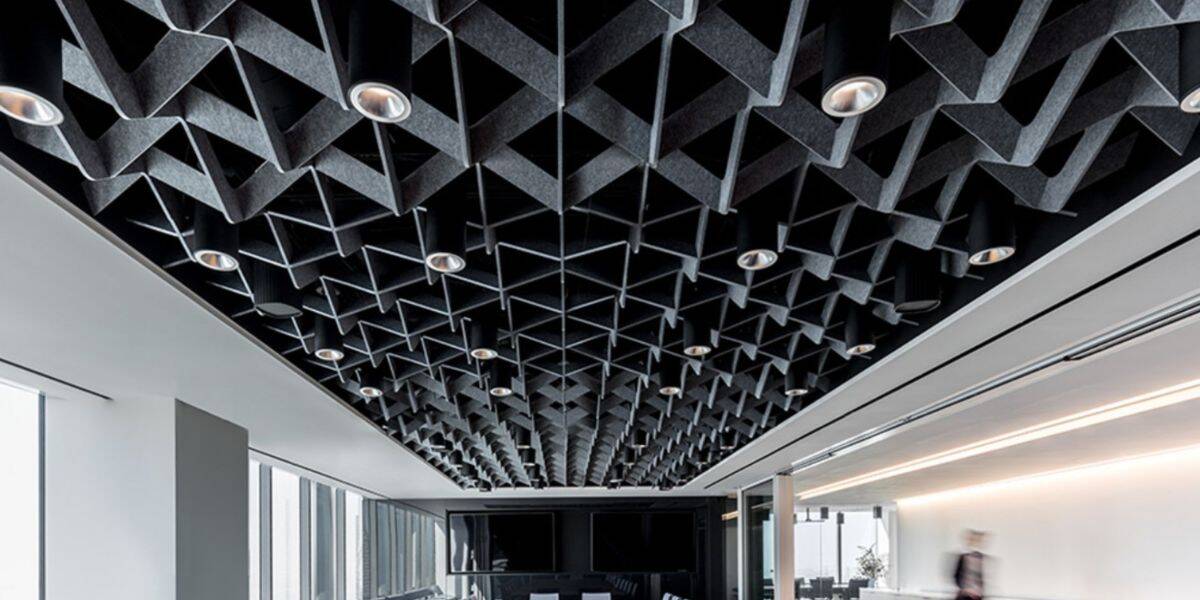
Dans la plupart des intérieurs commerciaux, l'énergie de la parole remonte immédiatement après avoir quitté la bouche du locuteur. La première réflexion significative se produit souvent au niveau du plan de plafond avant de retourner vers la zone occupée. Cela crée ce que les acousticiens appellent un premier chemin de réflexion :
Source de la parole → Plafonnement → Énergie réfléchie → Auditeurs.
Lorsque les plafonds sont durs, les surfaces réfléchissantes telles que le plâtre, le béton apparent ou le métal pour terrasse, répercutent rapidement l'énergie de la parole, augmentant le temps de réverbération et réduisant la clarté.
L'absorption murale aide, mais elle aborde principalement les réflexions latérales. Les réflexions sur les frais généraux sont généralement plus dominantes dans les environnements ouverts et de conférence, car :
- Le plafond s'étend sur toute la zone occupée.
- Il reflète l'énergie dans le champ de la parole.
- Il renforce le bruit sur de grandes zones horizontales.
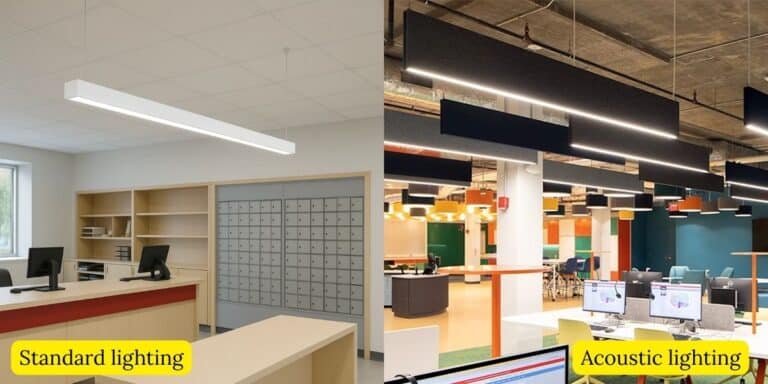
Éclairage acoustique Interrompt cette boucle de réflexion verticale directement au niveau du plan de réflexion. En plaçant des luminaires acoustiques dans le chemin de réflexion du plafond, l'énergie de la parole à mi-fréquence (généralement 500-2000 Hz) est absorbée avant de revenir aux occupants.
Le placement du mur périmétrique n'intercepte pas ce rebond vertical précoce. Les luminaires en feutre à base de plafond réduisent l'intensité des premières réflexions plus efficacement car ils se trouvent directement dans le cheminement sonore.
Dans les environnements ouverts, en particulier, l'absorption des frais généraux offre un impact acoustique plus élevé par mètre carré par rapport au traitement périmétrique uniquement.
Zones de placement de base
R : Au-dessus des postes de travail et des clusters de bureau
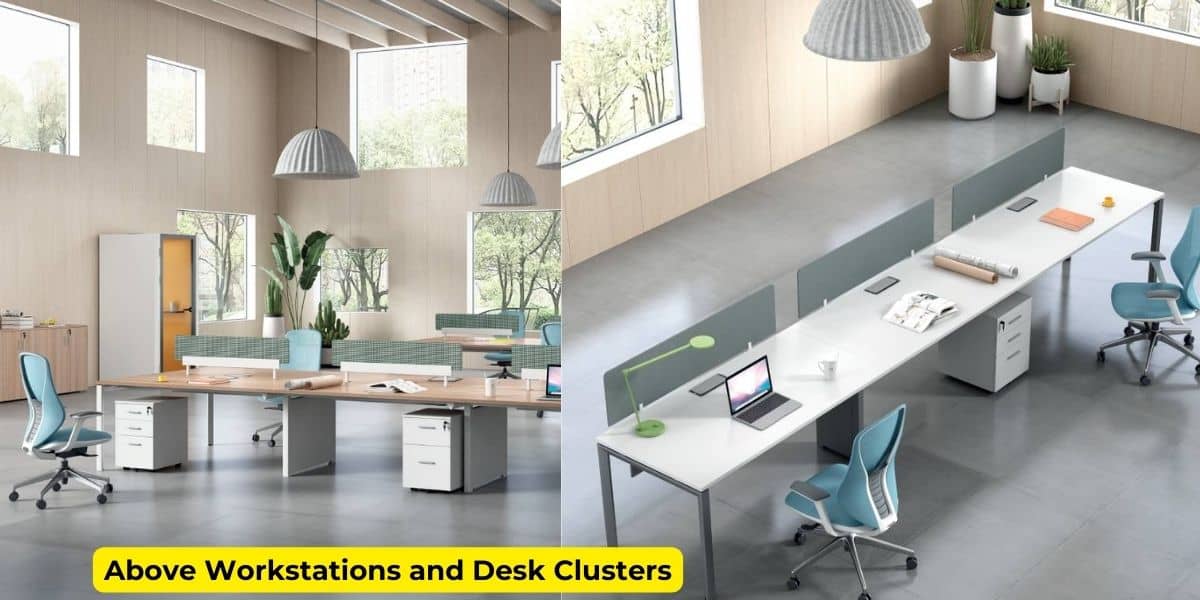
Les bureaux à aire ouverte concentrent la parole dans les groupes de postes de travail. Les conversations, les appels vidéo et les échanges collaboratifs génèrent une énergie sonore à mi-fréquence soutenue.
Installation de l'éclairage acoustique directement au-dessus des grappes de bureau :
- Absorbe la parole avant qu'il ne se propage latéralement.
- Réduit l'accumulation de réverbération sur les lignes.
- Limite la diaphonie entre les équipes.
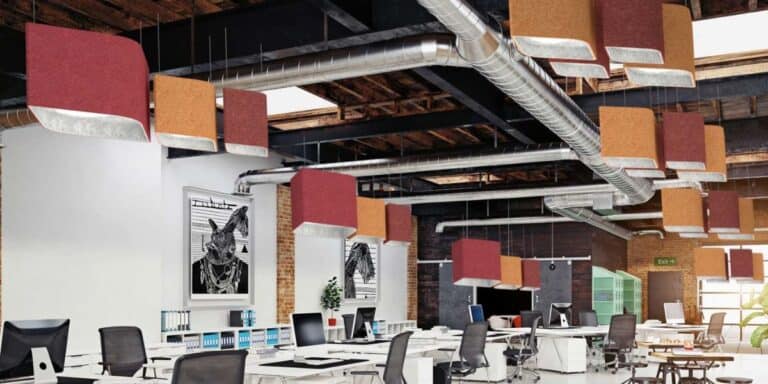
Luminaires en feutre sont particulièrement efficaces car le feutre de polyester dense absorbe la parole à mi-fréquence là où se trouve la plupart des énergies d'intelligibilité.
La logique de distribution est importante. Plutôt que de placer des luminaires le long des couloirs ou près des murs, les luminaires doivent être centrés au-dessus des bureaux actifs et s'étendre légèrement au-delà de l'empreinte de l'assise. Comme ligne directrice :
- Ciblez une couverture de plafond de 20 à 351 tp3t au-dessus des zones de bureau à haute activité.
- Maintenez un espacement constant pour éviter les lacunes de réflexion non traitées.
- Évitez les mises en page périmétriques uniquement, qui permettent aux zones centrales de parole de rester réfléchies.
Les dispositions sous-performantes placent généralement l'éclairage de manière décorative le long des trajectoires de circulation plutôt qu'au-dessus des sources sonores.
B : Au-dessus des tables de conférence
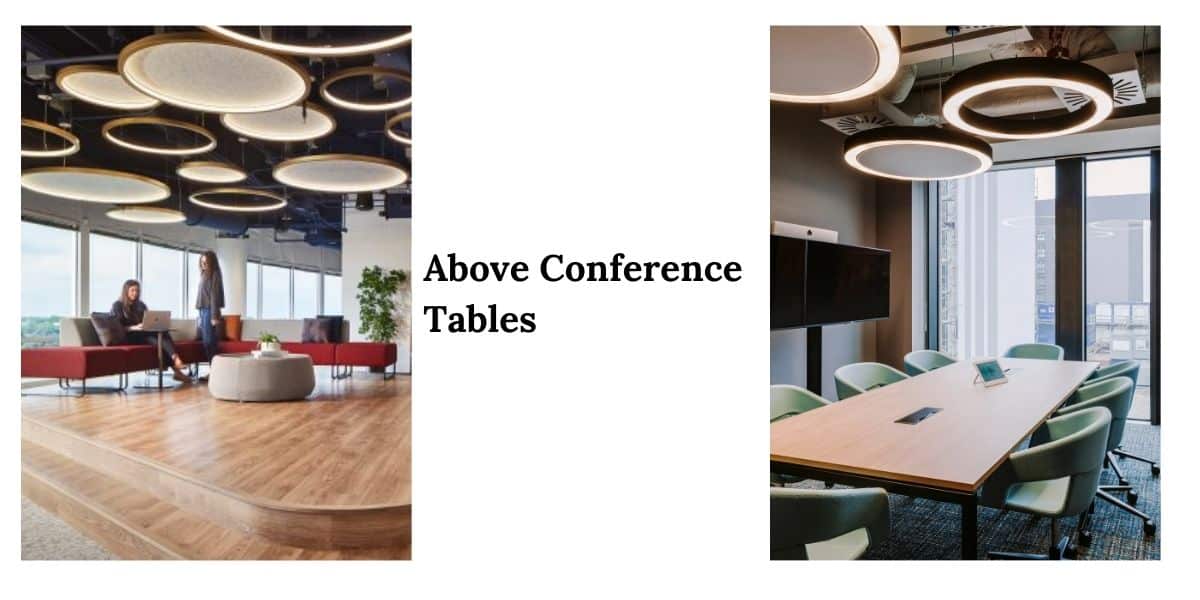
Les salles de conférence concentrent la parole directe dans une zone fixe. Plusieurs participants parlent vers le centre de la table et le son se reflète verticalement sur le plafond.
La configuration optimale :
- Installez l'éclairage acoustique au centre au-dessus de la table.
- Étendez la couverture de 300 à 600 mm au-delà de l'empreinte du tableau.
- Alignez les luminaires avec l'axe de la table pour une absorption uniforme.
Si une pièce est allongée, une disposition linéaire qui reflète la forme de la table fonctionne mieux qu'un seul cluster compact.
La hauteur compte également. Dans les plafonds typiques de 2,7 à 3 m, la suspension de 400 à 800 mm sous la dalle améliore l'efficacité d'absorption en plaçant le matériau plus près de la zone de réflexion.
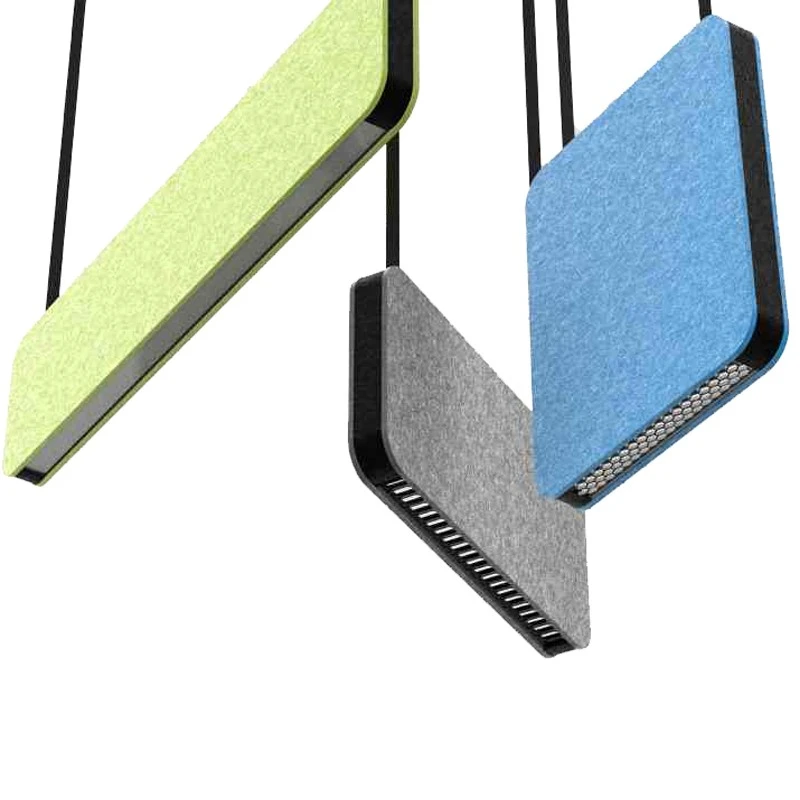
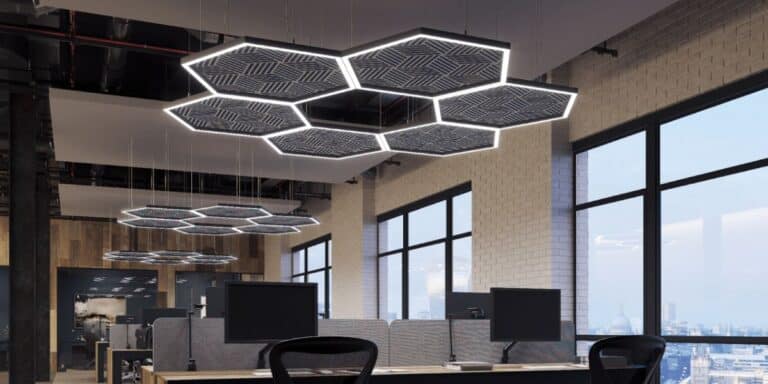
Lumière linéaire LED super mince
- Tension d'entrée: AC100-277V / AC220-240V,50-60Hz
- Direction émettrice : vers le bas
- Taille: 121836400mm
- CCT : 3000K/4000K/6000K
- Puissance : 30W
- Flux lumineux : 100-110lm/W
- CRI : > 80 ra
- PF : > 0,90
- Fllicker gratuit : oui
- Angle du faisceau : 120°.
- Classe IP : IP20
- Garantie : 5 ans
- Couleur de la planche acoustique en feutre : rouge / vert / bleu / gris plus de 48 couleurs
C : Zones de collaboration et espaces de détente
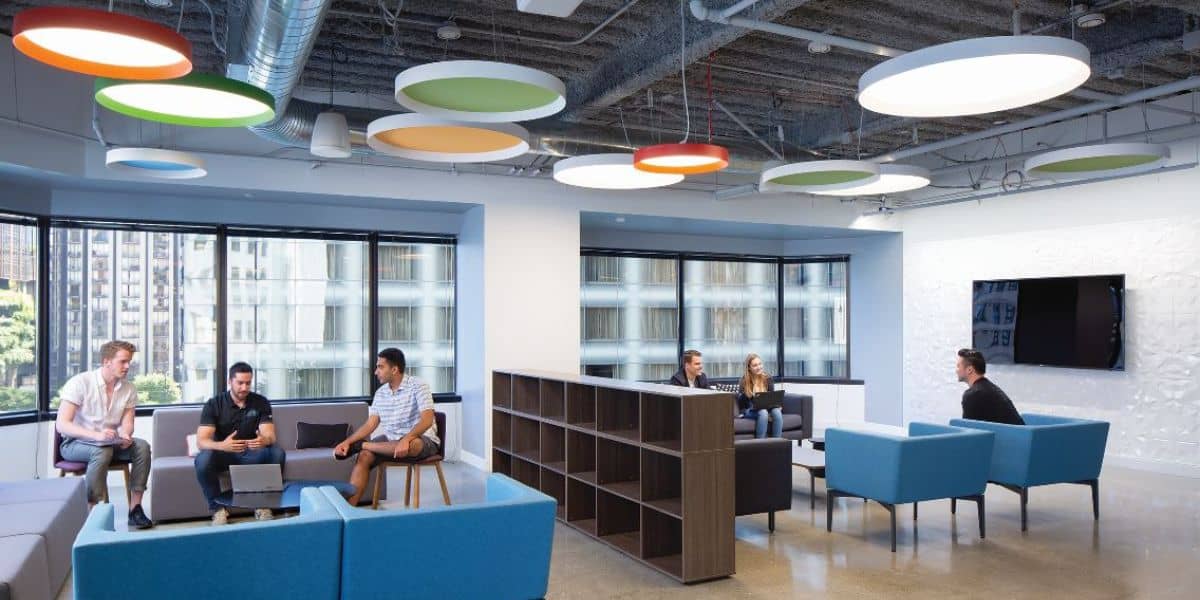
Les zones informelles génèrent des clusters de paroles imprévisibles mais concentrés. Sans absorption par le dessus, le bruit se répand dans les zones calmes adjacentes.
Installation de l'éclairage acoustique ci-dessus :
- Clusters de sièges souples
- Espaces de rassemblement
- Pods de réunion informels
Crée des zones d'absorption localisées. Cela contient du son près de sa source et empêche une accumulation de réverbération sur le plancher.
La stratégie de placement doit donner la priorité au confinement du son, et non à la symétrie visuelle.
Hauteur d'installation et directives de suspension
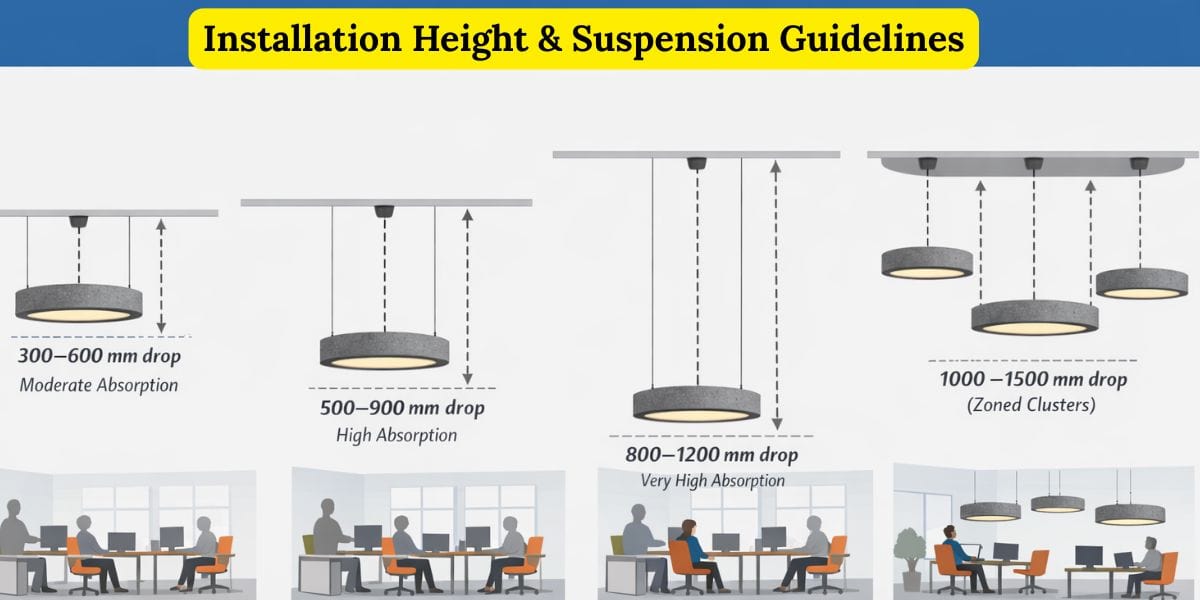
La profondeur de suspension influence considérablement les performances. La réduction de l'éclairage acoustique augmente son interaction avec les ondes sonores en positionnant le matériau dans des trajectoires de réflexion active.
Pour les plafonds exposés ou les dalles hautes, une suspension plus profonde améliore la capture acoustique.
Tableau 1 – Directives de suspension recommandées
| hauteur sous plafond | Profondeur de suspension suggérée | Impact acoustique | notes |
| 2,6–2,8 m | 300–600 mm | Modéré à élevé | Convient aux salles de conférence et aux bureaux |
| 2,8 à 3,2 m | 500–900 mm | Haut | Améliore le contrôle de la parole en plan ouvert |
| 3,2 à 4,0 m | 800–1200 mm | Élevé (zones localisées) | Essentiel pour les plafonds exposés |
| >4,0 m | 1 000 à 1 500 mm (clusters zonés) | ciblé | Combinez avec des luminaires acoustiques supplémentaires |
Une suspension inférieure augmente l'absorption efficace car le son rencontre le matériau avant de se disperser complètement.
Dans les plafonds hauts de plus de 3 m, l'installation de luminaires étanches à la dalle réduit considérablement les performances. La baisse de l'éclairage acoustique améliore l'interaction avec les fréquences de la parole.
Couverture et stratégie de distribution
Le pourcentage de couverture et le modèle de distribution déterminent l'efficacité globale.
En règle générale :
- 20–25% de couverture dans les bureaux de bruit modéré.
- 30–40% de couverture dans les zones de collaboration élevée.
- Densité localisée plus élevée au-dessus des zones de conférence.
Une répartition uniforme sur les zones actives surpasse le clustering de tous les luminaires dans une zone.
Les petits pendentifs espacés de manière uniforme peuvent fonctionner ainsi que de grands panneaux s'ils sont distribués correctement. Les grands panneaux d'éclairage acoustiques créent des champs d'absorption plus larges mais nécessitent un alignement minutieux avec les zones d'activité.
Tableau 2 – Stratégie de distribution par type d'espace
| Type d'espace | Zone de placement principal | Modèle de distribution | Un traitement supplémentaire est-il nécessaire ? |
| bureau ouvert | Clusters de bureau au-dessus | même la grille sur les zones de travail | Parfois, les luminaires acoustiques des murs s'ils sont très réfléchis |
| salle de conférence | Centré au-dessus du tableau | Cluster linéaire ou rectangulaire | Rarement si la couverture est adéquate |
| Espace de coworking | Domaines de collaboration mixtes | Clusters zonés | Souvent oui pour les murs en verre |
| réception | Zone d'attente pour les places assis | Concentré sur les sièges | Peut-être pour les hauts plafonds |
| Haut plafond atrium | Poches d'activité | Clusters suspendus | Oui pour le contrôle du volume |
Évitez de placer tout l'éclairage acoustique le long des bords du périmètre. Le placement distribué aligné sur la concentration de la parole donne de meilleures performances que le groupement décoratif.
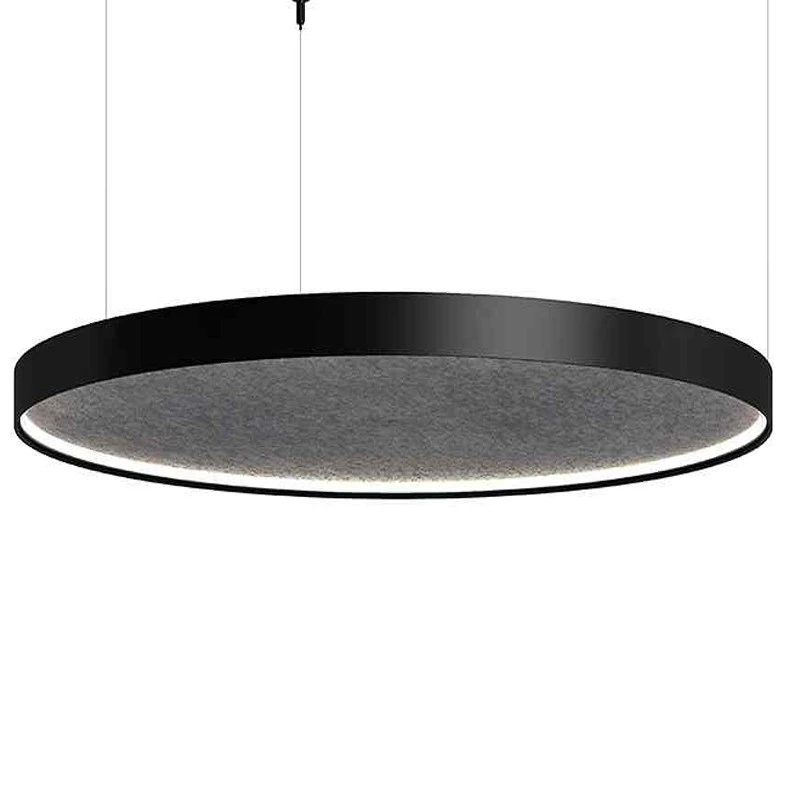
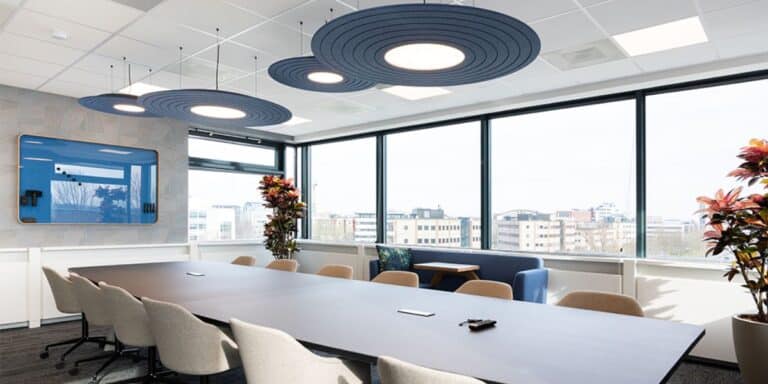
Lampe à suspension LED en cercle avec un cercle acoustique direct
- Tension d'entrée: AC100-277V / AC220-240V,50-60Hz
- Taille de hauteur : H65mm
- Taille D : 600 mm / 800 mm / 1000 mm / 1200 mm
- CCT : 3000K/4000K/6000K
- Puissance : 40W/60W/80W/96W
- Flux lumineux : 100-110lm/W
- contre -éblouissement : oui
- CRI : > 80 ra
- PF : > 0,90
- Fllicker gratuit : oui
- Angle du faisceau : 120°.
- Classe IP : IP20
- Garantie : 5 ans
- Couleur de la planche acoustique en feutre : rouge / vert / bleu / gris plus de 48 couleurs
Guide d'installation spécifique à la pièce
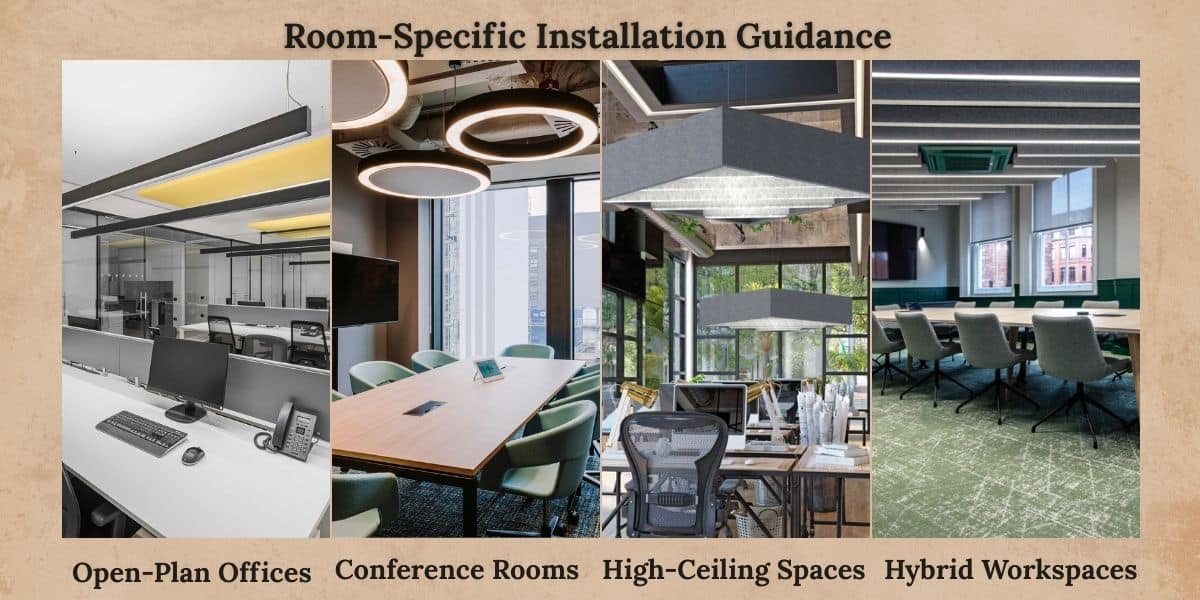
Bureaux à aire ouverte
Utilisez des grilles distribuées au-dessus des bureaux, pas des couloirs. Les mises en page centralisées de couloirs uniquement ne parviennent pas à adresser la parole à sa source.
Si les plafonds dépassent 3 m :
- Augmenter la profondeur de suspension.
- Cluster les luminaires acoustiques directement au-dessus des bureaux actifs.
- Complétez avec des luminaires acoustiques supplémentaires si la réverbération reste élevée.
Salles de conférence
Installez un éclairage acoustique central au-dessus de la table. Pour les chambres longues :
- Utilisez des tableaux linéaires qui suivent la géométrie du tableau.
- Ajoutez des appareils secondaires près des extrémités de la table si nécessaire.
Évitez de placer des luminaires près des murs à moins que les réflexions latérales ne soient graves.
Espaces à haut plafond
Les plafonds élevés augmentent la réverbération en raison du volume plus important. Dans ces espaces :
- Suspendre les luminaires plus bas dans la zone occupée.
- groupez-vous au-dessus des sièges actifs ou des zones de collaboration.
- Combinez avec les luminaires muraux si les surfaces en verre dominent.
Le placement doit cibler les zones d'activité, et non l'espace vide.
Espaces de travail hybrides
Les bureaux hybrides reconfigurent fréquemment les agencements de bureau. Les systèmes d'éclairage acoustique modulaires offrent une flexibilité.
Stratégie de placement :
- Identifiez les groupes de paroles probables.
- Utilisez des systèmes de suspension reconfigurables.
- Évitez les centres de table décoratifs fixes qui ne s'adaptent pas aux changements de mise en page.
La logique acoustique doit rester alignée sur les modèles d'occupation en évolution.
Quand l'éclairage acoustique seul ne suffit pas
Certaines conditions limitent les performances autonomes :
- Temps de réverbération très élevés.
- Grandes façades en verre.
- murs en béton.
- volumes à double hauteur.
Dans ces cas, l'éclairage acoustique doit servir d'absorption des frais généraux, complétée par des Appareils acoustiques.
Le traitement du plafond intercepte les réflexions verticales, tandis que le traitement mural contrôle les réflexions latérales. La combinaison produit des performances équilibrées.
Ignorer la réflectivité des murs dans les espaces très vitrés peut saper les solutions de plafond uniquement.
Erreurs d'installation courantes
- Installer uniquement au périmètre plutôt qu'au-dessus des zones de parole.
- Traiter l'éclairage acoustique comme purement décoratif.
- Ignorer la hauteur de suspension dans les hauts plafonds.
- Les appareils d'espacement sur espacement, créant des lacunes de réflexion non traitées.
- Installer uniquement les trajectoires de circulation ci-dessus.
- Ne parvenant pas à aligner le placement sur les modèles de parole réels.
La plupart des problèmes de performances découlent d'un placement mal aligné, d'un nombre insuffisant de montages.
Liste de vérification des décisions de placement
Tableau 3 – Liste de contrôle des décisions d'installation
| Facteur d'évaluation | Que faut-il évaluer | Pourquoi cela affecte-t-il les performances |
| Concentration d'activité de | Densité de bureau, zones de réunion | Détermine où l'absorption doit être la plus élevée |
| hauteur sous plafond | Dimension dalle au sol | Influence la profondeur de suspension |
| Réflectivité de surface | Verre, béton, métal | Une plus grande réflectivité augmente le besoin de couverture |
| volume de pièce | mètres cubes | Un volume plus important augmente la réverbération |
| Disposition hybride ou fixe | Fréquence de reconfiguration | Impacts Nécessité de placement modulaire |
| Besoin de luminaires acoustiques supplémentaires | Gravité de réflexion du mur | Assure un contrôle acoustique équilibré |
Cette liste de contrôle prend en charge la prise de décision structurée plutôt que l'installation axée sur l'esthétique.
Flux de travail de placement pratique
Un processus de placement professionnel suit généralement ces étapes :
Étape 1 : Identifier les zones à forte vocation
Cartographiez les groupes de postes de travail, les tables de réunion et les zones de sièges informelles.
Étape 2 : Carte des surfaces de réflexion
Évaluer la réflectivité du plafond et la hauteur de la pièce.
Étape 3 : Déterminez la plage de suspension
Sélectionnez la profondeur de suspension en fonction de la hauteur du plafond et de l'efficacité d'absorption souhaitée.
Étape 4 : Modèle de distribution des plans
Choisissez des dispositions de grille, de lignes linéaires ou de cluster alignées avec les zones d'activité.
Étape 5 : Évaluer le traitement supplémentaire
Évaluez si des luminaires acoustiques muraux sont nécessaires pour un contrôle équilibré.
Ce flux de travail donne la priorité à l'alignement des performances par rapport à l'uniformité visuelle.
Tendances des placements 2026
Les tendances émergentes mettent l'accent sur l'
- Systèmes de plafond intégrés alliant éclairage et absorption.
- Éclairage acoustique modulaire pour environnement de travail hybride.
- Systèmes de suspension flexibles pour des performances réglables.
- Commande acoustique zonée remplaçant les grilles de panneaux de plafond.
De plus en plus, l'éclairage acoustique remplace les panneaux de plafond séparés en combinant l'éclairage et l'absorption ciblée dans la zone de réflexion.
Conclusion
L'éclairage acoustique doit être installé directement au-dessus des zones sonores primaires, répartis stratégiquement sur les zones de plafond et suspendus à des hauteurs qui maximisent l'efficacité d'absorption. La logique de placement compte plus que le nombre de montages. Lorsqu'il est aligné sur les modèles de parole et la géométrie du plafond, l'éclairage acoustique améliore considérablement le confort et la clarté.
FAQ
Articles Similaires