2011年からの看板とLEDストリップ照明工場

2011年からの看板とLEDストリップ照明工場

音響と防音対策: お金がかかるというよくある誤解

The difference between sound absorption and soundproofing is simple but often misunderstood. Sound absorption manages how sound behaves inside a space by reducing reflections and reverberation, while soundproofing prevents sound from entering or leaving a space through structural barriers. Confusing the two leads to wasted budgets because people invest in surface treatments when they actually need construction changes, or expect decorative solutions to solve structural noise problems. This misunderstanding is especially common when acoustic lighting is involved, where expectations often exceed what the solution is designed to do.

This article explains the distinction clearly, why the confusion persists, and where acoustic lighting fits realistically, without hype or assumptions.

What Is Sound Absorption?

音響照明

Sound absorption is the control of reflected sound within a room. It focuses on how sound behaves after it is produced, not on stopping sound from traveling between spaces.

What sound absorption does

Sound absorption reduces echoes, flutter, and excessive reverberation by allowing sound energy to dissipate when it contacts absorptive surfaces. Instead of bouncing repeatedly off hard surfaces, sound is softened and controlled.

What problem it solves

The primary problem sound absorption addresses is poor acoustic clarity. In untreated spaces, speech becomes harder to understand, music sounds muddy, and background noise builds up. Absorption helps improve speech intelligibility and overall acoustic comfort.

Where sound absorption is used

Sound absorption is used in offices, meeting rooms, studios, classrooms, restaurants, and other interior environments where clarity and comfort matter. It is commonly applied through ceilings, wall panels, and other interior elements designed to manage reflections.

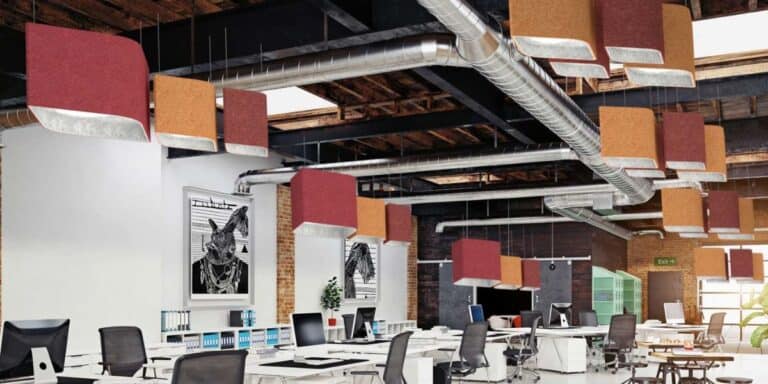
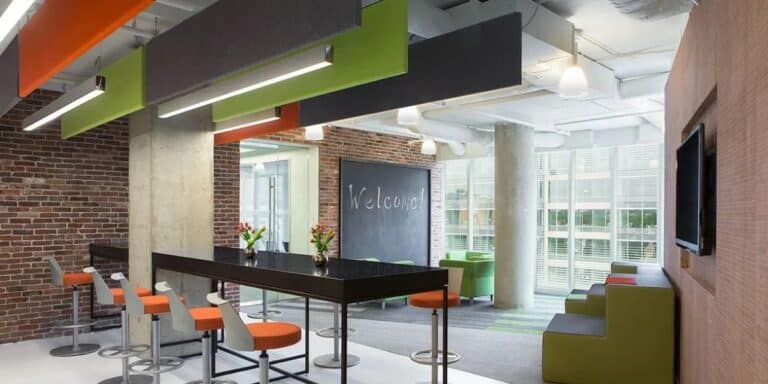
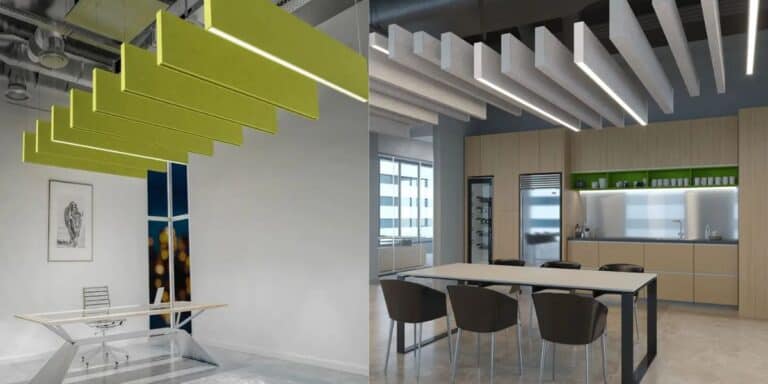
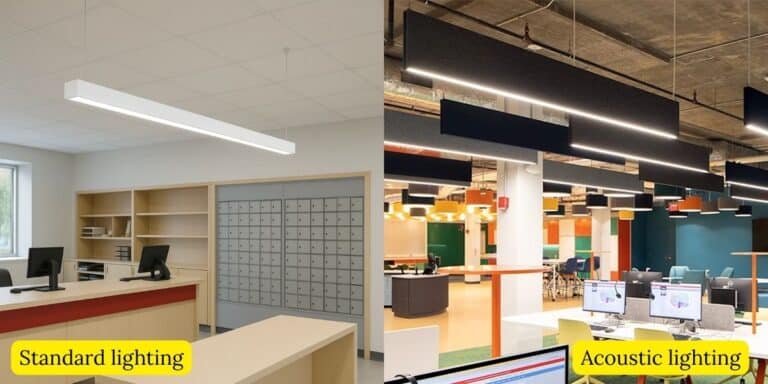
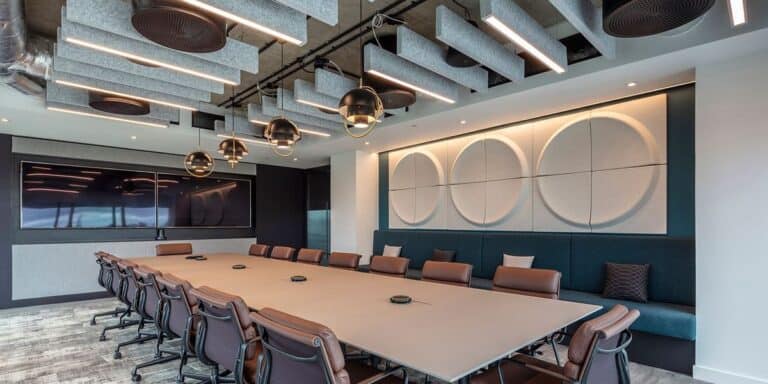
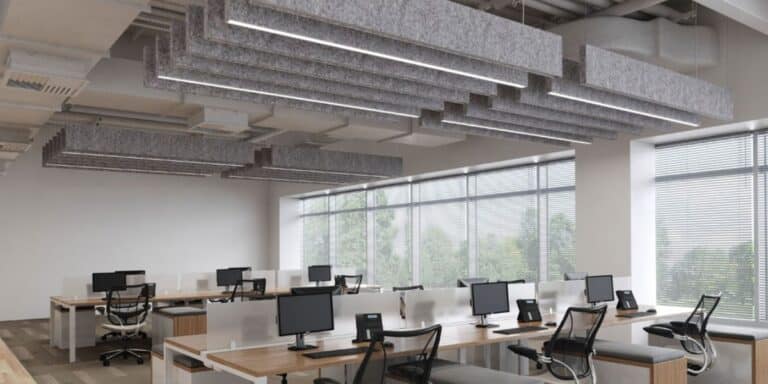
Acoustic lighting belongs in this category. It is designed to contribute to sound absorption while also providing illumination, particularly in ceiling applications.

What Is Soundproofing?

音響照明

Soundproofing is the prevention of sound transmission between spaces. It addresses how sound moves through walls, ceilings, floors, and structural gaps.

What soundproofing does

Soundproofing limits the amount of sound that passes from one room to another. It focuses on blocking, isolating, or decoupling sound paths through construction systems.

What problem it solves

Soundproofing solves problems related to privacy and noise leakage. This includes stopping conversations from being heard next door, preventing music from traveling between rooms, or reducing external noise intrusion.

Why soundproofing is structural, not decorative

Soundproofing depends on mass, airtight construction, separation, and structural detailing. It typically involves walls, floors, ceilings, and penetrations. Because of this, it cannot be achieved through surface-mounted or decorative products alone. Lighting fixtures, absorptive panels, and ceiling elements do not replace structural soundproofing systems.

Why Do People Confuse Sound Absorption and Soundproofing?

The confusion comes from how sound problems are experienced and how solutions are marketed or misunderstood.

Similar symptoms, different causes

In many offices and studios, people experience noise and assume sound is “leaking.” In reality, the issue is often internal reflection, where sound builds up and becomes overwhelming. Absorption helps in these cases, but it does not stop sound from traveling to other rooms.

Real-world examples

In open offices, employees may complain about noise and privacy. Adding absorptive ceilings improves comfort but does not prevent conversations from being heard in adjacent rooms.
In studios, reflections may cause recordings to sound unclear, while external noise still enters because the structure itself is not isolated. Treating one problem does not solve the other.

How wrong assumptions waste money

When absorption is mistaken for soundproofing, budgets are spent on products that cannot deliver the expected result. Conversely, when soundproofing is installed where absorption would have been sufficient, projects become unnecessarily complex and expensive. The cost is not just financial but also operational, as expectations are not met.

Where Acoustic Lighting Fits In

音響照明

Acoustic lighting is often caught in the middle of this confusion. Understanding its role clearly prevents unrealistic expectations.

音響照明

スリムな防眩音響 LED 線形ライト

  • 入力電圧: AC100–277V / AC220–240V, 50–60Hz
  • 住宅のサイズ: W58 × H200 mm / W58 × H300 mm
  • 放出方向: 下向きの
  • Length Options: 1218 mm / 1220 mm / 1288 mm
  • Correlated Color Temperature (CCT): 3000k / 4000k / 6000k
  • パワーだ: 30 W / 32 W
  • 光束: 100–110 lm/W
  • クリ: > 90 Ra
  • Power Factor (PF): > 0.90
  • ちらつきはありません: はい
  • ビーム角: 36°
  • IP等級: IP20
  • 保証: 5年
  • Felt Acoustic Board Color Options: Red / Green / Blue / Grey (more than 48 color options)

The role of acoustic lighting in sound absorption

Acoustic lighting integrates light delivery with sound-absorbing elements. It is designed to support acoustic comfort by reducing reflected sound from ceiling areas while fulfilling lighting requirements. Its purpose is functional integration, not noise isolation.

Why acoustic ceiling lighting affects reflections, not isolation

Ceilings play a major role in sound reflection. Acoustic ceiling lighting helps manage these reflections by combining absorptive surfaces with luminaires. However, it does not add mass, airtightness, or separation. For this reason, it does not stop sound from entering or leaving a space.

How integrated acoustic lighting solutions help manage ceilings

In modern interiors, ceilings must accommodate lighting, acoustics, and services without becoming cluttered. Acoustic lighting solutions allow designers to address sound absorption and illumination together, simplifying coordination while maintaining realistic acoustic goals.

According to the referenced product category, these systems are designed as integrated ceiling elements that combine lighting with acoustic support. Any expectation beyond absorption would fall outside their intended use.

Sound Absorption vs. Soundproofing: A Clear Comparison

音響照明

アスペクトSound AbsorptionSoundproofing
目的Improve acoustic comfort inside a spaceReduce sound transmission between spaces
方法Managing sound reflectionsBlocking or isolating sound paths
Typical materialsAbsorptive surfaces and treatmentsStructural assemblies and barriers
What it can solveEcho, reverberation, clarity issuesNoise leakage, privacy problems
What it cannot solveSound traveling through walls or ceilingsPoor internal acoustics

This distinction is critical when selecting solutions and setting expectations.

How Misunderstanding Impacts Project Decisions

Design-stage consequences

When absorption and soundproofing are not clearly separated, design decisions become misaligned. Decorative treatments are specified for problems they cannot solve, while structural needs are overlooked.

Budget and retrofit risks

Fixing the wrong problem first often leads to retrofits. This increases cost and disrupts operations. In many cases, the original issue could have been addressed correctly with proper diagnosis.

Stakeholder expectations

Architects, designers, and facility managers often face pressure to “fix noise.” Clear communication about what each solution does helps manage expectations and avoids dissatisfaction after installation.

結論

Misunderstanding the difference between sound absorption and soundproofing leads to costly mistakes. Absorption improves acoustic comfort by managing reflections, while soundproofing addresses sound transmission through structural means. Treating one as a substitute for the other results in wasted budgets and unmet expectations.

Acoustic lighting fits clearly within the sound absorption category. It helps manage reflected sound while providing illumination, particularly in ceiling applications. It is not designed to block noise or replace structural soundproofing systems.

Clear definitions and realistic expectations are the foundation of effective acoustic decisions. Choosing the right solution starts with understanding what problem you are actually trying to solve.

よくある質問

音響照明音響照明
アコースティック ライティングは、レコーディング スタジオの雰囲気をどのように改善できるでしょうか。
アコースティック ライティングは、制御されたサウンド動作と快適で機能的な照明という 2 つの重要な要件に同時に対処することで、レコーディング スタジオの雰囲気を改善します。 音響を吸収する素材を慎重に設計された照明システムと統合することで、音響照明は不要な残響を軽減し、音声と音楽の明瞭度を改善し、視覚的に落ち着いた雰囲気を作り出します...
音響照明音響照明
エネルギー効率の高い音響照明オプションはありますか?
はい、最新のエネルギー効率の高い音響照明オプションは、利用できるだけでなく、現代の商業プロジェクトでも広く採用されています。 高性能システムは、効果的な吸音を組み合わせ、通常は 0.7 を超える NRC と、120 lm/w を超える高効率の LED 照明により、建物の残響と電気消費量の両方を削減できます...
音響照明音響照明
吸音に最適な音響照明器具は何ですか?
吸音に最適な音響照明器具は、高性能で微小孔のある音響吸収材 (通常はクラス A 吸収) を高品質の低輝度 LED 照明とシームレスに統合したハイブリッド システムで、現代空間でのノイズ制御と視覚的な快適さを同時に解決するように設計されています。 モダンなインテリアはすっきりと印象的ですが、本物のインテリアが付いています。
業務用インテリア用の円形プロファイル ライト業務用インテリア用の円形プロファイル ライト
LED プロファイル照明 – 直線、曲線、カスタム形状
はじめに – 照明はもはや線形ではありません。照明デザインの今日のデザインは、直線をはるかに超えています。 現代の建築や商業的なインテリアでは、照明は、機能だけでなく形においても、空間の視覚的アイデンティティを形成する上で重要な役割を果たします。 当社のモジュラー LED プロファイル照明システムは、さまざまな構成をサポートしています。
防水IP等級とは-01防水IP等級とは-01
LEDストリップライトの防水IP規格ガイド
照明プロジェクトでLEDストリップライトを選ぶ際には、防水IP等級を理解することが重要です。これらの規格は、製品が固体や液体からどの程度保護されるかを決定し、さまざまな環境での使用に適しているかどうかに影響します。LEDストリップを購入する際に考慮すべきことの1つは、その製品が防水IP等級に適合しているかどうかです。
CIExy1931_マカダム=エリプスCIExy1931_マカダム=エリプス
LEDストリップライト用SDCMのすべて
ダイナミックで常に革新的なLED照明の世界では、色の均一性に対する顧客の要求に応えることが不可欠になっています。カラーマッチングの標準偏差(SDCM)は、LED照明ソリューションの色温度の均一性を確保する上で重要な役割を果たす指標です。 異なる2つのLED照明を配置することを想像してみてください。

共有:

フェイスブック
ツイッター
ピンタレスト
リンクトイン
購読する
通知する
ゲスト
0 コメント
最古
最新 最も投票された
インラインフィードバック
すべてのコメントを表示

SignliteLEDブログを検索

カテゴリー

トップへ

今すぐ見積もりを取る