Polski
  English
  简体中文
简体中文  Deutsch
  Español
  Français
  Italiano
  日本語
日本語  한국어
한국어  Português
  Русский
  Türkçe
  Nederlands
  Tiếng Việt
  ไทย
ไทย 
Wholesale LED strip prices typically range from $0.50 to $15+ per meter, depending on factors such as LED chip type, CRI rating, IP protection level, and order volume. For buyers searching where is the best place to buy LED lights, understanding these variables is critical before comparing suppliers or requesting quotes.
This guide breaks down the real cost structure behind wholesale LED strips, including pricing differences across SMD, High CRI, COB, RGB, and Neon Flex products. Whether you are sourcing bulk LED strips for commercial projects, building a private label lighting brand, or looking for affordable LED lights online, this article provides a clear benchmark of what you should actually pay.
We’ll also cover hidden pricing factors such as SDCM binning, dimming compatibility, certifications, and MOQ tiers — helping contractors, lighting brands, resellers, and warehouse buyers make informed procurement decisions.
LED strip wholesale price by product type
LED strip prices vary significantly by product type — from basic single-color strips under $1/m to premium COB and RGB strips above $8/m, with voltage, LED density, and application requirements all affecting your final wholesale cost.
Wholesale LED Strip Price Comparison (by Type)
| Typ produktu | Napięcie | Typical FOB Price | CRI | Najlepsze dla |
| Basic SMD 2835 (single color) | 12V / 24V | $0.50 – $2.00 / m | 70–80 | Cove, cabinet, decoration |
| Mid-range SMD (single color) | 24V | $1.50 – $3.50 / m | 80-90 | Retail, office, residential |
| High CRI 90+ strip | 24V | $2.00 – $5.00 / m | 90–95 | Hospitality, museum, retail |
| RGB / RGBW strip | 12V / 24V | $2.50 – $5.50 / m | . | Accent, entertainment, smart |
| Taśma LED COB | 24V | $0.50 – $8.00 / m | 90–98 | Architectural, linear, façade |
| IP65 waterproof strip | 12V / 24V | $2.50 – $6.00 / m | Varies | Outdoor, wet locations |
| LED Neon Flex | 12V / 24V | $6.00 – $12.00 / m | 80-90 | Signage, outdoor contour |
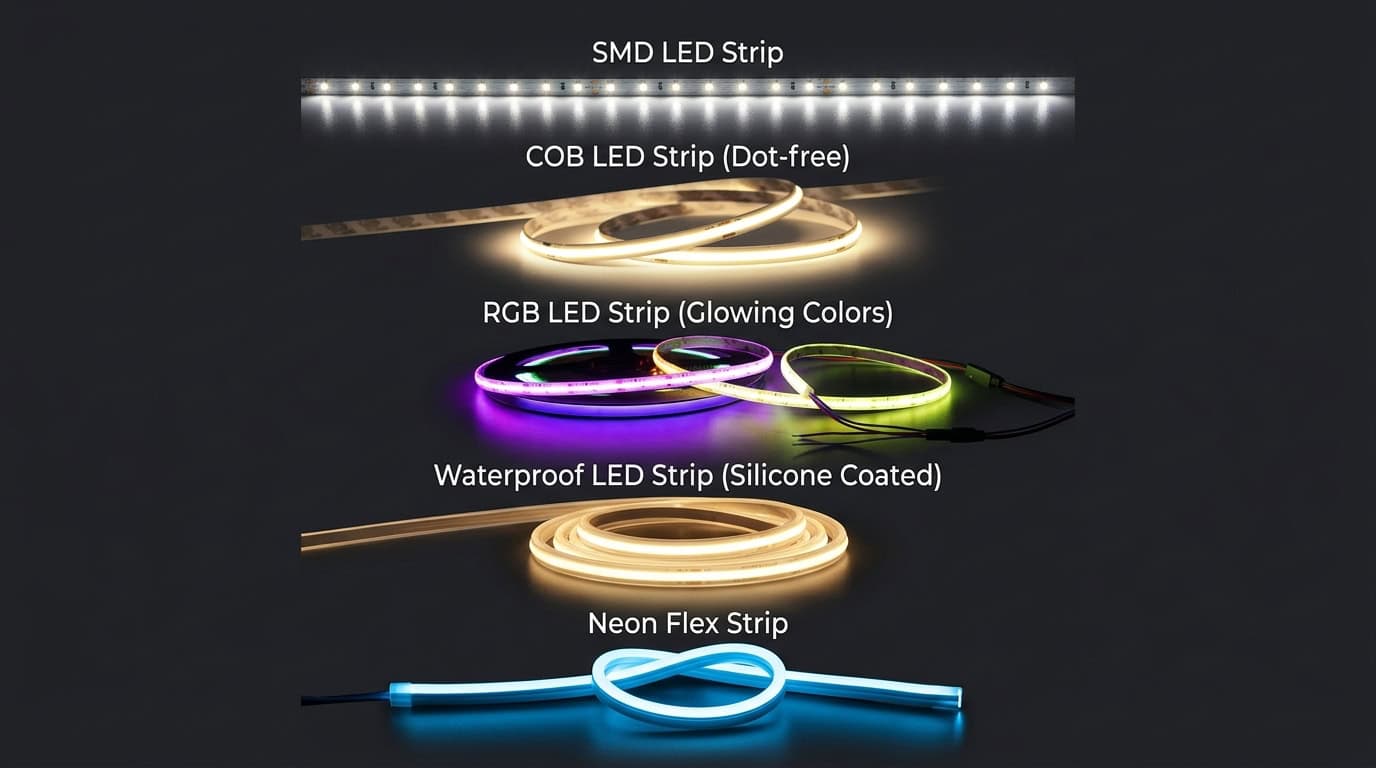
Basic & mid-range SMD strip
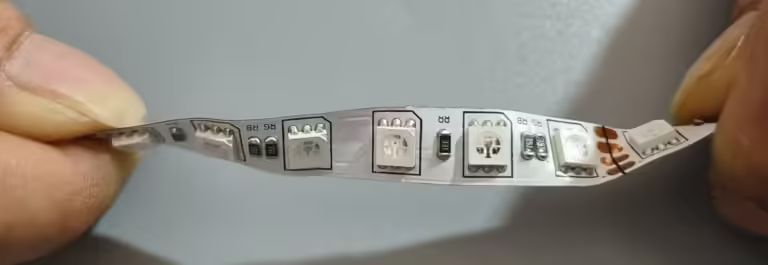
Basic and mid-range SMD LED strips remain the most widely used option for bulk LED strip lights and general commercial applications. Pricing differences between 12V and 24V LED strip options are typically small, but 24V systems offer better voltage stability and reduced brightness drop over longer runs.
However, lower-cost SMD strips often come with trade-offs such as shorter lifespan, looser color consistency, and limited warranty coverage. For large-volume buyers, pricing drops significantly at higher quantities, making them ideal for cost-sensitive retail or decorative projects.
High CRI 90+ strip
High CRI LED strips (CRI 90+) render colors more accurately — essential for retail display lighting, hospitality environments, and any application where product appearance directly impacts customer perception.
The price premium comes from tighter binning tolerances and higher-quality LED chips, which ensure consistent color output across batches. Compared to standard strips, buyers can expect a 20–50% increase in cost, but the visual impact and reduced color mismatch risk justify the investment in most commercial settings.
RGB & smart-compatible LED strips
RGB LED strip lights are widely used in entertainment, architectural accent lighting, and smart home integrations. Pricing varies depending on configuration: RGB (basic color mixing), RGBW (adds true white), and RGB+CCT (dual white temperature control).
For buyers looking for LED strips that work with Alexa or other smart systems, it’s important to note that compatibility depends on the controller or driver (Zigbee, Wi-Fi, Z-Wave), not the strip itself. Dimmable LED strip functionality is similarly driver-dependent, which can increase total system cost.
Taśma LED COB
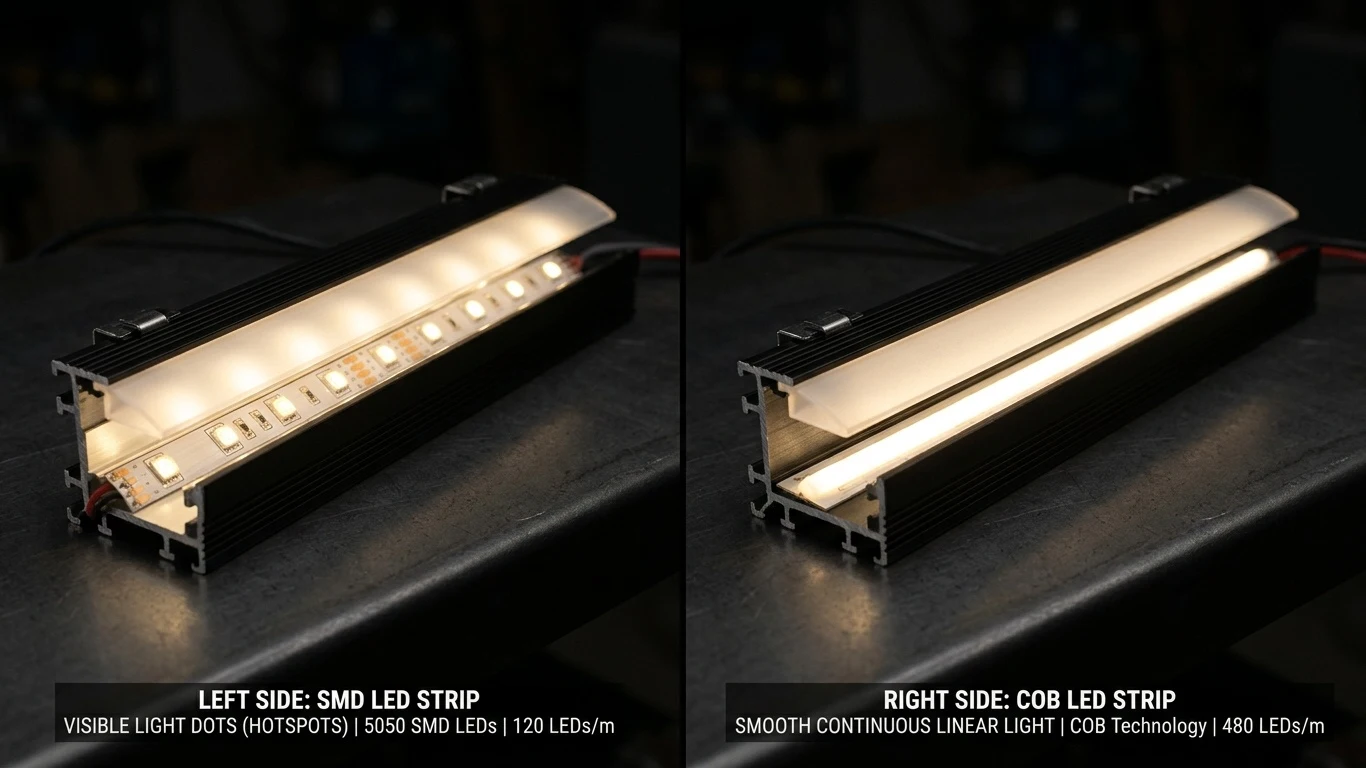
COB (Chip-on-Board) LED strips eliminate visible light dots, delivering a continuous, uniform linear illumination that is ideal for architectural channels, cabinet lighting, and high-end retail environments.
Compared to traditional SMD strips, COB technology offers superior light consistency, improved thermal performance, and higher perceived quality — which explains its higher wholesale price range. Typical specifications include PCB widths of 8mm or 10mm and power densities between 5W and 15W per meter.
→ See the top COB LED strip manufacturers in China (2025 guide)
How to choose between 12V and 24V for wholesale orders
Choosing between 12V and 24V LED strips depends primarily on installation length and application type. 12V LED strips are better suited for short runs (under 5 meters) and low-power applications, offering lower driver costs and greater flexibility for small-scale projects.
In contrast, 24V LED strips are preferred for commercial installations due to reduced voltage drop, improved brightness consistency, and better overall system efficiency. For wholesale buyers managing inventory, standardizing on 24V products can simplify power supply selection and reduce SKU complexity.
What drives LED strip price differences? (beyond just “cheap from China”)
The price gap between budget and premium LED strips comes down to five technical factors: chip binning quality, PCB construction, IP protection level, dimming compatibility, and third-party certification — not just the country of manufacture.
LED chip & SDCM binning
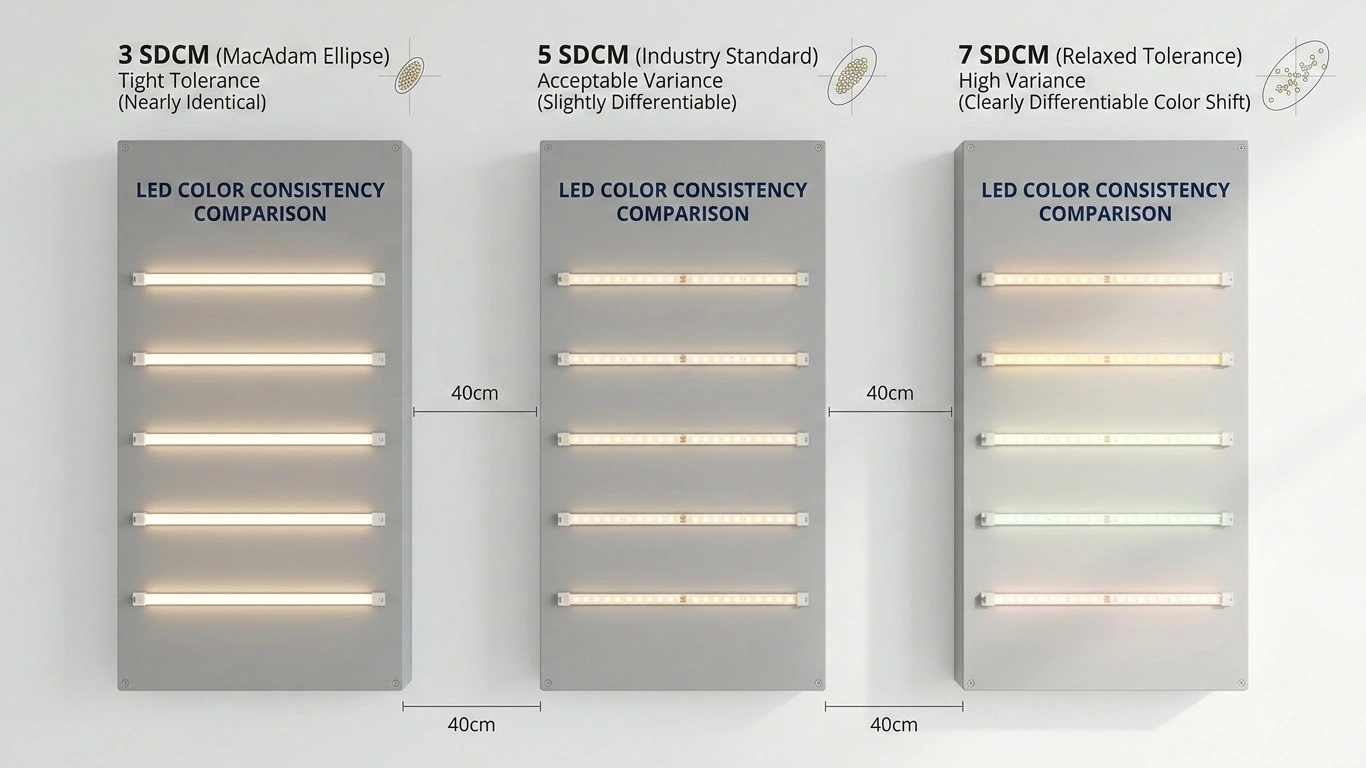
SDCM (Standard Deviation of Color Matching) measures color consistency across an LED batch — ≤3 SDCM is essential for retail and architectural lighting where adjacent strips must match visually without noticeable variation.
| SDCM Level | Spójność kolorów | Price Premium | Najlepsze dla |
| ≤ 3 SDCM | Excellent — imperceptible variation | +20–40% | Retail, museum, hospitality |
| ≤ 5 SDCM | Good — acceptable for most uses | liniał bazowy | Commercial, office |
| ≤ 7 SDCM | Visible variation likely | Lowest tier | Decorative, non-critical |
In addition to binning tolerance, LED chip brand selection significantly impacts pricing. Generic chips offer the lowest cost but inconsistent performance, while premium brands such as Samsung, Nichia, or Lumileds can increase strip prices by 20–60% due to higher efficiency, stability, and tighter color control.
→ 2025 COB LED strip market price analysis: supply chain & brand comparison
PCB thickness & copper weight
PCB construction is a critical but often overlooked factor in LED strip pricing. Higher-quality strips use thicker copper layers (typically 2oz vs 1oz) to improve heat dissipation and reduce voltage drop, directly extending product lifespan.
Wider PCB designs (8mm, 10mm, 12mm) also support higher power densities and better thermal management. While these upgrades increase material costs, they significantly reduce failure rates in commercial installations — making them a better long-term investment for bulk buyers.
IP rating — what waterproofing actually costs
Waterproofing adds measurable cost to LED strips depending on the protection level required:
| Stopień ochrony IP | Ochrona | vs IP20 Price | Zastosowanie |
| IP20 | Brak ochrony | liniał bazowy | Indoor, dry |
| IP44 | Splash-proof | +10–20% | Bathroom, covered outdoor |
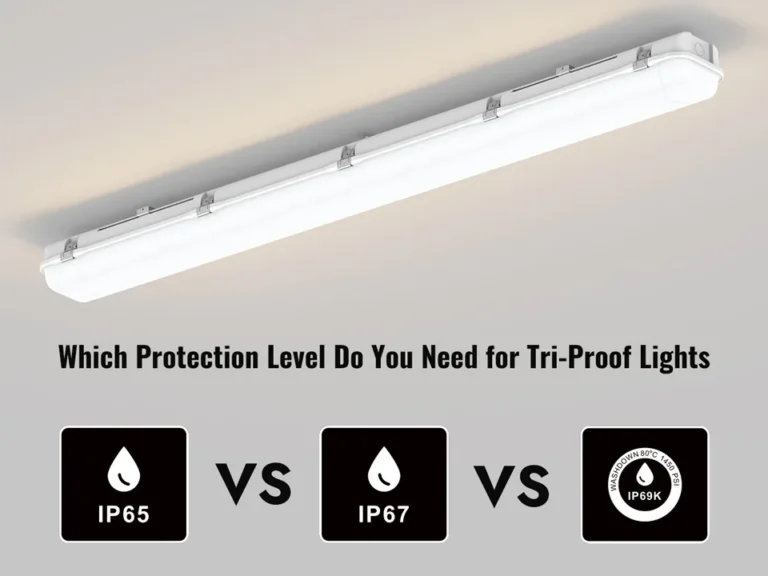
| IP65 | Dust-tight + water jets | +20–35% | Outdoor, wash-down |
| IP68 | lądowy | +40–60% | Pools, fountains |
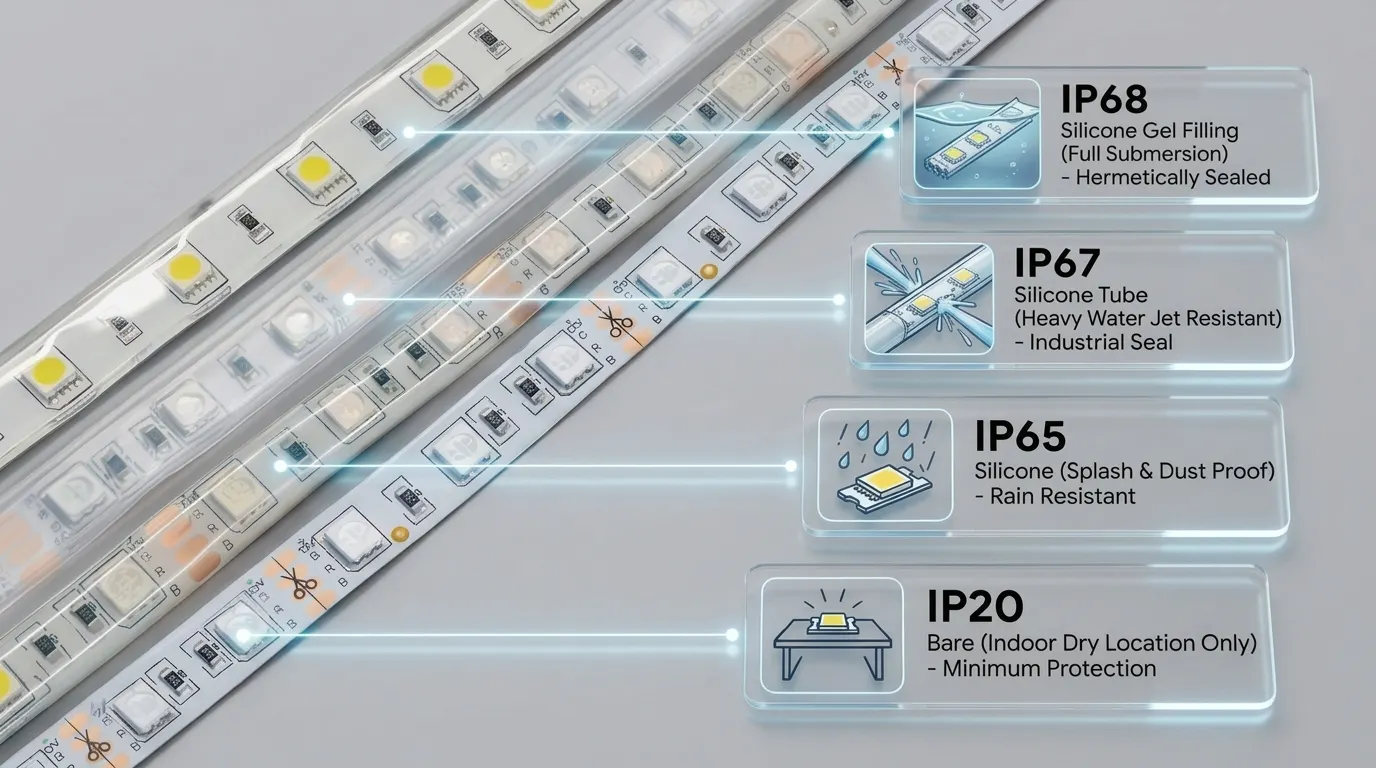
Higher IP ratings require additional materials such as silicone coatings or extrusion tubes, as well as more complex manufacturing processes — all contributing to increased wholesale pricing.
Dimming compatibility
Dimming compatibility determines whether an LED strip can be smoothly controlled across brightness levels — incompatible drivers often cause flicker, buzzing, or premature system failure.
| Dimming Type | Compatible With | Price Premium | powszechne użycie |
| PWM (standard) | Most basic drivers | liniał bazowy | Residential, retail |
| TRIAC (phase-cut) | Standard wall dimmers | +5–15% | Retrofit projects |
| 0–10V | Commercial BMS systems | +15–30% | Office, hotel |
| DALI / DMX | Advanced control systems | +30–50%+ | Architectural, stage |
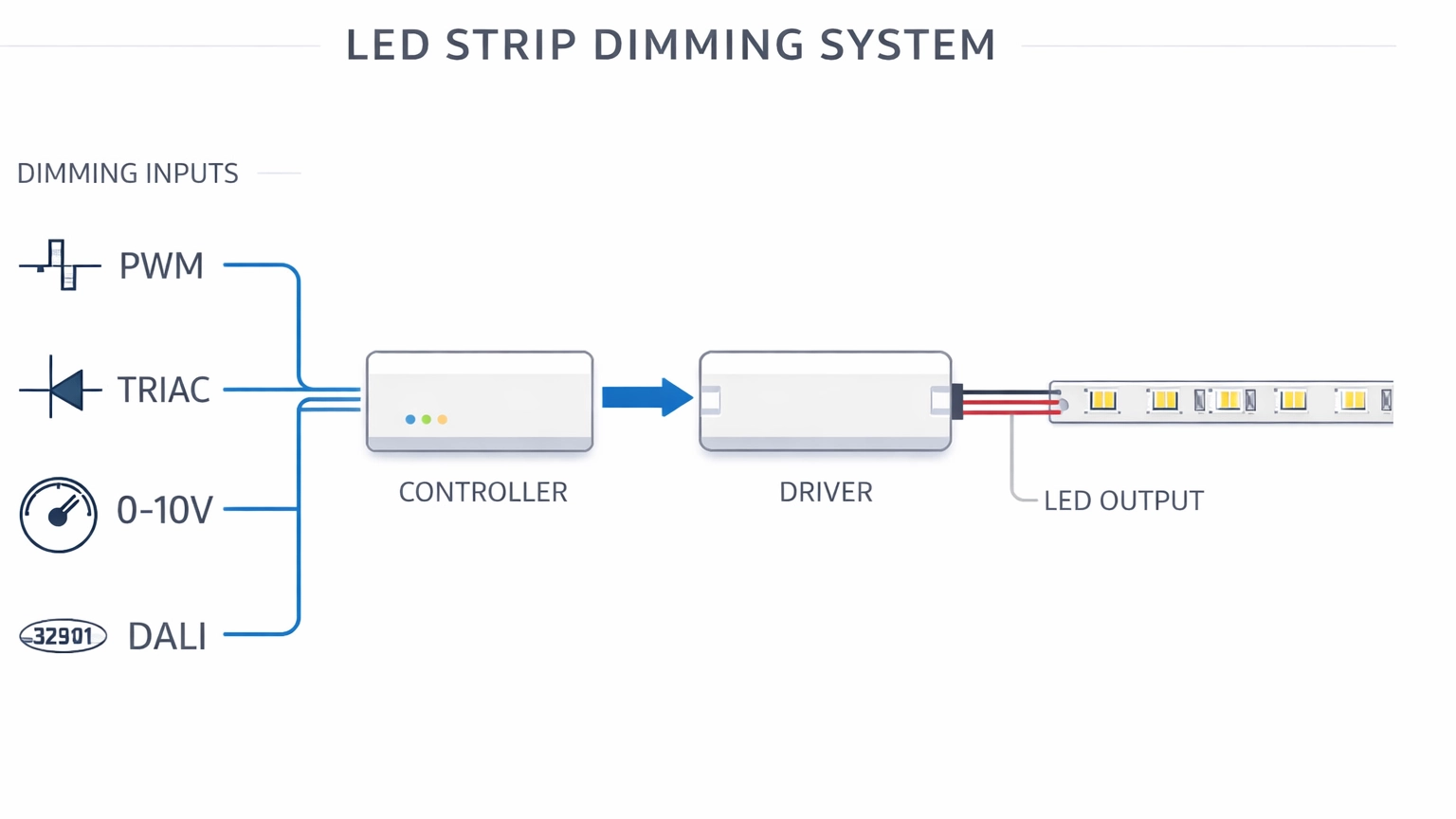
For buyers sourcing dimmable LED strip lights or smart-compatible systems, it’s important to evaluate the full ecosystem — including drivers and controllers — rather than focusing only on strip pricing.
Certifications that affect LED strip wholesale pricing
Certified LED strips carry a 10–30% price premium over uncertified alternatives — but for commercial projects and US/EU resale, certification is a legal requirement, not an option.
LED Strip Certification Cost Impact
| Certyfikacja | Market | What It Verifies | Price Impact |
| CE | EU / Europe | Safety, EMC, RoHS compliance | +8–15% |
| UL / ETL | USA / Canada | Electrical safety compliance | +10–20% |
| RoHS | Global | Restriction of hazardous substances | +3–8% |
| LM-80 | Professional specs | Lumen maintenance (6,000 hrs) | +5–12% |
| TM-21 | Long-life projects | Lifetime projection (L70/L80) | +5–10% |
| IP rating report | Outdoor use | Environmental protection validation | +5–15% |
UL vs CE vs ETL — which does your market require?
Certification requirements depend on your target market. For North America, UL or ETL certification is typically mandatory, with both standards recognized as equivalent for electrical safety compliance. In Europe, CE marking combined with RoHS compliance is required before products can legally enter the market.
When sourcing wholesale LED strips, buyers should always request supporting documentation — including UL/ETL certificates, CE declarations, LM-80 test reports, IES photometric files, and flicker test data. These documents are often required during project approval, especially for commercial lighting installations.
Why uncertified strips cost less — and the hidden risks
Uncertified LED strips are cheaper primarily because manufacturers avoid the high cost of compliance testing, which can range from $5,000 to $30,000 per product model. These costs are typically amortized into certified product pricing, explaining the visible price gap in wholesale quotes.
However, the risks are substantial. Products without proper certification may fail building inspections, be rejected by distributors, or even void insurance coverage in the event of electrical failure. For buyers importing LED light strips from China or supplying to regulated markets, these risks can far outweigh any upfront savings.
→ Jakie testy jakości powinny przejść taśmy LED?
For any project destined for US or EU commercial resale, always request third-party lab reports — not just manufacturer declarations.
MOQ, bulk pricing & OEM options for wholesale buyers
Wholesale LED strip pricing is volume-dependent — most manufacturers offer meaningful price breaks at 500m, 1,000m, and 5,000m+, with OEM and private label options typically available starting from 1,000 meters.
Typical MOQ & price break tiers
| Typ produktu | Standard MOQ | Price Break At | Najlepsze dla |
| Standard SMD strip | 100–500m | 1,000m+ | Retail stores, small contractors |
| High CRI / COB strip | 200–500m | 500m+ | Lighting designers, commercial |
| Custom CCT / wattage | 500–1,000m | 2,000m+ | OEM buyers, spec projects |
| Private label / bulk rolls | 1,000–3,000m | Project-based | Distributors, store brands |
MOQ (Minimum Order Quantity) varies depending on product complexity and customization level. Standard products typically have lower entry thresholds, while customized or high-performance strips require larger commitments due to production setup costs.
Bulk roll formats for commercial & warehouse buyers
LED strips are commonly supplied in roll formats of 5m, 10m, 50m, and 100m reels, with significant cost advantages at longer lengths (especially 50m+ bulk rolls). For warehouse buyers and large-scale projects, bulk reels reduce packaging waste and improve installation efficiency.
Most LED strips are cuttable at fixed intervals (typically every 2cm to 5cm), allowing precise length adjustments on-site. For inventory optimization, buyers are advised to standardize specifications — such as voltage (preferably 24V) and color temperature — to simplify stock management and increase turnover rates.
Private label & OEM customization
Private label LED strips allow distributors and lighting brands to sell manufacturer-quality products under their own brand — typically starting from 1,000m MOQ with a 4–8 week lead time.
Opcje dostosowywania obejmują:
- Reel length (5m / 10m / bulk roll)
- Color temperature (CCT tuning)
- Power density (W/m)
- PCB width and connector type
- Branding (labels, packaging, manuals)
OEM customization usually adds a 10–25% price premium, depending on tooling requirements, packaging design, and production volume. For long-term buyers, this investment enables brand differentiation and higher resale margins.

How to evaluate a wholesale LED strip supplier
A reliable wholesale LED strip supplier should provide technical documentation, third-party test reports, and a written warranty policy — not just a competitive unit price.
Supplier Evaluation Checklist
| Obszar oceny | What to Request | Red Flag If Missing |
| Technical specs | Datasheet: watts, lumens, CRI, CCT, SDCM | Vague or unverifiable specs |
| Certyfikaty | CE / UL / ETL / RoHS certificates + lab reports | No test reports available |
| Performance tests | LM-80, TM-21, IES photometric files | Marketing claims only |
| Flicker & dimming | Flicker test data, dimming compatibility list | No flicker spec mentioned |
| QC process | IQC → SMT → aging test → final QC flow | No QC documentation |
| Gwarancja | Written terms: years, defect rate, replacement | Verbal only, no written policy |
| Factory audit | On-site visit or third-party audit report | Refuses inspection |
→ Full guide: how to evaluate a COB LED strip manufacturer from China

Beyond documentation, experienced buyers also evaluate supplier responsiveness, engineering support capability, and consistency across sample batches. A supplier that can clearly explain specifications such as SDCM levels, PCB structure, and dimming compatibility is typically more reliable than one competing purely on price.
Where to buy LED strips wholesale: US suppliers vs direct from China
Wholesale LED strips can be sourced directly from Chinese manufacturers (lower unit cost, higher MOQ) or through US-based distributors (faster delivery, lower MOQ, local support) — the right choice depends on your order volume, timeline, and risk tolerance.
US vs China Sourcing Comparison
| Czynnik | Direct from China (factory) | US Wholesale Distributor |
| Unit price | Lowest (FOB Shenzhen) | 15–40% higher |
| MOQ | 100m – 3,000m+ | As low as 1 reel (5m) |
| czas prowadzenia | 3–6 weeks (+ shipping) | 1–5 days |
| Personalizacja | Full OEM / private label | Limited or none |
| Certyfikacja | Available on request | Usually pre-certified |
| Payment risk | Higher (mitigate with trade assurance / LC) | Niższy |
| Najlepsze dla | High-volume, spec projects | Urgent jobs, small quantities |
Understanding US-based LED strip distributors
US-based distributors typically fall into two categories: generalist suppliers that stock a wide range of LED products, and specialized lighting distributors focusing on high-CRI, architectural, or commercial-grade solutions.
For buyers searching who are the top LED suppliers in the US lub where to get affordable LED lights online, the key is not brand name but inventory availability, certification compliance, and delivery speed. Distributors are ideal for small orders (under 100 meters), rapid project turnaround, or when local technical support is required.
How to safely import LED strips directly from a Chinese factory
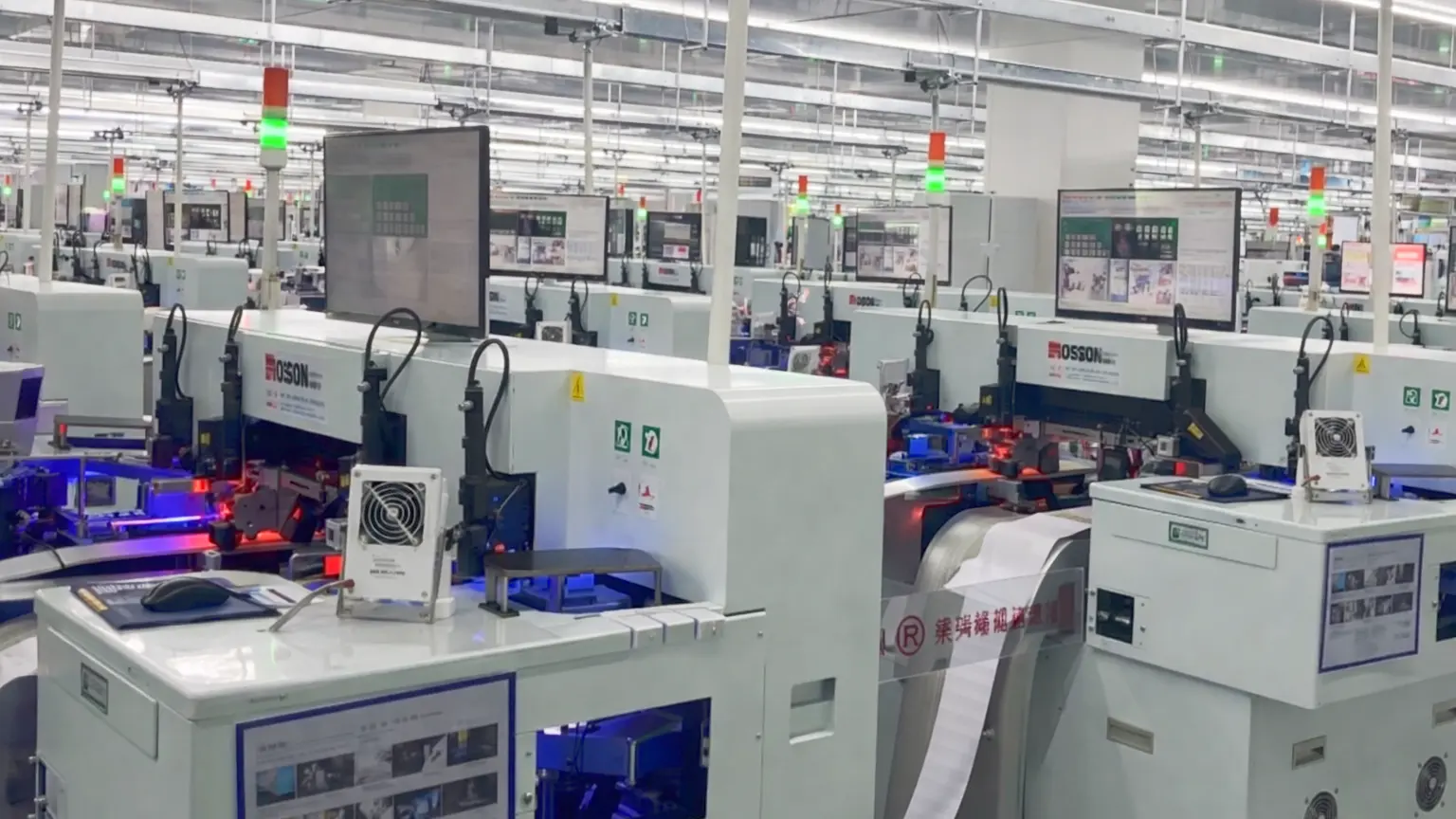
Importing LED strips directly from China requires verifying factory certifications, requesting pre-shipment samples, and using trade assurance or LC payment terms to protect your order.
A typical sourcing process includes:
- Sample evaluation (brightness, CRI, consistency)
- Certification verification (UL, CE, RoHS reports)
- Small trial order before scaling
- Secure payment method (Alibaba Trade Assurance or Letter of Credit)
For buyers searching how to import LED paski świetlne I other fixtures from China, this structured approach minimizes risk while unlocking significant cost advantages for bulk purchases.
FAQ
Powiązane posty