Português
  English
  简体中文
简体中文  Deutsch
  Español
  Français
  Italiano
  日本語
日本語  한국어
한국어  Polski
  Русский
  Türkçe
  Nederlands
  Tiếng Việt
  ไทย
ไทย 
A diferença entre absorção de som e isolamento acústico é simples, mas muitas vezes incompreendida. A absorção de som gerencia o comportamento do som dentro de um espaço, reduzindo os reflexos e a reverberação, enquanto a insonorização impede que o som entre ou saia de um espaço através de barreiras estruturais. Confundir os dois leva a orçamentos desperdiçados porque as pessoas investem em tratamentos de superfície quando realmente precisam de mudanças na construção ou esperam soluções decorativas para resolver problemas estruturais de ruído. Esse mal-entendido é especialmente comum quando a iluminação acústica está envolvida, onde as expectativas geralmente excedem o que a solução foi projetada para fazer.
Este artigo explica claramente a distinção, por que a confusão persiste e onde a iluminação acústica se encaixa de forma realista, sem exageros ou suposições.
O que é absorção de som?

A absorção de som é o controle do som refletido dentro de uma sala. Ele se concentra em como o som se comporta após a produção, não em impedir que o som viaje entre os espaços.
O que a absorção de som faz
A absorção sonora reduz os ecos, a vibração e a reverberação excessiva, permitindo que a energia do som se dissipe quando entra em contato com as superfícies de absorção. Em vez de saltar repetidamente em superfícies duras, o som é suavizado e controlado.
qual problema resolve
O principal problema endereços de absorção de som é uma má clareza acústica. Em espaços não tratados, a fala se torna mais difícil de entender, a música parece enlameada e o ruído de fundo se acumula. A absorção ajuda a melhorar a inteligibilidade da fala e o conforto acústico geral.
Onde a absorção de som é usada
A absorção de som é usada em escritórios, salas de reuniões, estúdios, salas de aula, restaurantes e outros ambientes internos, onde a clareza e o conforto são importantes. É comumente aplicado através de tetos, painéis de parede e outros elementos internos projetados para gerenciar reflexões.
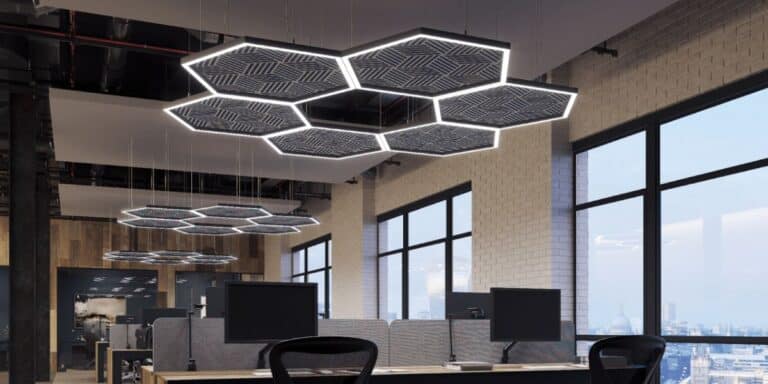
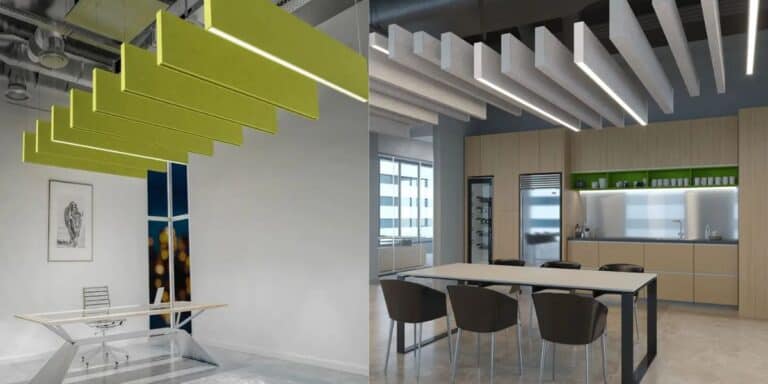
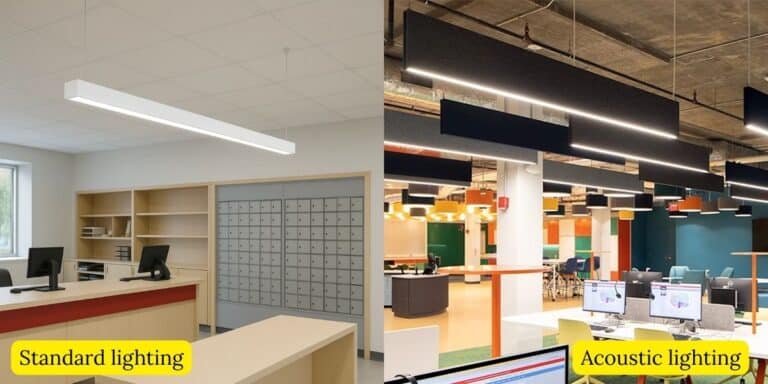
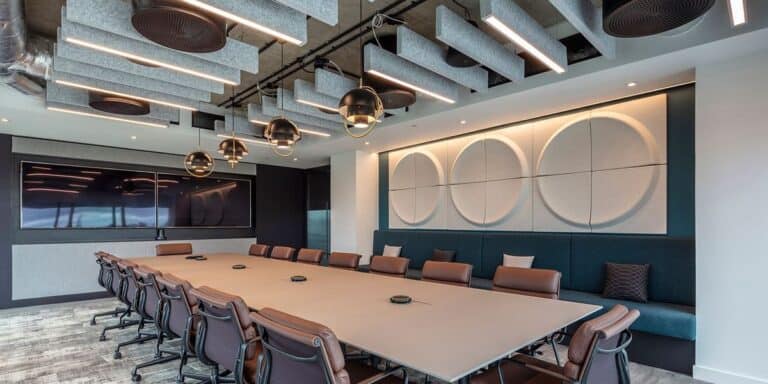
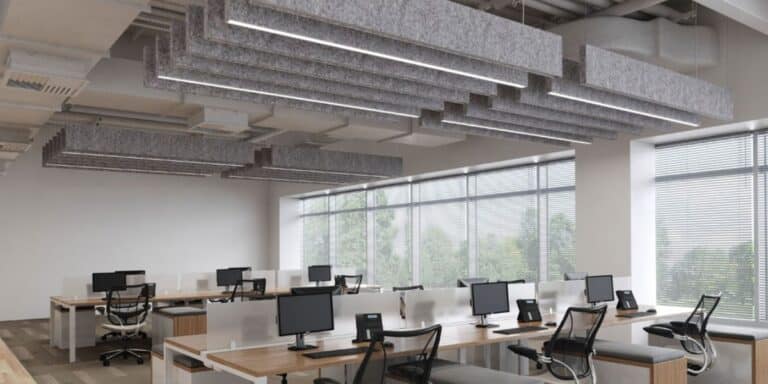
A iluminação acústica pertence a esta categoria. Ele foi projetado para contribuir para a absorção do som, além de fornecer iluminação, principalmente em aplicações de teto.
O que é isolamento acústico?

A insonorização é a prevenção da transmissão de som entre os espaços. Ele aborda como o som se move através das paredes, tetos, pisos e lacunas estruturais.
O que a insonorização faz
A insonorização limita a quantidade de som que passa de uma sala para outra. Ele se concentra em bloquear, isolar ou desacoplar caminhos de som por meio de sistemas de construção.
qual problema resolve
A insonorização resolve problemas relacionados à privacidade e vazamento de ruído. Isso inclui impedir que as conversas sejam ouvidas ao lado, impedir que a música viaje entre as salas ou reduza a intrusão externa de ruído.
Por que a insonorização é estrutural, não decorativo
A insonorização depende da massa, construção hermética, separação e detalhes estruturais. Normalmente envolve paredes, pisos, tetos e penetrações. Por causa disso, não pode ser alcançado apenas por produtos decorativos ou decorativos. Luminárias, painéis de absorção e elementos de teto não substituem os sistemas de isolamento acústico estrutural.
Por que as pessoas confundem absorção de som e isolamento acústico?
A confusão vem de como os problemas de som são vivenciados e como as soluções são comercializadas ou mal compreendidas.
Sintomas semelhantes, causas diferentes
Em muitos escritórios e estúdios, as pessoas sentem ruído e assumem que o som está “vazando”. Na realidade, a questão geralmente é uma reflexão interna, onde o som se acumula e se torna esmagador. A absorção ajuda nesses casos, mas não impede que o som viaje para outras salas.
Exemplos do mundo real
Em escritórios abertos, os funcionários podem reclamar de ruído e privacidade. A adição de tetos de absorção melhora o conforto, mas não impede que as conversas sejam ouvidas em salas adjacentes.
Nos estúdios, as reflexões podem fazer com que as gravações pareçam pouco claras, enquanto o ruído externo ainda entra porque a estrutura em si não está isolada. Tratar um problema não resolve o outro.
Como suposições erradas desperdiçam dinheiro
Quando a absorção é confundida com a insonorização, os orçamentos são gastos em produtos que não podem fornecer o resultado esperado. Por outro lado, quando a insonorização é instalada onde a absorção seria suficiente, os projetos se tornam desnecessariamente complexos e caros. O custo não é apenas financeiro, mas também operacional, pois as expectativas não são atendidas.
Onde a iluminação acústica se encaixa

iluminação acústica É frequentemente apanhado no meio dessa confusão. Compreender seu papel claramente impede expectativas irreais.

Luz linear acústica anti-reflexo e fina
- Tensão de entrada: AC100–277V / AC220–240V, 50–60Hz
- Tamanho da habitação: W58 × H200 mm / W58 × H300 mm
- Direção de emissão: em baixo
- Opções de comprimento: 1218 mm / 1220 mm / 1288 mm
- Temperatura de cor correlacionada (CCT): 3000K / 4000K / 6000K
- Potência: 30 W / 32 W
- Fluxo luminoso: 100–110 lm/w
- IRC: > 90 ra
- Fator de potência (PF): > 0,90
- sem cintilação: Sim
- Ângulo de feixe: 36°
- Classificação IP: IP20
- Garantia: 5 anos
- Opções de cores de placa acústica de fe Vermelho/verde/azul/cinza (mais de 48 opções de cores)
O papel da iluminação acústica na absorção de som
A iluminação acústica integra a entrega de luz com elementos de absorção de som. Ele foi projetado para oferecer suporte ao conforto acústico, reduzindo o som refletido das áreas do teto, ao mesmo tempo em que atende aos requisitos de iluminação. Seu objetivo é a integração funcional, não o isolamento de ruído.
Por que a iluminação do teto acústico afeta os reflexos, não o isolamento
Os tetos desempenham um papel importante na reflexão sonora. A iluminação do teto acústico ajuda a gerenciar esses reflexos combinando superfícies de absorção com luminárias. No entanto, não adiciona massa, estanqueidade ou separação. Por esse motivo, ele não impede que o som entre ou saia de um espaço.
Como as soluções integradas de iluminação acústica ajudam a gerenciar os tetos
Nos interiores modernos, os tetos devem acomodar iluminação, acústica e serviços sem se tornarem confusos. As soluções de iluminação acústica permitem que os designers abordem a absorção de som e a iluminação juntos, simplificando a coordenação, mantendo objetivos acústicos realistas.
De acordo com a categoria de produtos referenciados, esses sistemas são projetados como elementos de teto integrados que combinam iluminação com suporte acústico. Qualquer expectativa além da absorção ficaria fora do uso pretendido.
Absorção de som versus insonorização: uma comparação clara

| Aspeto | absorção de som | insono insonorizado |
| Objetivo | Melhore o conforto acústico dentro de um espaço | Reduza a transmissão de som entre os espaços |
| método | Gerenciando reflexões de som | Bloqueando ou isolando caminhos de som |
| materiais típicos | Superfícies e tratamentos de absorção | Montagens e barreiras estruturais |
| O que ele pode resolver | Eco, reverberação, questões de clareza | Vazamento de ruído, problemas de privacidade |
| O que não pode resolver | Som viajando por paredes ou tetos | Acústica interna ruim |
Essa distinção é fundamental ao selecionar soluções e definir expectativas.
Como o mal-entendido afeta as decisões do projeto
Consequências do estágio de design
Quando a absorção e a insonorização não são claramente separadas, as decisões de design ficam desalinhadas. Os tratamentos decorativos são especificados para problemas que não podem resolver, enquanto as necessidades estruturais são esquecidas.
Riscos de orçamento e retrofit
Corrigir o problema errado primeiro geralmente leva a retrofits. Isso aumenta os custos e interrompe as operações. Em muitos casos, o problema original poderia ter sido resolvido corretamente com o diagnóstico adequado.
Expectativas das partes interessadas
Arquitetos, designers e gerentes de instalações geralmente enfrentam pressão para “consertar o ruído”. Uma comunicação clara sobre o que cada solução faz ajuda a gerenciar as expectativas e evita insatisfações após a instalação.
Conclusão
Errar mal a diferença entre absorção de som e isolamento acústico leva a erros caros. A absorção melhora o conforto acústico gerenciando reflexões, enquanto a insonorização aborda a transmissão do som por meios estruturais. Tratar um como um substituto para o outro resulta em orçamentos desperdiçados e expectativas não atendidas.
A iluminação acústica se encaixa claramente na categoria de absorção de som. Ajuda a gerenciar o som refletido, fornecendo iluminação, principalmente em aplicações de teto. Não foi projetado para bloquear o ruído ou substituir os sistemas de isolamento acústico estrutural.
Definições claras e expectativas realistas são a base de decisões acústicas eficazes. Escolher a solução certa começa com a compreensão de qual problema você está realmente tentando resolver.
FAQs
Postagens relacionadas