Português
  English
  简体中文
简体中文  Deutsch
  Español
  Français
  Italiano
  日本語
日本語  한국어
한국어  Polski
  Русский
  Türkçe
  Nederlands
  Tiếng Việt
  ไทย
ไทย 
No design moderno de espaço comercial, os problemas de ruído e reverberação são cada vez mais proeminentes, principalmente em ambientes como escritórios de plano aberto e salas de conferências. Níveis excessivos de ruído afetam severamente a eficiência do trabalho e a experiência do cliente. A reflexão e a reverberação de ruído não apenas fazem com que os espaços pareçam ruidosos, mas também diminuam a comunicação e a concentração.
As luminárias acústicas oferecem uma solução inovadora, proporcionando iluminação de alta qualidade, absorvendo e reduzindo o ruído de forma eficaz para melhorar os ambientes acústicos. Esses acessórios integram materiais acústicos com a funcionalidade de iluminação, proporcionando benefícios duplos para espaços comerciais, principalmente no controle de ruído.
Ao selecionar a iluminação acústica do LED, a classificação do coeficiente de redução de ruído (NRC) serve como uma métrica chave para avaliar o desempenho acústico. A classificação NRC quantifica a capacidade de absorção de som de uma luminária, ajudando os consumidores a escolher os produtos mais adequados para otimizar o design acústico de um espaço.
Compreender a importância das classificações NRC para luzes LED acústicas
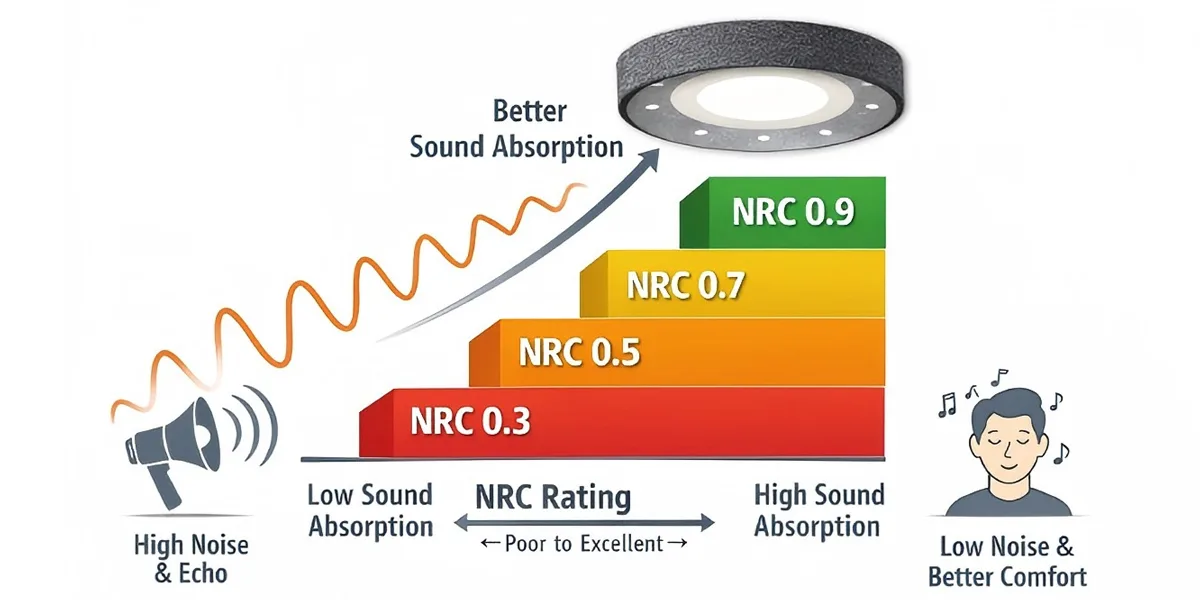
Ao selecionar luzes led acústicas, a classificação NRC serve como um indicador crucial para avaliar suas capacidades de absorção de som. A escala NRC varia de 0 a 1, com pontuações mais altas indicando propriedades de absorção sonora superiores. Uma luz de absorção de som com uma classificação NRC elevada pode reduzir significativamente os ecos e ruídos dentro de um espaço, aumentando assim sua qualidade e conforto acústico. Isso é particularmente crucial em ambientes de escritório modernos, salas de conferências, hospitais e ambientes semelhantes.
A classificação NRC reflete a capacidade de absorção de som de um material, mas também afeta o conforto acústico geral do ambiente. Compreender isso ajuda os consumidores a selecionar a luz LED de absorção de som mais adequada com base em suas necessidades específicas.
Qual classificação NRC é adequada para iluminação acústica?
Antes de discutir “o que constitui um NRC apropriado”, é essencial primeiro esclarecer a definição de NRC e seu significado na iluminação acústica.
O que é NRC (coeficiente de redução de ruído)?
NRC (coeficiente de redução de ruído) é uma métrica numérica padronizada usada na acústica para medir o desempenho de absorção de som de um material. É calculado medindo os coeficientes de absorção sonora em quatro frequências centrais (250 Hz, 500 Hz, 1000 Hz e 2000 Hz), levando sua média aritmética e arredondando para o 0,05 mais próximo.
Faixa de valores: 0,00–1,00
Significado fundamental: de uma perspectiva acústica, um valor mais alto indica uma capacidade de absorção de som mais forte, enquanto um valor mais baixo significa uma reflexão sonora mais pronunciada.
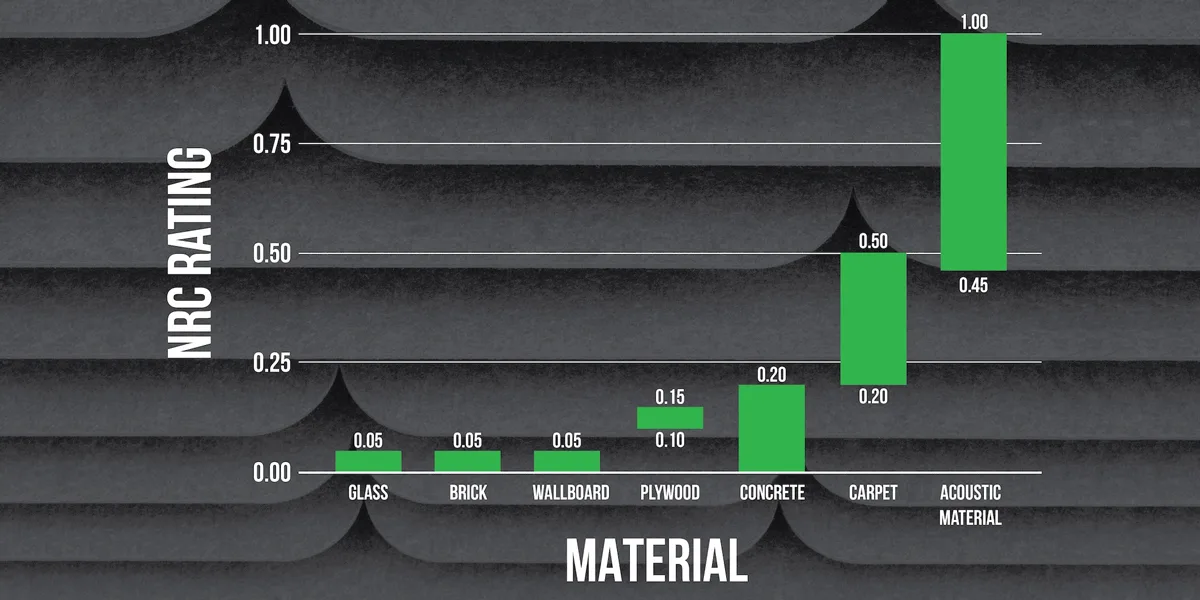
- NRC < 0,20: Normalmente classificados como materiais reflexivos
- NRC ≥ 0,20: Pode ser reconhecido como materiais de absorção de som
- NRC ≥ 0,80: Pertence a materiais de alta eficiência de absorção de som, adequados para espaços com altos requisitos acústicos
Como o NRC Rating impacta o desempenho da iluminação acústica?
Em sistemas de iluminação acústica, o NRC determina diretamente a capacidade de um dispositivo elétrico de reduzir a reverberação e controlar o ruído ambiental. Como as luzes LED acústicas são normalmente instaladas em tetos ou áreas elevadas, seus absorção de som As propriedades influenciam significativamente o ambiente acústico geral de um espaço. Valores mais altos do NRC minimizam os ecos e os reflexos do ruído, aumentando a inteligibilidade da fala e o conforto auditivo, resultando em um ambiente acústico mais estável e controlável.
Qual é a classificação NRC adequada para diferentes cenários de aplicativos?
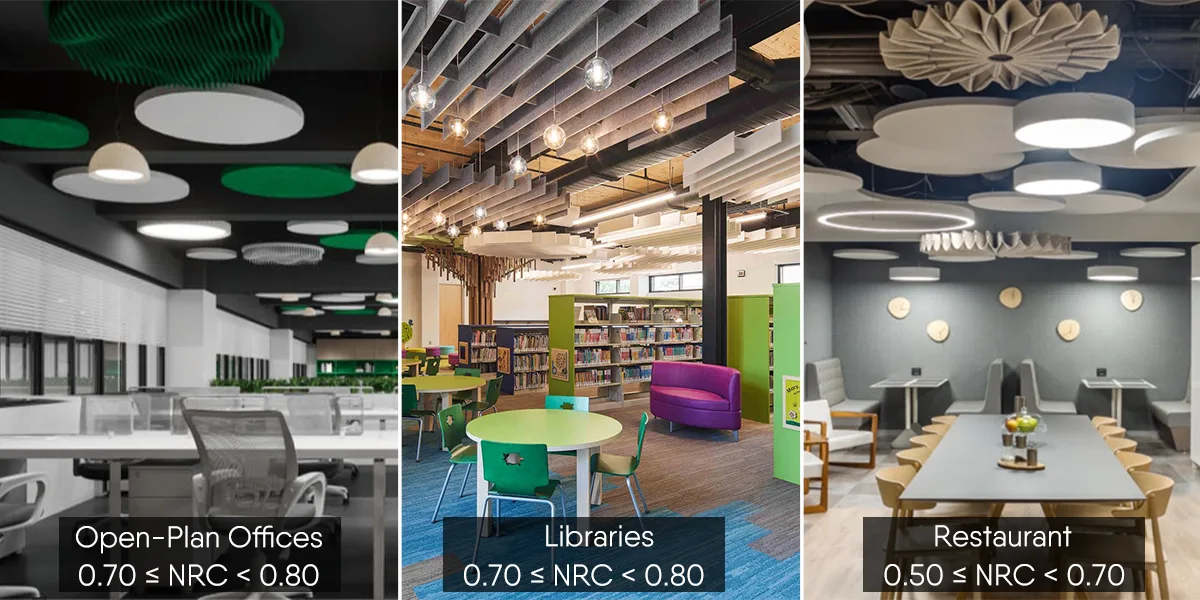
Os requisitos de iluminação acústica para NRC variam em diferentes ambientes de uso. A seleção deve considerar a funcionalidade do espaço, o orçamento e as especificações de design. Para iluminação acústica, são recomendados produtos com NRC ≥ 0,70 para atingir um desempenho acústico ideal. Consulte os seguintes padrões de classificação NRC e tabela de aplicativos para obter orientação:
Padrões e aplicativos de classificação NRC
| Faixa NRC | aula de desempenho acústico | Aplicativo recomendado | Função central |
| NRC ≥ 0,80 | Material de absorção de som de alta eficiência | Material de absorção de som de alta eficiência | Alcança o controle acústico ideal, reduz significativamente a reverberação, aumenta a clareza da fala e a pureza do áudio. |
| 0,70 ≤ NRC < 0,80 | Excelente material absorvente de som | Escritórios em plano aberto, salas de aula, bibliotecas, hospitais, salas de reuniões | Reduz efetivamente o ruído de fundo e a reverberação, melhora a eficiência da comunicação e o conforto espacial. |
| 0,50 ≤ NRC < 0,70 | Material de absorção de som moderado | Espaços residenciais comuns, lojas, corredores, áreas de descanso públicas | Melhora significativamente o ruído ambiental, o custo equilibra a flexibilidade do design, adequado para necessidades acústicas moderadas. |
| 0,20 ≤ NRC < 0,50 | material básico de absorção de som | Armazéns, estacionamentos, plantas industriais | Fornece uma função básica de absorção de som, reduz algum som refletido. |
| NRC < 0,20 | material reflexivo de som | Qualquer ambiente acústico que exija reflexão sonora (por exemplo, estágios, plataformas musicais) | Reflete principalmente o som, não adequado para cenários que requerem absorção de som. |
Por que o NRC é particularmente adequado para avaliar a iluminação acústica?
O NRC é amplamente utilizado para avaliar o desempenho de materiais acústicos arquitetônicos, como painéis de teto e paredes. A iluminação acústica combina inerentemente “sistemas de iluminação com soluções de teto acústico”.
Portanto, usar o NRC como a métrica principal para medir o desempenho acústico de luzes LED de absorção de som não é apenas profissional, mas também intuitivo, facilitando a comparação e seleção de designers, empreiteiros e compradores. Para a maioria dos espaços comerciais, uma classificação NRC entre 0,6 e 0,9 é considerada uma iluminação acústica ideal, pois proporciona uma absorção de som eficaz, mantendo a flexibilidade do design e o desempenho da iluminação.
Como as luzes LED acústicas aprimoram o controle de som em espaços modernos
Os edifícios modernos, principalmente os escritórios em plano aberto, geralmente sofrem de níveis de ruído excessivos. As luzes LED acústicas abordam isso integrando materiais ou estruturas de absorção de som. Eles fornecem iluminação enquanto absorvem ondas sonoras e reduzem os ecos, melhorando significativamente a clareza do som e o conforto no espaço. Seu design combina fontes de luz com materiais acústicos, não apenas resolvendo problemas de ruído, mas também melhorando o apelo estético geral do ambiente.
Por meio da configuração científica, essas luzes ajudam os espaços modernos a alcançarem o desempenho acústico ideal, atendendo aos requisitos estéticos e de iluminação, transformando o ruído ambiental de uma distração em um elemento discreto.
O papel das luzes LED acústicas no aprimoramento dos ambientes de escritório e residencial
Nos locais de trabalho e casas contemporâneas, a interferência do som frequentemente compromete a eficiência e o conforto. As luzes LED acústicas, como uma fusão inovadora de acústica e iluminação, estão otimizando silenciosamente a experiência acústica nesses espaços.
- Configurações do escritório : Embora os layouts abertos promovam a colaboração, eles também tecem zumbidos da impressora e os cliques no teclado em um ruído de fundo constante. A sala de reuniões ecoa mais discussões confusas. As luzes LED de absorção de som incorporam materiais porosos que absorvem ondas sonoras e reduzem os reflexos, tornando as reuniões mais claras. Simultaneamente, a temperatura de cor ajustável (do branco frio ao amarelo quente) se adapta a diferentes horários do dia, reduzindo o cansaço visual e promovendo uma atmosfera focada. Este design de “sinérgica sonora” transforma espaços ruidosos em paraísos eficientes.
- Configurações residenciais: o clamor urbano — como o ruído do tráfego e as atividades de vizinhança — geralmente se intromete na tranquilidade doméstica. As luzes LED absorvem o som absorvem ruídos de alta frequência, construindo uma “barreira acústica” em ambientes fechados. Usado em salas de estar ou quartos, os residentes desfrutam de momentos mais tranquilos para descansar ou ler. A eficiência energética do LED e a longa vida útil se alinham ainda mais com as necessidades de vida sustentável.
De salas de conferência a quartos, as luzes LED de absorção de som redefinem cientificamente a qualidade espacial, melhorando silenciosamente a vida e o trabalho.
Interpretando as classificações do NRC: por que elas são críticas para o acústico desempenho de iluminação
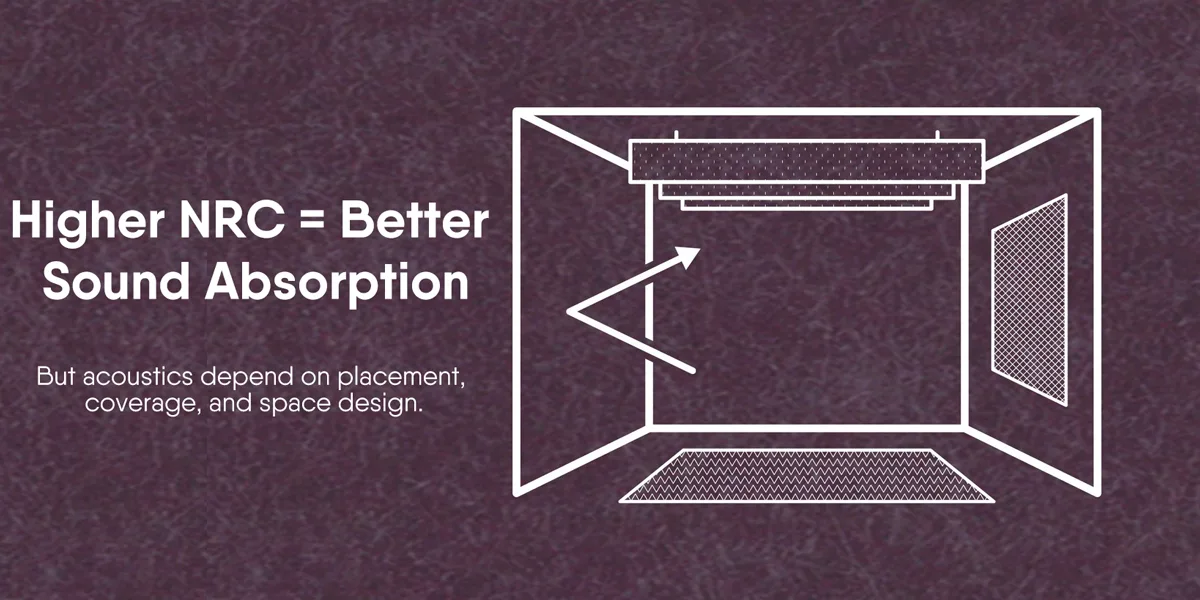
A classificação NRC serve como uma métrica central para avaliar o desempenho acústico da iluminação acústica, com sua importância na influência direta em ambientes de som interno.
A iluminação acústica atinge a conversão de energia sonora por meio de materiais porosos integrados (como fibra de poliéster, painéis de alumínio perfurado e algodão acústico). Seu valor NRC determina diretamente:
- Redução do tempo de reverberação: Em uma sala de conferências de 50㎡, as partidas com NRC ≥ 0,7 reduzem o tempo de reverberação de 2,1 segundos para 1,3 segundos, aumentando significativamente a inteligibilidade da fala.
- Índice de transmissão de fala melhorado (IST): A STI medida aumenta de 0,62 para 0,78, aumentando marcadamente a eficiência e o foco da comunicação.
- Supressão de interferência de ruído: Absorve efetivamente o zumbido do equipamento e os ecos da voz humana, criando um escritório silencioso e de baixa distração ou ambiente de reunião.
Normas e regulamentos atuais da indústria
- internacional: ASTM C423 serve como padrão oficial para testes NRC.
- Sem regulamentos obrigatórios: Atualmente, não existe um padrão dedicado para a indústria “Iluminação acústica LED”, com o NRC servindo apenas como referência funcional.
- Tendência de design colaborativo: padrões de iluminação como ISO/CIE 8995-1:2025 enfatizam a sinergia entre “conforto visual” e “conforto acústico”, impulsionando a iluminação de absorção de som como um recurso padrão em espaços inteligentes.
Valor do aplicativo do mundo real
O feedback do usuário das instalações reais indica que, após a instalação de luzes LED de alta absorção de NRC, as salas de conferências não têm mais eco ao falar, “reduzi o ruído do ar condicionado significativamente” e “foco aprimorado”. Seu valor se estende além da redução de ruído para remodelar a percepção espacial, onde a luz e o som servem em conjunto com a eficiência cognitiva e o conforto psicológico.
Uma excelente classificação NRC não apenas reduz o ruído, mas também previne sua propagação dentro dos espaços, garantindo que a qualidade do som permaneça consistentemente dentro de níveis confortáveis.
Como selecionar a luz LED acústica ideal para uma absorção de som aprimorada
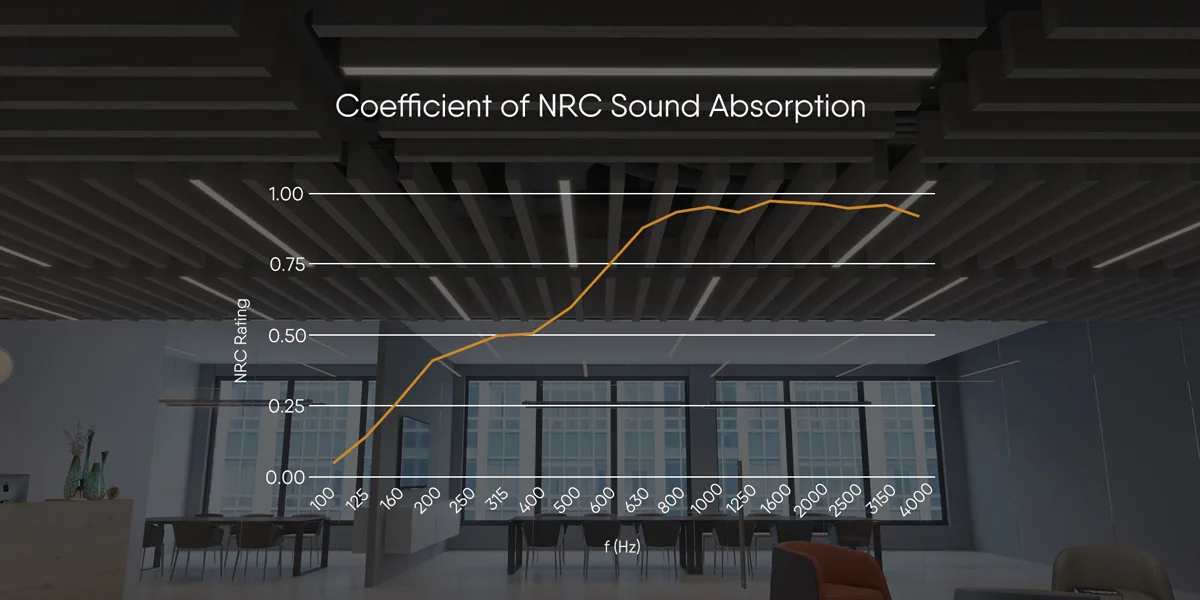
quando Escolhendo luzes LED acústicas adequadas, priorize a classificação NRC. Os acessórios de alta classificação são ideais para espaços com requisitos rigorosos de controle de ruído. Além disso, considere o tipo e a qualidade dos materiais acústicos para garantir que eles ofereçam o desempenho esperado de absorção de som no uso do mundo real. Simultaneamente, o design de fixação e a eficácia luminosa são fatores críticos que influenciam diretamente a experiência espacial geral.
- Cenários de correspondência de valor NRC:
a) Espaços pequenos (por exemplo, escritórios domésticos) podem optar pelo NRC 0,6 ou NRC 0,5-0,7. Esta gama absorve efetivamente o ruído do dia a dia (como sons de TV ou brincadeiras), evitando assim uma absorção excessiva que cria um espaço não natural.
b) Espaços grandes (por exemplo, salas de conferência) são recomendados para NRC 0,7-0,9. Valores mais altos do NRC reduzem os ecos nas salas de conferência, aprimoram a qualidade das chamadas de vídeo e minimizam a interferência do ruído de fundo em escritórios de plano aberto.
c) Os valores de NRC acima de 0,8 são adequados para ambientes profissionais, como estúdios de gravação, mas os espaços residenciais/escritórios exigem a absorção do som com a funcionalidade de iluminação.
- durabilidade do material: Priorize materiais acústicos resistentes ao fogo e à prova de umidade (por exemplo, espuma de classe A) para evitar a absorção do som devido à umidade ambiental.
- Parâmetros de iluminação: A temperatura da cor (2700K-4000K) e o índice de renderização de cores (CRI>90) devem se alinhar aos requisitos espaciais — por exemplo, 4.000K de aumento de luz neutra em escritórios.
- Conformidade com a certificação: Selecione marcas com certificações de teste rigorosas para garantir que as luminárias atendam aos padrões de desempenho acústico.
Iluminação acústica da SignlitLed Prioriza o desempenho acústico e o design estético. A lâmpada estruturada em favo de mel ilustrada atinge UGR<19, oferece um NRC de 0,75 e incorpora recursos de prevenção de brilho, tornando-o ideal para salas de estar residenciais.
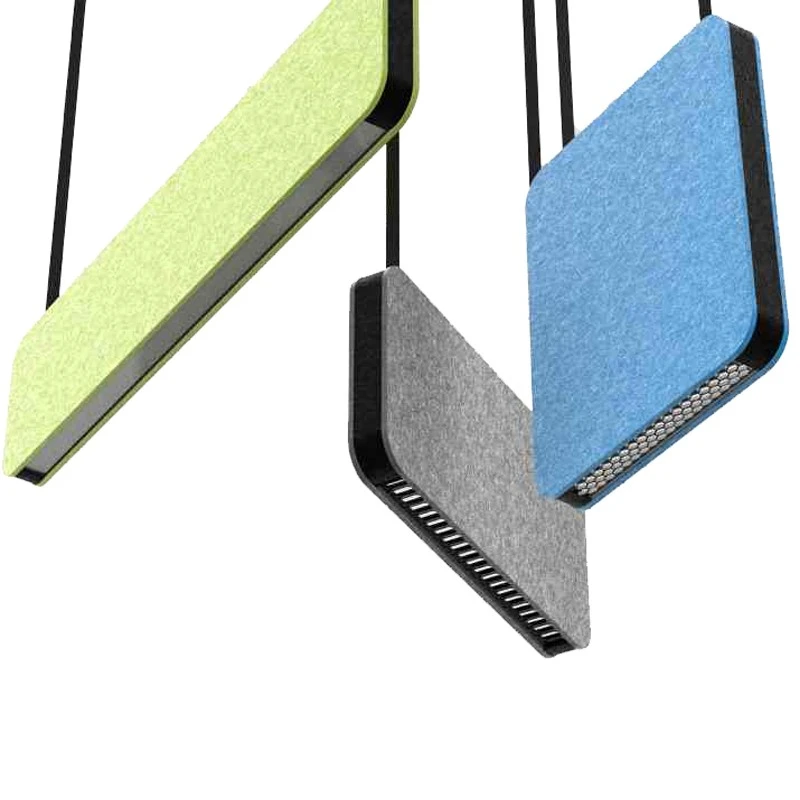
Luz linear de LED acústica super fina
Tensão de entrada: AC100-277V / AC220-240V, 50-60Hz
Direção de emissão: em baixo
Tamanho: 1218 *36*400mm
CCT: 3000K / 4000K / 6000K
Potência: 30w
Fluxo luminoso: 100-110 lm/w
IRC: >80ra
PF: >0.90
Flicker grátis: Sim
Ângulo de feixe: 120°
Grau IP: IP20
Garantia: 5 anos
Cor da placa acústica em feltro Vermelho/verde/azul/cinza mais de 48 cores opção
Como as luminárias acústicas atingem a iluminação e a redução de ruído simultaneamente?
Os consumidores modernos preferem cada vez mais produtos de iluminação que combinam um excelente desempenho acústico com a estética espacial. Por meio de um design engenhoso, a iluminação acústica LED mescla a funcionalidade com a arte, tornando-a um elemento indispensável nos espaços contemporâneos.
Os acessórios acústicos integram a funcionalidade por meio dos seguintes elementos de design:
- camadas de materiais: A superfície da lâmpada utiliza espuma porosa ou tecidos fibrosos (por exemplo, fibra de poliéster), permitindo que as ondas sonoras entrem e se convertam em calor por meio de atrito, mantendo a transmissão de luz.
- projeto estrutural: O abajur incorpora estruturas de algodão ou de favo de mel absorventes internamente para maximizar os caminhos de reflexão das ondas sonoras. A fonte de luz LED está embutida na camada de absorção de som, garantindo uma distribuição uniforme da luz.
Conclusão
Como inovador Solução de iluminação acú, os acessórios de LED de absorção de som estão se tornando cada vez mais padrão em arquitetura moderna e design espacial devido às suas excelentes classificações NRC e desempenho acústico.
De ambientes de escritório a espaços residenciais, locais comerciais a instituições educacionais, a iluminação acústica LED desempenha um papel vital para aumentar o conforto acústico espacial. Ao selecionar as classificações e acessórios NRC apropriados, os consumidores podem criar ambientes mais silenciosos e confortáveis, elevando a qualidade de vida e o trabalho.
FAQs
Postagens relacionadas