Português
  English
  简体中文
简体中文  Deutsch
  Español
  Français
  Italiano
  日本語
日本語  한국어
한국어  Polski
  Русский
  Türkçe
  Nederlands
  Tiếng Việt
  ไทย
ไทย 
A fita LED regulável para exteriores é amplamente utilizada em contornos arquitetônicos, iluminação paisagística e aplicações decorativas externas, onde tanto o desempenho da iluminação quanto a durabilidade ambiental são essenciais. Comparados com as instalações internas, os projetos externos exigem maior proteção à prova d'água, estabilidade do escurecimento e compatibilidade geral do sistema. Diferentes aplicativos podem priorizar fatores diferentes, dependendo das condições de instalação, dos métodos de controle e da escala do projeto. Este artigo descreve várias considerações importantes ao selecionar fitas LED dimmable para uso externo, fornecendo pontos de referência práticos para ajudar os compradores a avaliar produtos e soluções de forma mais eficaz para suas aplicações específicas.
Ambiente ao ar livre e classificação à prova d'água
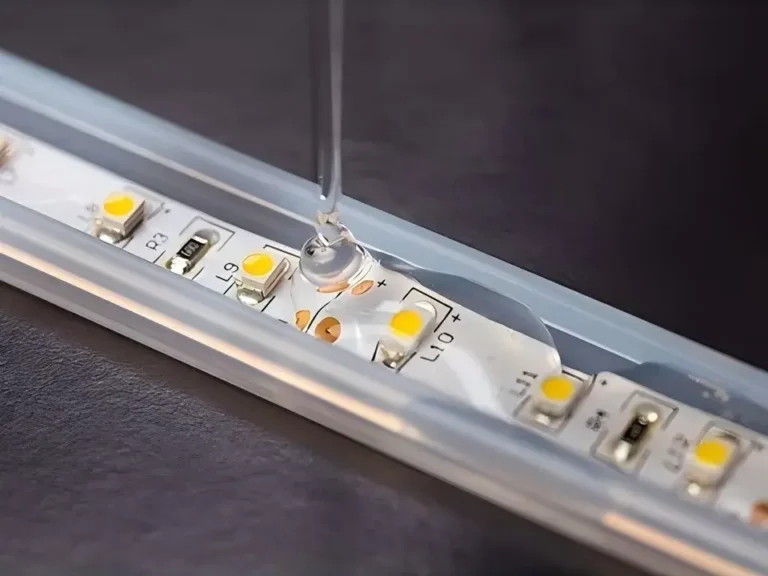
A fita LED regulável para exteriores está disponível em uma variedade de construções à prova d'água, e a seleção deve sempre ser baseada no ambiente de instalação real. As opções comuns incluem revestimento de silicone IP65, tubo de silicone IP65, extrusão oca IP67, enchimento de silicone IP68 e extrusão de silicone IP68. Cada estrutura oferece um equilíbrio diferente entre proteção contra umidade, flexibilidade, dissipação de calor e durabilidade a longo prazo. Não existe uma única fita LED à prova d'água para todos os projetos ao ar livre; a escolha adequada depende do nível de exposição, posição de montagem e condições ambientais.
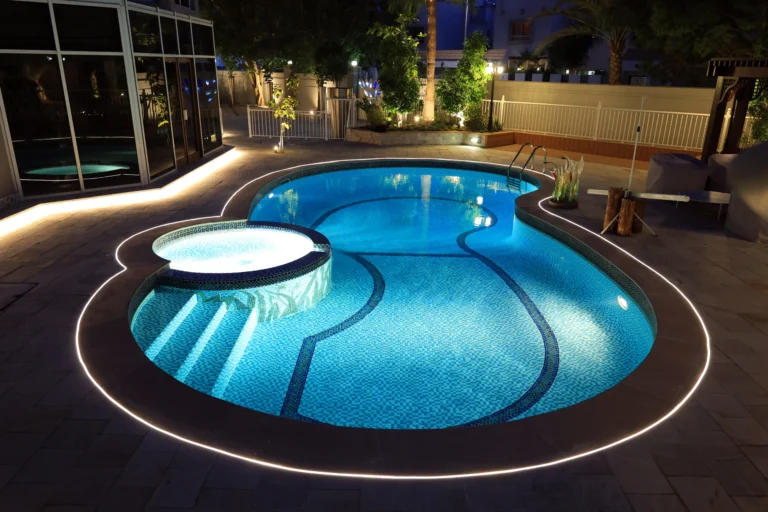
De uma perspectiva prática, as classificações de IP definem os limites de proteção em vez da qualidade geral do produto. IP65 fita led É adequado para ambientes expostos à chuva ou respingos de água, mas não contato contínuo com água. Os produtos IP67 são projetados para locais onde podem ocorrer imersões temporárias em água, como instalações no nível do solo ou áreas propensas ao acúmulo de água. A fita LED IP68 destina-se a imersão frequente ou a longo prazo e é normalmente usada em fontes, piscinas ou recursos de paisagem de alta umidade.
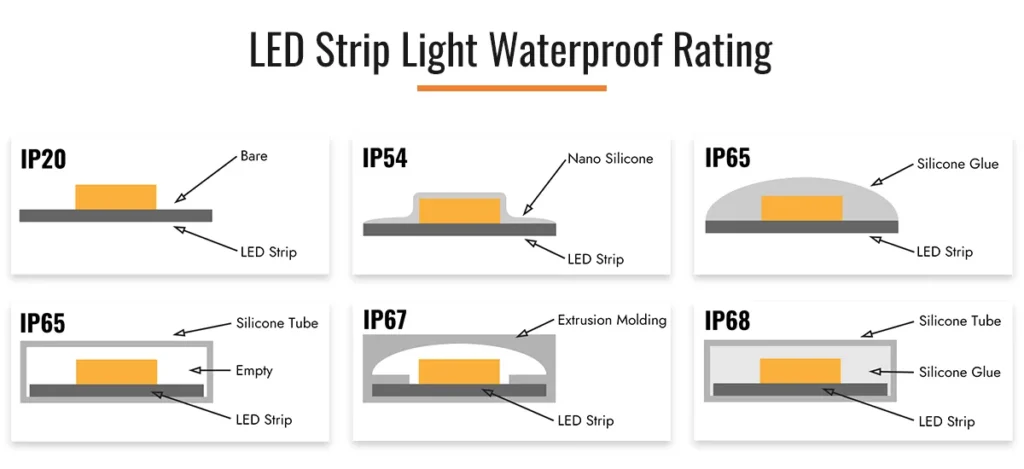
A tabela abaixo resume as classificações à prova d'água recomendadas para aplicações comuns ao ar livre:
| Cenário de aplicação | Classificação de IP recomendada |
| Construção de contornos de fachada | IP65 |
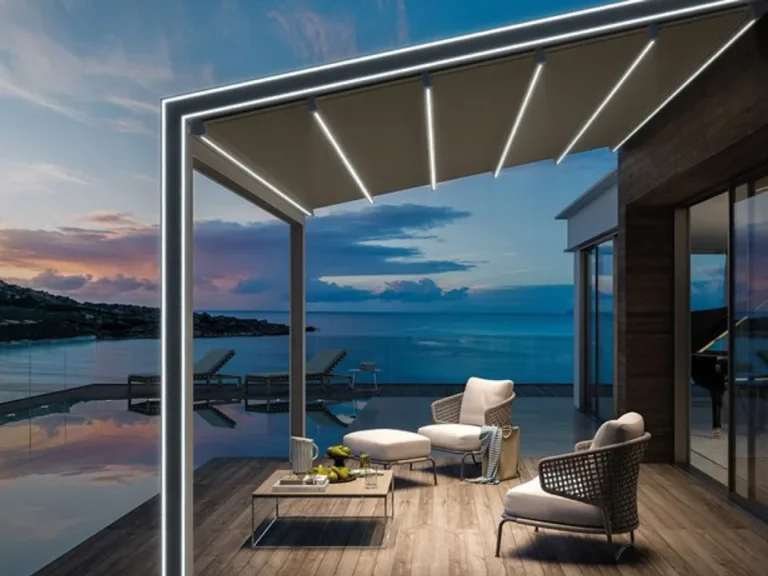
| beirais e copas | IP65 |
| Varandas e terraços | IP65 / IP67 |
| Linhas arquitetônicas no nível do solo | IP67 |
| Iluminação de jardim e paisagens | IP67 |
| perto de piscinas | IP68 |
| Recursos aquáticos e fontes | IP68 |
| instalações externas costeiras | IP67 / IP68 |
Em resumo, a seleção de classificação à prova d'água deve ser orientada por condições reais de exposição e não por suposições. Para instalações externas totalmente expostas, a fita LED com materiais resistentes a UV é fortemente recomendada para evitar o amarelecimento e a degradação do material. Para ambientes costeiros ou de alta salinidade, os produtos aprovados nos testes de spray de sal proporcionam confiabilidade aprimorada e maior vida útil.
Método de escurecimento e compatibilidade do sistema
Vários métodos de escurecimento são comumente usados em projetos de fita LED externa, cada um adequado para diferentes requisitos de controle e escalas de projeto. Os métodos mais amplamente aplicados incluem o escurecimento PWM, escurecimento de 0 a 10 V, DALI, triac (corte fase) e controle DMX. Embora todos esses métodos possam ser implementados em ambientes externos, seu desempenho e praticidade dependem principalmente do projeto do sistema, da complexidade da fiação e do nível de controle exigido.
A tabela a seguir compara esses métodos de escurecimento de uma perspectiva de projeto ao ar livre:
| método de escurecimento | Vantagens | Limitações | Aplicações típicas ao ar |
| PWM | Simples, econômico, estável | Controle centralizado limitado | Projetos ao ar livre de pequeno a médio porte |
| 0–10V | Padrão maduro, boa estabilidade | Fiação de controle adicional | Fachadas comerciais, sinalização externa |
| dáli | Controle endereçável e flexível | Custo do sistema mais alto | Grandes sistemas de iluminação arquitetônica |
| triac | Compatível com energia CA | Escurecimento limitado de baixo nível | Iluminação externa do retrofit |
| DMX | Controle preciso, efeitos dinâmicos | Requer a configuração correta do decodificador | Iluminação arquitetônica e paisag |
Na maioria das aplicações externas, a fita LED DC é compatível com todos os cinco métodos de escurecimento quando combinado com drivers ou controladores apropriados. Para projetos baseados em DMX, no entanto, a seleção do decodificador DMX correto é essencial, pois a configuração do canal e o tipo de saída afetam diretamente a estabilidade do sistema. Por outro lado, a fita LED AC normalmente é limitada a sistemas de controle de corte de fase triac e de escurecimento de fase selecionados, tornando-o mais adequado para instalações externas mais simples.
Brilho e uniformidade leve
O brilho é frequentemente uma consideração primária em aplicações de fita LED externa, principalmente para contornos arquitetônicos e iluminação externa funcional. Quando são necessárias altas luminosas eficácia e brilho máximo, a fita LED SMD geralmente é a opção preferida. A fita LED SMD de alta eficiência pode atingir uma eficácia luminosa acima de 180 lm/W, enquanto a fita LED COB normalmente atinge cerca de 150 lm/W. Para projetos com o mesmo nível de brilho, a fita LED SMD geralmente oferece melhor eficiência energética e menor consumo de energia, tornando-o adequado para instalações externas em grande escala.
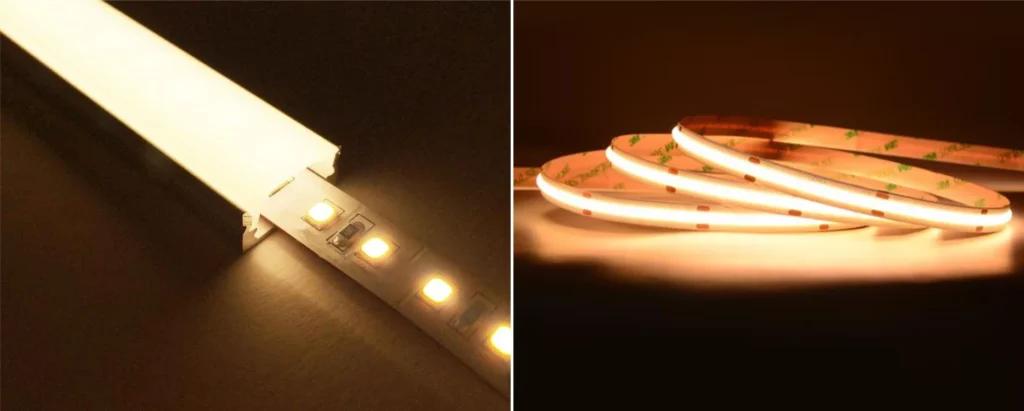
A uniformidade da luz é um fator separado, mas igualmente importante, especialmente em aplicações de iluminação linear visível. Quando é necessário um efeito de iluminação contínuo e sem pontos, a fita LED COB oferece vantagens claras devido à sua densidade de cavacos mais alta e superfície emissora de luz, resultando em uma iluminação suave sem manchas escuras. Alternativamente, a fita LED SMD combinada com perfis e difusores de alumínio também pode obter uma boa uniformidade, melhorando a dissipação de calor e a proteção mecânica.
Seleção de tensão de entrada para fita LED dimerizável externa
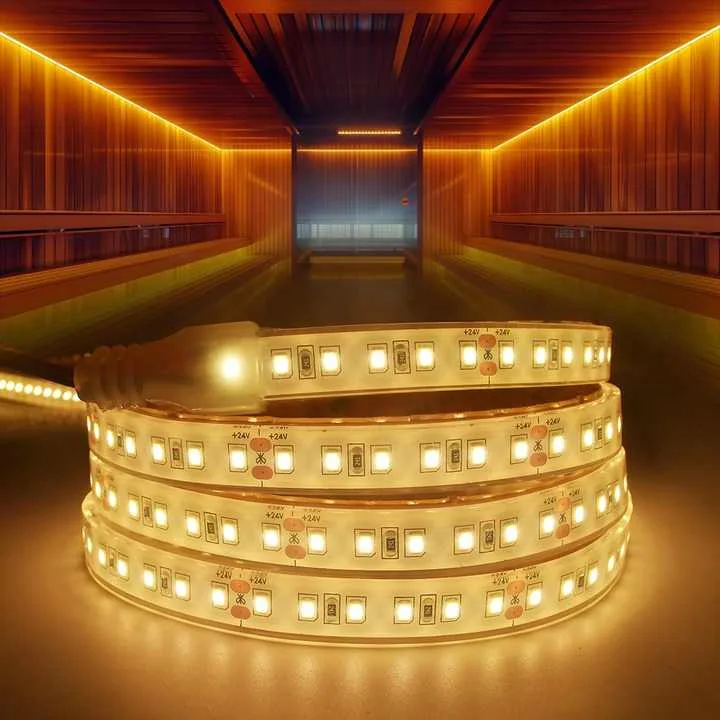
Para projetos ao ar livre, a fita LED de alta tensão geralmente não é recomendada devido ao aumento do risco de choque elétrico e requisitos de segurança mais complexos. Como resultado, a fita LED de baixa tensão DC é mais comumente usada, sendo DC12V e DC24V as opções mais amplamente aplicadas. No entanto, ao selecionar fita LED dimmerável, queda de tensão Deve ser cuidadosamente considerado, pois afeta diretamente a uniformidade do brilho e a consistência de escurecimento ao longo da corrida.
Com entrada de energia de extremidade única, a fita LED DC12V normalmente deve ser limitada a 5 metros, enquanto a fita LED DC24V pode se estender até 7 metros. Quando a entrada de energia de extremidade dupla é usada, os sistemas DC12V podem atingir aproximadamente 15 metros e os sistemas DC24V de até 20 metros. Exceder esses comprimentos pode resultar em redução visível do brilho e desempenho irregular de escurecimento.
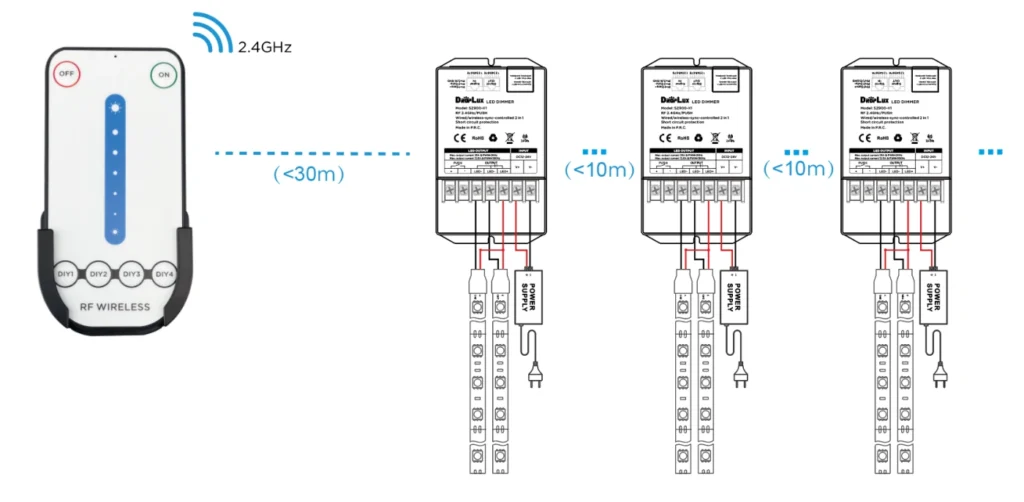
Para projetos que exigem longas corridas contínuas, a fita LED DC48V oferece uma alternativa prática. Ele suporta até 15 metros com entrada única e até 40 metros com entrada dupla, simplificando a fiação e reduzindo a queda de tensão. A principal limitação é a seleção relativamente menor de fontes de alimentação compatíveis. Quando o escurecimento PWM é usado, a consistência de escurecimento pode ser melhorada adicionando amplificadores de sinal entre as seções de fita LED ou adotando controladores síncronos, principalmente em grandes instalações externas.
Escolhendo o fornecedor certo para projetos externos de médio e grande porte
Para projetos de iluminação externa de médio a grande porte, a seleção de fornecedores desempenha um papel importante no desempenho geral do projeto. Na maioria dos casos, trabalhar diretamente com um fabricante genuíno é preferível ao fornecimento por meio de mercados online ou empresas comerciais. Os fabricantes normalmente oferecem preços mais competitivos, conhecimentos mais profundos do produto e suporte técnico mais forte. Mais importante, eles estão mais bem posicionados para fornecer personalização não padrão, o que geralmente é necessário em projetos de fita LED reguláveis externas
Ao avaliar os fabricantes, também devem ser considerados os recursos de conformidade e teste do produto. Certificações relevantes, como UL, CE e RoHS, demonstram conformidade regulatória, enquanto relatórios de teste – incluindo dados fotométricos do IES, testes de esfera e testes de spray salgado – oferecem garantia adicional de desempenho, segurança e confiabilidade a longo prazo em ambientes externos.
Outros fatores importantes a serem considerados
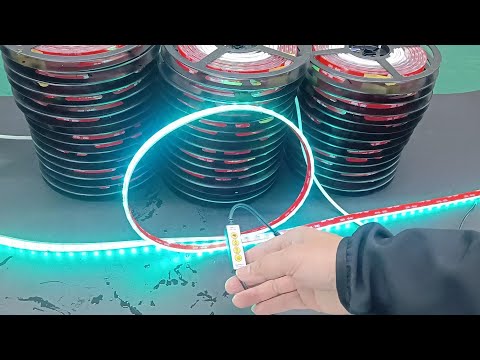
Além da classificação à prova d'água, método de escurecimento, brilho, seleção de tensão e escolha do fornecedor, vários fatores adicionais podem influenciar o desempenho a longo prazo da fita LED regulável externa. O gerenciamento térmico é particularmente importante, pois as estruturas à prova d'água podem restringir a dissipação de calor; a instalação adequada usando perfis de alumínio pode aumentar significativamente a confiabilidade. A consistência da cor durante o escurecimento, especialmente em níveis de brilho baixos, também deve ser avaliada em uma iluminação arquitetônica visível. Além disso, o design da saída do cabo, a vedação da tampa final e os detalhes da instalação desempenham um papel fundamental na prevenção da entrada de umidade ao longo do tempo. Para ambientes agressivos, a resistência aos raios UV, a proteção contra corrosão e os dados de teste verificados fornecem uma garantia adicional de operação estável a longo prazo.
Com mais de dez anos de experiência na fabricação de fitas LED para exteriores, a SignliteLed oferece suporte a uma ampla gama de aplicações de iluminação externa. Além dos produtos padrão, oferecemos soluções de fita LED personalizadas sob medida para requisitos específicos do projeto, incluindo design de circuitos, opções de cores e construção à prova d'água. Para garantir a compatibilidade do sistema e o desempenho estável do escurecimento, também fornecemos soluções de suporte completas, como controladores, amplificadores, decodificadores e fontes de alimentação. Ao combinar a personalização do produto com o suporte prático do sistema, ajudamos os clientes a implementar soluções de fita LED reguláveis ao ar livre de forma mais eficiente e confiável.
Postagens relacionadas