Tiếng Việt
  English
  简体中文
简体中文  Deutsch
  Español
  Français
  Italiano
  日本語
日本語  한국어
한국어  Polski
  Português
  Русский
  Türkçe
  Nederlands
  ไทย
ไทย 
A front-lit LED letter sign glows through its face, while a halo-lit sign a reverse-channel letter throws light onto the wall behind it. That single difference shapes how your brand looks during the day and at night. Because halo-lit, back-lit, and reverse channel are often used interchangeably, choosing the right LED backlit letter sign can be confusing.
This guide compares front-lit, halo-lit, and combination letters based on what matters most: daytime and nighttime appearance, real cost drivers, and the LED modules, spacing, voltage, and IP ratings engineered inside each type, so you can choose with confidence.
Chìa khóa rút ra
- Halo-lit and reverse-channel mean the same thing, and “back-lit” is the loose term people commonly use for this style.
- A front-lit letter has a translucent face that glows outward, carrying the brand color and shape directly.
- A halo-lit letter has an opaque metal face and throws light backward onto the wall, creating a glowing halo around the letter.
- A combination letter does both at once: a lit face plus a wall halo for the highest visual impact and the highest cost.
- The right choice depends on your brand look, budget, viewing distance, and wall color, since halo needs a light, smooth wall to read well.
What is a front-lit LED letter sign
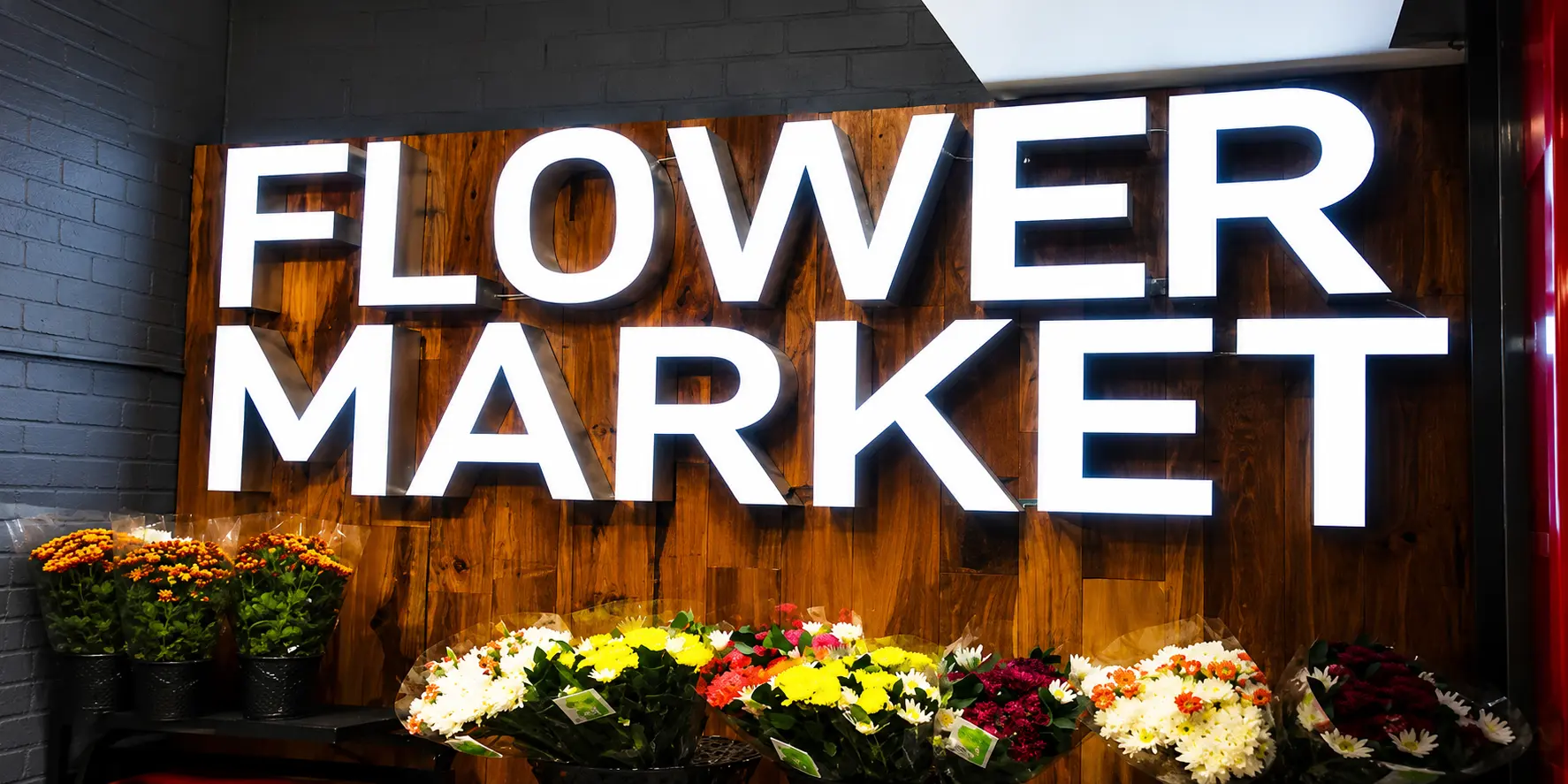
A front-lit LED letter sign is an illuminated channel letter with a translucent face that glows outward, lit by LED modules mounted inside the letter cavity behind the face.
The face is typically 3 mm (⅛″) cast acrylic, chosen because it diffuses light rather than letting it pass straight through. Behind it sits the return (the letter’s sidewall), while the interior contains a grid of LED modules bonded to the base of the can. The modules are arranged in rows and columns, not as a single strip, and are spaced so their beams overlap before reaching the face.
Proper beam overlap creates one even sheet of light. Poor spacing produces hotspots, where bright dots appear beneath each module with darker gaps between them. (The engineering behind that spacing is covered in “What LED lighting goes inside each type?” below.)
Front-lit letters are the preferred choice when signs must remain legible in full daylight and readable from a distance. The glowing face carries the brand color and shape directly, so the letters remain recognizable whether the LEDs are on or off. This makes them the default choice for storefronts, high-traffic frontages, and any sign that must perform equally well during the day and after dark.
For finishes, face colors, and sizing options, see our Dấu hiệu chữ LED chiếu sáng trang.
What is a halo-lit (reverse channel) LED letter sign?
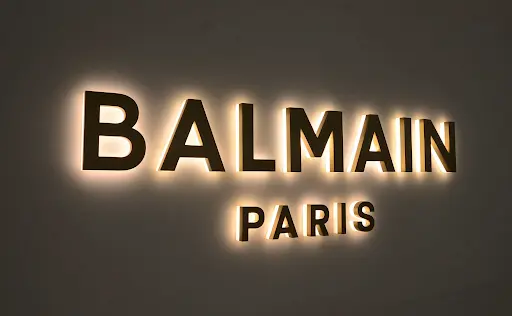
A halo-lit LED letter sign is a reverse-channel letter with an opaque face that projects light backward onto the wall, creating a glowing halo outline around the letter.
Its construction is the opposite of a front-lit letter. The face is solid metal, typically aluminum or stainless steel, while the return wraps back toward the wall and leaves the rear of the letter open. LED modules or strips are mounted inside that open back, facing the mounting surface instead of the viewer.
Because the metal face blocks all forward light, nothing on the letter itself glows. The visible effect comes entirely from reflected light around the edges. “Back-lit” is the common everyday name for this style, while the precise terms are reverse channel or halo-lit.
The standoff distance, created by mounting spacers or studs, is typically 38–50 mm (1.5–2 in) and is the most important variable a manufacturer controls. A shorter standoff creates a tighter, sharper halo, while a longer standoff spreads the light farther for a wider, softer glow. If the gap is too short, individual LED points may become visible. If it is too long, the halo becomes weak and diffuse.
Because halo lighting depends entirely on reflected light, the mounting surface matters as much as the letter itself. A light-coloured, smooth wall reflects the halo cleanly, while dark walls absorb the light and heavily textured surfaces such as rough stone, deep brick, or stucco scatter it into a patchy outline. This should be confirmed before the letters are engineered, not during installation.
Halo-lit letters suit premium, understated branding. Their clean metal face looks refined during the day, while the halo provides strong nighttime impact. They are commonly used in upscale interiors, corporate lobbies, and brand-conscious storefronts where closer viewing distances favor an architectural appearance over maximum long-distance readability.
For the LED modules engineered specifically for this reflected-light application, see our back-lit LED module phạm vi.
What LED lighting goes inside each type?
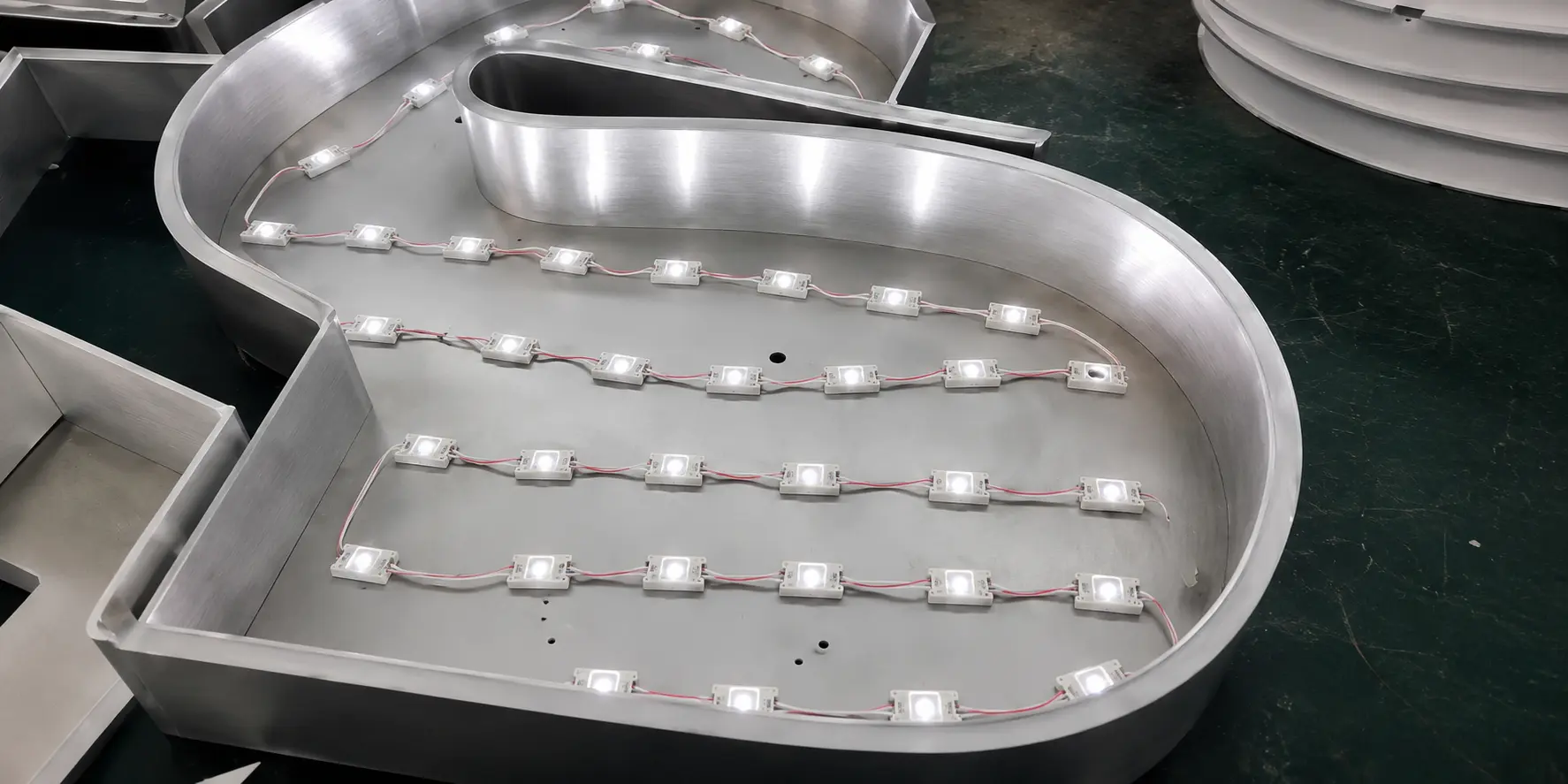
The lit style determines the LED layout, and the LED layout determines module choice, spacing, and voltage. For a broader look at how illuminated sign letters are lit in general, see our guide on Đèn LED nào được sử dụng bên trong các chữ cái ký hiệu được chiếu sáng.
Front-lit letters use a grid of modules facing the acrylic. Each module, for example SMD2835-3LED-0.9W (UTX358B), emits at a 160° beam angle, so the modules must be spaced to allow those beams to overlap before the light reaches the face. If spacing is too wide, or the letter is too shallow, hotspots appear. These are corrected by reducing module pitch, increasing return depth, or adding a diffuser layer. Module pitch and module count scale with letter size and depth.
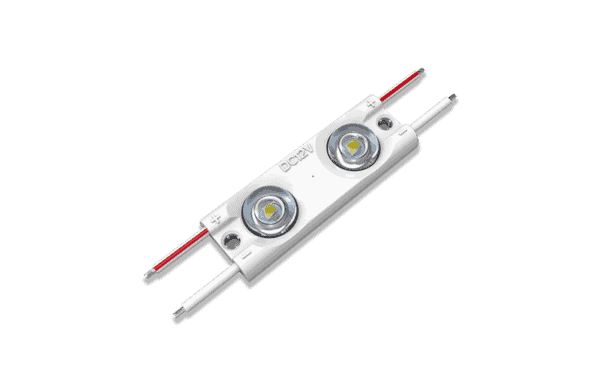
Đèn LED mô-đun DC12V đơn màu 2LED
- Thiết kế PCB lộ ra ngoài để tản nhiệt tốt
- Lỗi ánh sáng yếu cho tuổi thọ cao hơn
- Chip LED công suất cao 9V cho đầu ra sáng hơn và hiệu quả cao hơn
- Thiết kế dòng điện liên tục để giảm điện áp
- Kết nối nhiều hơn trên mỗi chuỗi
- Ống kính 160 ° để chiếu sáng đồng đều
- Thích hợp cho các dấu hiệu mỏng
Halo-lit (reverse channel) letters use modules or strips mounted on the open back and facing the wall, commonly SMD2835-2LED-0.6W (UTX357B). Because there is no illuminated face, hotspot control is less important than maintaining even output around the perimeter so the halo remains uniform instead of blotchy.
Combination letters use two separate lighting layouts: a front grid and a rear halo run. These operate on separate circuits so each system can be controlled independently.
Voltage and long letters
Modules operate on 12 V or 24 V DC, drawing roughly 50–75 mA each (0.6–0.9 W).
For long runs, 24 V is the preferred specification because 12 V can experience điện áp rơi, causing the modules farthest from the power feed to appear dimmer. Running at 24 V delivers the same power at lower current, reducing voltage drop and helping maintain even brightness.
Tính nhất quán màu
Modules are binned to 3-step MacAdam tolerance (Ra > 80) so every module appears the same white. Loose binning causes visible differences, making one area of the sign appear warmer or cooler than another.
Rating and life
Specify IP65 for standard outdoor exposure and ip67 for coastal or wash-down environments. signliteled modules are supplied to IP67.
Rated life is 50,000 hours to L70 (output at 70% of initial), allowing the sign to maintain usable brightness throughout its service life. roughly 11–14 years at a typical 10–12 hours of storefront operation per day.
| Sign Type | Bố cục đèn LED | Module (real) | uát | điện áp | Beam | IP |
| mở đầu | Grid across can base, facing acrylic | SMD2835-3LED-0.9W (UTX358B) | 0.9 W | 12/24V DC | 160 ° | ip67 |
| Halo-lit (reverse) | Modules on open back, facing wall | SMD2835-2LED-0.6W (UTX357B) | 0.6 W | 12/24V DC | 160 ° | ip67 |
| Combination | Front grid + rear halo run, separate circuits | UTX358B + UTX357B | 0.6–0.9 W | 12/24V DC | 160 ° | ip67 |
Module pitch and per-letter spacing in mm vary with letter depth and are set at production.
For the modules engineered for each application, see our back-lit LED module Và side-lit LED module pages.
Which LED letter sign type should you choose?
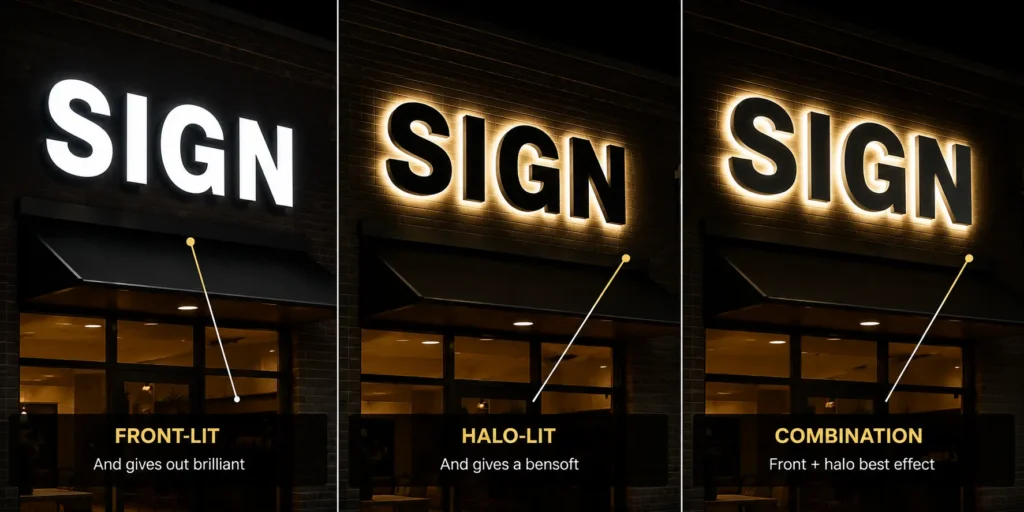
Choose front-lit for daytime visibility and value, halo-lit for a premium modern look, and combination when you want maximum impact around the clock. The right choice depends on your brand, budget, viewing distance, and wall.
| kịch trường | Recommended Type | tại sao |
| Daytime storefront visibility | mở đầu | The glowing face carries the brand color and shape, staying legible in full daylight and readable from a distance. |
| Premium / upscale night look | Halo-lit | The clean metal face reads as quality by day, and the wall halo delivers an understated, architectural glow after dark. |
| Maximum 24/7 impact | Combination | A lit face plus a wall halo gives the strongest presence day and night, at the highest cost. |
| Tight budget | mở đầu | Simpler construction and a single LED layout make it the most cost-effective illuminated option. |
| Modern minimalist brand | Halo-lit | The solid metal face and soft halo suit clean, contemporary branding without a bright lit face. |
| Interior lobby logo | Halo or combination | Close viewing distances and controlled lighting let the halo shine, with combinations available for extra depth. |
Get a Quote — Dấu hiệu chữ LED chiếu sáng
Front-lit vs halo-lit vs combination — the actual difference
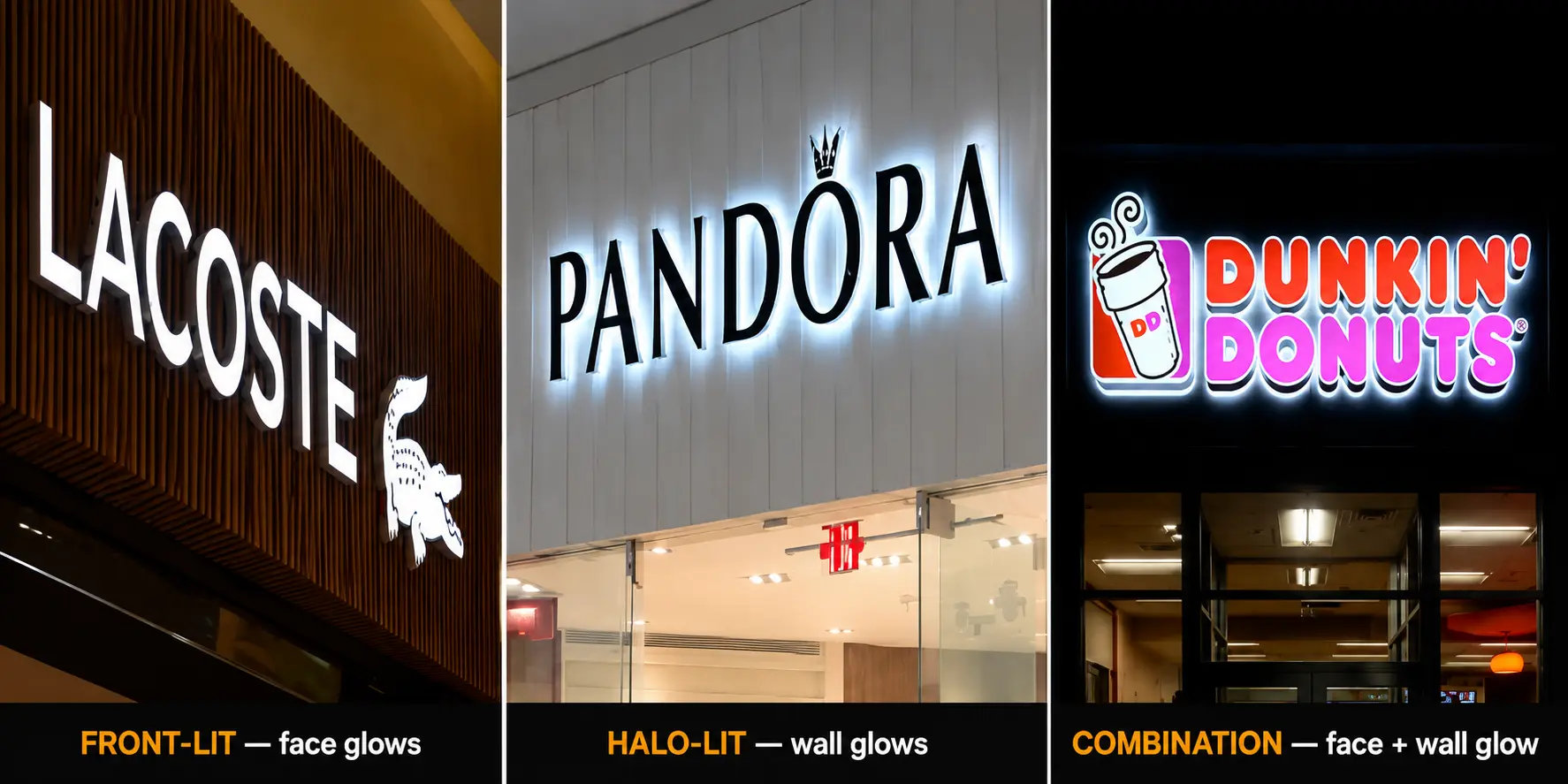
The difference between front-lit, halo-lit, and combination letters is where the light appears.
A front-lit letter has a translucent face that glows outward toward the viewer. A halo-lit letter, also called a reverse-channel letter and commonly referred to as “back-lit,” has a solid metal face that throws light backward onto the wall, creating a glowing outline instead of a lit face. A combination letter combines both effects by pairing a lit face with a wall halo. Once you understand that halo-lit, reverse-channel, and back-lit describe the same wall-glow method, the remaining differences become straightforward.
| Attribute | mở đầu | Halo-Lit (reverse) | Combination |
| How it’s lit | LED grid behind a translucent face, glowing outward | LED modules on the open back, facing the wall | Both — a front grid and a rear halo run |
| Face material | Translucent ~3 mm acrylic | Opaque aluminium or stainless steel | Translucent acrylic face, mounted off the wall for a rear halo |
| Where light shows | On the letter face | On the wall around the letter | On both the face and the wall |
| Daytime look | Bright, colored, legible face | Clean, solid metal — reads as quality | Colored face with a metal-quality feel |
| Nighttime look | Evenly lit glowing face | Soft glowing halo outline | Lit face framed by a wall halo |
| Best viewing distance | Long — readable from far | Closer — halo softens at distance | Long, with added close-up depth |
| giá tương đối | thấp kém | địa vị cao | cao |
| Sử dụng điển hình | Storefronts, high-traffic frontages | Upscale interiors, modern brand facades | Flagship signs needing maximum 24/7 impact |
Where each lighting type works best, by industry
High-traffic retail favors front-lit for daytime legibility and cost, hospitality and corporate spaces favor halo-lit for a premium look, and flagship or landmark locations often justify combination letters for maximum day-and-night impact.
| sự sắp đặt | Best-fit Type | tại sao |
| Retail storefronts & strip malls | mở đầu | High daytime traffic, budget-sensitive, needs long-distance legibility |
| Restaurants & QSR | Front-lit or Combination | Brand color on the face matters; combination adds night-time draw near dining hours |
| Khách sạn & Khách sạn | Halo-lit | Upscale, architectural look fits lobby and facade branding |
| Corporate offices & lobbies | Halo-lit | Close viewing distance, understated premium branding |
| Shopping malls (multi-tenant) | mở đầu | Directory-style visibility, cost-efficient across many tenants |
| Auto dealerships & showrooms | Combination | High-traffic, 24/7 visibility justifies the added cost |
| Flagship / landmark stores | Combination | Maximum brand impact where the location itself is a marketing asset |
See more real installations in our LED Illuminated Letters application gallery.
What about front + halo combination letters?
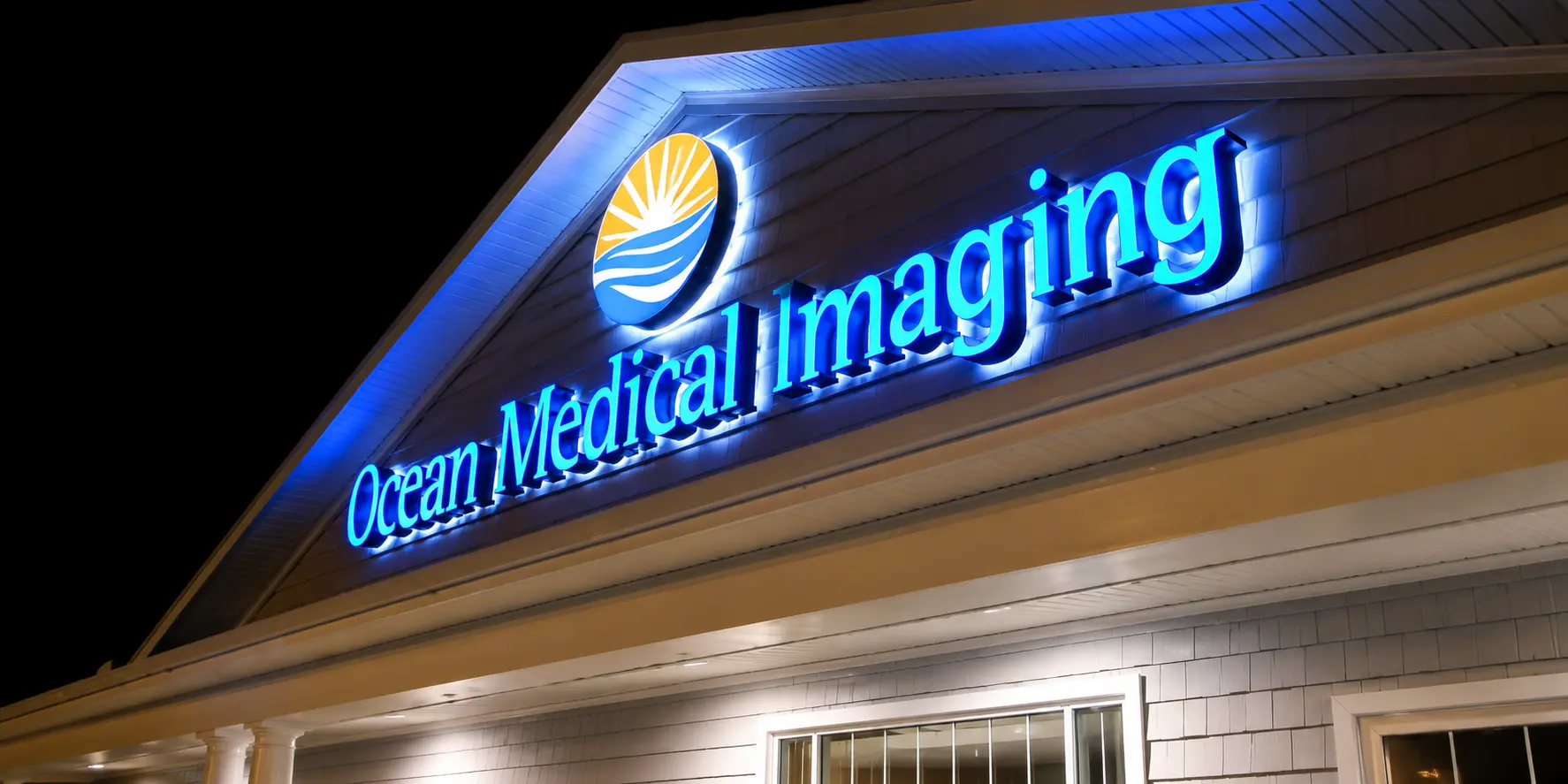
A combination LED letter uses two independent lighting systems: a front-lit grid and a rear halo run, allowing the face and wall halo to operate together or independently.
The two lighting systems are wired as separate circuits, typically on their own drivers or output channels rather than sharing one supply. Because they operate independently, each can be switched, dimmed, or colored on its own. You can run a warm-white lit face with a cool-white halo, dim the halo while keeping the face at full output, or switch either layer off entirely. This level of control is not available with a single-circuit letter.
Inside the letter, each lighting layer uses a module matched to its purpose. The front grid uses a higher-output module such as the UTX358B (SMD2835, 3 LEDs, 0.9W) to create an even, bright acrylic face. The halo run uses a lower-output module such as the UTX357B (SMD2835, 2 LEDs, 0.6W) because reflected wall light requires less intensity than a lit face. Matching each module to its application keeps both lighting effects balanced.
The trade-off is additional engineering. Two lighting layouts require more modules, more wiring runs, a larger combined power budget, and usually a controller to manage separate channels. This increases cost compared with both front-lit and halo-lit letters. In return, you get maximum day-and-night visibility with a fully legible face and a wall halo working together around the clock.
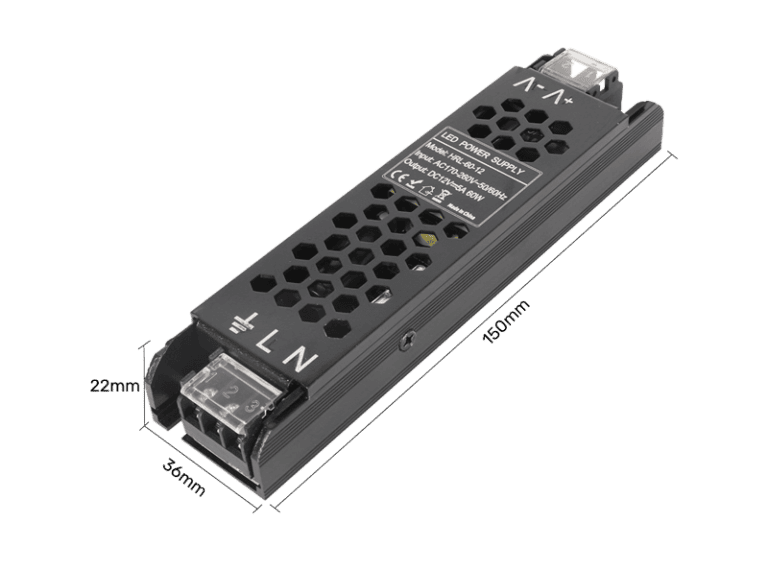
Trình điều khiển siêu mỏng 12V cho đèn LED dải
- Điện áp đầu vào: AC110-260V
- Dải tần số: 47-63Hz
- Hệ số công suất: 0,5-0,6
- Hiệu quả:> 80%
- Công suất định mức: 60W
- Điện áp đầu ra: DC12V
- Dòng điện định mức: 5A
- IP 20
- Bảo hành: 3 năm
- Kích thước: L150 × W36 × H22mm
Plan the channels and power accordingly. See our Bộ điều khiển LED Và Nguồn điện LED pages for matching drivers and controls to a two-layer build.
Visibility and readability — day vs night
Front-lit letters provide the strongest daytime readability, halo-lit letters create the strongest architectural night effect, and combination letters deliver both.
Readability depends on two factors: how the letter performs in different lighting conditions and the height of the letters. The lighting style determines the first, while letter height determines the second.
During daylight, front-lit letters perform best. The illuminated face carries the brand color and shape whether the LEDs are on or off, allowing the sign to remain fully legible under full sun and visible from long distances. Halo-lit letters rely on reflected wall light, which is overwhelmed by daylight, so they appear as clean metal letters without a visible halo. Combination letters share the daytime advantage because of their illuminated face.
At dusk, the difference becomes smaller. As ambient light decreases, the halo begins to appear, allowing halo-lit and combination letters to gain visual presence while front-lit faces remain consistently bright.
At night, each style creates a different viewing experience. A front-lit face remains the most legible because the evenly illuminated surface maintains its color and shape over long viewing distances. Halo-lit letters produce a softer, architectural glow that becomes harder to distinguish as viewing distance increases because the eye reads the surrounding halo rather than an illuminated face. Combination letters provide both a readable illuminated face and a surrounding halo, making them suitable for both long sightlines and close viewing.
The legibility rule
As an industry guideline, a sign is comfortably readable at roughly 10 feet of distance for every 1 inch of letter height — about 3 metres per 25 mm.
This guideline is a starting point rather than a guarantee. Contrast, lighting style, and viewing conditions all influence actual readability, while a soft halo generally becomes harder to read at distance than a bright illuminated face of the same size.
SignliteLED letters run from 100 mm to 2000 mm tall, covering everything from close interior logos to large building-top signage.
| chiều cao chữ | Approx. Max Readable Distance |
| 100 mm (4 in) | ~40 ft (12 m) |
| 300 mm (12 in) | ~120 ft (37 m) |
| 600 mm (24 in) | ~240 ft (73 m) |
| 1000 mm (40 in) | ~400 ft (122 m) |
| 2000 mm (79 in) | ~790 ft (240 m) |
Color temperature (CCT) — matching light to face and material
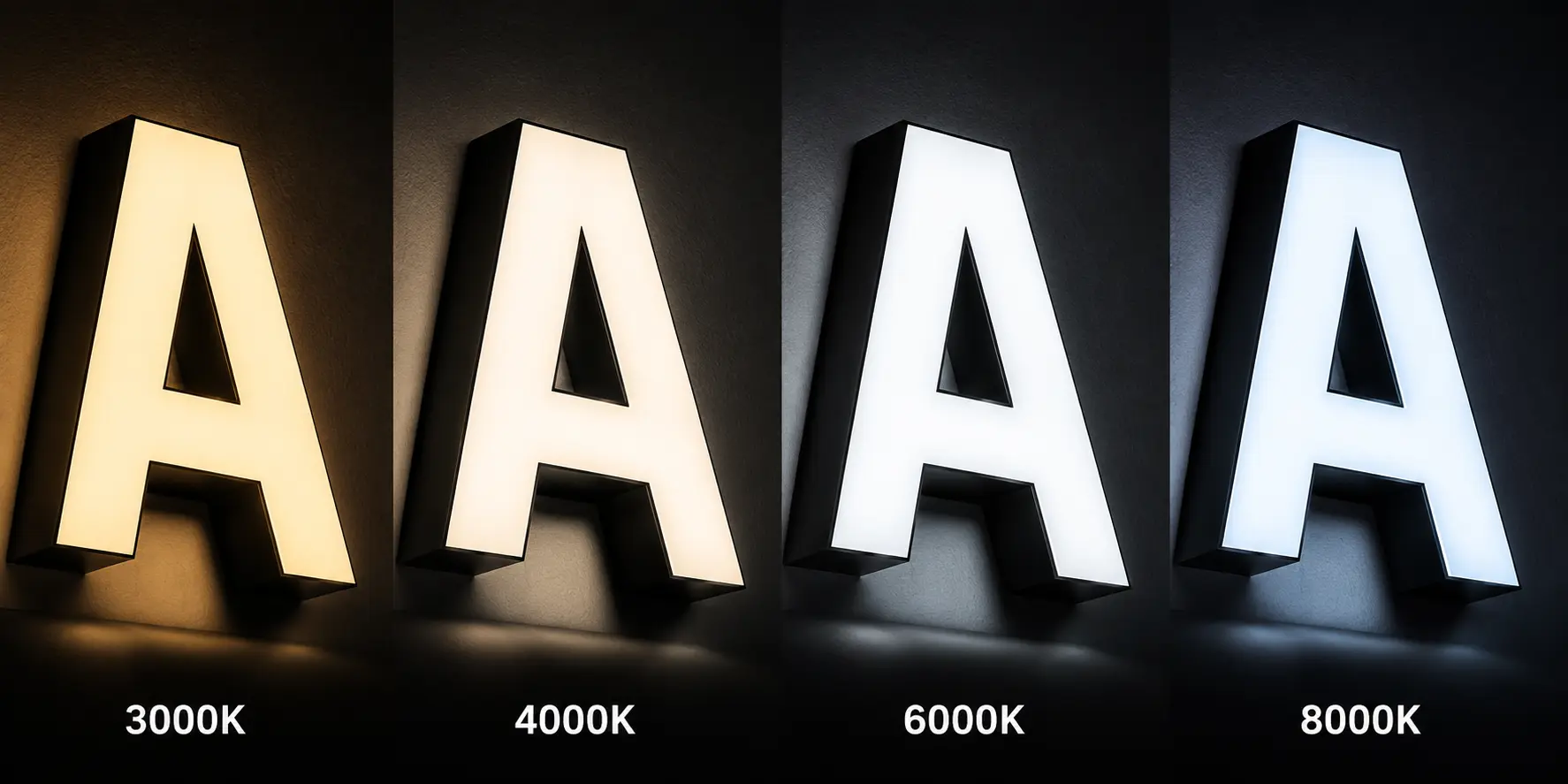
The right color temperature depends on the face material, wall surface, and the lighting effect you want to achieve.
Color temperature, measured in Kelvin (K), determines how warm or cool white light appears. Our modules are available in 3000K, 4000K, 6000K, and 9000K, and each performs differently depending on the application. see our full 3000k vs 4000k vs 5000k vs 6000k comparison for more on choosing color temperature
On a front-lit acrylic face, the face color influences how the CCT appears. 3000K produces a soft, amber-leaning glow that suits cream, ivory, and warm brand colors. Behind bright white acrylic, however, it can appear creamy or slightly dingy instead of clean white.
4000K is the most versatile option. It renders white acrylic as true white while reproducing most brand colors accurately, making it the safest specification when you’re unsure.
6000K creates a crisp, bright, modern appearance that suits clinical, technology, and contemporary branding.
9000K produces an even cooler, blue-leaning white for the sharpest, coolest look.
For halo-lit letters, the reflected surface matters as much as the face. Stainless steel and light, neutral-colored walls reflect cooler CCTs cleanly, making 6000K ideal for a sharp, modern halo. On beige, wood, or warm stone walls, 3000K complements the surface color and creates a softer, more inviting glow.
For dynamic lighting or exact brand colors, RGB modules (SMD5050) allow a sign to change colors or display a specific brand hue. On combination letters, RGB lighting can be controlled independently for each lighting system.
Always confirm the CCT against the face material and wall before production. It is much easier to specify correctly than to relamp a completed letter.
Cost comparison — which costs more and why?
Front-lit letters are generally the most affordable, halo-lit letters cost more, and combination letters are the most expensive because each step adds materials, labor, or control equipment.
Front-lit letters are generally the lowest-cost option because they use a single lighting system with one LED grid behind an acrylic face. Simpler fabrication, fewer components, and straightforward installation reduce both material and labor costs.
Halo-lit letters cost more primarily because of the metalwork rather than the LEDs. Their opaque aluminum or stainless-steel face must be cut, formed, and finished to a high standard since it remains visible during the day. Installation is also more demanding because the halo depends on an accurate and consistent standoff distance.
Combination letters cost the most because they effectively combine two illuminated signs into one. Two independent LED layouts require additional modules, wiring, power capacity, and typically a controller for separate lighting channels, along with the metal-face fabrication already required for halo-lit letters.
Across all three styles, several factors determine the final price:
- Materials, including acrylic, finished metal, and the amount of each material used.
- Labor required for fabrication and installation.
- Letter size and depth, which increase material usage, module count, and handling requirements.
- Control equipment, including drivers, controllers, dimming systems, and RGB control channels where independent operation is required.
A small front-lit letter and a large RGB combination letter sit at opposite ends of these cost drivers, which is why pricing varies significantly between projects.
Common mistakes when choosing or installing illuminated letters
Most illuminated-letter problems result from specification mistakes made before fabrication, and each one can be prevented during the design stage.
1. Putting a halo letter on a dark or textured wall
The halo effect relies entirely on reflected light. Dark walls absorb the light, while rough stone, deep brick, and stucco scatter it into a patchy outline.
Prevention: Confirm the mounting surface before choosing halo-lit letters. Specify a light-coloured, relatively smooth wall or install a mounting panel that provides a suitable reflective surface.
2. Under-specifying the IP rating outdoors
Using indoor-grade or low-IP modules outdoors allows dust and moisture to enter the electronics, leading to premature failure.
Prevention: Specify IP65 for standard outdoor exposure and IP67 for coastal or wash-down environments. Match the IP rating to the installation location.
3. Mixing color bins across a face
Modules from inconsistent color bins create a patchy appearance, with some areas looking warmer or cooler than others.
Prevention: Specify modules binned to 3-step MacAdam tolerance for consistent color across the entire face.
4. Running 12V on long letters
Long 12V runs experience voltage drop, causing modules farthest from the power feed to appear dimmer.
Prevention: Specify 24V for long or large letters to reduce voltage drop and maintain even brightness.
5. Getting the standoff distance wrong on halo letters
A standoff that is too short creates a tight halo and may expose individual LED points. A gap that is too large creates a weak, diffuse halo.
Prevention: Match the standoff distance to the letter size and desired halo width, and use consistent mounting hardware across the installation.
How are illuminated letters mounted — raceway, direct, or wireway?
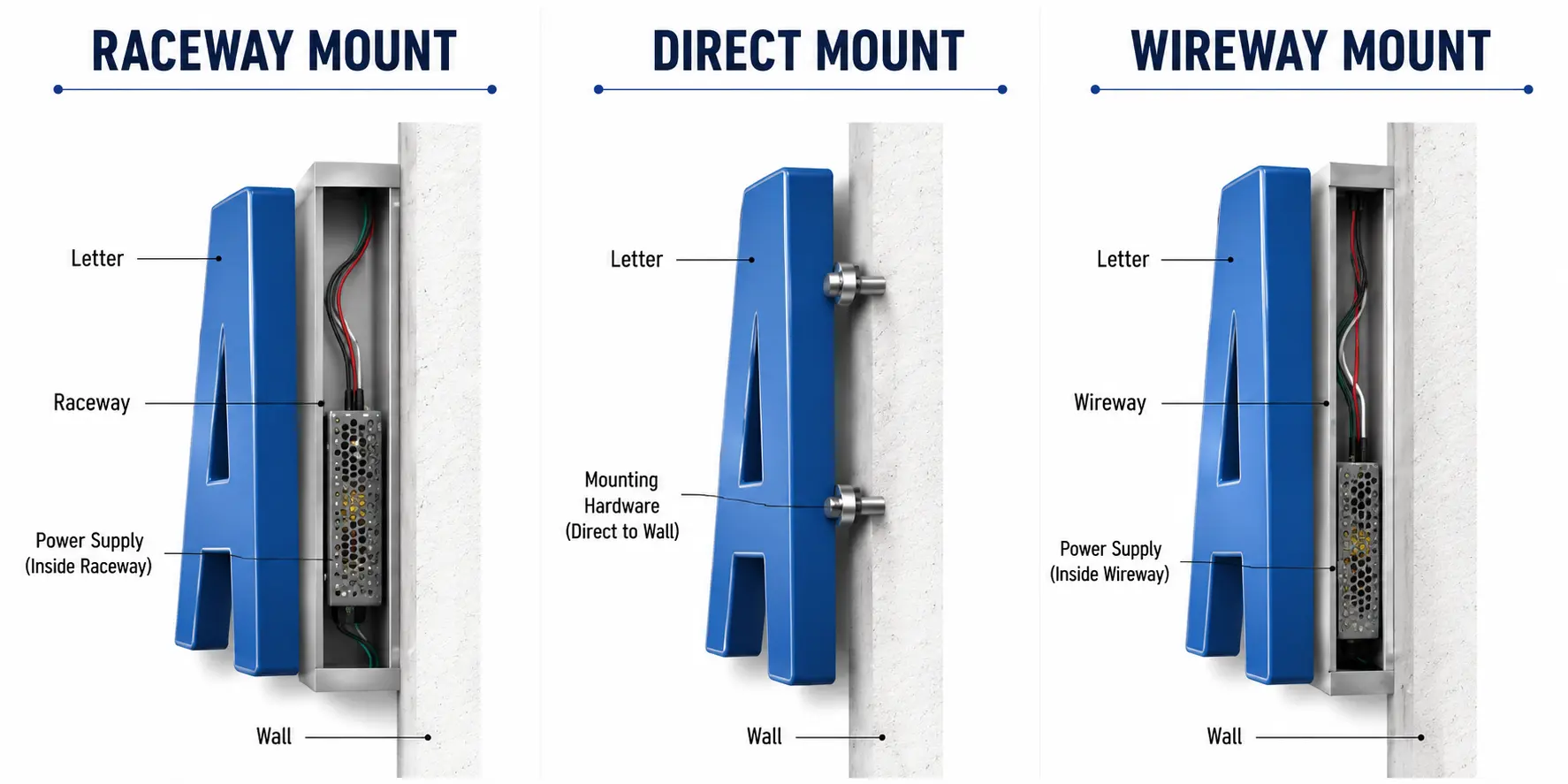
The three mounting methods — direct (flush) mount, raceway, and wireway — trade off visual cleanliness, facade drilling, and how easy the electronics are to service later.
Direct (flush) mount bolts the letters straight to the building surface, with wiring passing through the wall to a driver housed indoors. It gives the cleanest look and is the most cost-effective for smaller signs, but it requires the most drilling into the facade, and servicing the wiring later means removing the sign itself.
Raceway mount attaches a metal enclosure to the wall that houses the wiring Và the power supply, with the letters mounted directly on the raceway. It requires fewer holes in the actual facade than direct mounting and is easier to service — a technician opens the raceway rather than pulling the sign down. The raceway itself is visible but can be painted to match the building. Many lease agreements specifically require raceway mounting for this reason, and it’s also the practical choice for combination letters, since the extra circuit needs room for two drivers.
Wireway mount uses a slim aluminum channel that carries only the wiring — no driver — so the driver sits remotely inside the building. It has the lowest visual profile of the three, making it the best fit where local sign codes restrict how far a sign can protrude from the wall. The trade-off is that electrical servicing still requires removing the sign, since there’s no separate access point the way a raceway offers.
| cách thức | Houses | Facade drilling | tốt nhất cho |
| Direct mount | Wiring only; driver indoors | nhiều hơn hết | Small signs, tight budgets |
| đường đua | Wiring + power supply | Fewest | Lease-required installs; combination letters |
| Wireway | Wiring only; driver remote | Moderate, low profile | Locations with strict protrusion limits |
SignliteLED manufactures illuminated letters for all three mounting methods — see our LED Illuminated Letters Signs page for installation drawings and wiring layouts.
How to choose — final checklist
Confirm these nine points before production to ensure the sign is engineered correctly from the start.
| Mục danh sách kiểm tra | Những gì để xác nhận |
| Brand look | Whether the brand calls for a bold, brightly lit face (front-lit) or a premium, understated glow (halo-lit) — or both with combination. |
| Xem khoảng cách | The farthest point the sign must read from, using the ~10 ft per 1 inch of letter height guideline to set letter size. |
| Indoor / outdoor | Where the sign lives, since it drives IP rating, module choice, and mounting method. |
| Wall color | For halo letters, that the wall is light-coloured and relatively smooth so the halo reflects cleanly. |
| ngân sách | The range, keeping in mind front-lit is lowest, halo-lit higher, and combination highest. |
| điện áp | 12V for shorter letters, 24V for long or large letters to avoid voltage-drop dimming. |
| Xếp hạng IP | IP65 for standard outdoor exposure, IP67 for coastal or wash-down environments. |
| CCT / color | The target white (3000K, 4000K, 6000K, or 9000K) or RGB, matched to the face material and wall. |
| Control needs | Whether the sign needs switching, dimming, color change, or independent front/halo channels — and the controller to manage it. |
Phần kết luận
Choosing between front-lit, halo-lit, and combination letters depends on your brand appearance, budget, and required viewing distance.
The visible lighting style is only part of the decision. The LED engineering inside the sign, including module choice, spacing, voltage, color binning, and IP rating, determines whether the letters remain bright, even, and reliable over time or develop hotspots, patchiness, and uneven brightness.
Get both the visible design and the internal engineering right, and the letters will perform effectively during both the day and night throughout their service life. If you’re weighing letters against a different sign format altogether, see our comparison of channel letters vs. lightbox signs.
Every module in this guide is backed by SignliteLED’s 3+ year warranty, so these engineering choices come with a guarantee, not just a spec sheet
Send your logo, sign size, and location and SignliteLED will recommend the right lit style and modules.
hỏi Ẩn
Bài viết liên quan