Español
  English
  简体中文
简体中文  Deutsch
  Français
  Italiano
  日本語
日本語  한국어
한국어  Polski
  Português
  Русский
  Türkçe
  Nederlands
  Tiếng Việt
  ไทย
ไทย 
To choose a 24V dim-to-warm COB LED strip, confirm its measured color-temperature curve, full-output brightness, finished dimensions and compatibility with your driver and dimmer. Compare price per meter only after matching the protection version and included accessories.
Use the following seven points to prepare your purchasing brief:
- Dim-to-warm range: For a 3000K-to-1800K requirement, confirm the actual color-temperature transition throughout dimming.
- Brightness and efficiency: Specify lumens per meter—such as approximately 700 lm/m at full output—and compare measured lm/W under the same conditions.
- Color rendering: If the project requires CRI Ra ≥90, request results at the relevant dimming levels.
- Chip density and width: If 400+ chips/m is required, confirm the counting method, PCB width and finished dimensions, including protection and connectors.
- Dimming compatibility: Request a tested strip, driver and controller combination for the project’s 0–10V, PWM or TRIAC system.
- Environmental protection: Select the appropriate IP version and confirm sealing requirements and application limits.
- Price and documentation: Compare price per meter, MOQ, included accessories, warranty, datasheet availability and sample options.
What Is a Dim-to-Warm COB LED Strip?
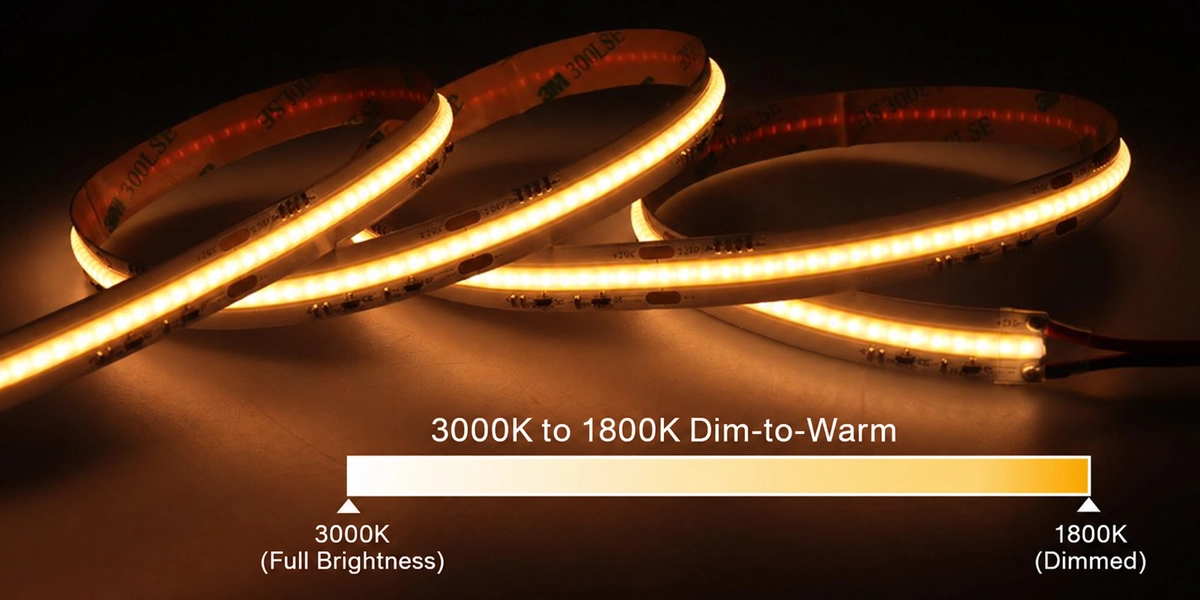
A dim-to-warm COB LED strip, also called a warm dim COB LED strip or dim-to-warm COB LED tape, lowers its color temperature as brightness decreases. A 24V model with a 3000K to 1800K dim-to-warm range produces warm white light at full output and progressively warmer light as it dims.
COB describes the chip-on-board construction used to create a continuous-looking line of light, often described as dotless lighting. The visible result still depends on the strip design and installation. Dim-to-warm describes how color temperature changes with brightness; COB construction alone does not provide this function.
| Característica | Dim-to-warm | Tunable white |
| Main behavior | Light becomes warmer as it dims | Color temperature can be selected within a specified range |
| Brightness and CCT | Follow a linked dimming curve | Can be controlled separately with a suitable system |
| Typical objective | Warmer atmosphere at lower light levels | Different white-light settings for activities or scenes |
| What to verify | CCT throughout dimming | Color range and controller functionality |
A tunable-white strip can be programmed to follow a warm-dimming scene with a suitable control system. Do not assume that function from the CCT range alone. For the underlying concept, see What Is Dim to Warm LED Strip Light?.
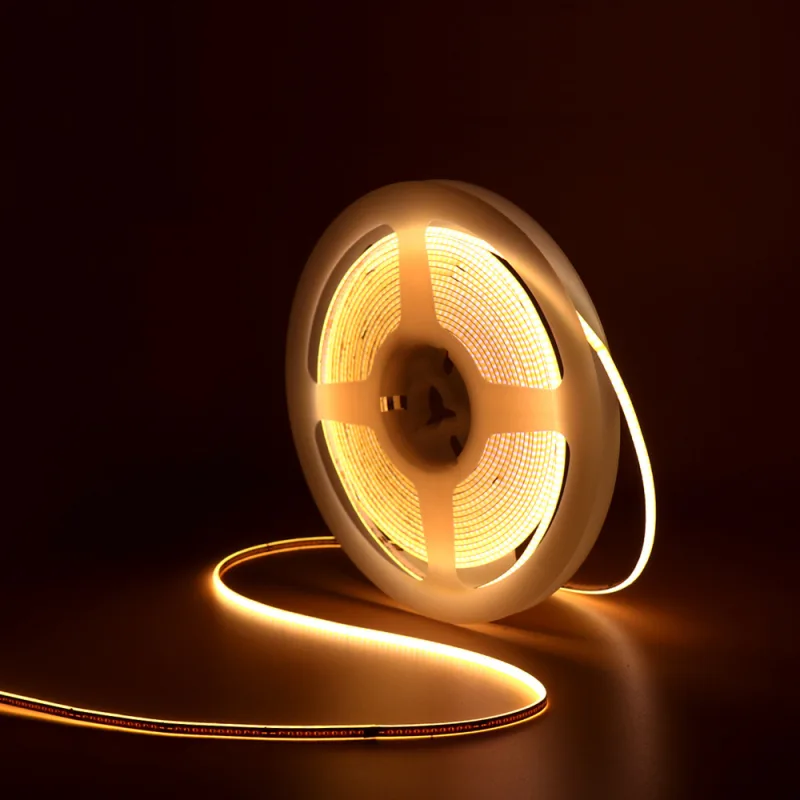
Tira de luz COB CCT de color variable y ajustable
- Tensión de entrada: DC12V/24V
- Power: 7W/m+7W/m
- Chips qty: 608chips
- CCT: CCT 1800-3000K/ 2700K-6500K
- Efficiency: >100lm/W
- Sección de corte: 26.31mm
- CRI: RA90+
- Clasificación IP: IP20/IP65/IP67/IP68
Turn Your Project Requirements into a Clear Specification
Separate essential requirements from preferences. A hotel project may need to retain its existing dimming system, while allowing some flexibility in strip width or light output.
Example purchasing brief — target specifications, not a product datasheet
| Artículo | Example purchasing requirement | Supplier confirmation |
| Tensión | 24 V CC | Rated voltage and required driver type |
| CCT behavior | 3000K at full output, warming toward 1800K | Measured transition and warm-end conditions |
| Densidad | At least 400 chips/m | Total count and counting method |
| Ancho | Within the available installation space | PCB and protected dimensions |
| representación en colores | CRI Ra ≥90 | Results at relevant dimming levels |
| Potencia luminosa | Approximately 700 lm/m at full brightness | Data for the selected CCT, power and IP version |
| Eficacia | Lowest practical power for required output | Measured lm/W and test conditions |
| Regulación | Project’s 0–10V, PWM or TRIAC system | Exact compatible equipment combination |
| Protección | Defined indoor or exposed environment | Construction, sealing and test conditions |
| Precio | Price per meter | Quantity, configuration and included items |
These are purchasing criteria, not a confirmed SignliteLED product configuration.
When suppliers quote “400 LEDs/m” or “480 chips/m,” ask what the number includes. A multi-channel product may divide its total chip count between different CCT channels. Density alone does not establish brightness, efficacy or dimming quality.
Check the Full 3000K-to-1800K Dimming Curve
Matching CCT endpoints do not guarantee matching dimming behavior. One strip may remain near 3000K for much of its dimming range; another may become warmer more gradually. Intermediate scenes matter in hotels, restaurants and residences.
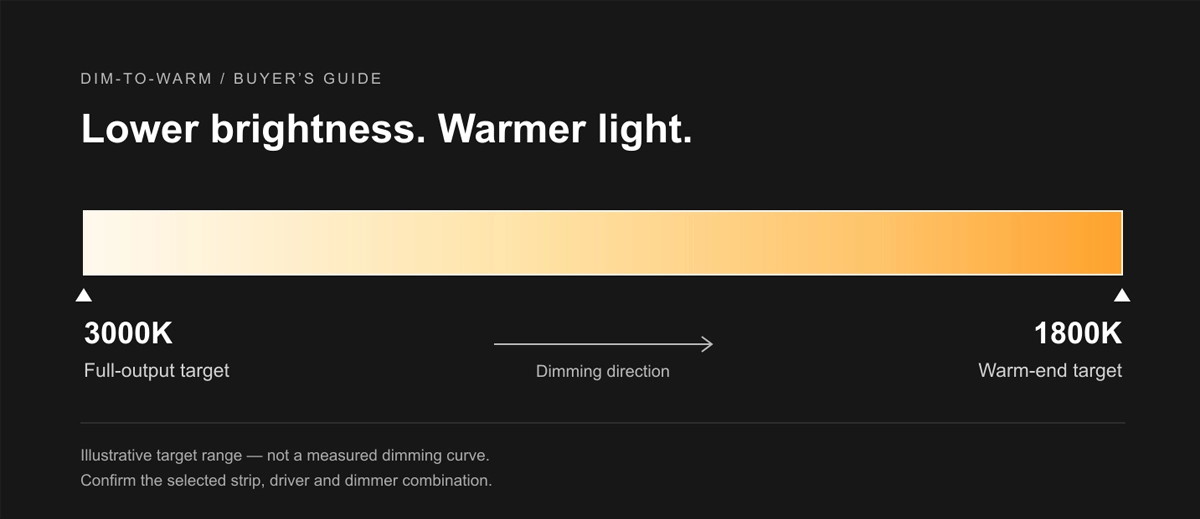
Ask for measured CCT and light output at several control settings, such as 100%, 50%, 10% and the minimum stable level. These are comparison points, not universal performance requirements. A 10% control setting does not necessarily produce 10% of full light output.
Evaluate the sample at the light levels people will actually use. In a hotel room, for example, the brighter setting may be suitable for arrival and unpacking, while a lower setting should create a comfortable evening scene without an abrupt change in color.
Check the transition between these settings and compare the different strip lengths planned for the installation. If CRI 90+ is required in both scenes, request measurements for both; a full-output result only describes that operating point.
Compare High-CRI COB LED Strips: Brightness, Efficiency and Width
When comparing high-CRI dim-to-warm COB LED strips, check color rendering and efficacy for the same model, CCT and dimming state.
Lumens per meter describe light output; lumens per watt describe luminous efficacy. For example, a strip producing 700 lm/m at 7 W/m has a strip-level efficacy of:
700 lm/m ÷ 7 W/m = 100 lm/W
This calculation illustrates how to compare efficacy; it is not a product rating. Use measured output and power for the same model, CCT, CRI and protection version.
Keep the measurement boundary consistent. Strip-level efficacy excludes driver losses, while a calculation based on mains input includes them. Comparing one supplier’s strip-level figure with another supplier’s system-level figure can give a misleading result.
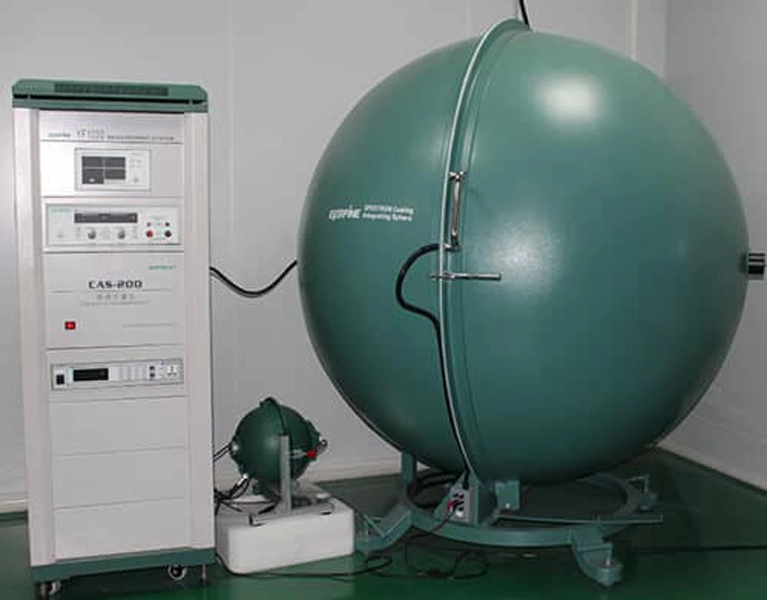
Is 700 lm/m Enough?
It depends on the diffuser, profile, mounting distance, surface reflectance, illuminated area and other lighting. Confirm whether the target refers to the bare strip or the finished luminaire. Evaluate a sample in the intended installation before approval.
How Narrow Should the Strip Be?
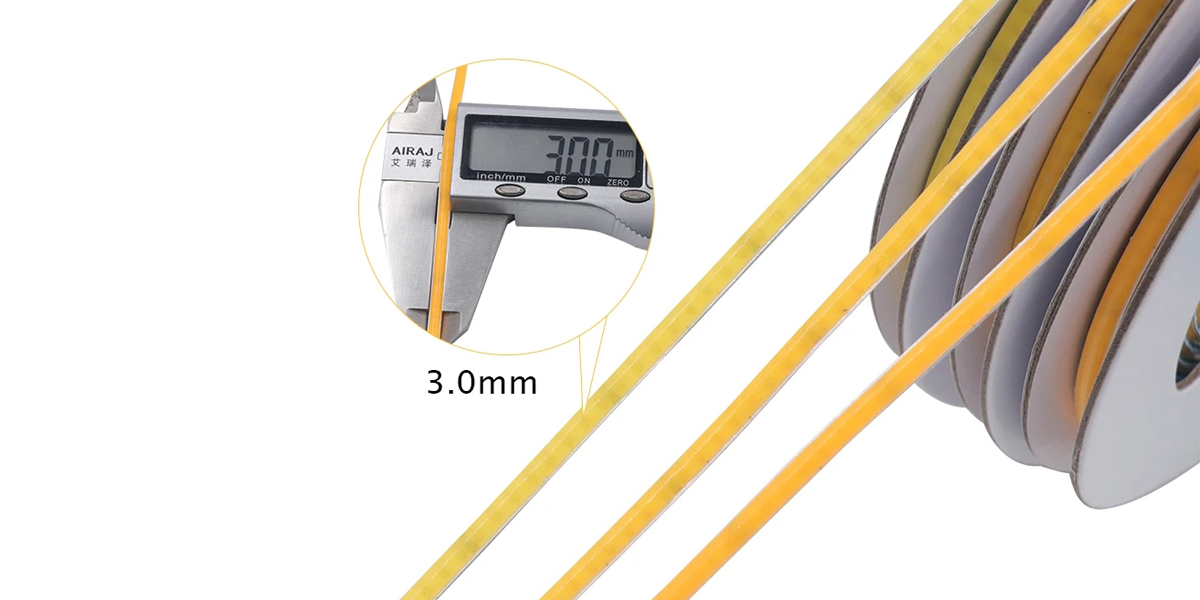
Measure the narrowest part of the installation channel, including corners and cable exits. The PCB may fit while a solder joint, connector or waterproof sleeve does not.
Compare that space with the finished strip dimensions, then check the cutting interval and permitted bend radius. For longer runs, confirm the power-feed arrangement and heat-dissipation requirements before fixing the layout.
En guide to ultra-thin and narrow LED strip lights covers related installation considerations. Confirm which widths are available for the selected dim-to-warm model.
Match the Strip to Your Dimming System
If a project already has wall dimmers or a building control system, start with those details. Send the supplier the control model, planned strip length and power requirement before selecting a driver.
A “dimmable” label is not enough. The same setup must reduce brightness and produce the expected change in color temperature. Our LED strip dimming guide explains the main control methods; for dim-to-warm strips, the color response needs to be checked as well.
0–10V: Check What the Driver Delivers
A driver with a 0–10V input may use a different method to regulate its output. Ask the supplier how that output works with the proposed strip, particularly near the bottom of the dimming range.
Also confirm whether the system dims to off or needs a separate switching function. This matters in hotel rooms and residential installations where users expect the wall control to turn the lights off completely.
PWM: Clarify Which Interface Is Being Specified
“PWM” can refer to a control signal entering a driver or to the power waveform supplied to the strip. These are not interchangeable specifications.
Confirm the supported frequency and whether the proposed combination changes color temperature as intended. A strip may dim under PWM without following the required warm-dimming curve.
For an example of how control inputs and power output are specified separately, see the MEAN WELL PWM driver datasheet. Compatibility still needs to be verified for the selected strip and controls.
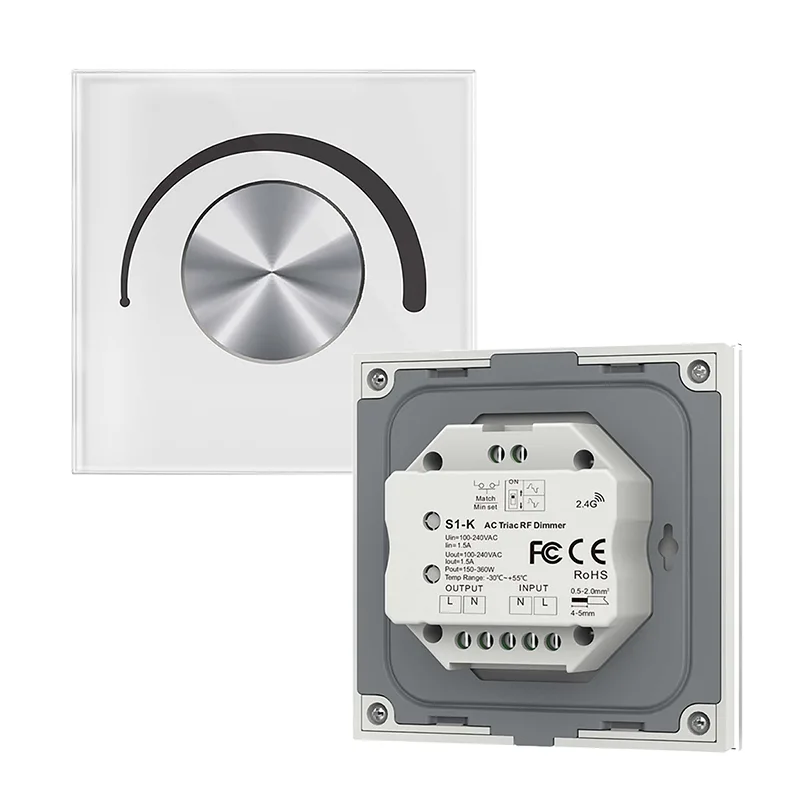
TRIAC: Confirm the Dimmer and Driver Pairing
A TRIAC wall dimmer must work through a compatible driver to control a 24V COB LED strip. It must not connect directly to the strip.
Ask the supplier to confirm the phase-cut type, permitted load and performance with the exact dimmer model. Testing at the planned load is especially useful at low brightness, where flicker, noise or sudden changes may become noticeable.
Before approving the combination, run a sample through its full dimming range. Check startup, shutoff, low-level stability and the transition from brighter warm white to the warmer dimmed setting. Keep the tested equipment models and wiring diagram with the approved specification.
Controlador de panel de atenuación PWM de tira LED COB
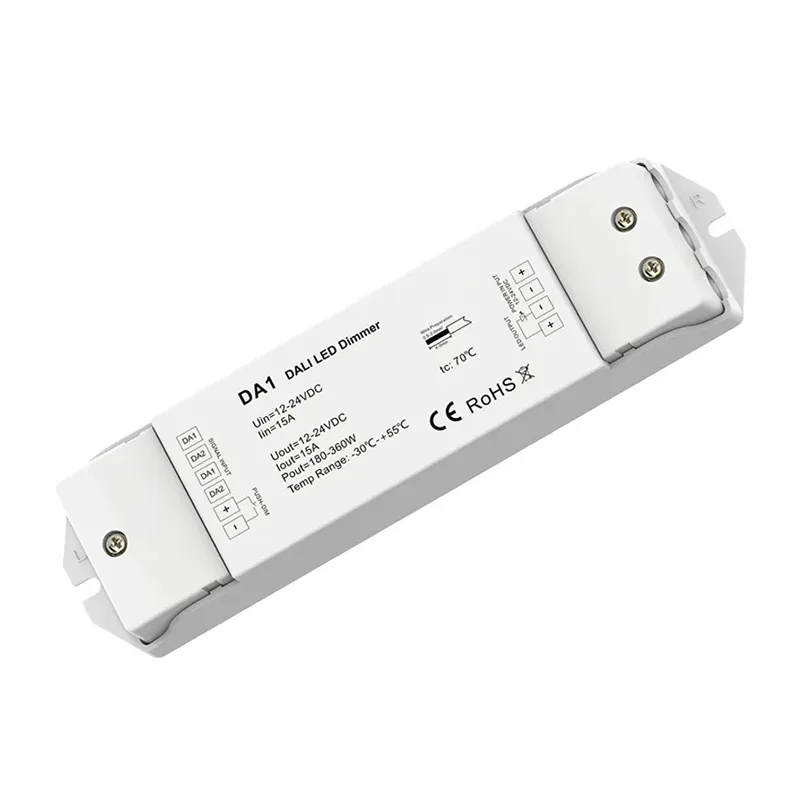
Controlador de atenuación DALI de tira de LED COB
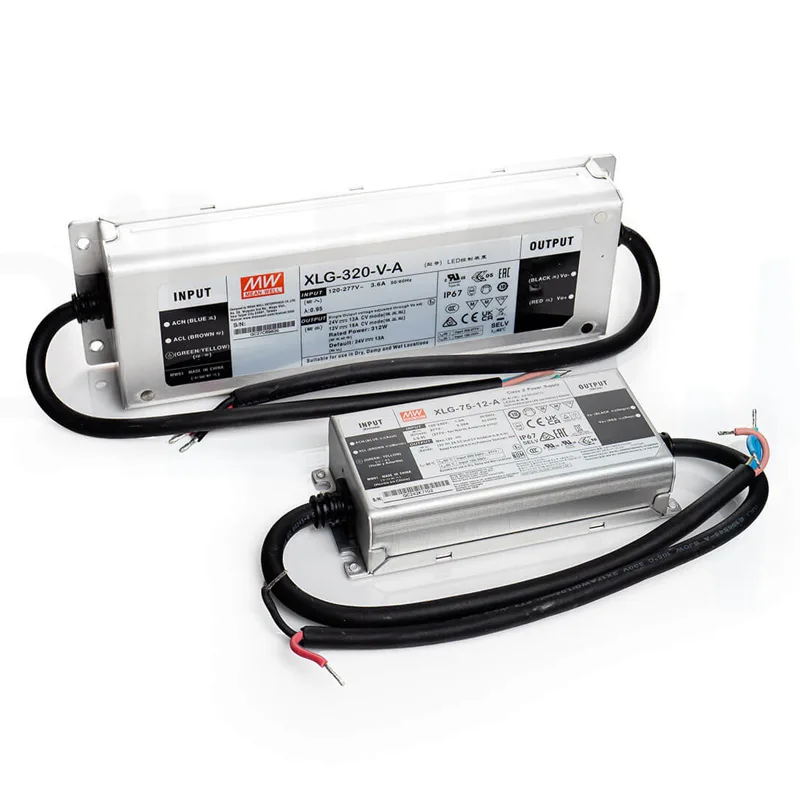
Mean-Well-XLG-Series-Constant-Voltage-LED-Power-Supply
Choose Protection for the Installation Environment
A dry ceiling cove and an exposed outdoor channel need different protection. Tell the supplier where the strip will be installed, how it will be cleaned and whether it may encounter condensation, splashes or immersion.
En Guía de clasificación de IP a prueba de agua de tira de LED introduces the common ratings. The classification itself is defined by IEC 60529, but the IP number alone does not describe every condition a product can withstand.
For dry indoor coves, cabinets and furniture, an IP20 version may be suitable if the strip stays dry and protected. Check for condensation or wet cleaning before deciding that waterproofing is unnecessary.
For splash-exposed locations, check the declared protection of the complete assembly, including the strip, cable exits, connectors and cut ends. If considering IP65, ask whether the product’s construction and documented performance match the actual exposure.
For installations involving immersion, request the applicable test conditions. IP67 addresses temporary immersion under specified conditions; an IP68 version needs a stated depth, duration and application limits. An immersion rating should not be treated as automatic approval for water jets, pools or every outdoor environment.
Outdoor use also raises questions beyond water ingress. Sunlight, temperature changes, salt and cleaning chemicals may affect material selection, so include these conditions in the purchasing brief.
Check the Dimensions After Waterproofing
A narrow PCB may fit the installation groove while the protected strip or connector does not. Waterproof construction can also affect flexibility, heat transfer and light output.
Before ordering, confirm:
- the finished width and height of the quoted version;
- the space required for connectors and sealed ends;
- the permitted cutting and resealing procedure;
- the optical and electrical data for that protection version.
For projects with many short sections, ask whether the supplier can provide factory-cut lengths with fitted leads and sealed ends. This can reduce on-site work, although the complete installation still needs to follow the specified sealing method.
If a specification uses IP65H, clarify what the suffix means and request the supporting documentation rather than assuming it describes a particular waterproof construction.
Compare Quotes for the Complete Supply
A price per meter is useful only when the configuration and included work are clear. One supplier may quote a standard reel; another may include cut lengths, fitted cables and sealed ends.
Give each supplier the same starting specification: 24V, the required dim-to-warm range, CRI, light output, maximum width, IP version and quantity. For a target of approximately 700 lm/m, ask for the corresponding power consumption and measurement conditions.
Then compare what will actually arrive on site.
Look Beyond the Reel Price
Check whether the quotation includes custom cutting, leads, connectors and waterproof end sealing. Drivers, controllers, profiles and mounting accessories may be listed separately.
For example, a lower-priced reel that requires cutting, soldering and sealing on site may cost more to install than prepared lengths. The better option depends on the project layout, labor cost and access for installation.
Keep sample charges, shipping and any development fees separate so they do not get confused with the recurring price per meter.
Separate Standard Options from Custom Development
When sourcing custom dim-to-warm COB LED strips from a manufacturer in China, distinguish between a change to an existing product and a new design requirement.
A custom cable length may involve different work from a new PCB width or a different warm-dimming curve. Ask which requests can be handled using an existing model and which require development and further testing.
En Guía de personalización de tiras LED can help you prepare the specification. Include:
- voltage, color-temperature range, output and CRI;
- maximum finished dimensions and required cut lengths;
- cable lengths and connector types;
- the dimming system and protection requirements;
- order quantity, labels and packaging.
Confirm the MOQ, sample lead time and any engineering charges for the proposed configuration. General customization options should not be assumed to be available on every dim-to-warm model.
Approve the Sample Before the Production Order
The sample should match the quoted strip, protection version and control arrangement. If anything differs, record it and establish what still needs testing.
Before releasing the production order, attach the approved sample reference, specifications, agreed tolerances and tested driver/dimmer models to the purchase documentation. Record any differences between the sample and the production configuration, and confirm the lead time, quotation validity and warranty terms.
Custom Dim-to-Warm COB LED Strips: What Should You Specify?

When sourcing custom dim-to-warm COB LED strips from a manufacturer in China, provide a clear project specification rather than relying on a standard product description.
Include:
- 24V operation and the required warm-dimming range;
- light output, CRI and maximum power per meter;
- PCB width and finished installation dimensions;
- cut lengths, cable lengths and connectors;
- dimming compatibility and IP requirements;
- order quantity, labeling and packaging.
Ask which requirements can be met by an existing model and which require custom development. Confirm MOQ, sample lead time, any engineering charges and test documentation for the proposed configuration.
Preguntas frecuentes
Conclusión
A suitable 24V dim-to-warm COB LED strip should deliver the required light, fit the installation and dim smoothly with the selected controls. Base your decision on data for the quoted model and a sample tested in the intended setup.
For a 3000K–1800K project, compare the color transition as well as full-output performance. Once the configuration is confirmed, compare price per meter together with preparation work, accessories and installation costs.
If you are sourcing from a COB LED strip manufacturer in China, explore the SignliteLED COB LED strip range o send your project requirements to discuss suitable standard or custom options, samples and pricing.
Escrito por: Elaine Zhu, Gerente General de SignliteLED
Revisión técnica: Jason Chen, líder de I+D en Signliteled
Correo electrónico: info@signliteled.com
Publicaciones relacionadas