English
  简体中文
简体中文  Deutsch
  Español
  Français
  Italiano
  日本語
日本語  한국어
한국어  Polski
  Português
  Русский
  Türkçe
  Nederlands
  Tiếng Việt
  ไทย
ไทย 
A reliable COB LED strip light manufacturer is defined as one that consistently delivers CRI ≥90, SDCM ≤3, and stable performance across production batches. These parameters ensure uniform lighting, accurate color rendering, and long-term durability in commercial and architectural applications.
In China’s highly competitive LED market, many suppliers offer similar products, but actual performance can vary significantly due to differences in materials, production control, and testing standards. Selecting the wrong manufacturer often leads to color inconsistency, reduced efficiency, and early product failure.
In this article, we will explain what COB LED strip lights are, how manufacturers differ, which technical factors determine product quality, and how to select a reliable supplier using measurable criteria.
What Is a COB LED Strip Light?
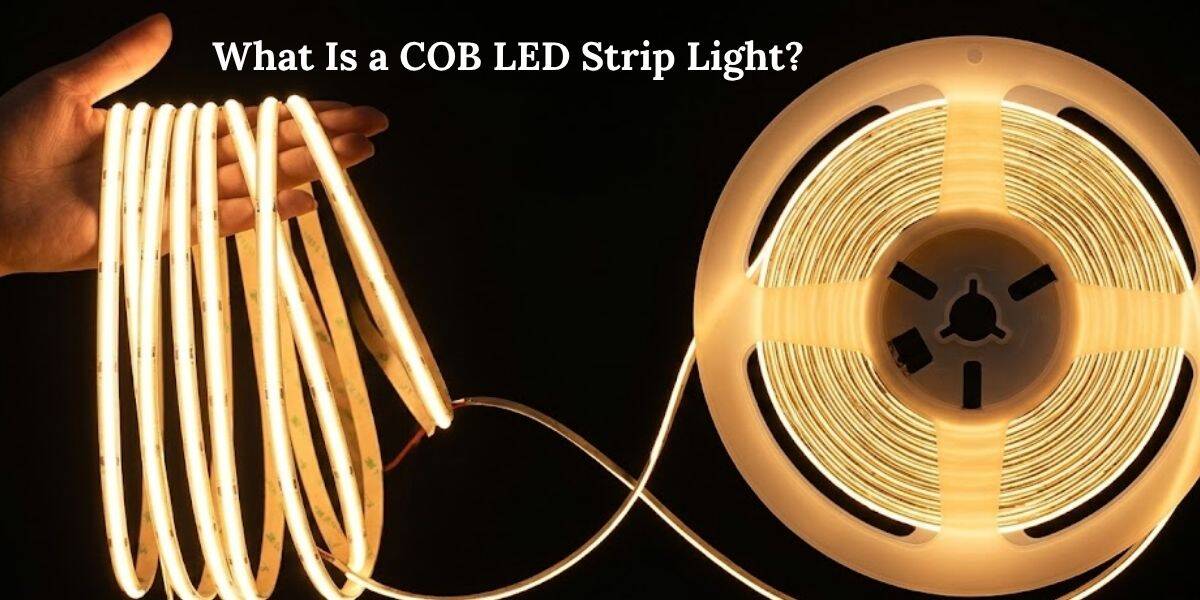
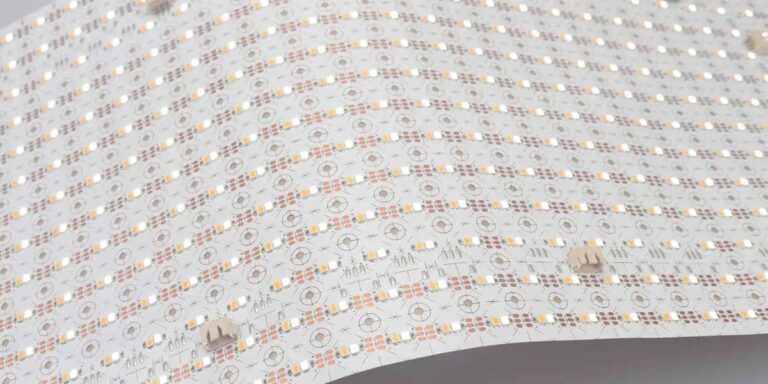
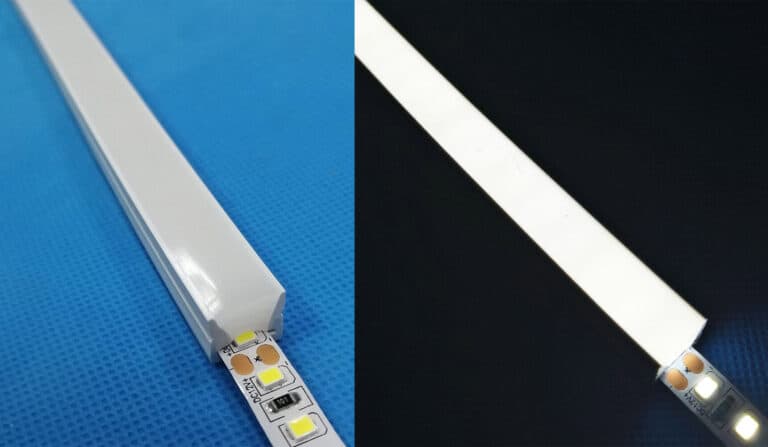
COB LED strip lights are defined as high-density lighting systems where multiple LED chips are mounted directly onto a printed circuit board (PCB) to produce continuous, dot-free illumination.
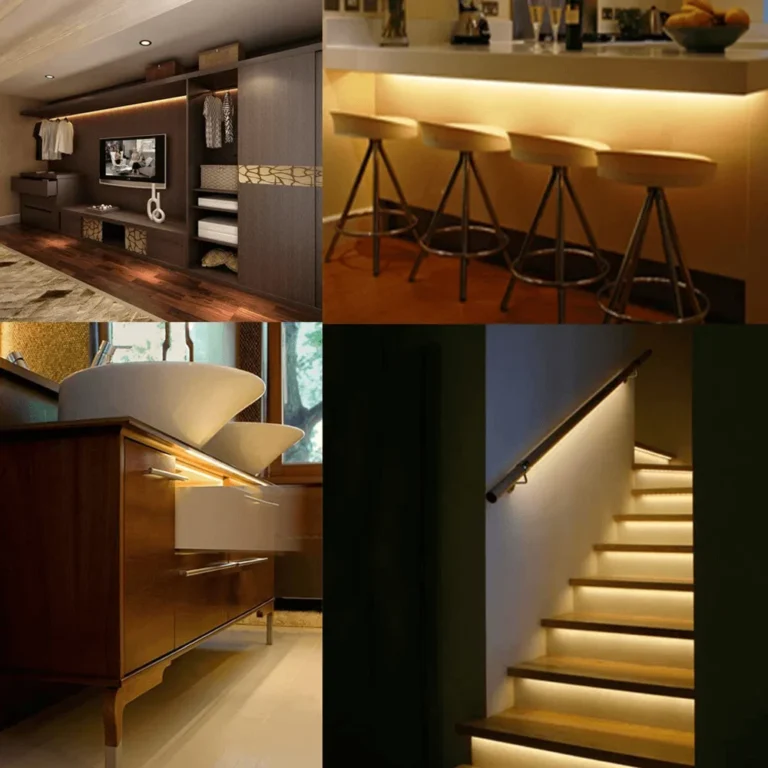
Unlike traditional LED strips, COB technology eliminates visible light نقاط and creates a smooth, uniform light output. This makes it suitable for applications where visual consistency is important, such as architectural lighting, retail displays, and linear installations.
Because of their uniform output and reduced glare, COB LED strips are widely used in environments where both performance and visual quality matter.
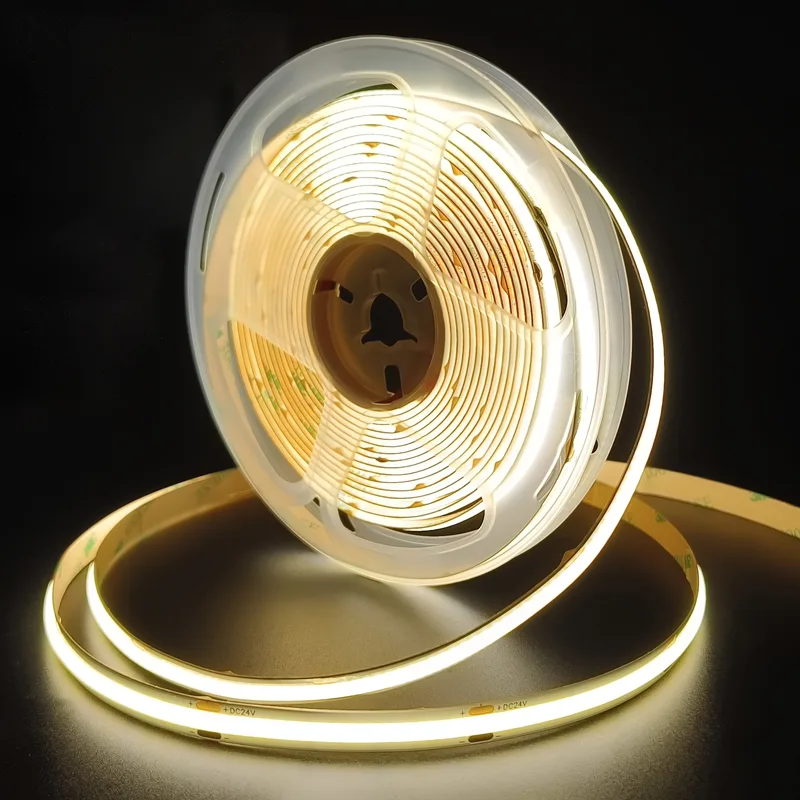
Single Color COB LED Strip Ligh
- LED Chip QTY per Meter: 320/384/480/528chips
- CRI: >90
- PCB Width: 8mm/10mm
- Color Temperature: Red/Green/Blue/3000K/4000K/6000K
- Input Voltage: DC12V/DC24V
- Power per meter: 8W/m, 10W/m, 11W/m, 14W/m
- Efficiency: 90lm/w – 105lm/w
- IP Grade: IP20/IP65/IP67/IP68
- Warranty: 3 years
- Price: USD $0.93-1.65 per meter
What Is a COB LED Strip Light Manufacturer?

A COB LED strip light manufacturer refers to a company that designs, assembles, and tests COB LED strip products. This includes LED chip integration, PCB design, phosphor coating, thermal management, and final quality inspection.
The role of the manufacturer is not limited to production. It also involves maintaining batch consistency, ensuring stable color output, and controlling performance variations across large orders.
In commercial projects, consistency is critical because even small differences in color or brightness can become visible when multiple strips are installed together.
To better understand how COB LED strip lights are produced in real manufacturing environments, the following video demonstrates the key production processes, including chip integration, phosphor coating, and quality inspection steps.

COB vs SMD LED Strip Lights
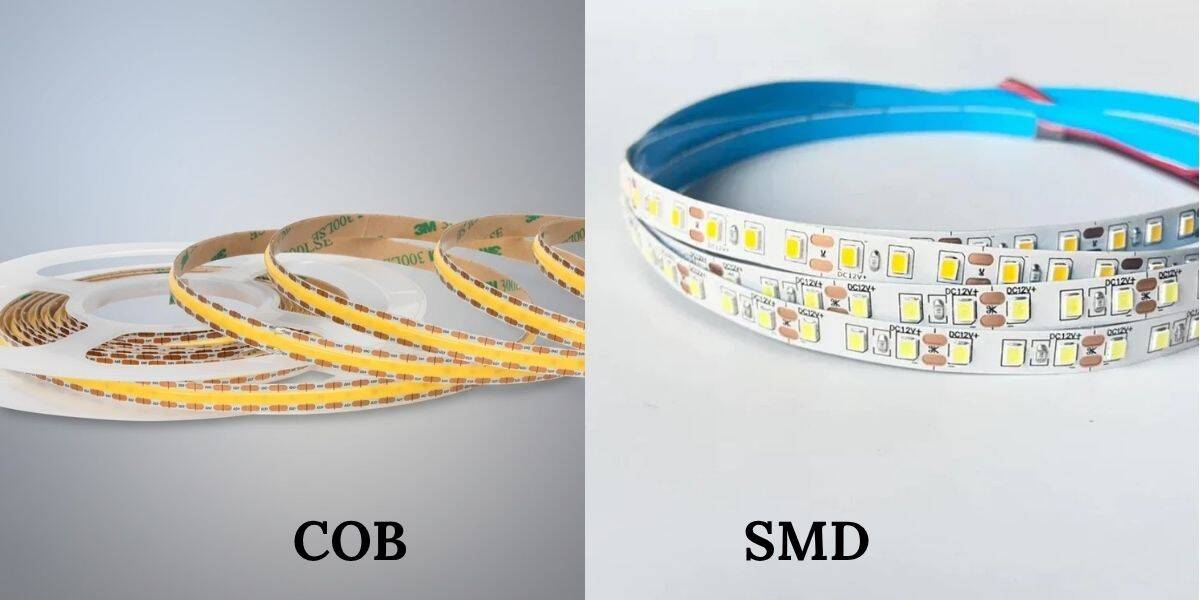
COB and SMD LED strips differ in structure, light output, and application suitability. COB technology focuses on uniformity, while SMD provides more general-purpose lighting.
Comparison Table
| Parameter | COB LED Strip | SMD LED Strip |
| LED Density | 300–800 chips/m | 60–240 LEDs/m |
| Efficiency | 100–140 lm/W | 90–130 lm/W |
| Light Output | Continuous (dot-free) | Visible LED points |
| Uniformity | High | Medium |
COB LED strips provide smoother and more consistent lighting, especially in visible installations.
Decision Insight:
COB LED strips are the better choice for applications requiring continuous and uniform light output.
Key Factors That Define COB LED Strip Quality
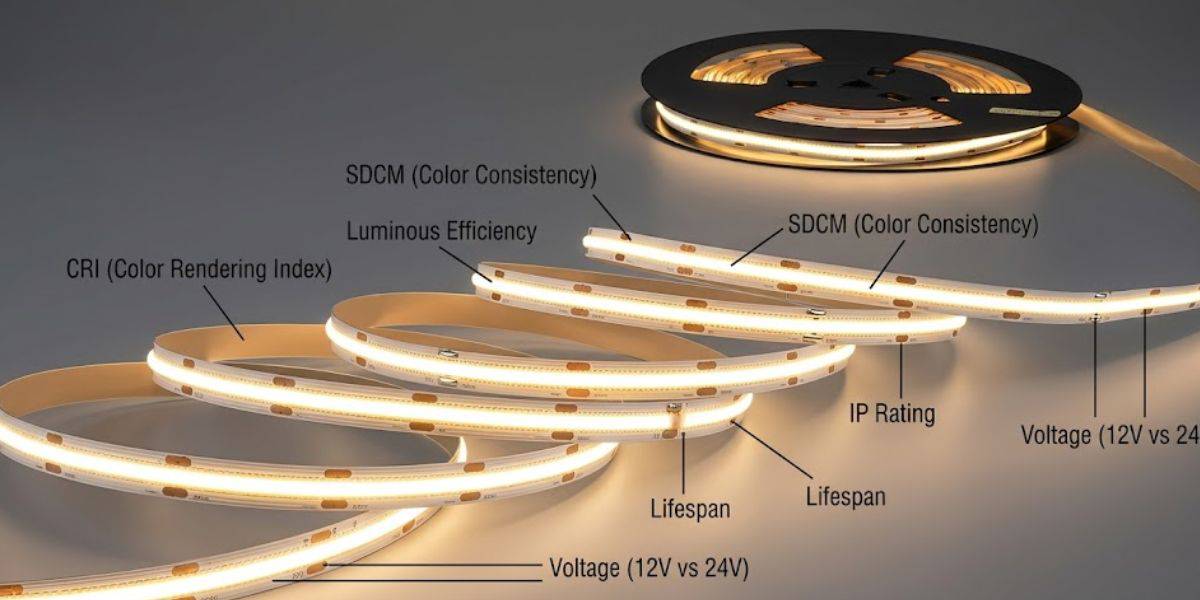
COB LED strip quality is determined by measurable technical parameters that directly affect performance and reliability.
CRI (Color Rendering Index)
CRI measures how accurately colors appear under light. For commercial applications, a value of CRI ≥90 is recommended to ensure natural color representation.
SDCM (Color Consistency)
SDCM measures color variation between LED strips. A value of ≤3 ensures minimal visible color difference across installations.
Luminous Efficiency
COB LED strips typically operate between 100–140 lm/W, depending on chip quality and manufacturing precision.
IP Rating
| IP Rating | Protection Level | Application |
| IP20 | No protection | Indoor environments |
| IP65 | Splash-resistant | Semi-outdoor areas |
| IP67 | Temporary immersion | Outdoor use |
| IP68 | Waterproof | Wet environments |
Lifespan
A typical COB LED strip has a lifespan of around 50,000 hours, assuming proper heat dissipation and operating conditions.
Voltage (12V vs 24V)
Both 12V and 24V systems are used, but 24V is generally preferred for longer installations due to better voltage stability and reduced brightness drop.
Decision Insight:
Manufacturers that consistently meet these technical benchmarks provide more reliable and stable lighting performance.
Types of COB LED Strip Manufacturers in China
COB LED strip manufacturers in China can be categorized based on their production model and capabilities.
OEM / ODM Manufacturers
These manufacturers focus on customized production, offering flexibility in specifications such as length, voltage, color temperature, and waterproofing.
To better understand how different manufacturers are positioned in the market, you can refer to the guide 2025 Top 10 COB LED Strip Light Manufacturers in China , which provides a structured overview of supplier types, capabilities, and market positioning.
Export Manufacturers
Export-oriented suppliers provide products designed for international markets, with certification compliance and standardized production processes.
Specialized COB Manufacturers
These manufacturers focus specifically on COB technology and typically offer improved consistency, better phosphor coating, and more stable performance.
OEM manufacturers are typically preferred for project-based lighting due to flexibility. For example, SignliteLED operates as an OEM/ODM manufacturer, providing customized COB LED strip solutions with controlled production processes and consistent quality output.
Decision Insight:
For most commercial projects, OEM manufacturers offer the best balance between customization and cost efficiency.
How to Evaluate a COB LED Strip Manufacturer
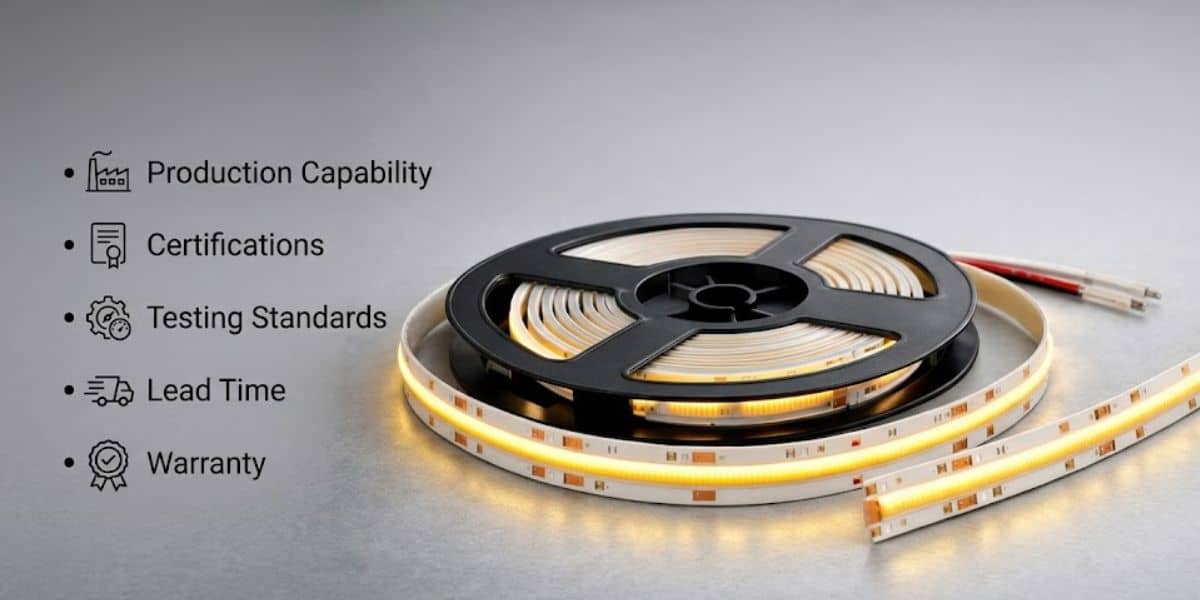
Selecting a manufacturer requires practical evaluation based on performance, certification, and production capability.
Production Capability
Reliable manufacturers maintain stable production lines and consistent output across batches.
Certifications
Products should comply with standards such as CE, UL, and RoHS depending on the target market.
Testing Standards
Professional manufacturers follow testing standards such as LM-80 (LED lifespan testing) and TM-21 (lifetime projection), which provide verified performance data.
Lead Time
Typical production lead time ranges from 2 to 5 weeks depending on order size.
Warranty
A warranty of 3–5 years indicates confidence in product reliability.
In practice, manufacturers such as SignliteLED follow structured testing processes and maintain stable production lines to ensure consistent performance across batches.
Decision Insight:
Manufacturers with verified testing data and consistent production control provide lower risk in commercial lighting projects.
Market Reality: What Buyers Should Know
In the COB LED strip market, not all products perform as claimed.
Some lower-cost products operate below 90 lm/W, even when higher efficiency is advertised. This results in increased energy consumption and reduced performance.
Color inconsistency is another common issue. Products with SDCM >3 often show visible differences when installed together, especially in linear lighting applications.
Thermal management also affects lifespan. Poor heat dissipation can lead to brightness degradation and reduced operating life over time.
Understanding these factors helps buyers avoid common issues and select more reliable products.
Supplier Type Comparison Table
| Supplier Type | Cost Range (USD/m) | Use Case |
| OEM Manufacturer | $3–$8 | Project-based lighting |
| Export Manufacturer | $5–$10 | International supply |
| Specialized COB Supplier | $6–$12 | High-end applications |
Within the OEM category, companies like SignliteLED are commonly selected for commercial lighting projects due to their ability to balance cost, customization, and consistent technical performance.
What are common mistakes when choosing a COB LED strip manufacturer?
Common mistakes refer to typical decision errors that lead to inconsistent lighting performance, reduced lifespan, or project failure due to poor supplier selection.
The most frequent mistakes include:
- Choosing based only on price
Lower-cost products often use lower-grade LED chips or poor thermal design, which reduces efficiency and lifespan. - Ignoring SDCM (color consistency)
Selecting products with SDCM >3 can result in visible color differences across installations. - Skipping certification verification
Products without CE, UL, or RoHS certification may not meet safety or compliance standards. - Selecting incorrect IP rating
Using IP20 strips in humid or outdoor environments can lead to moisture damage and failure. - Overlooking thermal management
Poor heat dissipation reduces LED lifespan and can cause brightness degradation over time.
What should you check before selecting a COB LED strip manufacturer?
A supplier selection checklist is a set of measurable criteria used to evaluate whether a manufacturer can provide consistent quality and reliable performance.
Before selecting a supplier, verify the following:
- CRI ≥90
Ensures accurate color rendering for commercial and architectural applications. - SDCM ≤3
Guarantees consistent color output across multiple LED strips. - Luminous efficiency ≥100 lm/W
Indicates acceptable energy performance for COB LED strips. - Correct IP rating for application
Match IP20, IP65, IP67, or IP68 based on environmental conditions. - Certification compliance (CE, UL, RoHS)
Confirms product safety and suitability for target markets. - Warranty ≥3 years
Reflects manufacturer confidence in product durability. - Stable production capability
Ensures consistency across large orders and multiple batches.
Conclusion
A reliable COB LED strip light manufacturer is defined by measurable performance rather than marketing claims. Key factors such as CRI, SDCM, efficiency, and certification provide a clear basis for evaluation.
Consistency across production batches is equally important, especially in commercial and architectural applications where uniform lighting is required.
Selecting a manufacturer with stable production processes, verified testing standards, and controlled quality ensures long-term performance and reduces project risk.
FAQs
Related Posts