English
  简体中文
简体中文  Deutsch
  Español
  Français
  Italiano
  日本語
日本語  한국어
한국어  Polski
  Português
  Русский
  Türkçe
  Nederlands
  Tiếng Việt
  ไทย
ไทย 
RGB LED strip: Compared to RGBW, RGB has one fewer pad and just four pads, which stand for the three primary colors—red, green, and blue—plus a positive pole.Red, blue, and green light may all be produced by an RGB LED, which when combined, can create millions of distinct colors.Additionally, RGB LED strips have one or more integrated controllers that are capable of controlling every LED in the strip.

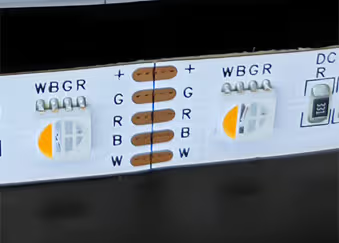
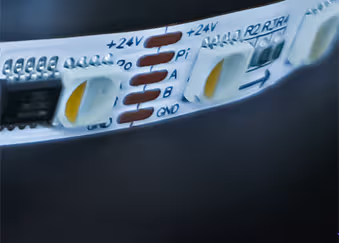
RGB light strips are frequently utilized in home décor, entertainment and event spaces (bars, nightclubs, and theaters), and more to provide an immersive lighting experience!

RGBW LED Strip:Red, green, blue, and white are the four colors that make up the RGBW LED strip.With the addition of white light, RGBW lights resemble RGB lighting. Red, green, blue, and white are the four LED strips used in RGBW LED lights, for instance.Naturally, RGBW is produced using the same principles as RGB, but with the addition of white light. RGBW lights generate a variety of colors by combining the light emitted by the four chips. Usually, the mixing is done in various ratios. Large-scale color mixing, tuned for a color rendering index of up to 95, also results in improved illumination and a higher CRI.
RGBWs are perfect for applications where excellent illumination is necessary. They are also useful in circumstances that call for colored lighting. They are frequently utilized as building and plant decorations as a result.
RGBIC LED Strip: RGBIC is made up of the three main colors—red, green, and blue. By combining the red, yellow, and blue primary colors in various ratios, you can create twelve basic colors. By combining the twelve colors in various ratios, you can create nearly every color.All of the features of an RGB light strip may be completed by an RGBIC light strip. It can emit all three colors of light—red, green, and blue—as well as any mix of them. However, it also includes integrated circuits (ICs), which offer further control over the behavior and illumination of the RGB LEDs on the strip.The strip is divided into several pieces by each IC. There are many LEDs and an IC in each part.Depending on the RGBIC strip type, each section may have a different amount of LEDs. It is possible to regulate each part separately. This implies that several light colors may be shown on a single RGB strip, with a distinct color light being emitted by each segment and even a separate light for every bead.
The installation and configuration procedures for the RGBIC led strip are the same as those for the regular RGB strip light, which is essentially an improved version of it.
RGB/RGBW and RGBIC diagrams for application effects:



What distinguishes RGB from RGBW from RGBIC?
The feature colors and quantity of each type of led strip distinguish RGB, RGBW, and RGBIC led strips from one another.RGB led is less expensive and has flexible length as compared to RGBW led strip. Installation is made simpler and more easy by being able to trim off extra RGB and RGBW lights at the cutting point. The leftover LED strip may be used for various ornamental applications.
An additional RGBIC light strip feature?
As previously said, RGBIC lights are identical to RGB lights in every way, save for a few. Unlike RGB light strips, the manufacturers do not advise cutting RGBIC light strips to change the length. Although they cost a little more, strips alter displays more than RGB strips do.
The RGBIC light band may generate more intricate lighting patterns over the full spectrum since it is separated into many pieces. This is so that each section of the strip may have a different color thanks to IC technology. Additionally, each segment of the RGBIC strip may be independently controlled, allowing for the activation of a single segment while keeping the others off. RGBIC light bands are more distinctive than RGB light bands because of these extra properties.
The amount of characteristics that distinguish RGB and RGBIC lights is what makes them different from one another. As we’ve covered, RGBICs are slightly more costly but offer additional functions.RGB lights are less expensive and have less functions, but they may be cut. You may select the kind of light strip that best fits your lighting requirements and price range by keeping these distinctions in mind.
RGBIC light strips will often provide good value for the money. In the present and the future, RGB fans will use it more and more. Its adaptability makes controlling the RGB setup’s lighting simpler. A more vivid lighting environment results from more intricate patterns. RGB strip lights are still a fantastic option, though, if all you’re looking for is standard RGB capabilities at a reasonable cost.
Related Posts