2011年からの看板とLEDストリップ照明工場

2011年からの看板とLEDストリップ照明工場

PCB と PCBA の違いは何ですか? (2026 年更新)

In the electronics manufacturing industry, “PCB” and “PCBA” are mentioned almost daily. However, these two concepts often cause confusion, even among hardware startups or procurement teams without an electronics background.

Some believe they are merely synonyms, others mistakenly assume PCBA is simply an “upgraded version of PCB,” and some procurement personnel even remain unclear about which service they truly require when requesting quotes.

In reality, the distinction between PCB and PCBA extends beyond definitions, directly impacting product costs, delivery cycles, quality risks, and supply chain complexity. Especially in the context of 2026, where electronics are highly intelligent and AI technology is deeply integrated into manufacturing processes, correctly understanding the distinction between PCB and PCBA has become critical for enterprises to reduce risks and enhance efficiency.

This article will systematically analyze the core differences between PCB and PCBA from multiple dimensions—technical definitions, manufacturing processes, cost structures, industry trends, and procurement decisions—to help engineers and procurement personnel make more informed choices in the early stages of projects.

What is a PCB? (Printed Circuit Board)

What is a PCB (Printed Circuit Board)

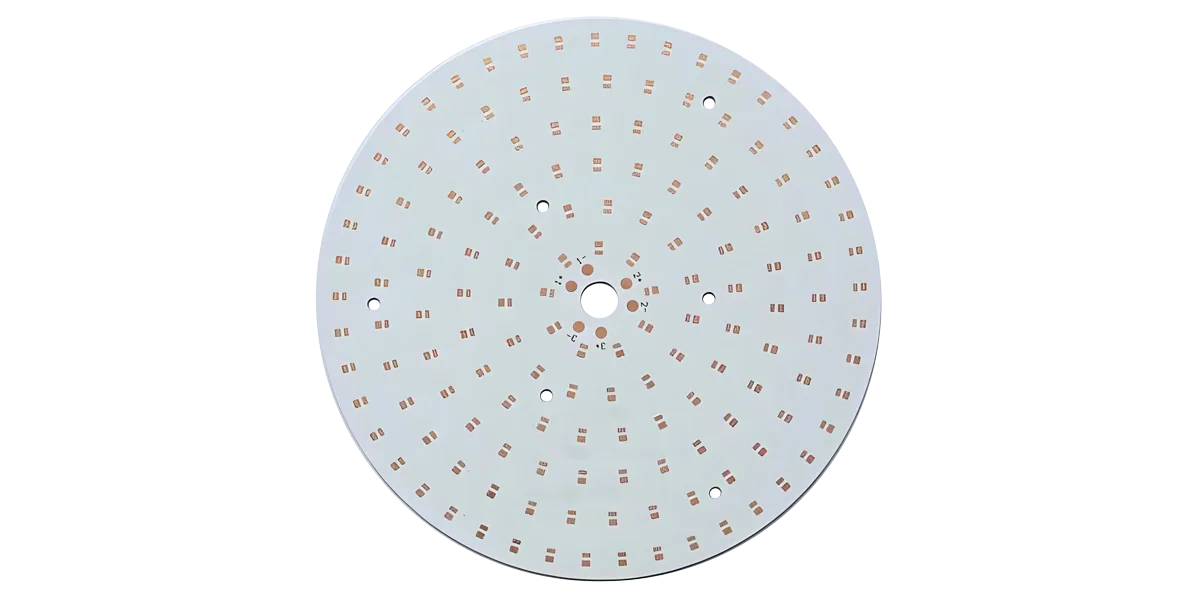
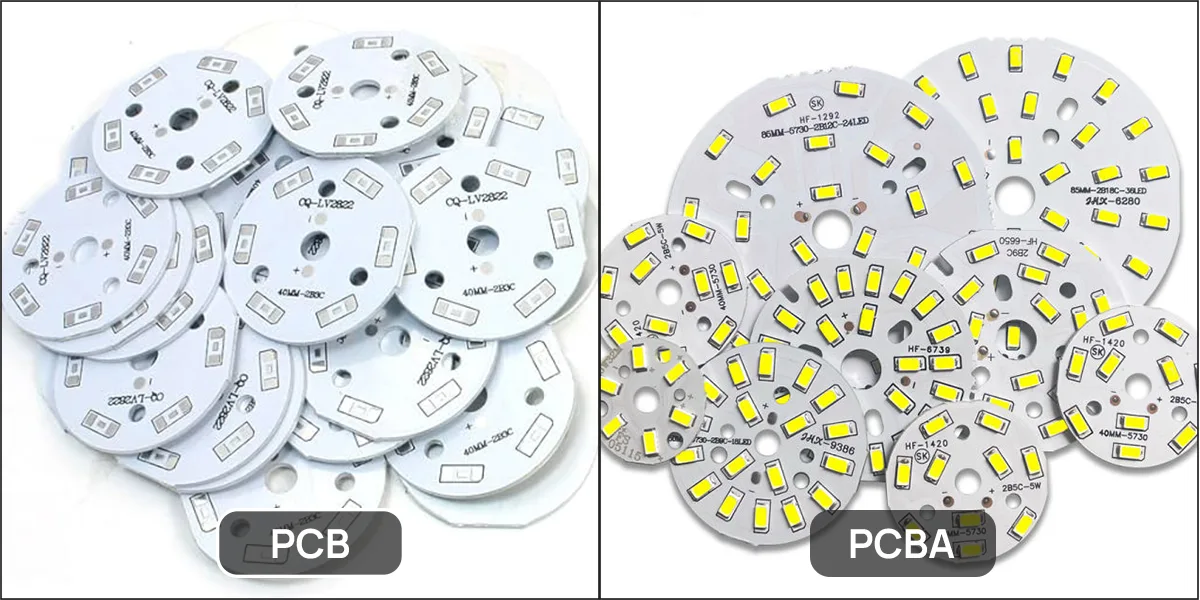
A PCB (printed circuit board) serves as the fundamental carrier for electronic components, enabling electrical connections through copper foil traces, pads, and vias. A PCB refers solely to the “bare board” without any electronic components mounted on it. However, it forms the physical foundation of electronic products, providing the substrate for circuitry and facilitating electrical connections.

PCBs serve as the starting point for all LED lighting systems, whether flexible LED strips or high-power LED modules.

Structural Components of LED PCBs

A typical LED PCB usually includes:

1. Base Material

  • FR-4: Suitable for low-to-medium power LEDs
  • Metal Core PCB (MCPCB): Aluminum or copper-based, widely used in high-power LED strips and modules for superior thermal performance
  • High-frequency Materials: Used in smart lighting and IoT LED systems

2. Copper Layer

Copper thickness (1 oz–6 oz) directly impacts:

  • Current carrying capacity
  • Voltage drop control
  • Thermal management performance of LED strips

3. Solder Mask

Prevents short circuits and oxidation. In the LED industry, white solder mask is widely adopted for its superior reflective properties.

4. Silkscreen

Markings indicate LED polarity, orientation, and part numbers, facilitating mass production and maintenance.

Common PCB Types in the LED Industry

The PCB types and applications in the LED industry are primarily as follows:

タイプ素材アプリケーション・シナリオ
LED フレキシブル ストリップ PCBフレキシブルプリント回路 (FPC)ライトスロット、キャビネット、不規則な設置環境
‌LED Module PCBFR-4 グラスファイバー基板 / アルミ製ベースボード直線ライト、天井灯 (低電力用 FR-4、高出力用アルミニウム)
LED 剛性ストリップ PCBアルミニウム製ベース PCB / 厚い銅製の FR-4 基板線形照明、産業用照明
LED Custom PCB BoardLED カスタム PCB ボードハイエンド/プロフェッショナル照明

What is PCBA? (Printed Circuit Board Assembly)

What is PCBA (Printed Circuit Board Assembly)

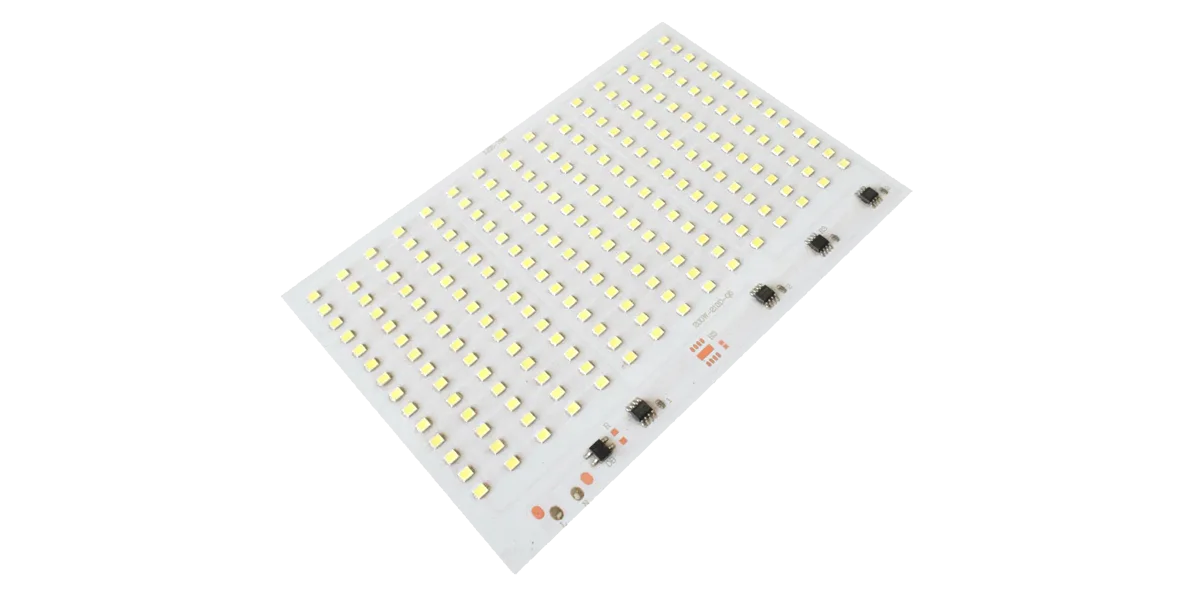
PCBA (Printed Circuit Board Assembly) refers to the finished circuit board produced by soldering electronic components such as resistors, capacitors, ICs, LEDs, and connectors onto a PCB using SMT or THT processes. It possesses complete electrical and functional properties. It is the finished circuit system after electronic components are soldered, assembled, and tested on the PCB.

PCBA is the critical step that makes a PCB “truly functional.”

1. Why Must LED Products Undergo PCBA?

Without PCBA:

  • LEDs cannot illuminate.
  • Constant-current drivers cannot operate stably.
  • Smart control and dimming functions cannot be implemented.

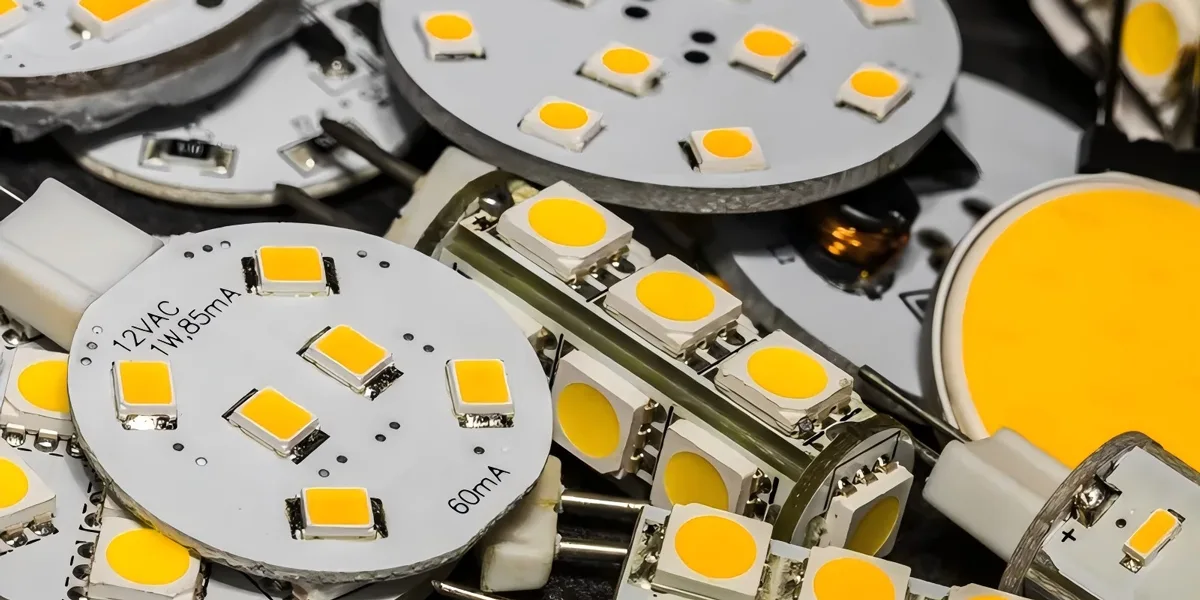
PCBA soldered LED chips, resistors, capacitors, driver ICs, connectors, and other components onto the PCB, transforming it into a functional lighting system.

2. LED PCBA Assembly Processes

  • SMT (Surface Mount Technology)

– Mainstream process for LED strips and modules

– High automation, efficiency, and consistency

– Suitable for high-density LED arrangements

  • THT (Through-Hole Technology)

– Used for power interfaces and high-current terminals

– High mechanical strength and stability

– Hybrid Assembly (SMT + THT)

– Common in commercial and industrial LED fixtures, balancing performance and reliability.

Comparison of PCB and PCBA Manufacturing Processes (Step-by-Step)

Understanding the manufacturing processes is key to grasping their differences.

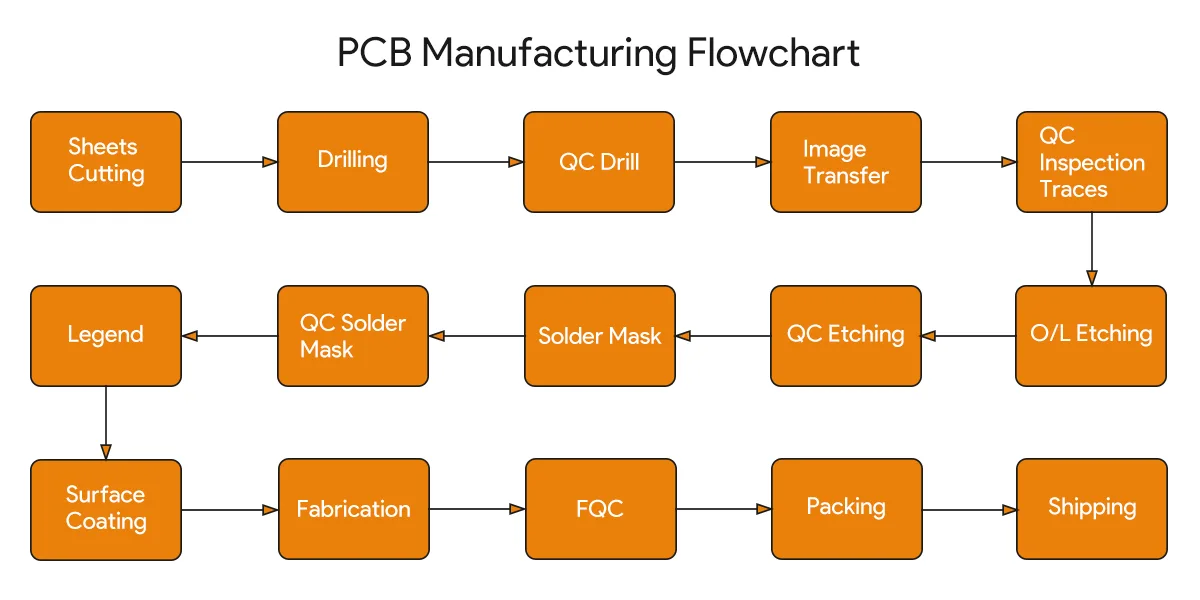
The PCB manufacturing process primarily involves exposure, etching, drilling, plating, etc. Refer to the following diagram for the specific workflow:

PCB Manufacturing Flowchart

At this stage, the completed PCB remains a bare board without any lighting or control functions.

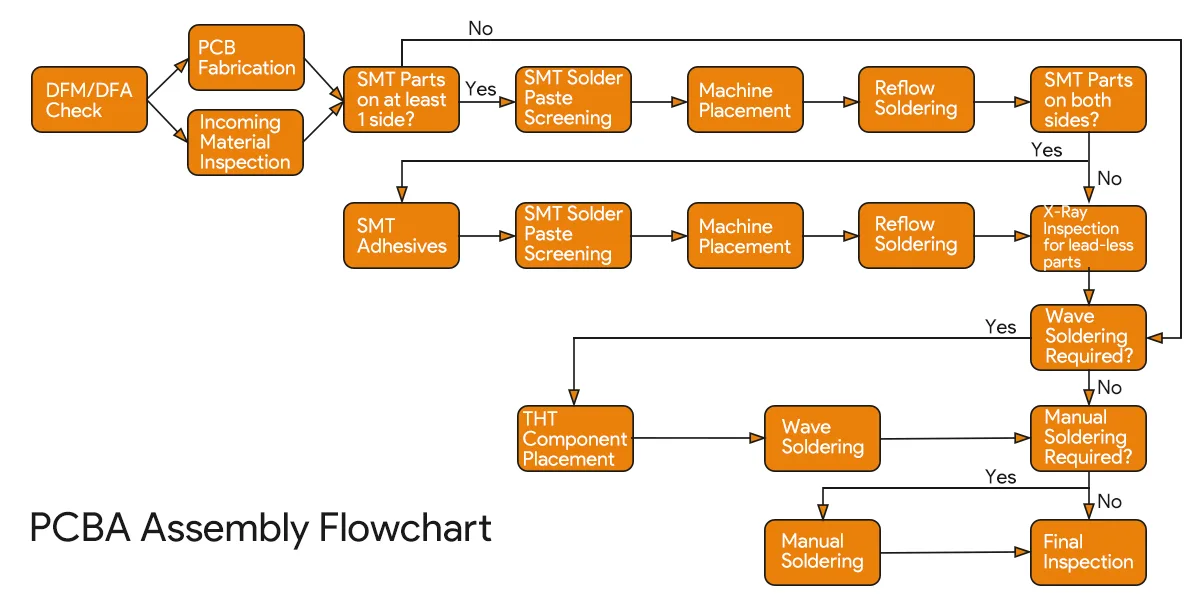
The PCBA manufacturing process primarily includes SMT placement, assembly, and testing. The specific workflow is illustrated in the chart below:

PCBA Assembly Flowchart-3

As shown, the PCBA process is significantly longer than PCB manufacturing and relies more heavily on expertise, equipment, and management capabilities.

PCB vs. PCBA: Key Differences at a Glance

PCB vs. PCBA Key Differences at a Glance

What exactly is the difference between PCB and PCBA? A simple analogy: PCB = the foundational structure, akin to a building’s framework and piping; PCBA = the functional finished product, a fully powered and operational building.

In LED lighting products, a bare PCB alone cannot emit light. Only after completing the PCBA can LED strips or modules function properly.

CategoryPCB (Printed Circuit Board)PCBA (Printed Circuit Board Assembly)
定義A bare board made of insulating substrate and conductive copper traces, without electronic componentsA functional module created by assembling electronic components (resistors, capacitors, ICs, etc.) onto a PCB
主な機能Provides electrical connection paths and mechanical support for componentsPerforms actual electronic functions such as signal processing, power management, and control logic
Physical StateUnpopulated “bare board”Fully assembled and soldered “finished module”
外観Green (or other color) solder mask with visible copper traces and padsCovered with components, solder joints, and leads; functional layout clearly visible
Manufacturing ScopeBoard fabrication onlyComponent sourcing + assembly + testing
生産プロセスMaterial cutting → Copper lamination → Circuit etching → Drilling → Surface finishIncoming inspection → SMT placement → Reflow / Wave soldering → Inspection & functional testing
Key Technical FocusTrace accuracy, impedance control, micron-level etching precisionSoldering quality, placement accuracy, yield control (typically ≥99.9%)
Cost StructureRaw materials + PCB fabrication processesElectronic components (BOM) + assembly + testing
Typical Cost LevelRelatively low (custom PCB: approx. $0.1–$5 per board)Higher (PCBA prototypes typically start from $30, depending on BOM)
Delivery OutputElectrical carrier without functionalityReady-to-use electronic circuit with defined functions

1. Functional Differences

  • PCB: Provides circuit pathways only
  • PCBA: Fully operational LED system ready for power-up

2. Scope of Manufacturing

  • PCB: Circuit board fabrication
  • PCBA: Component procurement + assembly + testing

3. Required Documentation (Frequently Asked Procurement Questions)

PCB Manufacturing Requires:

  • Gerber files
  • NC Drill files

PCBA requires:

  • BOM (Bill of Materials)
  • Pick-and-Place (coordinate files)
  • Stencil files

4. Testing and Quality Control

PCB:

  • Electrical continuity testing
  • Visual inspection
  • Copper thickness measurement
  • Impedance testing

PCBA:

  • SPI solder paste inspection
  • AOI automatic optical inspection
  • X-Ray (BGA, driver IC solder joint inspection)
  • ICT/Functional Testing (Brightness, Current, Stability)
  • Aging and Reliability Testing
  • Luminous Flux and Electrical Performance Testing

5. Packaging and Logistics

  • PCB: Vacuum moisture-proof packaging
  • PCBA: Anti-static packaging (ESD), custom trays

Why is PCBA significantly more expensive than PCB?

Why is PCBA significantly more expensive than PCB

This is one of the most frequently asked questions by procurement personnel. The higher cost of PCBA isn’t simply due to “increased processing fees,” but rather the result of multiple factors:

  • Component costs: Chips, resistors, capacitors, LEDs, driver ICs, and other components often constitute the largest portion of PCBA costs.
  • Labor and equipment investment: High-speed pick-and-place machines, reflow ovens, AOI systems, and testing equipment are all high-value assets.
  • Yield and risk costs: Soldering defects, material flaws, and design issues all carry risks of rework or scrap.
  • Supply chain management costs: Material shortages, component substitutions, and delivery schedule fluctuations require additional coordination.

From a business perspective, PCBA is fundamentally a “system engineering service,” not merely manufacturing processing.

By 2026, artificial intelligence has moved beyond conceptual stages to deeply integrate into PCB and PCBA production, accelerating the industry’s shift toward highly integrated and intelligent manufacturing.

Key trends include:

  • AI-Assisted DFM Analysis: Predicts potential manufacturing issues before production, reducing trial runs.
  • AI-powered AOI defect detection: Identifies complex flaws like cold solder joints and misalignment through deep learning, lowering misjudgment rates.
  • Intelligent scheduling and material forecasting: Optimizes capacity utilization while reducing delivery uncertainty.
  • Closed-loop quality data: Continuously improves yield and consistency through data analysis.

In the future, AI-enabled PCBA factories will gain significant advantages in delivery timelines, quality control, and cost management.

Should you opt for a bare PCB or a one-stop PCBA?

There’s no one-size-fits-all answer—it depends entirely on your project type.

If you have an experienced electronics team and reliable SMT resources and only need bare boards, PCBs offer greater flexibility and may be more cost-effective.

If you aim to reduce coordination costs, minimize quality risks, and accelerate time-to-market, one-stop PCBA is typically the superior choice.

For products like LED light boards, LED モジュール, and smart lighting, PCBA significantly enhances consistency and delivery reliability.

Common PCB/PCBA Procurement Pitfalls

The following errors are frequently encountered in real projects:

  • Providing incomplete or unverified design files
  • BOM discrepancies with actual design
  • Neglecting testing requirements while focusing solely on unit price
  • Assigning complex PCBA projects to PCB suppliers

These issues often remain unnoticed during quoting but amplify risks during mass production.

Procurement Decision Guide: How Should You Choose?

Before finalizing your selection, prioritize evaluating these factors:

  • Project complexity and batch size
  • Internal engineering and supply chain capabilities
  • Requirements for lead time and consistency
  • Need for a long-term, stable partner

The optimal choice is not necessarily the lowest quote but the solution with the lowest overall risk.

結論

In summary, PCBs and PCBAs serve distinct yet complementary roles in electronics manufacturing. PCBs provide the foundational structure and electrical connections, while PCBA delivers complete functionality and commercial value to the product.

For LED lighting manufacturers, understanding the distinction between PCB and PCBA transcends technical considerations—it is a strategic decision. Selecting the appropriate manufacturing and assembly solution helps reduce costs, enhance quality, and accelerate product launches in global markets. As product integration continues to advance, PCBA solutions with engineering capabilities and quality control advantages will play an increasingly vital role in the global electronics and LED lighting markets.

よくある質問

水中と表面の LED フィッシュ ライト: どちらがあなたに適していますか?
あなたが夜の釣り人であろうと、養魚場の運営者であろうと、単にドックを照らそうとしている人であろうと、右側の LED フィッシュ ライトは大きな違いを生む可能性があります。 これらのライトは、暗い海域での視認性を高めるだけでなく、ベイトフィッシュやより大きな捕食者を引き付ける上で重要な役割を果たします...
長い LED ストリップ ライトの設置で電圧降下を防ぐ方法長い LED ストリップ ライトの設置で電圧降下を防ぐ方法
長い LED ストリップ ライトの設置で電圧降下を防ぐ方法
長距離 LED ストリップ ライトの設置では、電圧降下が中心的な問題であり、明るさの不均一と寿命の短縮を引き起こします。 低電圧 LED ストリップ (12V/24V) の電流は、距離の増加とともに減少するため、ワイヤ抵抗による電圧損失が遠端の照明性能に大きく影響します。 介入しないと、電圧降下が過度の明るさを引き起こす可能性があります...
プロフェッショナル照明プロジェクト用COB LEDストリップ - 今すぐ見積もりを請求する!
近年、COB LEDストリップは北米とヨーロッパで人気が高まっており、特にプロフェッショナルなプロジェクトで高品質で均一な照明ソリューションを求める照明デザイナー、請負業者、販売業者の間で人気が高まっている。現代的な建築空間や商業空間では、洗練されたドットレスでエネルギー効率の高い照明が求められるため、COB(チップオンボード)LEDストリップは急速に普及している。
LEDストリップPCBテストLEDストリップPCBテスト
LEDストリップライトはどのような品質テストに合格すべきか?
LEDストリップライトを購入する必要がある場合、これらのストリップの品質がどのような状況なのか心配したことがあるだろうか?設置後、どれくらい持つのか?どのようにこれらのLEDライトストリップの品質を判断するために来るのですか?私は信じている...
カラー照明と白色照明の切り替え-1カラー照明と白色照明の切り替え-1
チューナブルホワイトRGB LEDストリップライトの選び方は?
チューナブル・ホワイトRGBとは? RGB LED :RGB LEDとは、赤、緑、青の3つのLEDチップで構成されたLEDライトビーズのことです。この3つのチップは、赤、緑、青の単色光を個別に発光させることができ、また、大きさを制御することによって、白色光を含む様々な色を混ぜることができる。
SMDストリップと比較したCOB-LEDストリップの明るさSMDストリップと比較したCOB-LEDストリップの明るさ
SMDストリップと比較して、COB LEDストリップは明るいですか?
LEDストリップ照明には、主に2つの技術が使われている:COBとSMD(表面実装ダイオード)だ。COBとSMDは、それぞれ異なる長所と短所を持つ。本記事では、COBとSMDのストリップ照明の違いを検証し、皆さんに...

共有:

フェイスブック
ツイッター
ピンタレスト
リンクトイン
購読する
通知する
ゲスト
0 コメント
最古
最新 最も投票された
インラインフィードバック
すべてのコメントを表示

SignliteLEDブログを検索

カテゴリー

トップへ

今すぐ見積もりを取る