English
  简体中文
简体中文  Deutsch
  Español
  Français
  Italiano
  日本語
日本語  한국어
한국어  Polski
  Português
  Русский
  Türkçe
  Nederlands
  Tiếng Việt
  ไทย
ไทย 
In the electronics manufacturing industry, “PCB” and “PCBA” are mentioned almost daily. However, these two concepts often cause confusion, even among hardware startups or procurement teams without an electronics background.
Some believe they are merely synonyms, others mistakenly assume PCBA is simply an “upgraded version of PCB,” and some procurement personnel even remain unclear about which service they truly require when requesting quotes.
In reality, the distinction between PCB and PCBA extends beyond definitions, directly impacting product costs, delivery cycles, quality risks, and supply chain complexity. Especially in the context of 2026, where electronics are highly intelligent and AI technology is deeply integrated into manufacturing processes, correctly understanding the distinction between PCB and PCBA has become critical for enterprises to reduce risks and enhance efficiency.
This article will systematically analyze the core differences between PCB and PCBA from multiple dimensions—technical definitions, manufacturing processes, cost structures, industry trends, and procurement decisions—to help engineers and procurement personnel make more informed choices in the early stages of projects.
What is a PCB? (Printed Circuit Board)
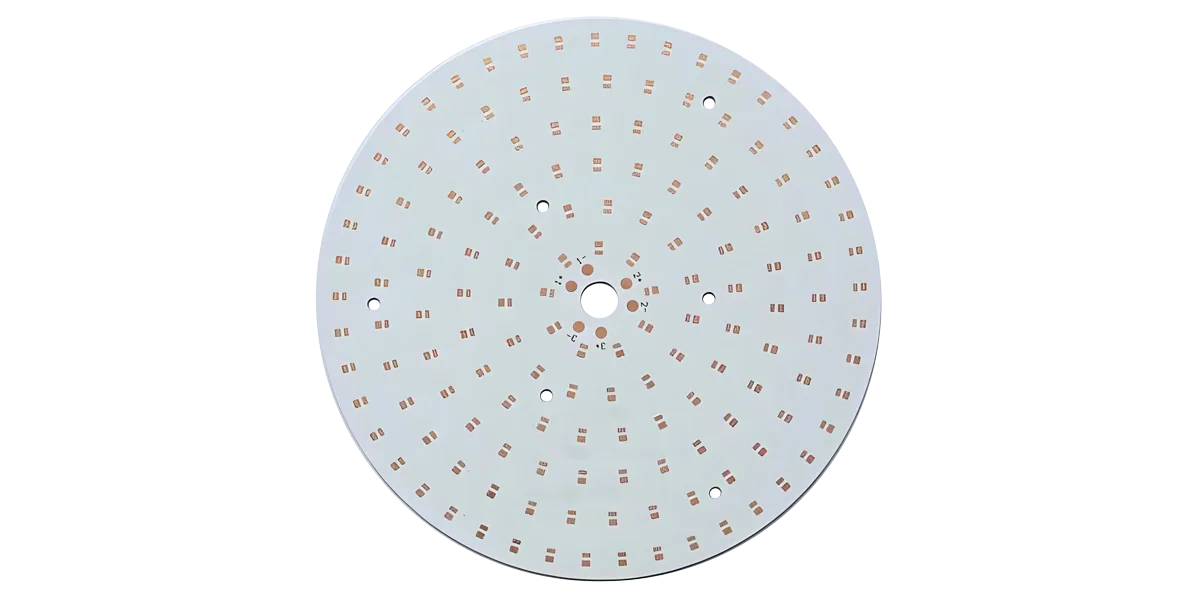
A PCB (printed circuit board) serves as the fundamental carrier for electronic components, enabling electrical connections through copper foil traces, pads, and vias. A PCB refers solely to the “bare board” without any electronic components mounted on it. However, it forms the physical foundation of electronic products, providing the substrate for circuitry and facilitating electrical connections.
PCBs serve as the starting point for all LED lighting systems, whether flexible LED strips or high-power LED modules.
Structural Components of LED PCBs
A typical LED PCB usually includes:
1. Base Material
- FR-4: Suitable for low-to-medium power LEDs
- Metal Core PCB (MCPCB): Aluminum or copper-based, widely used in high-power LED strips and modules for superior thermal performance
- High-frequency Materials: Used in smart lighting and IoT LED systems
2. Copper Layer
Copper thickness (1 oz–6 oz) directly impacts:
- Current carrying capacity
- Voltage drop control
- Thermal management performance of LED strips
3. Solder Mask
Prevents short circuits and oxidation. In the LED industry, white solder mask is widely adopted for its superior reflective properties.
4. Silkscreen
Markings indicate LED polarity, orientation, and part numbers, facilitating mass production and maintenance.
Common PCB Types in the LED Industry
The PCB types and applications in the LED industry are primarily as follows:
| Type | Material | Application Scenario |
| LED Flexible Strip PCB | Flexible Printed Circuit (FPC) | Light slots, cabinets, irregular installation environments |
| LED Module PCB | FR-4 Fiberglass Board / Aluminum Base Board | Linear lights, ceiling lights (FR-4 for low power, aluminum for high power) |
| LED Rigid Strip PCB | Aluminum Base PCB / Thick Copper FR-4 Board | Linear lighting, industrial lighting |
| LED Custom PCB Board | LED Custom PCB Board | High-end / professional lighting |
What is PCBA? (Printed Circuit Board Assembly)
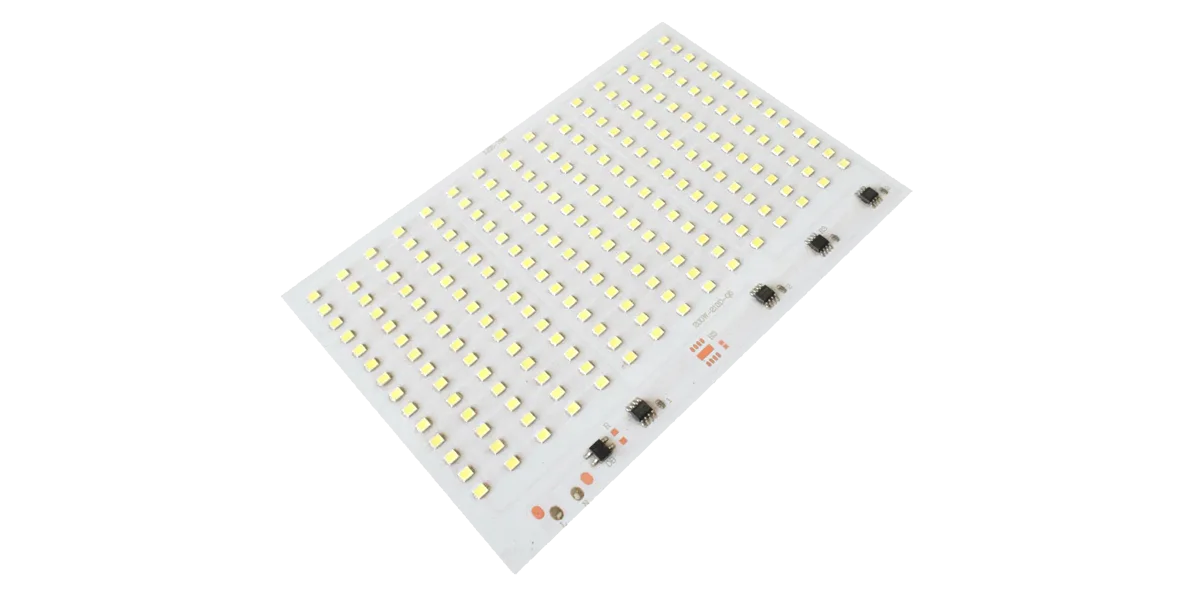
PCBA (Printed Circuit Board Assembly) refers to the finished circuit board produced by soldering electronic components such as resistors, capacitors, ICs, LEDs, and connectors onto a PCB using SMT or THT processes. It possesses complete electrical and functional properties. It is the finished circuit system after electronic components are soldered, assembled, and tested on the PCB.
PCBA is the critical step that makes a PCB “truly functional.”
1. Why Must LED Products Undergo PCBA?
Without PCBA:
- LEDs cannot illuminate.
- Constant-current drivers cannot operate stably.
- Smart control and dimming functions cannot be implemented.
PCBA soldered LED chips, resistors, capacitors, driver ICs, connectors, and other components onto the PCB, transforming it into a functional lighting system.
2. LED PCBA Assembly Processes
- SMT (Surface Mount Technology)
– Mainstream process for LED strips and modules
– High automation, efficiency, and consistency
– Suitable for high-density LED arrangements
- THT (Through-Hole Technology)
– Used for power interfaces and high-current terminals
– High mechanical strength and stability
– Hybrid Assembly (SMT + THT)
– Common in commercial and industrial LED fixtures, balancing performance and reliability.
Comparison of PCB and PCBA Manufacturing Processes (Step-by-Step)
Understanding the manufacturing processes is key to grasping their differences.
The PCB manufacturing process primarily involves exposure, etching, drilling, plating, etc. Refer to the following diagram for the specific workflow:
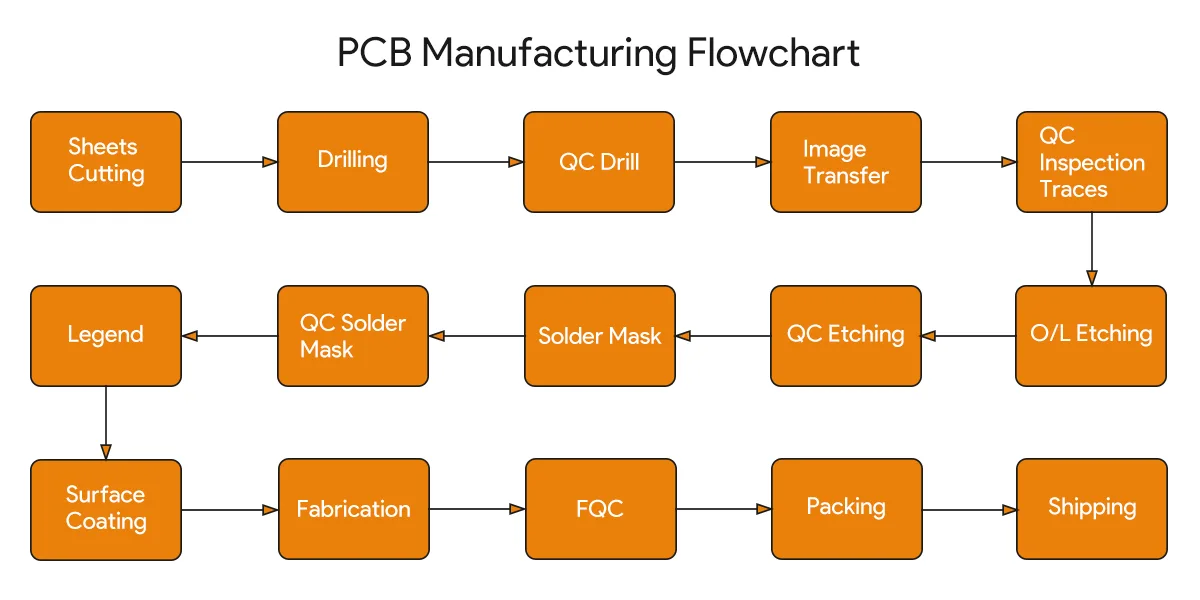
At this stage, the completed PCB remains a bare board without any lighting or control functions.
The PCBA manufacturing process primarily includes SMT placement, assembly, and testing. The specific workflow is illustrated in the chart below:
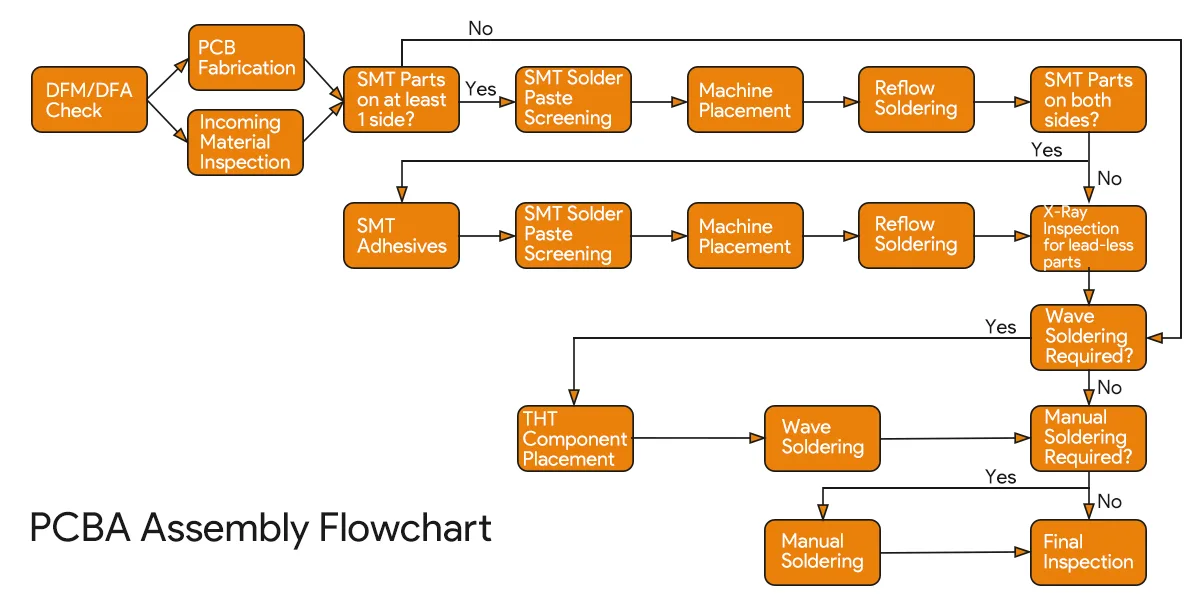
As shown, the PCBA process is significantly longer than PCB manufacturing and relies more heavily on expertise, equipment, and management capabilities.
PCB vs. PCBA: Key Differences at a Glance
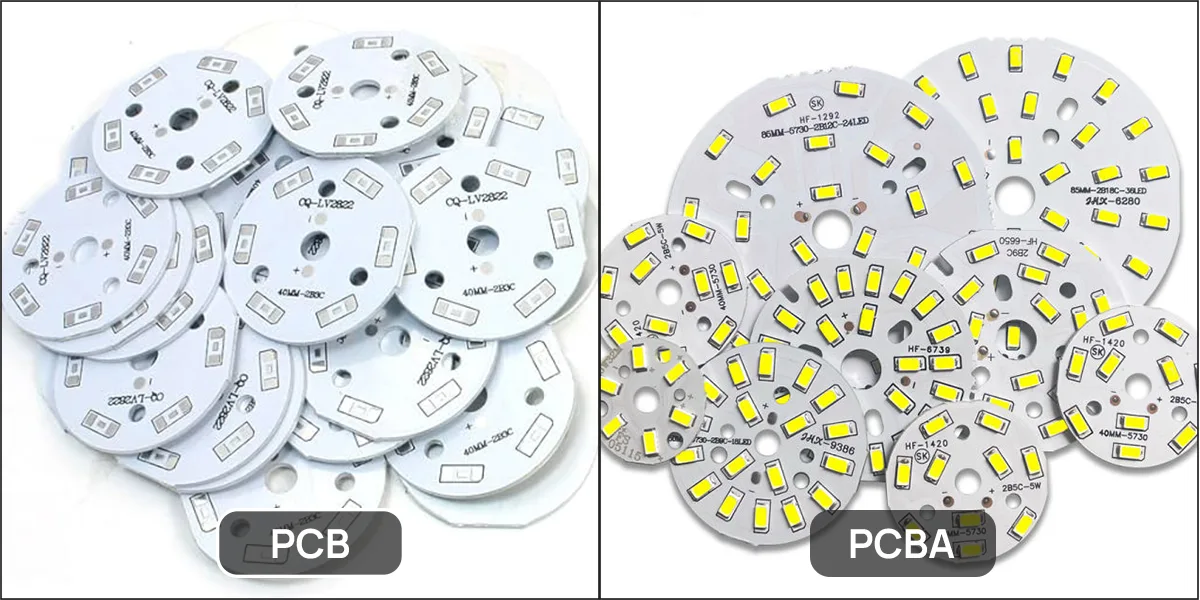
What exactly is the difference between PCB and PCBA? A simple analogy: PCB = the foundational structure, akin to a building’s framework and piping; PCBA = the functional finished product, a fully powered and operational building.
In LED lighting products, a bare PCB alone cannot emit light. Only after completing the PCBA can LED strips or modules function properly.
| Category | PCB (Printed Circuit Board) | PCBA (Printed Circuit Board Assembly) |
| Definition | A bare board made of insulating substrate and conductive copper traces, without electronic components | A functional module created by assembling electronic components (resistors, capacitors, ICs, etc.) onto a PCB |
| Primary Function | Provides electrical connection paths and mechanical support for components | Performs actual electronic functions such as signal processing, power management, and control logic |
| Physical State | Unpopulated “bare board” | Fully assembled and soldered “finished module” |
| Appearance | Green (or other color) solder mask with visible copper traces and pads | Covered with components, solder joints, and leads; functional layout clearly visible |
| Manufacturing Scope | Board fabrication only | Component sourcing + assembly + testing |
| Production Process | Material cutting → Copper lamination → Circuit etching → Drilling → Surface finish | Incoming inspection → SMT placement → Reflow / Wave soldering → Inspection & functional testing |
| Key Technical Focus | Trace accuracy, impedance control, micron-level etching precision | Soldering quality, placement accuracy, yield control (typically ≥99.9%) |
| Cost Structure | Raw materials + PCB fabrication processes | Electronic components (BOM) + assembly + testing |
| Typical Cost Level | Relatively low (custom PCB: approx. $0.1–$5 per board) | Higher (PCBA prototypes typically start from $30, depending on BOM) |
| Delivery Output | Electrical carrier without functionality | Ready-to-use electronic circuit with defined functions |
1. Functional Differences
- PCB: Provides circuit pathways only
- PCBA: Fully operational LED system ready for power-up
2. Scope of Manufacturing
- PCB: Circuit board fabrication
- PCBA: Component procurement + assembly + testing
3. Required Documentation (Frequently Asked Procurement Questions)
PCB Manufacturing Requires:
- Gerber files
- NC Drill files
PCBA requires:
- BOM (Bill of Materials)
- Pick-and-Place (coordinate files)
- Stencil files
4. Testing and Quality Control
PCB:
- Electrical continuity testing
- Visual inspection
- Copper thickness measurement
- Impedance testing
PCBA:
- SPI solder paste inspection
- AOI automatic optical inspection
- X-Ray (BGA, driver IC solder joint inspection)
- ICT/Functional Testing (Brightness, Current, Stability)
- Aging and Reliability Testing
- Luminous Flux and Electrical Performance Testing
5. Packaging and Logistics
- PCB: Vacuum moisture-proof packaging
- PCBA: Anti-static packaging (ESD), custom trays
Why is PCBA significantly more expensive than PCB?
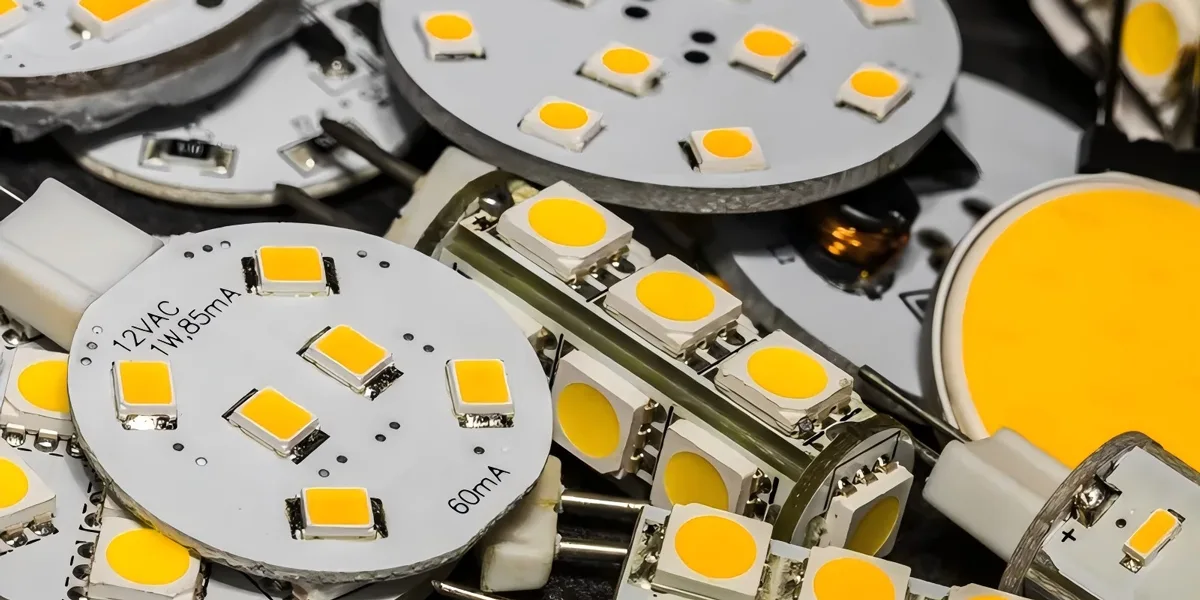
This is one of the most frequently asked questions by procurement personnel. The higher cost of PCBA isn’t simply due to “increased processing fees,” but rather the result of multiple factors:
- Component costs: Chips, resistors, capacitors, LEDs, driver ICs, and other components often constitute the largest portion of PCBA costs.
- Labor and equipment investment: High-speed pick-and-place machines, reflow ovens, AOI systems, and testing equipment are all high-value assets.
- Yield and risk costs: Soldering defects, material flaws, and design issues all carry risks of rework or scrap.
- Supply chain management costs: Material shortages, component substitutions, and delivery schedule fluctuations require additional coordination.
From a business perspective, PCBA is fundamentally a “system engineering service,” not merely manufacturing processing.
2026 Industry Trends: How AI Transforms PCB/PCBA?
By 2026, artificial intelligence has moved beyond conceptual stages to deeply integrate into PCB and PCBA production, accelerating the industry’s shift toward highly integrated and intelligent manufacturing.
Key trends include:
- AI-Assisted DFM Analysis: Predicts potential manufacturing issues before production, reducing trial runs.
- AI-powered AOI defect detection: Identifies complex flaws like cold solder joints and misalignment through deep learning, lowering misjudgment rates.
- Intelligent scheduling and material forecasting: Optimizes capacity utilization while reducing delivery uncertainty.
- Closed-loop quality data: Continuously improves yield and consistency through data analysis.
In the future, AI-enabled PCBA factories will gain significant advantages in delivery timelines, quality control, and cost management.
Should you opt for a bare PCB or a one-stop PCBA?
There’s no one-size-fits-all answer—it depends entirely on your project type.
If you have an experienced electronics team and reliable SMT resources and only need bare boards, PCBs offer greater flexibility and may be more cost-effective.
If you aim to reduce coordination costs, minimize quality risks, and accelerate time-to-market, one-stop PCBA is typically the superior choice.
For products like LED light boards, LED modules, and smart lighting, PCBA significantly enhances consistency and delivery reliability.
Common PCB/PCBA Procurement Pitfalls
The following errors are frequently encountered in real projects:
- Providing incomplete or unverified design files
- BOM discrepancies with actual design
- Neglecting testing requirements while focusing solely on unit price
- Assigning complex PCBA projects to PCB suppliers
These issues often remain unnoticed during quoting but amplify risks during mass production.
Procurement Decision Guide: How Should You Choose?
Before finalizing your selection, prioritize evaluating these factors:
- Project complexity and batch size
- Internal engineering and supply chain capabilities
- Requirements for lead time and consistency
- Need for a long-term, stable partner
The optimal choice is not necessarily the lowest quote but the solution with the lowest overall risk.
Conclusion
In summary, PCBs and PCBAs serve distinct yet complementary roles in electronics manufacturing. PCBs provide the foundational structure and electrical connections, while PCBA delivers complete functionality and commercial value to the product.
For LED lighting manufacturers, understanding the distinction between PCB and PCBA transcends technical considerations—it is a strategic decision. Selecting the appropriate manufacturing and assembly solution helps reduce costs, enhance quality, and accelerate product launches in global markets. As product integration continues to advance, PCBA solutions with engineering capabilities and quality control advantages will play an increasingly vital role in the global electronics and LED lighting markets.
FAQs
Related Posts