2011년부터 간판 및 LED 스트립 조명 공장

2011년부터 간판 및 LED 스트립 조명 공장

고-CRI LED 모듈을 위한 최고의 PCB 설계 실습

High-CRI LED modules are lighting systems designed to reproduce colors accurately under artificial illumination. CRI, or Color Rendering Index, measures how closely a light source reveals colors compared to a natural reference. LEDs with a high CRI value are commonly used in architectural lighting, retail displays, medical environments, studios, and any application where color accuracy matters more than raw brightness.

In these modules, the LED package is only part of the system. The printed circuit board plays a critical role in how consistently the LED performs over time. Compared to standard LED assemblies, high-CRI designs are far more sensitive to heat, electrical instability, and layout decisions. Small variations in junction temperature or drive current can shift the emitted spectrum, reducing color fidelity even when the LED itself is rated for high CRI.

This is why pcb led design for high-CRI applications focuses less on maximizing output and more on maintaining stability. Thermal behavior, current control, and optical uniformity must all work together. A well-designed LED PCB board helps preserve color quality over the product’s lifetime, while poor design choices can undermine even the best LED packages.

What Makes High-CRI LED PCB Design Different

PCB LED 디자인

High-CRI LEDs rely on carefully tuned phosphor systems to shape the output spectrum. These phosphors are more sensitive to operating conditions than those used in standard mid-CRI LEDs.

Phosphor sensitivity and temperature

The phosphor layer converts part of the blue LED emission into longer wavelengths. As temperature rises, phosphor efficiency and spectral balance can change. Even modest increases in junction temperature may lead to measurable shifts in correlated color temperature and CRI. This makes thermal consistency a first-order design concern.

Heat impact on color stability

Inconsistent heat spreading across the PCB can cause different LEDs on the same board to operate at different temperatures. The result is visible color variation across the module. Unlike lumen depreciation, these color shifts can appear early in the product life if the PCB design does not manage heat evenly.

Why PCB design directly affects long-term light quality

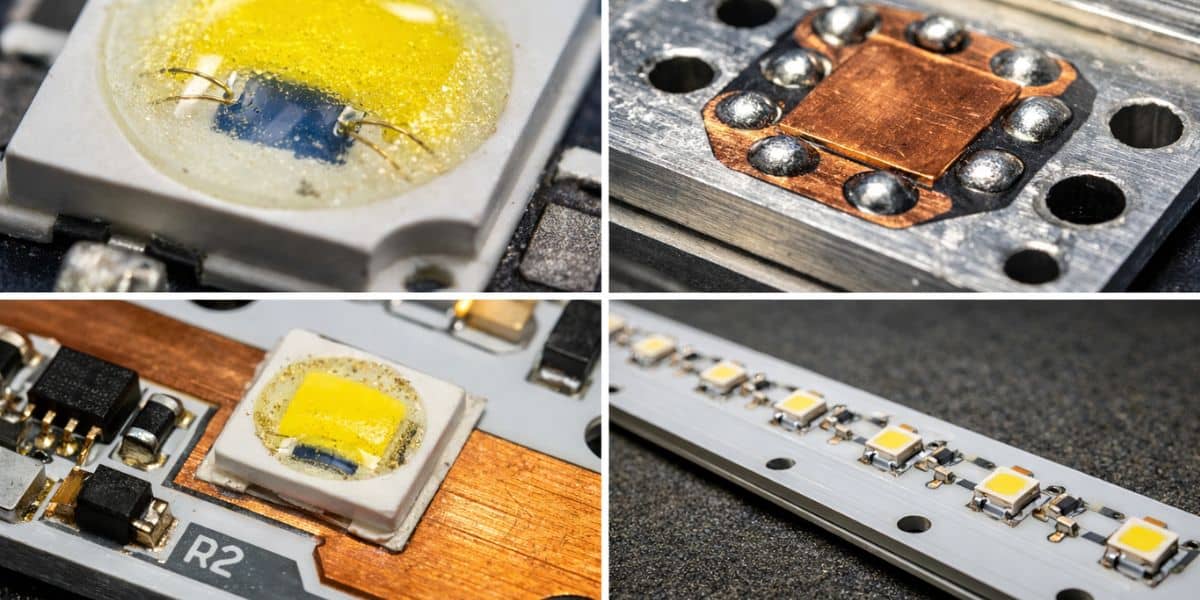
The PCB determines how heat leaves the LED, how current flows through it, and how mechanically stable the assembly remains over time. In high-CRI led pcb design, the board is not just an electrical carrier. It is a thermal and optical control structure that directly influences color stability.

열 관리 

Thermal management is the most critical aspect of pcb led light design for high-CRI applications. The goal is not simply to keep temperatures low, but to keep them uniform and predictable.

MCPCB vs FR-4

For high-power or tightly packed high-CRI LEDs, metal-core PCBs are commonly used.

  • FR-4 boards rely on copper planes and thermal vias to move heat into an external heatsink. They can be suitable for low-power or widely spaced LEDs, but their thermal conductivity is limited.
  • MCPCBs use a metal base, typically aluminum or copper, with a dielectric layer between the copper circuit and the metal core. This structure provides a direct thermal path away from the LED.

For high-CRI modules where color consistency is critical, MCPCBs are often preferred because they reduce temperature gradients across the board.

Aluminum vs copper base

Aluminum-core boards are widely used due to their balance of cost, weight, and thermal performance. Copper-core boards offer higher thermal conductivity but add cost and weight, and are usually reserved for applications with very high power density or limited airflow.

The choice should be based on thermal requirements, mechanical constraints, and system-level cooling, not on assumptions that one material always delivers better color performance.

Thermal vias and copper thickness

On FR-4 designs, thermal vias under the LED thermal pad help move heat into inner copper planes or a heatsink. The number, diameter, and placement of these vias matter more than using them excessively. Poorly placed vias can create uneven heat flow.

Copper thickness also affects heat spreading. Thicker copper planes distribute heat laterally, reducing hot spots and helping maintain consistent LED junction temperatures across the board.

Heat spreading logic

Effective thermal design spreads heat before it removes heat. Large copper areas, symmetric layouts, and consistent layer stacks help equalize temperature. This approach is especially important in linear LED modules, where temperature gradients can otherwise develop from one end of the board to the other.

Power Integrity and Current Control

Electrical stability is closely tied to color stability in high-CRI LED systems.

Importance of constant-current driving

High-CRI LEDs must be driven with a stable constant current. Variations in current directly affect junction temperature and emission spectrum. PCB design supports this by minimizing voltage drops, noise, and parasitic resistance.

Current ripple and flicker impact

Excessive current ripple can introduce flicker and thermal cycling at the LED junction. While flicker is often discussed in terms of human perception, it also contributes to long-term stress on phosphor materials. Proper decoupling and clean power routing on the PCB help reduce these effects.

Trace width, grounding, and decoupling

Wide traces reduce resistive losses and heat generation. A clear grounding strategy minimizes noise coupling into LED current paths. Decoupling capacitors placed close to driver interfaces help stabilize supply voltage and current delivery.

In PCB LED 디자인, these practices are not about pushing performance limits, but about avoiding unnecessary electrical stress that can degrade color quality over time.

PCB Layout and Optical Symmetry

Layout decisions influence both thermal and optical behavior.

LED placement symmetry

Symmetric placement ensures that each LED sees similar thermal and electrical conditions. Asymmetry can lead to localized hot spots, which translate into color variation across the illuminated surface.

Spacing and thermal cross-talk

LEDs placed too close together can heat each other, even if each device is within its rated limits. Adequate spacing allows heat to spread and dissipate more evenly. The optimal spacing depends on power level, board material, and cooling method.

Trace routing away from optical paths

High-current traces should be routed away from reflective or optical areas. This reduces unwanted absorption, shadowing, or localized heating near the emitting surface.

Solder mask reflectivity and stability

Light-colored, non-yellowing solder masks are often used in high-CRI led pcb board designs. While solder mask does not change CRI directly, discoloration over time can affect perceived color uniformity and light appearance.

Material Selection and Surface Finishes

PCB LED 디자인

Material choices influence reliability more than immediate performance.

PCB base materials

Beyond FR-4 and MCPCB options, dielectric materials with stable thermal conductivity and low aging characteristics are important. Inconsistent dielectric performance can alter thermal resistance over time.

ENIG and ENEPIG finishes

ENIG and ENEPIG surface finishes provide good solderability and corrosion resistance. From a color perspective, their value lies in long-term electrical and mechanical stability rather than optical effects.

A reliable finish reduces the risk of contact degradation, which could otherwise lead to uneven current distribution across LEDs.

Long-term reliability considerations

High-CRI applications often expect long service life with minimal color shift. Materials that resist oxidation, delamination, and thermal fatigue support this goal by keeping electrical and thermal paths stable.

Reliability and Protection for High-CRI Modules

PCB LED 디자인

Thermal aging risks

Repeated exposure to elevated temperatures accelerates phosphor aging and can shift color output. PCB design that limits peak temperatures and reduces thermal cycling helps slow this process.

Conformal coating

In harsh environments, conformal coatings can protect the PCB from moisture and contaminants. The coating must be optically stable and compatible with LED operation, as some materials can discolor under heat and light.

NTC thermistors and thermal feedback

Integrating an NTC thermistor on the PCB allows the system to monitor board temperature and reduce current if needed. This form of thermal protection supports color stability by preventing prolonged operation at damaging temperatures.

Common PCB Design Mistakes in High-CRI LED Modules

One frequent mistake is treating high-CRI LEDs the same as standard LEDs. Designs that work acceptably for general lighting may not preserve color quality in high-CRI applications.

Ignoring thermal symmetry can lead to visible color variation across the module. Overdriving LEDs to achieve higher brightness increases heat stress and accelerates color shift. Poor layout decisions, such as narrow traces or uneven copper distribution, introduce electrical and thermal imbalances that undermine long-term stability.

How Proper PCB Design Preserves CRI Over Time

Good pcb led design does not increase CRI beyond what the LED package provides. Instead, it preserves the rated color performance throughout the product life.

This requires system-level thinking. The PCB, driver, mechanical housing, and cooling method must be considered together. When thermal paths are consistent, current delivery is stable, and layout symmetry is maintained, high-CRI LEDs are more likely to deliver consistent color output year after year.

Design choices and their impact

디자인 측면PCB Design ChoiceImpact on CRI Stability
Thermal pathMCPCB with uniform copperReduces temperature gradients
LayoutSymmetric LED placementImproves color uniformity
Power routingWide, balanced tracesMaintains stable current
재질Stable solder mask and finishSupports long-term consistency

결론

High-CRI LED modules demand more from PCB design than standard lighting products. Thermal management, electrical stability, and layout symmetry all play direct roles in preserving color accuracy. A well-executed led pcb design does not promise higher CRI numbers, but it protects the color quality the LEDs are designed to deliver.

By focusing on consistent heat spreading, clean current paths, and reliable materials, engineers can ensure that high-CRI LED modules maintain their intended visual performance throughout their operational life.

자주 묻는 질문

LED PCB 디자인LED PCB 디자인
원예 조명을 위한 LED PCB 설계: 스펙트럼 계획, 열 설계 및 레이아웃 가이드
원예 조명을 위한 LED PCB 설계는 통제된 성장 환경에서 안정적으로 작동하는 안정적이고 장기간의 조명 시스템을 만드는 데 중점을 둡니다. 일반 조명과 달리 원예 시스템은 연속적인 광주기를 지원하고, 밀폐된 고정 장치 내에서 지속적인 열을 관리하며, 전체 성장 주기 동안 일관된 전기 성능을 제공해야 합니다. LED PCB가 어떻게 되는지...
PCB LEDPCB LED
스마트 거리 조명 응용 프로그램을 위한 PCB LED
스마트 가로등의 PCB LED는 발광 다이오드를 목적으로 설계된 인쇄 회로 기판에 직접 장착하여 안정적인 전기 작동, 제어된 방열 및 장기간의 서비스를 통해 일관된 광 출력을 보장하는 실외 조명 솔루션입니다. 이러한 솔루션은 스마트 거리 조명 시스템에 널리 적용됩니다.
LED 스트립 조명은 어떻게 설계 및 제조되나요?LED 스트립 조명은 어떻게 설계 및 제조되나요?
LED 스트립 조명은 어떻게 설계 및 제조되나요?
밤 어스름이 내려올 때마다 수천 개의 유성이 교차하는 듯한 별의 강, 창밖으로 떨어지는 별, 나무 꼭대기 사이로 구불구불한 궤적을 따라 밤의 LED 스트립 빛이 흘러나오고 건물의 벽면 스크린 색상이 수천 가지 색상으로 바뀝니다. 빛의 밴드가 부드럽게 흘러내립니다...
LED 네온 조명과 LED 스트립 조명의 차이점은 무엇입니까?LED 네온 조명과 LED 스트립 조명의 차이점은 무엇입니까?
LED 네온 조명과 LED 스트립 조명의 차이점은 무엇인가요?
LED 기술이 발전함에 따라 LED 조명의 대안이 점점 더 많아지고 있습니다. 집, 직장, 야외 공간에 생동감 있고 역동적인 조명을 추가하는 두 가지 일반적인 방법은 LED 네온 조명과 LED 스트립 조명입니다. 겉보기에는 비슷해 보이지만 두 조명에는 몇 가지 중요한 차이점이 있습니다. LED의 차이점...
LED-module_UNX383BLED-module_UNX383B
LED 사출 성형 모듈을 이해하려면 어떤 전문 지식이 필요합니까?
LED 사출성형 모듈은 우리가 흔히 볼 수 있는 조명 제품으로 지하철 라이트 박스의 발광 제품, 공항 간판의 발광 제품, 거리와 골목의 각종 간판 등에 LED 사출성형 모듈이 사용되고 있습니다. 그는 우리 도시와 마을에 무한한 빛과 재미를 가져 왔습니다!...
LED 사출 성형 모듈의 품질에 영향을 미치는 요인LED 사출 성형 모듈의 품질에 영향을 미치는 요인
LED 사출 성형 모듈의 품질에 영향을 미치는 요인은 무엇인가요?
LED 사출 성형 모듈은 고급 제품이며 용접, 보관, 배치 등 생산 공정에서 고유한 사양과 요구 사항이 있습니다. 이러한 사양과 요구 사항을 함께 살펴보겠습니다. 첫째, 자동 배치 및 리플로 납땜 시 주의사항 1. 리플로우 납땜은 두 번을 초과하지 않아야 합니다. 2. 순서대로...

공유하다:

페이스북
지저귀다
핀터레스트
링크드인
구독하다
알림
guest
0 댓글
가장 오래된
최신 가장 많이 투표된
인라인 피드백
모든 댓글 보기

SignliteLED 블로그 검색

카테고리

위로

지금 견적을 받으세요