한국어
한국어  English
  简体中文
简体中文  Deutsch
  Español
  Français
  Italiano
  日本語
日本語  Polski
  Português
  Русский
  Türkçe
  Nederlands
  Tiếng Việt
  ไทย
ไทย 
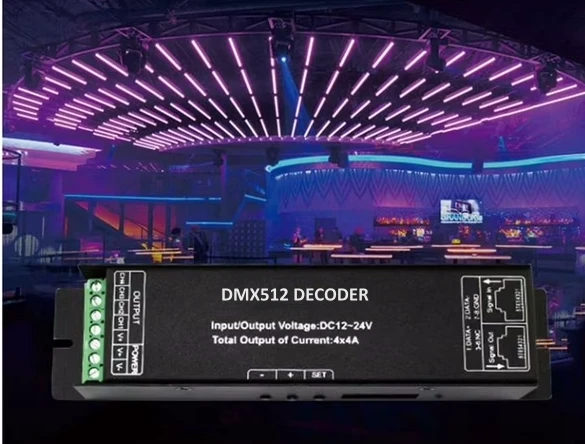
Choosing a DMX512 decoder may seem straightforward, but in real lighting projects, it often determines whether a system performs reliably or becomes a source of ongoing issues. Many users focus primarily on power ratings or basic compatibility, only to encounter problems such as flickering, unstable dimming, or inconsistent control after installation.
From the perspective of professionals who have worked across a wide range of DMX lighting projects and system integrations, a DMX decoder is far more than a simple accessory. It is a critical link between the controller and the lighting fixtures. In this article, we highlight the most important factors to consider when selecting a DMX512 decoder for your lighting setup, helping you avoid common mistakes and achieve stable, professional results.
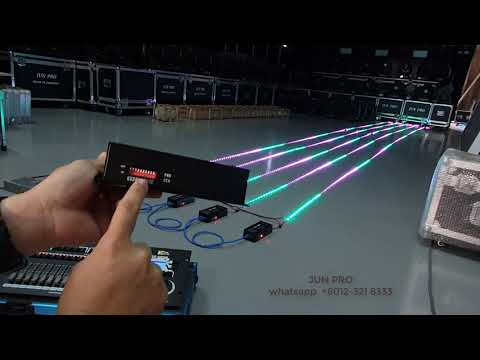
Signal Stability Is the Foundation of Any DMX System
In many DMX lighting projects, system instability is often blamed on controllers or fixtures. In practice, however, the decoder itself is a very common source of problems. DMX512 is a digital control protocol based on RS-485, which makes it highly sensitive to signal quality, electrical interference, and grounding conditions. When signal handling is not stable, issues such as flickering, delayed response, or random brightness changes can occur, even if all components appear compatible on paper.
From project implementation experience, one of the most critical factors is whether the decoder provides proper electrical isolation and reliable signal processing. Electrical isolation helps prevent noise, voltage differences, and ground loops from entering the control signal, particularly in larger installations or systems powered from multiple sources. Without sufficient isolation, DMX signals can easily become distorted, leading to unpredictable behavior across the lighting system.
Signal stability becomes even more important in projects with long DMX cable runs, multiple decoders connected in series, or equipment sourced from different brands. In these situations, a decoder that strictly follows DMX512 standards and maintains clean signal transmission can significantly reduce commissioning time and long-term maintenance issues. In real-world projects, stable signal performance is often the difference between a system that simply “works” and one that works reliably every day.
Channel Configuration Must Match the Lighting Application
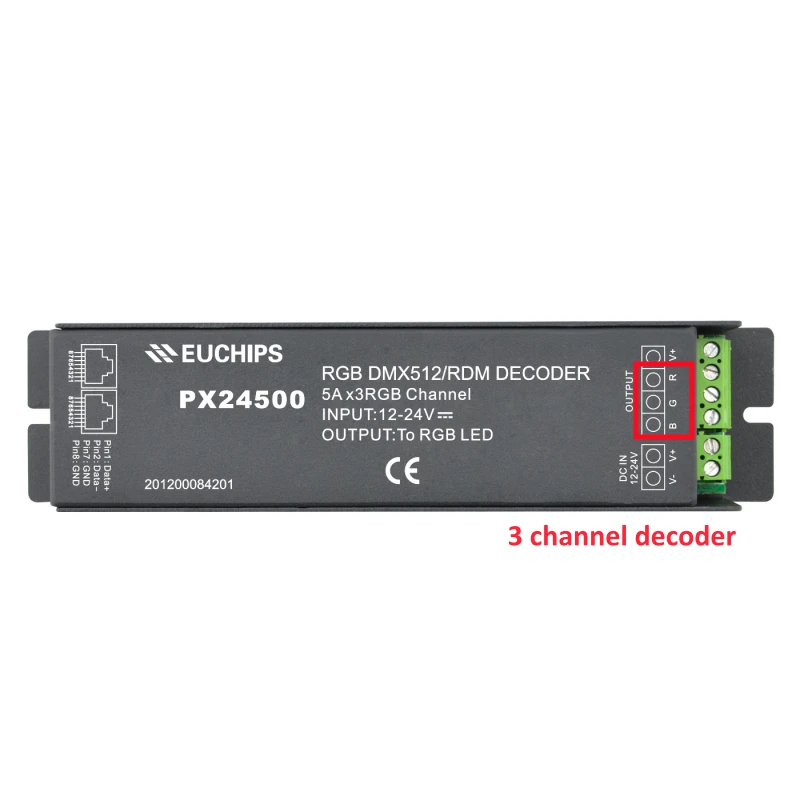
In DMX lighting projects, many control issues originate from incorrect channel configuration rather than hardware failure. Different lighting types require different control logic, and the decoder must support the correct channel structure to ensure predictable and intuitive operation.
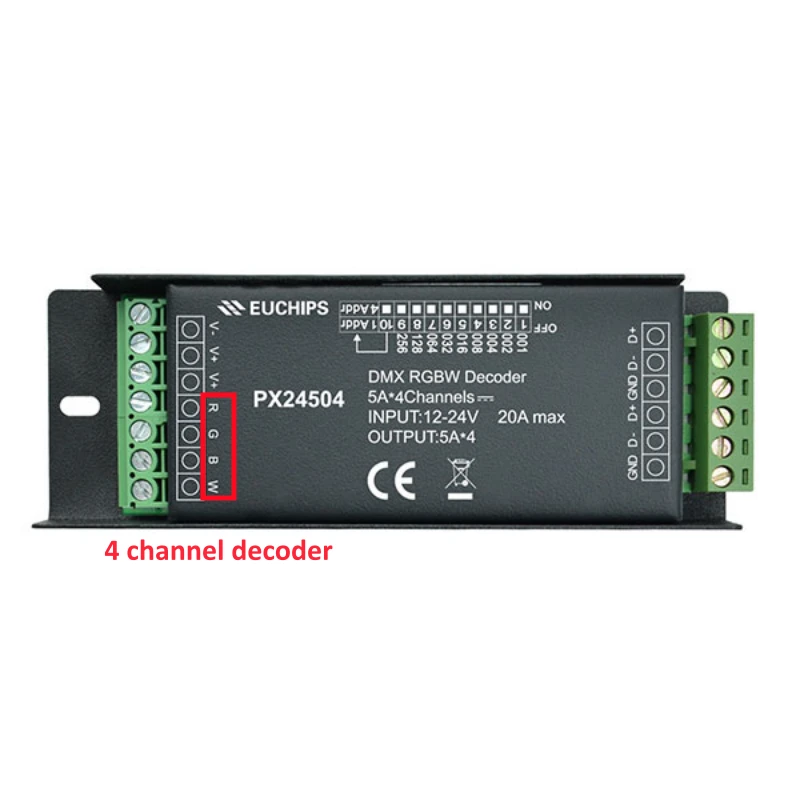
Single color lighting typically uses one control channel, while tunable white (CCT) systems rely on independent control of warm and cool white outputs. RGB and RGBW lighting introduce multi-channel color mixing, and RGBCCT fixtures combine both color mixing and color temperature control within the same system. Although these lighting types vary in complexity, they all depend on a decoder that can correctly map DMX channels to the intended output functions.
In projects involving DMX-controlled SPI addressable RGB lighting, channel configuration becomes even more critical. In this case, the decoder must support accurate DMX-to-SPI signal conversion and proper pixel addressing logic, as channel structure directly affects animation accuracy and control responsiveness.
From implementation experience, selecting the correct channel mode is often far more important than choosing a higher power rating. When the channel configuration does not align with the lighting application, even a stable DMX signal and sufficient output power cannot compensate for the resulting control limitations or operational confusion.
Dimming Performance Defines Whether Lighting Feels “Professional”
In DMX lighting projects, dimming quality is not only about whether lights can be dimmed, but how precisely and smoothly brightness can be controlled. From implementation experience, this directly depends on several key decoder parameters that are often overlooked during selection.
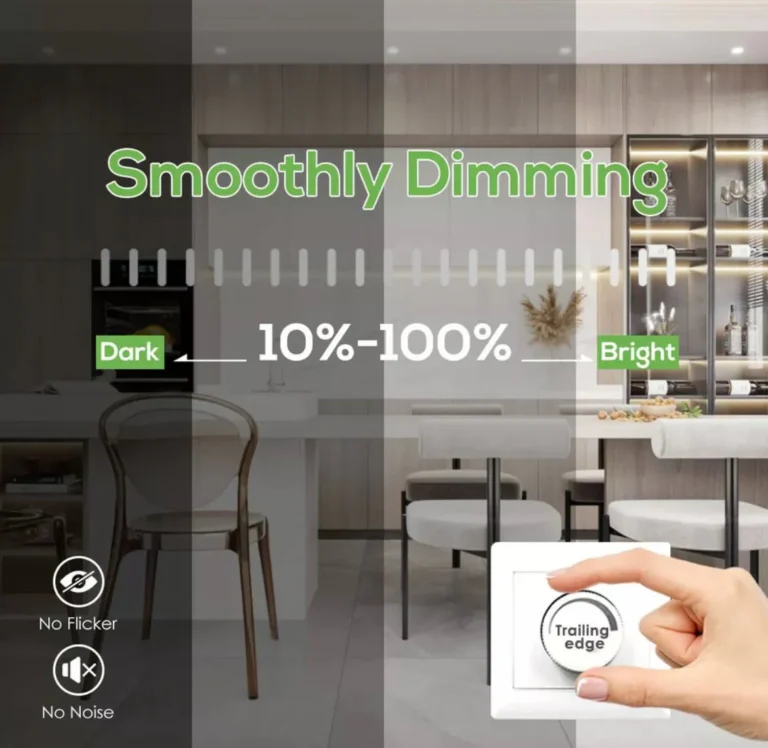
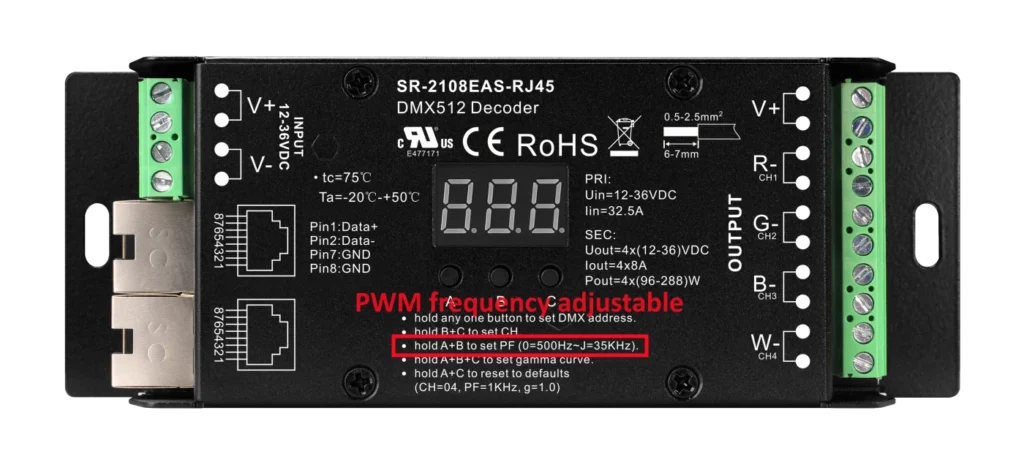
The most important factor is PWM frequency. A low PWM frequency can cause visible flicker, especially in office, retail, or camera-sensitive environments. For most professional applications, a decoder with a PWM frequency of at least 2 kHz is recommended, while higher-end projects may require even higher frequencies to ensure flicker-free performance.
Another critical parameter is dimming resolution. Decoders with limited resolution may appear acceptable at mid or high brightness levels but often struggle at low output, where brightness steps become noticeable. Higher-resolution dimming enables smoother transitions and finer control, which is essential in architectural and commercial lighting applications.
Finally, attention should be paid to low-level dimming stability. A decoder that maintains consistent output below 1% brightness allows for precise tuning during commissioning and delivers a more refined lighting experience. In practice, these parameters have a greater impact on perceived lighting quality than maximum power ratings alone.
Reliability Is Defined by the Decoder’s Internal Design and Specifications
When evaluating the reliability of a DMX512 디코더, it is important to focus on characteristics that can be verified directly from the decoder itself rather than external installation conditions. In real projects, long-term stability is largely determined by internal protection design, component selection, and thermal margins.
One of the most reliable indicators is a clearly defined set of built-in protection functions listed in the specification. Over-current, short-circuit, and over-temperature protection demonstrate that the decoder is designed to handle abnormal conditions without permanent failure. Decoders that specify automatic recovery behavior generally offer greater resilience during commissioning and daily operation.
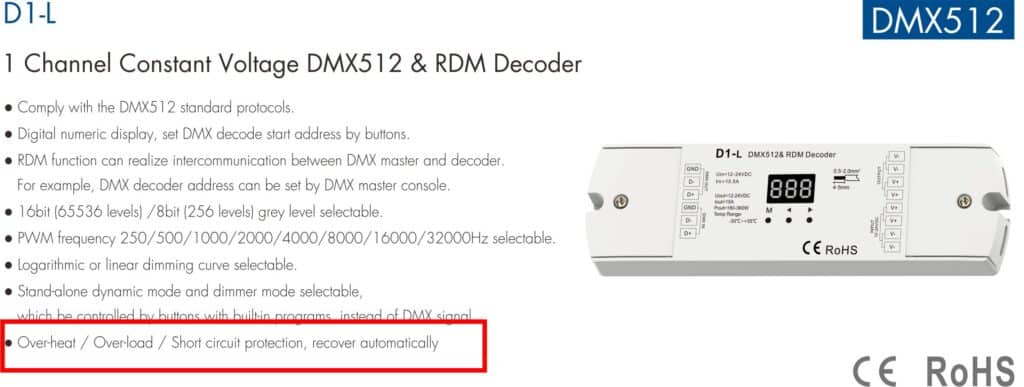
Another key parameter is the operating temperature range. A wider temperature range typically reflects a more conservative internal design and higher component tolerance, which translates into improved stability during continuous operation. Closely related to this is whether the decoder supports output derating under high load or elevated temperature, rather than abrupt shutdown.
Finally, the decoder’s housing and thermal design provide additional insight. Metal enclosures, clearly defined thermal design intent, and compliance markings such as CE or DMX512 standards all suggest that the product has been developed with long-term reliability in mind. In practice, these decoder-level characteristics are far more predictive of system stability than basic power ratings.
Other Factors Worth Checking Before Final Selection
After confirming core aspects such as signal stability, channel configuration, dimming performance, and internal reliability, several practical details are still worth reviewing. These factors rarely determine whether a DMX system functions at all, but they often affect installation efficiency, system compatibility, and future flexibility. From project experience, a quick review of these points can help avoid unnecessary limitations during commissioning or later expansion.
| Item to Check | Why It Matters in Practice |
| Output Type (CV / CC) | Ensures the decoder matches the electrical characteristics of the connected LED fixtures and avoids incorrect load connection. |
| Per-Channel Current Rating | Important for balancing loads across channels, especially in multi-channel applications such as RGB, RGBW, or RGBCCT. |
| DMX Address Setting Method | DIP switches, digital display, or software setting affect how quickly and accurately addresses can be configured on site. |
| RDM Support | Allows remote addressing and status feedback, which can simplify commissioning in larger DMX installations. |
| DMX Input / Output Terminals | Screw terminals vs. plug connectors influence wiring reliability and maintenance efficiency. |
| Mechanical Size and Mounting Options | Determines whether the decoder fits into standard control cabinets or project-specific enclosures without modification. |
Different Projects, Different Priorities
Although the core selection principles for a DMX512 decoder remain consistent, different project types naturally emphasize different aspects. Understanding these priorities helps narrow down options and prevents over- or under-specifying the system.
In architectural and facade lighting, long DMX cable runs and mixed-brand equipment are common. In these projects, signal stability, electrical isolation, and robust internal protection design are typically the top concerns, as system reliability directly affects maintenance costs and visual consistency.
For office and commercial indoor lighting, dimming performance becomes more critical. High PWM frequency, smooth low-level dimming, and consistent channel behavior are essential for achieving flicker-free, comfortable lighting, especially in spaces used for extended periods or video recording.
In entertainment and dynamic lighting applications, such as stages or media walls, channel configuration flexibility and response accuracy are often prioritized. The decoder must handle complex channel structures reliably while remaining fully compatible with the chosen control system.
Across all these project types, one common challenge is selecting the right decoder from a wide range of brands and specifications. With experience across numerous DMX lighting projects and access to multiple DMX512 decoder brands, SignliteLED focuses on helping customers choose the most suitable solution for each application. The goal is not to promote a single product, but to ensure stable performance, efficient commissioning, and long-term reliability from the start.
관련 게시물