Русский
  English
  简体中文
简体中文  Deutsch
  Español
  Français
  Italiano
  日本語
日本語  한국어
한국어  Polski
  Português
  Türkçe
  Nederlands
  Tiếng Việt
  ไทย
ไทย 
For commercial lighting, LED linear modules are generally preferred over LED strip lights. They provide superior thermal management, longer lifespan, higher reliability, and standardized mounting options. LED strip lights, while flexible and decorative, are mostly suitable for accent, residential, and low-power applications.
Both technologies use LED chips and low-voltage power systems, but they are designed for different purposes. Светодиодные линейные моду are typically integrated into commercial lighting fixtures, while LED strip lights are flexible lighting components often used in cabinets, architectural accents, or DIY lighting installations.
Understanding the differences between these two technologies can help lighting designers, fixture manufacturers, and project engineers choose the right solution for their applications.
Quick Answers: LED Linear Modules vs LED Strip Lights
The following quick answers explain the key differences between LED linear modules and LED strip lights for commercial lighting applications.
What is a LED linear module?
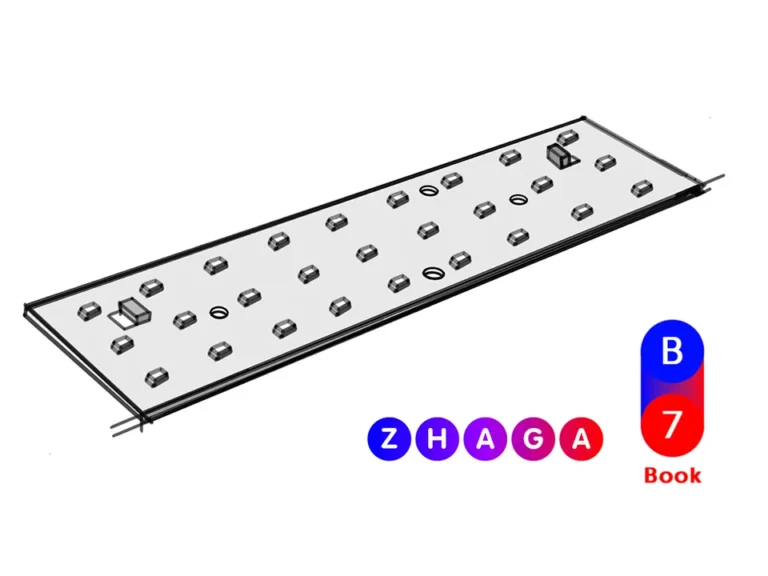
A LED linear module is a rigid printed circuit board that contains multiple LED chips arranged in a straight line. It is commonly used inside commercial lighting fixtures because it offers better heat dissipation, higher durability, and longer lifespan compared with flexible LED strip lights.
In many professional lighting systems, LED linear modules are powered by constant current LED drivers, which regulate the current through LEDs to ensure stable brightness and consistent performance.
What is the difference between LED linear modules and LED strip lights?
The main difference between LED linear modules and LED strip lights lies in their structure, electrical driving method, and typical applications. LED linear modules are rigid boards designed for commercial lighting fixtures and are often used with constant current LED drivers, providing stable brightness, better heat dissipation, and longer lifespan. LED strip lights, on the other hand, are flexible circuit boards that usually operate with constant voltage power supplies such as 12V or 24V, making them ideal for decorative, residential, or accent lighting installations where flexibility and easy installation are important.
Which is better for commercial lighting?
For most commercial lighting fixtures, LED linear modules are usually a better choice than LED strip lights because they provide superior heat dissipation, longer lifespan, and easier integration into professional lighting fixtures. LED strip lights are more commonly used for decorative or flexible lighting applications.
Can LED strip lights be used in commercial lighting fixtures?
Yes, LED strip lights can be used in some commercial lighting installations, especially for accent lighting or display lighting. However, most commercial fixtures prefer LED linear modules because they provide more stable performance and better heat dissipation.
Do LED linear modules last longer than LED strip lights?
Yes. LED linear modules typically last longer because their rigid PCB structure allows better heat dissipation. A typical LED linear module can last 50,000–100,000 hours, while many LED strip lights last 30,000–50,000 hours.
What Is a LED Linear Module and How Does It Work?
LED linear modules, also known as rigid LED boards, are widely used in commercial LED lighting fixtures. These high-performance LED modules provide excellent thermal management, long lifespan, and standardized installation options. Compared with flexible LED strips, LED linear modules deliver stable luminous output and are ideal for office, retail, and architectural lighting applications.
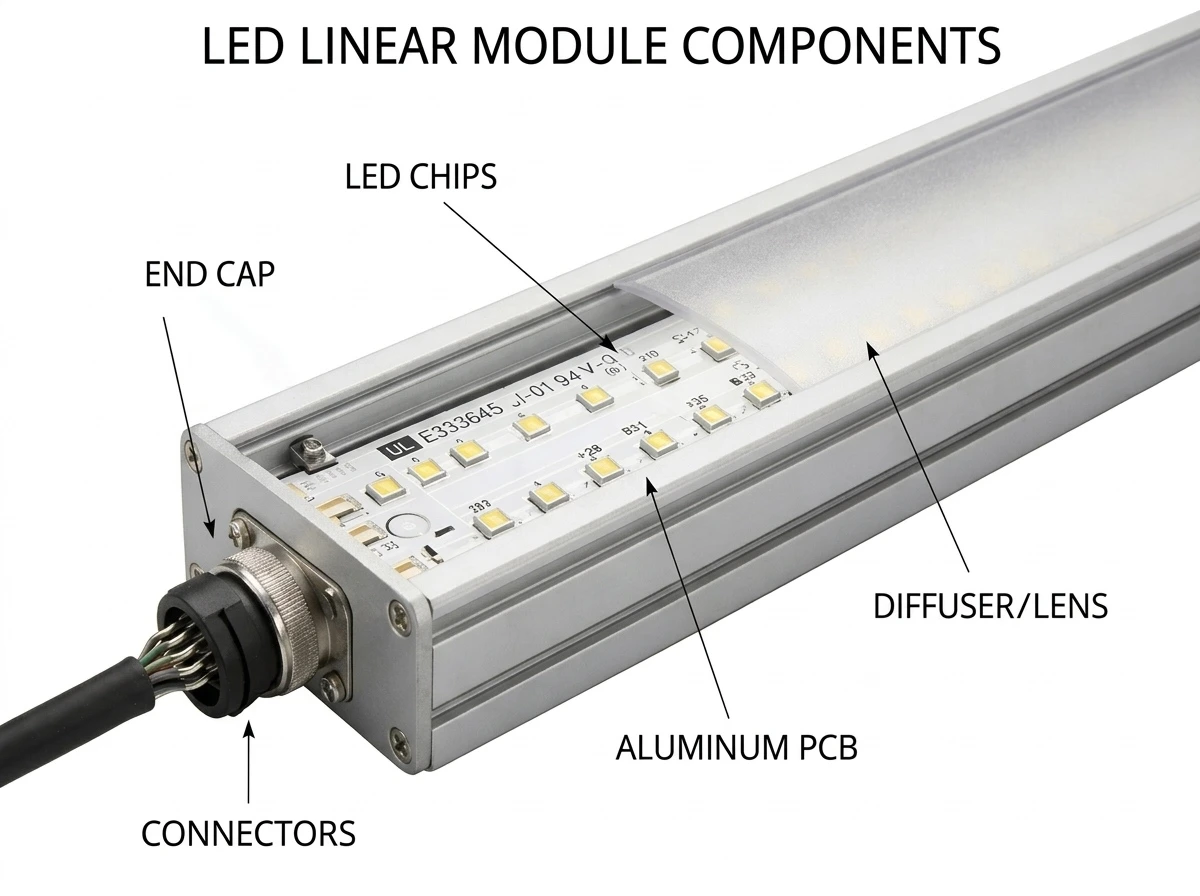
Unlike flexible LED strips, linear modules are typically mounted on aluminum or FR-4 boards and integrated directly into professional lighting fixtures such as office luminaires, retail display lighting, and architectural linear lights.
Key Characteristics of LED Linear Modules
- Rigid PCB structure
- Efficient heat dissipation
- Consistent optical performance
- Long operational lifespan
- Suitable for industrial and commercial fixtures
Common Components in LED Linear Modules
| составляющий | Функция |
| Светодиодные чипы | Produce light output |
| Алюминиевая печатная | Рассеивание тепла |
| Optical lens or diffuser | Control light distribution |
| Connectors (WAGO / Zhaga) | Electrical connection |
| Светодиодный драйвер | Converts AC power to DC power and regulates current to ensure stable LED operation |
Many commercial LED linear modules are designed to work with constant current LED drivers. These drivers deliver a fixed current to LEDs connected in series, ensuring consistent brightness, improved efficiency, and longer operational lifespan in professional lighting systems.
Typical Electrical Specifications
| Параметр | Типичный диапазон |
| Operating Current | 350–700mA |
| Forward Voltage | 20–60V |
| Power per module | 5W–30W |
| Driver Type | Драйвер постоянного тока |
Custom Linear LED Modules for OEM Projects
Because of their structure and thermal management capabilities, LED linear modules are commonly used in professional lighting fixtures and architectural lighting systems.
What Is an LED Strip Light (Tape Light) and How Does It Work?
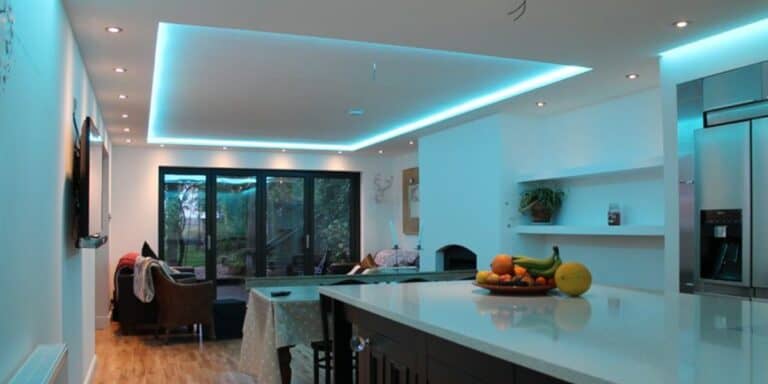
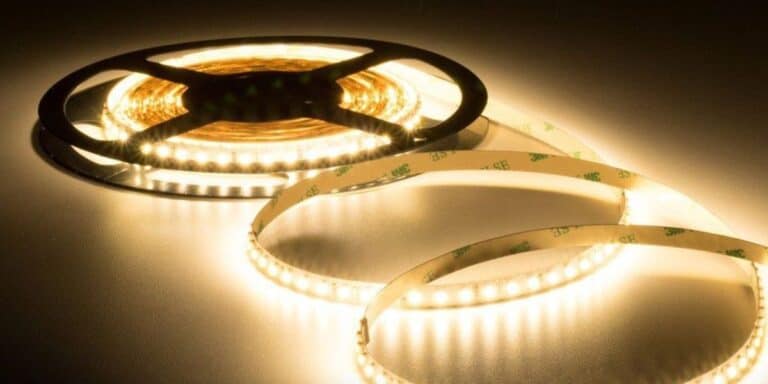
LED strip lights—also known as LED tape lights—are flexible circuit boards populated with surface-mounted LEDs. They are cuttable, adhesive-backed, and ideal for decorative or accent lighting.
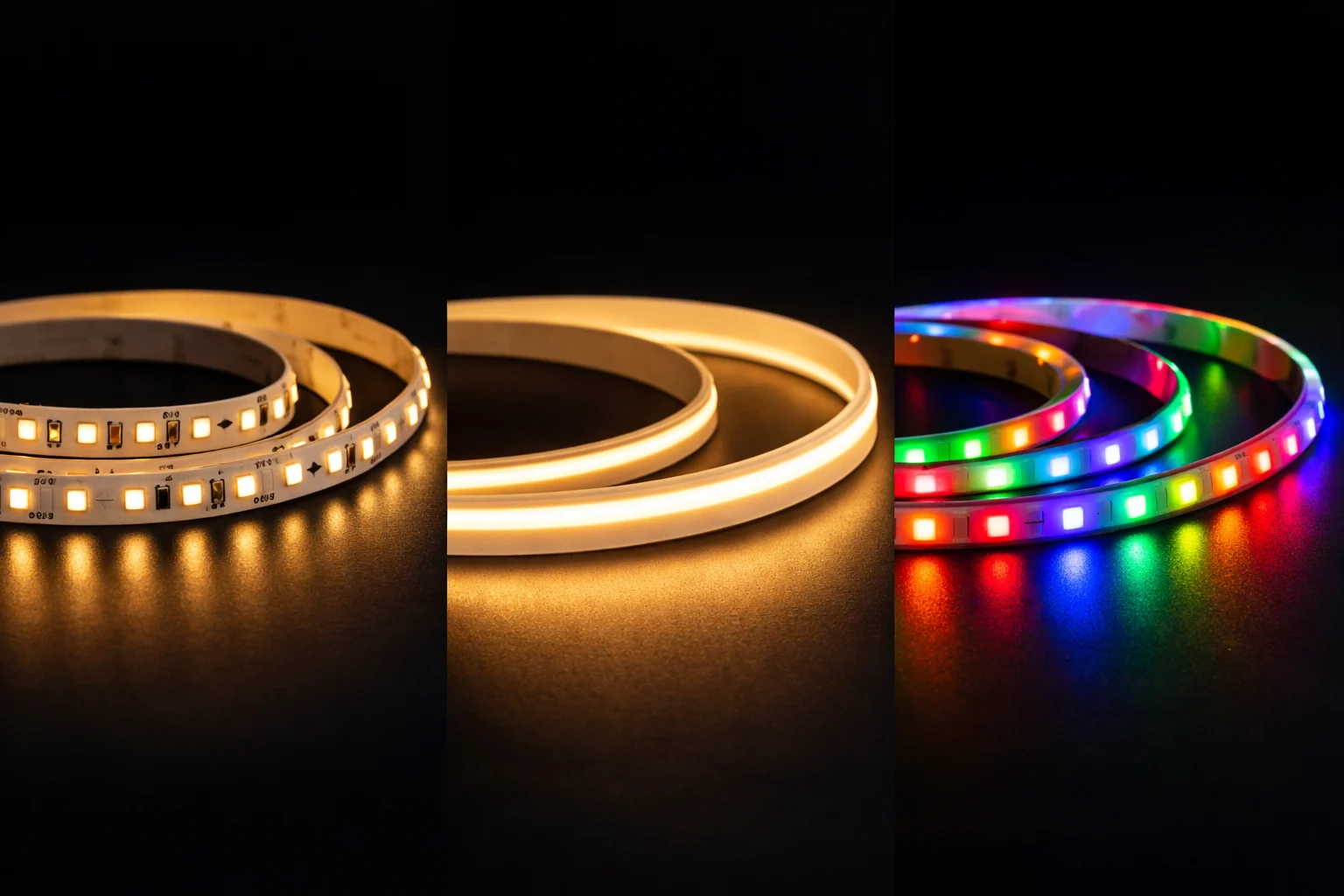
LED strips are widely used in decorative lighting, under-cabinet lighting, accent lighting, and residential applications.
Main Features of LED Strip Lights
- Гибкая печатная плата
- Adhesive backing for easy installation
- Cuttable segments
- Low voltage operation
- Available in multiple colors and color temperatures
Common Types of LED Strip Lights
| Тип | Описание |
| Светодиодная лента SMD | Standard LED strip technology |
| Светодиодная лента COB | Continuous light output |
| Светодиодная лента RGB | Multi-color lighting |
| Настраиваемая белая светодиодная лента | Adjustable color temperature |
Typical LED Strip Specifications
| Параметр | Типичный диапазон |
| рабочее напряжение | 12В/24В |
| Потребляемая мощность | 4W – 20W per meter |
| Продолжительность жизни | 30,000 – 50,000 hours |
| Рейтинг IP | IP20 – IP67 |
Because of their flexibility and simplicity, LED strips are ideal for accent lighting and decorative lighting projects.
LED Linear Modules vs LED Strip Lights: Key Differences
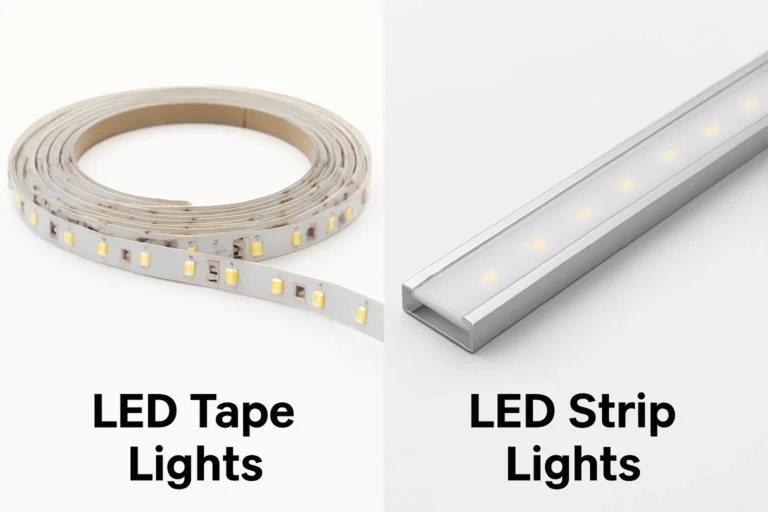
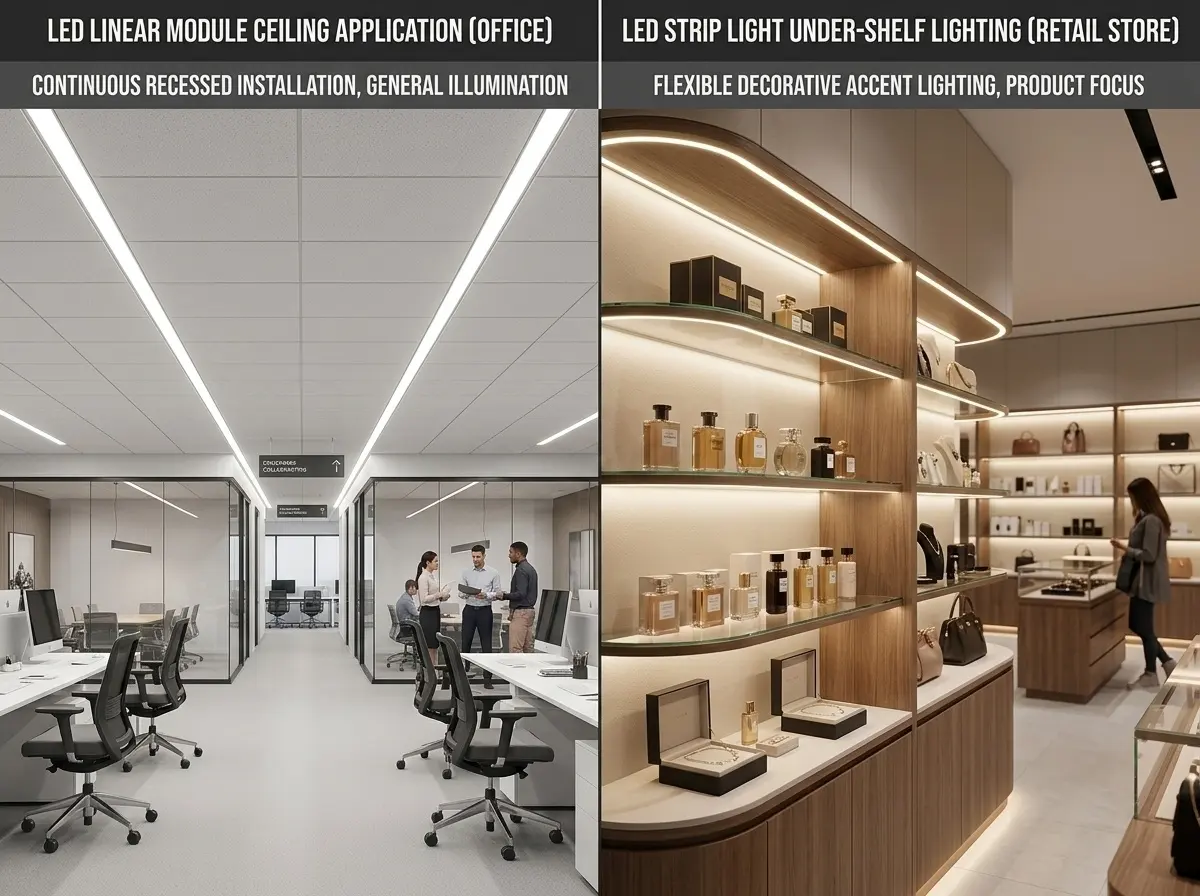
The main difference between LED linear modules and LED strip lights lies in their structure, durability, and intended use. Linear modules are rigid lighting boards designed for professional lighting fixtures, while LED strips are flexible circuits typically used for decorative or residential lighting installations.
Electrical Difference: Constant Current vs Constant Voltage Systems
The most important electrical difference between LED linear modules and LED strip lights is the driver type used to power the LEDs. LED strip lights typically operate in constant voltage (CV) systems, usually 12V or 24V DC, where current is limited by resistors in each LED segment. In contrast, many LED linear modules used in commercial lighting operate in constant current (CC) systems, where a dedicated LED driver provides a fixed current (such as 350mA or 700mA) to a series of LEDs. Constant current systems ensure that every LED receives the same current, improving efficiency, brightness consistency, and lifespan in professional lighting applications.
Constant Current vs Constant Voltage LED Systems
| Характеристика | Constant Voltage System | Constant Current System |
| Typical Product | Светодиодные ленты | Светодиодные линейные моду |
| Driver Type | Constant voltage driver | Драйвер постоянного тока |
| входной | 12В/24В постоянного тока | Fixed current (350–700mA typical) |
| LED Connection | Parallel segments with resistors | LEDs connected in series |
| Текущий контроль | Resistors limit current | Driver regulates current |
| Эффективность | Умеренный | Выше |
| Brightness Consistency | Средний | Высокий |
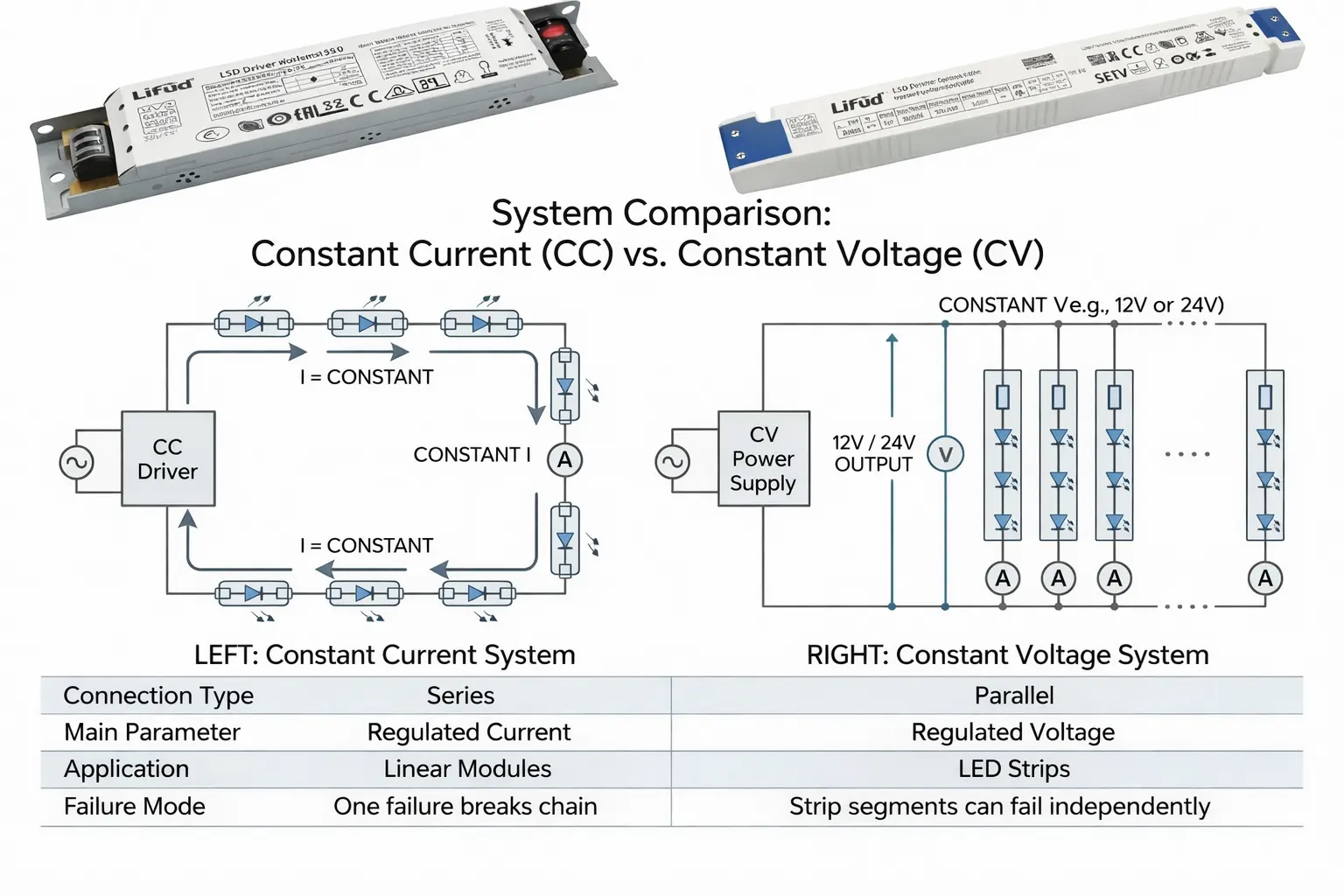
LED strip lights rely on constant voltage power supplies and resistor-based current control, while LED linear modules used in professional lighting systems often rely on constant current drivers to maintain stable LED performance.
Flexible LED Strip vs Rigid LED Linear Module
Flexible LED strips and rigid LED linear modules are two common types of linear LED lighting, but they differ in structure, electrical design, and applications. Flexible LED strips use thin flexible PCBs and typically operate in constant voltage systems such as 12V or 24V, making them easy to bend and install in decorative lighting projects. Rigid LED linear modules use aluminum or FR-4 boards and are commonly powered by constant current LED drivers, which allows higher brightness, better heat dissipation, and more stable performance in commercial lighting fixtures.
In general, LED strips are widely used for accent lighting and residential installations, while LED linear modules are preferred for commercial luminaires, retail lighting, and architectural linear lighting systems.
Structural Differences
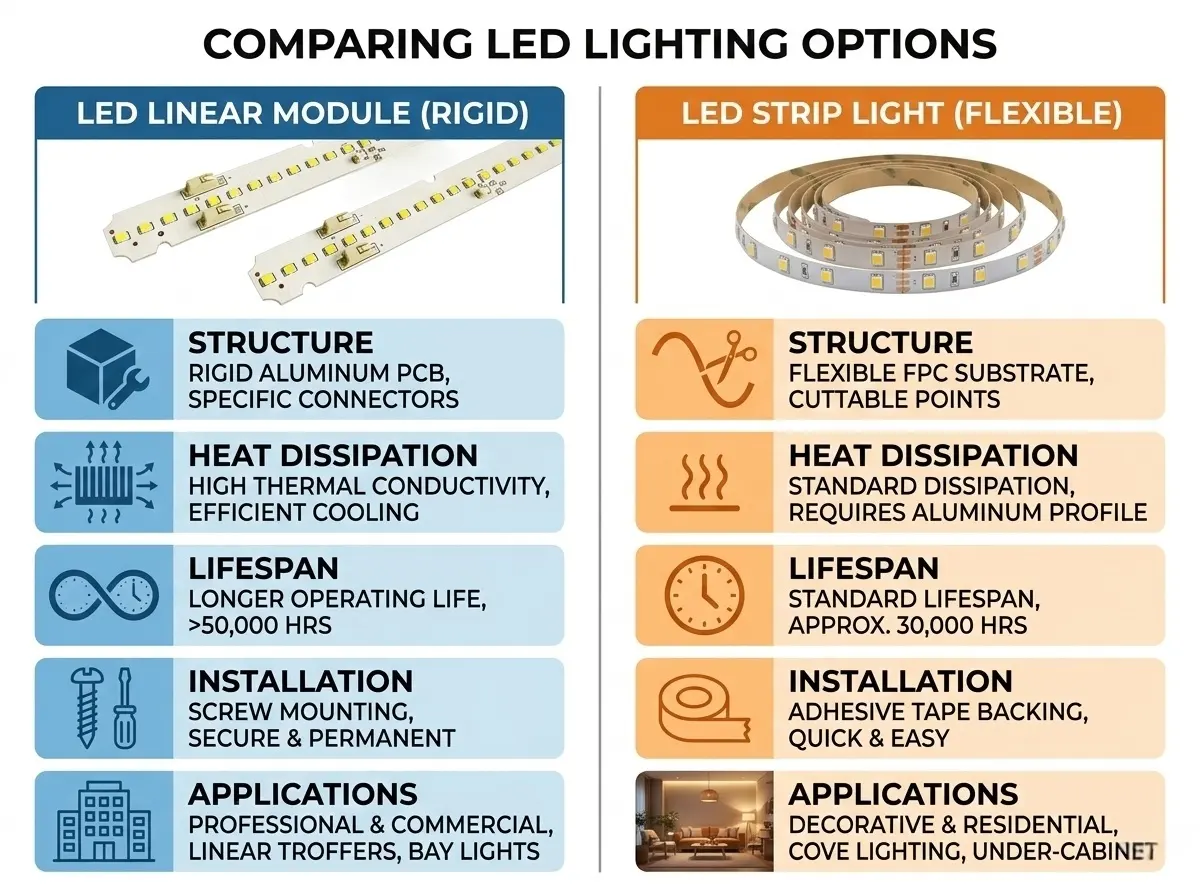
The primary structural difference between LED linear modules and LED strip lights lies in the type of circuit board used. LED linear modules are built on rigid boards such as aluminum PCBs, while LED strip lights use flexible printed circuit boards (FPC) designed for bending and easy installation.
Rigid aluminum boards provide better mechanical stability and improved heat transfer, which makes LED linear modules suitable for integration into commercial lighting fixtures such as office luminaires, retail displays, and architectural linear lights. In contrast, LED strip lights prioritize flexibility and simple installation. They often include adhesive backing and can be cut or bent to fit cabinets, shelves, and decorative lighting installations.
Key takeaway:
LED linear modules emphasize durability and fixture integration, while LED strip lights focus on flexibility and quick installation.
Термоуправление
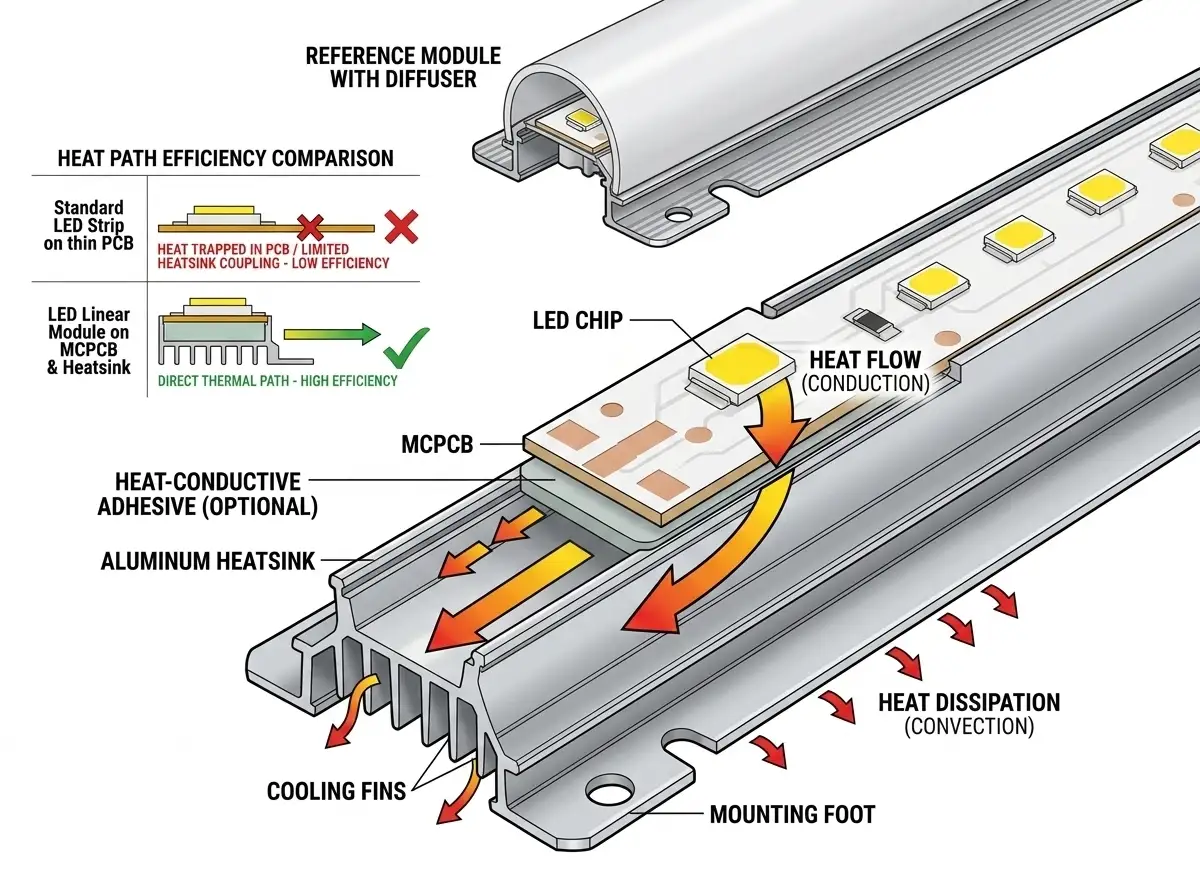
Thermal management is a critical factor affecting LED efficiency, brightness stability, and lifespan. LED linear modules typically provide better heat dissipation because they use aluminum PCBs that transfer heat away from LED chips and into the luminaire body or heat sink.
Efficient heat transfer helps maintain stable operating temperatures, which improves LED performance and extends operational life. Many commercial LED linear modules can achieve lifespans of 50,000–100,000 hours under proper thermal conditions. LED strip lights, however, rely on thin flexible circuit boards that dissipate heat less efficiently. For improved performance, they are often installed in aluminum channels or profiles to help manage heat.
Key takeaway:
LED linear modules offer superior thermal stability for high-power lighting, while LED strips are better suited for low-power decorative applications.
Besides structural design, thermal management is another key factor that affects LED performance and long-term reliability.
LED Linear Modules vs LED Strip Lights: Comparison Summary
When choosing between LED linear modules and LED strip lights, it is important to compare their structure, performance, installation method, and typical applications. The table below highlights the key technical differences between LED linear modules and LED strip lights, including driver type, electrical input, structure, and typical applications.
| Характеристика | Светодиодные линейные моду | Светодиодные ленты |
| Структура | Rigid PCB board | Flexible PCB tape |
| Driver Type | Драйвер постоянного тока | Constant voltage power supply |
| Electrical Input | Constant current (350–700mA typical) | 12 или 24 В постоянного тока |
| основное использование | Commercial lighting fixtures | Accent and decorative lighting |
| Установка | Mounted inside fixtures | Adhesive or aluminum channels |
| Рассеивание тепла | Excellent thermal performance | Limited heat dissipation |
| Продолжительность жизни | 50,000–100,000 hours | 30 000–50 000 часов |
| Техническое обслуживание | Modular replacement possible | Entire strip often replaced |
| Типовые применения | Office lighting, retail fixtures | Cabinet lighting, accent lighting |
Cost Difference Between LED Strip Lights and LED Linear Modules
The cost of LED strip lights and LED linear modules varies depending on LED density, brightness, PCB material, and certification requirements. In general, flexible LED strip lights are lower-cost lighting components, while rigid LED linear modules are designed for higher brightness and professional lighting fixtures, which usually increases their price.
Flexible LED strips typically use flexible PCBs and constant-voltage designs, which makes them inexpensive and easy to mass-produce. In global supply chains, standard LED strips usually cost around $1–$4 per meter in B2B export pricing, depending on LED density and quality.
Rigid LED linear modules use aluminum PCBs or thicker FR-4 boards, higher-power LED chips, and more robust thermal designs. Because of these structural differences, linear modules are usually more expensive, with typical B2B pricing around $3–$8 per meter for commercial lighting modules.
Typical Price Comparison
| Тип продукта | Typical Power | China Factory Price | Typical B2B Export Price | Типовое применение |
| Flexible LED Strip | 5–15W/m | $0.5–2/m | $1–4/m | Cabinet lighting, accent lighting |
| Светодиодная лента COB | 10–15W/m | $1.5–3/m | $3–6/m | Architectural decorative lighting |
| Rigid LED Linear Module | 10–30W/m | $1–5/m | $3–8/m | Linear luminaires, retail fixtures |
| Industrial Linear LED Board | 30–50W/m | $3–8/m | $8–20/m | Industrial lighting, plant lighting |
Several factors explain the price difference between LED strip lights and LED linear modules:
- PCB material (flexible PCB vs aluminum board)
- LED chip type and density
- brightness output and power level
- certification requirements (UL, ETL, CE, DLC)
- quality control and brand markup
In commercial lighting projects, engineers often choose LED linear modules despite their higher cost, because they provide better heat dissipation, longer lifespan, and more stable light output for professional luminaires.
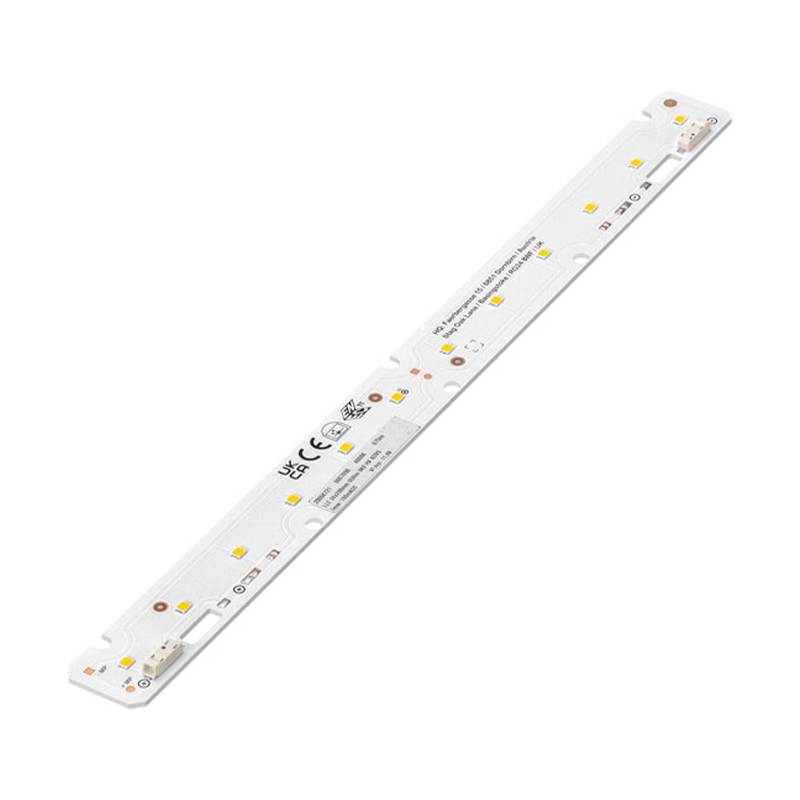
280x24 мм 1100LM светодиодный светильник
- Модель: ROX24T024E-280мм/RQX24T024E-280мм
- Входное напряжение: 20,9-22,7 В постоянного тока
- Входной ток: 275 мА
- Входной ватт: 6,1 Вт
- люмен: 1098-1241 лм
- Светоотдача: 183-205 лм/Вт
- Типы светодиодов: SMD3030/SMD2835
- Светодиодный чип Samsung/OSRAM/Lumileds/BridgeLux/Сеул
- КОЛИЧЕСТВО СВЕТОДИОДОВ: 24шт
- Цветовая температура: 2700K/3000K/4000K/5000K/6500K
- ИКР: 80/90
- Размеры: 279×23,6×1,6 мм
- Материал печатной платы: Алюминий/FR-4
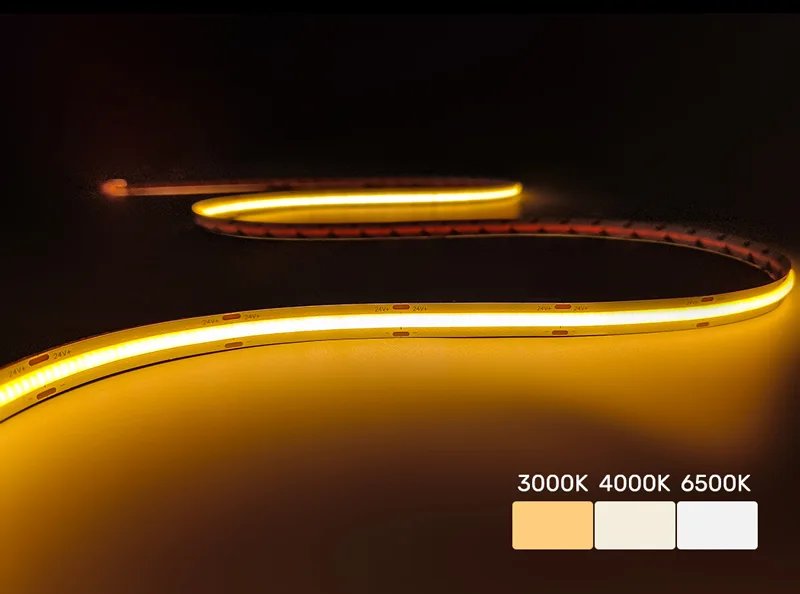
480Chips LED COB свет ленты для декоративного освещения
- 480 чипов/м, 100 лм/Вт, без точек
- Цветовая температура от 2700K до 6500K
- Диммируемый
- Угол обзора 180 градусов
- CRI90+, для декоративного освещения
- Беспаечная технология "катушка к катушке
Industry Expertise in LED Linear Lighting
With the rapid development of LED lighting technology, linear LED modules have become a core component in modern commercial lighting systems. Manufacturers and lighting engineers increasingly rely on modular LED solutions because they offer standardized installation methods, improved thermal performance, and consistent optical output.
Professional lighting manufacturers often design LED linear modules to comply with industry standards such as Zhaga specifications and international safety certifications. These standards ensure compatibility between LED modules, drivers, and lighting fixtures across different manufacturers. Learn about Zhaga Standard for LED Linear Modules паж
For commercial lighting projects—including office lighting, retail displays, and architectural lighting—engineers typically prioritize LED linear modules due to their reliability and long operational lifespan.
This growing adoption demonstrates why LED linear modules are now considered a key technology in modern architectural and commercial lighting systems.
Which Is Better for Commercial Lighting?
For most commercial lighting systems, LED linear modules are the preferred solution because they offer better thermal management, higher reliability, and easier integration into professional lighting fixtures.
LED strip lights are better suited for decorative or flexible installations.
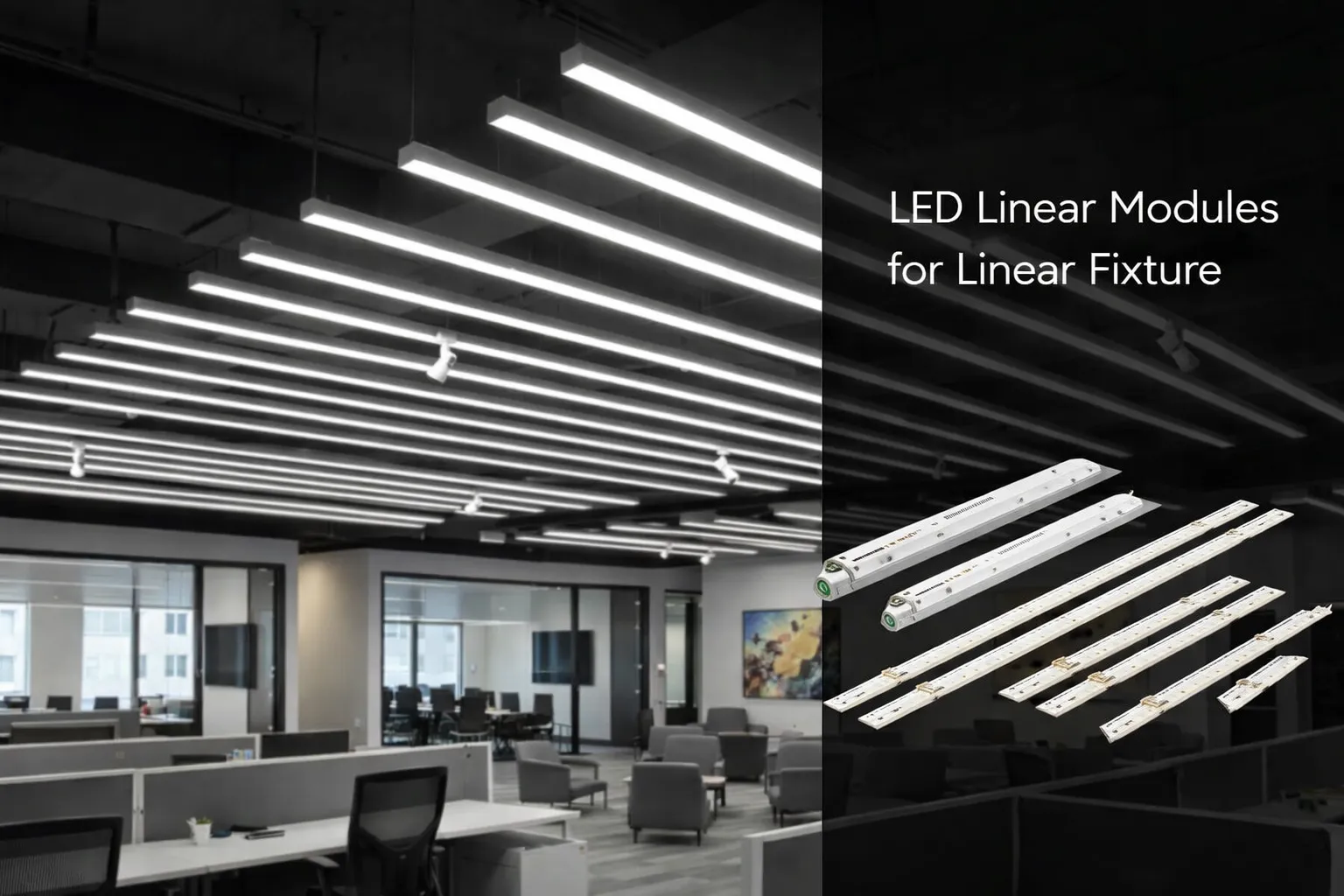
Advantages of LED Linear Modules for Commercial Projects
- Higher reliability
- Better heat management
- Более длительный срок службы
- Standardized mounting options
- Better compatibility with professional LED drivers
Learn high performance of commercial LED linear modules ст.
When LED Strip Lights Are a Better Choice
LED strip lights may be preferable when:
- Flexible installation is required
- Lighting is decorative or accent-based
- Low power consumption is needed
- Installation must be simple
Typical Commercial Applications
| Приложение | Recommended Solution |
| офисное освещение | Светодиодные линейные моду |
| Освещение торговых витрин | Светодиодные линейные моду |
| Архитектурное освещение | Both options |
| освещение кабинета | Светодиодные ленты |
| Акцентное освещение | Светодиодные ленты |
Learn the entire description of LED Linear Module Applications Article.

Что Electrical Options Are Available for LED Linear Modules?
Most LED linear modules used in commercial lighting operate with constant current LED drivers rather than fixed-voltage power supplies. These drivers deliver a controlled electrical current—commonly 350mA, 500mA, or 700mA—to a series of LEDs, ensuring consistent brightness and reliable performance.
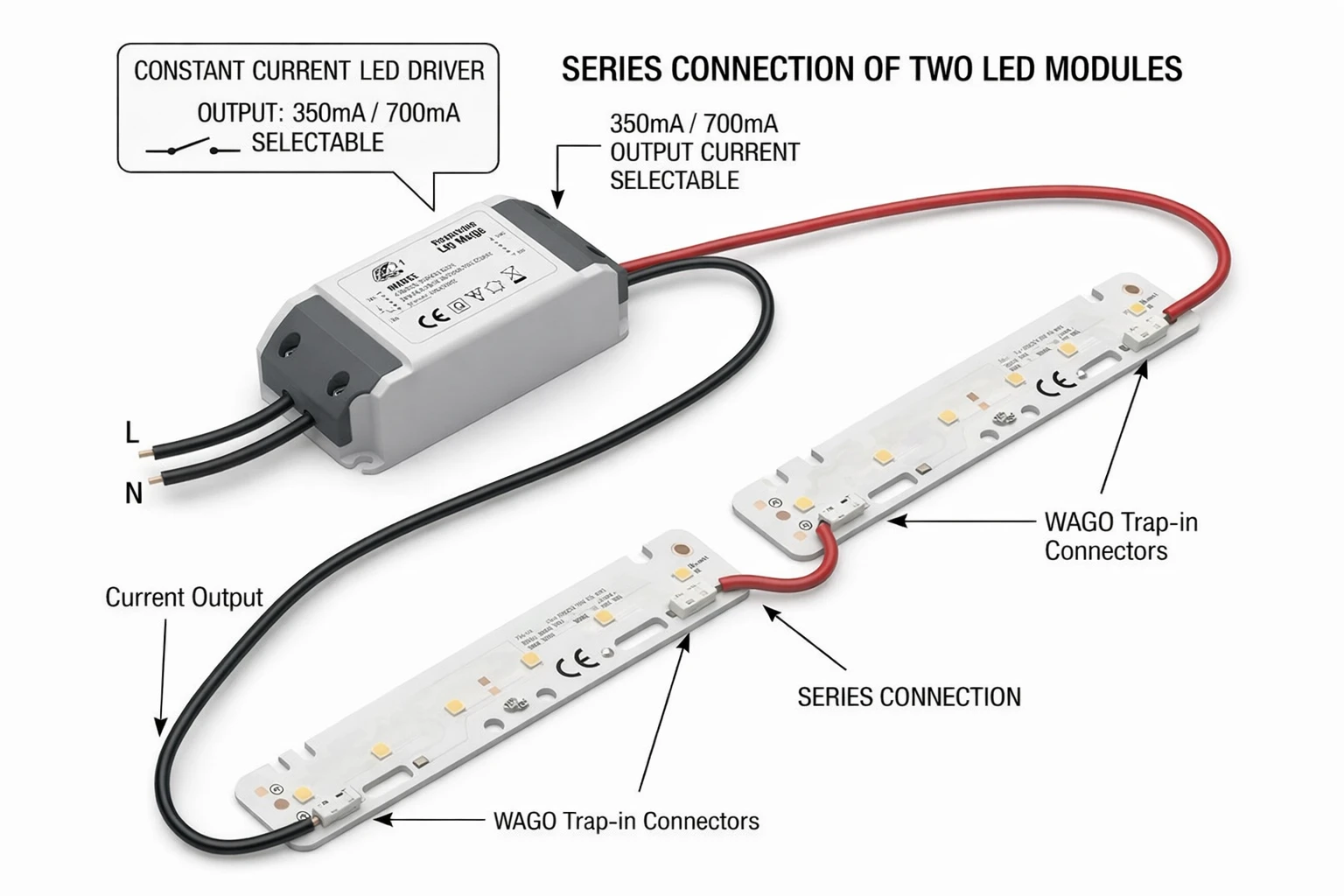
Unlike LED strip lights that typically run on 12V or 24V constant voltage systems, linear modules are designed so that the driver regulates the current while the voltage adjusts automatically based on the number of LEDs in the circuit. As a result, the forward voltage of a module can vary, often ranging between 20V and 60V in commercial lighting fixtures.
Because the current remains constant, LED linear modules maintain stable light output, improved efficiency, and longer lifespan, making them well suited for professional lighting systems.
Understanding the electrical characteristics of LED systems also helps explain why voltage drop behaves differently in constant voltage and constant current lighting designs.
How to Prevent Voltage Drop in LED Lighting Systems
Voltage drop occurs when electrical resistance in wires or connections reduces the voltage along a circuit, which can cause uneven brightness in LED lighting installations.
This problem is most common in constant voltage systems such as LED strip lights, particularly in long installations where voltage gradually decreases as distance from the power supply increases. As a result, LEDs located farther from the power source may appear dimmer.
In constant current LED systems, commonly used with LED linear modules, the driver automatically adjusts the output voltage to maintain a fixed current through the LEDs. This regulation helps maintain uniform brightness and stable light output across the entire lighting module.
Proper electrical design—including selecting the correct LED driver, using appropriate wiring, and distributing loads correctly—helps minimize voltage drop and ensures reliable LED lighting performance.
Are LED Linear Modules Dimmable?
Yes, most LED linear modules support dimming when paired with compatible drivers.
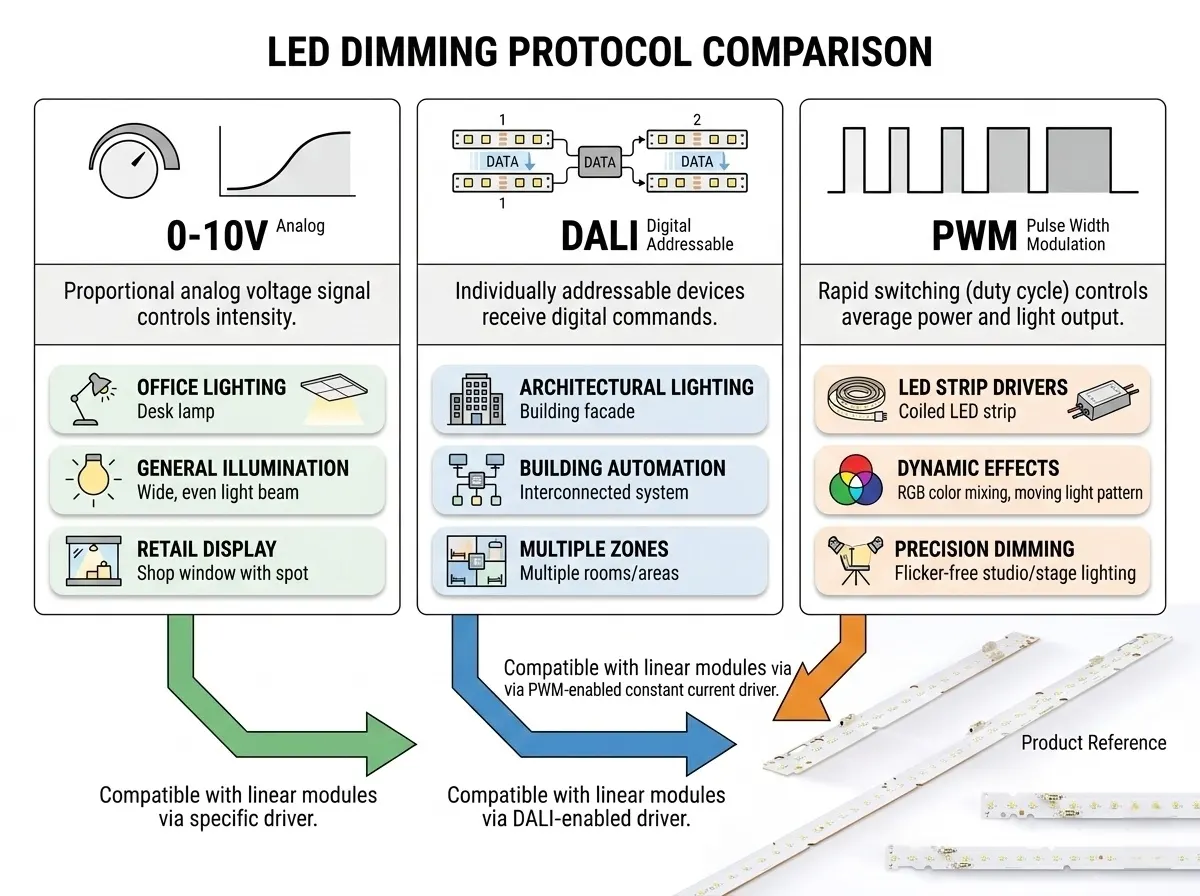
Common Dimming Technologies
| Метод затемнения | Приложение |
| 0-10В | торговое освещение |
| далипа | Умные строительные системы |
| пвм | LED electronic control |
| Triac | жилое освещение |
Dimming can improve energy efficiency, lighting comfort, and system flexibility.
What Power Supply Is Required for LED Lighting Systems?
LED lighting systems require an LED driver that converts AC mains power into controlled electrical output suitable for LEDs. In professional lighting fixtures, LED linear modules are typically powered by constant current LED drivers, which regulate the current supplied to the LEDs to maintain stable brightness and consistent performance.
Unlike constant voltage systems used by LED strip lights, constant current drivers provide a fixed current to LEDs connected in series. The driver automatically adjusts the output voltage according to the total forward voltage of the LED modules in the circuit.
Ключевые факторы при выборе светодиодного драйвера
When selecting a driver for LED linear modules, engineers typically consider several factors:
- current rating (for example 350mA, 500mA, or 700mA)
- driver voltage range
- total system power capacity
- dimming compatibility (such as 0–10V or DALI)
- safety and certification requirements
Choosing the correct driver ensures stable light output, efficient operation, and long-term reliability in commercial lighting systems.
Example Constant Current Driver Calculation
In many LED linear lighting systems, modules are connected in series and powered by a constant current LED driver. In a series circuit, the current remains the same through each module while the total voltage increases.
Example configuration:
- Number of LED modules: 10
- Forward voltage per module: 30V
- Rated current per module: 350mA
If all modules are connected in series:
- Total forward voltage: 30V × 10 = 300V
- Driver current: 350mA constant current
- Total power: 300V × 0.35A ≈ 105W
In practical lighting fixtures, designers usually divide modules into multiple shorter series strings so the driver voltage remains within common ranges (for example 40–120V). This approach improves safety, compatibility with standard LED drivers, and overall system reliability.
Recommended driver:
350mA constant current LED driver with sufficient voltage range and power capacity.
Learn How to Choose the Right LED Driver for Linear Modules Article.
What Color Temperature Should You Choose?
Color temperature is measured in Kelvin (K) and determines the visual tone of the light.
| Цветовая температура | Внешний вид | Типовые применения |
| 2700K | Теплый белый | жилое освещение |
| 3000K | Warm neutral | Гостеприимство |
| 4000K | Neutral white | офисное освещение |
| 5000K–6500K | Холодный белый | Industrial lighting |
Many modern lighting systems use tunable white technology, allowing users to adjust color temperature dynamically.
Can LED Linear Modules and LED Strip Lights Be Used Outdoors?
LED strip lights and LED linear modules can be used outdoors if they have the appropriate waterproof protection. Outdoor lighting systems typically require an IP65 or higher rating to protect against dust, rain, and moisture exposure.
IP Rating Guide
| Рейтинг IP | Уровень защиты |
| IP20 | Indoor only |
| IP65 | Water resistant |
| IP67 | Outdoor capable |
| IP68 | Submersible |
Outdoor installations typically require IP65 or higher protection.
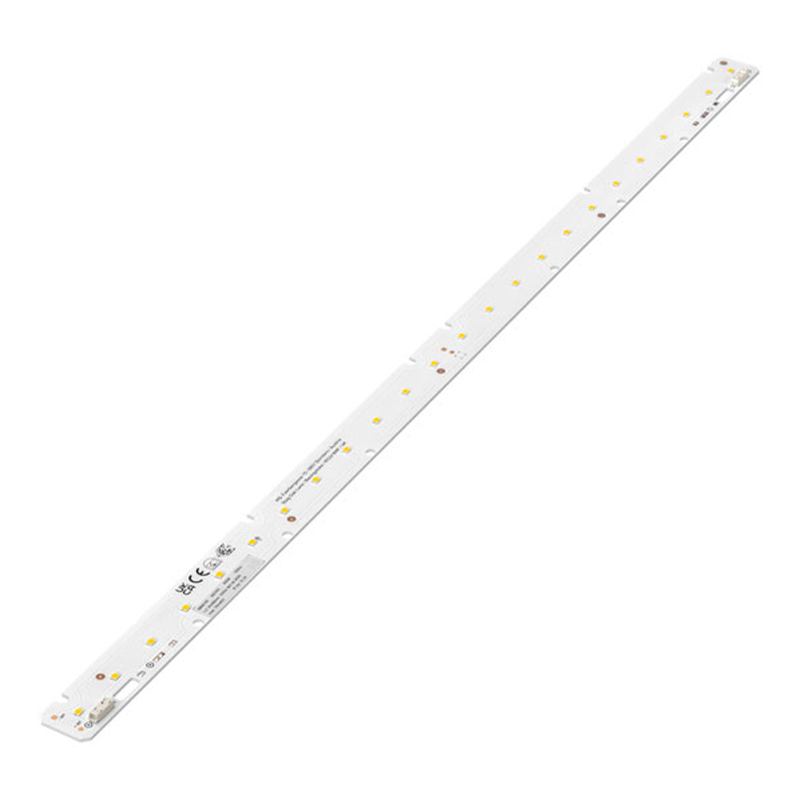
560x24 мм 2200LM SMD модуль светодиодный
- Модель: ROX24T048E-560 мм/RQX24T048E-560мм
- Входное напряжение: 41,8-45,4 В постоянного тока
- Входной ток: 275 мА
- Входной ватт: 12,1 Вт
- люмен: 2195-2482 лм
- Светоотдача: 183-205 лм/Вт
- Типы светодиодов: SMD3030/SMD2835
- Светодиодный чип Samsung/OSRAM/Lumileds/BridgeLux/Сеул
- КОЛИЧЕСТВО СВЕТОДИОДОВ: 48шт
- Цветовая температура: 2700K/3000K/4000K/5000K/6500K
- ИКР: 80/90
- Размеры: 559×23,6×1,6 мм
- Материал печатной платы: Алюминий/FR-4
- Сертификация: CE, RoHS
- Гарантия: 5 лет
How Much Electricity Do LED Lighting Systems Use?
LED lighting systems are highly energy efficient compared with traditional lighting technologies. Both LED linear modules and LED strip lights consume significantly less electricity while producing more light output, making them a cost-effective solution for residential and commercial lighting applications.
Example Energy Comparison
| тип освещения | Потребляемая мощность | Продолжительность жизни |
| Галоген | 60W | 2,000 hours |
| флюоресцентный | 20W | 10,000 hours |
| LED | 10W | 50 000+ часов |
LED systems can reduce electricity consumption by 50–80% compared with traditional lighting technologies.
How to Choose the Right Lighting Solution for Your Project
Selecting the correct lighting technology depends on several factors.
Consider These Criteria
- Application environment
- Installation structure
- Required brightness
- Термоуправление
- Electrical design
Quick Selection Guide
| сценарий | Recommended Solution |
| Commercial fixtures | Светодиодные линейные моду |
| Декоративное освещение | Светодиодные ленты |
| Архитектурное освещение | оба |
| Long installations | Светодиодные линейные моду |
| Flexible installation | Светодиодные ленты |

Заключение
LED linear modules are the preferred choice for commercial and architectural lighting, offering longer lifespan, better thermal management, and standardized installation. LED strip lights are ideal for decorative, accent, or flexible installations.
Choosing the correct solution depends on application type, installation environment, electrical design, and maintenance needs.
ЧАСТО ЗАДАВАЕМЫЕ ВОПРОСЫ
Похожие посты