English
  简体中文
简体中文  Deutsch
  Español
  Français
  Italiano
  日本語
日本語  한국어
한국어  Polski
  Português
  Русский
  Türkçe
  Nederlands
  Tiếng Việt
  ไทย
ไทย 
The difference between sound absorption and soundproofing is simple but often misunderstood. Sound absorption manages how sound behaves inside a space by reducing reflections and reverberation, while soundproofing prevents sound from entering or leaving a space through structural barriers. Confusing the two leads to wasted budgets because people invest in surface treatments when they actually need construction changes, or expect decorative solutions to solve structural noise problems. This misunderstanding is especially common when acoustic lighting is involved, where expectations often exceed what the solution is designed to do.
This article explains the distinction clearly, why the confusion persists, and where acoustic lighting fits realistically, without hype or assumptions.
What Is Sound Absorption?

Sound absorption is the control of reflected sound within a room. It focuses on how sound behaves after it is produced, not on stopping sound from traveling between spaces.
What sound absorption does
Sound absorption reduces echoes, flutter, and excessive reverberation by allowing sound energy to dissipate when it contacts absorptive surfaces. Instead of bouncing repeatedly off hard surfaces, sound is softened and controlled.
What problem it solves
The primary problem sound absorption addresses is poor acoustic clarity. In untreated spaces, speech becomes harder to understand, music sounds muddy, and background noise builds up. Absorption helps improve speech intelligibility and overall acoustic comfort.
Where sound absorption is used
Sound absorption is used in offices, meeting rooms, studios, classrooms, restaurants, and other interior environments where clarity and comfort matter. It is commonly applied through ceilings, wall panels, and other interior elements designed to manage reflections.
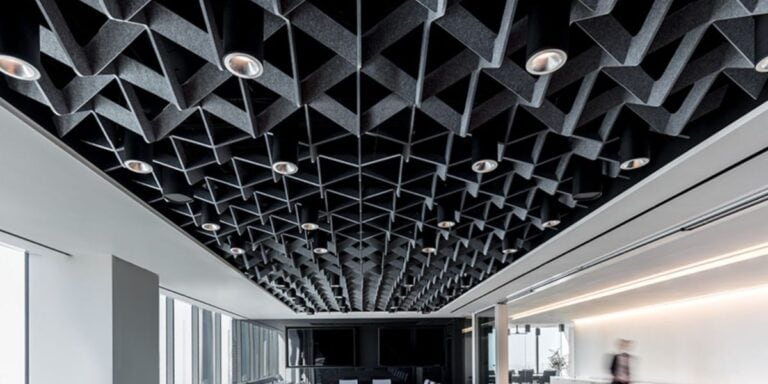
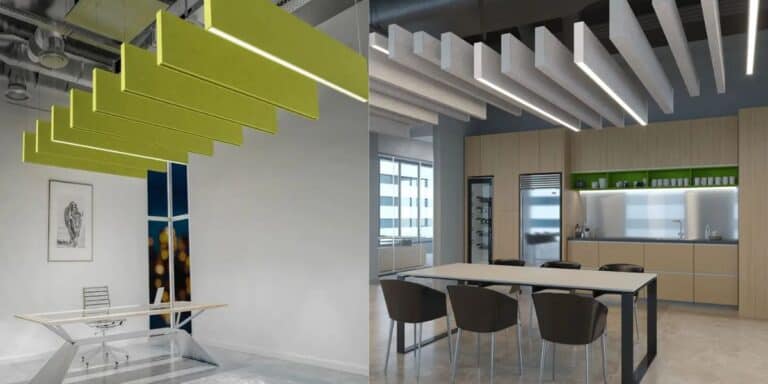
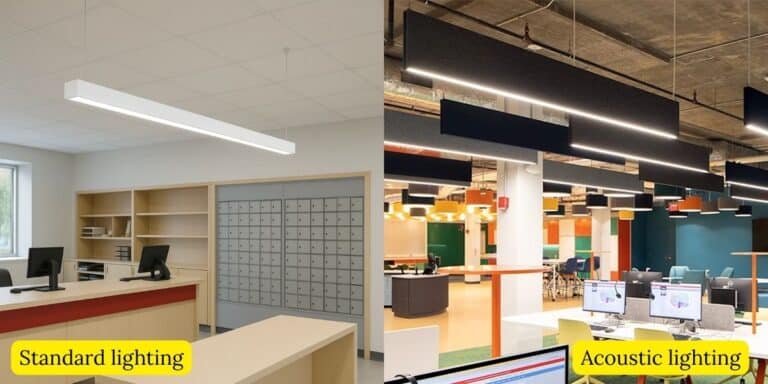
Acoustic lighting belongs in this category. It is designed to contribute to sound absorption while also providing illumination, particularly in ceiling applications.
What Is Soundproofing?

Soundproofing is the prevention of sound transmission between spaces. It addresses how sound moves through walls, ceilings, floors, and structural gaps.
What soundproofing does
Soundproofing limits the amount of sound that passes from one room to another. It focuses on blocking, isolating, or decoupling sound paths through construction systems.
What problem it solves
Soundproofing solves problems related to privacy and noise leakage. This includes stopping conversations from being heard next door, preventing music from traveling between rooms, or reducing external noise intrusion.
Why soundproofing is structural, not decorative
Soundproofing depends on mass, airtight construction, separation, and structural detailing. It typically involves walls, floors, ceilings, and penetrations. Because of this, it cannot be achieved through surface-mounted or decorative products alone. Lighting fixtures, absorptive panels, and ceiling elements do not replace structural soundproofing systems.
Why Do People Confuse Sound Absorption and Soundproofing?
The confusion comes from how sound problems are experienced and how solutions are marketed or misunderstood.
Similar symptoms, different causes
In many offices and studios, people experience noise and assume sound is “leaking.” In reality, the issue is often internal reflection, where sound builds up and becomes overwhelming. Absorption helps in these cases, but it does not stop sound from traveling to other rooms.
Real-world examples
In open offices, employees may complain about noise and privacy. Adding absorptive ceilings improves comfort but does not prevent conversations from being heard in adjacent rooms.
In studios, reflections may cause recordings to sound unclear, while external noise still enters because the structure itself is not isolated. Treating one problem does not solve the other.
How wrong assumptions waste money
When absorption is mistaken for soundproofing, budgets are spent on products that cannot deliver the expected result. Conversely, when soundproofing is installed where absorption would have been sufficient, projects become unnecessarily complex and expensive. The cost is not just financial but also operational, as expectations are not met.
Where Acoustic Lighting Fits In

Acoustic lighting is often caught in the middle of this confusion. Understanding its role clearly prevents unrealistic expectations.

Slim Anti-Glare Acoustic LED Linear Light
- Input Voltage: AC100–277V / AC220–240V, 50–60Hz
- Housing Size: W58 × H200 mm / W58 × H300 mm
- Emitting Direction: Downward
- Length Options: 1218 mm / 1220 mm / 1288 mm
- Correlated Color Temperature (CCT): 3000K / 4000K / 6000K
- Power: 30 W / 32 W
- Luminous Flux: 100–110 lm/W
- CRI: > 90 Ra
- Power Factor (PF): > 0.90
- Flicker Free: Yes
- Beam Angle: 36°
- IP Rating: IP20
- Warranty: 5 years
- Felt Acoustic Board Color Options: Red / Green / Blue / Grey (more than 48 color options)
The role of acoustic lighting in sound absorption
Acoustic lighting integrates light delivery with sound-absorbing elements. It is designed to support acoustic comfort by reducing reflected sound from ceiling areas while fulfilling lighting requirements. Its purpose is functional integration, not noise isolation.
Why acoustic ceiling lighting affects reflections, not isolation
Ceilings play a major role in sound reflection. Acoustic ceiling lighting helps manage these reflections by combining absorptive surfaces with luminaires. However, it does not add mass, airtightness, or separation. For this reason, it does not stop sound from entering or leaving a space.
How integrated acoustic lighting solutions help manage ceilings
In modern interiors, ceilings must accommodate lighting, acoustics, and services without becoming cluttered. Acoustic lighting solutions allow designers to address sound absorption and illumination together, simplifying coordination while maintaining realistic acoustic goals.
According to the referenced product category, these systems are designed as integrated ceiling elements that combine lighting with acoustic support. Any expectation beyond absorption would fall outside their intended use.
Sound Absorption vs. Soundproofing: A Clear Comparison

| Aspect | Sound Absorption | Soundproofing |
| Purpose | Improve acoustic comfort inside a space | Reduce sound transmission between spaces |
| Method | Managing sound reflections | Blocking or isolating sound paths |
| Typical materials | Absorptive surfaces and treatments | Structural assemblies and barriers |
| What it can solve | Echo, reverberation, clarity issues | Noise leakage, privacy problems |
| What it cannot solve | Sound traveling through walls or ceilings | Poor internal acoustics |
This distinction is critical when selecting solutions and setting expectations.
How Misunderstanding Impacts Project Decisions
Design-stage consequences
When absorption and soundproofing are not clearly separated, design decisions become misaligned. Decorative treatments are specified for problems they cannot solve, while structural needs are overlooked.
Budget and retrofit risks
Fixing the wrong problem first often leads to retrofits. This increases cost and disrupts operations. In many cases, the original issue could have been addressed correctly with proper diagnosis.
Stakeholder expectations
Architects, designers, and facility managers often face pressure to “fix noise.” Clear communication about what each solution does helps manage expectations and avoids dissatisfaction after installation.
Conclusion
Misunderstanding the difference between sound absorption and soundproofing leads to costly mistakes. Absorption improves acoustic comfort by managing reflections, while soundproofing addresses sound transmission through structural means. Treating one as a substitute for the other results in wasted budgets and unmet expectations.
Acoustic lighting fits clearly within the sound absorption category. It helps manage reflected sound while providing illumination, particularly in ceiling applications. It is not designed to block noise or replace structural soundproofing systems.
Clear definitions and realistic expectations are the foundation of effective acoustic decisions. Choosing the right solution starts with understanding what problem you are actually trying to solve.
FAQs
Related Posts