English
  简体中文
简体中文  Deutsch
  Español
  Français
  Italiano
  日本語
日本語  한국어
한국어  Polski
  Português
  Русский
  Türkçe
  Nederlands
  Tiếng Việt
  ไทย
ไทย 
When selecting a surge protective device, three parameters determine real performance: joule rating, voltage protection rating (clamping voltage), and compliance with UL 1449. Joules describe how much surge energy a device can absorb over time. Clamping voltage defines how high the voltage is allowed to rise during a surge. UL 1449 validates how these values are tested and reported. Focusing on only one of these metrics almost always leads to poor protection decisions and shortened system life.
Understanding Joule Rating in Surge Protective Devices

Joule rating indicates the total amount of surge energy a surge protective device can absorb before its protective components degrade beyond acceptable limits. In most SPDs, this energy absorption is handled by metal oxide varistors or similar nonlinear components that convert surge energy into heat.
What joule rating does indicate is cumulative energy handling capability. A higher joule value generally means the device can tolerate more or repeated surge events without immediate failure. This is particularly relevant in environments with frequent switching surges or unstable power quality.
What joule rating does not indicate is how well the SPD limits voltage during an individual surge. A device can have a high joule rating yet allow damaging voltage levels to pass through to connected equipment. Joules describe endurance, not precision.
Another common misunderstanding is assuming higher joules always equal better protection. In practice, joule rating must be matched to system exposure and coordination. An SPD designed to absorb extremely high energy may use components that clamp at higher voltages, which can be unacceptable for sensitive electronics.
In real installations, joule ratings vary widely depending on application:
- Small panel-level SPDs often fall in the low-to-mid thousands of joules
- Larger distribution or service entrance SPDs may reach tens of thousands of joules
These numbers alone do not predict lifespan. Actual service life depends on surge magnitude, frequency, thermal design, and how close each event pushes the device toward its absorption limits. A lower-joule SPD in a stable system may last longer than a high-joule device exposed to frequent severe surges.
The key takeaway is that joule rating must be viewed as one part of an overall performance envelope, not as a standalone indicator of quality or protection level.
Voltage Protection Rating

Voltage protection rating, often called clamping voltage, defines the maximum voltage that appears at the SPD terminals when it is subjected to a standardized surge test. This value is critical because it directly relates to what downstream equipment actually experiences during a transient event.
Clamping voltage should be evaluated against the withstand capability of the connected equipment. If the clamping level exceeds what insulation systems or electronic components can tolerate, damage may still occur even though a surge protective device is installed.
There is an inherent trade-off involved. Lower clamping voltage provides tighter voltage control and better protection for sensitive loads. However, achieving very low clamping levels places more stress on the protective components, increasing heat generation and accelerating aging. Over time, this can shorten the service life of the SPD.
Typical clamping voltage ranges depend on system voltage and application. For low-voltage electrical panels, clamping values are commonly several hundred volts above nominal system voltage. Values that are excessively low may appear attractive on paper but often result in reduced durability under repeated surge exposure.
For panel-level applications, clamping voltage should be interpreted practically:
- It must be low enough to protect connected equipment
- It must be high enough to avoid unnecessary device stress during minor transients
Selecting a surge protection device with an appropriate voltage protection rating requires balancing protection sensitivity with long-term reliability.
UL 1449 Explained for Buyers
UL 1449 is the primary safety and performance standard used to evaluate low-voltage surge protective devices. From a buyer’s perspective, it provides a consistent framework for comparing devices tested under the same conditions.
UL 1449 validates that an SPD has been subjected to defined surge waveforms, fault conditions, and endurance testing. It does not guarantee that the device is suitable for every application, but it ensures that published performance values are based on standardized test methods.
Two UL 1449 parameters are especially relevant when comparing surge protective devices.
Voltage Protection Rating (VPR)
VPR is the officially measured clamping voltage determined during UL testing. This is the number buyers should rely on rather than marketing terms such as “let-through voltage” or proprietary ratings.
Nominal Discharge Current (In)
Nominal discharge current represents the surge current level the SPD can repeatedly handle during testing without performance degradation beyond acceptable limits. A higher In rating generally indicates better robustness under repeated surge exposure.
Simply seeing “UL listed” on a datasheet is not enough. Buyers should confirm:
- The specific VPR values for the system voltage
- The nominal discharge current rating
- That the UL 1449 edition referenced is current
UL 1449 should be treated as a verification tool, not a shortcut decision factor.
How Joules, Volts, and UL 1449 Work Together
No single parameter defines the real-world performance of a surge protective device. Joule rating, clamping voltage, and UL 1449 compliance must be evaluated as a combined system.
Joules describe how much energy the device can absorb over time. Clamping voltage defines how effectively it limits voltage during each event. UL 1449 ensures that both values are measured and reported under standardized conditions.
Problems arise when one parameter is pushed to an extreme. A very high joule rating paired with high clamping voltage may protect the SPD itself while exposing equipment to damaging transients. Conversely, extremely low clamping voltage with minimal energy capacity may protect well initially but fail prematurely.
Balanced selection focuses on matching all three metrics to system conditions:
- Expected surge exposure
- Equipment sensitivity
- Installation location within the electrical system
From a system perspective, consistent and predictable behavior over time is more valuable than any single impressive numerical value.
AC vs DC Considerations in SPD Selection
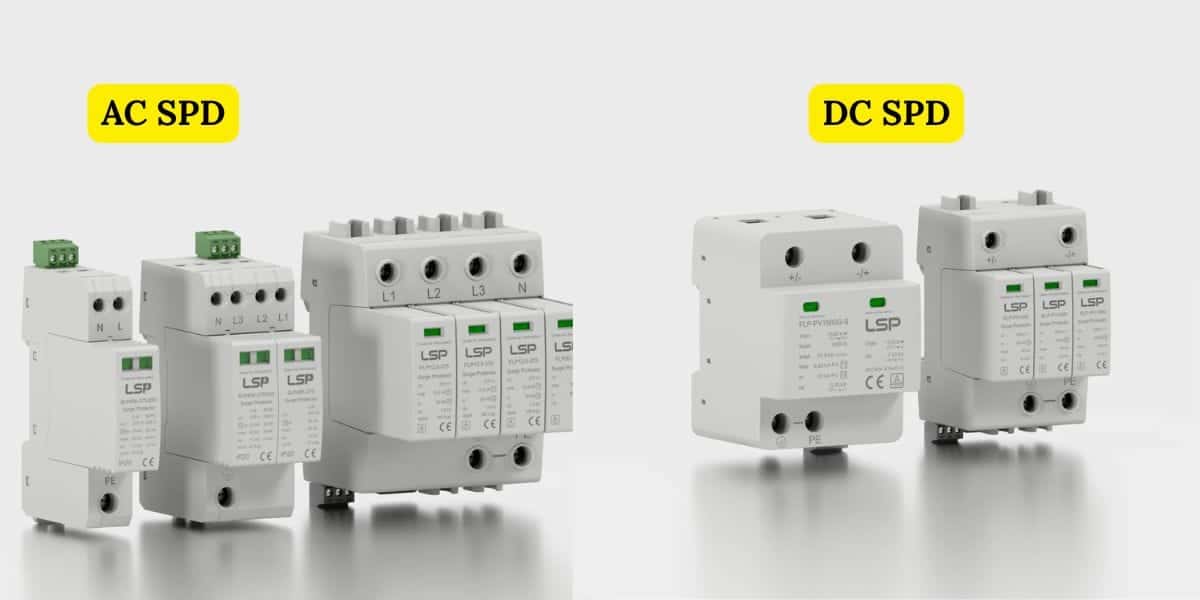
AC and DC systems experience surges differently, and this affects how surge protective devices are evaluated and selected.
In AC systems, surge events are influenced by alternating waveforms and natural current zero crossings, which can help extinguish transient currents. AC surge protection devices are tested and rated with this behavior in mind.
DC systems, such as photovoltaic arrays or battery storage, do not have natural zero crossings. Once conduction begins, current can persist longer, placing greater thermal stress on protective components. As a result, a DC SPD must be specifically designed and rated for DC operation.
When selecting an AC surge protection device, buyers should focus on:
- System nominal voltage
- Appropriate voltage protection rating
- UL 1449 parameters matching the application
For DC SPD selection, attention should be paid to:
- Maximum continuous operating voltage for DC
- Proper UL evaluation for DC circuits
- Surge current handling under continuous voltage stress
AC and DC surge protective devices are not interchangeable, even if nominal voltage ratings appear similar.
Selecting an SPD for Electrical Panels
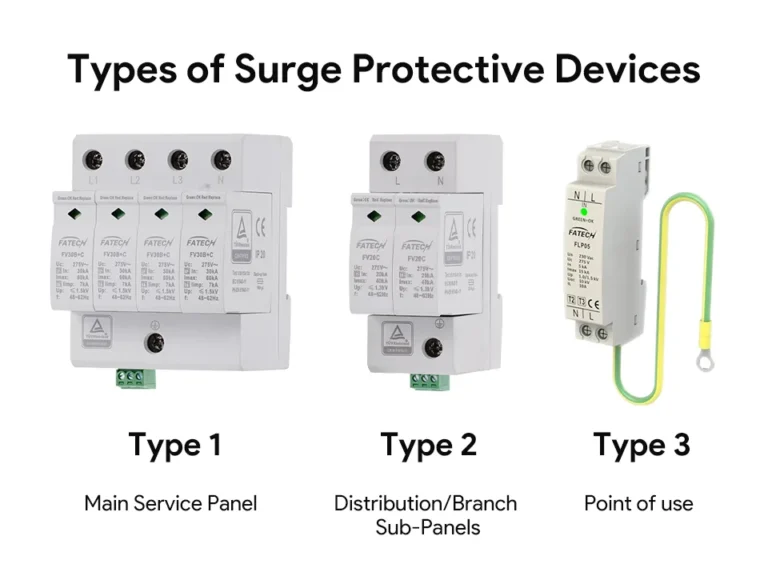
Electrical panels represent a critical location for surge protection because they serve as distribution points for downstream circuits and equipment.
When choosing a surge protection device for an electrical panel, system voltage is the first constraint. The SPD must be rated appropriately for the panel’s nominal and maximum operating voltage.
Panel location within the electrical system also matters. Panels closer to the service entrance typically see higher surge energy, while downstream panels may experience lower energy but require tighter voltage control for sensitive loads.
Expected surge exposure depends on factors such as:
- External power quality
- Switching activity within the facility
- Proximity to large inductive loads
Coordination with upstream and downstream protection is essential. The SPD selected for a panel should complement other protective devices rather than duplicating or conflicting with their behavior.
The goal is controlled voltage limitation combined with sufficient energy handling to maintain consistent performance over the life of the system.
Comparison Table
| Metric | What It Measures | What It Protects | Common Buyer Misinterpretation |
| Joule Rating | Total energy absorption capacity | SPD endurance over time | Higher joules always mean better protection |
| Clamping Voltage (VPR) | Maximum let-through voltage during surge | Connected equipment insulation and electronics | Lowest value is always best |
| UL 1449 Parameters | Standardized test validation | Accuracy and comparability of ratings | UL listed means universal suitability |
Common Buying Mistakes to Avoid
One of the most frequent mistakes is selecting a surge protective device based solely on joule rating. This ignores how voltage is controlled during individual events and often results in poor equipment protection.
Another issue is overlooking clamping voltage context. A low clamping value without sufficient energy capacity can lead to early device failure, while a high clamping value may leave sensitive equipment exposed.
Misreading UL 1449 listings is also common. Buyers sometimes assume all UL listed SPDs perform similarly, without checking specific VPR and nominal discharge current values.
Finally, assuming higher numbers automatically equal better protection oversimplifies a complex interaction of electrical parameters. Effective surge protection requires balance, not extremes.
Conclusion
Selecting a surge protective device is a technical decision that depends on understanding joule rating, voltage protection rating, and UL 1449 together. Each parameter describes a different aspect of performance, and none is sufficient on its own.
Evaluating these metrics as a coordinated set allows engineers and electricians to choose protection that aligns with real system conditions. This approach reduces long-term electrical risk, improves equipment reliability, and avoids the false confidence that comes from relying on a single headline number.
FAQs
Related Posts