English
  简体中文
简体中文  Deutsch
  Español
  Français
  Italiano
  日本語
日本語  한국어
한국어  Polski
  Português
  Русский
  Türkçe
  Nederlands
  Tiếng Việt
  ไทย
ไทย 
In modern commercial space design, noise and reverberation issues are increasingly prominent, particularly in environments like open-plan offices and conference rooms. Excessive noise levels severely impact work efficiency and customer experience. Noise reflection and reverberation not only make spaces feel noisy but also diminish communication and concentration.
Acoustic lighting fixtures offer an innovative solution, delivering high-quality illumination while effectively absorbing and reducing noise to enhance acoustic environments. These fixtures integrate acoustic materials with lighting functionality, providing dual benefits for commercial spaces—particularly in noise control.
When selecting acoustic LED lighting, the Noise Reduction Coefficient (NRC) rating serves as a key metric for evaluating acoustic performance. The NRC rating quantifies a fixture’s sound absorption capability, helping consumers choose the most suitable products to optimize a space’s acoustic design.
Understanding the Importance of NRC Ratings for Acoustic LED Lights
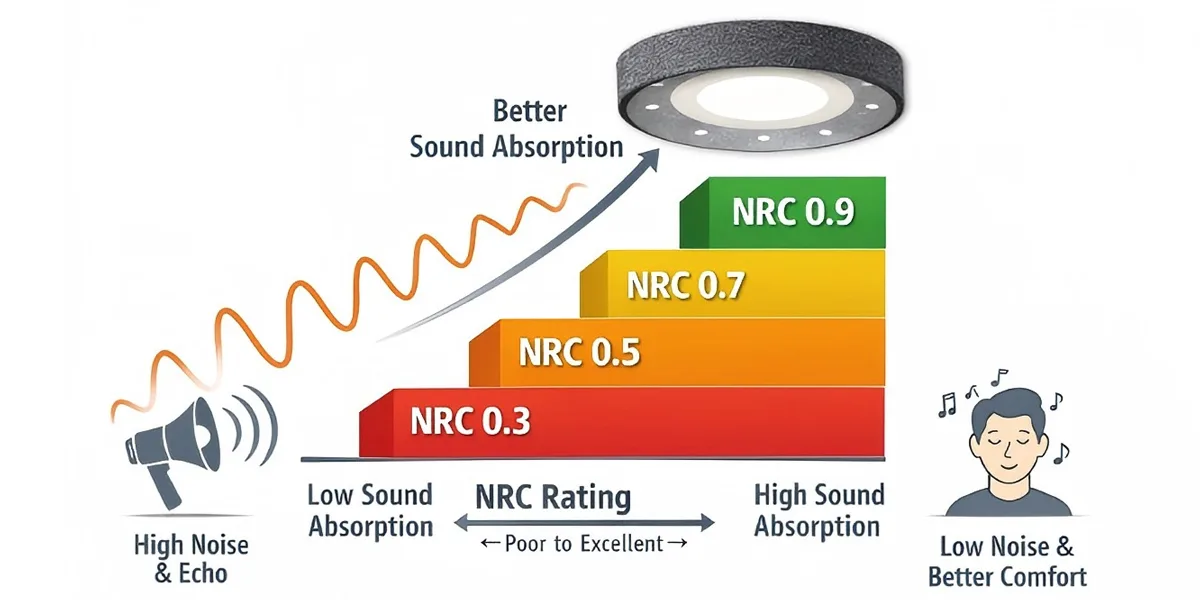
When selecting acoustic LED lights, the NRC rating serves as a crucial indicator for evaluating their sound absorption capabilities. The NRC scale ranges from 0 to 1, with higher scores indicating superior sound absorption properties. A sound-absorbing light with a high NRC rating can significantly reduce echoes and noise within a space, thereby enhancing its acoustic quality and comfort. This is particularly crucial in modern office environments, conference rooms, hospitals, and similar settings.
The NRC rating not only reflects a material’s sound absorption capability but also impacts the overall acoustic comfort of the environment. Understanding this helps consumers select the most suitable sound-absorbing LED light based on their specific needs.
What NRC Rating Is Suitable for Acoustic Lighting?
Before discussing “what constitutes an appropriate NRC,” it is essential to first clarify the definition of NRC and its significance in acoustic lighting.
What is NRC (Noise Reduction Coefficient)?
NRC (Noise Reduction Coefficient) is a standardized numerical metric used in acoustics to measure a material’s sound absorption performance. It is calculated by measuring the sound absorption coefficients at four center frequencies (250 Hz, 500 Hz, 1000 Hz, and 2000 Hz), taking their arithmetic mean, and rounding to the nearest 0.05.
Value range: 0.00–1.00
Fundamental Meaning: From an acoustic perspective, a higher value indicates stronger sound absorption capability, while a lower value signifies more pronounced sound reflection.
- NRC < 0.20: Typically classified as reflective materials
- NRC ≥ 0.20: Can be recognized as sound-absorbing materials
- NRC ≥ 0.80: Belongs to highly efficient sound-absorbing materials, suitable for spaces with high acoustic requirements
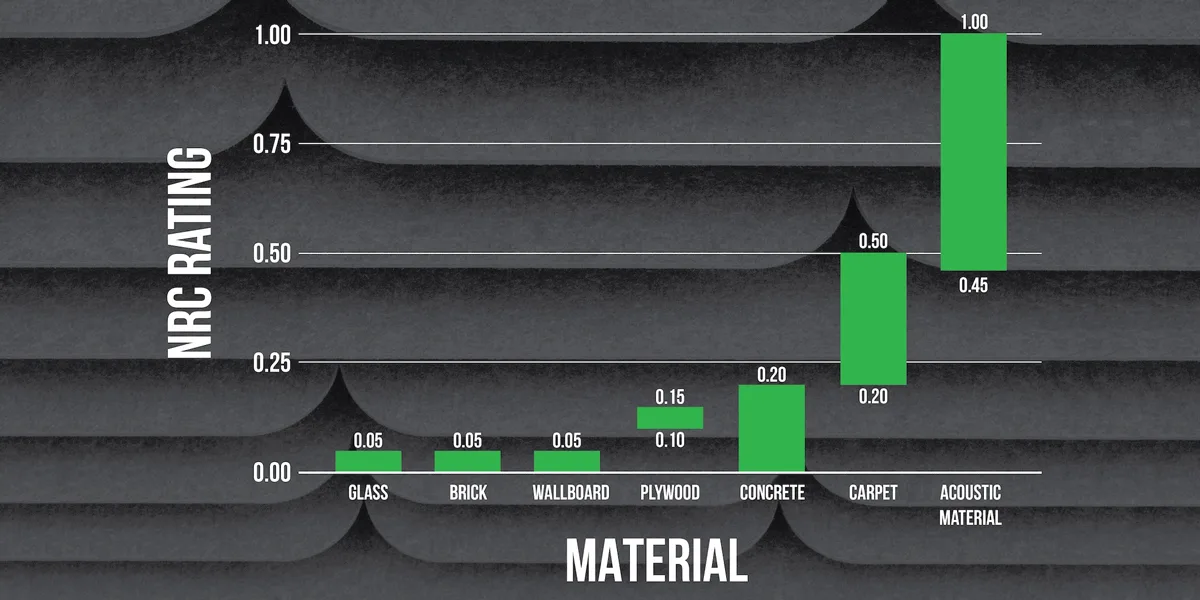
How does NRC rating impact acoustic lighting performance?
In acoustic lighting systems, NRC directly determines a fixture’s ability to reduce reverberation and control environmental noise. Since acoustic LED lights are typically installed in ceilings or elevated areas, their sound absorption properties significantly influence the overall acoustic environment of a space. Higher NRC values minimize echoes and noise reflections, enhancing speech intelligibility and auditory comfort, resulting in a more stable and controllable acoustic environment.
What is the appropriate NRC rating for different application scenarios?
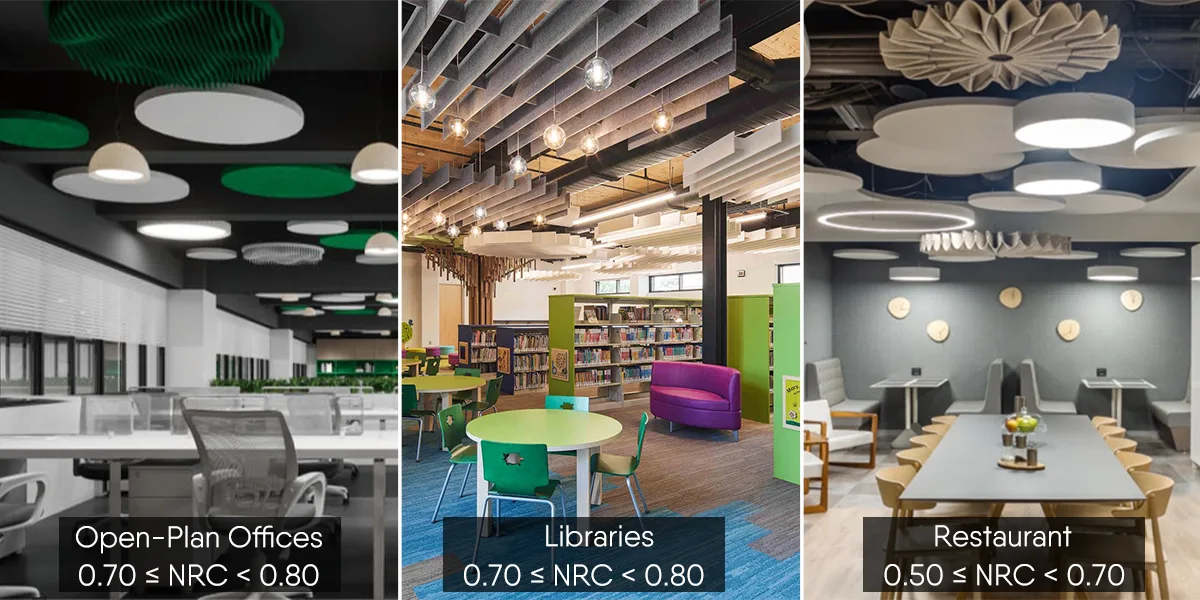
Acoustic lighting requirements for NRC vary across different usage environments. Selection should consider space functionality, budget, and design specifications. For acoustic LED lighting, products with NRC ≥ 0.70 are recommended to achieve optimal acoustic performance. Refer to the following NRC rating standards and application table for guidance:
NRC Rating Standards and Applications
| NRC Range | Acoustic Performance Class | Recommended application | Core Function |
| NRC ≥ 0.80 | High-Efficiency Sound Absorbing Material | High-Efficiency Sound Absorbing Material | Achieves optimal acoustic control, significantly reduces reverberation, enhances speech clarity and audio purity. |
| 0.70 ≤ NRC < 0.80 | Excellent Sound Absorbing Material | Open-Plan Offices, Classrooms, Libraries, Hospitals, Meeting Rooms | Effectively reduces background noise and reverberation, improves communication efficiency and spatial comfort. |
| 0.50 ≤ NRC < 0.70 | Moderate Sound Absorbing Material | Ordinary Residential Spaces, Stores, Corridors, Public Rest Areas | Significantly improves environmental noise, balances cost and design flexibility, suitable for moderate acoustic needs. |
| 0.20 ≤ NRC < 0.50 | Basic Sound Absorbing Material | Warehouses, Parking Lots, Industrial Plants | Provides basic sound absorption function, reduces some reflected sound. |
| NRC < 0.20 | Sound Reflective Material | Any acoustic environment requiring sound reflection (e.g., stages, music platforms) | Mainly reflects sound, not suitable for scenarios requiring sound absorption. |
Why is NRC particularly suitable for evaluating acoustic lighting?
NRC is widely used to assess the performance of architectural acoustic materials like ceiling and wall panels. Acoustic lighting inherently combines “lighting systems with acoustic ceiling solutions.”
Therefore, using NRC as the core metric for measuring the acoustic performance of sound-absorbing LED lights is not only professional but also intuitive, facilitating comparison and selection by designers, contractors, and buyers. For most commercial spaces, an NRC rating between 0.6 and 0.9 is considered ideal acoustic lighting, as it provides effective sound absorption while maintaining design flexibility and lighting performance.
How Acoustic LED Lights Enhance Sound Control in Modern Spaces
Modern buildings, particularly open-plan offices, often suffer from excessive noise levels. Acoustic LED lights address this by integrating sound-absorbing materials or structures. They provide illumination while absorbing sound waves and reducing echoes, significantly improving sound clarity and comfort within the space. Their design combines light sources with acoustic materials, not only solving noise issues but also enhancing the overall aesthetic appeal of the environment.
Through scientific configuration, these lights help modern spaces achieve optimal acoustic performance while meeting aesthetic and lighting requirements, transforming environmental noise from a distraction into an unobtrusive element.
The Role of Acoustic LED Lights in Enhancing Office and Residential Environments
In contemporary workplaces and homes, sound interference frequently compromises efficiency and comfort. Acoustic LED lights, as an innovative fusion of acoustics and illumination, are quietly optimizing the acoustic experience in these spaces.
- Office Settings: While open layouts foster collaboration, they also weave printer hums and keyboard clicks into a constant background noise. Meeting room echoes further muddle discussions. Sound-absorbing LED lights incorporate porous materials that absorb sound waves and reduce reflections, making meetings clearer. Simultaneously, the adjustable color temperature (from cool white to warm yellow) adapts to different times of day, reducing eye strain and fostering a focused atmosphere. This “sound-light synergy” design transforms noisy spaces into efficient havens.
- Residential Settings: Urban clamor—such as traffic noise and neighborly activities—often intrudes upon home tranquility. Sound-absorbing LED lights absorb high-frequency noise, building an “acoustic barrier” indoors. Used in living rooms or bedrooms, residents enjoy quieter moments for rest or reading. The LED’s energy efficiency and long lifespan further align with sustainable living needs.
From conference rooms to bedrooms, sound-absorbing LED lights scientifically redefine spatial quality, silently enhancing both life and work.
Interpreting NRC Ratings: Why They Are Critical for Acoustic Lighting Performance
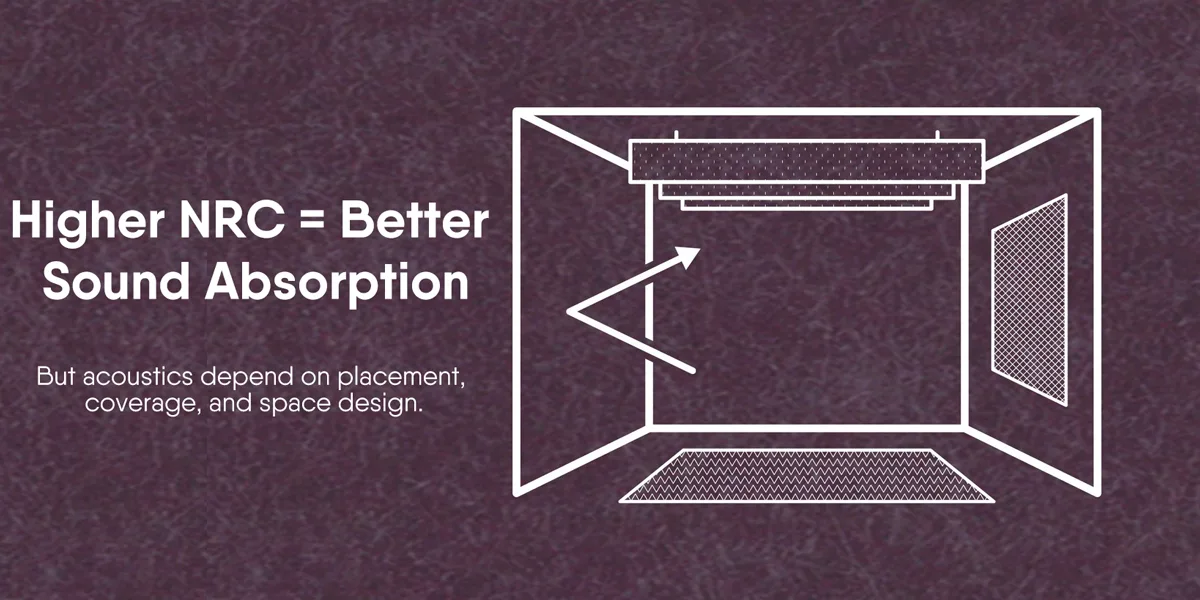
The NRC rating serves as a core metric for evaluating the acoustic performance of acoustic lighting, with its significance lying in its direct influence on indoor sound environments.
Acoustic lighting achieves sound energy conversion through integrated porous materials (such as polyester fiber, perforated aluminum panels, and acoustic cotton). Its NRC value directly determines:
- Reduced reverberation time: In a 50㎡ conference room, fixtures with NRC ≥ 0.7 reduce reverberation time from 2.1 seconds to 1.3 seconds, significantly enhancing speech intelligibility.
- Improved Speech Transmission Index (STI): Measured STI increases from 0.62 to 0.78, markedly boosting communication efficiency and focus.
- Noise interference suppression: Effectively absorbs equipment hum and human voice echoes, creating a quiet, low-distraction office or meeting environment.
Current Industry Standards and Regulations
- International: ASTM C423 serves as the authoritative standard for NRC testing.
- No mandatory regulations: Currently, no dedicated industry standard exists for “acoustic LED lighting,” with NRC serving only as a functional reference.
- Collaborative Design Trend: Lighting standards like ISO/CIE 8995-1:2025 emphasize the synergy between “visual comfort” and “acoustic comfort,” propelling sound-absorbing lighting as a standard feature in smart spaces.
Real-World Application Value
User feedback from actual installations indicates that after installing high-NRC sound-absorbing LED lights, conference rooms experience “no more echo when speaking,” “significantly reduced air conditioning noise,” and “enhanced focus.” Its value extends beyond noise reduction to reshape spatial perception—where light and sound jointly serve cognitive efficiency and psychological comfort.
An excellent NRC rating not only effectively reduces noise but also prevents its propagation within spaces, ensuring sound quality remains consistently within comfortable levels.
How to Select the Optimal Acoustic LED Light for Enhanced Sound Absorption
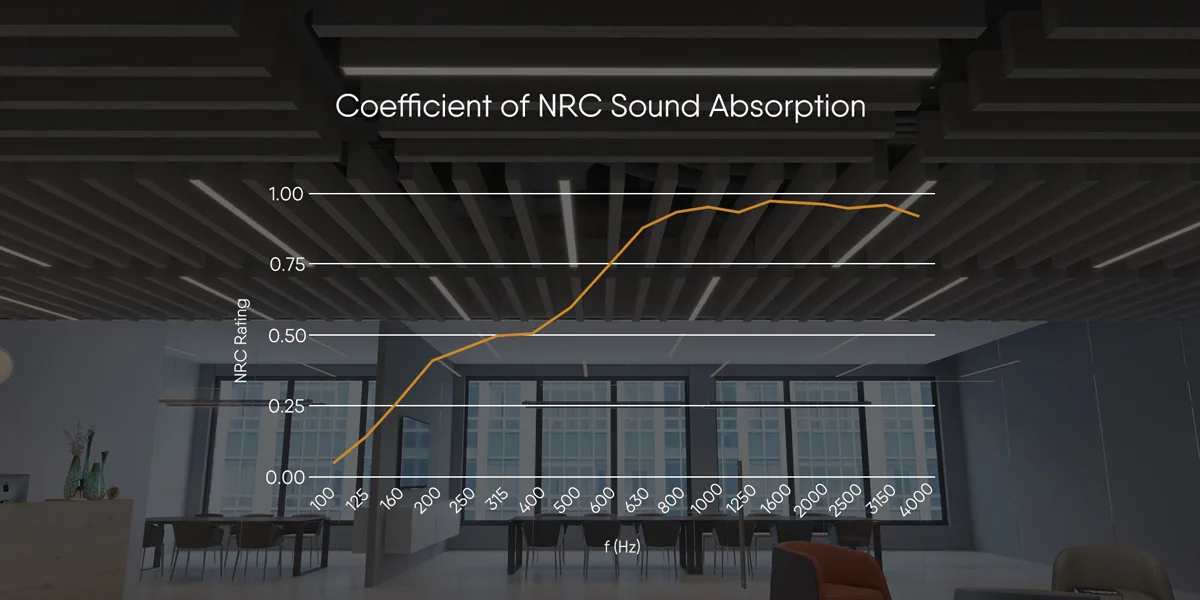
When choosing suitable acoustic LED lights, prioritize the NRC rating. High-rated fixtures are ideal for spaces with stringent noise control requirements. Additionally, consider the type and quality of acoustic materials to ensure they deliver expected sound absorption performance in real-world use. Concurrently, fixture design and luminous efficacy are critical factors directly influencing the overall spatial experience.
- NRC Value Matching Scenarios:
a) Small spaces (e.g., home offices) can opt for NRC 0.6 or NRC 0.5-0.7. This range effectively absorbs everyday noise (like TV sounds or children playing) while avoiding excessive absorption that creates an unnaturally quiet space.
b) Large spaces (e.g., conference rooms) are recommended for NRC 0.7-0.9. Higher NRC values reduce echoes in conference rooms, enhance video call quality, and minimize background noise interference in open-plan offices.
c) NRC values above 0.8 are suitable for professional settings like recording studios, but residential/office spaces require balancing sound absorption with lighting functionality.
- Material Durability: Prioritize fire-resistant and moisture-proof acoustic materials (e.g., Class A fire-rated foam) to prevent reduced sound absorption due to environmental humidity.
- Lighting Parameters: Color temperature (2700K-4000K) and Color Rendering Index (CRI>90) must align with spatial requirements—e.g., 4000K neutral light boosts focus in offices.
- Certification Compliance: Select brands with rigorous testing certifications to ensure luminaires meet acoustic performance standards.
SignliteLED’s acoustic lighting prioritizes both acoustic performance and aesthetic design. The illustrated honeycomb-structured lamp achieves UGR<19, delivers an NRC of 0.75, and incorporates glare prevention features, making it ideal for residential living rooms.
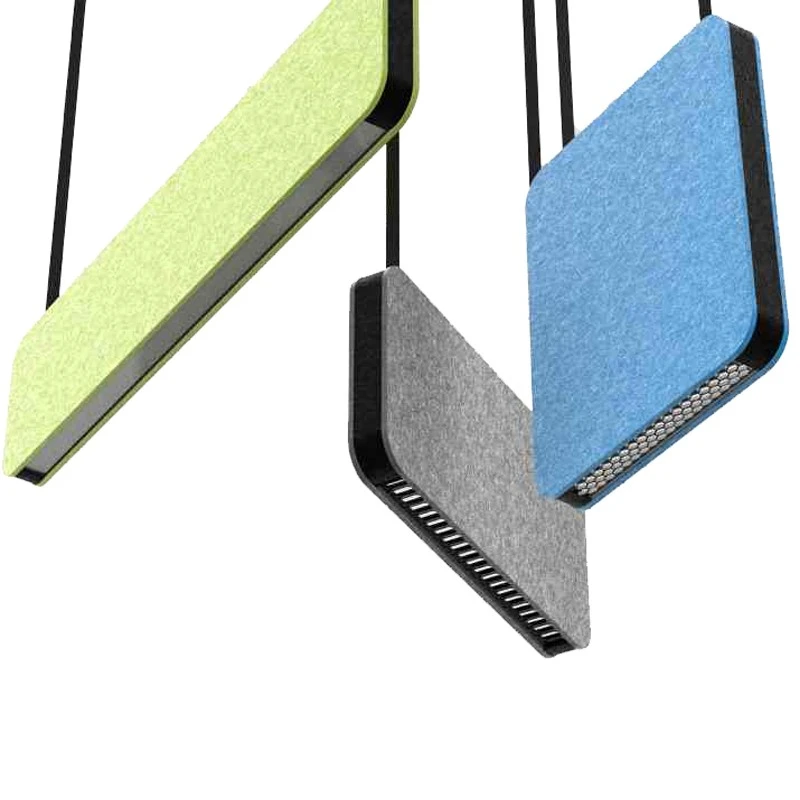
Super Slim Acoustic LED Linear Light
Input Voltage: AC100-277V / AC220-240V, 50-60HZ
Emitting Direction: Downward
Size: 1218*36*400mm
CCT: 3000K / 4000K / 6000K
Power: 30W
Luminous Flux: 100-110 lm/W
CRI: >80Ra
PF: >0.90
Fllicker Free: Yes
Beam Angle: 120°
IP Grade: IP20
Warranty: 5 Years
Felt Acoustic Board Color: Red / Green / Blue / Grey more than 48 colors option
How do acoustic fixtures achieve both lighting and noise reduction simultaneously?
Modern consumers increasingly favor lighting products that combine excellent acoustic performance with spatial aesthetics. Through ingenious design, acoustic LED lighting seamlessly merges functionality with artistry, making it an indispensable element in contemporary spaces.
Acoustic fixtures integrate functionality through the following design elements:
- Material Layers: The lamp surface utilizes porous foam or fibrous fabrics (e.g., polyester fiber), allowing sound waves to enter and convert into heat through friction while maintaining light transmission.
- Structural Design: The lampshade incorporates sound-absorbing cotton or honeycomb structures internally to maximize sound wave reflection paths. The LED light source is embedded within the sound-absorbing layer, ensuring uniform light distribution.
Conclusion
As an innovative acoustic lighting solution, sound-absorbing LED fixtures are increasingly becoming standard in modern architecture and spatial design due to their outstanding NRC ratings and acoustic performance.
From office environments to residential spaces, commercial venues to educational institutions, LED acoustics lighting plays a vital role in enhancing spatial acoustic comfort. By selecting appropriate NRC ratings and fixtures, consumers can create quieter, more comfortable environments, elevating the quality of life and work.
FAQs
Related Posts