English
  简体中文
简体中文  Deutsch
  Español
  Français
  Italiano
  日本語
日本語  한국어
한국어  Polski
  Português
  Русский
  Türkçe
  Nederlands
  Tiếng Việt
  ไทย
ไทย 
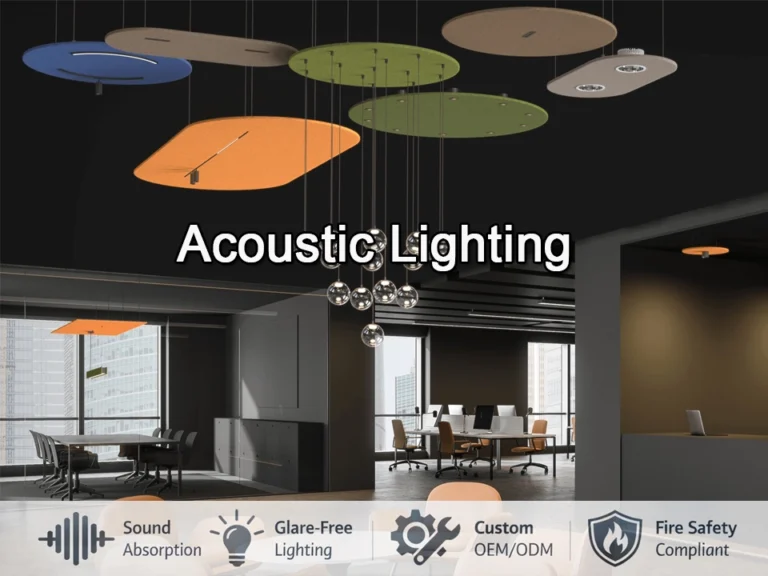
Acoustic lighting differs from standard lighting because it combines illumination with sound absorption, helping reduce echo and improve speech clarity in busy commercial interiors. Standard lighting focuses only on lighting performance and visual comfort, without changing how sound behaves in the room.
In practical terms, acoustic lighting supports both lighting design and basic acoustic control in one ceiling element.
This article explains the core differences, how acoustic lighting manages sound, and when it makes sense in real commercial spaces.
Define Both Terms Clearly

Standard lighting: Light fixtures designed primarily around illumination metrics such as lumens, beam control, CCT (color temperature), glare management, and overall visual appearance.
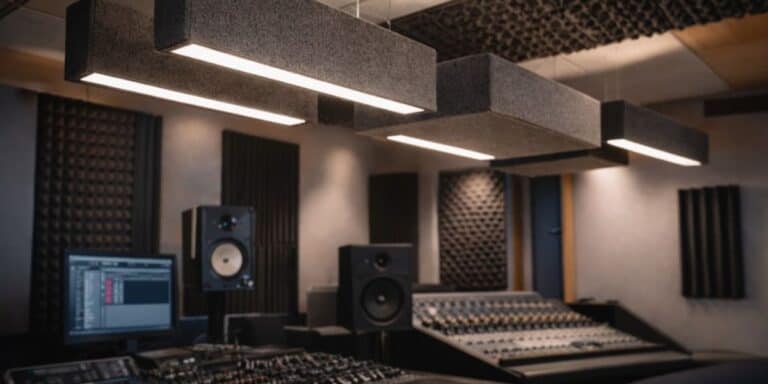
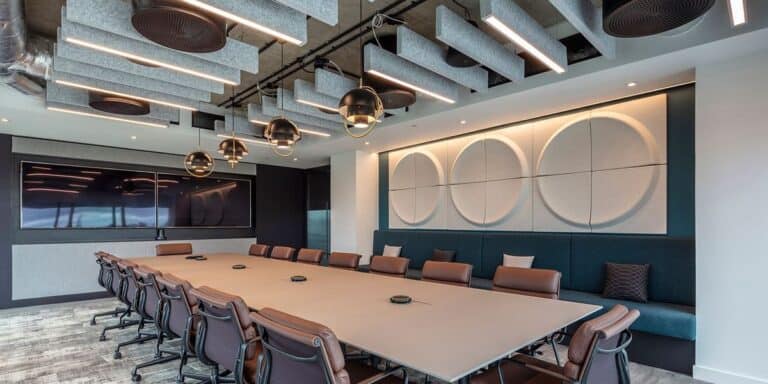
Acoustic lighting: Lighting fixtures built with sound-absorbing materials (often felt/PET) that reduce reflections and reverberation while still providing functional illumination.
Acoustic Lighting vs Standard Lighting (Practical Differences)
| Feature | Acoustic Lighting | Standard Lighting |
| Primary function | Light + sound absorption | Light only |
| Acoustic impact | Helps reduce reflected sound and reverberation | No acoustic benefit |
| Typical materials | Acoustic felt/PET + lighting components | Metal, plastic, glass, diffusers |
| Best-fit spaces | Open offices, meeting rooms, collaboration zones | Any space where acoustics are already controlled |
| Ceiling role (reflection control) | Adds “soft” absorption to ceiling plane | Mostly reflective or neutral surfaces |
| Maintenance/installation considerations | May require planning for size, suspension height, and cleaning | Often simpler and more standardized |
| Design flexibility | Adds texture and visual zoning with functional lighting | Wide range of lighting-only aesthetics |
| When it’s unnecessary | Rooms with low echo or existing acoustic treatment | Most basic or low-noise rooms |
Sound Management: What Changes in a Real Room?

In many commercial interiors, sound problems are not caused by “noise volume” alone. The bigger issue is how sound travels and bounces off hard surfaces. When speech and office noise reflect repeatedly, the room can feel louder even when people are not speaking loudly. Standard lighting can improve visual comfort, but it does not reduce echo or reverberation because it does not add meaningful sound-absorbing surface area to the room.
Key concepts that change with acoustic lighting:
Reflections
Sound reflects off ceilings, glass, drywall, and concrete. In open-plan layouts, these reflections spread speech across the room and reduce privacy.
Reverberation
Reverberation is the “ring” or persistence of sound after the source stops. Longer reverberation makes spaces feel busy and can blur speech.
Speech intelligibility
Speech intelligibility is how clearly people understand words, especially in meetings or collaborative work. Echo and reverberation reduce clarity, forcing people to repeat themselves.
Why open offices and meeting rooms suffer more
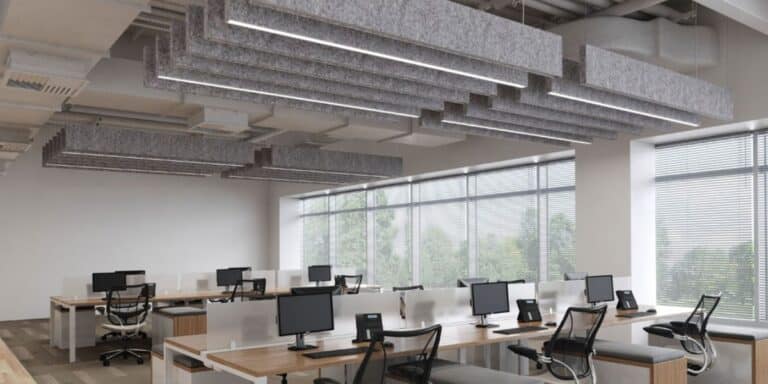
Open offices typically have hard ceilings and large surface areas, so reflections build up quickly. Meeting rooms can also suffer when glass partitions, minimal interiors, and hard tables create strong reflection paths.
One common indicator used to describe absorption performance is NRC (Noise Reduction Coefficient), but real-world results still depend on coverage area, ceiling height, and placement.
Ambiance Differences (What People Feel)

Lighting decisions shape how a space looks, but acoustics shape how it functions during real use. Acoustic lighting can also change perceived ambiance by adding softer visual forms and textured materials at ceiling level, which can make a space feel calmer compared to hard-surface, lighting-only fixtures. When acoustic absorption is added at the ceiling level, the experience can change in predictable ways.
In rooms that previously felt “live” or echo-prone, acoustic lighting often leads to:
- Less “shouty” conversations, especially around shared tables
- Clearer speech, with fewer repeated questions in meetings
- Reduced listening fatigue during longer discussions
- More comfortable collaboration, because voices don’t carry as aggressively
These effects are typically most noticeable in spaces with frequent speaking activity, like stand-up meeting areas, huddle rooms, and project zones.
Design Benefits (Where Acoustic Lighting Fits Better)

Acoustic lighting is often chosen when the ceiling needs to do more than hold luminaires. In many offices, the ceiling is also the largest uninterrupted reflective surface, so treating it can be efficient.
Ceiling real estate efficiency
Instead of installing separate lighting and separate acoustic products, acoustic lighting combines both functions. This can simplify ceiling layouts in spaces where wall area is limited or where the design aims to stay minimal.

58mm Width Acoustic LED Linear Light
- Input Voltage: AC110–120V / AC220–240V, 50–60Hz
- Emitting Direction: Downward
- Width Options: 58 mm / 80 mm
- Size: 1288 × 58 × 400 mm / 1288 × 80 × 400 mm
- LED Chip: SMD2835
- UGR: < 19
- Power Factor (PF): > 0.90
- CRI: > 90 Ra
- Luminous Efficacy: 100 lm/W
- Correlated Color Temperature (CCT): 3000K / 4000K / 6000K
- Power: 30 W
- Beam Angle: 120°
- IP Rating: IP20
- Flicker Free: Yes
- Warranty: 5 years
- Acoustic Panel Color Options: Red / Green / Blue / Grey (more than 48 color options)
Clean integration vs adding separate acoustic panels
Some interiors avoid wall-mounted absorbers for aesthetic or practical reasons (brand walls, storage, glass partitions). In these cases, an acoustic lighting panel can add absorption while keeping the visual language consistent.
Texture and softness from felt surfaces
Many felt-based products add a softer visual layer to spaces dominated by hard finishes. Felt lighting and fixtures can introduce texture without changing the overall layout or furniture plan.
Support for minimal interiors
Minimal interiors often rely on hard, clean surfaces, which can increase reflections. Acoustic lighting panels can help offset this by adding absorption in a location that doesn’t interrupt circulation or sightlines.
Common spaces where acoustic lighting makes sense:
- Open-plan work areas with collaboration clusters
- Meeting rooms with glass walls or minimal finishes
- Reception and waiting areas with hard floors
- Breakout zones where people speak casually
- Training rooms and multi-purpose spaces
When Standard Lighting Is Enough
Acoustic lighting is not necessary in every project. In many rooms, standard lighting performs perfectly well because acoustics are already controlled through materials and layout.
Standard lighting may be enough when:
The room already includes effective acoustic treatment (ceiling baffles, wall panels, acoustic ceiling tiles). In these spaces, adding absorption to the luminaires may not change the outcome much.
Soft finishes are doing the work. Carpet, upholstered seating, curtains, and bookshelves can reduce reflections and shorten reverberation time.
The room is small and not echo-prone. Compact rooms with lower ceilings and soft furnishings often don’t build up strong reverberation.
There are budget or maintenance constraints. Some projects prioritize standardization of parts, simplified cleaning, or strict replacement cycles.
This is why acoustic lighting is usually evaluated as a targeted solution, not a default upgrade.
Quick Selection Checklist
Use this quick checklist to decide whether acoustic lighting is likely to help:
- Room surfaces are mostly glass, concrete, tile, or drywall
- Ceiling height is medium to high (more reflection space)
- Occupancy is high and speaking activity is frequent
- Speech clarity is important (meetings, training, collaboration)
- Acoustic panels are limited or not currently installed
- Placement can be centered over collaboration zones
Placement Guidance
Placement determines whether acoustic lighting improves sound where it matters. The goal is to add absorption near the main speech activity and along common reflection paths.

Direct Circle Acoustic LED Pendant Light
- Input Voltage: AC100-277V / AC220-240V,50-60HZ
- Height Size: H65mm
- Size D: 600mm / 800mm / 1000mm / 1200mm
- CCT: 3000K / 4000K / 6000K
- Power: 40W / 60W / 80W / 96W
- Luminous Flux: 100-110Lm/W
- Anti-Glare: Yes
- CRI: >80Ra
- PF: >0.90
- Fllicker Free: Yes
- Beam Angle: 120°
- IP Grade: IP20
- Warranty: 5 years
- Felt Acoustic Board Color: Red / Green / Blue / Grey more than 48 colors option
Practical placement guidance:
Place it above tables and collaboration areas where speech happens most. This includes meeting tables, benching clusters, and shared work zones.
Position it near the center of reflection paths, not only where it looks balanced. In many rooms, the strongest reflections travel between the table, ceiling, and glass or hard walls.
Avoid installing it only around the perimeter. Perimeter placement can leave the main activity zone untreated, which limits the acoustic benefit even if the room looks well-designed.
In general, acoustic lighting works best when it’s treated as both a lighting layout and an acoustic coverage plan.
Conclusion
Standard lighting is designed to deliver illumination, visual comfort, and consistent appearance across a space.
Acoustic lighting adds a second function by reducing sound reflections and helping manage reverberation in echo-prone rooms.
It tends to be most useful in commercial spaces with frequent speaking, hard finishes, and open layouts.
Results depend on placement and coverage, especially above collaboration zones.
When a room is already acoustically treated, standard lighting may be all that’s needed.
FAQs
Related Posts