English
  简体中文
简体中文  Deutsch
  Español
  Français
  Italiano
  日本語
日本語  한국어
한국어  Polski
  Português
  Русский
  Türkçe
  Nederlands
  Tiếng Việt
  ไทย
ไทย 
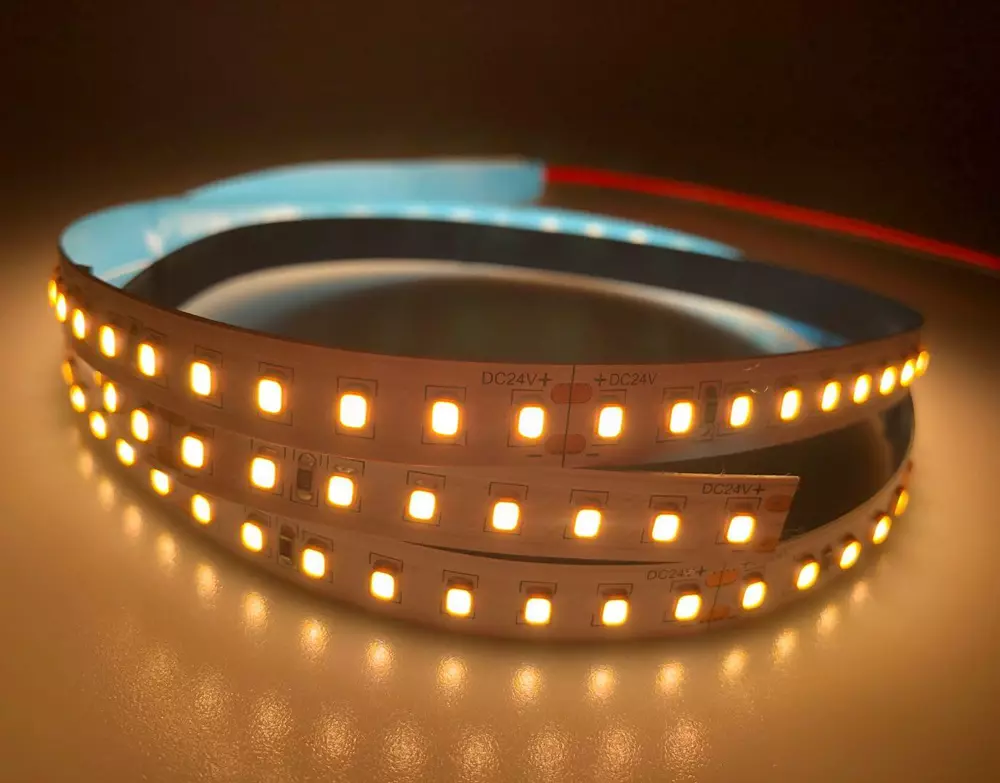
LED strips have almost strict requirements on the driving power. Unlike ordinary incandescent bulbs, LEDs can be directly connected to 220V AC mains. LED is driven by a low voltage of 2 to 3 volts, and complex changing circuits must be designed. LED lights for different purposes must be equipped with different power adapters.
Since LED is a semiconductor device with sensitive characteristics and has negative temperature characteristics, it needs to be in a stable working state and protected during the application process, thus generating the concept of driving. The driver is the core component of the LED flexible strip and plays an important role in the work of the LED.
LED flexible strip drivers can generally be divided into AC drivers and DC drivers.
According to different applications, LED flexible strip AC drivers are also divided into three circuit types: buck type, boost type, and converter type. The difference between an AC drive and a DC drive is that in addition to rectifying and filtering the input AC, there is also a problem of isolation and non-isolation from a safety point of view.
LED flexible strip DC drivers can be divided into three types according to their different functions and uses.
1. Converter type drive. It uses switching devices to cooperate with high-frequency transformers to realize energy transmission from primary to secondary, and at the same time do voltage/voltage conversion to drive light-emitting diodes to work. The voltage at the output terminal of this driver is not restricted by the input voltage, and can be designed according to the number of LED flexible strips that need to be connected in series. It is flexible in application and is suitable for the situation where the power supply voltage fluctuates near the voltage drop of the load tube, and is also suitable for the power supply voltage and The case where the pressure drop across the load tubes varies widely.
2. DC step-down driver. The basic principle is to use the switching device to cooperate with the reactive device to reduce the voltage and limit the current of the external power supply, and then drive the light-emitting tube to work. The series step-down driver has a simple structure and relatively high conversion efficiency. The main disadvantage of this kind of driver is that once the main switching device is damaged, a large current will directly pass through the luminous tube to burn the luminous tube. Obviously, this solution cannot be used when the supply voltage is lower than the load tube voltage drop.
3. DC boost driver. Its basic principle is to use switching devices to cooperate with reactive devices to store energy, boost voltage and limit current. The conversion efficiency of the boost driver is also relatively high. Its more significant advantage is that it will not damage the luminous tube when it fails. Boost drivers can only be used when the load transistor voltage drop is always higher than the supply voltage. When the voltage drop of the load tube is lower than the power supply voltage, the driver will run out of control, and a large current will directly pass through the luminous tube, causing the luminous tube to burn out.
When inputting low DC voltage, the number of LED flexible strips used is small. You can choose a step-down driver or a boost driver. Try to connect LED flexible strips in series instead of in parallel or in parallel. If the number of LED flexible strips is large, a boost driver should be used, and it should be connected in series instead of in parallel or less in parallel.
The driver of the LED flexible strip is the core component of the entire LED flexible strip. If a good driver is selected, the luminous efficiency and life of the LED flexible strip will be greatly improved. Therefore, when consumers choose and buy It must also be investigated and understood in detail.
Related Posts