Español
  English
  简体中文
简体中文  Deutsch
  Français
  Italiano
  日本語
日本語  한국어
한국어  Polski
  Português
  Русский
  Türkçe
  Nederlands
  Tiếng Việt
  ไทย
ไทย 
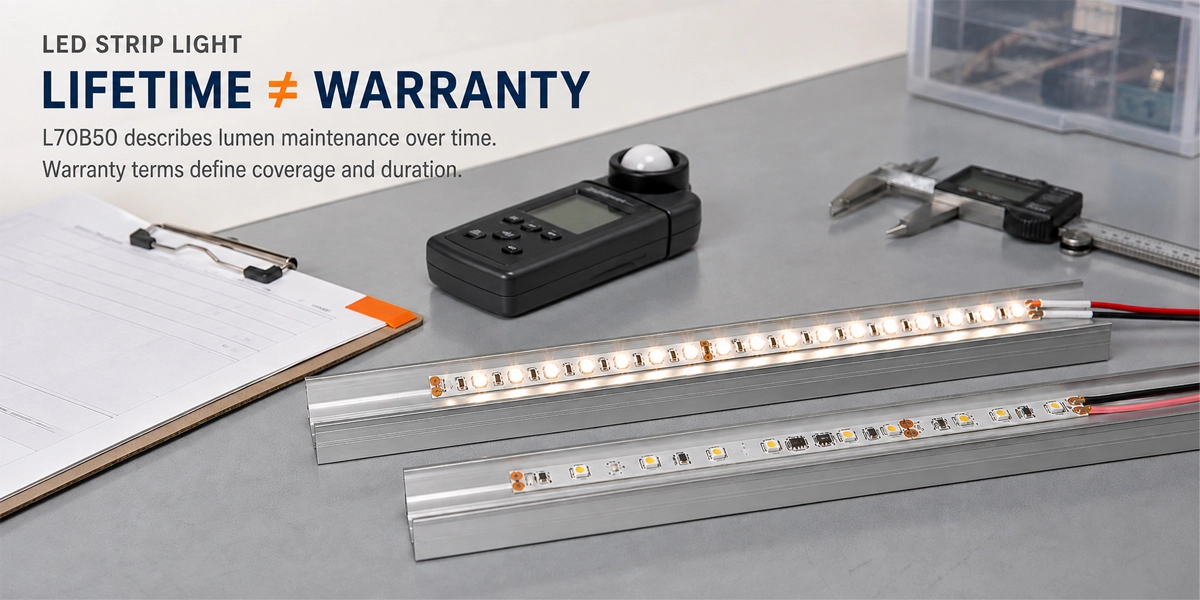
En tira de luz LED La garantía y su vida útil miden dos cosas diferentes. Una calificación de por vida como L70B50 a 50.000 horas estima el mantenimiento de lumenes en condiciones de prueba definidas. Una garantía de 3, 5 o 7 años define lo que hará el fabricante si se produce una falla de producto elegible durante un número específico de años calendario.
Esto explica por qué dos luces de tira de LED pueden tener la misma vida útil L70B50 pero diferentes períodos de garantía. El producto de garantía más larga puede utilizar diferentes componentes, corriente de funcionamiento, diseño térmico, encapsulación o procedimientos de control de calidad. Sin embargo, la diferencia también puede ser comercial, con precios, métodos de compensación o exclusiones de garantía.
Por lo tanto, una garantía más larga no es una prueba automática de una vida útil más larga de la tira de luz LED. Los compradores deben comparar las especificaciones del producto, la base de prueba y los términos de la garantía escritos antes de elegir entre diferentes rangos.
Garantía de la tira de luz LED frente a la vida: la diferencia clave
Una clasificación de duración de la luz de tira de LED describe el mantenimiento de la luz-salida esperada durante las horas de funcionamiento. Una garantía define la responsabilidad comercial del proveedor durante un período determinado.
| Artículo | Vida útil nominal | Garantía |
| lo que describe | Mantenimiento de lumen proyectado | Protección contra defectos o fallas elegibles |
| como se expresa | horas de oficina | años calendario |
| Referencia típica | L70, L80 o L90, a veces con un valor B | Condiciones de garantía por escrito |
| Condiciones principales | Temperatura, corriente de accionamiento y base de prueba | Modelo de producto, instalación, uso y exclusiones |
| Lo que no garantiza | Funcionamiento sin fallos del sistema completo | Brillo sin cambios durante todo el período de garantía |
Una calificación de 50.000 horas de vida no significa que la tira de LED dejará de funcionar a 50.001 horas. Asimismo, una garantía de tira de luz LED de cinco años no garantiza necesariamente cinco años de brillo sin cambios o cubre todas las posibles fallas.
La regla práctica es simple: usar la calificación de por vida para evaluar el mantenimiento esperado de lumen y la política de garantía para evaluar la protección comercial.
¿Qué significa L70B50?
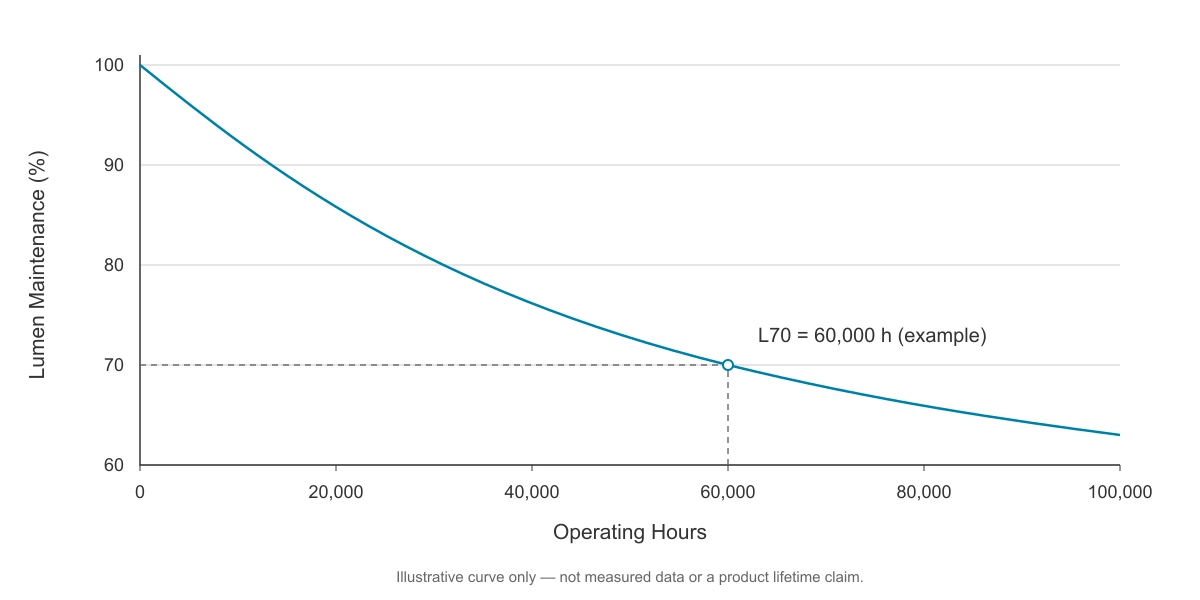
L70B50 combina un umbral de mantenimiento de lumen con una estadística de población.
- L70 significa que la fuente de luz LED mantiene 70% de su flujo luminoso inicial. Representa aproximadamente una depreciación de 30% de lumen, no una pérdida de 70%.
- B50 describe un resultado de la población media. Es un valor estadístico, no una garantía de que cada LED funcione de manera idéntica.
- Las horas indicadas representan el tiempo de operación proyectado asociado con esa condición bajo condiciones de prueba especificadas.
Por ejemplo, L70B50 a 50.000 horas significa que se proyecta que la población de LED evaluada alcance un nivel medio de mantenimiento de lumen de 70% después de 50.000 horas de operación bajo las condiciones aplicables.
No significa que cada LED entregará exactamente 70% de salida en ese momento, ni garantiza que cada componente del sistema completo de iluminación de tira de LED funcione sin fallas durante 50.000 horas.
L70B50 no describe directamente fallas tales como:
- LED muertos o secciones que no funcionan;
- rastros de PCB dañados;
- uniones de soldadura fallidas;
- conectores o cableado defectuosos;
- falla adhesiva;
- Silicona amarillenta o agrietamiento;
- entrada de agua y corrosión;
- Fallo de alimentación o controlador.
Esta distinción es importante porque dos tiras de LED pueden tener la misma clasificación de mantenimiento de lumen pero diferentes niveles de confiabilidad completa del producto.
Para más información, consulte nuestra guía de Larga de vida de la tira de LED y los factores que la afectan.
¿Cómo se utilizan LM-80 y TM-21?
LM-80 es un método de prueba de la sociedad de ingeniería iluminadora para medir los cambios en la salida de luz y las características de color de los paquetes, arreglos o módulos de LED en condiciones controladas.
TM-21 utiliza datos de LM-80 que califican para proyectar el mantenimiento de lumenes a largo plazo. Puede estimar cuándo una fuente de luz LED puede alcanzar un nivel como L70, L80 o L90.
LM-80 proporciona datos medidos, mientras que TM-21 proporciona una proyección. Ninguno de los métodos por sí solo determina el período de garantía o prueba cada componente en un sistema de iluminación de tira de LED instalado.
La relevancia de un reclamo de por vida depende de factores que incluyen:
- El paquete LED probado;
- corriente de funcionamiento;
- temperatura de prueba;
- duración de la prueba;
- tamaño de muestra;
- qué tan cerca las condiciones probadas representan el producto terminado.
Por lo tanto, los compradores deben preguntar si los datos de por vida se aplican al modelo LED específico y a las condiciones de funcionamiento utilizadas en el producto que se cotiza. La Iluminadora Sociedad de Ingeniería ofrece una Recursos oficiales de herramientas y estándares TM-21.

Este video de iluminación Cree explica cómo se utilizan los datos de prueba LM-80 y las proyecciones TM-21 para evaluar el mantenimiento de los lumen LED, no la vida útil del producto completo. Para las luces de tiras LED, los compradores también deben revisar las condiciones de funcionamiento, la fiabilidad de los componentes y los términos de garantía escritos.
¿Por qué dos tiras de LED pueden tener el mismo L70B50 pero garantías diferentes?
La misma clasificación L70B50 no prueba que dos luces LED tengan una construcción idéntica, tasas de falla o cobertura de garantía. Solo establece una declaración de mantenimiento de lumen en condiciones definidas.
La diferencia entre los rangos de garantía puede ser técnica, comercial o una combinación de ambos.
| Posible diferencia | Tipo | Por qué importa |
| Componentes LED | técnico | La calidad del paquete, la estabilidad del fósforo y la consistencia de la producción pueden afectar el rendimiento a largo plazo |
| Corriente de operación | técnico | La menor tensión eléctrica puede reducir el calor y la degradación lenta |
| Diseño térmico | técnico | El diseño de PCB, la densidad de potencia y el método de instalación afectan la temperatura de funcionamiento |
| encapsulación | técnico | La calidad de silicona y la construcción de sellado afectan el amarilleo, el agrietamiento y la resistencia al agua. |
| Prueba de producción | técnico | El envejecimiento, la inspección y el control por lotes pueden reducir las fallas tempranas |
| Tasa de falla de producto completo | técnico | L70B50 no describe completamente las secciones muertas, fallas de soldadura, problemas de conector o entrada de agua |
| Cobertura de garantía | comercial | Los recursos, exclusiones, límites operativos y requisitos de reclamación pueden diferir |
| Posicionamiento en el mercado | comercial | La misma plataforma de productos se puede ofrecer con diferentes paquetes de servicios o precios |
1. diferentes componentes
Dos tiras pueden utilizar LED con reivindicaciones similares de mantenimiento de lumen pero diferentes materiales de PCB, resistencias, procesos de soldadura, adhesivos, conectores o encapsulación.
Es posible que estas diferencias no cambien el valor declarado L70B50, pero pueden afectar la confiabilidad del producto completo.
Los compradores deben preguntar si el rango de garantía más larga utiliza un paquete LED diferente, especificación de PCB, adhesivo, conector o material impermeable.
2. Diferentes corrientes de funcionamiento
Conducir un LED a una corriente más baja generalmente reduce el estrés eléctrico y térmico. Por lo tanto, una tira de más conservador puede tener un menor riesgo de falla incluso cuando su calificación de mantenimiento de lumen declarada sea la misma que otro modelo.
Al comparar productos, no mires solo el brillo. Compara:
- potencia por metro;
- Cantidad de LED por metro;
- Corriente por segmento de LED o circuito;
- eficacia luminosa;
- Temperatura de PCB bajo funcionamiento normal.
Una tira que produce un alto brillo a partir de menos LED puede ejercer más tensión en cada LED que un diseño que distribuye la carga entre más componentes.
3. Diseño térmico diferente
El calor afecta la depreciación del lumen, la estabilidad del color, las juntas de soldadura, el adhesivo y los materiales circundantes.
Dos tiras de LED con la misma clasificación L70B50 pueden funcionar a diferentes temperaturas debido a las diferencias en:
- potencia por metro;
- ancho de PCB;
- especificación de cobre;
- espaciado de componentes;
- superficie de montaje;
- perfil de aluminio;
- Flujo de aire alrededor de la instalación.
un seleccionado apropiadamente Perfil de aluminio LED Puede ayudar con el montaje, la protección y la transferencia de calor. Nuestra guía para Elegir el perfil LED adecuado Explica cómo el tamaño, la potencia y la instalación de la tira afectan la selección de perfiles.
4. Diferentes encapsulados y construcción de IP
Para instalaciones exteriores, húmedas o expuestas, el sistema de encapsulación y sellado puede tener una mayor influencia en la vida real del producto que la clasificación de mantenimiento del lumen del LED.
Los puntos de falla potenciales incluyen:
- entradas de cable;
- conectores;
- extremos cortados;
- tapas de extremo;
- juntas entre materiales;
- silicona o recubrimiento dañado;
- humedad atrapada y condensación.
Dos productos pueden llevar el mismo valor L70B50 pero utilizar diferentes métodos o materiales de impermeabilización. Los compradores deben comparar la construcción completa de IP, no solo la calificación IP impresa.
Nuestro artículo sobre ¿Por qué fallan las luces de tira LED para exteriores? Explica los efectos de la entrada de agua, la exposición a los rayos UV, la corrosión y la disipación de calor deficiente.
5. Diferentes pruebas y control de calidad
Una garantía más larga puede reflejar una mayor confianza basada en los controles de producción en lugar de una clasificación L70B50 diferente.
Los controles relevantes pueden incluir:
- Inspección de componentes entrantes;
- Soldadura y inspección de PCB;
- envejecimiento motorizado;
- pruebas eléctricas y fotométricas;
- pruebas a prueba de agua;
- identificación por lotes;
- Análisis de fallas y registros de devolución.
Sin embargo, las declaraciones generales como las "pruebas estrictas" no son suficientes para una comparación profesional. Los compradores deben preguntar qué se prueba, cuánto dura la prueba y si se pueden rastrear los registros hasta el lote suministrado.
6. Diferentes tasas de fallas de productos completos
L70B50 se refiere principalmente al mantenimiento de lumen. No describe completamente la probabilidad de falla completa o parcial del producto.
Se puede diseñar un rango de garantía más largo para reducir las fallas que involucran la PCB, las juntas de soldadura, los conectores, la encapsulación u otros componentes, incluso cuando la fuente de luz LED lleva la misma clasificación de por vida.
Los datos históricos de devolución y falla también pueden dar a un fabricante una mayor confianza para ofrecer una mayor cobertura. Estos datos son comercialmente sensibles, pero el proveedor aún debe poder explicar qué medidas de diseño y control de calidad respaldan el período de garantía.
7 Diferentes condiciones de garantía
A veces los productos son técnicamente similares y la principal diferencia es contractual.
Una garantía puede proporcionar un reemplazo completo, mientras que otra es prorrateada. Una garantía más larga también puede imponer límites más estrictos a:
- Horario de funcionamiento diario;
- temperatura ambiente;
- fuentes de alimentación compatibles;
- método de instalación;
- uso en interiores o exteriores;
- devolución de carga;
- Costos de mano de obra y reinstalación.
Por lo tanto, es posible que una garantía de cinco años proporcione una protección más útil que una garantía de siete años con una cobertura más estrecha.
3. ¿Diferencia técnica o diferencia comercial?
Cuando dos productos tienen la misma L70B50 de por vida pero diferentes períodos de garantía, normalmente se aplica una de las tres situaciones:
- Los productos son técnicamente diferentes.
El producto de garantía más larga puede utilizar diferentes componentes, menor tensión de funcionamiento, diseño térmico mejorado o encapsulación más duradera. - La confianza en el control de calidad es diferente.
La construcción puede ser similar, pero las pruebas adicionales, el envejecimiento o el control por lotes respaldan un compromiso más largo. - La diferencia es principalmente comercial.
Los productos pueden compartir la misma plataforma pero tienen diferentes precios, remedios, exclusiones o posicionamiento en el mercado.
El período de garantía por sí solo no puede identificar qué situación se aplica. El proveedor debe proporcionar una explicación específica del modelo.
¿Cómo pueden los compradores verificar la diferencia?
Los distribuidores y compradores de proyectos pueden usar las siguientes preguntas al comparar los rangos de garantía de la tira de luz LED.
| Pregunta para preguntar | Por qué importa |
| ¿Utilizan ambos productos el mismo paquete de LED y la misma especificación de bin? | Identifica posibles diferencias en la fuente de luz |
| ¿La corriente de funcionamiento por LED es la misma? | Muestra si un diseño utiliza una carga eléctrica más conservadora |
| ¿Son idénticas las especificaciones de ancho de PCB y cobre? | Ayuda a comparar el diseño térmico y eléctrico |
| ¿Es la potencia por metro igual? | Una mayor densidad de potencia puede crear más calor |
| ¿Son idénticas las construcciones de encapsulación e IP? | Importante para instalaciones exteriores y húmedas |
| ¿Ambos productos utilizan la misma base de prueba de por vida? | Confirma si las reclamaciones L70B50 son directamente comparables |
| ¿Son diferentes los requisitos de control de calidad y envejecimiento? | Puede explicar una mayor confianza en la garantía |
| ¿La garantía es completa o prorrateada? | Determina el valor de compensación real |
| ¿Son los límites de hora y temperatura de operación iguales? | Una garantía más larga puede contener condiciones más estrictas |
| ¿Quién paga el flete, la mano de obra y la reinstalación? | Estos costos pueden exceder el valor de la tira de LED |
La comparación más útil combina especificaciones técnicas con el documento de garantía completo. La comparación de solo "50,000 horas" y "cinco años" deja de lado los factores que más probablemente afectan el riesgo del proyecto.
¿Cuántos años son 50.000 horas?
El equivalente en calendario de 50.000 horas de funcionamiento depende de cuánto tiempo funcione la tira de LED cada día.
| Tiempo de funcionamiento diario | Hora aproximada del calendario |
| 24 horas al día | 5,7 años |
| 18 horas/día | 7.6 años |
| 12 horas/día | 11.4 años |
| 8 horas al día | 17.1 años |
El cálculo es: 50.000 ÷ Horas de funcionamiento diarias ÷ 365
Una garantía de cinco años cubre aproximadamente 43.800 horas de funcionamiento en una aplicación continua de 24 horas al día, 7 días a la semana, pero solo unas 14.600 horas a las ocho horas del día.
Esta es la razón por la cual no se pueden convertir los horarios de vida y garantía sin indicar el horario de funcionamiento diario.
¿Cómo deben elegir los compradores entre los diferentes rangos de garantía?
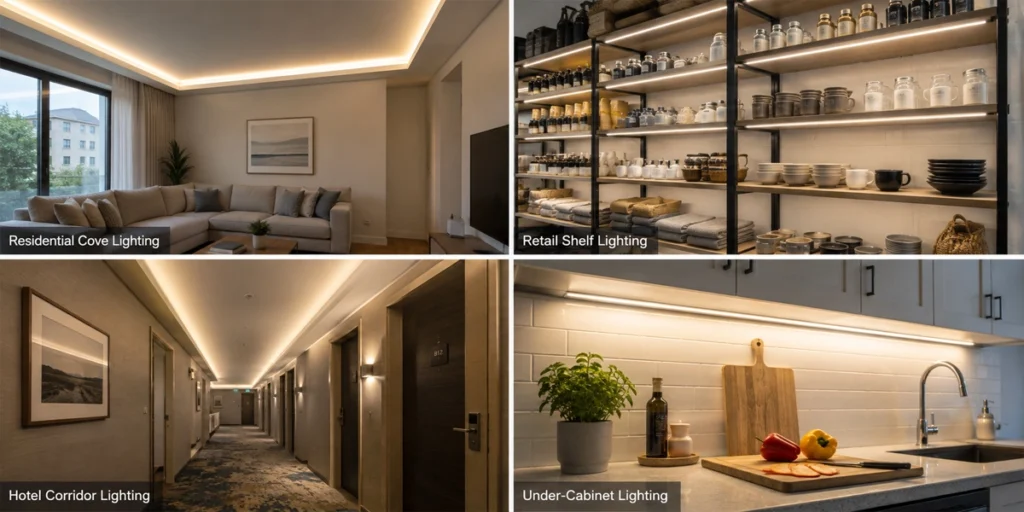
La garantía más larga no siempre es la mejor opción o la más económica. El rango apropiado depende del tiempo de funcionamiento, las condiciones de instalación y el costo de falla.
| Aplicación | Principales riesgos | Prioridad de compra |
| decoración residencial | Uso y presupuesto diario limitado | Salida adecuada, fuente de alimentación segura y garantía básica clara |
| Estantes y exhibidores minoristas | Diferencias de color de funcionamiento prolongada y de color visible | Mantenimiento de lumen, consistencia de color y control de calor |
| Cajas de señalización y luz | Operación de 12 a 24 horas y mantenimiento difícil | Diseño térmico, fuente de alimentación confiable y cobertura de reemplazo |
| Iluminación arquite | Humedad, UV, cambios de temperatura y corrosión | Sellado de construcción, materiales y protección de instalación |
| Proyectos de contrato | Costos laborales, retrasos y reclamos de clientes | Cobertura por escrito, trazabilidad por lotes y soporte al proveedor |
Una garantía de prima puede valer la pena cuando:
- La tira de LED funciona durante largas horas;
- El reemplazo requiere acceso o mano de obra costoso;
- El tiempo de inactividad del proyecto crea pérdidas comerciales;
- La instalación está expuesta al calor oa la humedad;
- El contrato del cliente requiere un período de garantía definido.
Una garantía más corta puede ser suficiente para instalaciones accesibles en interiores con uso diario limitado y bajos costos de reemplazo.
Para una comparación de productos más amplia, consulte la Guía de selección de tiras de luz LED comercial.
¿Qué deben solicitar los compradores a un proveedor de tiras de LED?
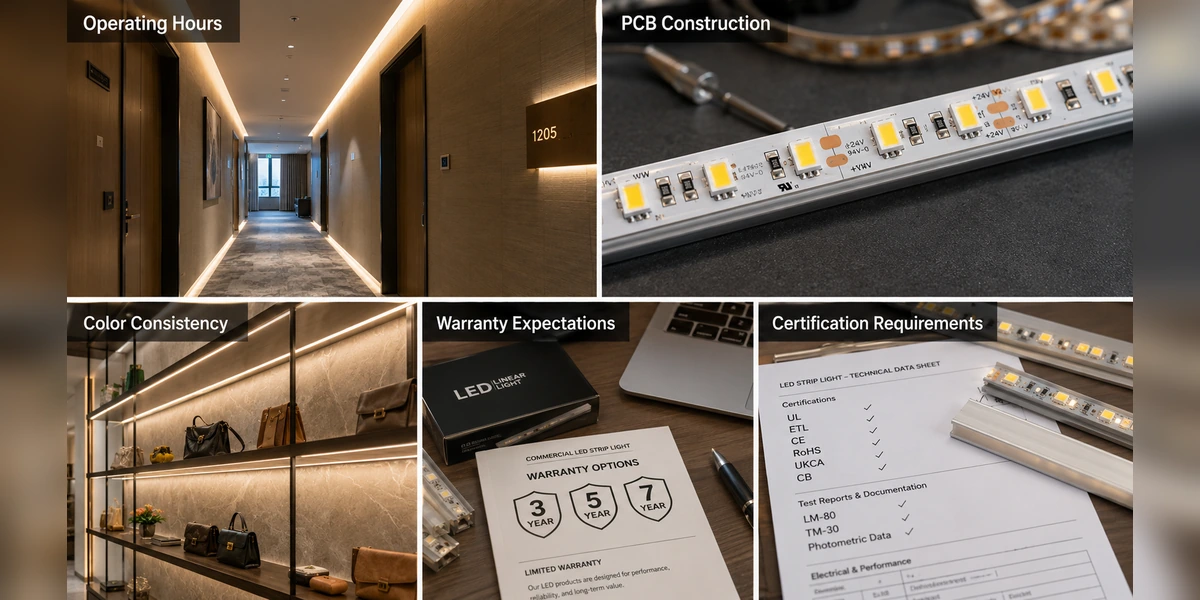
Antes de aprobar una tira de luz LED, solicite documentos para el modelo y la configuración exactas que se cotizan. Centrarse en lo siguiente:
- Especificaciones del producto: voltaje, corriente de funcionamiento, potencia por metro, construcción de PCB y límites de temperatura de operación.
- Evidencia de por vida: el significado de la calificación L70B50 declarada, datos relevantes de LM-80, cualquier proyección TM-21 y la base para la reclamación B50. Confirme si la evidencia se aplica a los componentes LED oa la tira terminada.
- Pruebas de confiabilidad: resultados de pruebas térmicas, eléctricas, de envejecimiento y ambientales relevantes. Para productos impermeables, solicite evidencia que respalde la clasificación IP indicada.
- Documentos de cumplimiento: declaraciones, certificados o informes de prueba aplicables al mercado de destino e instalación. Compruebe que cubren el modelo cotizado y la configuración del producto relevante.
- Requisitos de instalación: disipación de calor, longitud máxima de carrera, dimensionamiento de la fuente de alimentación y cualquier restricción que afecte al rendimiento o la elegibilidad de la garantía.
- Garantía y trazabilidad: cobertura por escrito, exclusiones, remedios, identificación por lotes y el procedimiento de reclamación.
Los documentos de cumplimiento, las proyecciones de por vida y las pruebas de fiabilidad tienen diferentes propósitos. Ninguno debe ser tratado como un sustituto de los demás, o por la garantía escrita. Pida al proveedor que confirme cómo se aplica cada documento al producto seleccionado.
Preguntas frecuentes
Conclusión
La garantía de duración nominal de una tira de luz LED y la garantía responden diferentes preguntas. L70B50 describe el rendimiento de mantenimiento de lumen bajo condiciones definidas, mientras que los términos de garantía escritos especifican las obligaciones del fabricante si se produce una falla elegible.
Por lo tanto, dos tiras de LED pueden tener la misma clasificación L70B50 pero diferentes períodos de garantía. Una garantía más larga no demuestra automáticamente una vida útil más larga; compare los datos de soporte, los requisitos de instalación y la cobertura del modelo exacto.
Para obtener ayuda para seleccionar una tira de luz de tira de SIGNLITELED, comparta su solicitud, las condiciones de operación y el período de garantía requerido, y solicite la hoja de datos correspondiente y los términos de garantía escritos para el modelo propuesto.
Autor: Jason Chen
Líder de I+D
Correo electrónico: engineer@signlite.com.cn
Móvil: +86 13528844818

Publicaciones relacionadas