English
  简体中文
简体中文  Deutsch
  Español
  Français
  Italiano
  日本語
日本語  한국어
한국어  Polski
  Português
  Русский
  Türkçe
  Nederlands
  Tiếng Việt
  ไทย
ไทย 
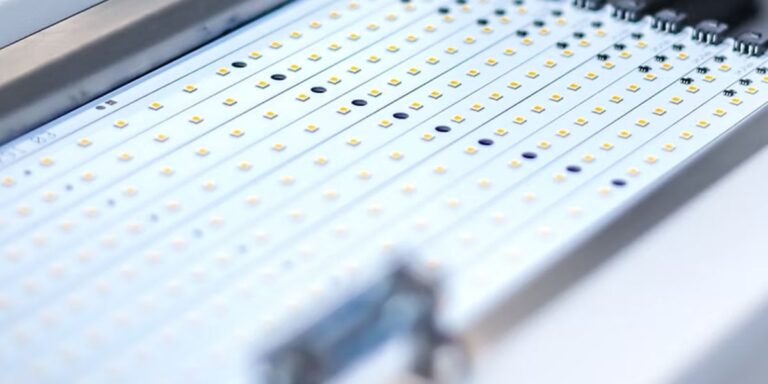
A reliable LED PCB SMT assembly partner is one that can consistently place LEDs with high accuracy, manage heat at the board level, and deliver repeatable results across prototypes and production runs. LED PCB assembly is more complex than standard SMT because small placement errors, thermal mismanagement, or component variation can directly reduce light output and lifespan. Reliability in this context means process control, predictable quality, and decision transparency rather than speed or price alone.
The 10 Key Questions to Evaluate an LED PCB SMT Assembly Partner

1 — What experience do you have with LED PCB and metal-core boards?
Direct experience with LED PCBs matters because LED assemblies behave differently under heat and current stress. A partner familiar with aluminum and other metal-core boards understands how layout, soldering profiles, and handling affect thermal paths. Without this experience, even a capable custom pcb manufacturer may underestimate LED-specific risks, leading to early failures or inconsistent optical performance.
2 — What SMT equipment do you use for LED placement accuracy?
LED reliability depends on precise placement and orientation, especially for high-density arrays and linear modules. The right SMT equipment ensures consistent alignment, solder volume control, and minimal rework. This question helps you assess whether a custom pcb maker can maintain placement accuracy at scale or if quality will vary between batches, increasing field failure risk.
3 — How do you manage thermal performance during LED PCB assembly?
Thermal management is central to LED lifespan and color stability. A reliable partner considers heat during soldering, component attachment, and post-assembly handling. This question reveals whether thermal control is treated as a system-level concern or an afterthought. Poor thermal practices during assembly can negate even a well-designed pcb custom layout.
4 — What inspection and quality control processes do you apply?
Inspection is not just about detecting obvious defects but about catching subtle issues that affect LED performance over time. Consistent quality control helps prevent latent failures caused by solder voids or misalignment. This question helps you compare partners based on process discipline rather than promises, especially when evaluating custom pcb assembly for mission-critical lighting systems.
5 — How do you handle LED binning and component consistency?
LED binning affects brightness, color temperature, and visual uniformity. A reliable partner has processes to manage component variation and maintain consistency within a single board and across production lots. This question is essential for applications where visual differences are unacceptable and where inconsistent sourcing can undermine an otherwise sound assembly process.
6 — Can you support both prototyping and volume production?
The ability to move from prototype to volume without changing partners reduces risk and miscommunication. This question evaluates whether the same standards and controls apply at different scales. For LED projects, inconsistencies between early builds and mass production often trace back to partners who treat prototyping and volume as unrelated processes.
7 — What is your typical lead time and scheduling reliability?
Lead time reliability matters more than nominal speed in LED PCB projects tied to installation schedules. This question helps you understand how well a partner plans capacity and manages change. Missed schedules can force rushed decisions or substitutions that affect LED performance, even when working with an experienced custom pcb manufacturer.
8 — How do you provide DFM feedback for LED PCB projects?
Design for manufacturability feedback is critical in LED assemblies because small layout decisions affect heat flow and placement yield. A reliable partner offers clear, early feedback focused on risk reduction rather than generic comments. This question shows whether DFM is used as a decision tool or treated as a formality in custom pcb assembly workflows.
9 — How do you manage supply chain and component sourcing risks?
LED components are sensitive to substitutions and shortages. A reliable partner has defined processes for sourcing, traceability, and change notification. This question helps you assess how supply disruptions are handled and whether you will be informed before decisions impact performance or compliance in pcb custom projects.
10 — What kind of communication, documentation, and post-assembly support do you provide?
Clear communication reduces risk throughout the project lifecycle. This question evaluates how issues are documented, how changes are approved, and how post-assembly questions are handled. Reliable partners provide consistent records and support that help you diagnose issues without guesswork, which is critical for long-term LED system stability.
Comparing a Standard vs Reliable LED PCB SMT Assembly Partner
| Evaluation Area | Standard Partner | Reliable Partner |
| LED PCB experience | General SMT exposure | Proven LED and metal-core focus |
| Thermal management capability | Assumed from design | Actively managed during assembly |
| Inspection methods | Basic visual checks | Process-driven inspection strategy |
| Prototyping speed | Fast but inconsistent | Controlled and repeatable |
| Production scalability | Separate from prototyping | Aligned across all volumes |
| DFM support | Generic or late | Early, LED-specific feedback |
| Supply chain handling | Reactive sourcing | Planned and transparent |
Why These Questions Work as a Decision Framework
These ten questions are designed to surface operational reality rather than marketing claims. Each one focuses on a risk area that is specific to LED PCB SMT assembly, where small process gaps can cause large downstream problems. Evaluating answers side by side allows you to compare partners on reliability indicators that matter over the full product lifecycle, not just during initial builds.
Using this framework also helps align internal stakeholders. Engineering teams can focus on technical risk, while procurement can assess predictability and communication. The result is a shared basis for decision-making that reduces subjective judgment and short-term thinking.
Common Evaluation Mistakes to Avoid
One common mistake is assuming that any experienced SMT provider is suitable for LED PCBs. Another is prioritizing quoted lead time or unit cost without understanding process control. Some teams also overvalue equipment lists without asking how those tools are used in practice. Avoiding these traps requires disciplined questioning and a focus on how decisions affect LED performance over time.
LED PCB and SMT Assembly Cost Structure
Cost evaluation for LED PCB SMT assembly depends primarily on PCB classification, base material, layer count, assembly complexity, and manufacturing turnaround time. Unlike general SMT projects, LED PCB assemblies introduce additional thermal and placement-accuracy constraints that directly influence both fabrication and assembly costs.
The following pricing references are based on publicly available data from PCB manufacturing platforms, online pricing calculators, and industry benchmarks commonly referenced by buyers during supplier evaluation. All values are approximate reference ranges intended for budgeting, comparison, and early procurement planning, not formal quotations.
PCB Classification and Typical Fabrication Cost Ranges
| PCB Classification | Typical Layer Count | Base Material | Common LED Applications | Approximate PCB Fabrication Cost (USD / unit, prototype volumes) |
| Single-layer PCB | 1 | FR4 | Indicator LEDs, low-power lighting | $1 – $5 |
| Double-layer PCB | 2 | FR4 | Linear LED boards, compact fixtures | $3 – $10 |
| Aluminum MCPCB | 1–2 | Aluminum core | High-power LED lighting, thermal-critical designs | $5 – $20 |
| 4-layer PCB | 4 | FR4 (standard or High-Tg) | Dense LED control and driver boards | $10 – $25 |
| HDI PCB | 4–6+ | FR4 / High-Tg | Compact, high-density LED modules | $30 – $60+ |
Cost ranges reflect standard specifications without expedited production, specialty finishes, or advanced electrical requirements.
LED PCB SMT Assembly Cost Drivers
SMT assembly cost for LED PCBs is influenced by several process-level variables that affect machine time, inspection effort, and thermal control during production.
| Cost Driver | Typical Cost Impact (USD / board, prototype volumes) | Explanation |
| LED placement density | +$1.50 – $4.00 | Higher LED counts increase placement cycles, feeder usage, and inspection time |
| PCB base material (MCPCB vs FR4) | +$2.00 – $6.00 | Aluminum-core boards require controlled thermal profiles and slower reflow processes |
| LED package size (small SMD formats) | +$1.00 – $3.00 | Smaller packages demand tighter placement tolerances and verification steps |
| LED binning control | +$0.50 – $2.00 | Lot separation, tracking, and handling introduce additional process overhead |
| Inspection level (AOI and manual checks) | +$1.00 – $3.00 | Additional inspection stages increase labor and equipment utilization |
Assembly cost impacts are indicative per-board references derived from commonly published SMT pricing models.
Turnaround Time and Cost Impact on LED PCB Projects
Manufacturing lead time selection has a measurable impact on total LED PCB SMT assembly cost, particularly for projects requiring strict thermal and placement control.
| Manufacturing Turnaround Time | Typical Cost Increase | Common Use Case |
| Standard (10–15 business days) | Baseline | Planned production builds and qualification runs |
| Accelerated (5–7 business days) | +20% to +40% | Pilot production and schedule-driven programs |
| Express (24–72 hours) | +50% to +100% | Urgent replacements or time-critical deployments |
Cost Interpretation for Procurement and Engineering Teams
These cost references allow procurement and engineering teams to evaluate LED PCB SMT assembly partners using realistic, classification-based pricing expectations. By understanding how PCB type, material choice, assembly complexity, and lead time affect total cost, buyers can make more informed decisions and avoid selections based solely on headline pricing without accounting for long-term reliability and production stability.
Conclusion
Choosing a reliable LED PCB SMT assembly partner is a risk management decision rather than a purchasing task. The ten questions in this guide provide a structured way to evaluate experience, process control, and consistency without drifting into manufacturing theory or sales claims. By focusing on LED-specific risks, communication quality, and long-term stability, decision-makers can select partners that support predictable performance across the full lifecycle of their lighting products.
FAQs
Related Posts