English
  简体中文
简体中文  Deutsch
  Español
  Français
  Italiano
  日本語
日本語  한국어
한국어  Polski
  Português
  Русский
  Türkçe
  Nederlands
  Tiếng Việt
  ไทย
ไทย 
Why Acoustic Lighting Selection Matters More Than Ever
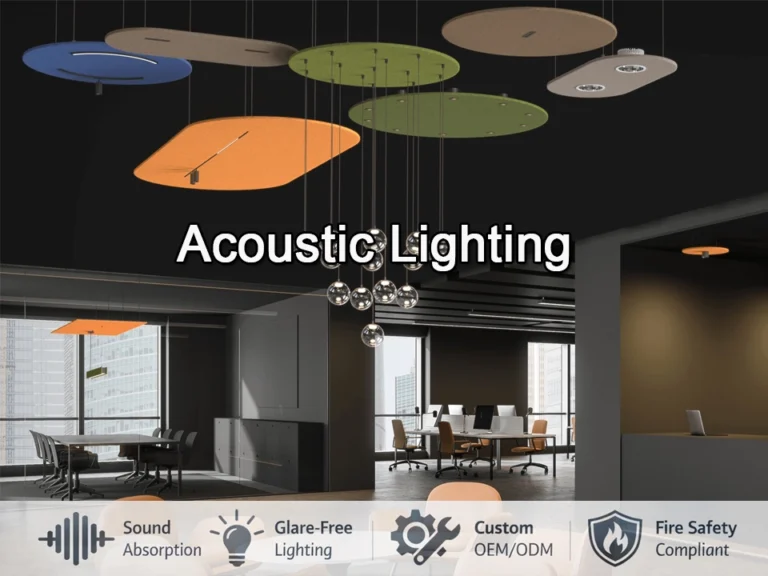
Acoustic lighting has become an essential solution in modern commercial and architectural spaces, where lighting quality and sound control must work together rather than separately. From open offices and meeting rooms to education and public spaces, acoustic lights are increasingly used to improve speech clarity, visual comfort, and overall spatial experience.
However, selecting the right acoustic lighting fixture is often more complex than choosing a standard luminaire. Acoustic panel lighting, acoustic ceiling lighting, and acoustic pendant lights involve multiple variables—felt thickness, acoustic performance, fixture structure, installation method, and lighting specifications. In many projects, designers either over-specify parameters or focus too much on appearance, leading to higher costs without proportional performance gains.
This article provides a practical selection guide for acoustic lighting solutions, helping designers and project teams choose the right acoustic light fixtures based on real application needs. By looking at product forms, key specifications, and installation considerations together, you can achieve balanced acoustic and lighting performance that is efficient, scalable, and suitable for commercial projects and OEM/ODM customization.

Match the Space: Choosing the Right Acoustic Lighting by Application
When selecting acoustic lighting solutions, the most common mistake is starting from product shape or price.
In practice, space type, noise behavior, and lighting function should always come first.
Acoustic lighting is not a one-size-fits-all product. Different environments—open offices, meeting rooms, classrooms, or public areas—require different acoustic light fixtures, felt thickness ranges, and installation strategies to achieve balanced sound absorption and effective illumination.
Open Offices
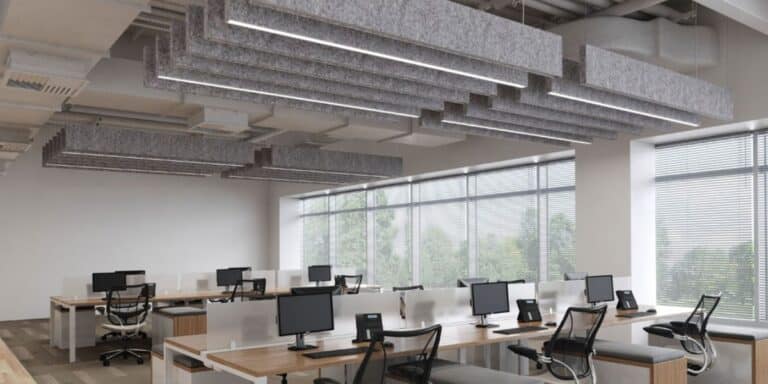
Open-plan offices are one of the most common application scenarios for acoustic ceiling lighting and acoustic linear lighting.
These spaces typically suffer from continuous background noise caused by conversations, keyboard sounds, and HVAC systems rather than sharp, isolated noise sources.
For this type of environment, long-form acoustic linear lighting or suspended acoustic ceiling lights work well because they provide:
- Broad sound absorption coverage
- Uniform lighting distribution
- Visual order across large ceiling spans
Typical specifications in open offices are usually moderate rather than extreme.
- PET felt thickness: 9–12 mm, or customized size
- NRC Target: ~0.6–0.75
- Mounting: Suspended or ceiling-integrated
- Felt Acoustic Board Color: Red / Green / Blue / Grey, or more colors option
Meeting Rooms & Collaboration Spaces
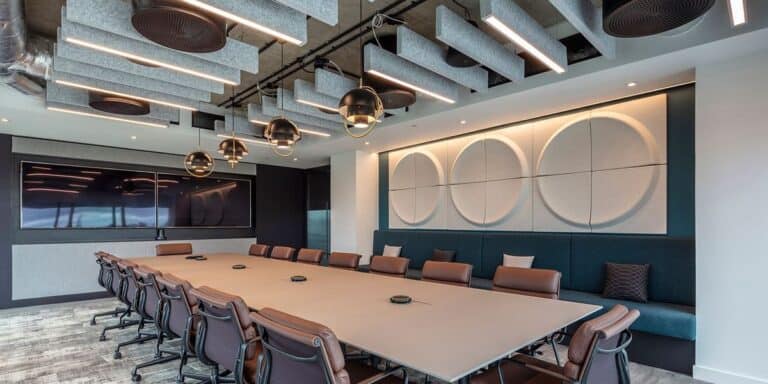
Meeting rooms place higher demands on speech clarity and sound control within a defined zone.
Unlike open offices, sound sources are more concentrated—typically around the meeting table—making acoustic pendant light designs a practical choice.
Compact acoustic pendant lights or grouped acoustic light fixtures positioned above the table help absorb reflections from voices while maintaining focused task lighting.
- Absorbing sound near the source
- Focused lighting without spillover
- Easy integration with design aesthetics
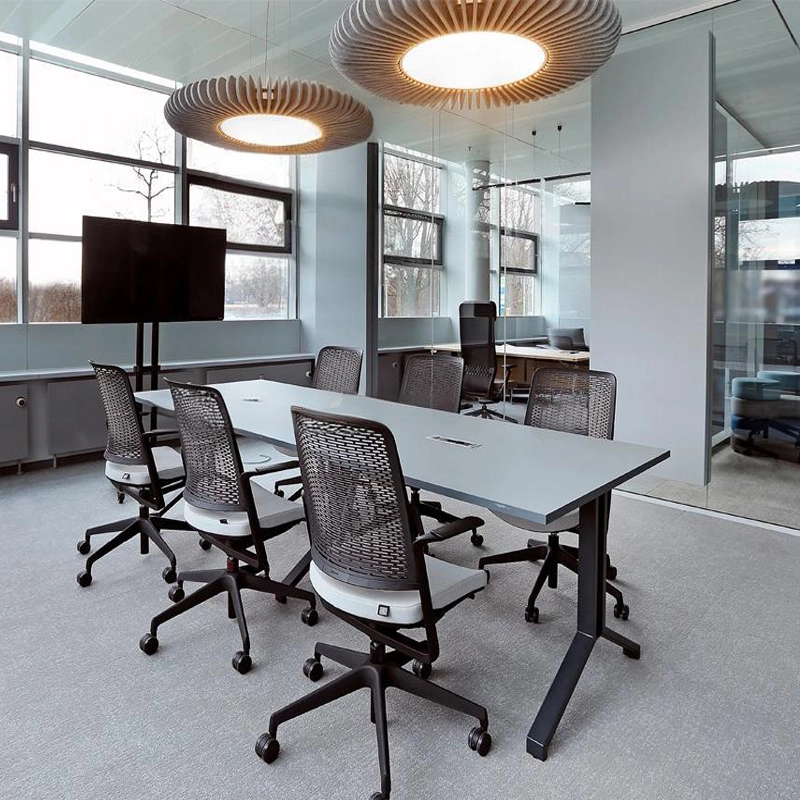
Typical specifications in meeting rooms:
- PET felt thickness: 12–15 mm, or customized size
- Focused absorption area, not full coverage
- Fewer fixtures, but higher absorption per unit
- Felt Acoustic Board Color: Red / Green / Blue / Grey, or more colors option
Classrooms & Training Rooms
In classrooms and training rooms, controlling reverberation is essential for speech intelligibility.
These spaces often require acoustic ceiling lighting or acoustic ceiling light fixtures that combine lighting with large-area sound absorption.
Instead of decorative forms, practicality dominates: uniform ceiling layouts, stable acoustic performance, and easy maintenance are key considerations.
Key considerations in these spaces:
- Larger absorption area over aesthetic design
- More emphasis on consistency and durability than on extreme parameters
- Easy to maintain over time
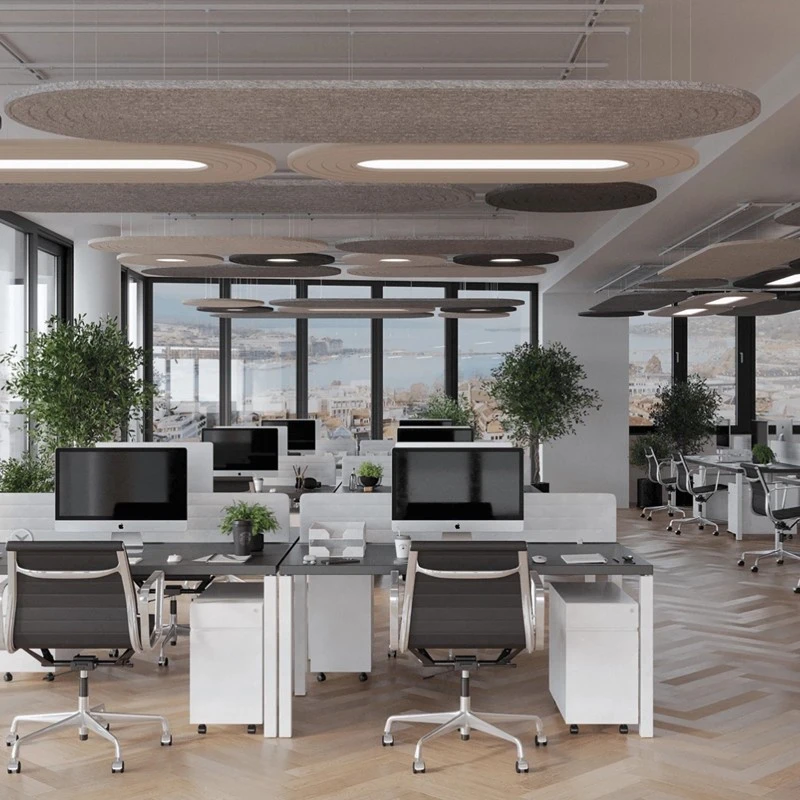
Typical specifications in meeting rooms:
- PET felt thickness: 12–18 mm, or customized size
- Focus on coverage and overall acoustic performance
- Designed for standardized installation and long-term use
- Felt Acoustic Board Color: Red / Green / Blue / Grey, or more colors option
Public & Creative Areas
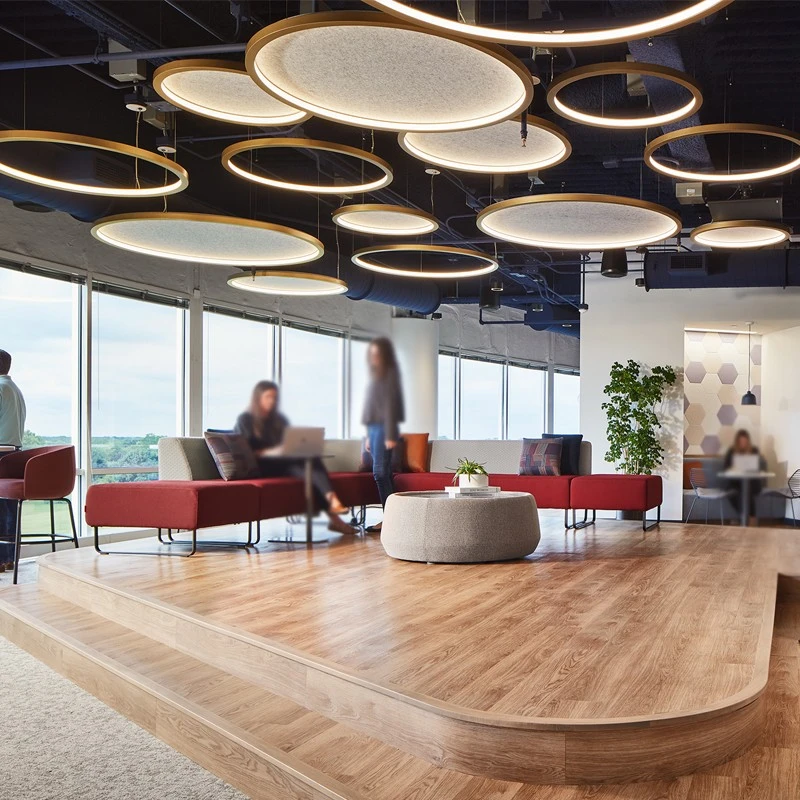
In public spaces such as lobbies, lounges, or creative zones, acoustic panel lighting and felt lighting designs often serve both functional and visual roles.
Here, acoustic lighting becomes part of the architectural language. Color, shape, and layout—such as light blue felt, light gray felt, or custom tones—are frequently used to reinforce branding or spatial identity.
Design priority in these areas:
- Balance between acoustic performance and visual design
- Acoustic parameters are less critical, with more focus on aesthetic integration
- Color and material matching with spatial identity

Typical specifications in creative areas:
- PET felt thickness: 9–12 mm, 12–18 mm or customized size
- Flexible choices depending on shape and installation
- Emphasis on overall effect rather than single parameters
- Felt Acoustic Board Color: Red / Green / Blue / Grey, or more colors option
Across different applications, the right acoustic lighting choice is always a balance between sound absorption needs, lighting function, and spatial design intent.
Understanding where and how the space is used makes selecting the appropriate acoustic lighting fixtures far more effective than starting from product specifications alone.
Key Parameters: Choosing What’s Enough, Not Excessive
Felt Thickness: How Thick Is Enough for Acoustic Lighting?
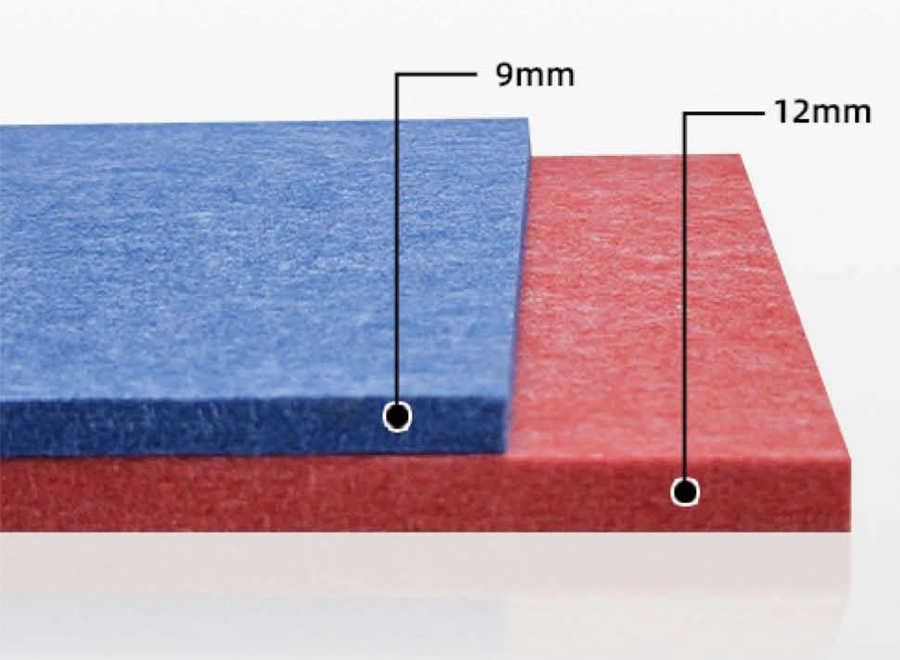
For acoustic lighting, a felt thickness of 9–12 mm is generally recommended for most commercial applications, offering a practical balance between sound absorption, fixture weight, and installation feasibility.
This thickness range is widely adopted in modern acoustic lighting systems using PET felt acoustic lighting materials, where both acoustic performance and design flexibility are required.
For most commercial acoustic lighting projects, 9–12 mm felt is sufficient.
For spaces with higher speech noise levels or larger room volumes, 12–18 mm felt is usually more appropriate.
Thicker felt generally improves sound absorption performance, but it also increases fixture weight and places stricter requirements on suspension systems and installation methods. As a result, felt thickness should be selected based on both acoustic targets and practical installation constraints, rather than absorption performance alone.
In practical applications:
- 9–12 mm felt is widely used in acoustic pendant lights and acoustic panel lighting for offices, meeting rooms, and open-plan workspaces, providing a balanced combination of acoustic control, visual lightness, and cost efficiency.
- 12–18 mm felt is better suited for classrooms, training rooms, and larger meeting spaces, where speech intelligibility and reverberation control become more critical.
- 18–27 mm felt is typically reserved for acoustically demanding environments or large-format acoustic panels, where sound control takes priority over fixture thickness, weight, and minimalist appearance.
NRC Values: What NRC Is Recommended for Acoustic Lighting?
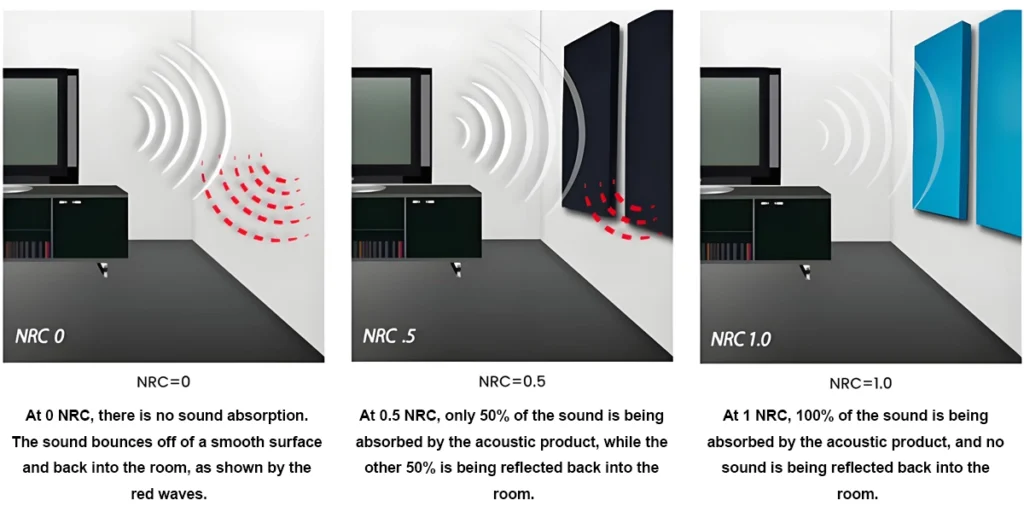
For most commercial acoustic lighting applications, an NRC range of 0.7–0.8 is generally sufficient to achieve noticeable sound comfort improvement.
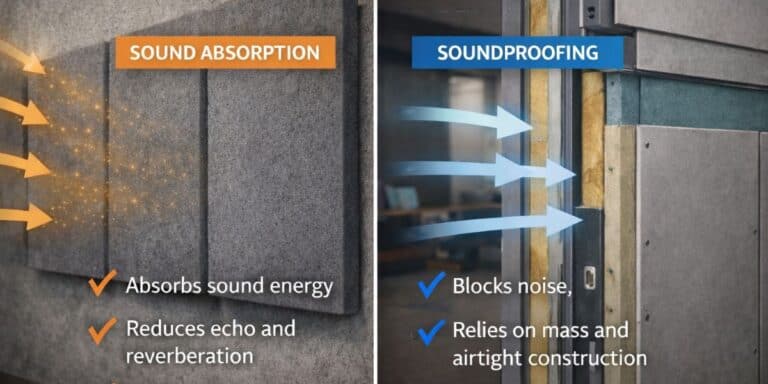
NRC is widely used to describe acoustic performance, but it is often misunderstood during product selection. In practical acoustic lighting projects, extremely high NRC values do not always lead to proportional improvements in perceived sound comfort—especially when acoustic lighting is only one component of a broader acoustic strategy.
As illustrated in the comparison image (NRC = 0 / 0.5 / 1), NRC represents different levels of sound absorption rather than a simple “good or bad” scale. Selecting the appropriate NRC level depends on how much acoustic contribution is realistically required from the lighting itself.
Typical reference ranges include:
- NRC 0.6–0.7 for open offices and public areas with continuous background noise, where moderate absorption helps reduce overall sound buildup.
- NRC 0.7–0.8 for meeting rooms, classrooms, and collaboration spaces, where speech clarity and reverberation control are more critical.
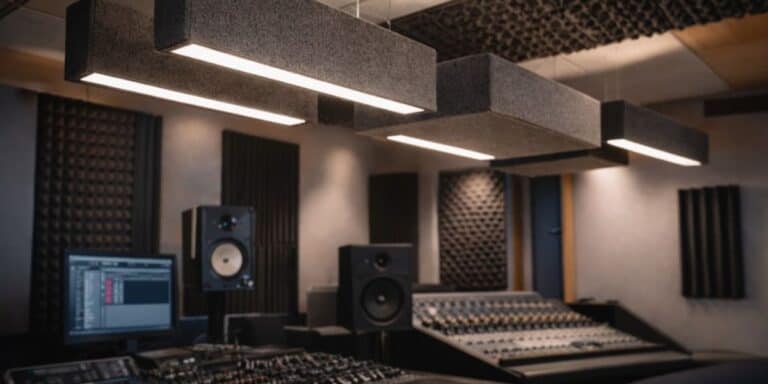
- NRC ≥ 0.9 for studios, auditoriums, or acoustically sensitive environments, where acoustic lighting usually plays a supporting role alongside dedicated acoustic treatments.
Installation Height: A Critical but Often Overlooked Factor
Installation height often has a greater impact on acoustic performance than increasing felt thickness.
Acoustic lighting fixtures need sufficient clearance from the ceiling to interact effectively with sound waves. When acoustic pendant lights or acoustic ceiling lighting are installed too close to the ceiling, their absorption efficiency is significantly reduced.
In most standard commercial spaces:
- Suspending acoustic lighting 300–600 mm below the ceiling improves absorption efficiency.
- In high-ceiling environments, increasing fixture quantity or adopting layered layouts is often more effective than specifying thicker felt.
- Installation height should always be evaluated together with ceiling structure, load capacity, and cable routing.
Table: Typical Parameter Selection by Application Type
| Application Type | Recommended Felt Thickness | Recommended NRC Range | Typical Mounting Height | Suggested Control Method |
| Open-plan office | 9–12 mm | ≥ 0.65 | 2.8–3.2 m | On/Off or 0–10V |
| Meeting room | 12–18 mm | ≥ 0.75 | 2.6–3.0 m | 0–10V / DALI optional |
| Education spaces | 18–24 mm | ≥ 0.80 | 3.0–3.5 m | DALI recommended |
| Hospitality / lobby | 9–12 mm | ≥ 0.60 | ≥ 3.2 m | Scene control optional |
Lighting Specs That Actually Matter in Acoustic Projects
UGR: Visual Comfort Becomes More Sensitive in Acoustic Lighting
In acoustic lighting design, visual comfort requires more careful attention than in conventional luminaires. Because acoustic fixtures are often larger, softer in form, and installed at lower heights, glare issues can become more noticeable if UGR is not properly controlled.
Unlike standard panel lights, acoustic lighting frequently enters the user’s direct field of view, especially in offices, classrooms, and meeting spaces. As a result, UGR should be treated as a visual risk control factor, ensuring that improved acoustic performance does not come at the expense of lighting comfort.
Proper UGR management helps acoustic lighting deliver balanced performance—supporting both sound absorption and comfortable visual conditions in occupied spaces.
CCT Selection: Functional Difference Between Meeting and Office Spaces
In acoustic lighting design, CCT selection is closely related to how the space is used rather than aesthetic preference alone. Meeting rooms and focus-oriented spaces typically benefit from neutral white light around 4000K, which supports alertness, clear communication, and visual clarity during discussions or presentations.
In contrast, open offices and long-duration workspaces often adopt slightly warmer tones such as 3000K–3500K. When combined with acoustic ceiling lighting or acoustic panel lights, warmer CCTs help reduce visual fatigue and create a more relaxed atmosphere, especially in environments where acoustic treatment already softens the space visually.
Direct vs. Direct/Indirect Lighting: How Distribution Shapes the Space
Light distribution has a direct impact on how acoustic lighting interacts with both the ceiling and the occupied zone. Direct-only lighting focuses illumination downward, making it suitable for task-oriented areas such as desks, meeting tables, and classrooms where controlled brightness and clear visibility are required.
Direct/indirect (bi-directional) lighting adds upward illumination to the ceiling, helping balance overall brightness and reduce contrast between surfaces. In acoustic lighting solutions, this approach is often used in open-plan offices, large meeting rooms, and architectural spaces where visual openness and ambient comfort are equally important.
When Lighting Specs Don’t Need to Be Pushed Further
Not every acoustic lighting application requires the lowest possible UGR or the most complex light distribution. In circulation areas, informal collaboration zones, or decorative acoustic installations, pushing lighting specifications to their limits often brings limited functional benefit while increasing cost and system complexity.
In such cases, prioritizing visual consistency, ease of installation, and integration with acoustic elements usually leads to a more practical outcome. Matching lighting specifications to real user behavior—rather than theoretical performance targets—helps keep acoustic lighting projects efficient, controllable, and scalable.
Standard Fixtures vs Custom Acoustic Lighting
In acoustic lighting projects, one of the most common decisions designers and buyers face is whether to choose a standard fixture or invest in a custom acoustic lighting solution. While standard products may appear simpler at first glance, custom acoustic lighting often delivers better performance, integration, and long-term value—especially in commercial and architectural projects.
When Standard Acoustic Lighting Works
Standard acoustic light fixtures are typically suitable for:
- Small offices or meeting rooms
- Projects with fixed ceiling heights and simple layouts
- Short lead-time requirements
- Limited customization needs
These products usually come with predefined sizes, fixed felt thickness, and limited color options. For basic acoustic ceiling lighting needs, they can be a practical and cost-effective solution.
Why Custom Acoustic Lighting Is Preferred in Commercial Projects
In real-world projects, acoustic lighting must integrate with architecture, MEP systems, and interior design concepts. Custom acoustic lighting allows designers to control proportions, performance, and installation methods from the beginning.
Custom solutions are especially common in:
- Offices and open-plan workplaces
- Conference centers and corporate headquarters
- Education spaces and libraries
- Hospitality and public interiors
In these environments, acoustic pendant lights, acoustic linear lighting, and acoustic ceiling panels with lights are often tailored to fit the space rather than forcing the space to fit the product.
What Can Be Customized in Acoustic Lighting
Custom acoustic lighting is not limited to shape alone. Most projects involve multiple adjustable parameters to balance acoustic performance, lighting function, and visual design.
Below are the most common customization options:
| Custom Item | Typical Options |
| Felt thickness | 9 mm / 12 mm / 18 mm / 24 mm / 27 mm |
| Felt color & finish | Wide color palette, felt textures, custom colors |
| Fixture size | Length, width, diameter, modular combinations |
| Lighting direction | Downlight / Indirect / Direct & indirect |
| Dimming & control | On-off, 0–10V, DALI, tunable white |
| Mounting method | Suspended, surface-mounted, integrated ceiling |
| Acoustic target | NRC-oriented or balanced acoustic design |
Cost Difference: Standard vs Custom Acoustic Lighting
Standard products benefit from scale production and fixed specifications, resulting in lower unit costs. Custom acoustic lighting, however, reflects additional expenses in:
- Material consumption (thicker felt, larger sizes)
- Tooling or forming methods
- Engineering and drawing support
- Acoustic and lighting performance validation
That said, custom solutions often reduce hidden costs during installation and later adjustments, making them more cost-efficient at the project level.
OEM & ODM: Why Customization Is Not as Complex as It Seems
For experienced manufacturers, OEM and ODM acoustic lighting is a standardized process rather than an experimental one. Once key parameters—such as felt thickness, fixture size, and control requirements—are defined, most custom acoustic lighting solutions can be developed efficiently and repeatedly.
For designers and project owners, this means:
- Predictable lead times
- Controlled cost ranges
- Consistent quality across batches
- Better alignment with acoustic and lighting goals
Common Selection Mistakes Designers Make
In real-world acoustic lighting projects, performance issues rarely come from product defects. More often, they are caused by selection mismatches—choosing specifications that look good on paper but don’t align with the actual space, structure, or usage scenario.
In acoustic lighting design, avoiding the wrong choice is often more important than pursuing the “best” parameters.
Below are three common mistakes we see repeatedly in commercial acoustic lighting projects.
Mistake 1|Choosing Felt That Is Too Thin
Many designers select felt thickness mainly based on appearance or budget, assuming that “any acoustic felt will work.” In practice, felt thickness directly affects sound absorption range, structural rigidity, and long-term stability of acoustic light fixtures.
For example, thin felt panels (such as 9 mm) perform well for mid–high frequencies and are ideal for thermoformed or wrapped acoustic pendant lights. However, in larger open offices, meeting rooms, or spaces with low-frequency noise buildup, thicker options (18–24 mm) provide noticeably better acoustic balance.
Key takeaway: Felt thickness should match the space size, noise profile, and fixture form—not just the visual design.
Mistake 2|Prioritizing Shape Over Acoustic Function
Modern acoustic lighting offers striking forms—rings, curves, baffles, and sculptural acoustic ceiling lights. While these designs enhance visual impact, problems arise when shape becomes the only selection criterion.
For instance, a large ring-shaped acoustic light may look impressive but provide limited effective absorption area if installed too high or used in isolation. In contrast, linear acoustic lighting or acoustic baffle lighting arranged in sequences can deliver much more consistent sound control.
Key takeaway: Acoustic lighting fixtures should be evaluated as part of a system, not just as standalone visual elements.
Mistake 3|Ignoring Installation Structure and Ceiling Conditions
Another common oversight is selecting acoustic ceiling lighting without fully considering ceiling type, suspension height, load capacity, or cable routing. This often leads to last-minute redesigns, added cost, or compromised performance.
For example, some acoustic panel lights are specified without confirming whether the ceiling can support suspended installation, or whether recessed mounting is even possible. In some cases, switching from direct-only lighting to direct–indirect lighting becomes difficult due to structural limitations discovered too late.
Key takeaway: Installation method should be confirmed before finalizing acoustic lighting specifications.
Final Thought for Designers
Successful acoustic lighting design is not about avoiding ambition—it’s about aligning acoustic performance, lighting function, structure, and budget. By steering clear of these common mistakes, designers can deliver acoustic lighting solutions that are both visually compelling and technically sound.
Conclusion
Selecting the right acoustic lighting is not about achieving the highest acoustic or lighting specifications. In real commercial projects, success comes from matching performance to actual space conditions—including how the space is used, where noise is generated, and how the lighting system is installed.
By starting with application scenarios and then evaluating felt thickness, NRC targets, installation height, and lighting control accordingly, designers can avoid over-specification while still delivering effective acoustic and visual comfort. In many cases, choosing parameters that are appropriate rather than maximum leads to better cost control, simpler installation, and more predictable project outcomes.
Whether using standard fixtures or developing custom acoustic lighting through OEM / ODM processes, a clear selection logic helps ensure that acoustic lighting integrates smoothly with architecture, MEP systems, and interior design—rather than becoming an isolated or over-engineered element.
FAQ
Related Posts