Italiano
 English
 简体中文
 Deutsch
 Español
 Français
 日本語
 한국어
 Polski
 Português
 Русский
 Türkçe
 Nederlands
 Tiếng Việt
 ไทย

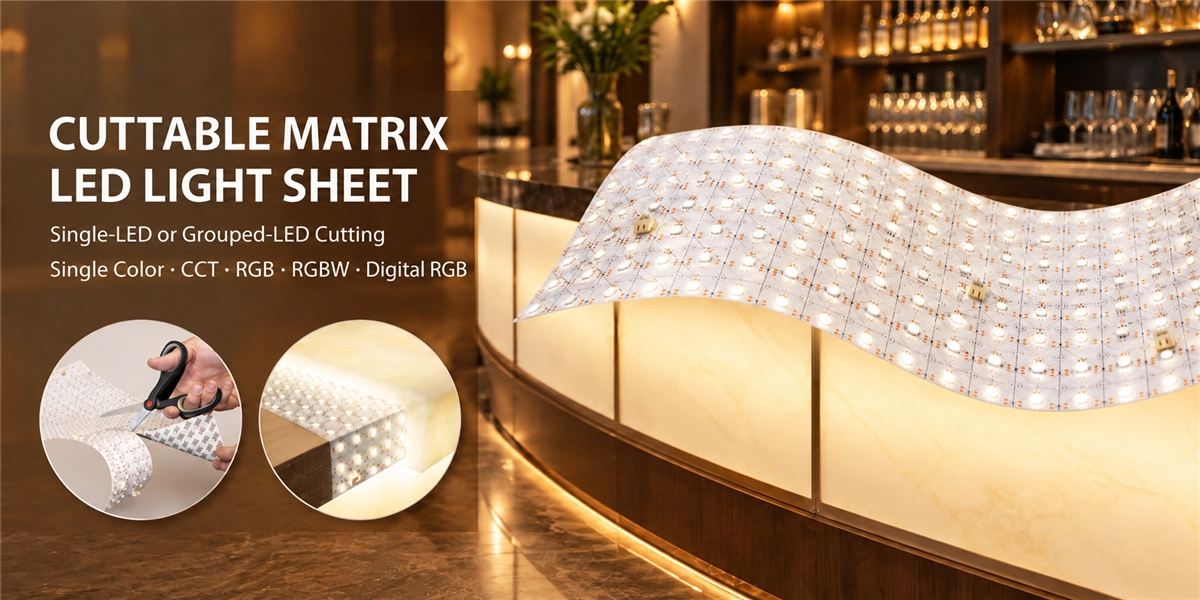
A cuttable matrix LED light sheet is a thin, flexible backlighting panel that can be trimmed along model-specific marked cutting cells. The 500 × 233 mm series is available in single-color, CCT-adjustable, RGB, RGBW and digital RGB configurations for static, tunable-white and programmable color lighting.
This guide uses a 24V CCT model with 840 SMD2835 LEDs and a 33.33 × 33.33 mm cutting grid as its main specification example. Other versions use different LEDs, voltages and circuit layouts.
The sheet distributes light across broad, shallow or irregular surfaces, making it suitable for light boxes, signs, retail displays, illuminated counters and backlit stone. It is a flexible backlight source, not a flexible video display.
What Is a Cuttable Matrix LED Light Sheet?
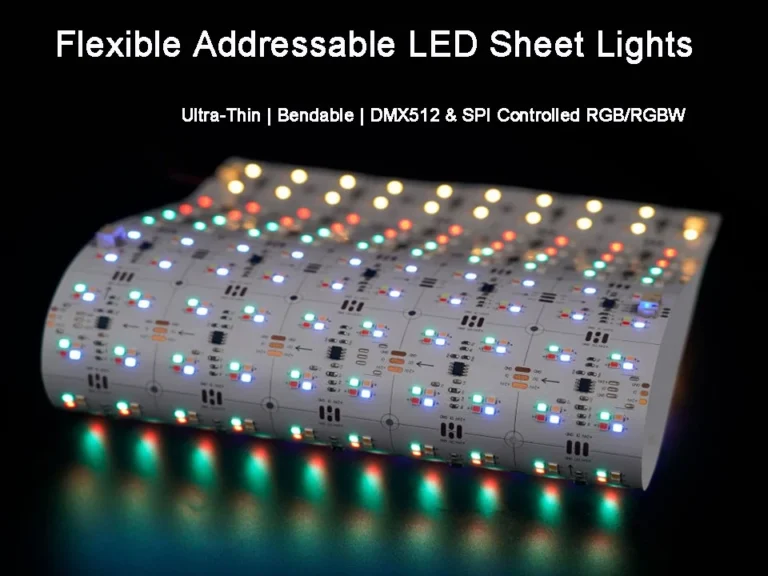
A matrix LED light sheet places many LEDs and conductive paths across a flexible printed circuit board. Instead of arranging LEDs in one long line like a conventional LED strip, the circuit spreads them over a wide surface.
This structure creates a broad light source that can fit behind acrylic, fabric, translucent stone, graphics and other facing materials. It is especially useful when an ordinary rigid LED panel will not fit or when LED strips would require too much cutting, spacing and manual wiring.
Marked cells divide the circuit into permitted cutting areas. The sheet can be reduced or shaped around selected boundaries without rebuilding the entire panel from separate strips. The exact cutting freedom depends on the circuit design.
The product family includes several lighting configurations:
| configurazione | Typical purpose |
| unico colore | Fixed white or colored backlighting |
| CCT Adjustable | Tunable white lighting |
| RGB | Synchronized full-color effects |
| RGBW | RGB effects plus a dedicated white channel |
| RGB digitale | Addressable pixels and programmed color effects |
The 500 × 233 mm format is available in several configurations, but voltage, LED type, LED quantity, power, cutting cells and control requirements remain model-specific.
For that reason, this article uses the CCT-adjustable version as a consistent technical reference rather than presenting its specifications as universal values for the entire series.
How the Matrix Structure Changes Backlighting
The most noticeable difference between a matrix sheet and a standard LED strip is the distribution of light.
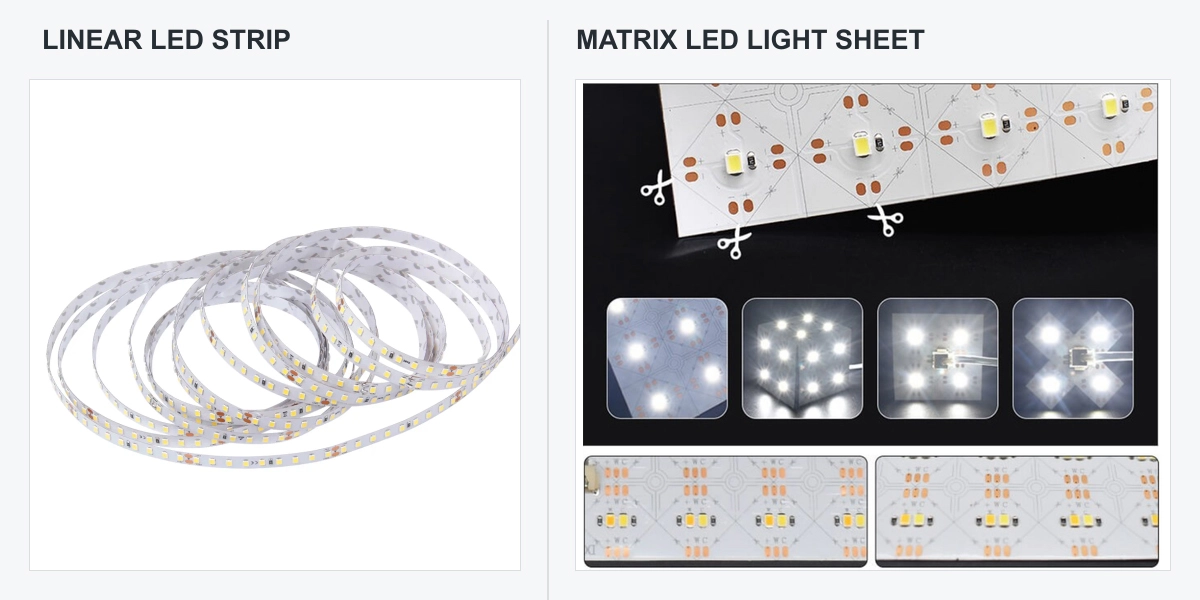
With LED strips, the installer decides the distance between each row. Incorrect spacing can create bright lines, dark bands or uneven corners. More wiring is also required because individual strip sections need to be connected.
A matrix LED light sheet already distributes LEDs across a defined grid. Once the correct LED density and installation depth are selected, the light is easier to spread evenly across a broad surface.
This does not mean that every sheet automatically produces a perfectly uniform result. The final appearance still depends on:
- Distance between the LEDs and the facing material
- LED density and beam angle
- Transmission rate of the acrylic, fabric or stone
- Interior surface reflectivity
- Brightness required from the finished product
- Shape and depth of the illuminated structure
A sample test using the actual facing material gives more useful information than comparing LED quantity alone. A dense sheet installed too close to a highly transparent surface may still show visible light points. A lower-density sheet can perform well when the structure provides enough diffusion depth.
Light Color and Control Options
The first product decision is the lighting effect required by the finished application. The 500 × 233 mm series is available in single-color, CCT-adjustable, RGB, RGBW and digital RGB configurations. Their voltage, LED package, LED quantity, power and control requirements vary by model.
Single-Color Light Sheets
A single-color sheet produces one fixed light color. It is the simplest option for static light boxes, illuminated graphics and architectural backlighting where color adjustment is unnecessary.
The referenced 24V version uses 105 SMD2835 LEDs. It can also be paired with a compatible constant-voltage dimmer when brightness adjustment is required.
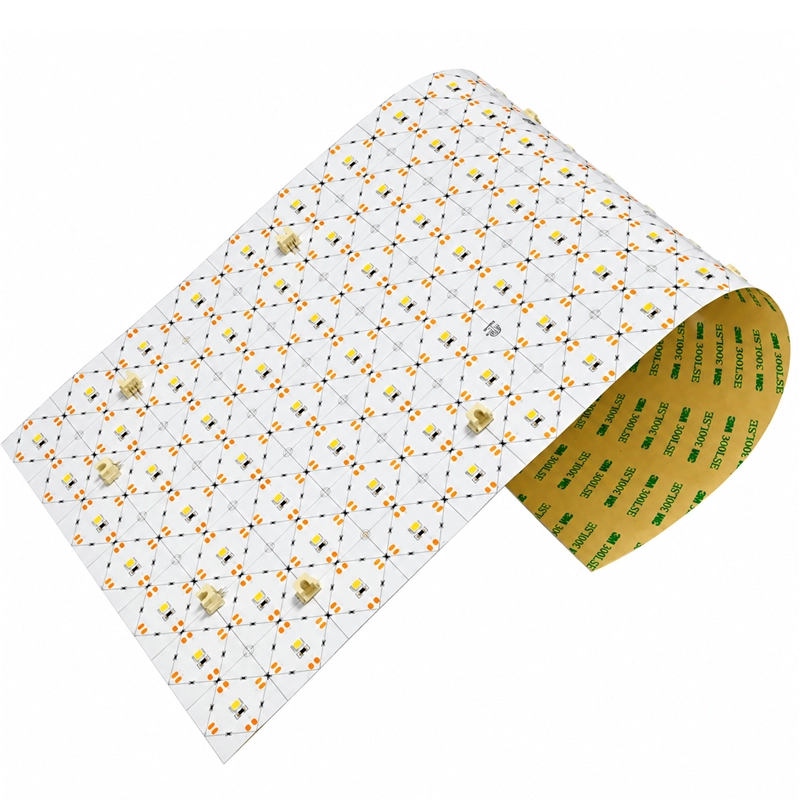
Single Color Matrix Led Light Sheet
- Tensione di ingresso: DC24V
- Watt: 12W/pcs
- LED QTY: 105pcs
- Tipo LED: 2835 SMD
- Colore: 3000K/4000K/6500K/R/G/Y/B
- CRI : Ra 80/ 90 @3000K/4000K/6500K
- Luminous flux: 120lm/W
- Grado IP: IP33
- Angolo del fascio di luce: 120°
CCT-Adjustable Light Sheets
A CCT-adjustable sheet combines warm-white and cool-white LEDs. A two-channel controller changes the balance between them, allowing the output to move from warm white to cool white.
The referenced 24V version uses 840 SMD2835 LEDs and covers 2700K to 6500K. It suits retail, hospitality and backlit-stone projects where the preferred white tone may change with the material or surrounding environment.
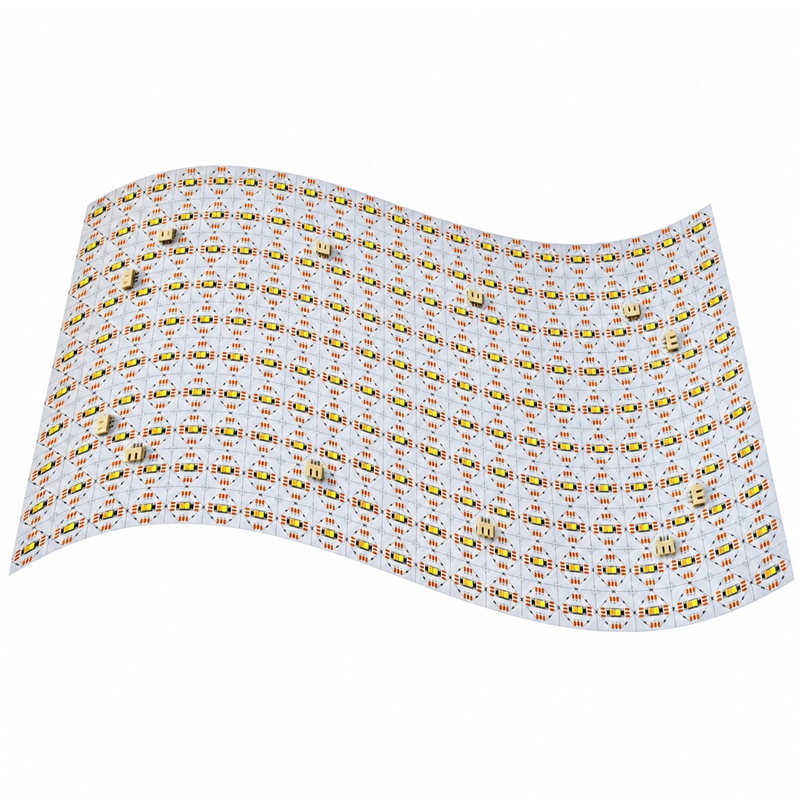
CCT-adjustable Matrix Led Light Sheet
- Tensione di ingresso: DC24V
- Watt: 24W/pcs
- LED QTY: 840pcs
- Tipo LED: 2835 SMD
- Colore: 3000K/4000K/6500K/R/G/Y/B
- CRI : Ra 80/ 90 @3000K/4000K/6500K
- Luminous flux: 120m/W
- Grado IP: IP33
- Angolo del fascio di luce: 120°
RGB and RGBW Light Sheets
RGB combines red, green and blue channels for synchronized color-changing effects. RGBW adds a dedicated white channel, producing a cleaner white output alongside decorative colors.
The referenced 24V RGB and RGBW versions use 420 SMD5050 LEDs per sheet. They are commonly selected for branded interiors, display fixtures, reception areas and decorative architectural features.
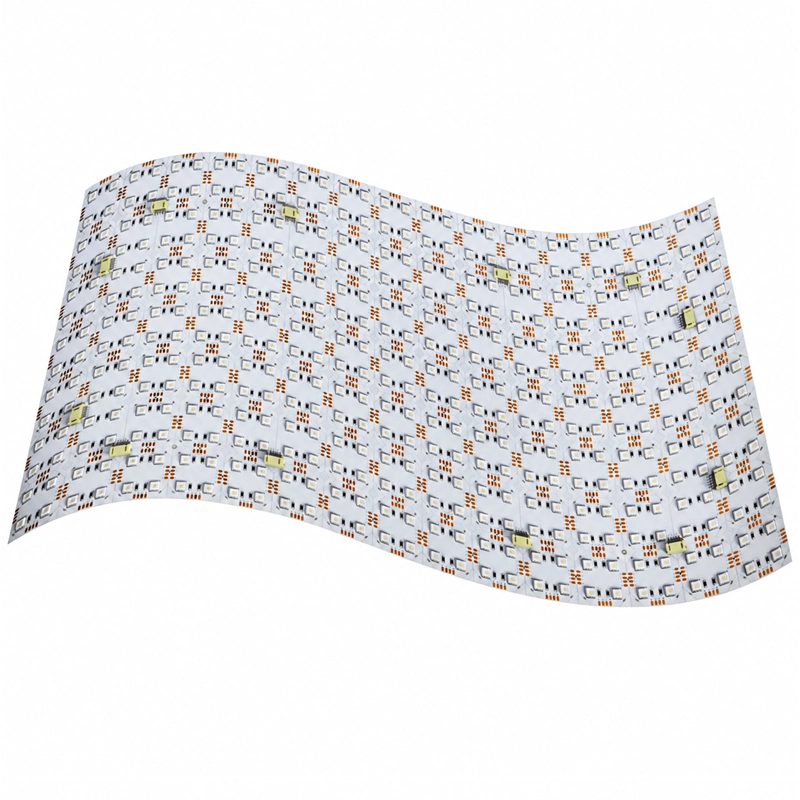
RGB/ RGBW Cuttable Matrix LED Light Sheet
- Tensione di ingresso: DC24V
- Watt: 36W/pcs@RGB, 48W/pcs@RGBW
- LED QTY: 420pcs
- LED Type: 5050 SMD
- Color: RGB/ RGBW
- Grado IP: IP33
- Angolo del fascio di luce: 120°
Digital RGB Light Sheets
A digital RGB sheet uses addressable LEDs that allow individual pixels or defined pixel groups to display programmed colors and effects.
The referenced 5V version uses 105 WS2812B LEDs. It supports chasing effects, gradients and animated color sequences, but it remains a decorative backlight rather than a flexible video display.
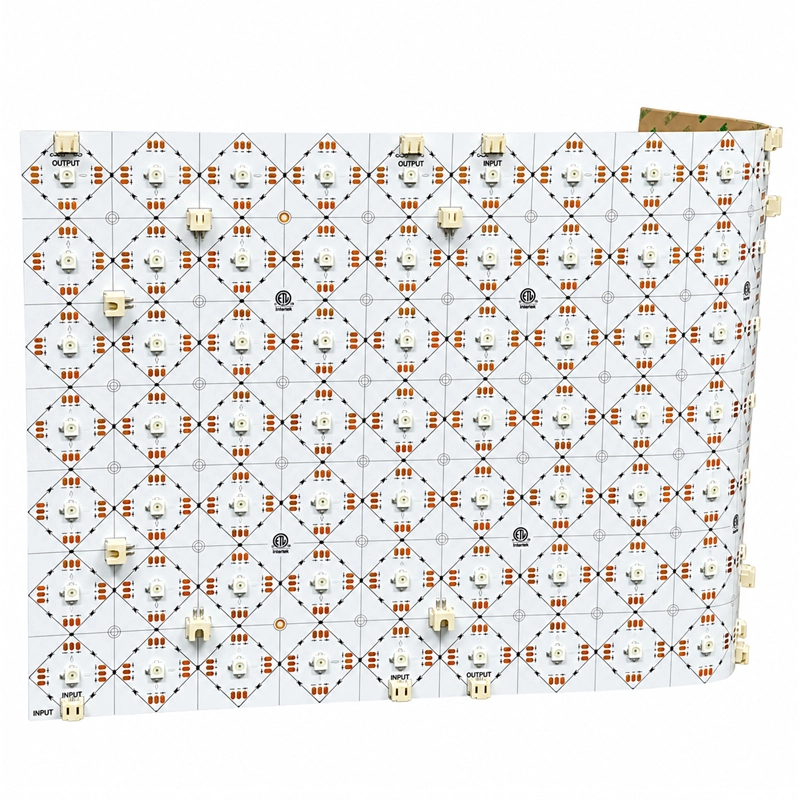
Digital RGB Cuttable Matrix LED Light Sheet
- Tensione di ingresso: DC24V
- Watt: 21W/pcs
- LED QTY: 105pcs
- IC Type: WS2812B
- LED Type: 5050 SMD
- Color: RGB/ RGBW
- Grado IP: IP33
- Angolo del fascio di luce: 120°
What Does “Cuttable” Actually Mean?
“Cuttable” does not automatically mean that the sheet may be cut at any location.
The PCB contains printed cutting marks that identify the boundaries designed to be separated. Depending on the model, one cutting cell may contain a single LED or a group of LEDs. The permitted direction and remaining electrical paths also depend on the circuit design.
A useful product description is therefore:
Single-LED or grouped-LED cutting options are available, depending on the model.
This is more accurate than claiming that every LED sheet can be cut freely in any direction.
Before cutting, check three things:
- The cutting-cell dimensions shown on the datasheet
- The position of the printed cutting marks
- The wiring and power-entry points required by the remaining shape
For the reference CCT model, the stated cutting grid is 33.33 × 33.33 mm. Do not apply that grid to the single-color, RGB, RGBW or digital version unless the corresponding drawing confirms it.
Cutting through an LED, component, connector or unmarked conductive path can disable part of the sheet. Any exposed copper or cut edge may also require insulation, depending on the installation environment.
Where Matrix LED Light Sheets Work Best
Cuttable matrix sheets are used for many of the same projects as conventional flexible LED sheets. Their main advantage appears when the illuminated area is wide, shallow, curved or irregular.
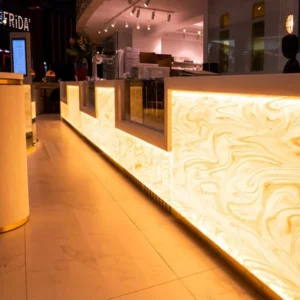
Common applications include shallow light boxes, retail display fixtures, illuminated counters, reception desks, exhibition stands, decorative wall panels, channel-letter backgrounds, backlit graphics and translucent stone.
In a rectangular light box, the sheet can reduce the time spent aligning multiple strip rows. In a curved counter, the flexible PCB follows the supporting surface more easily than a rigid LED panel. For an irregular sign shape, marked cutting cells allow unused areas to be removed with less rewiring.
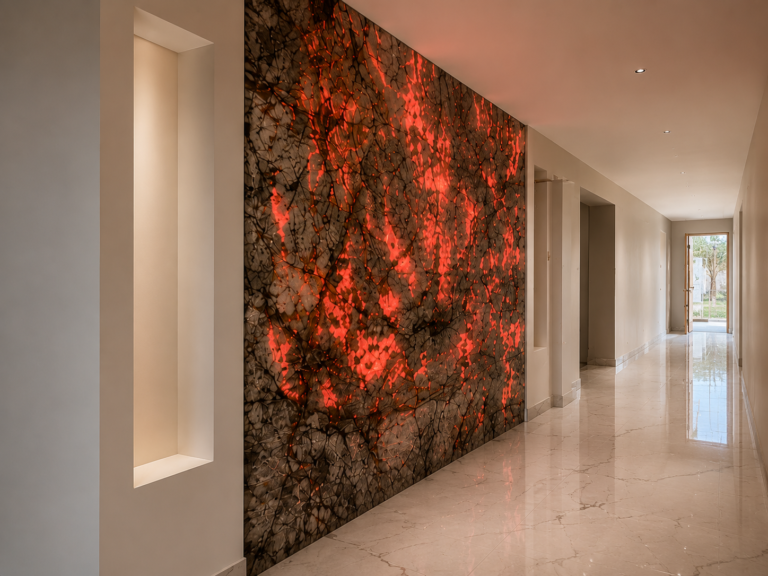
Backlit stone requires additional testing. Natural and artificial stone panels differ in thickness, color and light transmission. A layout that works behind white acrylic may not create the same result behind onyx, quartz or another translucent surface.
The sample should therefore reproduce the actual installation depth and facing material as closely as possible.




Which Specifications Matter Most?
Long specification lists can make comparison harder. In practice, a few items have the greatest effect on the finished result.
Sheet Size and Cutting Grid
The complete sheet size shows how much area one panel covers. The cutting grid shows how precisely it can follow the required shape.
A smaller cutting cell gives more control around curves, corners and narrow sections. It may also involve a denser and more complicated circuit.
Compare the drawing of the illuminated area with the cutting grid before ordering. This quickly reveals whether the sheet can follow the required boundary without leaving large unlit sections.
Voltage, Power and Control
The reference single-color, CCT, RGB and RGBW sheets operate at 24V, while the digital RGB version operates at 5V. This difference affects cable size, voltage drop, controller selection and the number of sheets that can share one power feed.
The control system must match the lighting version. Single-color sheets use a constant-voltage power supply and optional dimmer. CCT requires warm-white and cool-white channels, RGB and RGBW need compatible multi-channel controllers, and digital RGB adds a data signal for pixel control.
Before ordering, confirm the connector positions, wire lengths, total wattage, controller capacity and maximum recommended run. Larger 5V digital layouts may require additional power injection. Do not apply the CCT model’s wiring diagram to another version without checking its datasheet.
LED Density and Installation Depth
A higher LED quantity can reduce the distance between light points, but quantity alone does not guarantee uniform lighting.
The useful comparison is how the complete optical system performs at the available depth. This includes LED spacing, beam angle, diffuser transmission and internal reflection.
If the project has very little space between the sheet and the facing material, request a lighting test before confirming production.
CRI and White-Light Consistency
CRI matters when the light illuminates surfaces or materials whose colors need to appear natural. CRI 80 is adequate for many sign and decorative-lighting projects. CRI 90 is more suitable for premium retail, hospitality and material-display applications.
For larger projects, also confirm the color-temperature tolerance and binning standard. Two sheets described as 4000K can still show a visible difference when installed side by side if they come from different production batches.
Installation Considerations
The rear 3M 300LSE adhesive helps position the sheet on a clean substrate, but the tape should not be treated as the only mechanical support for every project. Dust, oil, textured surfaces, high temperatures and repeated movement can reduce adhesion. For the complete process, see our guide on how to cut, install and set up LED sheet lights.
Avoid sharp folds when fitting the sheet around a curve or corner. A flexible PCB can follow a gradual bend, but a tight crease may damage the copper paths, solder joints or LED packages. Complete a temporary layout and lighting test before removing the adhesive liner.
Heat also needs somewhere to escape. Although LED sheets are efficient, a large illuminated surface still generates heat. Mount the sheet on a suitable substrate, avoid trapping heat inside an undersized enclosure and select an Alimentazione a LED that matches the sheet voltage and total connected load.
For CCT, RGB, RGBW and digital RGB installations, use a compatible Controllore LED and confirm its channel type, output capacity and signal format. In damp locations, exposed connectors, solder joints and cut edges also require suitable protection. A bare flexible LED sheet should not automatically be treated as waterproof.
From Sample Evaluation to Production
For a new application, I would begin with the actual drawing and facing material rather than choosing a sheet from LED quantity alone.
A useful sample test reproduces:
- The planned lighting depth
- The final acrylic, fabric or stone
- The required brightness and color
- The intended dimming or control method
- Representative cut sections
- The proposed power and cable arrangement
Run the sample long enough to observe temperature, brightness stability and color consistency. Check both the center and edges of the illuminated area.
For RGB, RGBW and digital versions, test the real controller and programmed effects as well. A product may look correct with static white light but behave differently during dimming, color mixing or fast animation.
Once the sample has been approved, retain the tested configuration as the production reference. Changing the diffuser, mounting depth, LED version or controller after approval may change the visual result.
Custom options may include PCB layout, sheet dimensions, wire length, connectors, LED density, color temperature and control configuration. Feasibility and MOQ depend on how far the requested design differs from an existing circuit.

Information to Include in an RFQ
A short but specific RFQ produces a more useful quotation than a request for “a flexible LED sheet” alone.
includere:
- Overall illuminated dimensions
- Drawing of the required shape
- Facing material and thickness
- Available lighting depth
- Required light color or effect
- Input voltage preference
- Indoor or outdoor installation
- Estimated order quantity
- Required wire and connector positions
- Dimming or controller requirements
- Target completion date
For an irregular project, send a dimensioned PDF, DXF or CAD file if available. The supplier can then compare the shape with the cutting grid and identify unsuitable narrow sections before the sample is made.
Domande frequenti
Conclusione
A cuttable matrix LED light sheet provides a practical way to illuminate broad, shallow, curved and irregular surfaces. Its distributed LED layout can reduce strip spacing and wiring work, while its marked cutting cells allow the sheet to fit more closely around the required shape.
The product family covers fixed-color, tunable-white and dynamic-color projects. Begin with the lighting effect, installation depth and facing material, then compare the voltage, LED density, cutting grid, power requirement and control method of the corresponding model.
The reference CCT sheet in this guide measures 500 × 233 mm, operates at 24V and uses 840 SMD2835 LEDs, but those values should not be applied to every version. Single-color, RGB, RGBW and digital RGB sheets use different circuit layouts.
For project evaluation, send the illuminated dimensions, facing material, available depth and required lighting effect to Signlite. We can help identify the appropriate LED sheet light solution and prepare a sample specification for testing.
Post correlati