한국어
한국어  English
  简体中文
简体中文  Deutsch
  Español
  Français
  Italiano
  日本語
日本語  Polski
  Português
  Русский
  Türkçe
  Nederlands
  Tiếng Việt
  ไทย
ไทย 
예, 음향 설비 can reduce echo in conference rooms. They work by absorbing reflected sound energy, which reduces reverberation and makes speech easier to understand with fewer distracting reflections.
This article will explain how acoustic fixtures reduce echo, and the best placement strategies to improve speech clarity in conference rooms.
In practical terms, the biggest improvements usually come from placing absorption where speech reflections are strongest: above the meeting table and along the main reflection paths between speakers and listeners.
Why Conference Rooms Often Have Echo
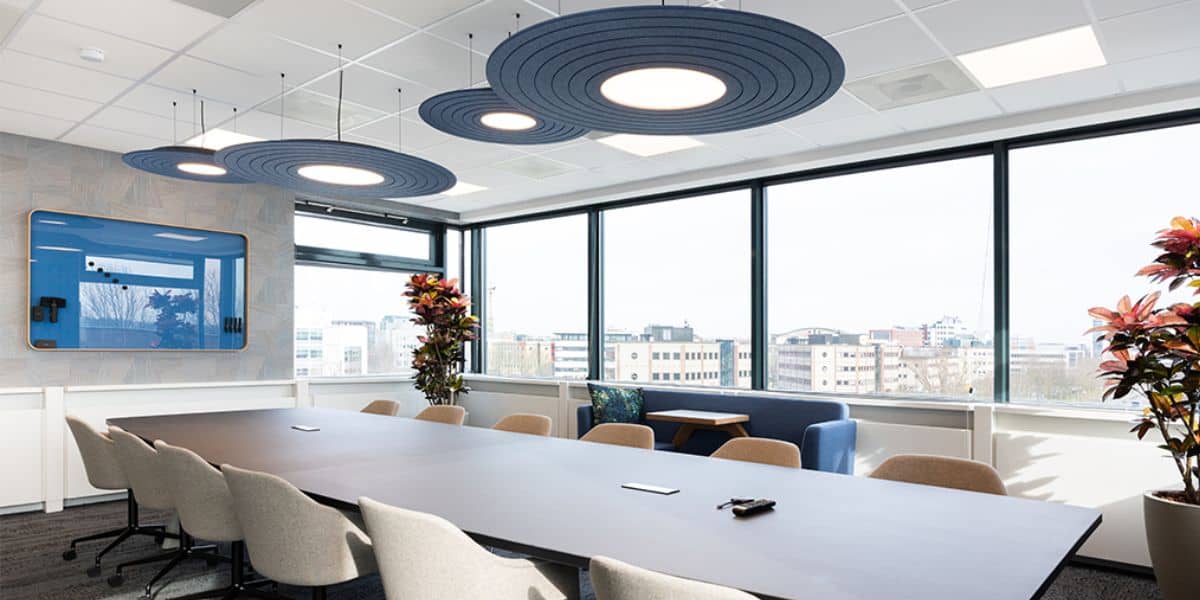
Echo and “roomy” sound are common in meeting spaces because conference rooms often prioritize clean surfaces, durability, and open layouts. Those same design choices increase sound reflection.
Typical causes include:
- Hard surfaces (glass, concrete, painted drywall, laminate tables)
- Parallel walls that bounce sound back and forth
- High ceilings with long reflection paths
- Minimal soft materials (few curtains, carpets, or upholstered items)
- Voice reflections and “speech smear” (reflections arrive slightly after the direct voice, reducing clarity)
In a conference room, echo is not just an “acoustic comfort” issue. It directly affects communication: people speak louder, repeat themselves, and remote-call microphones pick up more room sound than voice.
How Acoustic Fixtures Reduce Echo
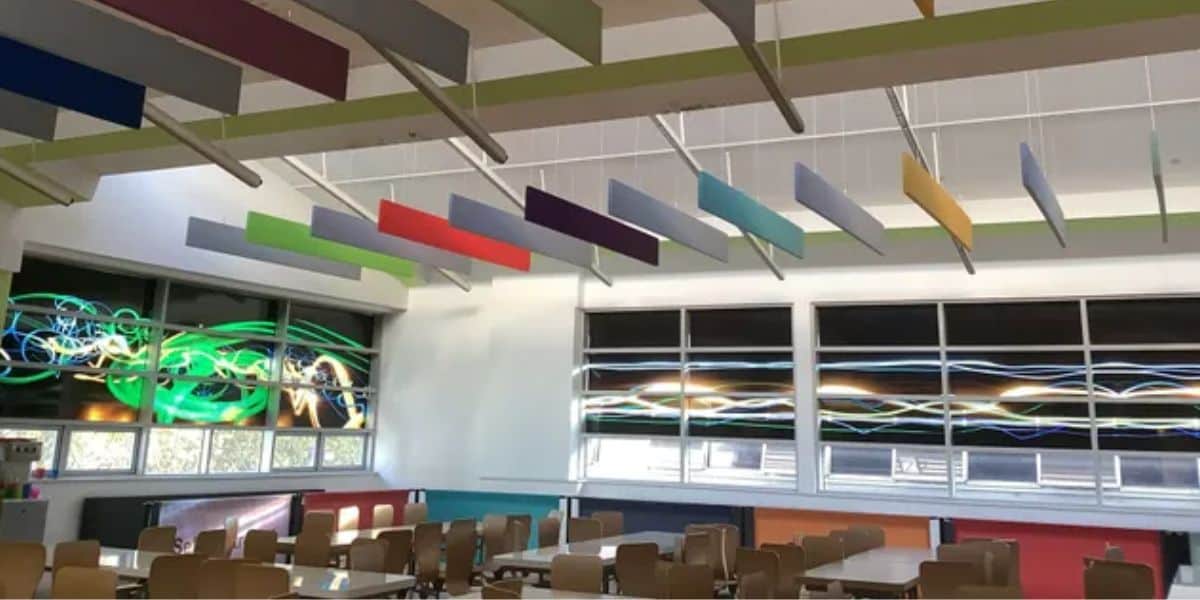
Acoustic problems in conference rooms are mostly caused by reflected sound, not the direct voice. When a person speaks, sound travels outward, hits surfaces, and bounces back into the room. If enough reflections remain strong, the room sounds “live” and speech becomes less clear.
Sound absorption vs reflection
- Reflective surfaces bounce sound back (glass, concrete, hard ceilings)
- Absorptive surfaces convert part of the sound energy into heat through friction inside porous materials (felt, mineral wool, PET, foam-based systems)
Acoustic fixtures help by reducing the strength of reflections, especially those arriving soon after the direct voice.
Reducing reverberation time
Conference rooms can suffer when sound lingers too long after each spoken word. Acoustic fixtures reduce how long sound persists in the room (often described as reducing the room’s “reverb tail”). You don’t need to calculate it to understand the impact: shorter reverberation makes speech more distinct.
Improving speech intelligibility
Speech clarity improves when the listener receives:
- a strong direct sound from the speaker, and
- fewer/softer early reflections that blur consonants
Acoustic fixtures reduce the “overlay” of reflections that makes voices feel smeared or tiring to follow.
Why mid-frequency absorption matters for speech
Human speech intelligibility is strongly influenced by mid-range frequencies (where many consonants and syllable cues live). In meeting rooms, it’s not enough to absorb only very high frequencies. Practical acoustic fixtures are useful because they often target the speech-relevant range, which is what makes meetings sound clearer rather than simply “duller.”
Key Types Mentioned in Real Searches

People researching conference-room acoustics often encounter a few common terms. These aren’t separate “magic solutions,” but they describe different ways absorption is integrated into a room.
Acoustic Fixtures
Acoustic fixtures are functional building elements that also provide sound absorption. In meeting rooms, they’re often suspended, ceiling-mounted, or wall-mounted.
How they help:
- Absorb reflected sound energy
- Reduce echo and excessive room “liveness”
- Improve clarity at the table and across the room
Where used:
- Over conference tables
- In ceiling grids or open ceilings
- On key wall zones that cause strong reflections
음향 조명
음향 조명 combines lighting with absorptive materials. The main advantage is that it uses ceiling real estate efficiently, which is often the most important area for controlling reflections in meeting rooms.
Why ceiling location matters:
- The ceiling is a major reflection surface for voices
- The table-to-ceiling bounce is a common reflection path
- Overhead placement can treat the speech zone without using wall space

다이렉트 서클 어쿠스틱 LED 펜던트
- Input Voltage: AC100-277V / AC220-240V,50-60HZ
- Height Size: H65mm
- Size D: 600mm / 800mm / 1000mm / 1200mm
- CCT: 3000K / 4000K / 6000K
- Power: 40W / 60W / 80W / 96W
- Luminous Flux: 100-110Lm/W
- Anti-Glare: Yes
- CRI: >80ra
- PF: >0.90
- Fllicker Free: Yes
- 빔 각도: 120°
- IP 등급: IP20
- 보증: 5년
- Felt Acoustic Board Color: Red / Green / Blue / Grey more than 48 colors option
Acoustic Lighting Panel
An acoustic lighting panel is typically a panel-style absorber that may be integrated with lighting or mounted near lighting zones.
How it’s used:
- Ceiling-mounted above the meeting area
- Sometimes installed on walls if ceiling options are limited
중요한 이유
- Panel forms can cover larger areas cleanly
- They’re easier to position over the table’s reflection zone
Felt Lighting and Fixtures
Felt lighting and fixtures refer to lighting or decorative ceiling elements made with felt or felt-like absorptive materials.
Why they’re common in modern offices:
- Felt-based materials are easy to shape into baffles, shades, and panels
- They fit minimalist interior styles
- They add absorption without looking like “soundproofing”
The key point: these terms describe how absorption is packaged, not whether it works. Performance depends heavily on placement and coverage.
Best Placement Strategies for Clear Speech

Good placement is what turns acoustic fixtures from “nice décor” into meaningful echo control. The goal is to treat the surfaces that create the strongest and most damaging reflections for speech.
Target First Reflection Points
First reflections are the earliest strong bounces that reach listeners shortly after the direct voice. They are especially harmful because they interfere with speech clarity without sounding like a distinct echo.
In conference rooms, common first-reflection paths include:
- Speaker → table → ceiling → listeners
- Speaker → side wall → listeners
- Speaker → glass wall → listeners
- Speaker → rear wall → listeners (often heard as slap-back)
Simple way to think about it:
- If a surface “sees” both the speaker and the listener, it can create a strong reflection.
- If that reflection arrives quickly, it blurs speech.
The best placement strategy is to absorb sound where these first reflections occur, starting with the ceiling zone above the table.
Ceiling Placement
Ceiling placement is often the highest-impact move because it targets the biggest reflection surface and the main speech zone.
Place fixtures above the meeting table
Mount acoustic fixtures directly over the table area because that is where:
- most voices originate
- most listeners are seated
- the strongest reflection loops happen
This is especially important for rooms with:
- hard ceilings (drywall, concrete)
- minimal ceiling texture
- open ceilings with reflective decking

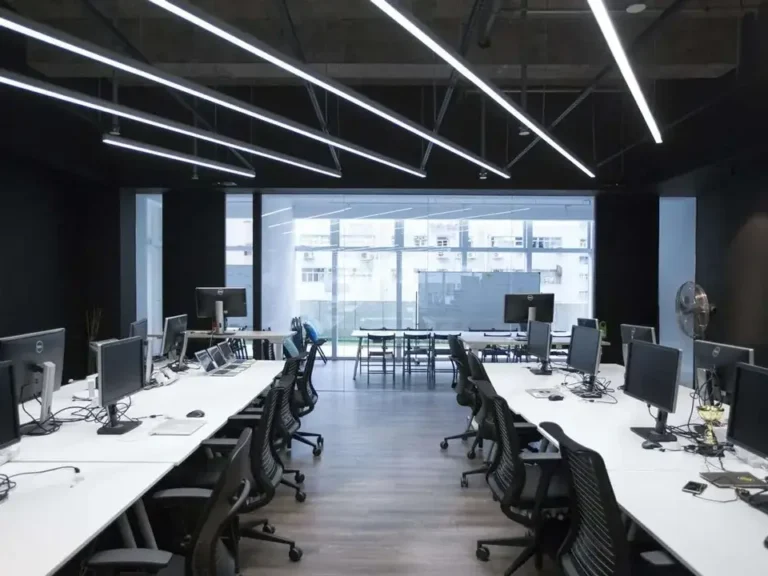
슈퍼 슬림 음향 LED 선형 빛
- Input Voltage: AC100-277V / AC220-240V,50-60HZ
- Emitting Direction: Downward
- Size: 1218*3640mm
- CCT: 3000K / 4000K / 6000K
- Power: 30W
- Luminous Flux: 100-110Lm/W
- CRI: >80ra
- PF: >0.90
- Flicker Free: Yes
- 빔 각도: 120°
- IP 등급: IP20
- 보증: 5년
- Felt Acoustic Board Color: Red / Green / Blue / Grey more than 48 colors option
Reduce the “ceiling bounce”
In many rooms, the ceiling acts like a mirror for sound. Voices bounce up, spread, and return to the table area. Acoustic fixtures interrupt this loop by absorbing energy before it returns.
This helps:
- in-person listeners (less smear across seats)
- hybrid meetings (mics capture less room sound)
- people at the far end of the table (clearer talkers)
Why central placement matters
A common mistake is putting absorption around the edges of the room while leaving the table zone untreated. In conference rooms, the acoustic priority is not “even coverage everywhere.” It’s speech clarity at the table.
Central placement works because:
- it treats the main speech source area
- it reduces reflections that travel across the table
- it improves clarity for the majority of seating positions
Wall Placement
Ceiling treatment often delivers the first big improvement, but wall placement is what makes results consistent across the room, especially in medium to large spaces.
Side walls: control lateral reflections
Side wall reflections can be very damaging because they arrive from left and right, creating a “wash” of reflected speech that makes it harder to focus.
Wall-mounted acoustic fixtures can help by:
- reducing harsh side reflections
- improving clarity for listeners along the table
- lowering the sense of “shoutiness” in the room
Rear wall: reduce slap-back in larger rooms
Rear wall reflections often create a distinct delayed bounce, especially when someone speaks toward the far end of the room. This is one of the reflections people notice most.
Rear-wall absorption is useful when:
- the room is longer than it is wide
- the far wall is hard and flat
- voices sound like they “bounce back” into the room
Why ceiling-only is sometimes not enough
Ceiling absorption reduces the biggest reflection surface, but walls still create:
- lateral reflections
- rear-wall slap-back
- reflections from glass partitions
If people still complain about clarity after ceiling treatment, walls are the next logical step.
Avoid Common Placement Mistakes
Most echo problems persist because absorption is installed in places that look balanced, but do not treat the actual reflection paths.
일반적인 실수는 다음과 같습니다.
- Placing only at one end of the room and leaving the table zone reflective
- Leaving large reflective zones untreated, especially ceiling area above the table
- Treating corners only but ignoring the main reflection paths between speakers and listeners
Corners and perimeter areas can help as supporting treatment, but they rarely solve conference-room speech clarity on their own.
빠른 비교 표
Acoustic Fixtures Placement Options for Conference Rooms
| Placement area | What it reduces | 최상의 대상 | Common mistake |
| Ceiling above table | strong reflections + echo | speech clarity | mounting too far from table |
| Side walls | lateral reflections | clearer dialogue | treating only one wall |
| Rear wall | “slap-back” echo | larger rooms | ignoring rear wall completely |
| Corners/perimeter | buildup of reflections | supporting control | using corners only as main solution |
This table shows why ceiling placement above the table is usually the first priority: it targets the strongest reflection paths in typical conference rooms.
Wall and perimeter treatments are still valuable, but they work best as supporting layers once the main speech zone is addressed.
Practical Room-by-Room Guidance
You don’t need a complex acoustic plan to make good decisions. A practical approach is to prioritize the speech zone first, then add supporting treatment where reflections remain noticeable.
Small meeting rooms
Typical issue: strong reflections in a compact space make voices sound harsh and close.
Priority order:
- Acoustic fixtures above the table
- One or two side wall zones if the room still feels sharp
- Rear wall only if slap-back is noticeable
In small rooms, ceiling placement often solves most of the problem quickly.
Medium conference rooms
Typical issue: ceiling bounce plus side-wall reflections reduce clarity across multiple seats.
Priority order:
- Ceiling absorption centered over the table
- Side wall treatment on both sides (balanced coverage)
- Rear wall support if the room is long or has a hard back surface
Medium rooms benefit from combining ceiling + walls so speech stays clear across the full table length.
Large boardrooms
Typical issue: reflections build up across distance, and rear-wall slap-back becomes more obvious.
Priority order:
- Strong ceiling treatment over the main seating area
- Rear wall absorption to control delayed reflections
- Side wall support to reduce lateral wash
- Perimeter/corner support only after the main reflection paths are controlled
In larger rooms, treating only one surface usually leads to uneven results. The room may sound better in some seats but not others.
Additional Tips That Improve Results
These practical adjustments can improve outcomes even when fixture coverage is limited.
- Combine ceiling + wall absorption when needed
Ceiling treatment reduces the biggest reflections, while walls improve consistency and reduce lateral smear. - Keep the speech zone priority (table area)
Focus on where people speak and listen. Decorative absorption far from the table often has less impact. - Reduce hard reflective clutter if possible
Large glass surfaces, bare walls, and highly reflective tables increase echo. Even small changes can reduce reflection strength. - Acoustic + lighting integration helps when ceiling space is limited
Acoustic lighting can make it easier to add absorption in the highest-impact location without competing with other ceiling services.
2026 Trend Note
In 2026, many offices are moving toward 음향 조명 and other integrated ceiling elements to support hybrid meetings. Modular ceiling solutions are also becoming more common, especially where spaces need to adapt. The focus is typically on balancing comfort and speech clarity without changing the room’s layout.
결론
예, 음향 설비 reduce echo in conference rooms by absorbing reflected sound and lowering the amount of reverberation that interferes with speech. The best results come from correct placement, especially on the ceiling above the meeting table, where first reflections are strongest. For clearer speech across all seats, ceiling treatment often works best when supported by side wall and sometimes rear wall absorption. The goal is simple: fewer strong reflections and more consistent conversation clarity.
자주 묻는 질문
관련 게시물