Nederlands
  English
  简体中文
简体中文  Deutsch
  Español
  Français
  Italiano
  日本語
日本語  한국어
한국어  Polski
  Português
  Русский
  Türkçe
  Tiếng Việt
  ไทย
ไทย 
Als u echt professionele, puntvrije lineaire verlichting wilt, is het gebruik van een goed LED-kanaal niet optioneel - het is essentieel. Een LED-kanaal bepaalt direct de warmteafvoer, lichtverspreiding, visueel comfort en de langetermijnbetrouwbaarheid van uw LED-stripverlichtingssysteem. Zonder dit kunnen zelfs hoogwaardige LED-strips last hebben van schittering, zichtbare hotspots en versnelde lumenafschrijvingen veroorzaakt door slechte thermische controle.
Veel lichtproblemen die worden toegeschreven aan LED-strips zijn eigenlijk het resultaat van het overslaan van het aluminium LED-kanaal. Wanneer LED-tape rechtstreeks op hout, gipsplaat of plastic oppervlakken wordt geïnstalleerd, bouwt de warmte zich snel op en blijft het licht hard en ongelijk. Een goed ontworpen LED-kanaalsysteem lost deze problemen op door zowel als koellichaam als optische besturingsbehuizing te fungeren, waardoor onbewerkte LED-strips worden omgezet in verfijnde architecturale verlichting.
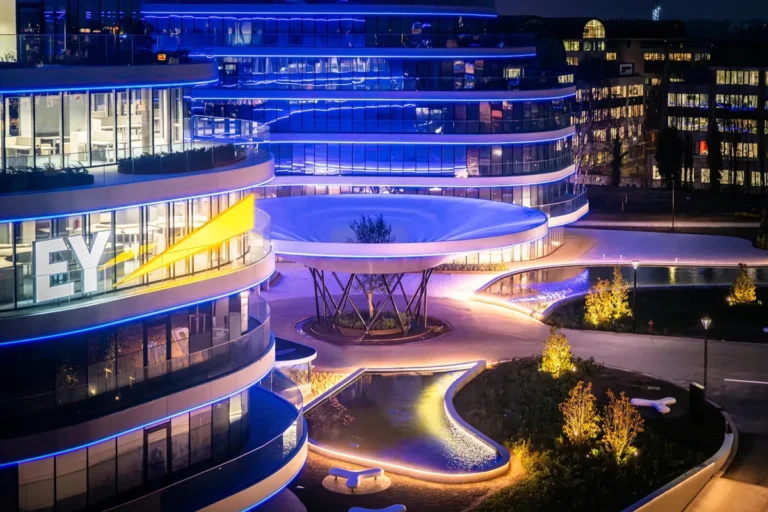
In deze handleiding leert u hoe u het juiste LED-kanaal voor verschillende toepassingen kiest, de kritische maatregels begrijpt, diffuseropties vergelijkt en praktische kooptips toepast. Of u nu een project specificeert of van plan bent om LED-kanaalsystemen voor installatie te kopen, deze principes zullen u helpen een consistente, vlekkeloze lineaire verlichting te bereiken. Inspiratiegalerij: Toptoepassingen van LED-aluminiumprofielen
Wat is een LED-kanaal en waarom heb je er een nodig?
Technische definitie en kernfunctie
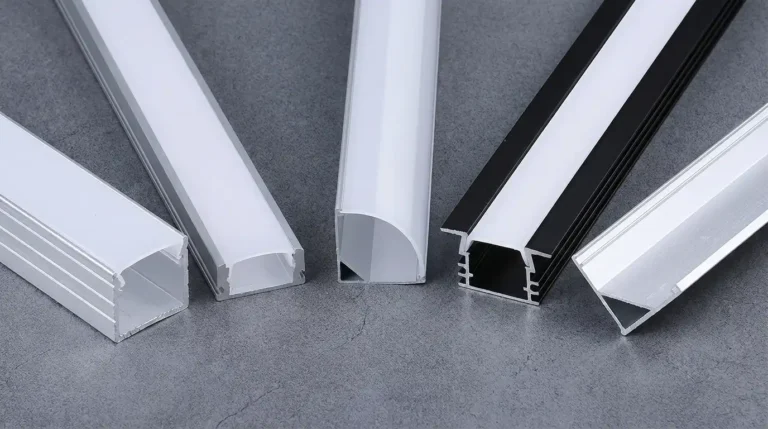
Een LED-kanaal (ook wel een LED-stripkanaal of aluminium LED-profiel genoemd) is een stijf behuizingssysteem dat is ontworpen om LED-strips te monteren, te beschermen, koelen en visueel te verfijnen. Het bestaat meestal uit een geëxtrudeerde aluminium behuizing, een diffusorafdekking en montageaccessoires zoals clips en einddoppen.
In professionele verlichtingstoepassingen is een LED-kanaal geen accessoire - het is een kernsysteemcomponent. Het transformeert zichtbare LED-tape in een gecontroleerde, duurzame en architectonisch geïntegreerde lineaire verlichtingsoplossing.
Warmteafvoer: de basis van de levensduur van LED
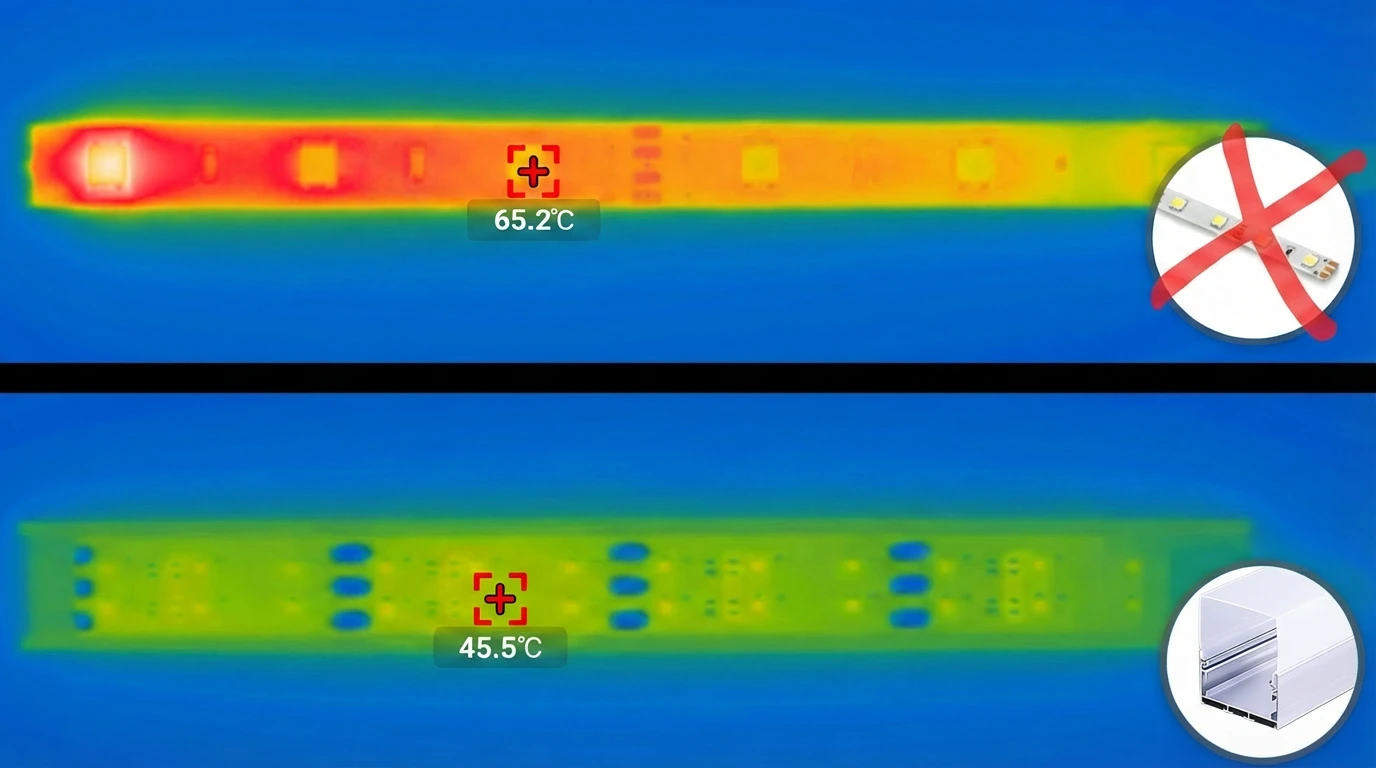
LED-strips genereren warmte op PCB-niveau. Zonder efficiënt thermisch beheer stijgen de junctietemperaturen, wat leidt tot snellere lumenafschrijvingen en voortijdige storingen. Een aluminium LED-kanaal pakt dit aan door te fungeren als een passief koellichaam. Aluminium heeft een hoge thermische geleidbaarheid (ongeveer 205 w/m·K), die dramatisch beter presteert dan plastic materialen.
Wanneer een LED-strip in een aluminium LED-kanaal wordt geïnstalleerd, verspreidt de warmte zich langs de extrusie en verspreidt zich de omringende lucht. Dit verlaagt de bedrijfstemperatuur en verbetert het onderhoud van de lumen. Kwaliteits-LED-strips die worden gebruikt met aluminium LED-kanalen met de juiste grootte kunnen meer dan 50.000 uur (L70) bedragen, terwijl strips die direct op hout of plastic worden gemonteerd, tot 30 procent sneller licht kunnen vergaan.
Technische afhaalmaaltijden: Een aluminium LED-kanaal is een thermisch beheerapparaat dat de LED-levensduur direct verlengt en de systeemprestaties stabiliseert.
Puntvrije prestaties: keerpunten in lijnen
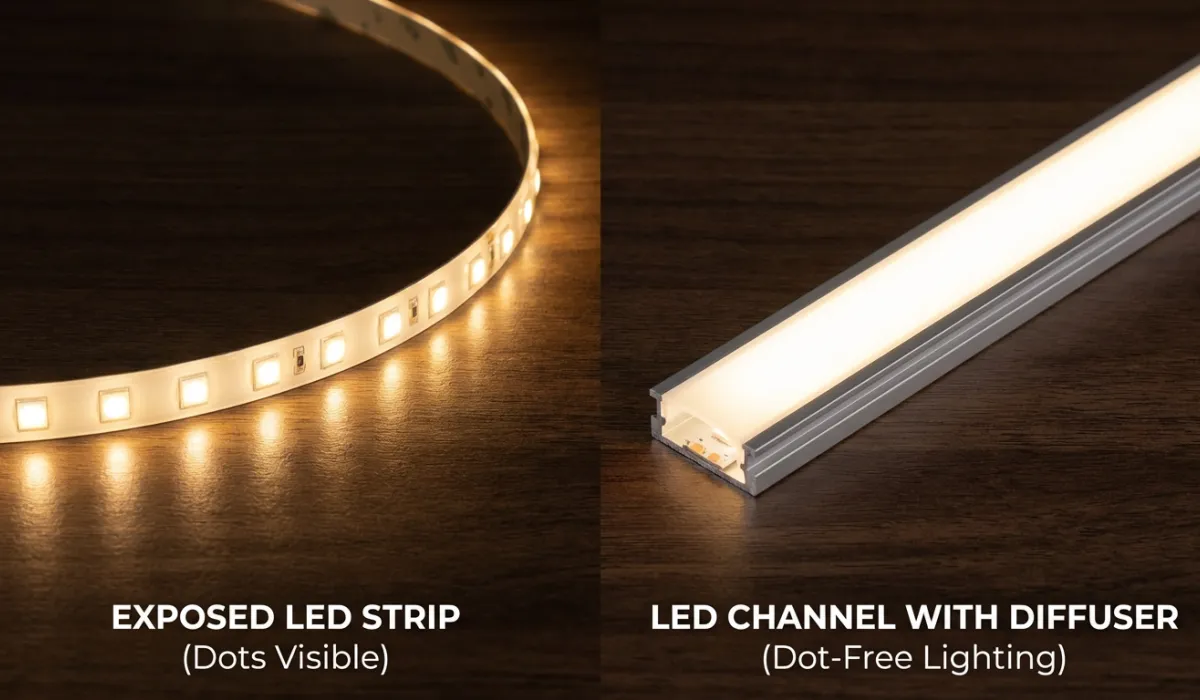
Ruwe LED-strips produceren discrete lichtpunten omdat individuele diodes langs de PCB zijn geplaatst. Zonder optische besturing creëert dit zichtbare hotspots, vooral in ondiepe of direct view-installaties.
Een LED-kanaal verbetert de visuele uniformiteit door optische diffusie:
- Kanaaldiepte vergroot de afstand tussen de LED-bron en de diffuser
- De diffuser verspreidt en vermengt het uitgestraalde licht
- Het resultaat is een continu lineair effect in plaats van zichtbare LED-punten
Deze optische besturing is van cruciaal belang voor toepassingen zoals architecturale baaien, plafondonthullingen, begrazing van de muur en hoogwaardige kastenverlichting.
Zonder een combinatie van LED-kanaal en diffusor op de juiste maat is het bereiken van echt vlekkeloze lineaire verlichting extreem moeilijk, zelfs bij gebruik van LED-strips met hoge dichtheid.
Bescherming en architecturale integratie
Naast thermische en optische prestaties, biedt een LED-kanaal mechanische bescherming en ondersteunt schone architecturale details.
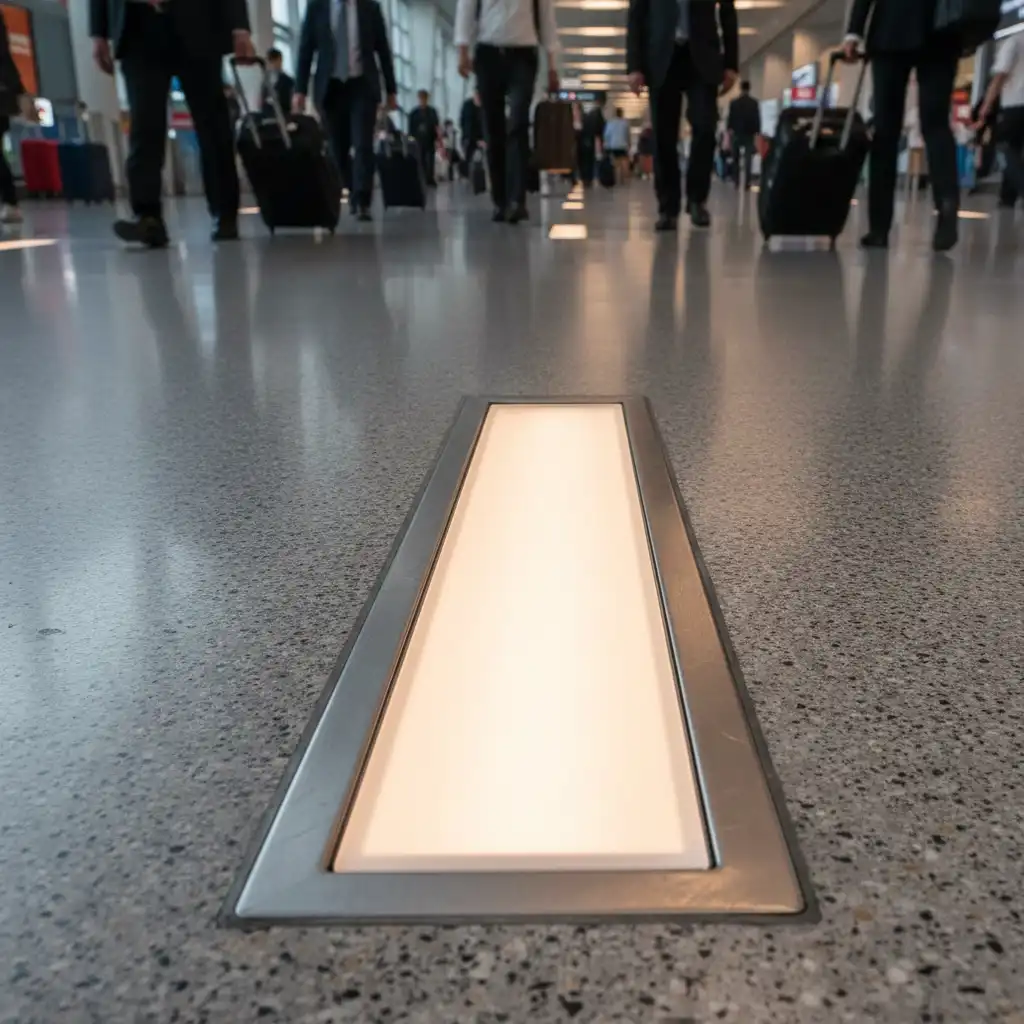
Fysieke bescherming
• Schildt LED-strips af van stof, impact en onbedoeld contact
• Voorkomt PCB buigen en soldeergewrichtsspanning
• Verlengt de levensduur in commerciële en drukke omgevingen
architectonische afwerking
• Creëert rechte, schone lichtlijnen
• Verbergt bedrading en montage-imperfecties
• Maakt inbouw, trimloze en naadloze lichtdetails mogelijk
Voor ontwerpers en ingenieurs functioneert het LED-kanaal als zowel een verlichtingscomponent als een constructie-element, overbruggende elektrische systemen en architecturale afwerkingen.
Aluminium versus kunststof LED-kanalen (waarom materiaal is van belang)
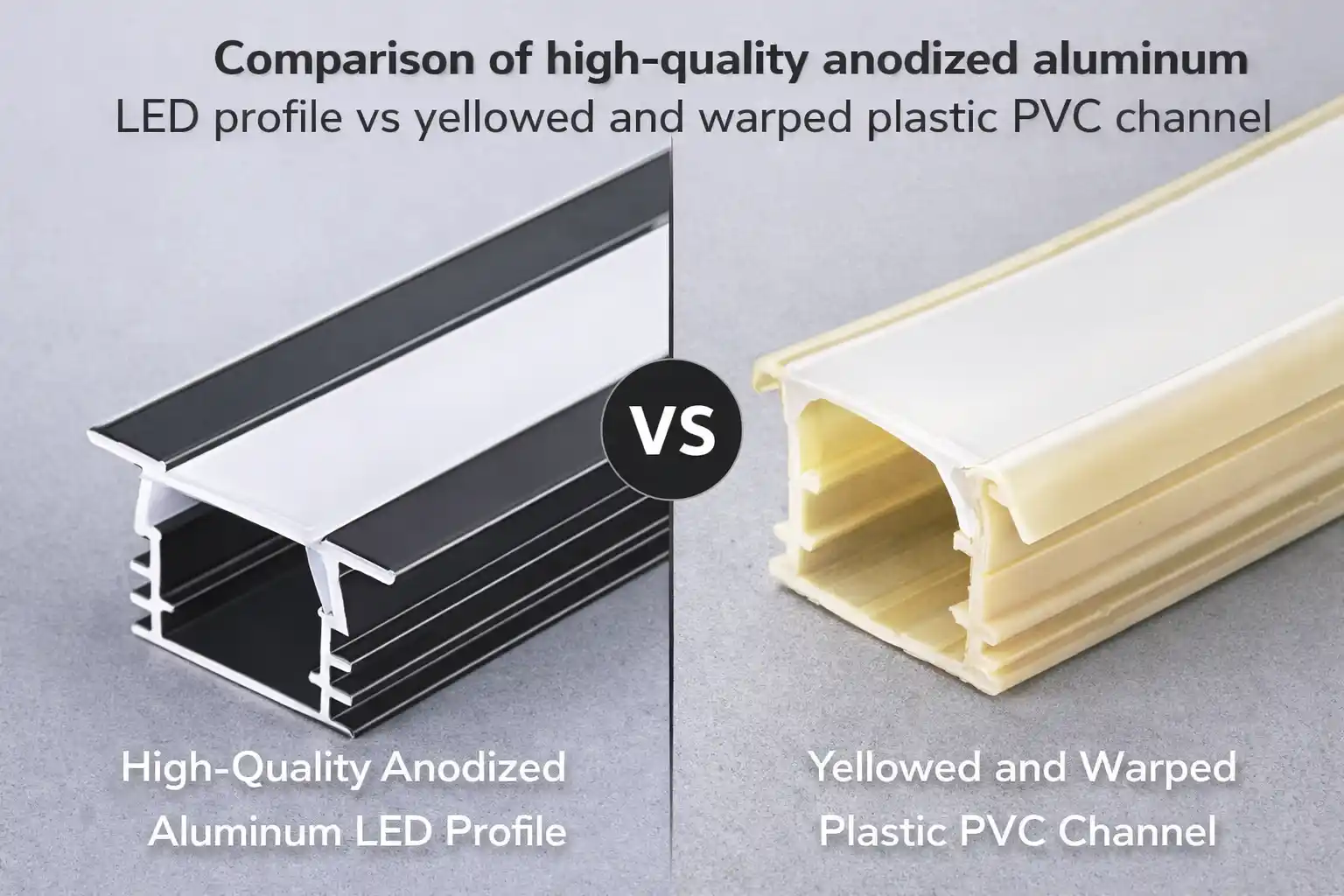
| Functie | Aluminium LED Kanalen | Kunststof / PVC-kanalen |
| Thermisch beheer | Uitstekende warmteafvoer, stabiliseert LED-temperatuur | Slechte warmteoverdracht, slaat warmte op |
| Duurzaamheid | Stijf, slagvast, hittebestendig | kan na verloop van tijd vervormen, barsten of verkleuren |
| Lumen onderhoud | Ondersteunt langdurige helderheid stabiliteit | Warmteopbouw versnelt lumenverlies |
| Esthetische kwaliteit | Architectonische, professionele afwerking | Ziet er vaak tijdelijk of low-end uit |
Kunststof LED-kanalen kunnen acceptabel zijn voor kortdurend of decoratief gebruik, maar aluminium LED-kanalen zijn de industriestandaard voor architecturale, commerciële en high-output verlichting waar prestaties en levensduur van cruciaal belang zijn.
Soorten LED-kanalen (volgens installatiemethode)
Het selecteren van het juiste LED-kanaal hangt af van hoe het in de ruimte wordt geïntegreerd. De installatiemethode heeft een directe invloed op de thermische prestaties, lichtdiffusie, verblindingsregeling en complexiteit van de constructie. De drie primaire categorieën zijn opbouwmontage, verzonken (inclusief trimless) en hoek- of schuine LED-kanalen.
Opbouw LED Strip kanalen
Opbouw LED-kanalen zijn de meest veelzijdige en meest gebruikte. Ze zijn direct geïnstalleerd op afgewerkte oppervlakken zoals hout, kasten, metaal of metselwerk en zijn ideaal voor retrofit-projecten en verlichting voor meubels. Typische toepassingen zijn onder-kastverlichting, rekkenverlichting en taakverlichting.
Een belangrijke technische factor is de kanaalhoogte, die de optische menging en de zichtbaarheid van de stippen beïnvloedt.
| Kanaalhoogte | Typisch bereik | optisch effect | Aanbevolen gebruik |
| Laag profiel | 7–10 mm | Minimale LED-tot-diffuser afstand; hoger risico op zichtbare stippen | Decoratieve accenten, low-output strips |
| Standaard profiel | 12–15 mm | Verbeterde lichtvermenging en verblindingsregeling | Algemene taak- en architectonische verlichting |
| Diep oppervlakteprofiel | 16–20+ mm | Superieure diffusie en verminderde zichtbaarheid van de hotspot | Hoge dichtheid of COB LED-strips |
De diepere LED-kanalen zorgen voor een betere lichtspreiding en een meer uniforme output, wat van cruciaal belang is voor het verminderen van zichtbare LED-punten in directe zichtinstallaties.
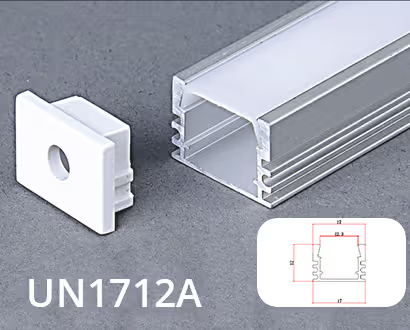
Opbouw aluminium profiel
Gewicht: 0.141KG
Dikte: 0,8 mm
PC-kleur: melkwit
Maat: L1000*w17*H12mm
Eindkappen/Clips: 1paar/m
Aluminiu kleur: Zilver/Zwart
Verzonken en trimloze LED-stripkanalen
Inbouw LED kanalen worden gelijk met omringende bouwmaterialen geïnstalleerd, waardoor een schoon, geïntegreerd lichteffect ontstaat. Trimless, ook wel gips-led-kanalen genoemd, elimineert zichtbare randen volledig en creëert een naadloze "lichte sleuf", waardoor ze ideaal zijn voor hoogwaardige architecturale projecten. Deze kanalen zijn meestal ingebed in gipsplaatplafonds of muurassemblages.
| Functie | verzonken kanaal | Trimloos / gips-in kanaal |
| Installatiefase | Na oppervlakte-uitsparing | Voor het laatste gips en afwerking |
| Zichtbaar kader | Dunne trimrand zichtbaar | Geen zichtbare trim na afwerking |
| Esthetisch resultaat | Schoon maar gedefinieerde opening | Naadloos "lichtslot"-effect |
| Vaardigheidsvereiste | Matig | Hoog (vereist precisie van gipsplaatafwerking) |
| Typische toepassingen | Plafonds, wandslots, kasten | Luxe woonwijk, hotels, galerieën |
De diepere LED-kanalen worden vaak gecombineerd met LED-strips met hoge dichtheid om optische menging te verbeteren en vlekkeloze lineaire verlichting te bereiken.
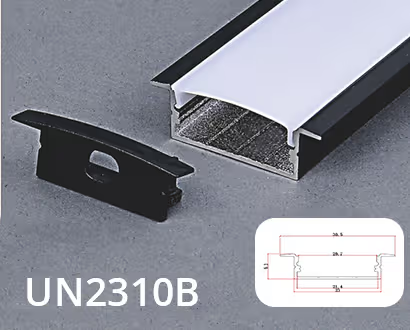
Aluminium inbouwprofiel
Gewicht: 0.102KG
Dikte: 0,8 mm
PC-kleur: melkwit
Maat: L1000*w23*H10mm
Eindkappen/Clips: 1paar/m
Aluminiu kleur: Zilver/Zwart
Hoek en 45° LED-stripkanalen
Hoek- en 45-graden LED-kanalen zijn ontworpen om licht diagonaal te projecteren, waardoor ze ideaal zijn voor indirecte verlichting waar verticale en horizontale oppervlakken elkaar ontmoeten. Door de stralingshoek te verschuiven, verminderen ze verblinding en verbeteren ze de lichtverdeling over aangrenzende oppervlakken. Veelvoorkomend gebruik zijn kasthoeken, trapdetails, displayrekken en overgangen in de baai.
| Installatielocatie | doel verlichting | Prestatievoordeel |
| Onder kasten (achterhoek) | Taakverlichting aanrecht | richt licht naar buiten, vermindert backsplash-schaduwen |
| Plafond-tot-muur kruising | Indirecte sfeerverlichting | Creëert een zacht wandwaseffect |
| Plank voorhoeken | display verlichting | Verlicht de verticale objecten gelijkmatig |
| Stappen en traphoeken | Veiligheid en accentverlichting | Verbetert de zichtbaarheid zonder directe verblinding |
Hoek-LED-kanalen verbeteren de waargenomen helderheid en visueel comfort zonder het wattage te verhogen, waardoor ze efficiënt zijn voor gelaagd lichtontwerp. Installatiegids: Mastering 45° hoek LED aluminium profielen.
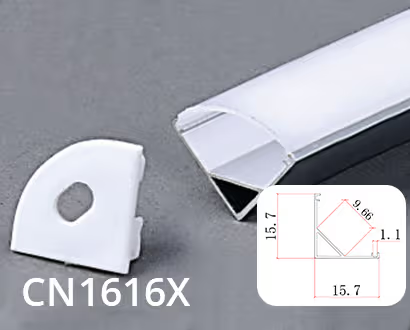
Aluminium hoekprofielen
Gewicht: 0,093KG
Dikte: 0,8 mm
PC-kleur: melkwit
Maat: L1000*W16*H16mm
Eindkappen/Clips: 1paar/m
Aluminiu kleur: Zilver/Zwart
Overzicht installatietypevergelijking
De installatiemethode van een LED-kanaal beïnvloedt zowel de constructievereisten als de optische prestaties. De onderstaande samenvatting helpt bij het vereenvoudigen van specificatiebeslissingen.
| Kanaaltype | Montagewijze | visuele stijl | Typische diepte | het beste voor | Complexiteit van installatie |
| Opbouw gemonteerd | vast op afgewerkt oppervlak | Zichtbare lineaire armatuur | Ondiep tot diep | Kasten, planken, renovaties | Laag |
| afgemeten | Geïnstalleerd in uitsparing | spoelen, geïntegreerd | Middelmatig tot diep | Plafonds, muren, freeswerk | Medium |
| Trimloos / in gips | ingebed voordat u klaar bent | Naadloze architecturale slot | Middelmatig tot diep | Luxe architecturale projecten | Hoog |
| Hoek / 45° | gemonteerd in binnenhoeken | Indirect, schuin licht | Ondiep tot medium | Onder kasten, baaien, displays | Laag tot gemiddeld |
Het kiezen van het juiste LED-kanaaltype zorgt ervoor dat het verlichtingssysteem in lijn is met zowel constructiebeperkingen als het gewenste visuele effect.
LED-kanaalgroottes: breedte, diepte en lengte uitgelegd
De grootte van het LED-kanaal is een kritische factor in lineair lichtontwerp. Het kiezen van de verkeerde afmetingen kan leiden tot zichtbare hotspots, oververhitting en verminderde verlichtingsprestaties. Een goede maatvoering zorgt voor mechanische pasvorm, stabiel thermisch gedrag en een soepele optische diffusie.
In dit gedeelte wordt uitgelegd hoe u de juiste breedte, diepte en lengte selecteert voor een professionele LED-kanaalinstallatie.
de interne breedteregel
Bij het specificeren van een LED-kanaal is de belangrijkste dimensie de interne bruikbare breedte, niet de externe profielgrootte. Dit bepaalt of de LED-strip goed past en of er voldoende ruimte is voor bedrading, soldeerverbindingen en connectoren.
Een praktische technische regel is om aan beide zijden van de LED-strip speling mogelijk te maken.
Aanbevolen richtlijn:
Interne LED-kanaalbreedte = LED-strip PCB-breedte + 1–2 mm
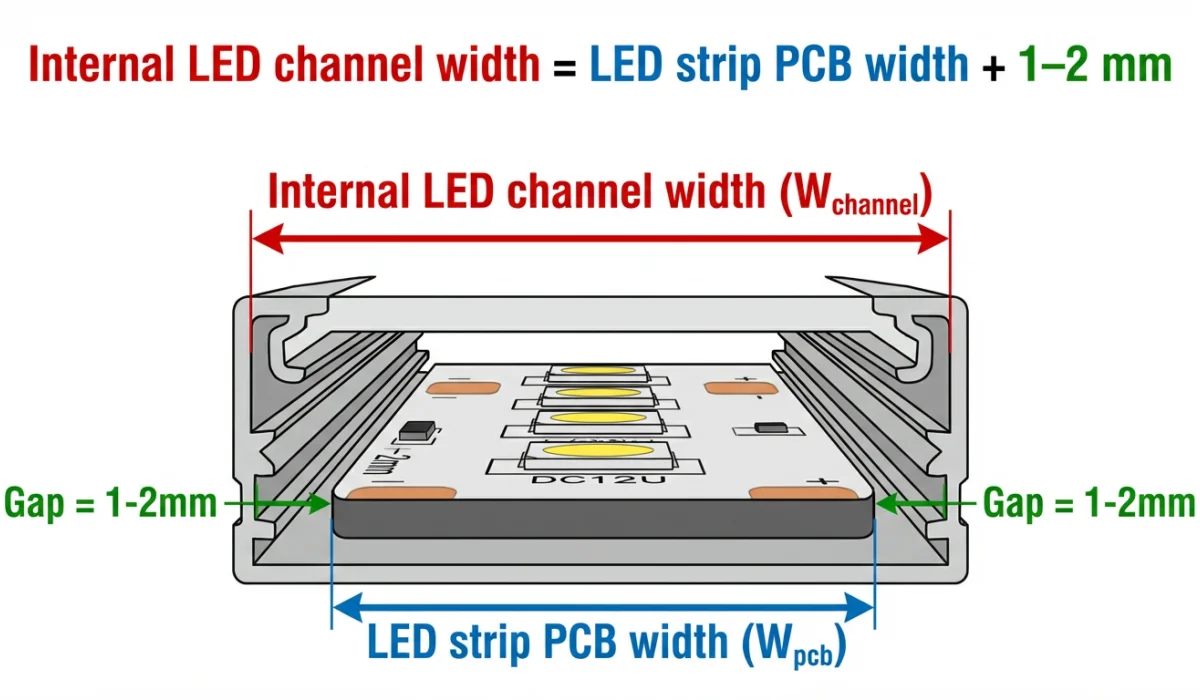
Deze extra ruimte voorkomt compressie, vermindert de spanning op soldeerpads en vereenvoudigt de installatie.
| LED-strip PCB-breedte | Minimale interne kanaalbreedte | vastleggen |
| 8 mm | 10 mm | Geschikt voor SMD-strips met één rij |
| 10 mm | 12 mm | Gemeenschappelijk voor 2835 of 5050 strips met hoge dichtheid |
| 12 mm | 14 mm | Aanbevolen voor RGB of hogere vermogensstrips |
| 16 mm | 18–20 mm | nodig voor brede COB of dubbele rijstrips |
Ondermaatse LED-kanalen beperken de luchtstroom en vang de warmte, waardoor de betrouwbaarheid op lange termijn wordt verminderd.
Diepte versus LED-pitch: de vlekkeloze verlichtingsformule
De diepte van het LED-kanaal is een primaire factor bij lichtdiffusie. Een grotere diepte vergroot de afstand tussen de LED-bron en de diffuser, waardoor het licht effectiever kan mengen. Voor stippenvrije prestaties met een melkachtige diffuser moet de kanaaldiepte gelijk zijn aan of groter zijn dan de LED-toonhoogte.
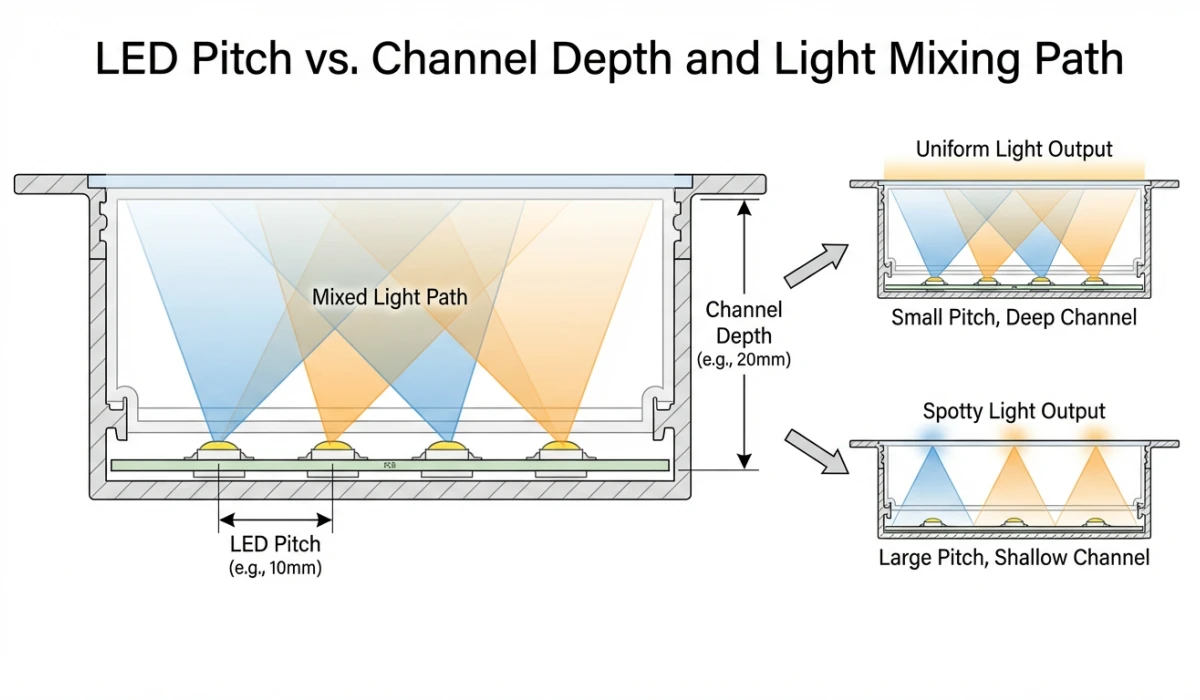
| LED Dichtheid | ca. lichtweide | Aanbevolen minimale kanaaldiepte |
| 60 LED's/m | ~16,6 mm | 16 mm of dieper |
| 120 LED's/m | ~8,3 mm | 12 mm of dieper |
| 180 LED's/m | ~ 5,5 mm | 10 mm of dieper |
| COB LED-strip | Continue fosforlaag | 8-10 mm typisch voldoende |
Ondiepe LED-kanalen vergroten het risico op zichtbare hotspots, vooral bij LED-strips met hoge dichtheid.
Ondiepe versus diepe kanalen: competenten van prestaties
Diepere LED-kanalen verbeteren de lichtuniformiteit, maar vereisen meer installatieruimte. De keuze hangt af van visuele verwachtingen en constructiebeperkingen.
| Kanaaldiepte | Voordelen | Beperkingen | Beste toepassingen |
| Ondiep (7-10 mm) | Slanke uitstraling, past in krappe ruimtes | Hoger risico op zichtbare stippen | Verborgen baaien, indirecte verlichting |
| Medium (12-15 mm) | Goede diffusie, uitgebalanceerd ontwerp | Iets meer zichtbaar profiel | Kasten, planken, algemeen architectonisch gebruik |
| Diep (16-25+ mm) | Uitstekende hotspot-onderdrukking, verminderde schittering | Vereist meer installatiediepte | Premium architecturale verlichting, COB-strips |
Waar het LED-kanaal direct zichtbaar is, verbeteren diepere profielen het visueel comfort en de waargenomen lichtkwaliteit aanzienlijk.
Standaard lengtes en technische overwegingen
LED-kanalen worden vervaardigd in standaardlengtes en het selecteren van de juiste maat verbetert de uitlijning en installatie-efficiëntie.
| Standaard lengte | algemeen gebruik | vastleggen |
| 1 meter | Retail- en doe-het-zelfproject | Eenvoudige afhandeling en verzending |
| 2 meter | Residentiële en lichte commerciële | Minder gewrichten, cleaner lijnen |
| 3 meter | Architectonische | Vermindert verbindingspunten |
| 8 ft (94 in) | Noord-Amerikaanse commerciële projecten | Komt overeen met de gemeenschappelijke ruimte voor het bouwen van module |
Langere LED-kanalen verminderen het aantal gewrichten, waardoor de visuele continuïteit en de mechanische sterkte worden verbeterd. Installateurs moeten echter rekening houden met thermische uitzetting en een kleine opening tussen secties laten.
Breedte, diepte en thermische prestaties
LED-kanaalafmetingen beïnvloeden ook thermisch gedrag. Bredere en diepere aluminiumprofielen bieden een groter oppervlak voor warmteafvoer, waardoor de temperatuur van de junctie lager en beter onderhoud aan de lumen behouden blijft. Ondermaatse LED-kanalen kunnen warmte vasthouden, lichtverval en levensduur van het verkortsysteem vasthouden. Een goede maatvoering ondersteunt daarom optische prestaties, verblindingsregeling en betrouwbaarheid op lange termijn, waardoor een eenvoudige LED-strip een lineair verlichtingssysteem van professionele kwaliteit wordt.
Diffusers zijn belangrijk: heldere VS-melk- versus zwarte covers
De diffuser is de primaire optische besturingscomponent in een LED-kanaalsysteem. Terwijl het aluminium LED-kanaal de warmte en structuur beheert, bepaalt de diffuser hoe licht wordt gezien - wat de helderheid, schittering, zachtheid en LED-punten zichtbaar blijft. Het kiezen van de verkeerde LED-kanaaldiffuser kan leiden tot hard licht, zichtbare hotspots of verminderd visueel comfort, zelfs als de kanaalgrootte correct is.
Diffusers zijn ontworpen om lichttransmissie en diffusie in evenwicht te brengen, en elk type dient een ander lichtdoel.
| Type diffuser | lichttransmissie | visueel effect | het beste voor |
| onschuldig | ~90-95% | Maximale helderheid, LED-stippen vaak zichtbaar | Indirecte verlichting, verborgen baaien, verborgen kanalen |
| Melkachtig (opaal) | ~70-75% | Zacht, uniform licht, dot-vrij uiterlijk | Onderkast, planken, wandslots, algemene architecturale verlichting |
| Zwart (rook) | ~30–45% | Kanaal ziet er donker uit als het uit is, subtiele gloed wanneer het aan staat | High-end retail, gastvrijheid, bioscoop, minimalistische interieurs |
Duidelijke diffusers geven prioriteit aan output boven zachtheid en zijn het beste waar het LED-kanaal voor direct zicht is verborgen. Melkachtige diffusers bieden de beste balans tussen efficiëntie en visueel comfort en zijn de standaardkeuze voor zichtbare lineaire verlichting. Zwarte diffusers richten zich op esthetiek en helpen het LED-kanaal visueel te verdwijnen als het wordt uitgeschakeld, maar met verminderde helderheid wanneer het wordt verlicht.
Diepe duik: Hoe de juiste LED-kanaaldiffuser te kiezen (helder versus melkachtig versus zwart)
Materiaal is belangrijk: PC versus PMMA
LED-kanaaldiffusers zijn meestal gemaakt van polycarbonaat (PC) of acryl (PMMA), en de materiaalkeuze beïnvloedt duurzaamheid en uiterlijk op de lange termijn.
Polycarbonaat biedt een hoge slagvastheid en een betere hittetolerantie, waardoor het geschikt is voor krachtige LED-kanaalinstallaties. UV-gestabiliseerde PC is ook bestand tegen vergeling in buiten- of zonoverbogen omgevingen.
PMMA biedt een uitstekende optische helderheid en een soepele diffusie, maar kan sneller geel worden bij langdurige UV-blootstelling, tenzij speciaal behandeld. Voor architecturale en commerciële projecten is materiaalkwaliteit net zo belangrijk als de diffusorkleur.
Waterdichte en outdoor LED-kanalen: wat te weten
Waterdichte en buiten LED-kanalen zijn essentieel voor het beschermen van lineaire verlichtingssystemen tegen vocht, stof en barre omgevingsomstandigheden met behoud van thermische en optische prestaties. Een goed gespecificeerd LED-kanaal beschermt niet alleen de LED-strip tegen het binnendringen van water, maar zorgt ook voor een stabiele warmteafvoer bij fluctuerende buitentemperaturen. Het begrijpen van waterdichtingsmethoden, IP-classificaties en duurzaamheid van materiaal is van cruciaal belang voor de betrouwbaarheid op lange termijn.
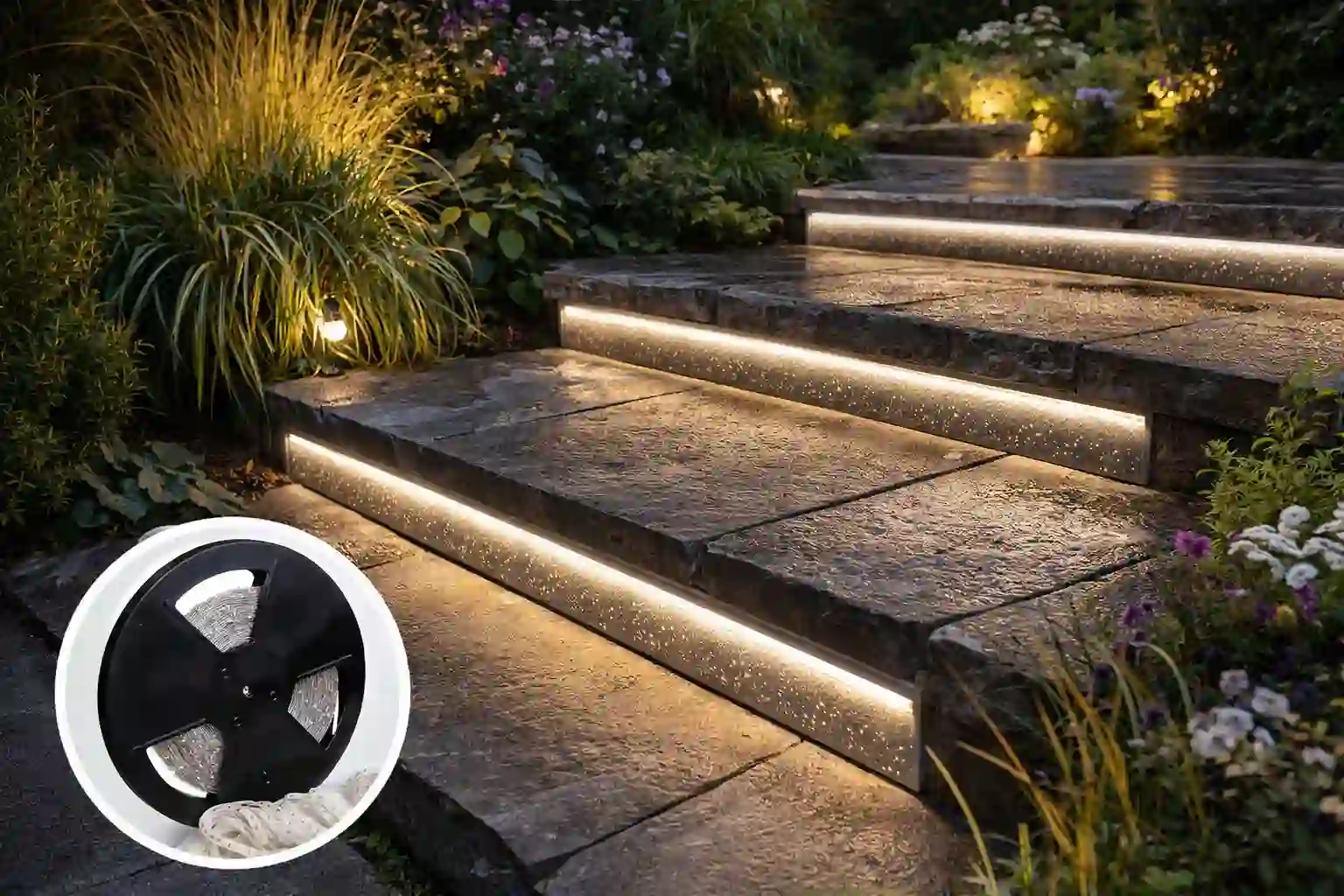
Structurele waterdichting versus strip waterdicht maken
Structurele waterdichting verwijst naar het afdichten van het hele LED-kanaalsysteem om de waterinvoer te blokkeren. Dit omvat het gebruik van afgedichte einddoppen, pakkingen en neutrale siliconenkit bij alle verbindingen en afsluitingen.
Stripwaterdichting verwijst naar de LED-strip zelf die wordt gecoat of ingekapseld in een waterbestendige laag, meestal geclassificeerd als IP65 of hoger. Maar zelfs een waterdichte LED-strip kan uitvallen als deze in een niet-verzegeld LED-kanaal wordt geïnstalleerd waar water kan ophopen.
Voor buiteninstallaties moeten zowel de LED-strip als de LED-kanaalbehuizing worden beschouwd als onderdeel van één waterdicht systeem, vooral in omgevingen met zware regen, vochtigheid of blootstelling aan zout.
De juiste IP-classificatie kiezen voor LED-kanalen voor buiten
Ingress Protection (IP)-classificaties geven aan hoe goed een LED-kanaalsysteem bestand is tegen stof en water. Het selecteren van de juiste waardering is afhankelijk van de installatieomgeving.
| IP-classificatie | Beschermingsniveau | Geschikt voor |
| IP65 | Stofdicht en bestand tegen waterstralen | Buitenmuren, gevels en gebieden die aan regen zijn blootgesteld |
| IP66 | Beschermd tegen krachtige waterstralen en stofdicht | Natte omgevingen zoals fonteinen en looppaden |
| IP67 | Dompelbaar tot 1 meter gedurende 30 minuten | Hoge-vochtigheidszones, in de buurt van zwembaden of dokken |
| IP68 | Geschikt voor continue onderdompeling | Zwembaden, Waterpartijen, Onderwater architecturale verlichting |
Installatietechnieken voor waterdichte LED-kanalen
Een goede installatie is van cruciaal belang voor het handhaven van de waterdichte integriteit Zelfs een high-IP LED-kanaal kan uitvallen als het verkeerd is gemonteerd.
• Gebruik afgedichte einddoppen om water binnendringen bij kanaalafsluitingen te voorkomen
• Breng neutrale siliconenkit aan langs voegen en naden
• Routebedrading door waterdichte aansluitdozen om blootliggende verbindingen te voorkomen
Aandacht voor detail tijdens de installatie zorgt ervoor dat het LED-kanaalsysteem zijn nominale beschermingsniveau na verloop van tijd behoudt.
Materialen en UV-bestendigheid voor LED-kanalen buiten
Aluminium LED-kanalen zijn ideaal voor gebruik buitenshuis vanwege hun sterkte, corrosiebestendigheid en uitstekende warmteafvoer. Voor aan de zon blootgestelde locaties moeten kanalen UV-gestabiliseerde coatings of geanodiseerde afwerkingen hebben om verkleuring en oppervlaktedegradatie te voorkomen.
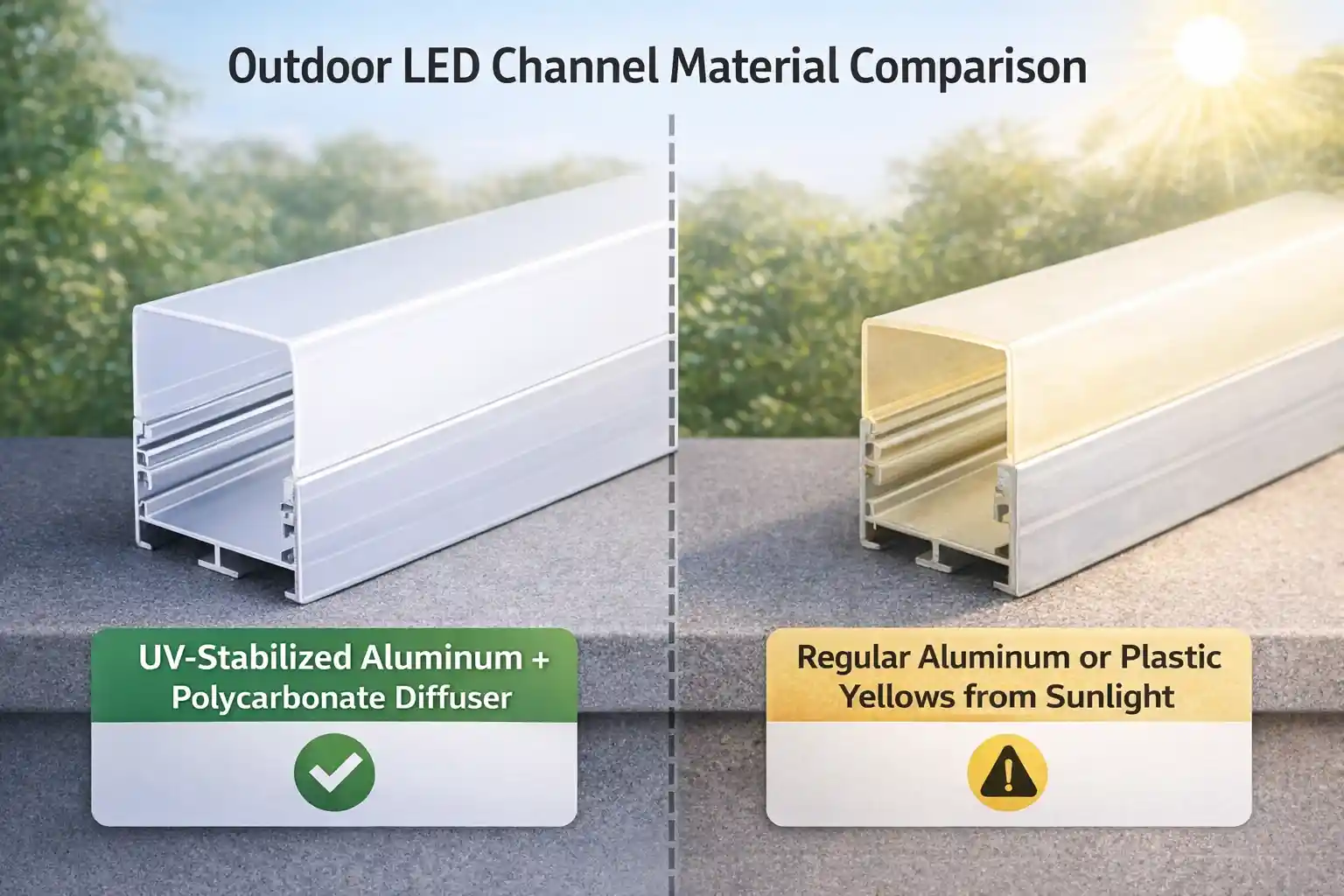
Diffusers die in LED-buiten-buitenkanalen worden gebruikt, moeten ook UV-bestendig zijn, meestal gemaakt van UV-gestabiliseerd polycarbonaat, om vergeling en verlies van lichtoverdracht na verloop van tijd te voorkomen. Een goede materiaalkeuze zorgt ervoor dat zowel prestaties als uiterlijk worden gehandhaafd in veeleisende buitenomgevingen.
Veelvoorkomende fouten bij het kopen van LED-kanalen
Het kiezen van het juiste LED-kanaal houdt meer in dan het selecteren van een profiel dat "er goed uitziet". Specificatie- en installatiefouten kunnen leiden tot ongelijke helderheid, zichtbare hotspots, oververhitting en een verkorte levensduur van het systeem. Door de volgende fouten te vermijden, presteert uw LED-kanaalsysteem betrouwbaar en levert het professionele verlichtingsresultaten.
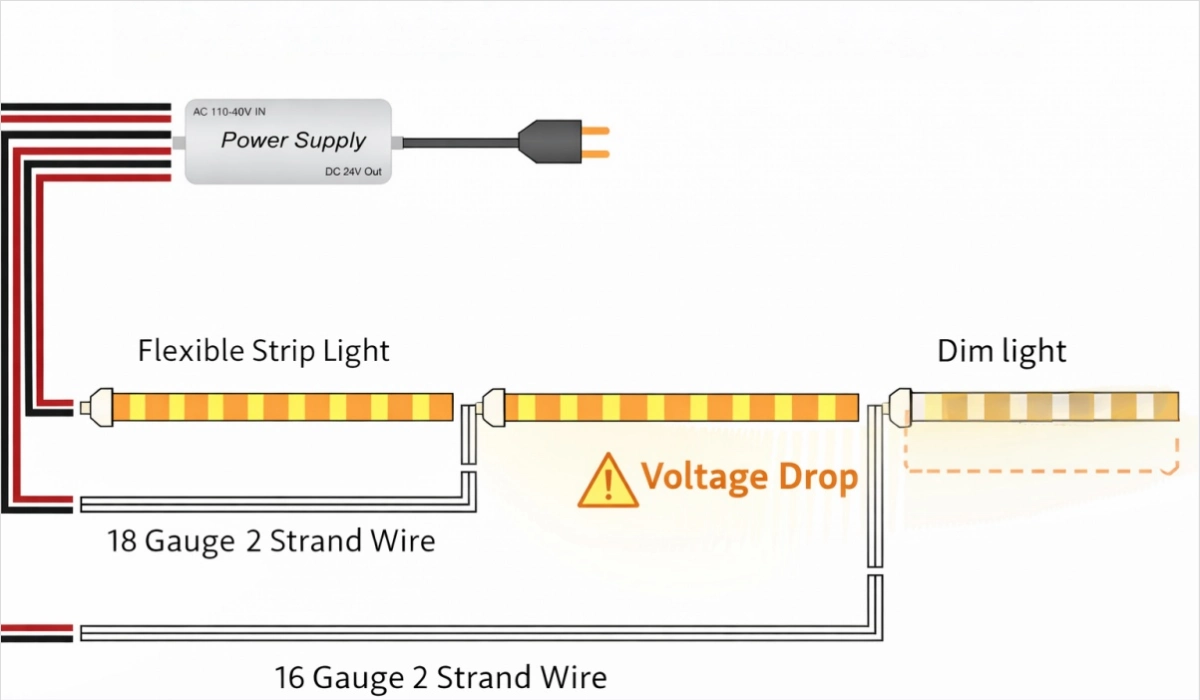
1. spanningsval negeren
Bij lange LED-stripruns (meestal meer dan 5-10 meter) kan spanningsval dimmen en inconsistente helderheid veroorzaken. Zelfs met een LED-kanaal van de juiste grootte heeft een slechte stroomverdeling invloed op de algehele prestaties.
Gebruik dikkere draden voor lange afstanden, bevestig dat de voeding de volledige belasting aankan en voeg stroominjectiepunten toe voor runs van meer dan 10 meter om stabiele verlichting te behouden.
2. Thermisch beheer verwaarlozen
Een LED-kanaal is ook een thermisch beheerapparaat. Profielen die te ondiep zijn of gemaakt zijn van materialen van lage kwaliteit, houden warmte vast, versnellen lumenafschrijvingen en verminderen de levensduur van de LED.
Kies altijd aluminium LED-kanalen en pas de kanaaldiepte aan om kracht en dichtheid te strippen. Diepere profielen zijn vooral belangrijk voor high-output LED-strips zoals COB.
3. Met uitzicht op kanaaldiepte
Kanaaldiepte heeft direct invloed op de optische prestaties. Ondiepe LED-kanalen kunnen afzonderlijke LED-punten zichtbaar maken, waardoor afleidende hotspots ontstaan.
Laaguitgangsstrips kunnen werken in profielen van 7-10 mm, maar installaties met directe zicht of hoge dichtheid vereisen doorgaans 12-16 mm of diepere LED-kanalen om glad, uniform licht te bereiken.
4. Diffusertype negeren
De LED-kanaaldiffuser heeft een sterke invloed op de uiteindelijke lichtkwaliteit. Het selecteren van de verkeerde afdekking kan leiden tot schittering of zichtbare LED-punten.
| Type diffuser | lichttransmissie | visueel effect | het beste voor |
| onschuldig | ~95% | Maximale helderheid, zichtbare stippen | Verborgen of indirecte verlichting |
| Melkachtig (opaal) | 70-75% | Zacht, uniform, puntvrij licht | Taakverlichting, zichtbare lineaire runs |
| Zwart (rook) | 30–45% | Subtiele gloed, kanaal blends wanneer uit | Hoogwaardige architecturale en winkelruimtes |
Stem de LED-kanaaldiffuser af op de visuele doel- en installatieomgeving.
5. De verkeerde kanaallengte of -breedte kiezen
De interne breedte moet 1-2 mm breder zijn dan de LED-strip-PCB om compressie te voorkomen en bedradingsruimte toe te laten. Kanalen die te smalle trapverwarming zijn en de installatie bemoeilijken.
Zorg er voor lange runs voor dat de lengtes van de LED-kanaaltjes gepland zijn om de verbindingen te minimaliseren en de visuele continuïteit te behouden, terwijl toch thermische uitzettingsspleet mogelijk wordt.
6. Niet plannen voor uitbreiding
Verlichtingssystemen evolueren vaak. Zonder planning kunnen toekomstige upgrades demontage van geïnstalleerde LED-kanalen vereisen.
Laat extra bedradingscapaciteit, toegankelijke stroompunten en modulaire kanaallay-outs over, zodat extra LED-strips of drivers kunnen worden toegevoegd zonder afgewerkte oppervlakken te beschadigen.
7 Installatierichtlijnen overslaan
Onjuiste installatie kan zowel prestaties als veiligheid in gevaar brengen. Volg altijd de instructies van de fabrikant voor montage, bedrading en afdichting.
Gebruik voor waterdichte LED-kanalen de gespecificeerde einddoppen, pakkingen en afdichtingsmiddelen om de beoogde IP-classificatie te behouden en vochtinvoer te voorkomen.

Conclusie: Zorgvuldige aandacht voor stroomverdeling, thermisch ontwerp, diffusorselectie en installatiepraktijken zorgen voor een LED-kanaalsysteem voor uniforme, efficiënte en langdurige lineaire verlichting. Het vermijden van deze veelvoorkomende fouten beschermt zowel de prestaties als de visuele kwaliteit.
Aangepaste & groothandel LED-stripkanalen van fabrikant
Voor grootschalige verlichtingsprojecten bieden op maat gemaakte en groothandels-LED-kanalen meer flexibiliteit en efficiëntie in vergelijking met kant-en-klare oplossingen. Door rechtstreeks samen te werken met fabrikanten zoals Sigliteled, kunt u oplossingen op maat maken die voldoen aan uw unieke ontwerp-, prestaties- en kostenvereisten. Of u nu een architect, lichtontwerper of distributeur bent, door de voordelen van op maat gemaakte LED-kanalen te begrijpen, worden uw verlichtingsprojecten de gewenste resultaten behalen.
Aanpassingsopties
SignLiteled biedt een reeks aanpassingsopties om aan specifieke projectvereisten te voldoen. Deze opties zijn essentieel voor het bereiken van zowel esthetische doelen als prestatiebehoeften.
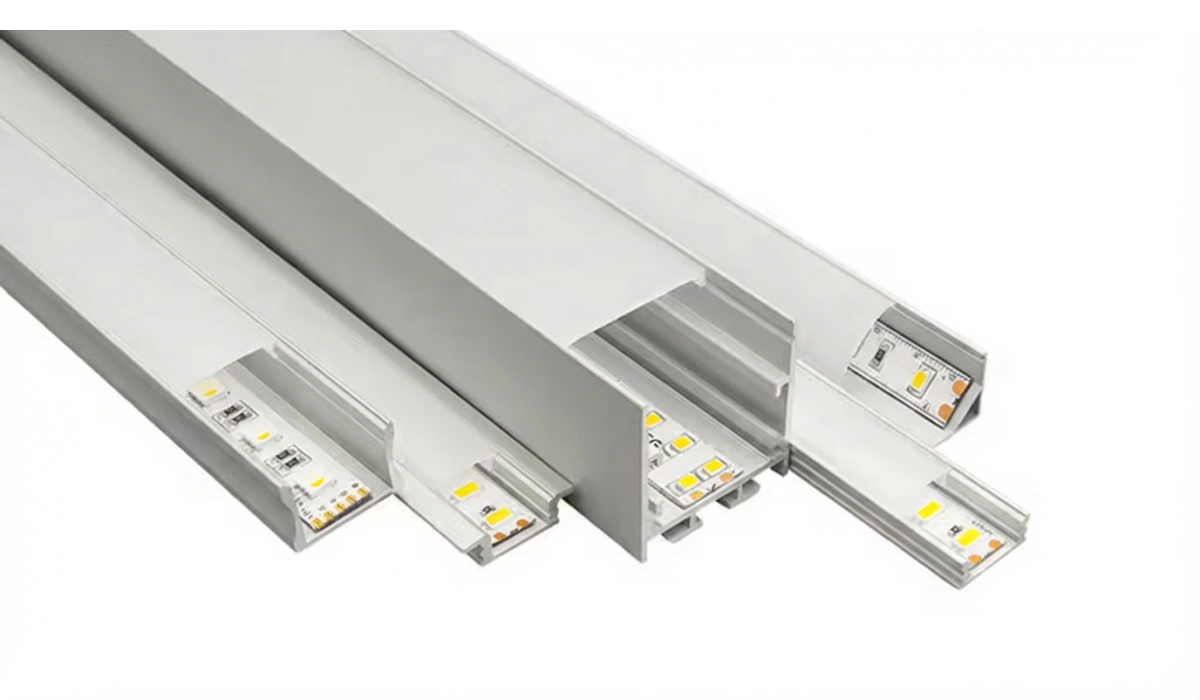
| Aanpassingsoptie | Beschikbare functies | Voordelen |
| Lengte | Aanpasbaar aan projectspecificaties | Past bij specifieke ontwerpbehoeften |
| afdoen | Geanodiseerd, mat, glanzend, gepoedercoat | Past bij projectesthetiek |
| Type diffuser | Helder, melkachtig, zwart, mat | Besturing lichtdiffusie |
| Kanaaldiepte | Ondiep tot diep | Zorgt voor een goede warmtebeheersing en lichtverspreiding |
| Materiaal | Aluminium, roestvrij staal, aangepaste legeringen | Duurzame en roestbestendige opties |
Conclusie
Het kiezen van het juiste LED-kanaal is essentieel voor zowel de prestaties als de esthetische kwaliteit van uw verlichtingsinstallatie. Of het nu uw doel is om zichtbare LED-vlekken te elimineren, de warmteafvoer te verbeteren of een slanke, architecturale afwerking te bereiken, het juiste LED-kanaal kan het verschil maken. Door de verschillende soorten, maten en aanpassingsopties te begrijpen die beschikbaar zijn, kunt u weloverwogen beslissingen nemen die zowel de functionaliteit als de levensduur van uw LED-verlichtingssysteem verbeteren. Houd altijd rekening met kritische factoren zoals kanaaldiepte, diffusertype en de installatieomgeving om optimale resultaten te bereiken. Met de juiste kennis van het LED-kanaal creëer je elke keer weer onberispelijke, professionele verlichtingsoplossingen.
FAQ
Gerelateerde berichten