Polski
  English
  简体中文
简体中文  Deutsch
  Español
  Français
  Italiano
  日本語
日本語  한국어
한국어  Português
  Русский
  Türkçe
  Nederlands
  Tiếng Việt
  ไทย
ไทย 
Choosing the wrong LED chip bracket can shorten your Taśmy LED’s lifespan, reduce light efficiency, and increase costs. With copper, aluminum, iron, and copper-iron alloy options available, it’s essential to know which material fits your application, budget, and performance requirements. This guide breaks down each bracket type, explains how plating impacts reliability, and helps you select the most suitable LED bracket for high-power, indoor, outdoor, or commercial LED strips.
Understanding which bracket material is used in your LED strip and how it is plated is crucial for making the right purchase decision. In this guide, we break down the differences between copper, aluminum, iron, and copper-iron alloy brackets, explain why plating matters more than the base material, and show how these choices affect both performance and price.
Key Insights:
- Copper brackets = best for high power, outdoor, and long-term use.
- Iron brackets = cost-effective but short-lived, suitable only for low-power or temporary applications.
- Aluminum & Copper-Iron alloys = balance between cost and performance.
- Plating quality (especially silver thickness) significantly impacts lifespan and light output.
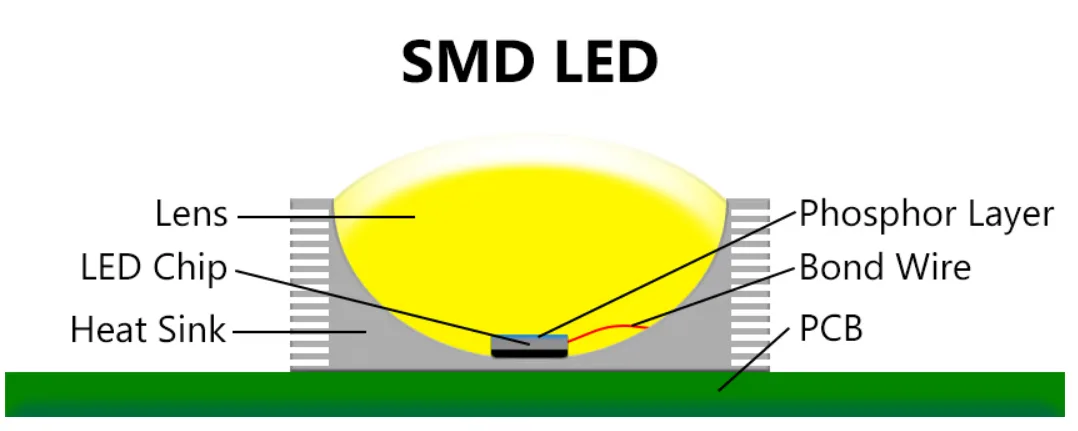
What Does a LED Bracket Do?
A LED chip bracket might look like a simple piece of metal, but it plays several critical roles that directly affect the performance, reliability, and lifespan of your LED strips. Understanding these roles is essential before comparing materials like copper, aluminum, iron, or alloys.
Core Functions:
- Chip Support: The bracket securely holds the LED chip in place with precise alignment. Even a slight misalignment can reduce light efficiency, uniformity, and beam quality.
- Electrical Conduction: Electrical current passes through the bracket to power the LED chip. Poor conductivity can cause energy loss, flickering, or even LED failure.
- Heat Dissipation: During operation, LED chips generate heat. The bracket conducts heat to the PCB or heat sink. Insufficient heat dissipation accelerates light decay and shortens LED lifespan.
- Oxidation Resistance & Solderability: Brackets are typically plated with metals like silver to resist oxidation, enhance reflectivity, and facilitate soldering. Poor plating can lead to blackened LEDs or failed solder joints.
Function Comparison Table
| Funkcja | Opis | Impact on LED | notatki |
| Chip Support | Holds LED chip in precise alignment | Misalignment reduces light efficiency and uniformity | Critical for beam quality |
| Electrical Conduction | Conducts current to the LED chip | Poor conduction → flicker, energy loss, potential failure | Depends on bracket material conductivity |
| Rozpraszanie ciepła | Transfers heat to PCB or heat sink | Poor dissipation → faster light decay, shorter lifespan | More important for high-power LEDs |
| Oxidation Resistance & Solderability | Plated surface resists oxidation and facilitates soldering | Poor plating → dark LEDs, failed solder joints | Silver plating thickness matters |
In short, the LED bracket acts as the skeleton, conductor, and heat sink of the chip. Any failure in these functions can cause early light decay or complete LED failure. Understanding these core roles is essential before evaluating bracket materials like copper, aluminum, iron, or copper-iron alloys, as the choice of material will influence heat management, electrical performance, and the overall reliability of your LED strips.
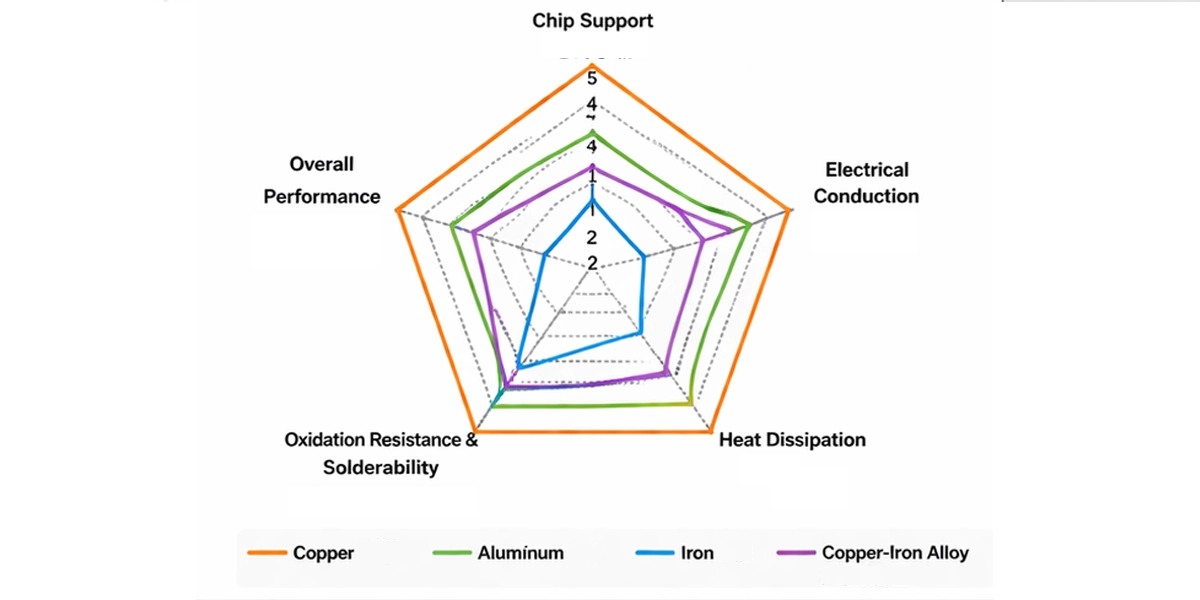
Types of LED Bracket Materials: Copper, Aluminum, Iron & Alloy for Optimal Strip Performance
LED chip brackets come in four main materials: copper, iron, aluminum, and copper-iron alloys. Each has unique properties affecting heat dissipation, electrical performance, lifespan, and cost. Understanding these differences helps you make the right choice for your LED strips.
Copper Brackets
What it is
Copper brackets are LED chip holders made from pure copper (red/purple copper) or copper alloys. They provide excellent heat conduction, high electrical conductivity, and long-term corrosion resistance.
Plusy:
- Excellent heat dissipation
- High electrical conductivity
- Corrosion-resistant, long lifespan
Wady:
- Drogie
- Some products labeled “copper” may actually be copper-plated iron
Zastosowania:
- High-power LED strips
- Oświetlenie zewnętrzne
- Commercial and engineering projects
- COB LED modules
Wpływ ceny:
High – 8–10× the cost of iron brackets
Iron Brackets
What it is
Iron brackets are LED chip holders made from low-cost iron. They are simple but prone to rust and heat limitations.
Plusy:
- Very low cost
- Widely available
Wady:
- Słabe rozpraszanie ciepła
- Prone to rust
- Short lifespan, faster light decay
Zastosowania:
- Low-power or temporary lighting
- Decorative or indoor short-term projects
Wpływ ceny:
Low – cheapest option
Aluminum Brackets
What it is
Aluminum brackets are made from aluminum or aluminum alloys, offering a balance of heat dissipation, weight, and cost.
Plusy:
- Moderate heat dissipation
- Lightweight
- Corrosion-resistant
Wady:
- Not suitable for high-power LEDs
- Moderate electrical conductivity
Zastosowania:
- Medium-power indoor lighting
- Budget-sensitive projects
Wpływ ceny:
Medium – lower than copper, higher than iron
Copper-Iron Alloy Brackets
What it is
Copper-iron alloy brackets are made by adding a small amount of iron to copper, balancing performance and cost.
Plusy:
- Balanced heat dissipation
- Improved strength
- Moderate cost
Wady:
- Lower conductivity than pure copper
- Moderate corrosion resistance
Zastosowania:
- Mid- to high-end LED strips where cost-performance balance is required
Wpływ ceny:
Medium – cheaper than copper, more expensive than iron
Tabela szybkich porównań
| Materiał | What it is | Plusy | Wady | Zastosowania | Cena |
| miedziak | Pure copper or copper alloys | Best heat & electrical performance, corrosion-resistant | Expensive, some are copper-plated iron | High-power, outdoor, commercial, COB | Wysoki |
| Iron | Low-cost iron | Very cheap, widely available | Poor heat, rusts, short lifespan | Low-power, temporary, decorative | Niski |
| Aluminium | Aluminum or aluminum alloys | Moderate heat, lightweight, corrosion-resistant | Not for high-power, moderate conductivity | Medium-power, budget projects | Średni |
| Copper-Iron Alloy | Copper with small iron addition | Balanced heat, stronger than iron, moderate cost | Lower conductivity than copper, moderate corrosion | Mid/high-end cost-effective projects | Średni |
LED Bracket Plating Quality: Enhance Performance, Longevity & Reliability
While the bracket material determines Rozpraszanie ciepła and electrical performance, the plating layer—especially silver plating—can be even more critical for your LED strips. It affects oxidation resistance, solderability, light reflectivity, and long-term reliability.
Key Roles of Plating
- Oxidation Resistance: A good plating layer prevents the bracket from corroding over time. Poor plating can cause darkened LEDs or failed solder joints.
- Reflectivity: Silver plating reflects up to 95% of the light emitted by the chip, improving light efficiency.
- Solderability: Proper plating facilitates strong, reliable solder joints.
- Sulfur & Corrosion Protection: Thick silver plating with anti-sulfide treatment prevents blackening in humid or salty environments.
Plating Thickness Recommendations
| Plating Layer | Typical Thickness | Premium Option | Efekt |
| Silver | 8 μm | ≥15 μm | Better oxidation & sulfur resistance, higher reflectivity |
| Nickel | 1–3 μm | 3–5 μm | Prevents base metal diffusion |
| miedziak | 5–10 μm | 10–15 μm | Improves conductivity and heat transfer |
Even the best bracket material cannot perform well without proper plating. Silver plating thickness, anti-sulfide treatment, and plating uniformity directly influence the LED strip’s longevity, light efficiency, and reliability. For outdoor, high-power, or long-term applications, choose brackets with thicker silver plating and quality anti-corrosion treatment.
How Bracket Material Affects LED Strip Price, Performance & Reliability
The bracket material of an LED chip can significantly affect the final price of an LED strip, even if the chip, PCB, and design remain the same. Choosing the right material balances performance, reliability, and cost-effectiveness.
Why Material Matters
- Material Cost: Copper brackets are much more expensive than iron, sometimes 8–10× higher, which directly increases the LED strip cost.
- Production Yield: Lower-quality or rust-prone brackets (like iron) can lead to higher solder failures or early LED degradation, increasing production waste and cost.
- Plating Requirements: High-end copper brackets usually require thicker silver plating and anti-sulfide treatment, adding to material and processing cost.
- Application & Reliability: Outdoor, high-power, or long-term lighting projects demand copper brackets with proper plating, justifying a higher price.
Typical Price Impact Table
| Bracket Material | Cost Impact | Relative Price |
| miedziak | Wysoki | bardzo wysoki |
| Iron | Niski | Niski |
| Aluminium | Średni | Średni |
| Copper-Iron Alloy | Średni | Średni |
Kluczowe na wynos
- Bracket material directly influences LED strip cost and reliability.
- Copper brackets with proper plating are ideal for high-performance, long-term, or outdoor applications, but increase price.
- Iron or aluminum can be cost-effective for budget projects or low-power indoor use, with shorter lifespan.
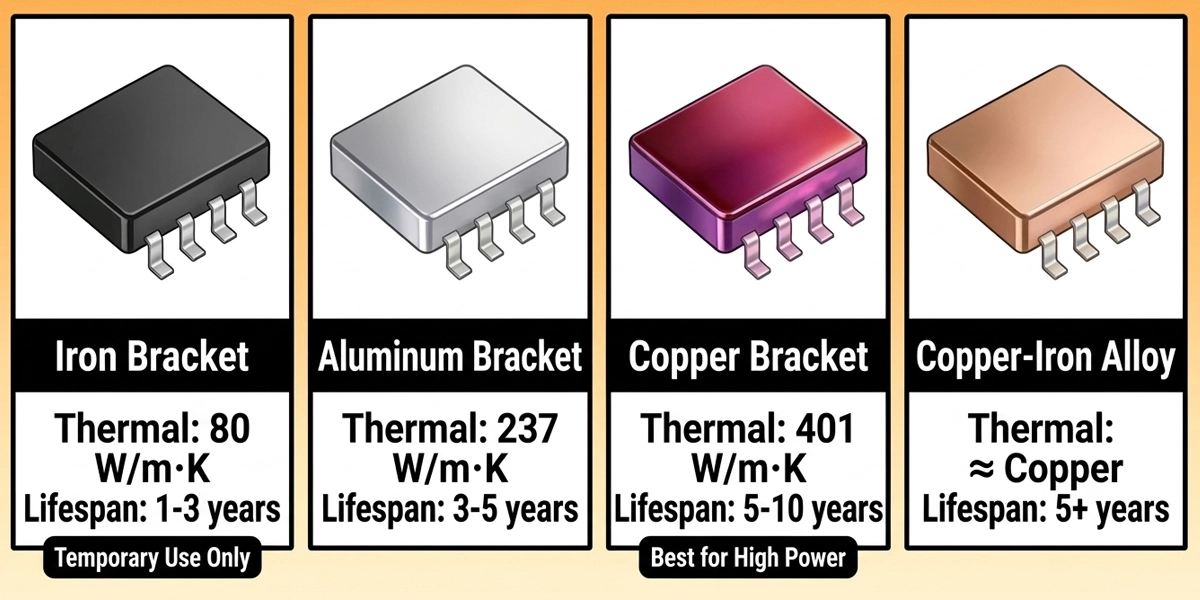
How to Choose the Right LED Bracket for Your Project
How LED Strip Manufacturers Choose Bracket Materials
Manufacturers select LED chip bracket materials by balancing performance, cost, and application requirements. The choice is not random—it directly affects product reliability, lifespan, and final price.
For high-power or outdoor LED strips, copper brackets with thick silver plating are typically chosen to ensure stable performance and long-term durability. For mid-range commercial or indoor applications, copper-iron alloy or aluminum brackets are often used to balance cost and performance. For budget-sensitive or short-term projects, iron brackets may be selected to reduce production costs.
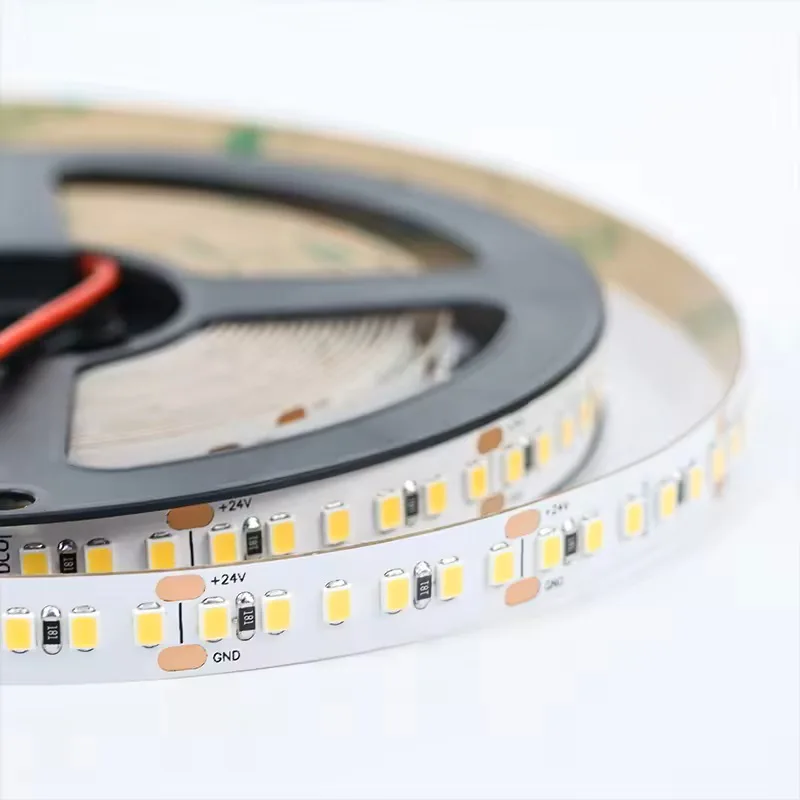
Taśma świetlna SMD2835
Model nr: FQX10T120X
Napięcie wejściowe: DC12V/24V
Moc: 19,2 W/m
ILOŚĆ diod LED: 120 diod LED/m
CCT: 2700K, 3000K, 4000K, 6500K
CRI: >80
Wydajność: 110lm/W
Kąt wiązki: 120°
Przekrój cięcia: 50mm@12V, 100mm@24V
Stopień ochrony IP: IP20/IP65/IP67/IP68
Gwarancja: 3 lata
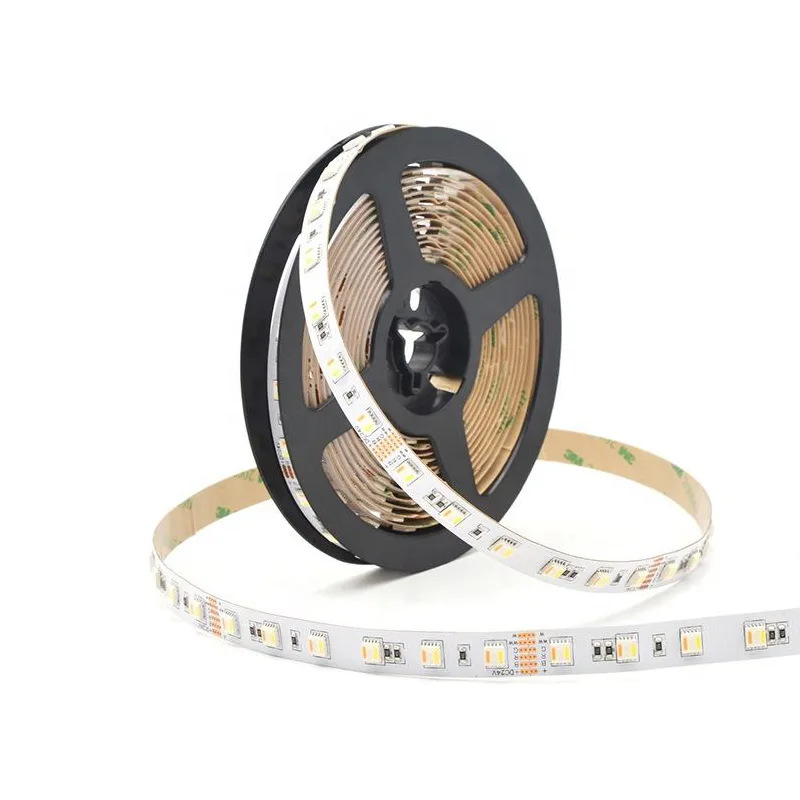
Taśma świetlna SMD5050
Model nr: FAH12T096X
Napięcie wejściowe: DC12V/24V
Moc: 20 W/m
ILOŚĆ diod LED: 96 diod LED/m
CCT: RGBW
CRI: >80
Wydajność: NIE DOTYCZY
Kąt wiązki: 120°
Przekrój cięcia: 31,25 mm przy 12 V, 62,5 mm przy 24 V
Stopień ochrony IP: IP20/IP65/IP67/IP68
Gwarancja: 3 lata
LED Bracket Selection Guide: Application, Plating, Power & Cost
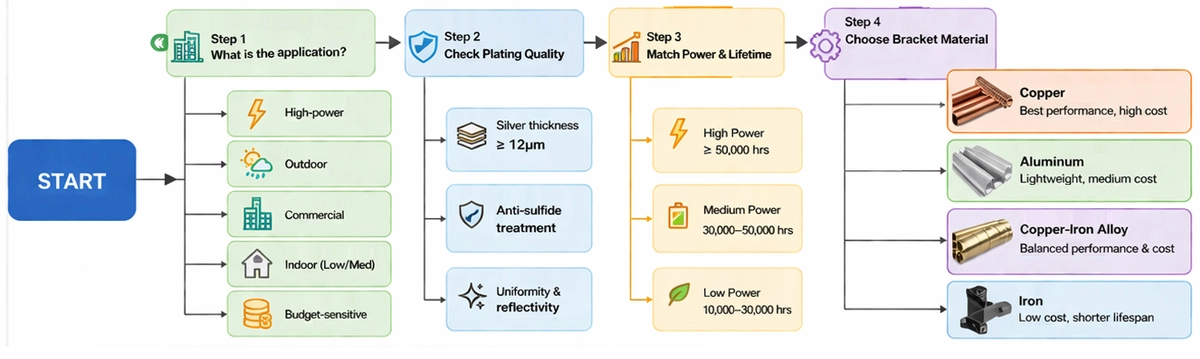
Step 1: Determine the Application
| scenariusz | Recommended Bracket | notatki |
| High-power LED strips | miedziak | Use ≥12μm silver plating & anti-sulfide treatment |
| Oświetlenie zewnętrzne | miedziak | Ensure corrosion resistance |
| Commercial projects | Copper or Copper-Iron Alloy | Balance cost & performance |
| Indoor medium/low power | Aluminum or Alloy | Ekonomiczne rozwiązanie |
| Budget-sensitive | Iron | Shorter lifespan |
Step 2: Check Plating Quality
- Silver Thickness: Thicker silver plating improves oxidation and sulfur resistance.
- Anti-Sulfide Treatment: Essential for humid or coastal environments.
- Uniformity: Ensures stable light output and soldering reliability.
Step 3: Match Power & Lifetime Requirements
| Moc | Recommended Material | Długość życia |
| Wysoki | miedziak | ≥50 000 godzin |
| Średni | Alloy / Aluminum | 30,000–50,000 hrs |
| Niski | Iron / Aluminum | 10,000–30,000 hrs |
Step 4: Balance Cost vs Performance
- High reliability → Copper is worth the investment
- Cost-sensitive → Aluminum or iron is acceptable
- Long-term projects → Avoid iron brackets
Step 5: Ask the Right Questions
- Is the bracket copper, aluminum, iron, or alloy?
- If copper, is it pure copper or brass/copper-plated iron?
- What is the silver plating thickness?
- Is anti-sulfide treatment applied?
For more guidance on choosing LED chips for LED strips, see Jak wybrać odpowiednie koraliki LED do taśm LED?.
FAQ
Wniosek
The LED bracket is the backbone of an LED chip, directly affecting heat dissipation, electrical performance, lifespan, and even the final cost of LED strips. While the base material determines core performance, the plating layer—especially silver thickness and anti-sulfide treatment—plays a critical role in long-term reliability.
There is no single “best” LED bracket material—it depends on your application, power requirements, and budget:
- For high-power, outdoor, or long-term use → Copper brackets are the best choice
- For balanced cost-performance → Copper-iron alloy or aluminum
- For low-cost or temporary use → Iron brackets can be acceptable
Choosing the right bracket is not about selecting the most expensive option, but the most suitable one for your specific project. Always confirm the bracket material, copper type, and plating quality with your supplier to avoid premature failure and ensure long-term performance.
Powiązane posty