Русский
  English
  简体中文
简体中文  Deutsch
  Español
  Français
  Italiano
  日本語
日本語  한국어
한국어  Polski
  Português
  Türkçe
  Nederlands
  Tiếng Việt
  ไทย
ไทย 
Acrylic is often a good starting point for non-illuminated letters in a brand color. Aluminum works well for lightweight painted letters and fabricated letter bodies, while stainless steel is usually selected when a brushed or polished metal surface is part of the design. Front-lit LED letters commonly use both acrylic and metal.
Material alone, however, does not define the finished sign. Construction, depth, surface treatment, illumination and installation conditions can make two signs made from the same material look and perform very differently.
This guide explains how acrylic, aluminum and stainless steel are used in custom 3D letters and what buyers should compare before approving a quotation.
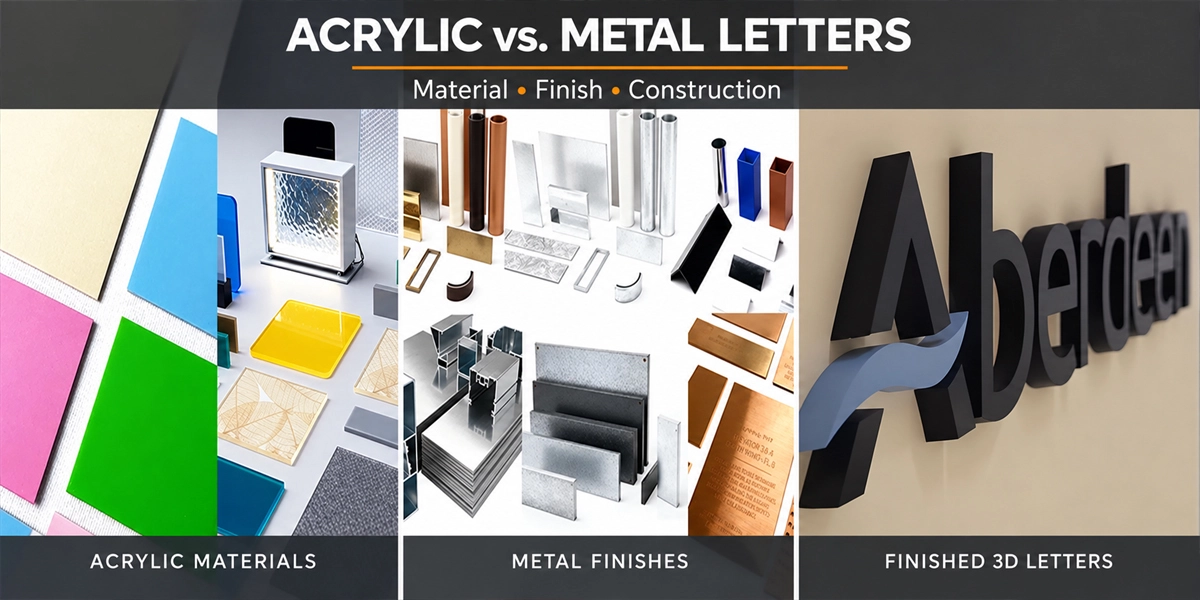
Acrylic vs. Aluminum vs. Stainless Steel Letters
The table below provides a starting point. It should not replace a model-specific drawing or material sample.
| любовное | Acrylic letters | Aluminum letters | Stainless steel letters |
| Typical appearance | Clear, colored, translucent or painted | Painted, powder-coated, anodized or another specified finish | Brushed, polished or another specified finish |
| Common construction | Cut, machined, layered or assembled | Flat-cut or fabricated hollow letters | Flat-cut or fabricated hollow letters |
| Role in illuminated signs | Transmits or diffuses light when a suitable grade is used | Commonly forms opaque returns or backs | Commonly forms opaque faces, returns or backs |
| тяжесть | Depends on thickness and construction | Lighter by material density than stainless steel | Heavier by material density than aluminum |
| Outdoor selection | Sheet grade, UV exposure, finish and fixings | Alloy, coating, exposure and fixings | Grade, finish, exposure and fixings |
| Main cost factors | Thickness, cutting, edge finishing and assembly | Forming, welding, coating and assembly | Grade, forming, welding and surface finishing |
“Acrylic letters” may describe simple cut lettering or an illuminated letter with an acrylic face, metal sides, LEDs and wiring. These products should not be compared on the material name alone.
The construction must also be considered. Solid-cut, layered and fabricated hollow letters can have different depths, weights, edge details and prices even when they use the same face material.
Check the Letter Construction Before Comparing Materials
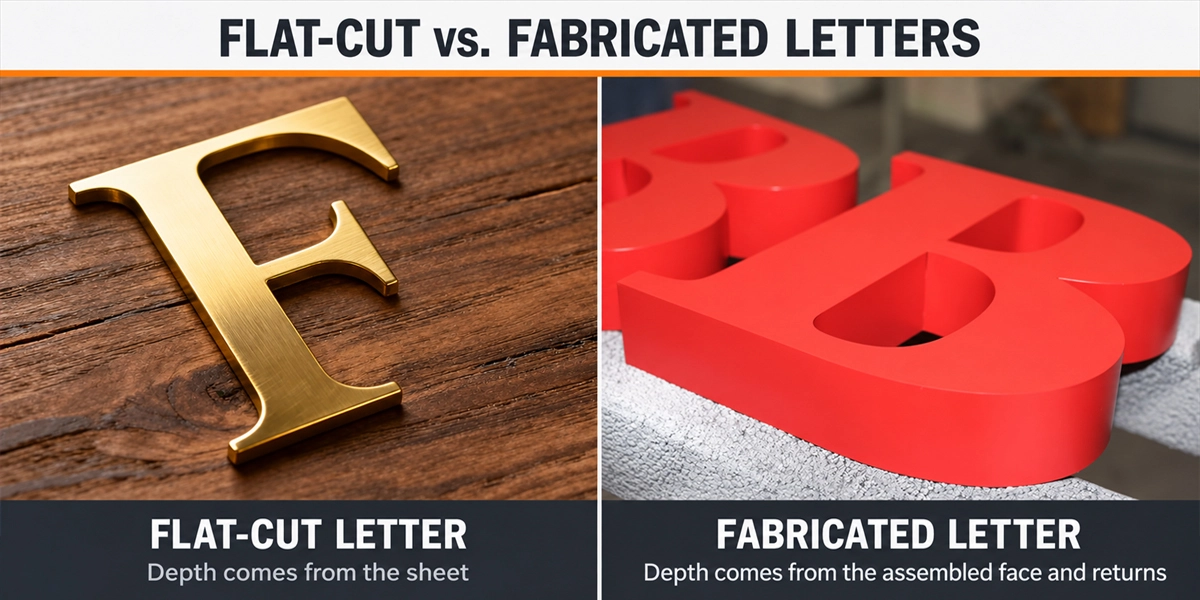
A useful quotation should identify both the material and the way the letter is built.
Cut Dimensional Letters
Cut letters get their depth from the sheet or plate. Their edges remain visible after installation, making material thickness and edge finishing especially important for reception walls and other close-viewing locations.
A front-view rendering rarely shows this clearly. A side-view photograph, sectional drawing or physical sample gives a better impression of the finished depth.
The specification should state:
- material and thickness;
- face and edge finishes;
- letter dimensions;
- fixing method.
Fabricated Letters
Fabricated letters are assembled from separate faces, returns—the side walls of the letters—and backs where required. This creates a deeper profile without making the entire letter solid.
Fabrication quality becomes more noticeable at corners, seams and joints. A letter that looks clean from across a street may appear less refined when installed at eye level.
For a deep custom 3D sign, compare the fabricated construction with the cut-letter alternative. The difference can affect the letter depth, finished weight, visible joints, lighting arrangement and mounting method.

This construction differs from flat-cut letters, which are cut directly from a solid sheet and do not contain an internal lighting cavity.
For more detail on illuminated letter components, see our guide to illuminated channel letter construction.
Which Material Produces the Finish You Want?
Material selection often begins with appearance. Physical samples are useful because they reveal texture, reflections and edge details that may be missing from a digital rendering.
Acrylic for Brand Colors and Illuminated Faces
Acrylic sign letters are widely used for non-illuminated reception signs, layered logos and illuminated faces.
For non-illuminated letters, consider the actual color, thickness, surface and edge finish. A brand color shown on a screen may look different when reproduced in acrylic.
Illuminated faces require an additional check. Two sheets both described as “white acrylic” may transmit and diffuse light differently. One may appear brighter, while another may provide more even illumination.
ACRYLITE’s light transmission and reflectance guidance explains why white and colored acrylic sheets can behave differently.
When appearance is critical, evaluate the proposed acrylic and LED combination both switched off and illuminated.
Acrylic is less suitable when the design requires a genuine brushed or polished metal surface. For a deep profile, fabricated construction may also be more practical than simply increasing the acrylic thickness.
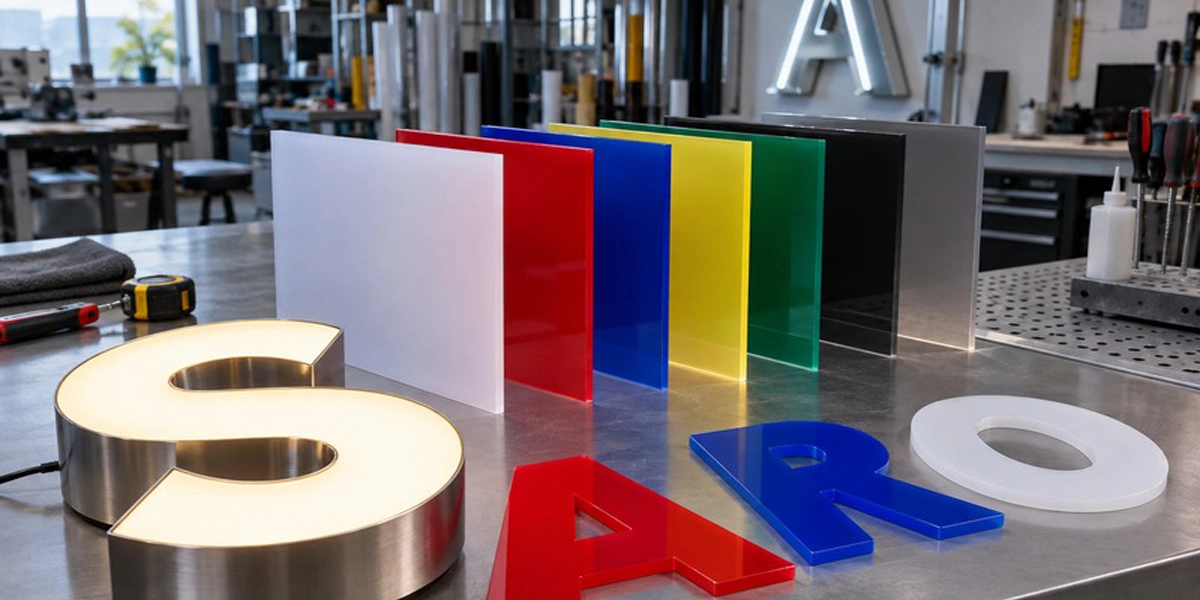
Aluminum for Painted Letters and Fabricated Bodies
Aluminum is commonly used for painted metal letters, returns and backs. Its relatively low weight makes it useful for larger fabricated letters and assemblies where installation weight matters.
A flat-cut aluminum letter and a fabricated aluminum letter can look similar from the front but very different from the side. The drawing should therefore show the total depth as well as the face dimensions.
The coating description also needs more detail than a color name. For example, “black” does not indicate whether the finish will be matte, satin or gloss. The sample should show how the faces, edges, corners and joints will appear.
Painted aluminum should not be treated as a substitute for exposed stainless steel when the natural metal surface is central to the design.
Stainless Steel for Brushed or Polished Surfaces
Stainless steel is a strong candidate when the metal itself is intended to remain visible.
For brushed stainless steel, the grain direction should be consistent across the complete sign. Mirror-polished steel reflects the surrounding wall, floor, lighting and movement, so it should be assessed in relation to the installation site.
Close-up photographs or a sample can reveal how the corners, seams and sides are finished.
If all visible surfaces will be painted, it is worth understanding why stainless steel has been specified. Painted aluminum may produce a similar visual result at a lower finished weight, although site conditions or structural requirements may still justify stainless steel.
Can Acrylic and Metal Be Used in the Same Letter Sign?
Yes. Many illuminated 3D letters combine several materials rather than relying on one.
A front-lit letter may include:
- a translucent acrylic face;
- aluminum or stainless steel returns;
- a metal or acrylic back;
- internal LED modules;
- wiring and a power supply;
- mounting hardware.
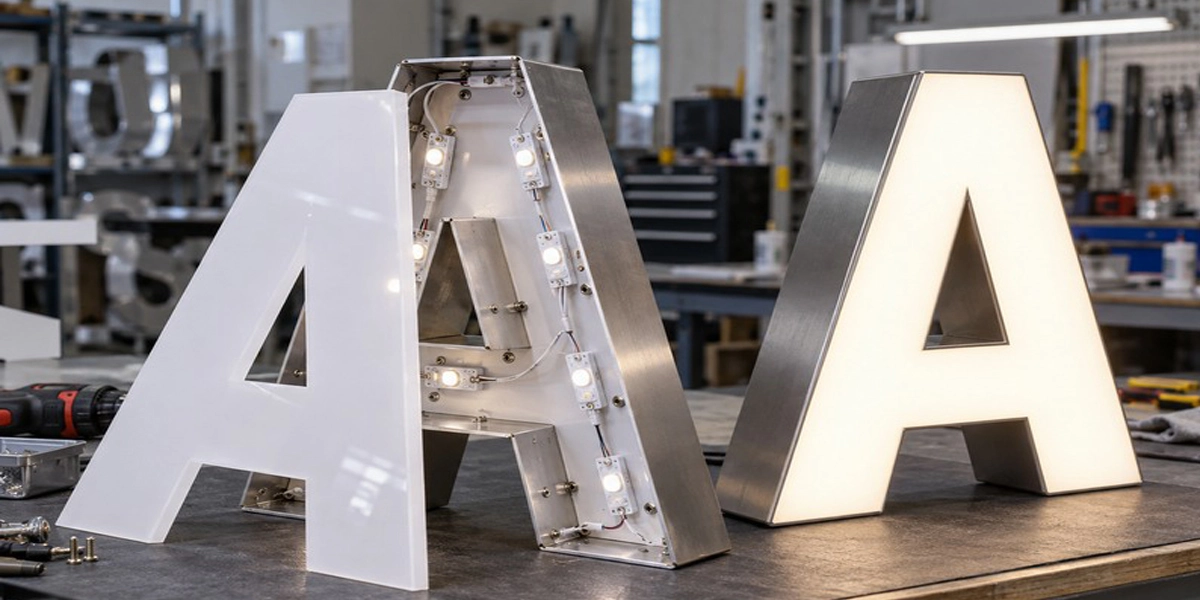
The acrylic controls the face color, light transmission and diffusion. The metal creates the depth and supports the assembled structure.
For this reason, an illuminated letter should be evaluated as a finished product. A quotation that describes it only as an “acrylic letter” or “metal letter” leaves important details unclear.
The face, returns, back, LEDs, power supply and mounting system should be identified separately.
Will the Letters Suit the Installation Location?
Once the appearance has been selected, the material and construction must be matched to the site.
Indoor, Outdoor and Coastal Conditions
“Outdoor quality” is too general to serve as a complete specification.
| Место установки | Important considerations |
| Indoor reception or lobby | Close-view finish, reflections, wall construction and fixings |
| Outdoor storefront | Sun, rain, temperature changes, coating system and mounting |
| Coastal or heavily exposed site | Salt exposure, material grade, fasteners, finish and maintenance access |
For acrylic, the selected sheet should have published properties appropriate for its intended use. ACRYLITE LED diffused sign-grade sheet, for example, is intended for signage and outdoor exposure. That does not mean every acrylic sheet has the same properties.
For stainless steel, corrosion performance is influenced by the grade, surface condition, fabrication and environment. Outokumpu’s Supra range technical data discusses the effects of chloride exposure, surface finish and crevices.
For painted aluminum, the preparation and coating of fabricated edges and joints should form part of the production specification.
A site photograph is valuable. A description such as “near the coast, under a canopy and exposed to wind-driven rain” gives the supplier more useful information than the word “outdoor.”
Front-Lit and Halo-Lit Letters
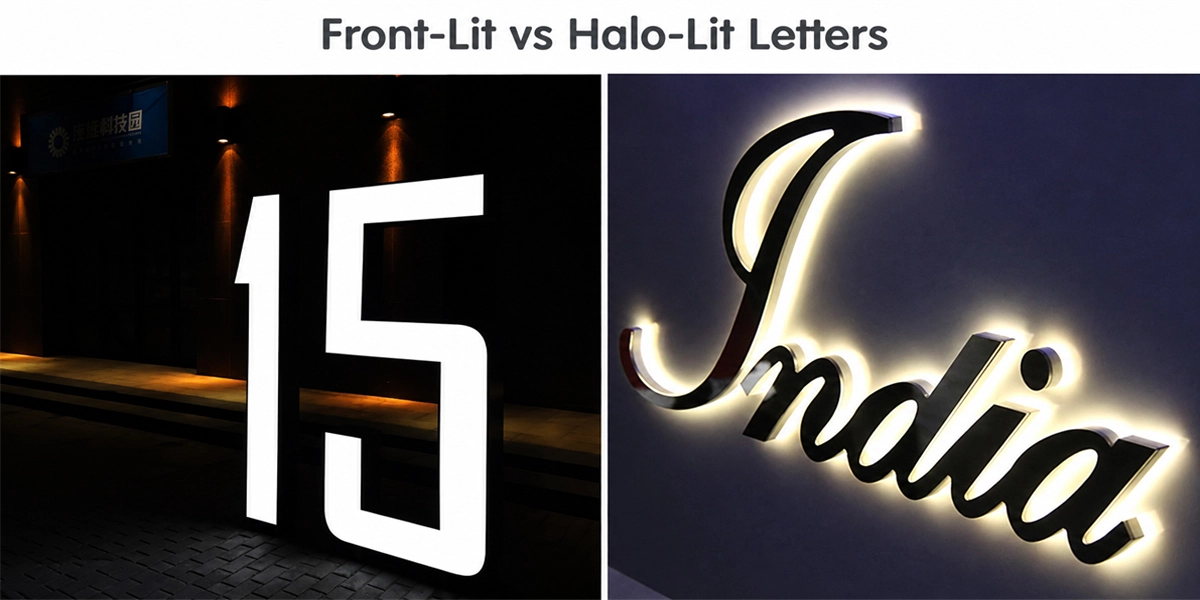
The position of the light affects the material combination.
| Required effect | Construction to discuss |
| The complete letter face glows | Translucent acrylic face with an illuminated fabricated body |
| A metal face with a halo behind it | Opaque metal face and returns with rear illumination |
| No illumination | Cut, layered or fabricated letters selected for finish and depth |
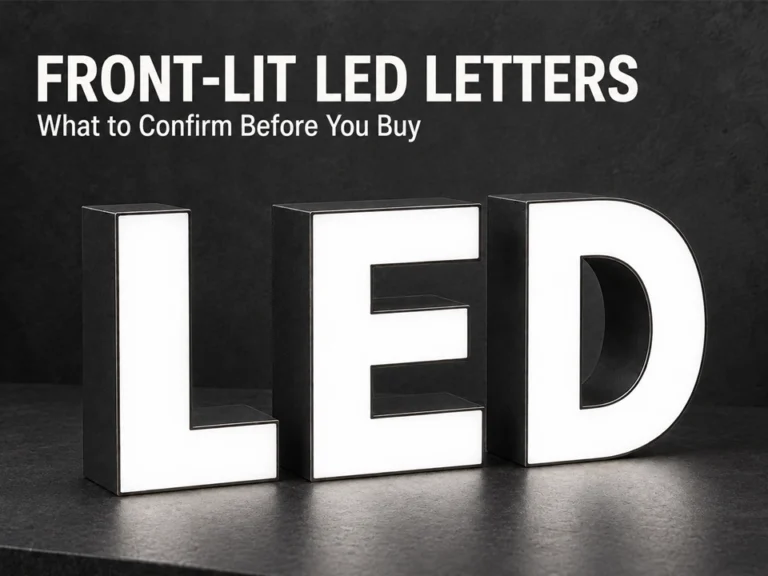
In a front-lit letter, the acrylic face, letter depth, internal surfaces and LED layout all influence brightness and uniformity.
With halo-lit letters, the mounting wall becomes part of the optical system. Wall color, texture, reflectivity and the distance behind the letter can change the halo.
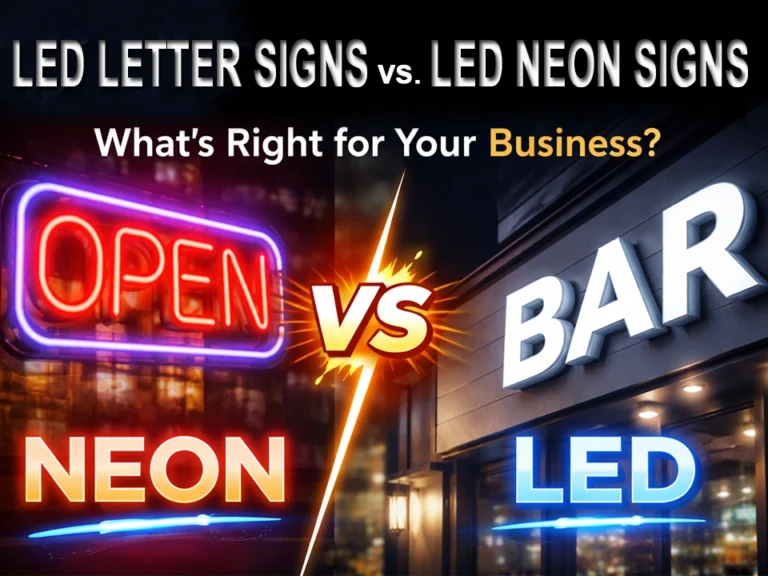
наш front-lit and halo-lit LED letter sign comparison explains the two lighting effects in more detail.
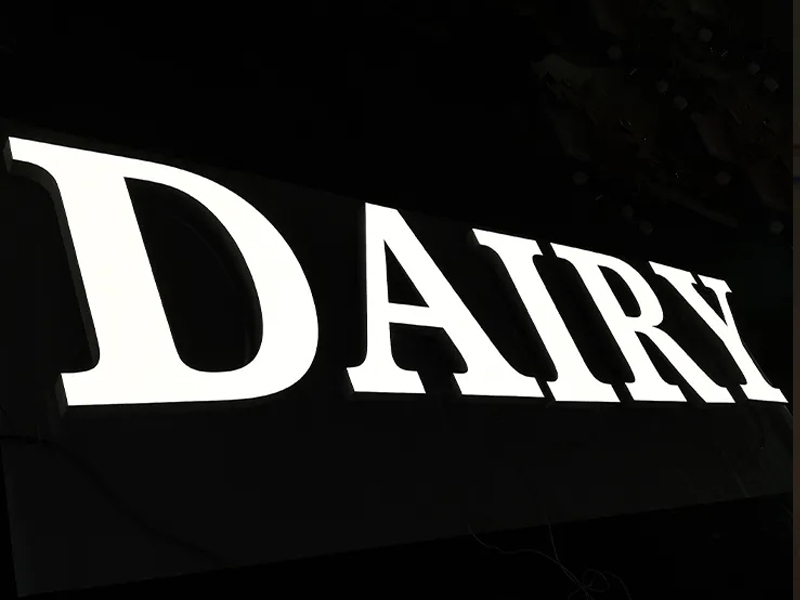
Светодиодные буквенные знаки спереди
- Лицо: акриловая поверхность с настраиваемыми цветами, толщиной и вариантами освещения
- Возврат: боковые стенки из алюминия или нержавеющей стали с настраиваемой глубиной, отделкой и обработкой поверхности
- Источник света: высокоэффективные светодиодные модули с регулируемыми вариантами яркости и цветовой температуры
- Установка: возможны настенные, монтируемые на шпильки или монтажные системы Raceway
Are Acrylic Letters Cheaper Than Metal Letters?
Simple cut acrylic letters are often economical, but there is no fixed price order for every custom sign.
A quotation may be affected by:
- letter size and quantity;
- material thickness;
- solid-cut or fabricated construction;
- edge and surface finishing;
- illumination;
- mounting hardware;
- packaging and delivery.
Cut acrylic and painted aluminum can sometimes be compared for non-illuminated brand-colored lettering. A stainless steel halo-lit letter serves a different visual and functional purpose, so its price cannot be compared with acrylic on material cost alone.
| Quote item | Information to identify |
| Artwork and dimensions | Font or logo, letter height, overall width and quantity |
| строительство | Cut, layered or fabricated; illuminated or non-illuminated |
| материалы | Face, returns and back listed separately |
| Thickness and depth | Material thickness and total letter depth |
| заканчивать | Color, coating, sheen, grain direction or metal treatment |
| Освещение | LEDs, color temperature, power supply and controls |
| Установка | Fixing method, wall clearance, template and accessories |
| Supply scope | Packaging, spare parts and delivery terms |
Any change that reduces the price should be shown in the revised specification. Otherwise, the buyer cannot tell whether two suppliers are quoting the same product.
When comparing a custom 3D sign manufacturer in China with another supplier, use the same specifications and delivery basis. Our guide to top LED letter sign manufacturers in China covers the broader supplier evaluation process.
One Logo, Three Possible Material Choices
Consider a company choosing dimensional lettering for a reception wall. The artwork remains the same, but the desired result changes the most suitable material.
This is an illustrative example rather than a completed project or quotation.
| Project priority | First option to assess | Reason to consider another option |
| Brand-colored letters without illumination | Finished cut acrylic | Different depth, edge appearance or mounting requirements |
| A visible brushed metal surface | Brushed stainless steel | Budget, weight or site conditions |
| An illuminated face | Acrylic face with a fabricated metal body | Letter geometry, lighting tests or installation requirements |
For the first brief, the acrylic color and edges are the main approval points.
For the second, the exposed brushed surface is fundamental to the design. Colored acrylic would not provide the same result.
For the third, the buyer should assess the complete illuminated assembly rather than comparing only the face material.
In each case, approval should be based on a representative sample, a construction drawing and a quotation with a defined supply scope.
Часто задаваемые вопросы
Заключение
The best material is the one that produces the required appearance and works with the chosen construction and installation site.
Acrylic is often a practical choice for brand-colored letters and illuminated faces. Aluminum suits lightweight painted letters and fabricated bodies. Stainless steel is appropriate when an exposed brushed or polished surface is important.
Before production, approve:
- a sample showing the material and finish;
- a drawing showing the construction and mounting;
- a quotation stating exactly what is included.
To discuss a project with SignliteLED, send your artwork, dimensions, quantity, site photographs, desired lighting effect and delivery destination through our custom 3D letters and LED letter signs page.
You do not need to decide every material and construction detail before contacting us. We can recommend suitable options based on the required appearance, installation conditions and budget.
For front-lit projects, our custom letter ordering guide explains the remaining checks before production.
Автор: Элейн Чжу
Специалист по контенту и маркетингТехнический обзор Ларса Денга
Светодиодные вывески менеджер по продукту
Электронная почта: info@signliteled.com
Похожие посты