English
  简体中文
简体中文  Deutsch
  Español
  Français
  Italiano
  日本語
日本語  한국어
한국어  Polski
  Português
  Русский
  Türkçe
  Nederlands
  Tiếng Việt
  ไทย
ไทย 
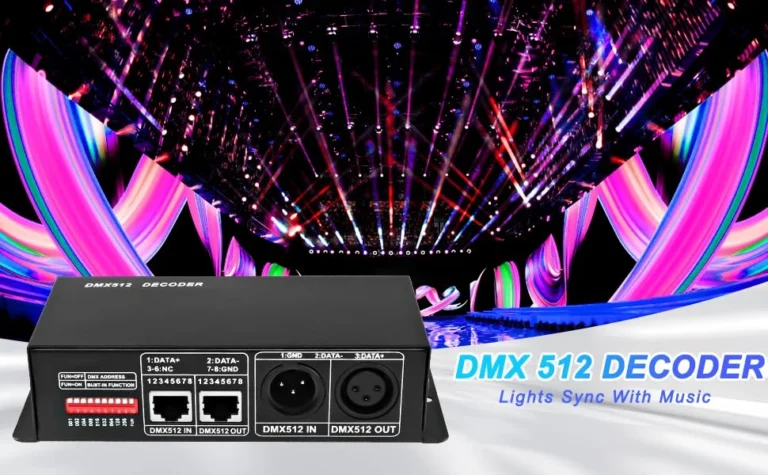
In professional lighting projects, DMX512 decoders are often treated as standard accessories, yet their differences can have a direct impact on system stability, dimming performance, and long-term reliability. With a wide range of DMX512 decoders available online—varying in output type, channel capacity, electrical design, and control features—choosing the right model is not always straightforward. From architectural lighting to stage and commercial applications, understanding how these decoders differ is essential for system designers, installers, and project managers. This article explores the key differences between various DMX512 decoders and explains how to select the most suitable option for different lighting applications.
Differences by Output Type and Control Method
DMX512 decoders available online can be broadly categorized based on their output type and control method. The most common differences include constant voltage versus constant current output, supported color configurations, and the way output signals are delivered to LED loads. These factors directly determine which types of LED fixtures a decoder can control and how stable the lighting performance will be in real applications.
1. Constant Voltage (CV) vs. Constant Current (CC)
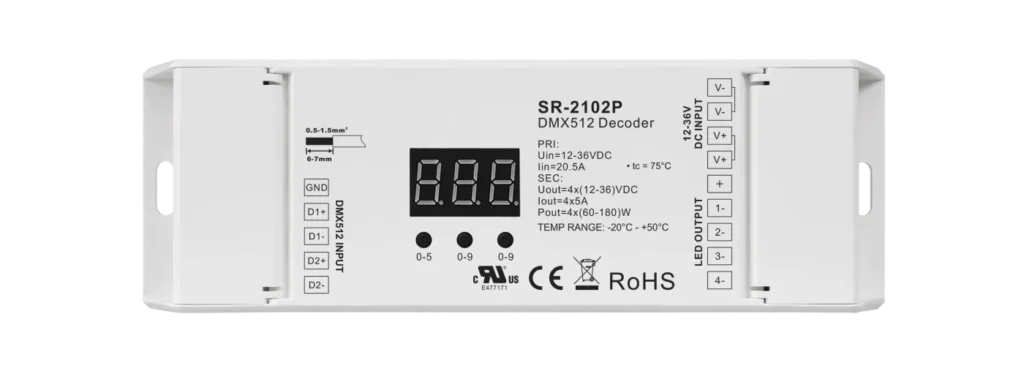
Constant Voltage (CV) DMX512 decoders are designed for LED products that operate at a fixed voltage, such as 12V or 24V LED strip lights, LED modules, and LED neon flex. In this configuration, the decoder regulates brightness by adjusting the output signal while the LED load determines the current. CV decoders are widely used in architectural and decorative lighting due to their flexibility and compatibility with most LED strips.
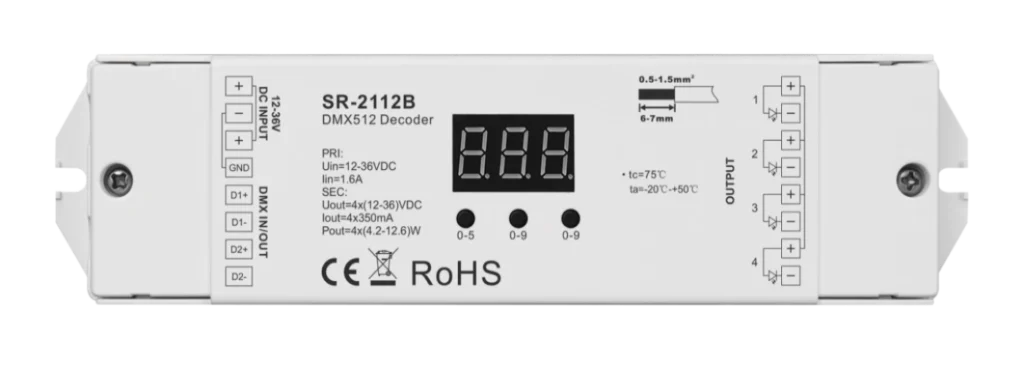
Constant Current (CC) DMX512 decoders, on the other hand, are used for high-power LEDs and LED fixtures that require precise current regulation, such as LED downlights, linear fixtures, and custom luminaires. By controlling current directly, CC decoders ensure consistent brightness, improved LED lifespan, and better thermal management in professional lighting systems.
Sunricher Constant Voltage DMX512 Decoder
Sunricher Constant Current DMX512 Decoder
2. Color Support and Channel Configuration
DMX512 decoders also differ in color support, including single color, tunable white, RGB, RGBW, RGBCCT, and addressable LED control. As color complexity increases, more DMX channels are required, making channel planning and compatibility with the DMX lighting control system essential for larger projects.
3. PWM Output vs. Current Output Differences
Most constant voltage DMX512 decoders use PWM (Pulse Width Modulation) output to achieve dimming, while constant current decoders rely on current regulation. PWM-based dimming offers flexible control but requires proper frequency selection to avoid flicker, whereas current-based output provides smoother dimming and greater stability for professional-grade LED fixtures.
Differences in Channel Capacity and Signal Compatibility
DMX512 decoders vary significantly in channel capacity and signal compatibility, which directly affect how many lighting parameters can be controlled and how reliably the decoder communicates within a DMX lighting control system. These differences are especially important in multi-fixture installations, large-scale architectural projects, and professional stage lighting environments.
1. Channel Capacity and Control Flexibility
DMX512 decoders are available with different channel configurations, such as 3-channel, 4-channel, 5-channel, as well as high-channel models including 12-channel, 24-channel, and even 48-channel versions. Low-channel decoders are typically used for single-color or simple RGB applications, where control requirements are limited. In contrast, higher-channel DMX512 decoders are designed for complex lighting effects, including RGBW, RGBCCT, and multi-zone lighting control. Selecting the correct channel capacity helps avoid wasted DMX addresses while ensuring sufficient control precision.
2. DMX Signal Standards and RDM Compatibility
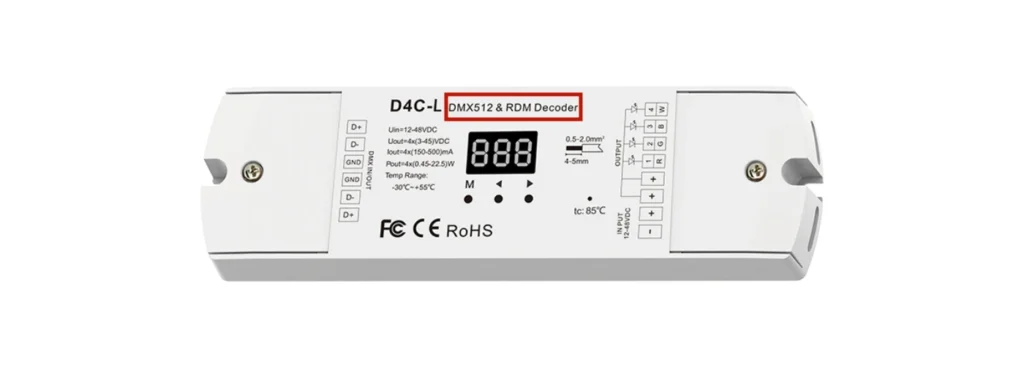
Most modern DMX512 decoders support the DMX512 or DMX512-A standard, ensuring compatibility with mainstream DMX controllers and lighting consoles. Some advanced decoders also support RDM (Remote Device Management), allowing users to remotely set DMX addresses, monitor device status, and simplify system commissioning. RDM compatibility is particularly valuable in installations where physical access to decoders is limited, such as ceiling cavities or outdoor enclosures.
Skydance RDM DMX512 decoder
3. Address Setting and Signal Stability
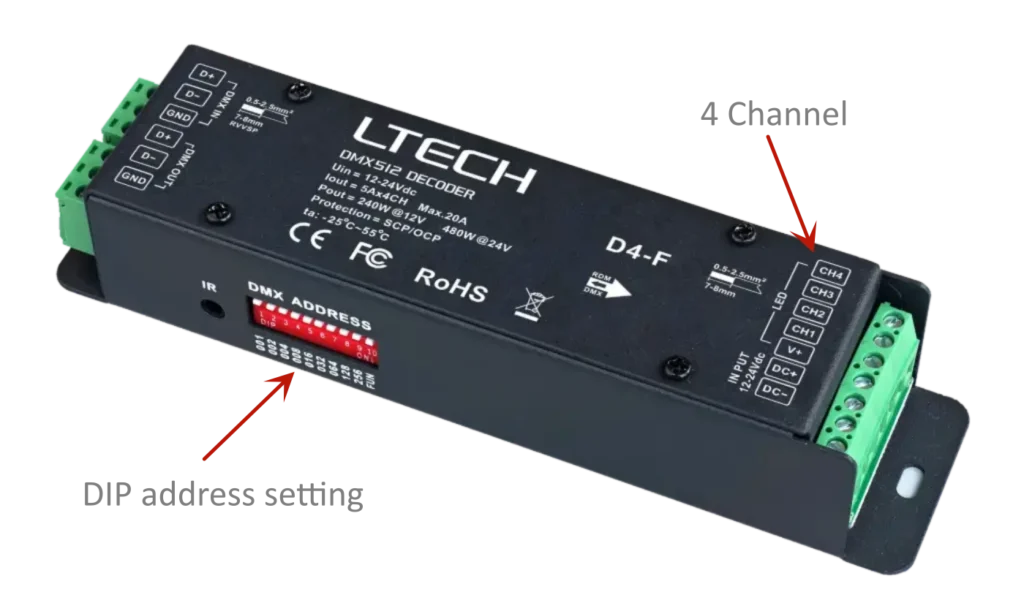
Another key difference lies in how DMX addresses are assigned and how signal stability is maintained. Entry-level DMX512 decoders often use DIP switches for manual address setting, while higher-end models feature digital displays or software-based configuration. Additionally, professional DMX decoders incorporate signal isolation, termination options, and improved noise immunity to ensure stable data transmission, especially in long-distance or electrically noisy environments.
Differences in Application Scenarios and User Types
Different DMX512 decoders are designed to serve different application scenarios and user types. While many products available online claim broad compatibility, practical performance varies significantly depending on project scale, lighting complexity, and operating environment.
1. Small Projects and Entry-Level Applications
For small installations, DIY projects, or basic decorative lighting, low-channel constant voltage DMX512 decoders are often sufficient. These decoders are commonly used with single-color or RGB LED strip lights in retail displays, bars, or residential accent lighting. Simplicity, ease of installation, and basic dimming performance are typically the main priorities for these users.
2. Architectural and Commercial Lighting Projects
In architectural and commercial lighting applications, such as hotels, offices, museums, and facades, system stability and control accuracy become more critical. Medium- to high-channel DMX512 decoders supporting RGBW or RGBCCT configurations are widely used to achieve dynamic color effects and precise white tuning. Features such as flicker-free dimming, reliable signal transmission, and comprehensive protection design are essential for long-term operation.
3. Stage, Entertainment, and Professional Installations
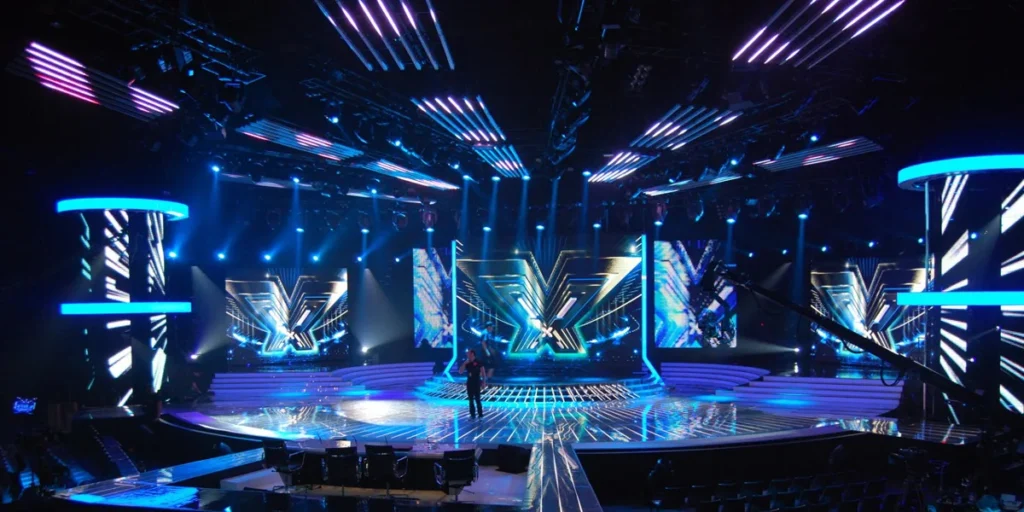
For stage lighting, entertainment venues, and large-scale professional projects, high-performance DMX512 decoders with advanced channel capacity, RDM support, and robust electrical design are preferred. These environments demand fast response, consistent output, and seamless integration with professional DMX lighting control systems. In such cases, selecting a professional-grade DMX512 decoder is critical to ensuring both visual performance and system reliability.
How to Choose the Right DMX512 Decoder for Your Project
DMX512 decoders differ significantly in output type, channel capacity, electrical performance, and intended applications. Constant voltage and constant current designs serve different LED loads, while channel configuration and color support determine control flexibility. Electrical specifications, dimming behavior, and protection features directly affect system reliability. For professional lighting projects, selecting a DMX512 decoder based on application requirements—not price alone—is essential to achieving stable performance, long service life, and consistent lighting results.
Professional Support for DMX512 Decoder Selection
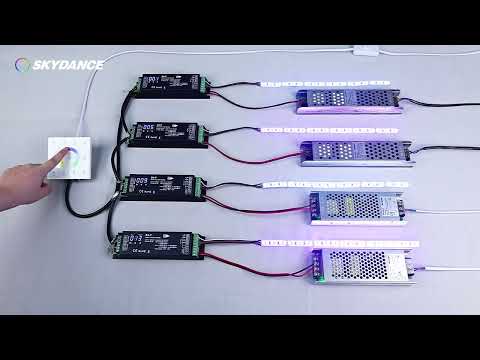
With extensive experience in DMX lighting control systems, we work closely with multiple well-established DMX512 decoder brands such as LTECH, Sunricher, Euchips, and Skydance. By understanding different decoder architectures, specifications, and real-world performance, we help clients select the most suitable DMX512 decoders for their specific lighting applications. Whether for architectural, commercial, or entertainment projects, our practical expertise ensures compatibility, stability, and long-term system reliability.
Frequently Asked Questions (FAQ)
1. What is the difference between a DMX512 decoder and a DMX controller?
A DMX512 controller sends control signals, while a DMX512 decoder receives those signals and converts them into usable outputs for LED fixtures such as LED strips or modules.
2. How do I choose between a constant voltage and constant current DMX512 decoder?
Constant voltage decoders are used for LED strips and neon lights, while constant current decoders are required for high-power LEDs and fixtures that need precise current regulation.
3. How many DMX channels do I need for my lighting project?
The required channel count depends on the color type and control complexity, such as single color, RGB, RGBW, or RGBCCT. More complex color control requires more DMX channels.
4. Are all DMX512 decoders compatible with DMX512-A controllers?
Most modern DMX512 decoders support DMX512 or DMX512-A, but it is always recommended to verify signal compatibility and termination requirements before installation.
5. What is RDM, and do I need an RDM-compatible DMX512 decoder?
RDM allows remote addressing and monitoring of DMX devices. It is especially useful in large or hard-to-access installations but not mandatory for all projects.
6. Can one DMX512 decoder control multiple LED fixtures?
Yes, as long as the total electrical load does not exceed the decoder’s output capacity and the channel configuration matches the lighting setup.
7. Why is flicker-free dimming important in DMX lighting systems?
Flicker-free dimming improves visual comfort and is critical for environments with cameras, such as studios, retail spaces, and architectural lighting projects.
8. Is a higher-priced DMX512 decoder always better for professional projects?
Not necessarily. The best DMX512 decoder is the one that matches the project’s electrical requirements, control complexity, and long-term reliability needs.
Related Posts