English
  简体中文
简体中文  Deutsch
  Español
  Français
  Italiano
  日本語
日本語  한국어
한국어  Polski
  Português
  Русский
  Türkçe
  Nederlands
  Tiếng Việt
  ไทย
ไทย 
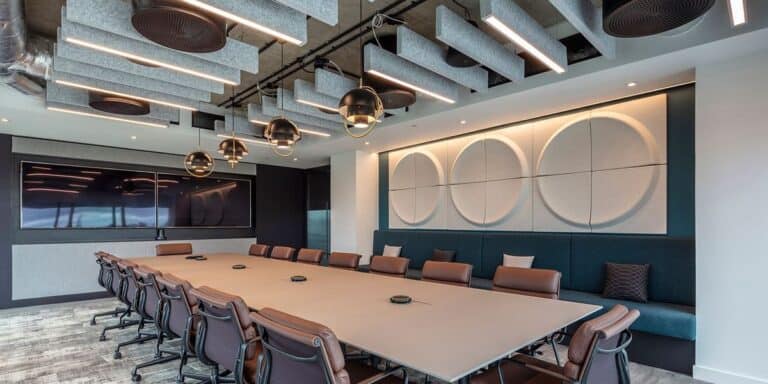
Acoustic lighting performs best when installed directly above primary sound activity zones such as workstations, conference tables, collaboration areas, and open-plan seating. Ceiling placement is critical because the ceiling acts as a major reflection surface for speech. Proper spacing, height, and distribution determine how effectively the fixture reduces reverberation and improves speech clarity.
This article explains optimal placement zones, height considerations, reflection control logic, room-type strategies, and common installation mistakes. The focus is strictly on placement performance so architects, designers, acoustic consultants, and facility managers can make informed installation decisions.
Why Ceiling Placement Matters More Than Wall Placement
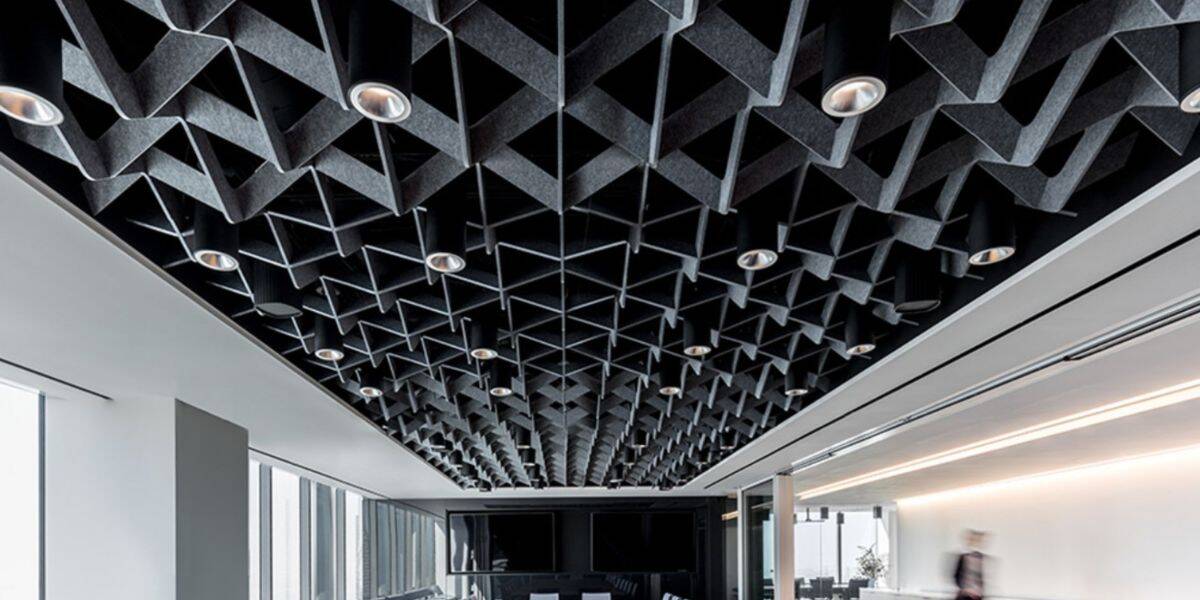
In most commercial interiors, speech energy travels upward immediately after leaving the speaker’s mouth. The first significant reflection often occurs at the ceiling plane before returning downward into the occupied zone. This creates what acousticians refer to as a first reflection path:
Speech source → ceiling → reflected energy → listeners.
When ceilings are hard, reflective surfaces such as gypsum board, exposed concrete, or metal decking, reflected speech energy re-enters the room quickly, increasing reverberation time and reducing clarity.
Wall-mounted absorption helps, but it primarily addresses lateral reflections. Overhead reflections are typically more dominant in open-plan and conference environments because:
- The ceiling spans the entire occupied zone.
- It reflects energy back into the speech field.
- It reinforces noise across large horizontal areas.
Acoustic lighting interrupts this vertical reflection loop directly at the reflection plane. By placing acoustic fixtures within the ceiling reflection path, mid-frequency speech energy (typically 500–2000 Hz) is absorbed before it returns to occupants.
Perimeter wall placement does not intercept this early vertical bounce. Ceiling-based felt lighting fixtures reduce the intensity of first reflections more effectively because they sit directly in the sound path.
In open environments especially, overhead absorption delivers higher acoustic impact per square meter compared to perimeter-only treatment.
Core Placement Zones
A: Above Workstations and Desk Clusters
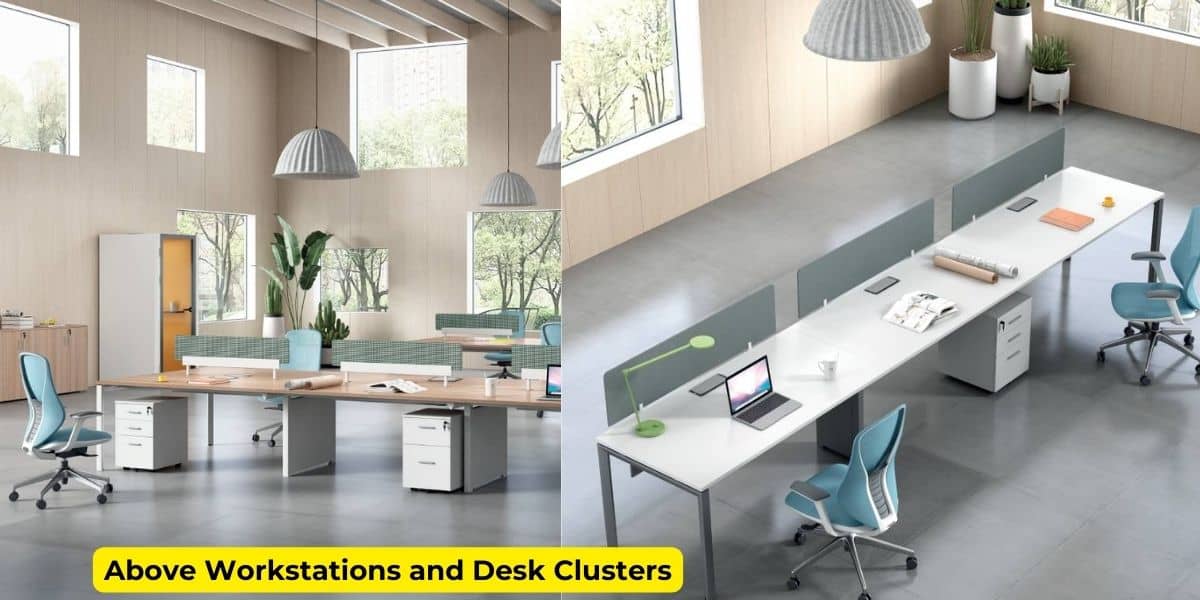
Open-plan offices concentrate speech within workstation groupings. Conversations, video calls, and collaborative exchanges generate sustained mid-frequency sound energy.
Installing acoustic lighting directly above desk clusters:
- Absorbs speech before it spreads laterally.
- Reduces reverberant buildup across rows.
- Limits cross-talk between teams.
Felt lighting fixtures are particularly effective because dense polyester felt absorbs mid-frequency speech where most intelligibility energy lies.
Distribution logic matters. Rather than placing fixtures along corridors or near walls, fixtures should be centered above active desks and extend slightly beyond the seating footprint. As a guideline:
- Target 20–35% ceiling coverage above high-activity desk zones.
- Maintain consistent spacing to avoid untreated reflective gaps.
- Avoid perimeter-only layouts, which allow central speech zones to remain reflective.
Underperforming layouts typically place lighting decoratively along circulation paths rather than above sound sources.
B: Above Conference Tables
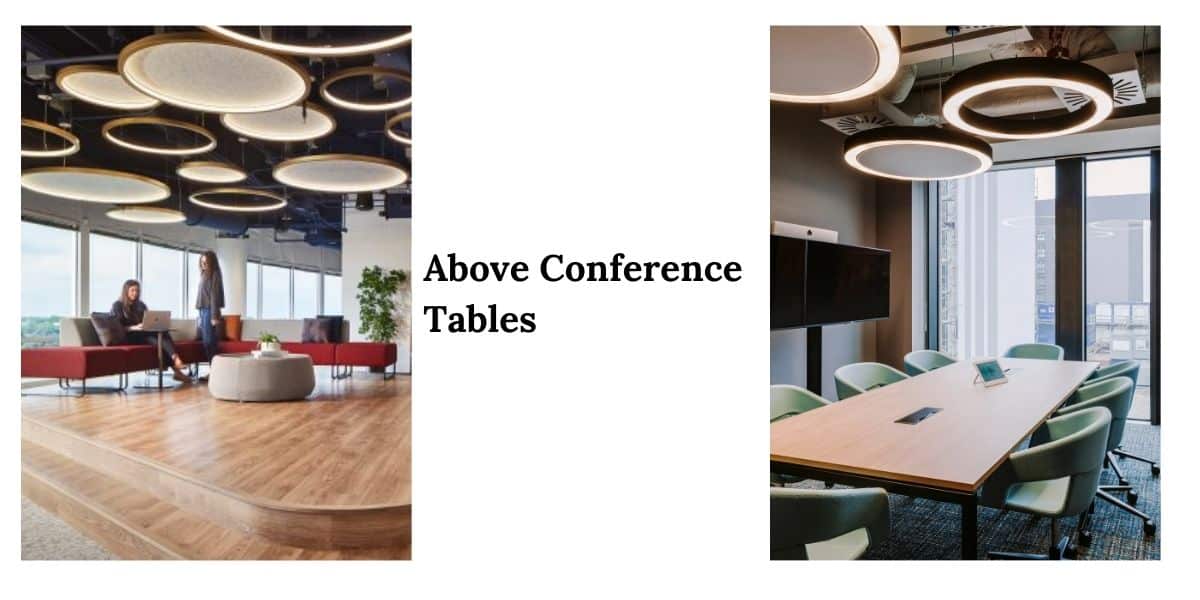
Conference rooms concentrate direct speech in a fixed area. Multiple participants speak toward the center of the table, and sound reflects vertically off the ceiling.
The optimal configuration:
- Install acoustic lighting centrally above the table.
- Extend coverage 300–600 mm beyond the table footprint.
- Align fixtures with the table axis for even absorption.
If a room is elongated, a linear arrangement that mirrors the table shape performs better than a single compact cluster.
Height also matters. In typical 2.7–3 m ceilings, suspending fixtures 400–800 mm below the slab improves absorption efficiency by placing material closer to the reflection zone.
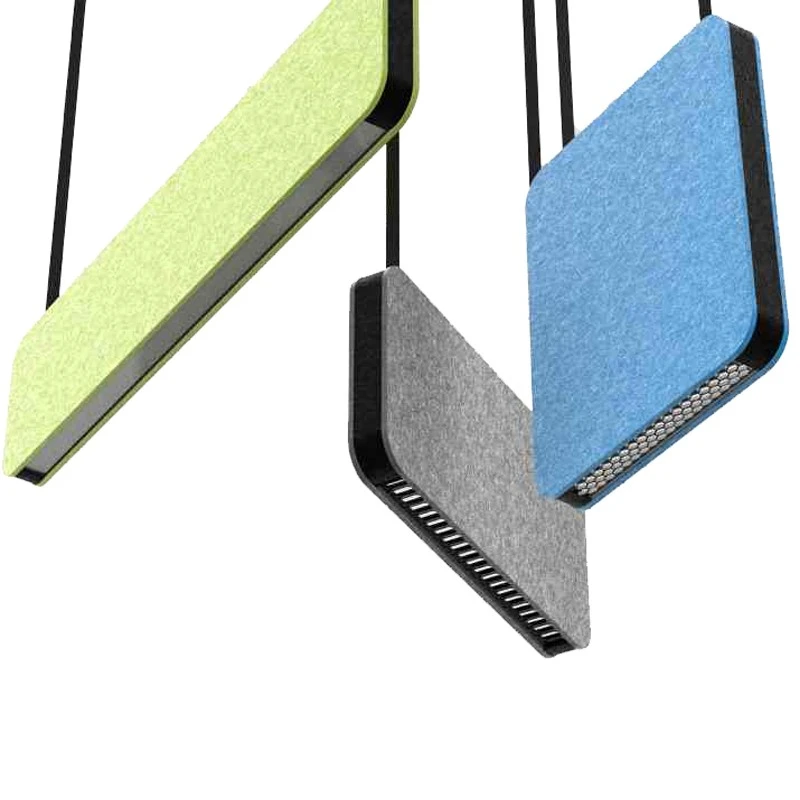
Super Slim Acoustic LED Linear Light
- Input Voltage: AC100-277V / AC220-240V,50-60HZ
- Emitting Direction: Downward
- Size: 121836400mm
- CCT: 3000K / 4000K / 6000K
- Power: 30W
- Luminous Flux: 100-110Lm/W
- CRI: >80Ra
- PF: >0.90
- Fllicker Free: Yes
- Beam Angle: 120°
- IP Grade: IP20
- Warranty: 5 Years
- Felt Acoustic Board Color: Red / Green / Blue / Grey more than 48 colors option
C: Collaboration Zones & Lounge Areas
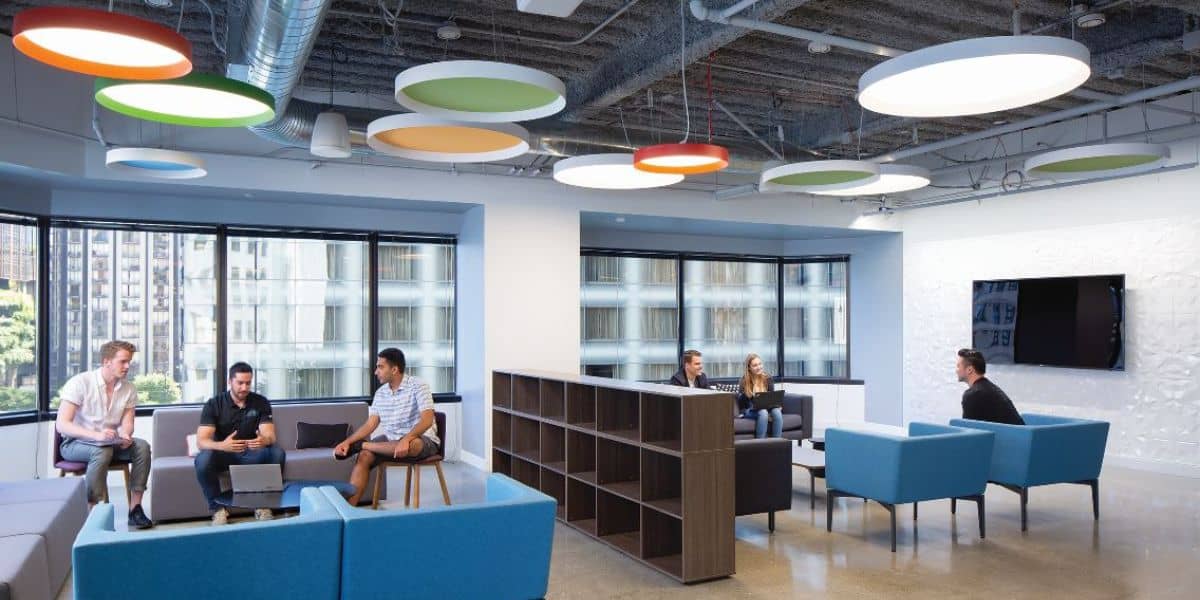
Informal zones generate unpredictable but concentrated speech clusters. Without overhead absorption, noise spills into adjacent quiet zones.
Installing acoustic lighting above:
- Soft seating clusters
- Huddle spaces
- Informal meeting pods
creates localized absorption zones. This contains sound near its source and prevents reverberant buildup across the floorplate.
Placement strategy should prioritize sound containment, not visual symmetry.
Installation Height & Suspension Guidelines
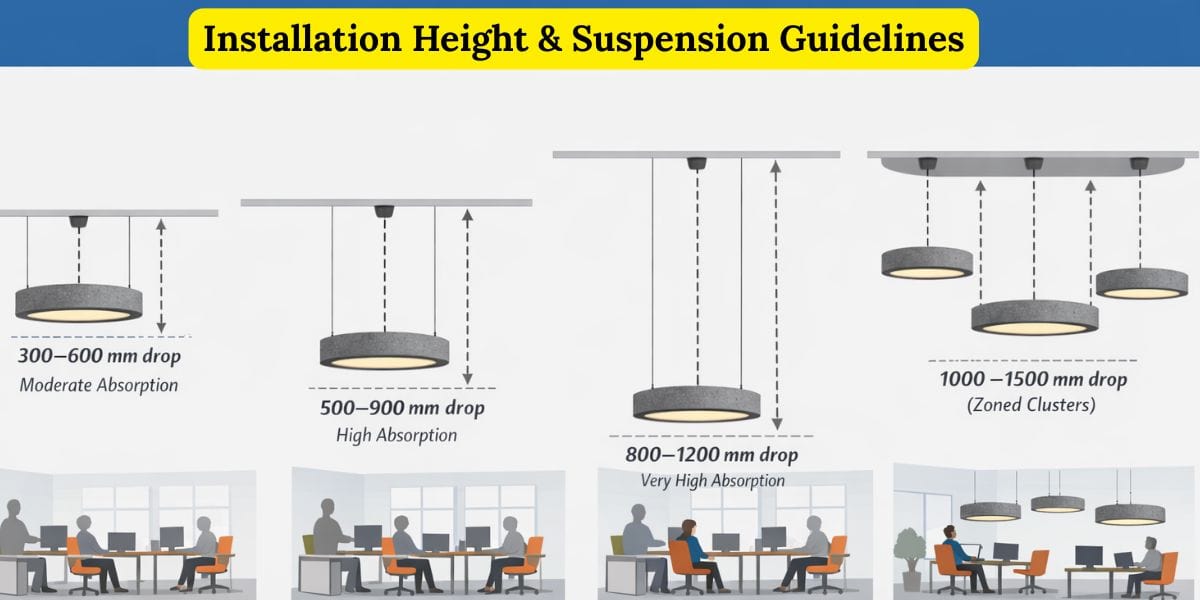
Suspension depth significantly influences performance. Lowering acoustic lighting increases its interaction with sound waves by positioning material within active reflection paths.
For exposed ceilings or high slabs, deeper suspension improves acoustic capture.
Table 1 – Recommended Suspension Guidelines
| Ceiling Height | Suggested Suspension Depth | Acoustic Impact | Notes |
| 2.6–2.8 m | 300–600 mm | Moderate to high | Suitable for conference rooms and offices |
| 2.8–3.2 m | 500–900 mm | High | Improves speech control in open-plan |
| 3.2–4.0 m | 800–1200 mm | High (localized zones) | Essential for exposed ceilings |
| >4.0 m | 1000–1500 mm (zoned clusters) | Targeted | Combine with additional acoustic fixtures |
Lower suspension increases effective absorption because sound encounters the material before fully dispersing.
In high ceilings above 3 m, installing fixtures tight to the slab reduces performance significantly. Bringing acoustic lighting downward improves interaction with speech frequencies.
Coverage & Distribution Strategy
Coverage percentage and distribution pattern determine overall effectiveness.
As a rule of thumb:
- 20–25% coverage in moderate noise offices.
- 30–40% coverage in high collaboration zones.
- Higher localized density above conference areas.
Even distribution across active zones outperforms clustering all fixtures in one area.
Small pendants spaced evenly can perform as well as large panels if distributed correctly. Large acoustic lighting panels create broader absorption fields but require careful alignment with activity zones.
Table 2 – Distribution Strategy by Space Type
| Space Type | Primary Placement Zone | Distribution Pattern | Additional Treatment Needed? |
| Open office | Above desk clusters | Even grid over work areas | Sometimes wall acoustic fixtures if highly reflective |
| Conference room | Centered above table | Linear or rectangular cluster | Rarely if coverage adequate |
| Coworking space | Mixed collaboration areas | Zoned clusters | Often yes for glass walls |
| Reception | Waiting seating zone | Concentrated over seating | Possibly for high ceilings |
| High ceiling atrium | Activity pockets | Suspended clusters | Yes for volume control |
Avoid placing all acoustic lighting along perimeter edges. Distributed placement aligned with speech concentration yields better performance than decorative grouping.
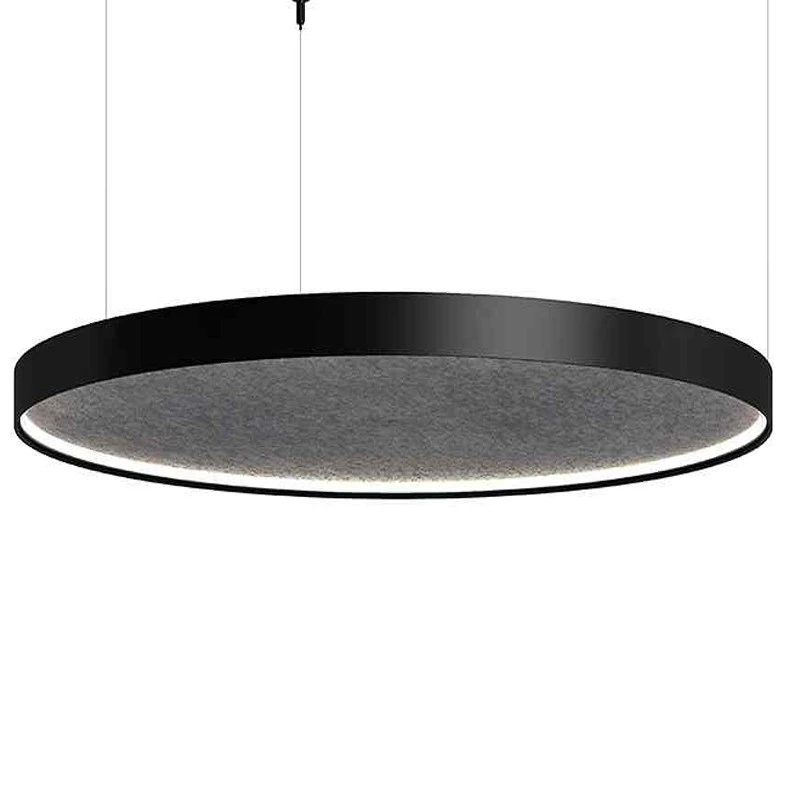
Direct Circle Acoustic LED Pendant Light
- Input Voltage: AC100-277V / AC220-240V,50-60HZ
- Height Size: H65mm
- Size D: 600mm / 800mm / 1000mm / 1200mm
- CCT: 3000K / 4000K / 6000K
- Power: 40W / 60W / 80W / 96W
- Luminous Flux: 100-110Lm/W
- Anti-Glare: Yes
- CRI: >80Ra
- PF: >0.90
- Fllicker Free: Yes
- Beam Angle: 120°
- IP Grade: IP20
- Warranty: 5 years
- Felt Acoustic Board Color: Red / Green / Blue / Grey more than 48 colors option
Room-Specific Installation Guidance
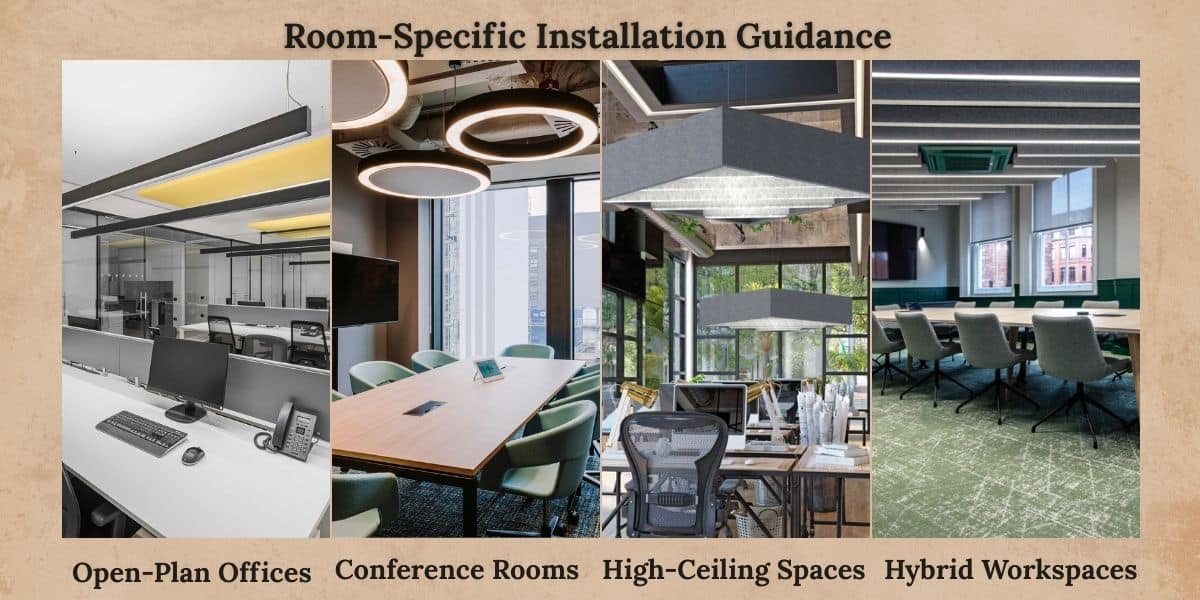
Open-Plan Offices
Use distributed grids above desks, not corridors. Centralized corridor-only layouts fail to address speech at its source.
If ceilings exceed 3 m:
- Increase suspension depth.
- Cluster acoustic fixtures directly above active desks.
- Supplement with additional acoustic fixtures if reverberation remains high.
Conference Rooms
Install central acoustic lighting above the table. For long rooms:
- Use linear arrays that follow table geometry.
- Add secondary fixtures near table ends if necessary.
Avoid placing fixtures near walls unless lateral reflections are severe.
High-Ceiling Spaces
High ceilings increase reverberation due to larger volume. In these spaces:
- Suspend fixtures lower into the occupied zone.
- Cluster above active seating or collaboration areas.
- Combine with wall acoustic fixtures if glass surfaces dominate.
Placement must target activity areas, not open void space.
Hybrid Workspaces
Hybrid offices frequently reconfigure desk layouts. Modular acoustic lighting systems offer flexibility.
Placement strategy:
- Identify likely speech clusters.
- Use reconfigurable suspension systems.
- Avoid fixed decorative centerpieces that do not adapt to layout changes.
Acoustic logic must remain aligned with evolving occupancy patterns.
When Acoustic Lighting Alone Is Not Enough
Certain conditions limit standalone performance:
- Very high reverberation times.
- Large glass façades.
- Concrete walls.
- Double-height volumes.
In these cases, acoustic lighting should serve as overhead absorption, supplemented by vertical acoustic fixtures.
Ceiling treatment intercepts vertical reflections, while wall treatment controls lateral reflections. The combination produces balanced performance.
Ignoring wall reflectivity in highly glazed spaces can undermine ceiling-only solutions.
Common Installation Mistakes
- Installing only at the perimeter rather than above speech zones.
- Treating acoustic lighting as purely decorative.
- Ignoring suspension height in high ceilings.
- Over-spacing fixtures, creating untreated reflective gaps.
- Installing above circulation paths only.
- Failing to align placement with actual speech patterns.
Most performance issues stem from misaligned placement, not insufficient fixture count.
Placement Decision Checklist
Table 3 – Installation Decision Checklist
| Evaluation Factor | What to Assess | Why It Affects Performance |
| Speech activity concentration | Desk density, meeting zones | Determines where absorption must be highest |
| Ceiling height | Slab-to-floor dimension | Influences suspension depth |
| Surface reflectivity | Glass, concrete, metal | Higher reflectivity increases need for coverage |
| Room volume | Cubic meters | Larger volume increases reverberation |
| Hybrid vs fixed layout | Reconfiguration frequency | Impacts need for modular placement |
| Need for additional acoustic fixtures | Wall reflection severity | Ensures balanced acoustic control |
This checklist supports structured decision-making rather than aesthetic-driven installation.
Practical Placement Workflow
A professional placement process typically follows these steps:
Step 1: Identify Speech-Heavy Zones
Map workstation clusters, meeting tables, and informal seating areas.
Step 2: Map Reflection Surfaces
Evaluate ceiling reflectivity and room height.
Step 3: Determine Suspension Range
Select suspension depth based on ceiling height and desired absorption efficiency.
Step 4: Plan Distribution Pattern
Choose grid, linear, or clustered layouts aligned with activity zones.
Step 5: Evaluate Additional Treatment
Assess whether wall acoustic fixtures are required for balanced control.
This workflow prioritizes performance alignment over visual uniformity.
2026 Placement Trends
Emerging trends emphasize performance integration:
- Integrated ceiling systems combining lighting and absorption.
- Modular acoustic lighting for hybrid work environments.
- Flexible suspension systems for adjustable performance.
- Zoned acoustic control replacing full-ceiling panel grids.
Increasingly, acoustic lighting replaces separate ceiling panels by combining illumination and targeted absorption within the reflection zone.
Conclusion
Acoustic lighting should be installed directly above primary sound zones, distributed strategically across ceiling areas, and suspended at heights that maximize absorption efficiency. Placement logic matters more than fixture count. When aligned with speech patterns and ceiling geometry, acoustic lighting significantly improves comfort and clarity.
FAQs
Related Posts