English
  简体中文
简体中文  Deutsch
  Español
  Français
  Italiano
  日本語
日本語  한국어
한국어  Polski
  Português
  Русский
  Türkçe
  Nederlands
  Tiếng Việt
  ไทย
ไทย 
COB (Chip-on-Board) LED technology has become a mainstream lighting solution thanks to its high luminous efficiency, uniform light output, and excellent color rendering. However, the true measure of product quality lies not just in brightness, but in its long-term reliability and lumen maintenance performance, which directly influence the lifespan of COB LED strips and overall customer satisfaction.
To provide an objective comparison, the SignliteLED conducted a continuous 2200-hour durability test on several COB LED strip brands currently available on the market. The test covered lumen maintenance, CCT stability, CRI changes, power variation, and failure modes, offering a comprehensive evaluation of real-world performance over time.
This report highlights the reliability differences among brands and offers technical guidance for selecting high-quality COB LED strip lights.
What Is a Durability Test?
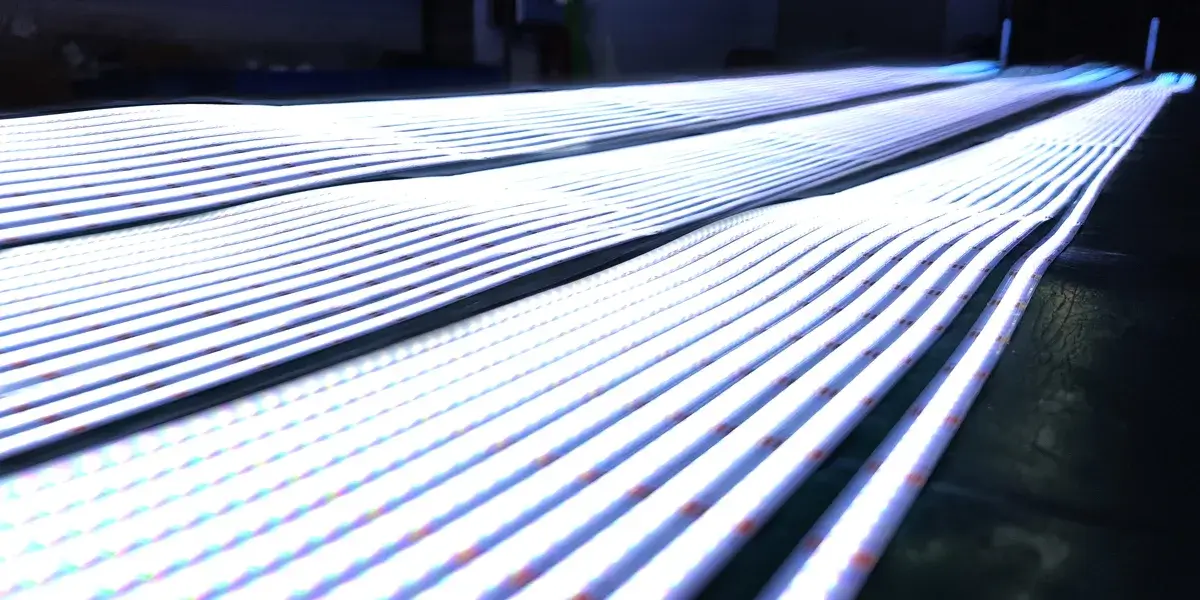
A durability test evaluates how long an LED strip light can operate under normal usage conditions. It simulates real-world environments to verify whether a product can achieve its claimed lifespan (e.g., 50,000 hours for most professional-grade LED strips).
| Test Type | Method | Industry Standard | Passing Criteria |
| Continuous Operation | 24/7 operation under rated load | IEC 60598-1, LM-80 | ≤5% luminous flux degradation |
| Thermal Cycling | -20°C to +60°C cycles | IEC 60068-2-14 | No cracks or delamination |
| Vibration Test | 5–500 Hz vibration exposure | MIL-STD-810G | No loose components |
These parameters help determine long-term LED reliability, COB strip resilience, and thermal stability.
To learn more about LED strip light lifespan, read the blog “LED Strip Light Lifespan: How Long Do They Last and Why?”
Understanding Lumen Maintenance: Key Indicators and Standards
Lumen maintenance rate (LMR) is the percentage of initial luminous flux remaining after continuous operation for a specified period. Example: If an LED retains 90% brightness after 3000 hours, its lumen maintenance rate is 90%.
The most recognized industry standards include:
- LM-80: Measures lumen depreciation of LED packages/modules for 6,000+ hours (typically up to 10,000 hours) under controlled temperature and current conditions.
- TM-21: Uses LM-80 data to predict long-term lumen maintenance, often projecting performance out to tens of thousands of hours.
In actual product testing, the 3000-hour aging test serves as an accelerated life test to evaluate early-stage performance stability. This period allows manufacturers to detect premature failures, thermal instability, and lumen depreciation trends before LEDs enter mass production.
COB LED Strip Test Overview and Methods
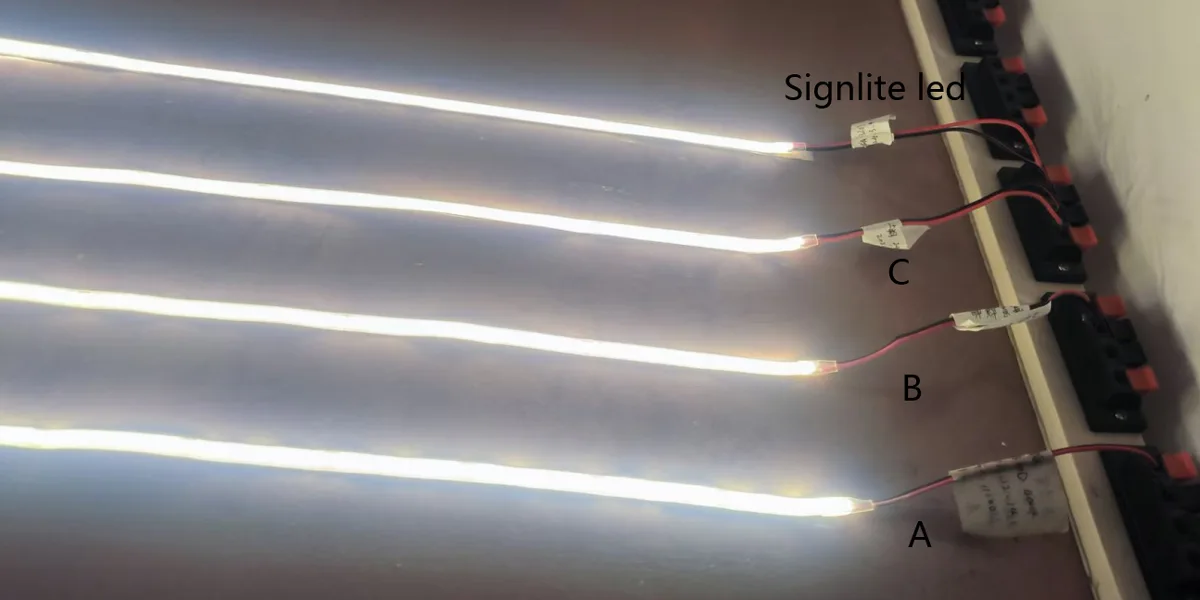
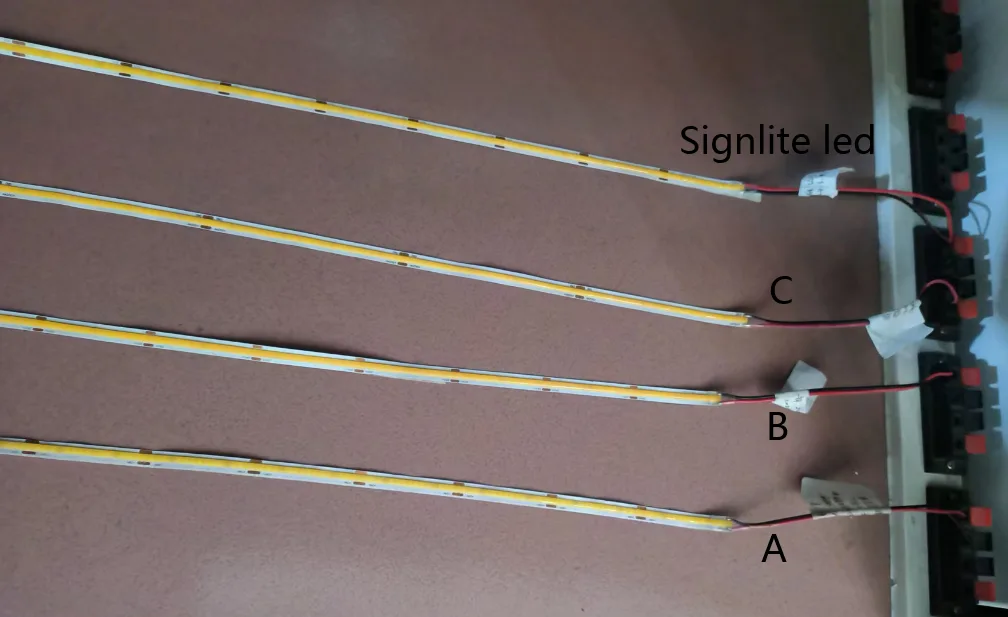
To simulate long-term real-use conditions, we tested three market brands (labeled A, B, C) alongside SignliteLED’s 24V COB LED strip.
Test Conditions
- Duration: 2200 hours continuous operation
- Ambient Temperature: 25 ± 2°C
- Humidity: 60 ± 5%
- Power Supply: Constant Voltage 24V DC
- Measurement Intervals: 0h, 500h, 1000h, 1500h, 2200h
Measured Parameters
- Luminous Flux (lm)
- Correlated Color Temperature (CCT)
- Color Rendering Index (CRI)
- Power Consumption & Efficacy
Test Equipment
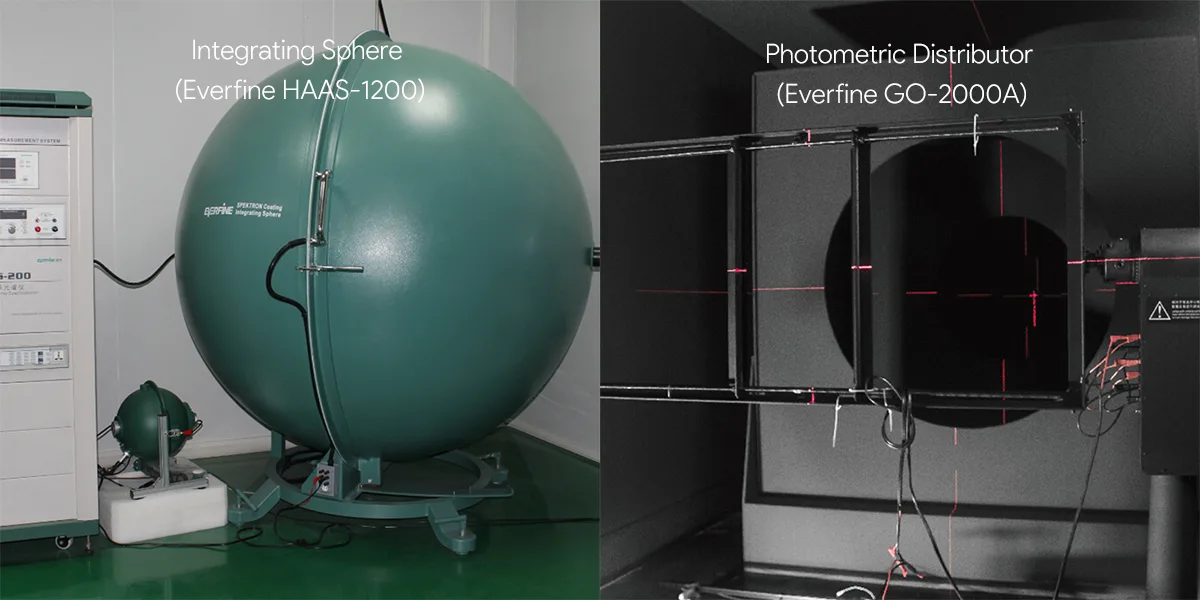
High-precision optical instruments were used:
- Integrating Sphere (Everfine HAAS-1200)
- Photometric Distributor (Everfine GO-2000A)
Initial Test Data (320 LEDs/m, DC24V)
| Brand | Power (W/m) | Initial Luminous Flux (lm/m) | CCT (K) | CRI (Ra) |
| A | 10.46 | 1152.4 | 4095 | 82.8 |
| B | 7.75 | 897.65 | 3961 | 91.7 |
| C | 7.90 | 678.30 | 3929 | 90.5 |
| SignliteLED | 7.80 | 784.30 | 4132 | 90.8 |
Lumen Maintenance Comparison Results
During the 2200-hour continuous aging process, significant differences were observed in the lumen depreciation performance across different brands.
Lumen maintenance rate formula:
LMR = (L0 / L2200) × 100%
Lumen Maintenance at Each Interval
| Brand | 500h | 1000h | 1500h | 2200h | Final LMR | Rating |
| A | 97.62% | 98.2% | 97.47% | 89.47% | Poor | ★★★ |
| B | 98.8% | 99.33% | 98.37% | 96.85% | Good | ★★★★☆ |
| C | 93.03% | 95.67% | 95.09% | 94.37% | Moderate | ★★★★ |
| SignliteLED | 97.12% | 99.83% | 98.69% | 97.69% | Excellent | ★★★★★ |
Key Findings
- SignliteLED demonstrated the best long-term stability with only 2.3% lumen depreciation after 2200 hours.
- Brand B performed well overall (96.85% LMR).
- Brand C showed moderate lumen loss and noticeable mid-term degradation.
- Brand A had the most severe depreciation, retaining only 89.47% brightness—indicating poor thermal management.
Reliability and Degradation Mechanism Analysis
Phosphor and Encapsulation Stability
The thermal stability of phosphors and silicone materials is a key factor affecting light decay.
- Lower-quality brands using ordinary silicone exhibited yellowing, reducing transparency and accelerating lumen loss.
- SignliteLED uses high-temperature-resistant silicone, ensuring better optical stability over time.
Thermal Management Design
Heat dissipation determines LED junction temperature and directly affects lifespan.
- SignliteLED’s use of 2oz copper PCB and optimized thermal pathways significantly reduces heat buildup.
- Brand A uses a thinner single-layer PCB, causing higher thermal stress and faster degradation.
Physical Appearance & Failure Observation
Microscopic inspection revealed:
- Brand A: noticeable yellowing after aging.
- SignliteLED & Brand C: clean appearance with no visible deterioration.
Cost-Performance Comparison & Application Recommendations
Reliability is certainly important, but cost is also a significant consideration in engineering applications.
Cost vs. Reliability
| Brand | Price (USD/m) | Lumen Maintenance | Cost-Performance Rating |
| A | 0.60 | 89.47% | ★★★ |
| B | 1.08 | 96.85% | ★★★★☆ |
| C | 0.72 | 94.37% | ★★★★ |
| SignliteLED | 0.68 | 97.69% | ★★★★★ |
Insights
- Brand A: cheapest, but worst lumen depreciation; suitable only for short-term or decorative lighting.
- Brand B: good performance but highest price.
- Brand C: balanced cost-performance for mid-range applications.
- SignliteLED: best cost-performance ratio; ideal for commercial, architectural, and high-end interior projects.
Recommended Applications
- High-End Architectural / Hotel / Commercial Projects: → SignliteLED or Brand B
- Retail / Display Lighting: → SignliteLED or Brand B
- Low-budget, short-term projects: → Brand A (use with caution)
Conclusion
The 2200-hour durability test clearly demonstrates significant reliability differences among COB LED strip brands. While initial specifications appear similar, long-term performance varies widely due to differences in materials, thermal management, and encapsulation quality.
SignliteLED achieved the best overall reliability, retaining 97.69% brightness after 2200 hours. Brand B provided stable but more costly performance. Brand C showed moderate reliability. Brand A suffered severe lumen depreciation and inadequate thermal stability.
This long-term reliability test reaffirms that:
✔ Initial brightness does not reflect real product lifespan.
✔ Durability testing is essential to evaluate COB LED strip quality.
✔ Material selection and heat management are the core determinants of longevity.
SignliteLED will continue conducting long-term evaluations across multiple brands, providing authentic data to help engineers and buyers make more informed decisions when sourcing COB LED strip lights.
Related Posts