English
  简体中文
简体中文  Deutsch
  Español
  Français
  Italiano
  日本語
日本語  한국어
한국어  Polski
  Português
  Русский
  Türkçe
  Nederlands
  Tiếng Việt
  ไทย
ไทย 
The primary labor difference between LED sheets and LED modules is installation density and wiring repetition.
In large-format signage, a led light sheet can reduce mounting and wiring labor by eliminating hundreds of individual placement points. In small channel letters or tight cavities, LED modules remain more labor-efficient because they allow targeted placement without panel trimming.
This comparison breaks down installation time, wiring effort, mounting density, long-term maintenance, and scalability to determine where labor costs increase and where they compress.
The 30-Second Comparison

Choose LED Sheets for:
Large lightboxes, retail facades, airport signage, and flat backlit panels where repetitive mounting dominates labor time.
Choose LED Modules for:
Channel letters, deep-cabinet signs, segmented compartments, and irregular shapes where flexibility reduces fitment adjustments.
Labor differences become significant as scale increases.
Labor Cost Comparison Table
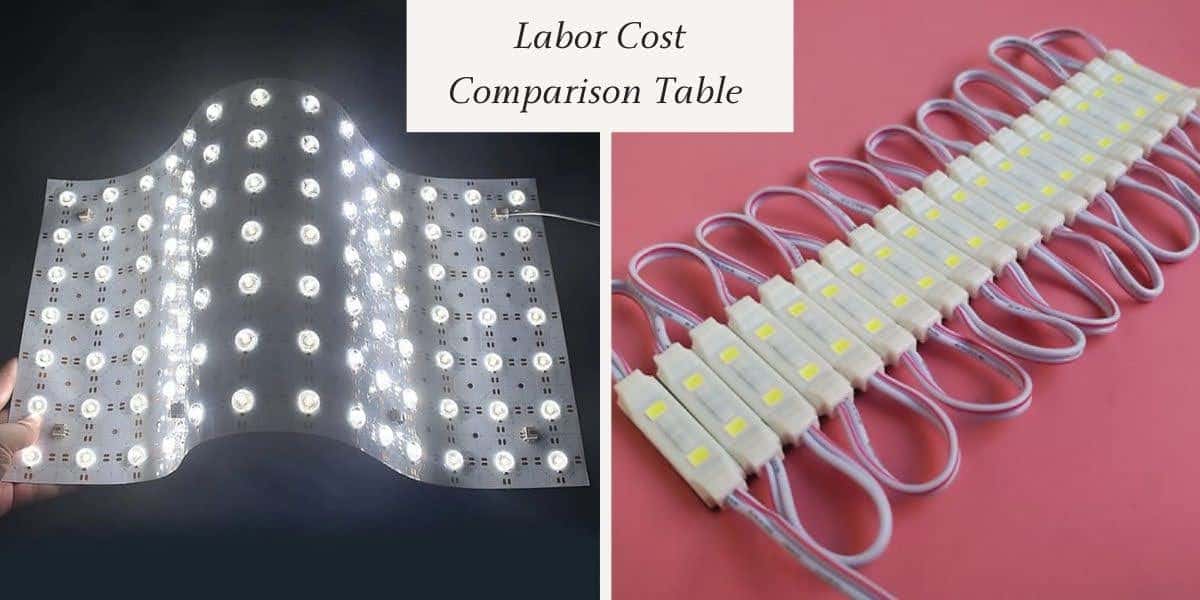
| Labor Factor | LED Sheets | LED Modules | Labor Cost Impact |
| Installation Time | Covers large surface per panel | Installed individually across the signage cabinet | Sheets reduce repetitive fastening in large signage |
| Wiring Complexity | Few main power feeds per panel | Pre-wired daisy-chain connections between LED modules | Modules increase wiring time as size grows |
| Mounting Density | Low fastening count per m² | High fastening count per m² | Higher density increases technician hours |
| Alignment & Calibration | Factory-spaced diodes | Manual spacing and positioning required | Modules require layout verification time |
| Large Signage Coverage | Efficient with led light sheet panel format | Labor scales linearly with module count | Sheets scale more gradually |
| Maintenance | Panel-level access | Individual module tracing | Modules increase diagnostic labor |
| Replacement | Replace defined panel section | Replace single module | Modules reduce part cost but increase touchpoints |
| Scalability | Labor growth moderate | Labor growth proportional | Sheets reduce labor escalation at scale |
Installation Labor Analysis
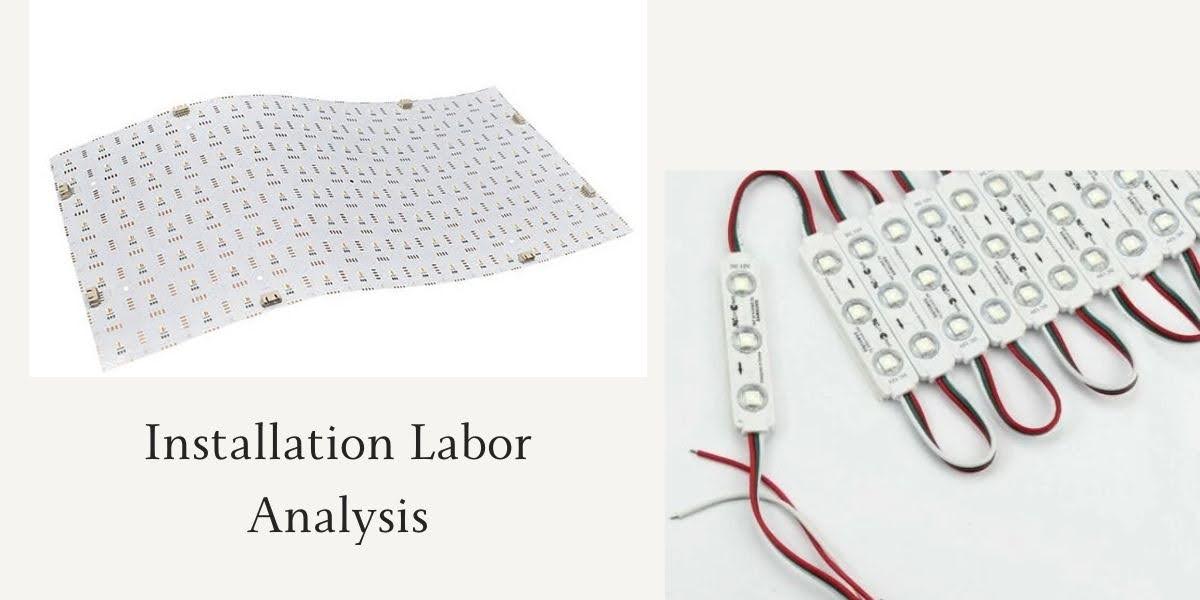
nstallation labor is driven by repetition.
LED modules must be mounted individually across the sign cabinet. Each module requires positioning, fastening, and spacing alignment. In a 4 x 8 ft lightbox, this can mean installing 80 to 150 modules depending on spacing requirements. Every fastening action adds cumulative labor time.
A led light sheet panel covers a much larger surface area per unit. Instead of installing dozens of components, technicians secure fewer integrated panels. This reduces fastening repetition significantly.
The difference becomes visible in medium to large signage. In small signs, repetition is limited, so labor advantage is minimal. In large-format signage, repetitive placement becomes the dominant labor driver.
Coverage efficiency is therefore the primary installation differentiator.

Optical Lens LED Sheets
Wiring & Electrical Labor Impact
Electrical work often consumes as much time as physical mounting in signage installations.
LED modules are typically supplied as pre-wired daisy-chain products, eliminating the need for separate jumper wires between units. However, as signage size increases, the total number of module chains, routing paths, and power feed points increases. Installers must still manage cable routing, secure wiring paths within the cabinet, verify polarity, and test continuity across each daisy-chain segment to ensure consistent operation.
In larger signage cabinets, additional power feed points may be required to maintain uniform brightness and minimize voltage drop along extended daisy chains. Each additional feed point introduces routing, termination, fastening, and inspection steps. While the modules themselves are pre-connected, overall wiring management still scales with surface area and cabinet size.
By comparison, a high brightness led light sheet distributes current across an integrated panel structure. Fewer external wiring paths are required, and power feeds are typically centralized rather than distributed across multiple module chains. This reduces routing density and simplifies inspection in large flat signage applications.
Fewer connections generally result in:
- Fewer polarity errors
- Less cable routing
- Faster inspection
- Reduced rework risk
Electrical labor savings become more noticeable as signage area expands. In small cabinets, the difference may be minimal. In large-format installations, wiring management and power distribution planning increasingly influence total technician hours.
Mounting & Alignment Efficiency
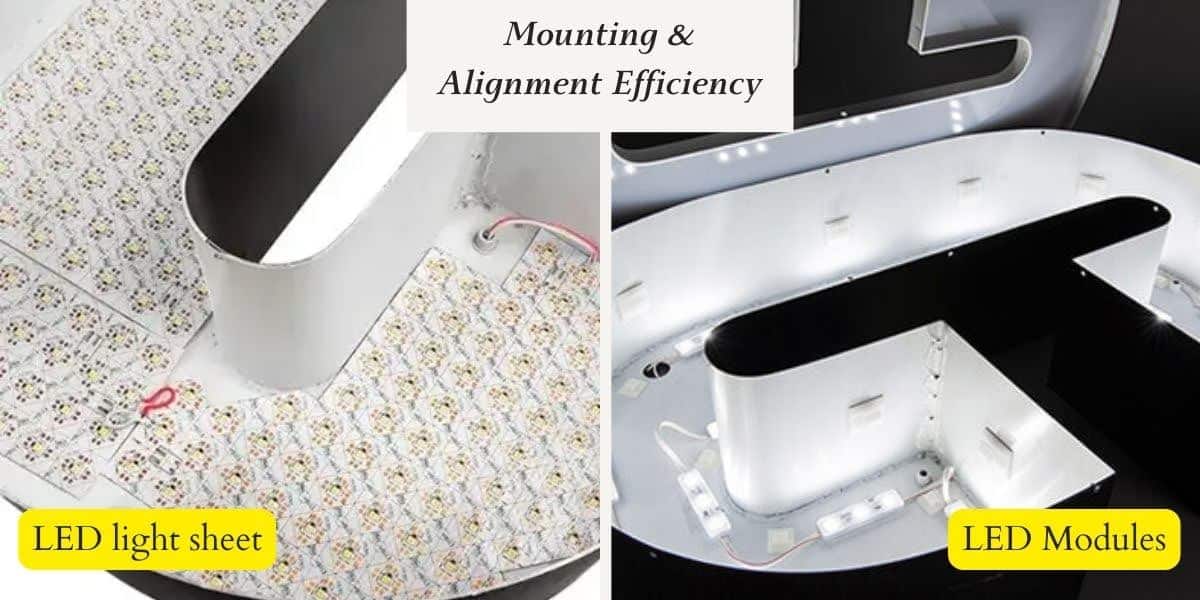
Illumination uniformity requires precise spacing.
With LED modules, installers must maintain consistent spacing across the cabinet. Minor spacing errors can create visible hotspots, particularly in shallow cabinets. Measuring and adjusting spacing increases labor time.
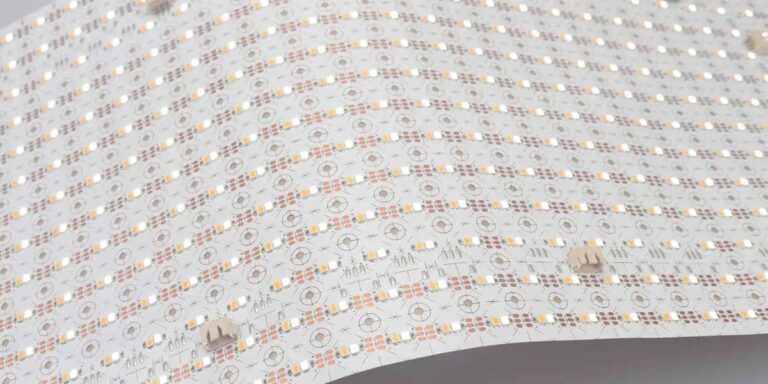
A uniform illumination led light sheet reduces this calibration process. Diode spacing is pre-engineered, so installers focus on panel placement rather than node-by-node alignment.
In flat signage, this significantly reduces inspection time.
However, geometry changes the equation.
In small channel letters, modules are easier to distribute within narrow strokes. A flexible led light sheet may accommodate moderate curves, but highly irregular shapes still favor modular placement.
Labor efficiency therefore depends on cabinet geometry.
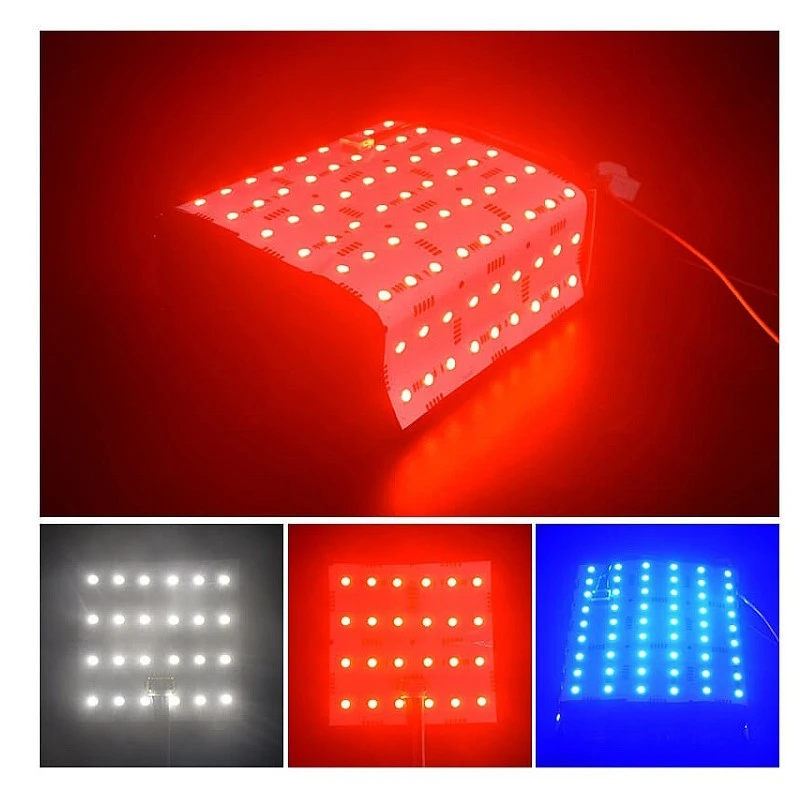
RGBW LED Sheets
- Size( L x W ): 250mmx250mm/ 490mmx250mm
- LED type: 5050 RGBW 4 In 1 SMD
- LED quantity: 150PCS/ 288PCS
- Working voltage: DC 24V
- Power: 24W/ 48W
- Emitting color: RGB+3000K, RGB+4000K, RGB+6500K
- Light Efficiency: 90LM/W
- Minimum cutting length: 50mmx50mm/ 20.4mmx122.5mm
- Beam angle: 120°
- Dimmable: YES
- Waterproof Level: IP20 non-waterproof, IP54 waterproof
- Warranty: 3 years
Maintenance & Long-Term Labor Costs
Installation labor is only part of the equation.
With LED modules, troubleshooting requires identifying and replacing individual failed units. While this reduces material replacement cost, diagnostic tracing can be time-consuming in large arrays.
A led light sheet panel simplifies troubleshooting. Instead of isolating dozens of nodes, technicians may replace a defined section. This reduces diagnostic time but may increase component replacement cost.
In large retail deployments, standardized panel replacement procedures reduce technician variability and shorten service visits.
In small signs with limited access, module-level replacement may involve less disassembly.
Long-term labor depends on accessibility design and system layout, not just technology choice.
When LED Modules May Be More Labor-Efficient
LED modules can reduce labor in specific applications:
- Small channel letters with narrow strokes
- Segmented signage compartments
- Very shallow cabinet depths
- Highly irregular shapes
In these cases, trimming or segmenting a led light sheet may require additional preparation time, offsetting mounting advantages.
For one-off small installations, modules often provide practical flexibility without significant labor penalty.
Scalable Signage Economics

Labor scaling is where differences become measurable.
In large airport panels or retail facades, mounting hundreds of modules multiplies fastening and wiring steps. Labor grows proportionally with module count.
With led light sheet panels, mounting density per square meter is lower. Instead of increasing labor at the same rate as area expansion, sheets compress repetition.
The advantage is not elimination of labor, but reduction of escalation.
As signage area increases, repetitive actions dominate cost. Sheet-based systems reduce the number of repetitive tasks required to achieve full illumination.
Key Takeaways
- LED sheets reduce repetitive mounting labor in large-format signage.
- LED modules increase wiring connections and calibration time as surface area grows.
- Modules remain practical in small letters and irregular geometries.
- Labor differences become significant only when installation scale increases.
- Wiring density directly influences technician hours.
- Panel-level replacement can reduce diagnostic labor in large systems.
- Sign geometry determines mounting efficiency more than technology alone.
Conclusion
Labor cost in signage is a cumulative factor that depends entirely on the scale and complexity of the project. While LED modules are practical for small-scale applications, their repetitive mounting, spacing calibration, and multiple electrical connections cause labor hours to spike as the installation area expands. In contrast, LED light sheets compress this labor by reducing fastening density and simplifying electrical routing across large flat or moderately curved surfaces. Therefore, technology selection should be driven by specific sign size, cabinet geometry, and long-term service strategy rather than material price alone. Ultimately, true labor efficiency is determined by how effectively the lighting system minimizes repetitive manual tasks at scale.
FAQs
Related Posts