English
  简体中文
简体中文  Deutsch
  Español
  Français
  Italiano
  日本語
日本語  한국어
한국어  Polski
  Português
  Русский
  Türkçe
  Nederlands
  Tiếng Việt
  ไทย
ไทย 
Introduction
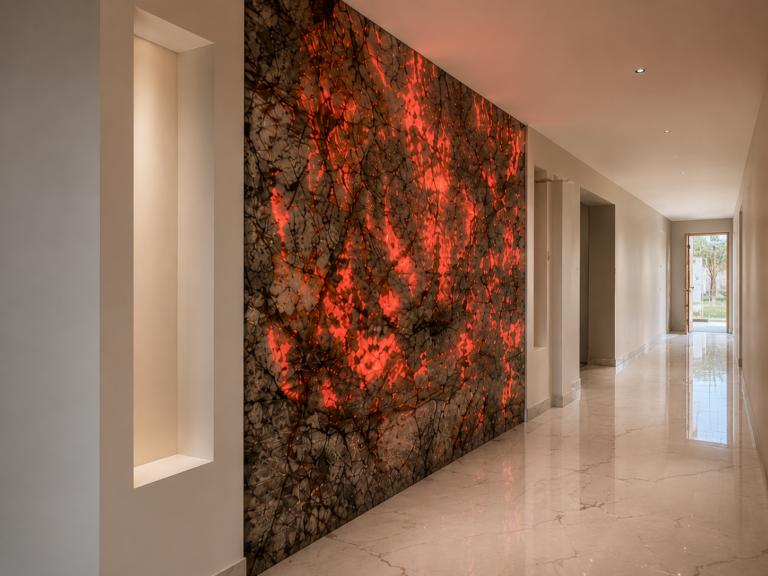
Stone backlighting projects require more than just a light source — they demand a carefully engineered lighting system that can deliver uniform illumination across large translucent surfaces while maintaining installation simplicity and electrical stability.
In this project, a Netherlands-based lighting manufacturer was developing a series of large architectural stone wall panels. The main challenge was not only achieving a visually uniform backlit effect, but also designing a system architecture that could scale across multiple large panels with minimal wiring complexity.
This case demonstrates how LED Sheet Light technology was engineered into a simplified, panel-based lighting system using centralized power and Casambi-based control.

Project Overview
| Item | Details |
| Project Type | Architectural Stone Backlighting |
| Application | Large Interior Stone Wall Panels |
| Material | Translucent Natural Stone |
| Lighting Solution | Tunable White LED Sheet System |
| Control System | Casambi / PWM / 0–10V |
| Main Challenge | High-load uniform backlighting with simplified wiring |
| Final Result | Seamless panel-based architectural lighting system |
Key Takeaways
- The project required a system-level lighting design, not just a light source selection.
- Each stone panel was designed with a 1 power supply + 1 control system architecture.
- High-load panels (up to ~450W) required careful evaluation of driver limitations and load distribution.
- Casambi was selected as the primary control platform due to its wireless flexibility and reduced wiring complexity.
- Parallel wiring of LED sheets was critical to ensure uniform brightness across large surfaces.
- The final system eliminated multiple small drivers, significantly reducing installation complexity on site.
Project Overview: A Nordic Design Studio’s Custom Stone Backlighting Request
This project was developed for a Dutch lighting manufacturer working on a series of architectural stone wall backlighting installations.
The application involved large-format translucent stone panels used in interior architectural spaces, where the lighting system needed to deliver a uniform backlit effect without hotspots, while maintaining a simple and scalable electrical structure for installation on site.
Unlike standard decorative lighting projects, this case required careful coordination between:
- Stone material translucency
- LED sheet layout density
- Power distribution across large panels
- Control system simplicity (Casambi / 0–10V compatibility)
From the early stage, the project was not only about selecting a light source, but about designing a complete lighting system architecture that could be practically installed and controlled at scale.
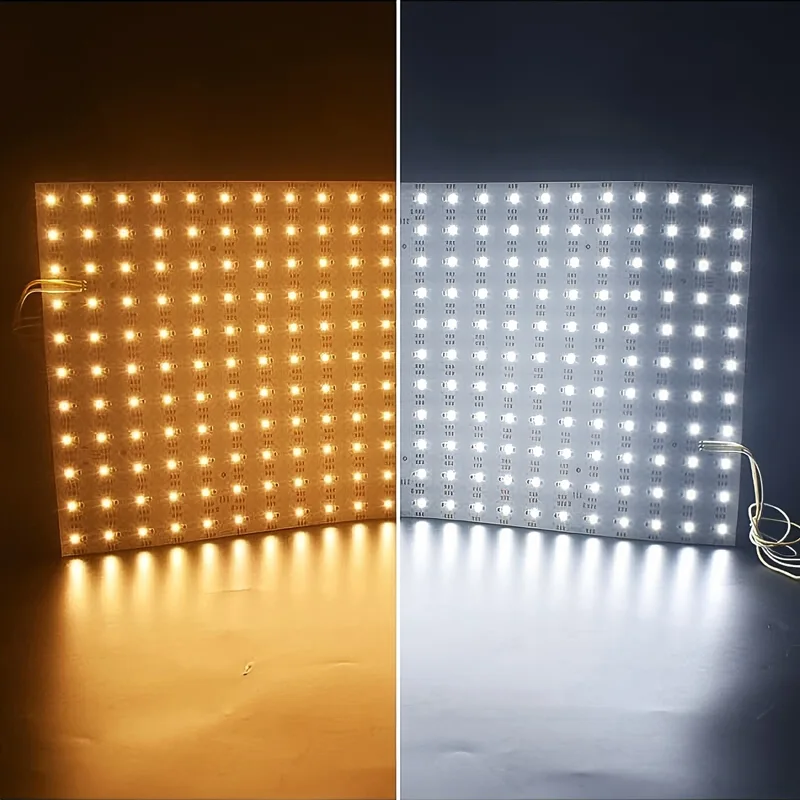
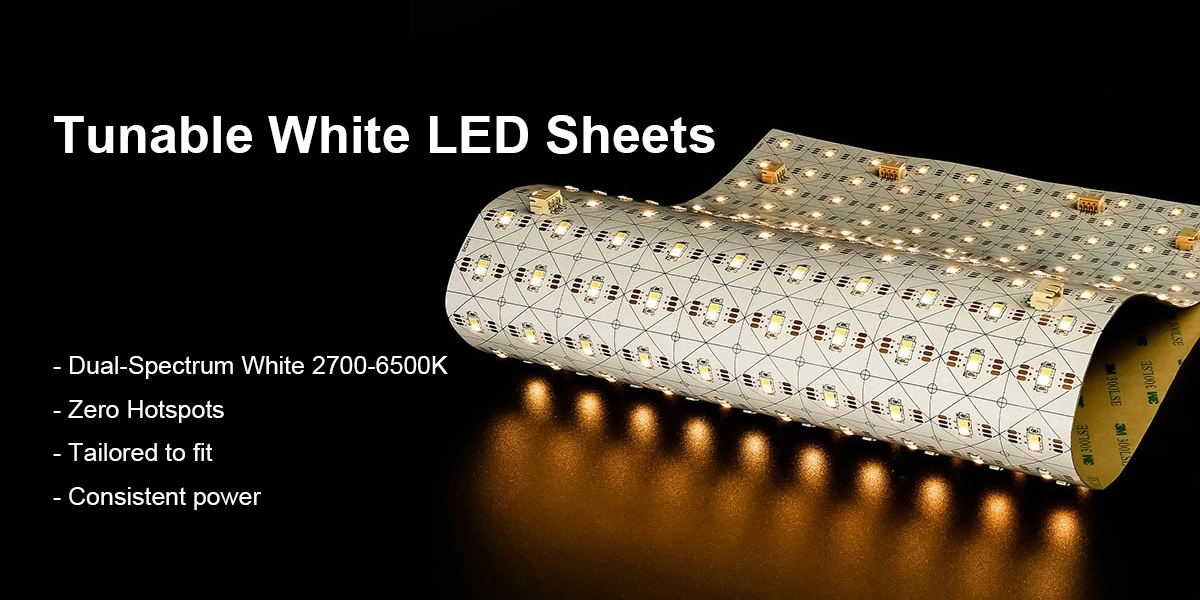
Tunable White LED Sheets
Size ( LxH ): 250mmx 250mm/ 490mmx245mm
LED type: 2835 SMD
LED quantity: 200PCS/484PCS
Working voltage: DC 24V
Power: 16W / 40W
Color temperature adjustable range: 2700K – 6500K
Luminous flux:1600lm/m/3800lm/m
Color rendering index: >90Ra
Minimum cutting length: 25mmx25 mm/22.3 mm x22.3mm
Dimmable: YES
Beam angle: 120°
Client Design Objectives
Client Requirements & System Objectives
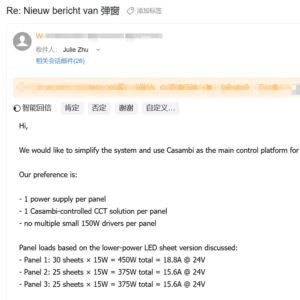
From the early design stage, the client’s focus was not only on achieving high-quality stone backlighting, but more importantly on defining a scalable and installation-efficient system architecture that could be replicated across multiple large panels.
The project requirements gradually became more system-oriented rather than product-oriented, with the following key objectives:
- Each stone panel should operate as an independent lighting unit
- A simplified structure of 1 power supply per panel + 1 control system per panel
- Avoid the use of multiple small drivers to reduce wiring complexity on site
- Ensure full-surface uniform backlighting without visible hotspots
- Support tunable white (2700K–6500K) for architectural flexibility
- Maintain compatibility with both Casambi wireless control and 0–10V wired control systems
- Ensure the system can be installed and maintained with minimal on-site adjustment
During the discussion phase, it became clear that the main challenge was not only electrical load distribution, but also how to balance control flexibility, driver limitations, and installation practicality within a single simplified architecture.
Load Calculation & System Constraints
Electrical Load Analysis & System Constraints
Based on the final LED sheet configuration confirmed during the engineering discussion, each stone panel was designed using a high-density LED sheet layout operating at 24V constant voltage.
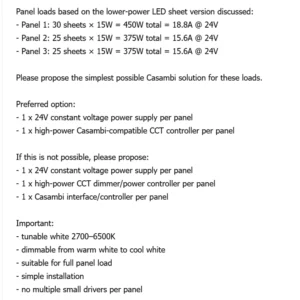
The total electrical load per panel was calculated as follows:
- Panel 1 (2676 × 1200 mm): 30 LED sheets → approx. 450W (~18.75A @ 24V)
- Panel 2 (2397 × 1194 mm): 25 LED sheets → approx. 375W (~15.6A @ 24V)
- Panel 3 (2397 × 1200 mm): 25 LED sheets → approx. 375W (~15.6A @ 24V)
This confirmed that each panel was operating in a high-power range for constant voltage LED sheet systems, requiring careful consideration of both power supply sizing and current distribution strategy.
Project Load Overview (Per Panel)
| Panel | Size (mm) | LED Sheets | Total Load | Current @24V |
| Panel 1 | 2676 × 1200 | 30 pcs | ~450W | ~18.75A |
| Panel 2 | 2397 × 1194 | 25 pcs | ~375W | ~15.6A |
| Panel 3 | 2397 × 1200 | 25 pcs | ~375W | ~15.6A |
System-Level Constraint: Driver & Control Limitations
During system validation, an important technical constraint was identified:
Most available Casambi and 0–10V LED drivers for this category are typically rated at approximately 150W per driver unit.
This created a clear system design challenge:
- Each panel load (375W–450W) exceeded the capacity of a single driver
- A conventional design would therefore require 3–4 drivers per panel
- This would significantly increase wiring complexity, installation time, and failure points
At the same time, the client’s design goal was explicitly to maintain a “one panel = one power supply + one control system” architecture, which directly conflicted with a distributed multi-driver approach.
Wiring & Distribution Requirement
Another critical engineering requirement was related to LED sheet connection behavior.
Due to the large number of LED sheets per panel, the system needed to be designed with a parallel wiring architecture on the input side, ensuring:
- Equal voltage distribution across all LED sheets
- Prevention of voltage drop across long cable runs
- Consistent brightness and color temperature across the entire stone surface
This wiring strategy is essential for large-area backlighting applications, where even minor voltage imbalance can result in visible brightness inconsistencies.
Engineering Conclusion (Pre-Solution Stage)
From a system design perspective, the project presented three main constraints:
- High total load per panel (up to ~450W)
- Driver limitations (~150W per control unit)
- Requirement for simplified, single-controller-per-panel architecture
These constraints made it clear that the final solution would need to prioritize system simplification and centralized control logic, rather than a traditional distributed driver approach.

Engineering Control Options & Decision Logic
Control System Evaluation & Engineering Decision
Given the electrical load per panel and the requirement for a simplified “one panel – one control system” architecture, several control strategies were evaluated during the engineering phase.
The selection was not based on features alone, but on system compatibility with high-power LED sheet loads, driver limitations, and installation constraints.
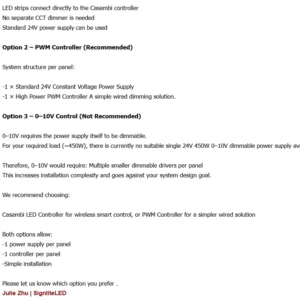
Option 1 — Casambi Wireless Control System (Preferred Solution)
The Casambi system was evaluated as the primary control architecture for this project.
From a system perspective, its key advantage is that the control logic is integrated at the driver level, allowing:
- Wireless dimming and tunable white control (2700K–6500K)
- Direct app-based control without external control wiring
- Reduced on-site wiring complexity
- Better scalability for multi-panel architectural installations
In this project, Casambi was aligned with the client’s requirement for:
“1 control system per panel with minimal installation complexity”
However, due to power limitations of individual Casambi driver units (~150W per unit), the system still required careful driver grouping strategy under a single panel architecture.
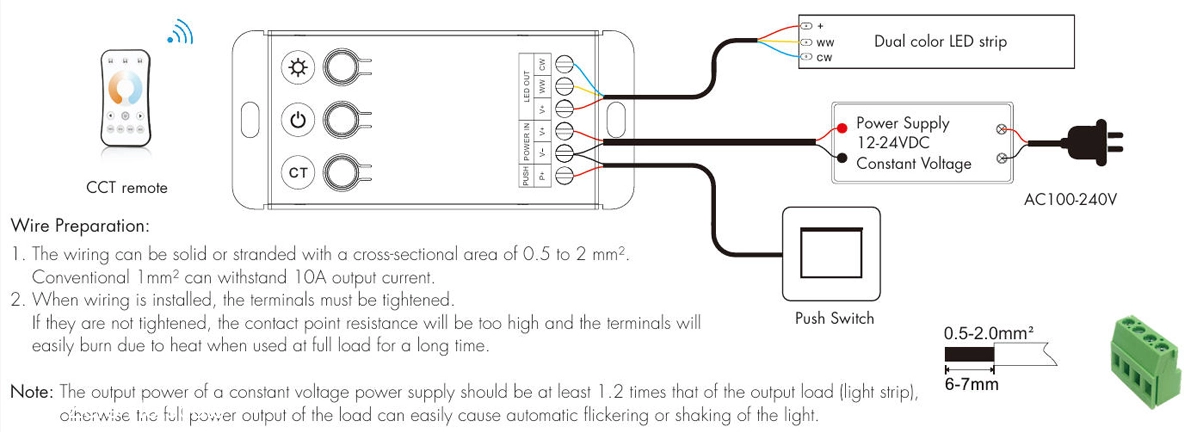
Option 2 — PWM Dimming Control (Wired Alternative)
PWM control was considered as a more conventional wired dimming solution.
Its main characteristics include:
- High stability for constant voltage LED systems
- Simple integration with 24V power supplies
- Lower system cost compared to wireless solutions
From an engineering standpoint, PWM was classified as a fallback option, suitable for test setups or non-wireless installations where simplicity and cost control are prioritized over smart functionality.

Option 3 — 0–10V Control System (Not Recommended for This Project)
The 0–10V control method was also evaluated but identified as not suitable for this specific system architecture.
The main limitations were:
- Requires dimmable drivers at the power supply level
- Each driver typically limited to ~150W capacity
- Large panels would require multiple distributed drivers
- Increased wiring complexity and reduced installation efficiency
This directly conflicted with the project’s key objective of: “Avoid multiple small drivers per panel and simplify installation as much as possible”
As a result, 0–10V was excluded from the final system design for this application.

Control System Comparison
| Control Type | Suitability | Advantages | Limitations | Final Decision |
| Casambi | Recommended | Wireless, flexible, scalable | Driver power limitation (~150W) | Selected |
| PWM | Medium | Simple, stable, low cost | No smart control | Backup option |
| 0–10V | Not recommended | Traditional control method | Requires multiple drivers | Rejected |
Engineering Decision Summary
After evaluating all three control strategies, the selection was driven by system-level constraints rather than individual product features.
The final decision criteria were:
- Compatibility with high-load LED sheet panels (375W–450W)
- Minimum number of drivers per panel
- Reduced wiring complexity on site
- Scalability across multiple large architectural panels
- Flexibility for future smart lighting integration
Based on these factors, the system design direction naturally converged toward a Casambi-centered control architecture combined with centralized constant voltage power distribution.
Final System Architecture
Final Approved System Design
After evaluating electrical load requirements, control system limitations, and installation constraints, the final system architecture was agreed based on a simplified and scalable design approach.
The final configuration adopted a panel-based independent control structure, where each stone wall panel operates as a self-contained lighting unit.
System Configuration (Per Panel Basis)
Each panel was designed with the following structure:
- 1 × 24V constant voltage power supply
- 1 × centralized control system (Casambi or PWM depending on application)
- LED sheet array connected in parallel configuration
This architecture ensured that each panel could operate independently while maintaining consistent lighting performance across large architectural surfaces.
Load Allocation per Panel
The final system was implemented based on the confirmed electrical loads:
- Panel 1: ~450W total load
- Panel 2: ~375W total load
- Panel 3: ~375W total load
Each power supply was selected with an appropriate safety margin to ensure stable long-term operation under continuous load conditions.
Control System Implementation
The control strategy was finalized as follows:
- Panels 1 & 2: Casambi-based wireless tunable white control (2700K–6500K)
- Panel 3: 0–10V wired dimming control (as per client system requirement)
- Test setup: PWM dimming solution for evaluation and sample verification
This mixed-control approach ensured compatibility with different project requirements while maintaining a unified electrical architecture.
Wiring & Distribution Principle
All LED sheets within each panel were connected in a parallel wiring configuration at the input stage, ensuring:
- Equal voltage distribution across all LED sheets
- Stable brightness consistency across large surface areas
- Elimination of visible brightness gradients or hotspots
- Simplified maintenance and replacement strategy
This wiring method is particularly critical in large-scale stone backlighting applications, where uniform optical output is a key design requirement.
System Outcome
The final solution successfully achieved the original project objectives:
- Simplified system architecture (one panel = one power unit + one control system)
- Reduced installation complexity on site
- Stable high-load operation per panel (up to ~450W)
- Flexible control options (Casambi, 0–10V, PWM)
- Uniform backlighting performance across all stone surfaces
Engineering Conclusion
The project demonstrates how LED sheet technology can be integrated into a modular architectural lighting system, where electrical design, control strategy, and installation requirements are optimized as a single unified engineering solution.
Rather than relying on a distributed driver approach, the final architecture prioritized:
system simplification, centralized control logic, and scalable panel-based design
This approach significantly improved installation efficiency while maintaining high-quality visual performance for architectural stone backlighting applications.
Final System Configuration
| Component | Specification | Notes |
| Power Supply | 24V Constant Voltage | 1 per panel |
| Control System | Casambi / PWM / 0–10V | Based on panel requirement |
| LED Layout | Parallel Wiring | Ensures uniform brightness |
| Max Load | 375W–450W per panel | High-density LED sheet system |
System Validation (Lighting Test Results)
System Validation & Lighting Performance Test
After the final system installation, a full lighting test was conducted to verify the uniformity and stability of the LED sheet backlighting performance across all stone panels.
The system was evaluated under real operating conditions, including full load operation and complete panel coverage.
The test confirmed the following key performance results:
- Uniform light distribution across large stone surfaces
- No visible hotspots or dark zones detected
- Stable color temperature consistency (2700K–6500K range)
- No noticeable voltage drop or brightness inconsistency across LED sheet arrays
- Stable operation under full-load conditions per panel (up to ~450W)
The parallel wiring architecture proved to be critical in ensuring consistent voltage distribution, which directly contributed to the uniform optical performance of the stone backlighting system.
From a system validation perspective, the final installed result confirmed that the panel-based architecture was suitable for large-area architectural stone lighting applications.
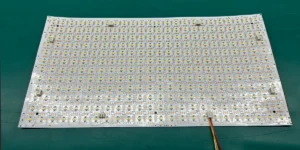
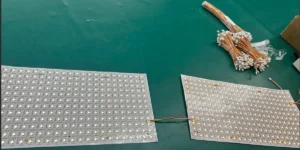
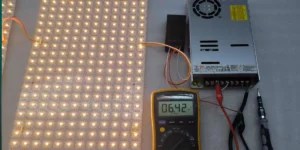

The following video shows the LED sheet system installed in the stone backlighting project, demonstrating real-world uniform illumination performance under operational conditions.

FAQ
Project Summary & Engineering Value
Engineering Value
This project demonstrates how LED sheet technology can be successfully engineered into a scalable architectural backlighting system through a system-level design approach.
Rather than focusing solely on lighting performance, the project was developed around three core engineering principles:
- Stable optical performance across high-density LED sheet layouts
- Simplified panel-based electrical architecture
- Centralized control strategy for large-scale installations
Applications Suitable for This System Architecture
This panel-based LED sheet lighting architecture is particularly suitable for:
- Architectural stone wall backlighting
- Large-area translucent stone installations
- Luxury hotel lobby feature walls
- Commercial reception wall lighting
- Backlit decorative interior surfaces
- Custom architectural lighting projects requiring simplified wiring and centralized control
Need Support for a Stone Backlighting Project?
Our engineering team can help with:
- LED sheet layout optimization
- Power supply and load calculation
- Casambi / PWM / 0–10V system selection
- Wiring architecture recommendations
- Backlighting uniformity evaluation
- OEM LED sheet customization
Whether you are designing a hotel feature wall, translucent stone installation, or large-area architectural backlighting system, we can help optimize the lighting structure based on your project requirements.
Auther: Julie Zhu
Product Manager
E-Mail: julie.zhu@signlite.com.cn
Mobile / WhatsApp: +86 137 2872 4759

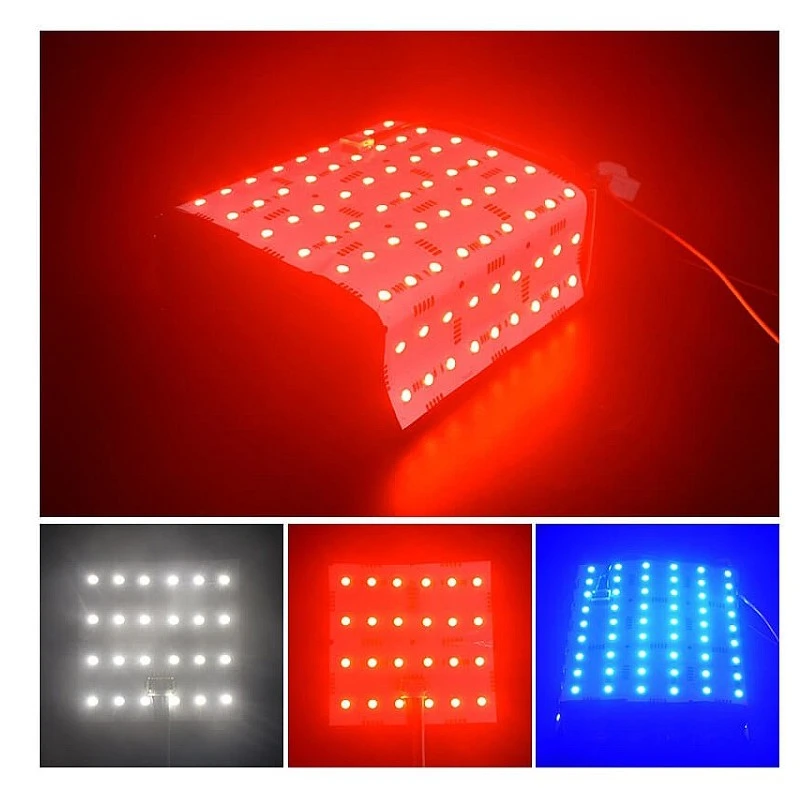
RGBW LED sheet lights
Size(LxW): 250mmx250mm/490mmx250mm
LED type: 5050 RGBW 4 In 1 SMD LEDs
LED quantity: 150LEDs/288LEDs
Working voltage: DC 24V
Power: 24 W/48W
Emitting color: RGB + warm white ( 3000K ), RGB + natural white ( 4000K ), RGB + cool white ( 6000K )
Light Efficiency: 90LM/W
Minimum cutting length: 50mmx50mm/20.4mm x122.5mm
Beam angle: 120°
Dimmable: YES
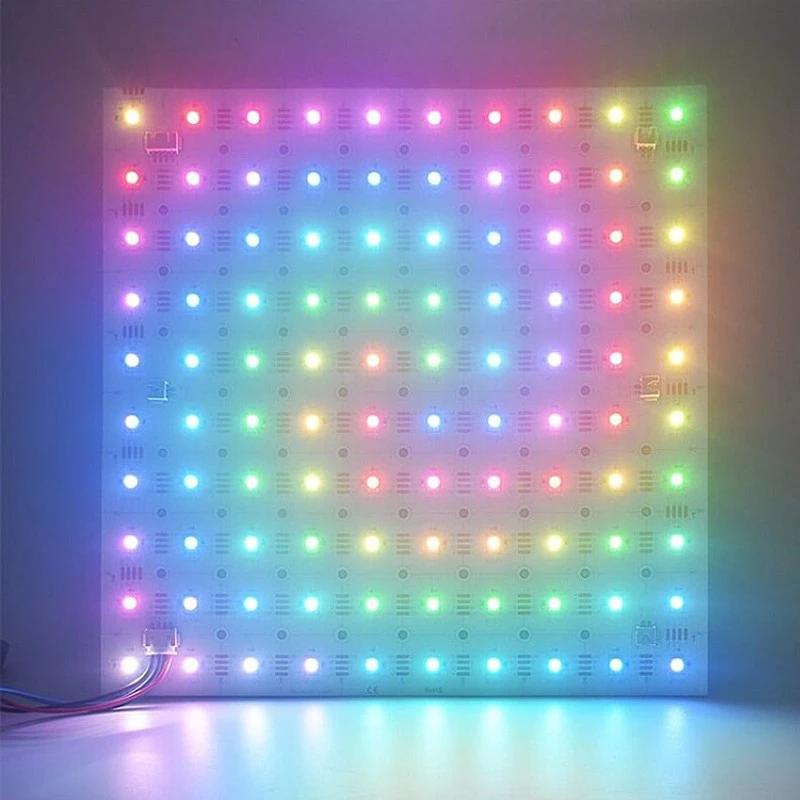
Addressable LED Sheets
Size(LxW): 250mmx250mm
LEDs: 100 pieces 5050 SMD
IC type: Built-in WS2812
IC quantity: 100 pieces
Color: RGBIC
Working voltage: DC 12V
Current: 1.08A
Power: 13W
Luminous flux: 20lm/LED
Wavelength: 620-625nm(red), 520-525nm(Green), 465-470nm(Blue)
Beam angle: 120°
Related Posts