English
  简体中文
简体中文  Deutsch
  Español
  Français
  Italiano
  日本語
日本語  한국어
한국어  Polski
  Português
  Русский
  Türkçe
  Nederlands
  Tiếng Việt
  ไทย
ไทย 
In commercial and residential lighting projects, color quality and visual comfort are becoming just as important as energy efficiency. As LED technology continues to evolve, lighting designers and engineers are paying closer attention to advanced optical performance indicators such as CRI, R9, blue light emissions, and full-spectrum output. These factors directly influence how accurately objects are represented under light, as well as how safe and comfortable the light is for human eyes. Whether you are choosing SMD LED strips for cabinets, COB strip lights for continuous linear illumination, or flexible LED neon lights for decorative elements, understanding these lighting metrics will help you deliver better project outcomes and a more premium visual experience.
CRI and R9: The True Measurement of Color Accuracy
What Are CRI, Ra, and R9 — And How Are They Different?
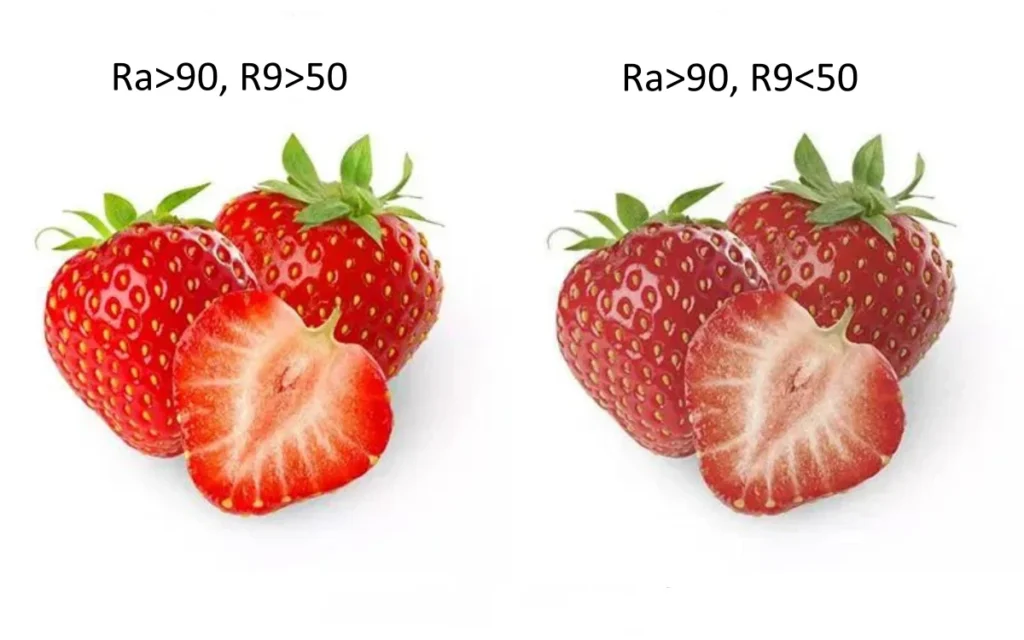
CRI (Color Rendering Index) is a metric that evaluates how accurately a light source reveals the colors of objects compared to natural sunlight. The commonly referenced CRI value, Ra, is calculated based on the average performance of eight pastel test color samples (R1–R8). However, these samples do not include saturated red, which is crucial in many real environments. This is where R9 comes in — it specifically measures how well deep red colors (skin tones, meat, fresh fruits, fabrics, artworks) appear under the light. A light strip may claim a high Ra value, but still perform poorly in real-life color reproduction if its R9 score is low.
Why Is R9 So Important?
R9 directly influences the perceived warmth and natural feel of illuminated objects. High R9 lighting improves the appearance of human faces, making skin tones healthier and more vibrant. It enhances the visual quality of products in retail and hospitality spaces, and it is essential for medical, art, and food display environments. For premium projects with strict lighting specifications, a CRI above 90 must be paired with a high R9 score — ideally R9 > 50 or even R9 > 80.
Why Some Ra90 LED Strips Have Very Low R9?
Achieving high Ra does not guarantee high R9. Many manufacturers optimize only the first eight color samples to artificially boost the Ra value, while reducing red phosphor content to save cost and improve luminous efficacy. As a result, some Ra90 LED strip lights still have R9 values below zero, meaning they distort red tones. This is especially common in low-cost COB strips and SMD strips using standard phosphor formulations.

CRI Differences Among SMD, COB, and LED Neon Strips
SMD LED Strips: Performance depends heavily on LED binning and phosphor quality; high-CRI versions are available but vary widely by supplier.
COB LED Strips: Because of the continuous chip array and advanced phosphor coating process, COB strips typically achieve more uniform lighting and more stable CRI, making them a better choice for Ra90+ and high R9 specifications.
LED Neon Flex: Color accuracy depends on the internal light source. The silicone diffuser may slightly shift spectral output, so high-CRI COB-based neon lights usually perform better.
How to Choose the Right CRI Rating for Your Project
General lighting: CRI 80+ / R9 > 0
Residential & high-end retail: CRI 90+ / R9 > 50
Hospitals, museums, food lighting: CRI 95+ / R9 > 80
Always request full CRI report (R1–R15) and spectral test data rather than relying solely on Ra or catalog claims.
Blue Light Hazard and IEC 62471 Classification
Blue light refers to visible light in the short-wavelength region — roughly 400–500 nm — which carries relatively high photon energy and can, under high intensity or prolonged exposure, contribute to photochemical stress on the retina.
To regulate this, IEC 62471 defines four “Risk Groups” for photobiological safety of lamps:
RG0 (Exempt) — no photobiological hazard under reasonable exposure.
RG1 (Low Risk) — safe under normal use/behavior constraints.
RG2 (Moderate Risk) — may be hazardous with unusually long or direct exposure, though typical use remains safe.
RG3 (High Risk) — potentially hazardous even for brief or momentary exposure.
When specifying LED strip lighting (SMD, COB, Neon etc.) for interior or ambient use, designers should aim for RG0 or RG1 classification — meaning the blue-light weighted radiance stays within safe limits under standard viewing conditions. For a detailed technical explanation of how blue-light radiance is measured and classified in LED products, refer to the article “IEC 62471 Blue Light Hazard Explained”.
Full Spectrum LED Strips: A Closer Step to Natural Sunlight
What Is Full Spectrum Lighting?
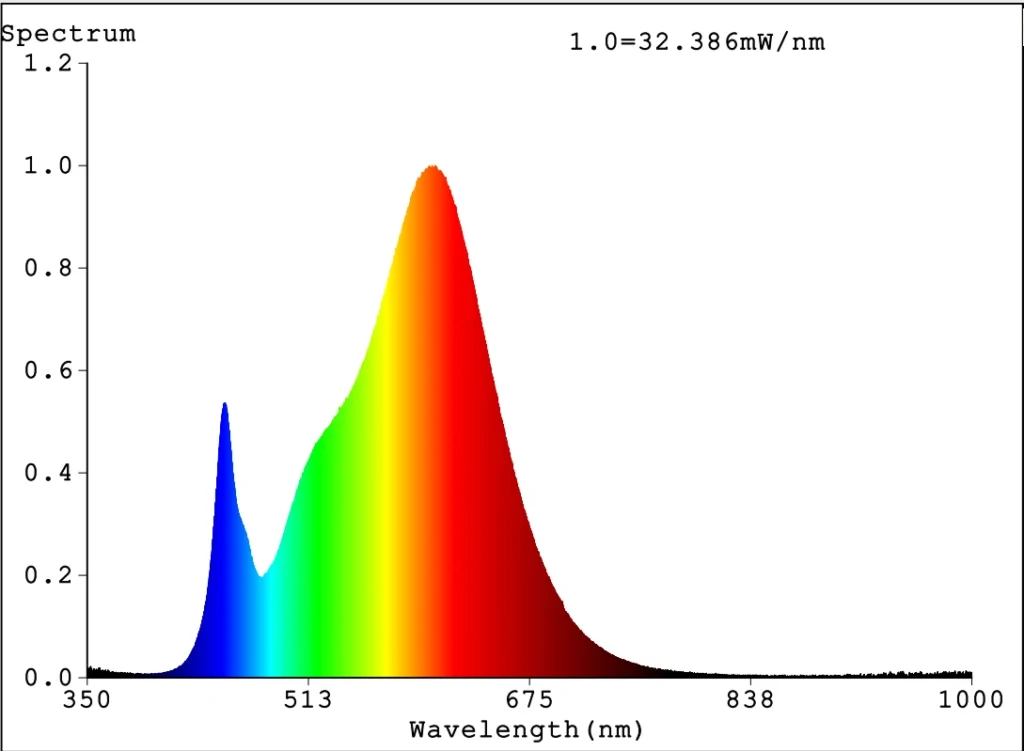
In general illumination, full-spectrum LED lighting refers to light sources whose spectral distribution closely mimics natural daylight. Unlike plant-growth lighting that enhances specific red and blue wavelengths for photosynthesis, full-spectrum lighting for daily environments aims for a continuous and balanced spectrum — providing all visible wavelengths more uniformly, instead of leaving strong peaks and gaps like conventional LEDs.
How Does It Differ from Traditional LEDs?
Standard white LEDs usually rely on a blue LED chip coated with a limited amount of phosphor. This creates uneven spectral power distribution with a significant blue spike and weak red region, which often leads to low R9 values and unnatural color rendition.
Full-spectrum LEDs, however, use advanced phosphor blends to boost missing wavelengths — especially the deep red and cyan regions — resulting in more complete color reproduction and a lighting quality closer to sunlight.
Benefits for Visual Comfort and Well-Being
A more continuous spectrum provides several advantages:
Better visual clarity & color recognition: Objects look more realistic and vivid.
Reduced eye strain: Less spectral imbalance, more comfortable long-term viewing.
Improved human mood & circadian support: Light that resembles daylight can help regulate sleep-wake cycles and create a more uplifting atmosphere.
These benefits contribute to healthier and more productive environments in both residential and commercial spaces.
Where Should Full-Spectrum LED Strips Be Used?
Premium Residential Lighting
Improves skin tone appearance, enhances décor colors, and supports daily comfort and relaxation.
Museums & Art Galleries
Ensures artworks are displayed with accurate tones while providing visually pleasant illumination for visitors.
Retail & Hospitality Applications
Enhances product visual appeal (fashion, cosmetics, food) and creates a high-end atmosphere that drives purchasing desire.

Conclusion — Choose High-Quality LED Strips for Better Lighting Performance
Achieving excellent lighting results requires more than just high brightness. By selecting LED strips with high CRI, strong R9 performance, low blue light hazard, and full-spectrum capability, lighting designers can create safer, healthier, and more visually appealing environments.
At SignliteLED, we offer a wide range of SMD LED strips, COB LED strips, and LED neon flex designed for professional projects. Our products are available with CRI up to Ra95 and R9 > 80, and all meet RG0 safety standards for blue light emission. We also support custom full-spectrum solutions to help you deliver premium lighting experiences across high-end residential, retail, and commercial spaces. Contact us to upgrade your next project with superior-quality lighting.
Related Posts