English
  简体中文
简体中文  Deutsch
  Español
  Français
  Italiano
  日本語
日本語  한국어
한국어  Polski
  Português
  Русский
  Türkçe
  Nederlands
  Tiếng Việt
  ไทย
ไทย 
If you manage a parking garage, you already know this: bad lighting is expensive.
Dark corners hurt safety, patchy coverage frustrates drivers, and outdated fluorescents burn through your energy budget and maintenance hours.
That’s exactly where LED Tri-Proof Lights for parking garages come in.
These are not just “another LED fixture.” Tri-proof means protection against water, dust, and impact—the three things that destroy most lights in real-world garages. Think IP65/IP66 waterproof, IK08/IK10 impact-resistant housings, and long-life drivers designed to run for years in damp, dirty, high-traffic structures.
In this Complete Buyer’s Guide 2026, you’ll see:
- How the right IP66 tri-proof LEDs can cut your lighting costs by up to 60–70%
- Which lumens, wattage, and color temperature (4000K–5000K) actually work best in multi-level garages
- What’s new for 2026: smart motion sensors, IoT controls, and eco-friendly designs that help with codes and ESG goals
- How to choose between budget and premium options, including proven fixtures from brands like SignliteLED
If you’re planning a garage retrofit or building new in 2026, this guide will give you clear, practical criteria to pick LED Tri-Proof Lights that boost safety, lock in long-term savings, and keep you ahead of upcoming regulations.
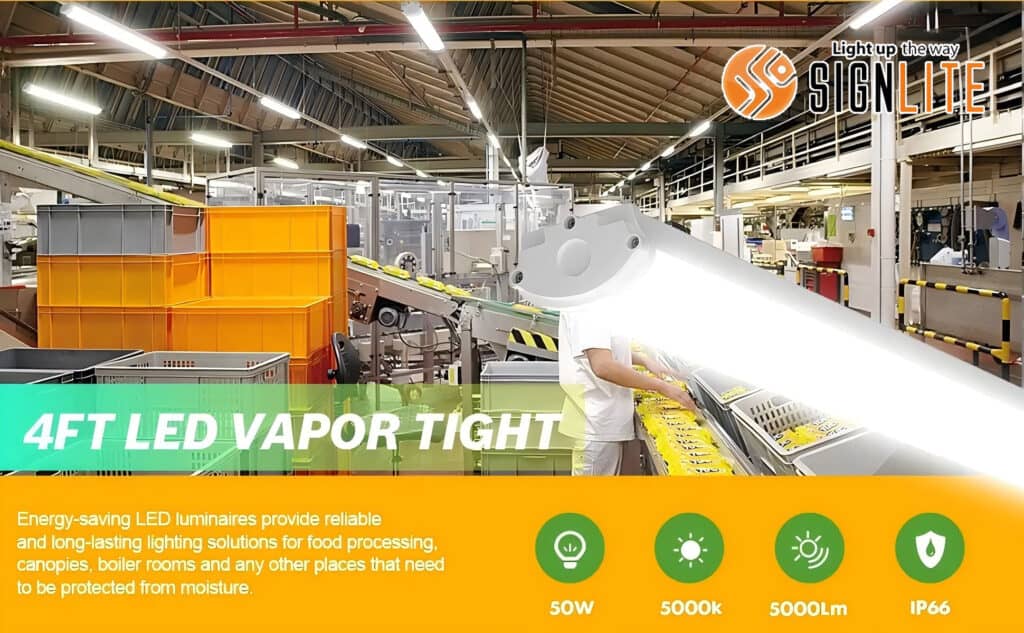
Why Parking Garages Need LED Tri‑Proof Lights
Parking garages are some of the toughest environments for lighting. You’re dealing with constant exhaust fumes, dust, humidity, water leaks, vibration, low ceilings, and moving vehicles 24/7. Standard fixtures fail fast here, which is why IP65/IP66 waterproof, IK08/IK10 impact-resistant LED tri-proof lights are becoming the global standard for secure, low-maintenance parking lighting.
Harsh Garage Conditions
In real garages, lights must survive:
- Moisture and condensation from weather changes and underground humidity
- Corrosive exhaust gases and salt (especially in coastal or winter regions)
- Mechanical impacts from vehicles, equipment, and vandalism
- Temperature swings in open-sided or rooftop structures
LED tri-proof luminaires use sealed housings, anti-corrosion materials, and durable polycarbonate covers, so they keep performing where typical vapor-tight or open fixtures fail.
Safety, Visibility, and Compliance
Poor lighting increases accidents, crime, and liability. Modern parking garage lighting standards and many local codes now expect:
- Uniform illumination with minimal dark spots for pedestrian and vehicle safety
- Fast, flicker-free start in cold and damp conditions
- 5000K cool white light for better visibility and CCTV image quality
- Reliable emergency and backup compatibility in critical areas
With high-lumen, well-distributed beam angles, LED tri-proof lights for parking garages improve reaction times, make people feel safer, and help you meet security and building-code expectations.
From Fluorescent to LED – and Toward 2026 Net‑Zero
Old fluorescent and HID fixtures waste energy, fail early, and drive up maintenance costs. In contrast, energy-efficient tri-proof LED garage lights deliver:
- Up to 60–75% energy savings vs. fluorescent strips and vapor-tight tubes
- 50,000–100,000 hour lifespans, slashing relamping in hard-to-reach ceilings
- Stable output in cold and damp environments, with instant-on performance
As cities and property portfolios target 2026 net‑zero and ESG goals, upgrading to sustainable LED lighting for multi-level garages is one of the fastest, most measurable wins. When you combine high-efficiency drivers, motion-sensor control, and smart dimming, your parking structure becomes a powerful asset in your global decarbonization strategy—not a hidden energy drain.
Core Features of LED Tri-Proof Lights for Parking Garages
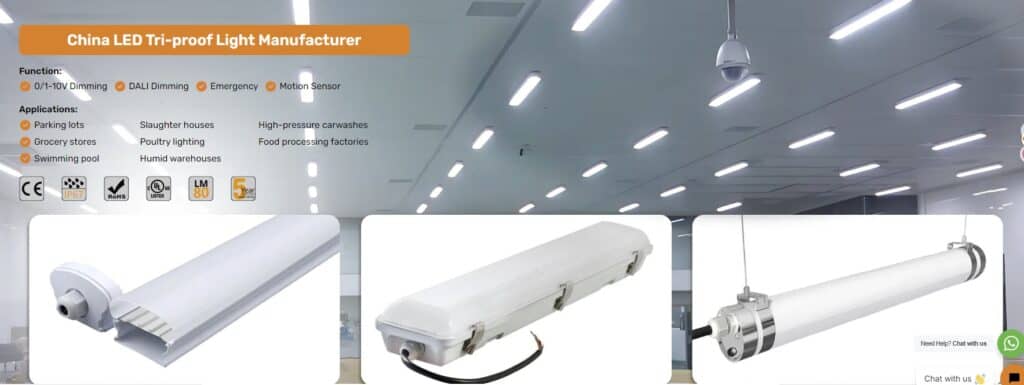
LED Tri-Proof Lights are built to survive parking garages: damp air, exhaust, dust, and the occasional impact. Here’s what really matters when you’re buying in 2026.
IP65 / IP66 & IK08 / IK10 – What These Ratings Really Mean
For parking garages, IP66 waterproof LED garage lights and IK10 impact-resistant parking fixtures are the sweet spot:
| Feature | What It Means in Real Life | Recommended for Garages |
|---|---|---|
| IP65 | Dust-tight, protected from water jets | Indoor/covered levels |
| IP66 | Dust-tight, heavy water jets, harsher conditions | Exposed edges, ramps |
| IK08 | Handles accidental knocks, balls, trolleys | Light traffic areas |
| IK10 | Very high impact resistance (up to 20J hits) | Low ceilings, tight bays |
I always spec IP66 + IK10 for busy, low-clearance garages. It’s cheap insurance against early failures and vandalism.
Performance Specs That Actually Matter
Don’t just look at wattage. Focus on lumen output, beam angle, and color temperature:
| Spec | Typical Range for Tri-Proof | What to Choose for Garages |
|---|---|---|
| Lumen Output | 3,000 – 10,000 lm | 4,000–6,000 lm per fixture for most levels |
| Beam Angle | 120° – 150° | 120° for uniform bays & aisles |
| Color Temperature | 3000K – 6500K | 4000K–5000K cool white for security & clarity |
Go for 5000K cool white parking security lights where safety and CCTV clarity are the priority (entry/exit, payment zones).
Energy Efficiency, Lifespan & Surge Protection
Modern energy-efficient tri-proof luminaires should tick these boxes:
- Efficiency: ≥ 120 lm/W (140 lm/W is even better for ROI)
- Lifespan: 50,000–100,000 hours (L70) – that’s 10+ years in many garages
- Surge Protection: Minimum 2–4 kV, 6 kV if your site has unstable power
- Power Factor: ≥ 0.9 to avoid wasted energy
This is where tri-proof beats old fluorescent vapor-tight fittings by a mile on both cost and maintenance.
2026 Smart Upgrades: Motion, Dimming, IoT
To support 2026 net-zero and smart-building goals, I now design most garages with:
- Motion-sensor parking lot illumination
- Lights dim to 10–30% when no movement
- Ramp up instantly when vehicles or people are detected
- Dimmable IP65 fixtures for humid environments
- 0–10V, DALI, or wireless dimming to fine-tune energy use
- Systems like DALI-controlled linear lighting scale well to multi-level garages
- Smart IoT tri-proof garage systems
- Remote monitoring (failures, runtime, energy reports)
- Scene control by level, time band, or occupancy pattern
When you combine dimmable, sensor-ready tri-proof LED battens with a smart control backbone, hitting aggressive energy targets and local 2026 incentive requirements becomes much easier.
How to Choose the Right LED Tri-Proof Lights for Parking Garages
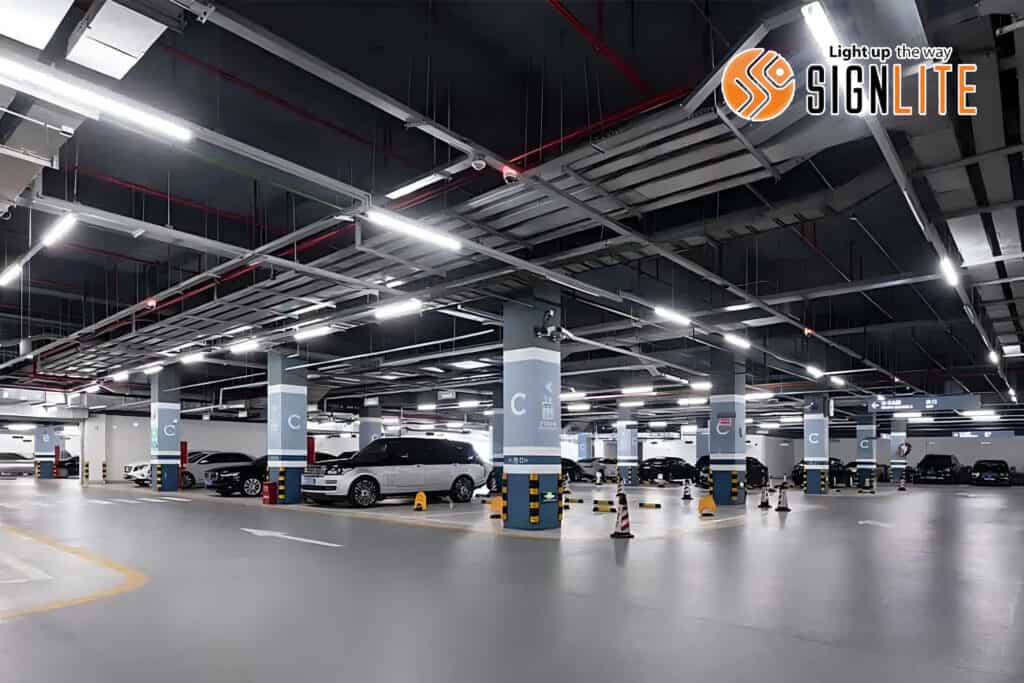
Choosing LED tri-proof lights for a parking garage is all about matching the fixture to the space, the budget, and your long-term plans (energy, safety, and smart control).
1. Assess Your Garage Space & Lighting Needs
Start with the basics:
- Garage type: underground, multi-level, open-sided, coastal, or humid
- Ceiling height:
- < 3 m: standard tri-proof battens
- 3–5 m: higher lumen tri-proof or mini high-bay
- Risk zones: entries/exits, ramps, payment areas, stairwells, EV charging
- Lighting targets (typical):
- General areas: 50–100 lux
- Ramps, entrances, ticket zones: 100–150 lux
Do a quick walk-through at night: anywhere that feels “dark” or unsafe needs higher lumen or closer fixture spacing.
2. Budget Tiers: Entry-Level vs Premium
Entry-level tri-proof LED
- Fixed output (no dimming)
- Basic IP65/IK08
- Good for small, low-traffic garages
- Lowest upfront cost, medium-long payback
Mid-range
- IP65–IP66, IK08–IK10
- Optional motion sensor & 0–10 V dimming
- Better drivers, 50,000+ hrs lifespan
- Strong choice for most commercial garages
Premium / 2026-ready
- IP66, IK10, anti-corrosion housing
- Smart control (DALI, Zigbee, IoT), grouping & scenes
- High efficacy (150–170 lm/W), best surge protection
- Ideal for large or 24/7 structures aiming at net-zero goals
If you’re planning smart dimming or synced control, pair tri-proof fixtures with a reliable LED controller; for example, a sync-capable dimmer like the CTL-S DIM SYNCD01 LED controller makes grouped dimming simple on big parking decks.
3. Key Buying Factors (Non-Negotiables)
When I specify tri-proof lights for garages, I always lock in these points:
- IP & IK Rating
- IP65/IP66 = strong waterproof/dustproof
- IK08–IK10 = impact-resistant for low ceilings and vandal risk
- Dimmability & Controls
- 0–10 V or DALI dimming
- Motion sensors for low-traffic zones
- Smart/IoT capable if you want app or BMS control
- Scalability
- Easy to add more fixtures or groups later
- Standard wiring and drivers (no weird proprietary stuff)
- Cold-start & Temperature Range
- Instant on at -20 °C or lower for cold climates
- Stable performance in hot, humid, or coastal garages
- Optics & Color
- 4000K–5000K (neutral–cool white) for security visibility
- Wide beam (120°+) for even coverage, no dark spots
4. Side-by-Side Spec Comparison Table
Use a quick spec table when deciding between models:
| Feature | Entry-Level Tri-Proof | Mid-Range Tri-Proof | Premium Smart Tri-Proof (2026) |
|---|---|---|---|
| Power range | 20–40 W | 30–60 W | 30–80 W |
| Efficacy (lm/W) | 110–130 lm/W | 130–150 lm/W | 150–170 lm/W |
| IP rating | IP65 | IP65–IP66 | IP66 |
| IK rating | IK07–IK08 | IK08–IK10 | IK10 |
| Dimming | No | Optional 0–10 V | 0–10 V / DALI / wireless |
| Motion sensor | No | Optional | Integrated / networked |
| Smart/IoT | No | Limited | Full IoT integration & grouping |
| Color temp | 4000K or 5000K (fixed) | 3000K–5000K options | Tunable range, better uniformity |
| Typical use | Small private garages | Standard commercial parking garages | Large, multi-level, net-zero projects |
| Payback time vs fluorescent | 2–4 years | 1.5–3 years | 1.5–2.5 years (with smart dimming savings) |
Lock in the basics (IP/IK, lumen output, temperature range), then decide how far you want to go on controls and smart features based on your 2026 energy targets and budget.
Top LED Tri-Proof Light Recommendations for 2026
SignliteLED IP66 Tri-Proof Series (Core Pick for 2026)
For 2026 parking garage projects, I’m putting the SignliteLED IP66 Tri-Proof series front and center. It’s built specifically for harsh, real-world garage conditions: humidity, car exhaust, dust, occasional water spray, and the odd impact from vehicles or trolleys.
Key points for parking garages:
- IP66 waterproof & dustproof – handles high humidity, wash-downs, and open ramp areas.
- Impact-resistant housing – durable polycarbonate body and aluminum backbone make it ideal for low ceiling and tight parking spots.
- High lumen-per-watt – strong brightness with lower energy draw, ideal for long operating hours.
- Smart-ready options – motion sensors, daylight dimming, and potential IoT integration for 24/7 monitored garages.
- Stable power design – paired with reliable LED drivers similar in class to our [LPV-series power supplies](https://www.signliteled.com/products/led-power-supply/lpv–
Installation Best Practices for LED Tri-Proof Lights in Parking Garages
Pre-install Site Audit & Layout Planning
Before we hang a single LED tri-proof light, we always audit the site:
- Measure the space: length, width, height, ramp slopes, and dead corners.
- Check existing wiring: voltage, circuit load, breaker condition, emergency lines.
- Identify critical zones: entrances/exits, payment areas, stairwells, elevators, pedestrian paths.
- Set lighting targets: lux levels per zone (typically 75–150 lux for general areas, higher at pay stations and entries).
- Plan fixture spacing: match beam angle, mounting height, and lumen output so you avoid dark patches and glare.
I always build a simple layout drawing: fixture positions, circuit groups, motion-sensor zones, and future IoT/smart expansion. This is where we lock in decisions on IP66 waterproof LED garage lights, IK10 impact-resistant fixtures, and dimmable IP65 options for humid environments.
Step-by-Step Mounting & Wiring
Every parking garage is different, but the workflow is almost always:
- Power off & lock out
- Shut down the relevant circuits and apply lockout/tagout. No exceptions.
- Mark fixture locations
- Snap chalk lines or laser lines for rows.
- Mark anchor positions on concrete or steel channels.
- Mount the brackets
- Use corrosion-resistant anchors and hardware (especially in coastal or humid garages).
- Keep brackets level to avoid water pooling on the housing.
- Install the LED tri-proof luminaires
- Clip or screw the housing into the brackets firmly.
- Make sure end caps and seals are fully seated (critical for IP65/IP66).
- Wire the electrical
- Match voltage and polarity; use proper waterproof cable glands.
- For motion-sensor parking illumination or dimming, follow the 0–10V
Maintenance and Long-Term ROI of LED Tri-Proof Lights for Parking Garages
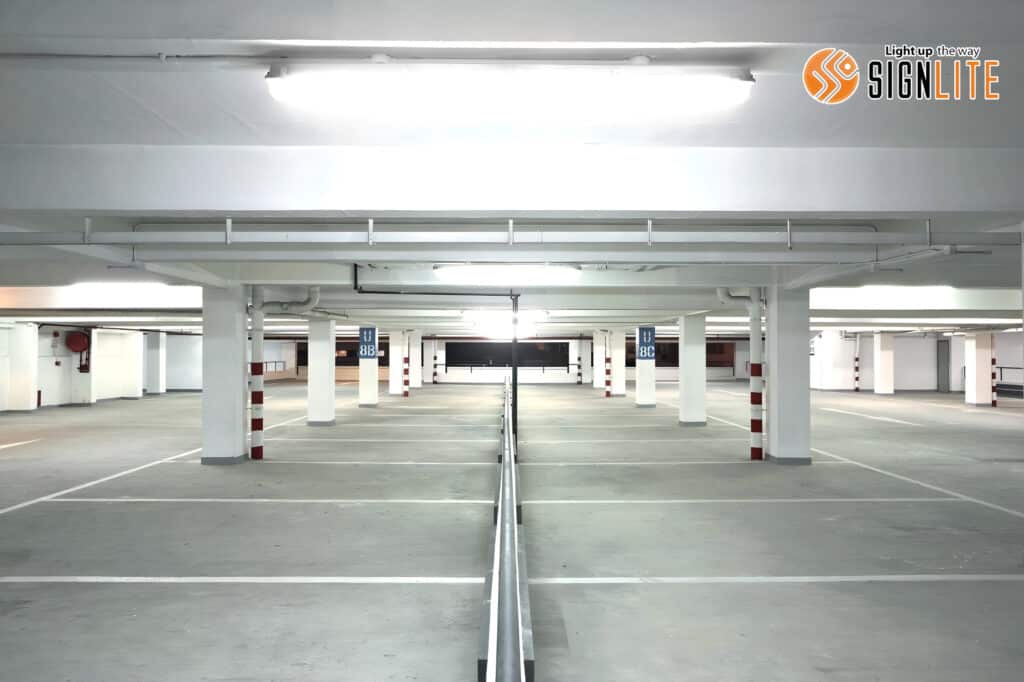
Easy Maintenance Tips for Longevity
LED tri-proof lights are low-maintenance, but you still need a plan if you want them to last 10–15+ years:
- Clean lenses every 6–12 months to remove dust, exhaust, and oil film. Use a damp cloth and neutral cleaner only.
- Inspect gaskets and cable glands to keep IP65/IP66 waterproof protection intact – replace cracked seals immediately.
- Check mounting hardware in high-vibration or coastal garages; tighten loose brackets and replace corroded screws with stainless steel.
- Test motion sensors and dimming quarterly to be sure lights respond fast in critical areas like entrances and payment points.
- Use surge-protected power supplies and drivers (similar to what we use in our industrial LED power supplies) to avoid failures during grid spikes.
Calculating Cost Savings and Energy Reduction
When you switch from fluorescent or HID to energy-efficient tri-proof luminaires, your numbers usually look like this:
- Energy savings: 50–70% vs. old tubes or fixtures.
- Maintenance savings: no lamp changes, fewer lift rentals, less downtime.
- Simple ROI check:
- Annual kWh saved = (Old wattage – New wattage) × hours/year ÷ 1000
- Annual savings = Annual kWh saved × local kWh rate
- Payback period (years) = Total project cost ÷ Annual savings
Most garages we upgrade see payback in 2–4 years, faster if you add motion-sensor parking lot illumination and dimming in low-traffic hours.
Sustainability Benefits and Recycling
LED tri-proof garage systems help hit 2026 sustainability and net‑zero targets:
- Lower CO₂ emissions from reduced kWh consumption.
- No mercury, unlike many old fluorescent tubes.
- Longer lifespan (50,000–100,000 hours) means fewer fixtures manufactured, shipped, and disposed of.
- Recycle aluminum housings, drivers, and wiring through local e‑waste programs; treat old fluorescent tubes as hazardous waste and dispose of them properly.
Real-Life ROI & Crime Reduction Case
One of our multi-level garage clients (about 400 spaces) replaced old 2×36W fluorescent battens with IP66 waterproof LED garage lights with motion sensors and 5000K cool white output:
- Energy cut by 62%, saving ~US$22,000 per year.
- Maintenance calls dropped by 80% in the first 3 years.
- Lighting uniformity improved by 30%, with brighter, shadow-free ramps and stairwells.
- Local police data showed a 25% drop in vandalism and vehicle break-ins after the upgrade, mainly due to better visibility and fewer dark corners.
Result: payback in just under 3 years, plus a safer, cleaner-looking garage that users trust and operators are proud to show.
FAQ: LED Tri-Proof Lights for Parking Garages (2026)
1. What’s the difference between tri-proof and vapor-tight lights?
Short answer: All tri-proof are vapor-tight, but not all vapor-tight are tri-proof.
| Feature | Tri-Proof LED Lights | Vapor-Tight LED Lights |
|---|---|---|
| Protection focus | Water + dust + impact + corrosion | Mainly moisture & dust |
| Typical rating | IP65–IP66, IK08–IK10 | Often IP65, impact rating not always given |
| Housing | Heavy-duty PC / aluminum, anti-corrosion | Plastic body, basic sealing |
| Best use | Parking garages, tunnels, harsh industrial use | Damp rooms, covered walkways |
For real parking garages, I always specify IP66 + IK10 tri-proof instead of generic vapor-tight strips. The failure rate and breakage risk drop sharply.
2. How do LED tri-proof lights handle coastal saltwater corrosion?
If your garage is near the coast, treat it like a harsh industrial site.
Look for:
- Anti-corrosion coatings on metal parts
- Stainless steel clips and screws (304 or 316)
- UV-stabilized polycarbonate housing and diffuser
- IP66 or better with tested salt-spray resistance
Basic vapor-tight lights will yellow, crack, and rust fast in salty air. Our anti-corrosion LED battens are built exactly for these coastal conditions.
3. Can LED tri-proof garage lights qualify for 2026 tax credits and incentives?
n many regions, yes – especially where governments are pushing net-zero 2030–2050 and 2026 interim targets.
To increase your chances:
- Choose UL / DLC / CE listed energy-efficient tri-proof luminaires
- Make sure they’re dimmable and support motion sensors / smart controls
- Keep invoices, spec sheets, photometric files, and before/after kWh data
- Work with a certified installer who knows local rebate programs
Most programs reward:
- kWh reduction vs old fluorescent/HID
- Controls (motion sensing, daylight dimming, IoT)
4. Can I add motion sensors and smart controls to tri-proof lights?
Yes, and you should. For parking garages, this is where a lot of the ROI comes from.
You can integrate:
- Built-in microwave or PIR motion sensors
- 0–10V or DALI dimming
- IoT gateways for scheduling, monitoring, and zoning
If you’re planning color or effect lighting in entrance areas or wayfinding, the same mindset used with DMX512 pixel control (as in our DMX LED controller solutions) applies to smart tri-proof systems: central control, scene logic, and reduced maintenance.
5. What CCT (color temperature) is best for parking garages?
For security and visibility:
| Application | Recommended CCT |
|---|---|
| General garage areas | 4000K–5000K |
| Security / CCTV coverage zones | 5000K cool white |
| Premium residential / hotel sites | 3500K–4000K (softer) |
5000K cool white parking security lights usually give the best camera performance and “safe” feel.
6. Are LED tri-proof lights safe for low-ceiling garages?
Yes, just size them correctly.
Check:
- Glare rating (UGR) and diffuser quality
- Proper wattage and lumen output for your mounting height
- Beam angle (typically wide, 120° for uniform coverage)
For very low ceilings (2.2–2.5 m), I lean on slim, wide-beam tri-proof battens, mounted directly to the slab.
7. How long do LED tri-proof garage lights last?
Good tri-proof fixtures should offer:
- 50,000–100,000 hours rated life
- L70 or L80 lumen maintenance
- 5–7 year warranty from a serious supplier
In real parking garage use, that’s often 8–12+ years if you use motion dimming and keep them clean.
8. Are tri-proof lights suitable for retrofits in old underground structures?
Yes. Most of our projects are retrofits.
What we do:
- Use LED retrofit tri-proof battens that match or improve existing spacing
- Tap into existing conduit and junction boxes
- Upgrade wiring to fit 0–10V dimming and sensors where needed
For complex control zones, we sometimes pair tri-proof lighting with external controllers, similar in principle to an advanced RGB controller setup – but dedicated to white, dimmable garage lighting.
9. Can LED tri-proof lights work in very cold or very hot parking garages?
Yes, if you choose the right spec.
Look for:
- Operating range at least -20°C to +45°C (or better)
- Instant cold start with no warm-up
- Surge protection and quality drivers in hot climates
Cheap fixtures often fail first at the driver, not the LEDs.
10. Are tri-proof lights dimmable?
Most professional IP65/IP66 tri-proof fixtures support:
- 0–10V dimming
- DALI (in more advanced systems)
- On/off or step dimming via motion sensor modules
Just double-check “dimmable” in the spec sheet – some entry-level models are still on/off only.
If you share your garage size, ceiling height, and location (indoor, rooftop, coastal, etc.), I can narrow this down to 1–2 ideal LED tri-proof specs and a realistic payback estimate.
Related Posts