English
  简体中文
简体中文  Deutsch
  Español
  Français
  Italiano
  日本語
日本語  한국어
한국어  Polski
  Português
  Русский
  Türkçe
  Nederlands
  Tiếng Việt
  ไทย
ไทย 
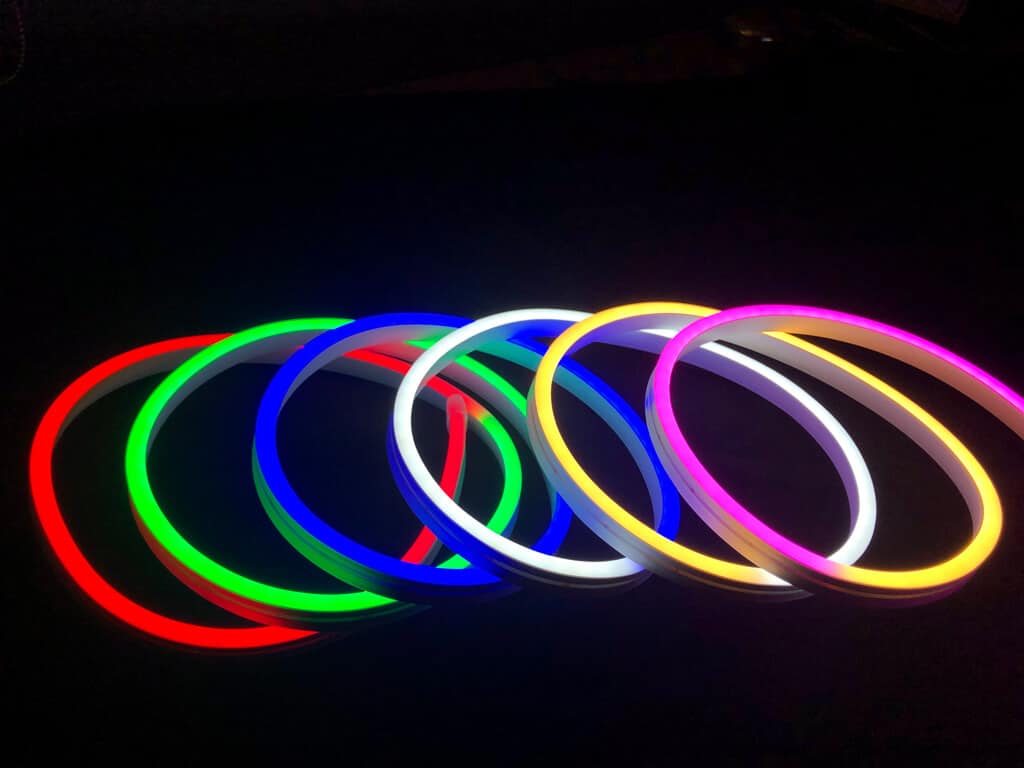
A common lighting option, LED neon lights have many benefits over conventional glass neon lights. They have a lot of customizing choices, are durable, and use little energy. Is it possible for LED neon lights to change colors? is a common query. We shall examine the response to this question in this blog article.
Yes, LED neon lights can change colors, to give you the quick answer. In contrast to how classic glass neon lights change colors, LED neon lights use a different process. To change the color of a standard glass neon light, a different gas must be inserted into the tube; this new gas emits a different color when excited by an electric current.
RGB LED chips are used in LED neon lights to change the colors. Red, green, and blue are the three basic hues of light, and their abbreviation is RGB. Any color can be made by mixing these main colors in various ways. Red, Green, and Blue (RGB) LED chips feature independent red, Green, and Blue (RGB) diodes that can be separately regulated to produce a wide spectrum of colors.
A controller is used to modify each diode’s intensity in order to change the color of an LED neon light. For instance, in order to produce the color purple, just the red and blue diodes would be activated, leaving the green diode off. The red, green, and blue diodes would be on fully to produce the color yellow, but the blue diode would be off.
Remote controllers and DMX controllers are the two primary categories of controllers used to alter the color of LED neon lights. You may change the color of your LED Neon lights with the touch of a button thanks to remote controllers, which are straightforward and user-friendly. The use of DMX controllers, which are more complicated, is more common in professional settings like large-scale installations or stage lighting. The color and brightness of LED neon lights may be more precisely controlled with DMX controllers, which can also be programmed to provide unique lighting effects.
It’s significant to remember that not all LED Neon lights have color-changing capabilities. Some LED neon lights are made to radiate a single, unchangeable color. If color changing capabilities are crucial to you, make sure to examine the product specifications before selecting LED Neon lights.
In conclusion, RGB LED chips and a controller allow LED neon lights to change colors. Although the method for changing colors in LED neon lights is distinct from that utilized in conventional glass neon lights, it still offers a variety of customizing options. If color changing capabilities are crucial to you, make sure to examine the product specifications before selecting LED Neon lights. LED neon lights with color-changing capabilities provide a flexible and dynamic lighting solution that may improve any area or environment.
Related Posts