Deutsch
  English
  简体中文
简体中文  Español
  Français
  Italiano
  日本語
日本語  한국어
한국어  Polski
  Português
  Русский
  Türkçe
  Nederlands
  Tiếng Việt
  ไทย
ไทย 
Ja, LED-Neonschilder im Freien können bei Regen und Schnee arbeiten, wenn sie für die Installation im Freien konzipiert und den richtigen Umgebungsbedingungen angepasst sind. Die langfristige Zuverlässigkeit im Freien hängt jedoch in der Regel mehr von der wasserdichten Abdichtung, dem Schutz des Steckers, der Installationsmethode, der UV-Belastung und der Platzierung der Stromversorgung ab als der LED-Streifen allein.
Viele als „wasserdichte“ verkaufte Schilder entwickeln nach wiederholtem Regen, Feuchtigkeit, Sonnenlicht oder Winterwetter immer noch Probleme, da die schwächsten Stellen häufig Anschlüsse, Kabelverbindungen, Endkappen und Treiber und nicht die LEDs selbst sind.
Zum Beispiel weist ein unter einem Café-Halbkappe installiertes Schild sehr unterschiedliche Bedingungen auf als ein vollständig freiliegendes Schild an einer Straßenfassade. Einer befasst sich hauptsächlich mit Feuchtigkeit und gelegentlichem Regenspray, während der andere im Laufe des Jahres Stürmen, direktem Sonnenlicht, Schneeansammlungen und Temperaturänderungen ausgesetzt ist. Dieser Unterschied in der Exposition kann die langfristige Leistung im Freien erheblich beeinträchtigen.
Bei vielen Ausfällen im Freien funktionieren die LEDs selbst immer noch normal. Probleme beginnen normalerweise viel früher, wenn die Feuchtigkeit langsam schlecht versiegelt wird, sich die Feuchtigkeit um den Fahrer herum ansammelt oder die langfristige Wetterexposition die gefährdeten Teile des Systems schwächt.
Dieser Artikel erklärt, was einen Outdoor-Ausschnitt tatsächlich ausmacht LED-Neon Schilder wasserdicht, warum manche Schilder nach Regen oder Winterwetter ausfallen, was IP65, IP67 und IP68 wirklich im Freien bedeuten und was Käufer überprüfen sollten, bevor sie ein Neonschild für eine langfristige Installation im Freien wählen.
Können LED-Neonschilder im Freien den Regen tatsächlich überleben?
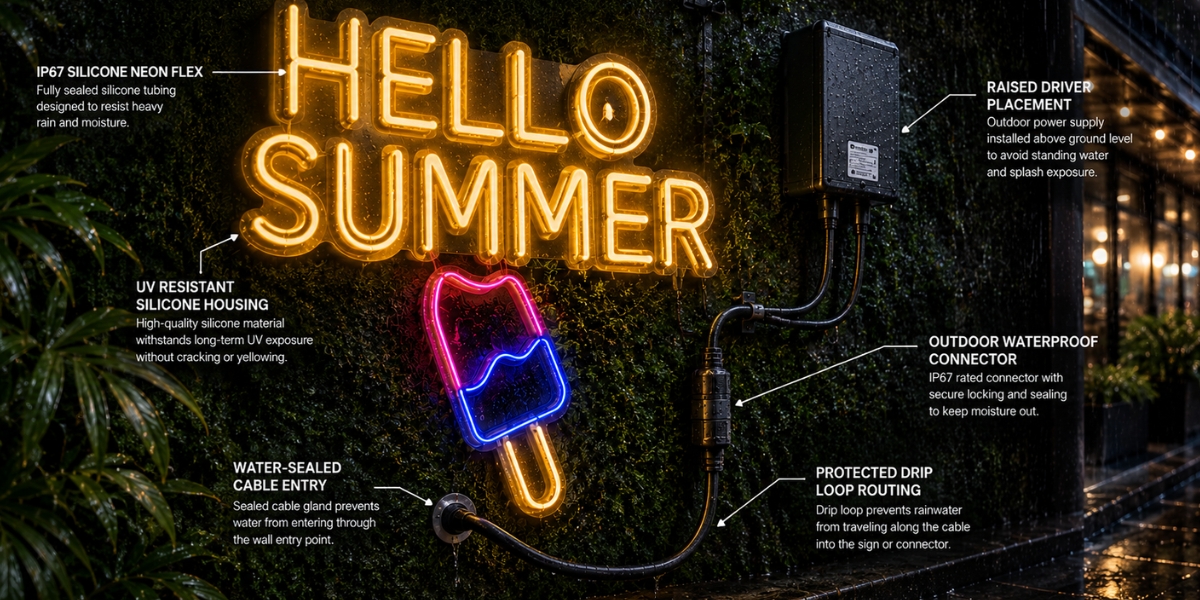
Ja, LED-Neonschilder im Freien können Regen überleben, wenn sie für die Installation im Freien ausgelegt sind und korrekt geschützt sind. Die langfristige Leistung im Freien hängt jedoch stark von der Verbinderdichtung, der Installationsmethode, der Entwässerungsplanung, dem Netzteilschutz und der Umweltbelastung ab.
Ein kleines Neonschild, das unter einem überdachten Café-Eingang hängt, weist sehr unterschiedliche Bedingungen auf als ein großes Schild an einer vollständig freiliegenden Straßenfassade. Einer befasst sich hauptsächlich mit Feuchtigkeit und gelegentlichem Regenspray, während der andere das ganze Jahr über Stürmen, direktem Sonnenlicht, Winterfeuchtigkeit und wechselnden Temperaturen ausgesetzt sein kann.
Dieser Unterschied in der Exposition ist ein Grund, warum einige Neonzeichen im Freien jahrelang weiter betrieben werden, während andere nach wiederholter Wetterexposition Probleme zeigen.
Bei realen Außenanlagen beginnen Ausfälle häufig eher an verwundbaren Verbindungspunkten als an Neon.
Probleme beginnen oft in kleineren Bereichen um das Schild:
- Kabelverbindungen
- Anschlüsse
- Endkappen
- Stromversorgung
- Entwässerungsbereiche hinter dem Schild
Bei starkem Regen kann sich beispielsweise Wasser langsam entlang des Stromkabels bewegen und sich um den Stecker sammeln, anstatt abzulaufen. Wenn die Abdichtung in diesem Bereich mit der Zeit schwächer wird, kann bei wiederholten Stürmen allmählich Feuchtigkeit eindringen.
Das Schild kann zunächst noch normal funktionieren. Dann treten Monate später kleine Probleme auf:
- Zufälliges Flackern
- Abschnitte abblenden
- Instabile Farben
- Teile des Schildes werden nach Regen abgeschaltet
Dies geschieht normalerweise, weil sich bereits Korrosion um elektrische Verbindungsstellen im System herum gebildet hat.
Ein Nahaufnahmebild, das einen versiegelten wasserdichten Stecker und einen schlecht geschützten Stecker vergleicht, würde hier natürlich passen, da viele Käufer nie sehen, wo tatsächlich Ausfälle im Freien beginnen.
Ein weiteres häufiges Problem ist das Netzteil. Einige Schilder verwenden Indoor-Fahrer im Freien, weil sie weniger kosten. Das Problem ist, dass sich im Fahrergehäuse langsam Feuchtigkeit aufbauen kann, insbesondere hinter geschlossenen Schildern oder schlecht belüfteten Fassaden.
Auch ohne direkte Regenbelastung kann die eingeschlossene Feuchtigkeit die Elektronik im Laufe der Zeit beeinträchtigen.
Das Schlauchmaterial beeinflusst auch das Verhalten eines Schildes im Laufe der Zeit. PVC-Schläuche können bei der Installation stabil aussehen, aber längere Sonneneinstrahlung kann einige Materialien allmählich härter oder leicht gelb machen, insbesondere bei heller Neon, die jeden Tag direktem Sonnenlicht ausgesetzt sind.
Das Materialverhalten hängt auch vom spezifischen Neonprofil und der Umweltexposition ab. Einige Neon-Outdoorsysteme verwenden Silikon, da es bei Temperaturänderungen im Allgemeinen flexibler bleibt und wetterbedingte Bewegungen stetiger toleriert, obwohl die langfristige Leistung im Freien immer noch stark von der Dichtungsqualität, den UV-Bedingungen und dem Installationsdesign abhängt.
| Outdoor-Problem | Was verursacht es normalerweise |
|---|---|
| Nach Regen flackern | Feuchtigkeit langsam eindringt Stecker |
| Tote Abschnitte im Winter | Wasser erreicht schwache Kabelverbindungen und Gefrieren |
| gelbe Schläuche | Langzeit-UV-Exposition bei einigen Materialien |
| Fahrerausfall | Innenraumadapter im Freien |
| Rost um Drähte | Schlechte Abdichtung in der Nähe von Verbindungs |
Kommerzielle Outdoor-Neonsysteme werden häufig mit stärkerer Aufmerksamkeit auf die Abdichtung von Steckern, die Entwässerungsplanung und den Fahrerschutz ausgelegt, da die langfristige Leistung im Freien mehr von der Neon-Schlauch abhängt. Sobald ein Schild das ganze Jahr über echtem Wetter ausgesetzt ist, wird die Installationsqualität oft genauso wichtig wie die Produktspezifikationen.
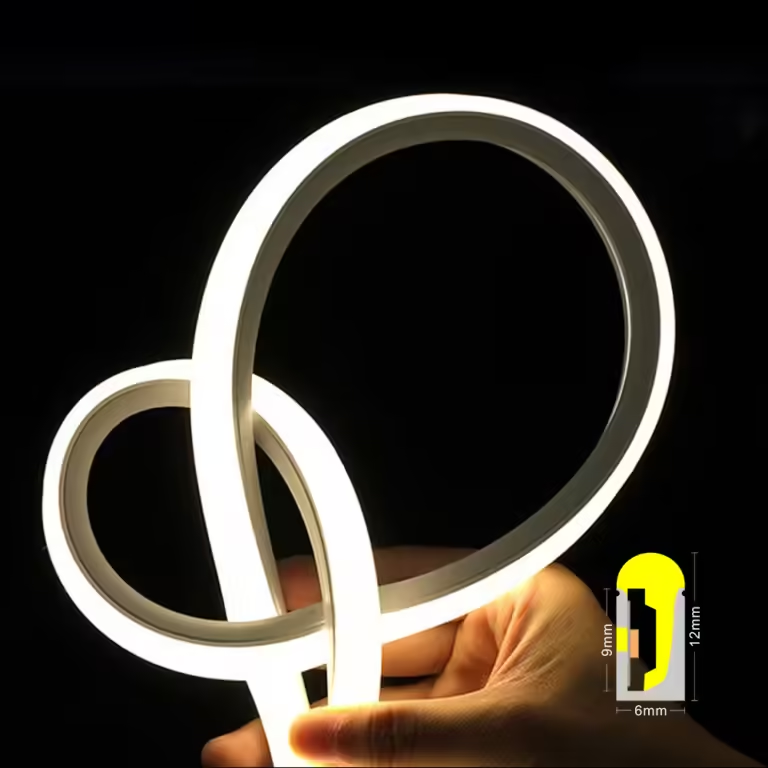
Seite biegen S0606/S0612 Silikon LED Neon Flex Strip
- Eingangsspannung: DC24V
- Watt: 9,6 W/m
- LED ANZAHL SMD2835 120LEDs/m
- Farbtemperatur: 2700K/3000K/4000K/5000K/6500K/customizable
- CRI: >80
- Lumen: >240lm/m
- IP-Grad: IP65/IP67
- Kabeleingang: Vorderseite/Seite/Unterseite für optionale
- Min. Biegedurchmesser: 100mm
- Schneidbare Länge: 50mm
- Länge: 5Meter/Rolle
Warum flackern einige Neonschilder im Freien nach Regen?
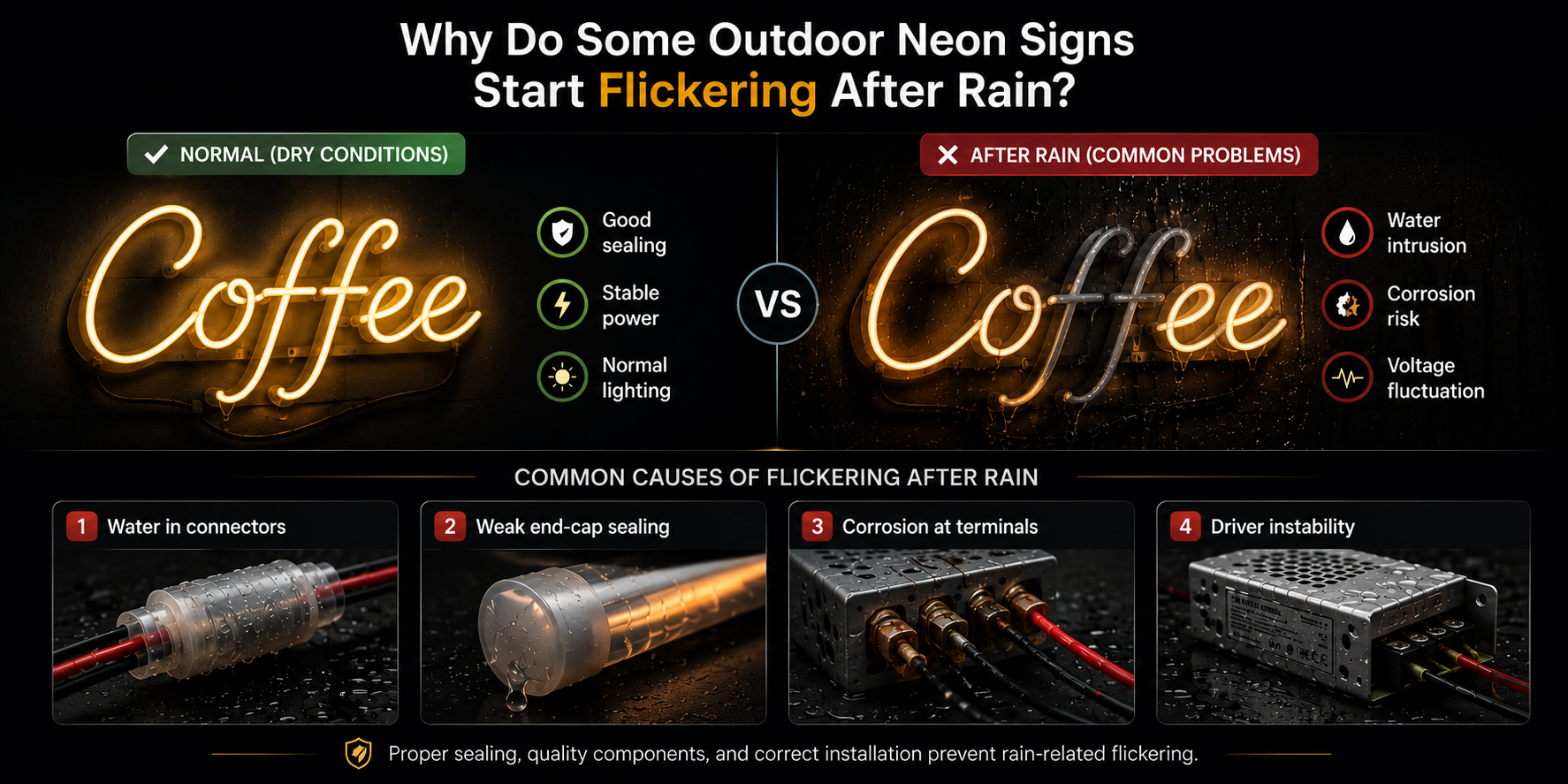
Neon-Schilder im Freien beginnen nach Regen zu flackern, wenn die Feuchtigkeit langsam anfällige elektrische Verbindungspunkte erreicht. In vielen Fällen funktionieren die LEDs selbst immer noch, aber eine schwache Verbindungsdichtung, eingeschlossene Feuchtigkeit oder Wassereintritt in Kabelverbindungen beeinträchtigen allmählich die elektrische Stabilität.
Eines der ersten Anzeichen für Wasserschäden im Freien ist das Flackern. Das Schild kann immer noch normal eingeschaltet werden, aber bestimmte Buchstaben beginnen nach dem Regen zu blinken, die Farben werden instabil oder ein Abschnitt sieht plötzlich dimmer aus als der Rest.
In vielen Außenanlagen entwickelt sich dieses Problem allmählich, anstatt alles gleichzeitig zu passieren. Ein Schild kann monatelang bei trockenem Wetter normal funktionieren, bevor nach Stürmen oder feuchten Nächten kleine Probleme auftreten. Das bedeutet oft, dass Feuchtigkeit bereits irgendwo im System einen elektrischen Anschluss erreicht hat.
Das Flackern im Freien beginnt häufig in schutzbedürftigen Bereichen wie:
- Kabelverbindungen
- Lötbereiche
- Freiliegende Anschlüsse
- Schlecht versiegelte Endkappen
Beispielsweise kann Regenwasser langsam entlang des Stromkabels wandern und sich in der Nähe des Steckers sammeln, anstatt abzulaufen. Wenn die Abdichtung um diesen Bereich mit der Zeit schwächer wird, tritt bei wiederholter Regenexposition allmählich Feuchtigkeit in den Verbindungspunkt ein.
Der Schaden ist zunächst schwer zu bemerken. Vielleicht flackert eine Ecke nach starkem Regen gelegentlich. Später wird die elektrische Verbindung weniger stabil und das Flackern wird deutlicher.
Im Freien-Restaurantschilder und freiliegende Fassadeninstallationen entwickeln diese Probleme häufig schneller, da sie wiederholtem Sonnenlicht, Feuchtigkeit und wechselnden Wetterbedingungen ausgesetzt sind. Direktes Sonnenlicht kann auch im Laufe der Zeit kostengünstigere Dichtungsmaterialien beeinflussen. Einige Klebstoffe oder Schrumpfmaterialien können nach langer Umweltbelastung allmählich abschwächen.
Kleine Installationsdetails sind wichtiger als viele Käufer erkennen. Anschlüsse nach oben weisen häufig Wasser nach Regen auf, während schlecht verlegte Kabel die Feuchtigkeit direkt in Richtung elektrischer Anschlüsse wandern lassen.
Kommerzielle Außeninstallateure reduzieren diese Risiken in der Regel, indem sie gefährdete Bereiche sorgfältiger schützen. Die Steckverbinder werden üblicherweise in wasserdichten Anschlusskästen platziert, die Kabelausgänge sind zur Verbesserung der Drainage nach unten abgewinkelt und die Netzteile sind vom stehenden Wasser entfernt positioniert.
Connector-Vergleichsbilder machen diese Unterschiede in der Regel bei der Installationsplanung leichter verständlich, da viele Ausfälle im Freien in Bereichen beginnen, die Käufer bei der ersten Installation selten bemerken.
Bei diesen Problemen geht es bei diesen Problemen nicht nur um das Erscheinungsbild. Während der Installation kann ein schlecht versiegeltes Außenschild noch funktionieren, aber wiederholte Wartungsbesuche nach Stürmen oder Winterwetter können die langfristigen Betriebskosten erhöhen. Dies ist einer der Gründe, warum Restaurants, Einzelhandelsgeschäfte und Projekte zur Fassadenbeleuchtung in der Regel vor Beginn der Installation genauer auf wasserdichte Steckverbinder, Entwässerungsplanung und Fahrerschutz achten.
| Problem nach Regen gesehen | Was verursacht es normalerweise |
|---|---|
| Flackernde Buchstaben | Feuchtigkeit erreicht schwache Verbindungspunkte |
| Ein Abschnitt wird dunkel | Korrosion um Lötstellen langsam entstehen |
| Schild funktioniert normalerweise nur bei trockenem Wetter | Wasser in Kabelverbindungen eingeschlossen |
| Zufällige Abschaltungen nach Stürmen | Schwache wasserdichte Abdichtung um Stecker |
| Fahrer vorübergehend angehalten | Feuchtigkeitsablagerungen im Netzteil |
Sobald die Außenfeuchte immer wieder elektrische Verbindungen erreicht, reichen die wasserdichten Bewertungen in der Regel nicht mehr aus, um eine langfristige Zuverlässigkeit zu gewährleisten.
Was bedeuten IP65, IP67 und IP68 eigentlich für Neonschilder im Freien?

IP-Bewertungen erklären, wie viel Feuchtigkeit und Wassereinwirkung ein Neon-Outdoor-System für die Handhabung entwickelt. In den meisten Neon-Outdoor-Installationen funktioniert IP65 für teilweise geschützte Bereiche. IP67 wird häufig für exponierte Außenbedingungen verwendet, und IP68 ist im Allgemeinen für Umgebungen mit kontinuierlicher Wasserexposition vorbehalten.
Die wasserdichte Leistung hängt jedoch von mehr als der gedruckten IP-Nummer ab. Die Anschlussversiegelung, die Installationsmethode, die Entwässerungsplanung und die Umweltbelastung spielen weiterhin eine wichtige Rolle für die langfristige Zuverlässigkeit im Freien.
Beispielsweise erfährt ein unter einer überdachten Ladenfront installiertes Neonschild sehr unterschiedliche Bedingungen als eine an einer vollständig freiliegenden Straßenfassade. Einer ist hauptsächlich leichtem Regenspray und Feuchtigkeit ausgesetzt, während der andere mit Stürmen, starkem Wind, Schneeansammlungen und Wasser, das sich bei starkem Regen an den Steckern ansammelt, zu bewältigen.
Dieser Unterschied in der Exposition ist genau der Grund, warum IP-Bewertungen wichtig sind.
IP65: Funktioniert am besten in teilweise geschützten Außenbereichen
IP65 ist hauptsächlich für die Behandlung von Wassersprühen und nicht für eine längere direkte Wassereinwirkung konzipiert.
In realen Outdoor-Projekten wird IP65 häufig verwendet für:
- Überdachte Eingänge
- Schilder unter Vordächern installiert
- Teilweise geschützte Schaufenster
- Bereiche, in denen Regen selten direkt die Stecker erreicht
Die Einschränkung wird spürbarer, sobald die Installation vollständig freigelegt ist.
Bei Stürmen kann windgetriebener Regen leichter zu Kabelverbindungen und Endkappen gelangen. Bei schlechter Entwässerung kann sich auch Wasser hinter dem Schild sammeln. In solchen Situationen kann der Spritzschutz allein nicht immer langfristigen Schutz bieten.
IP67: Wird häufig für exponierte Außenbedingungen verwendet
IP67 bietet einen stärkeren Schutz vor vorübergehender Wassereinwirkung und wird häufig dort eingesetzt, wo das Wetter im Freien anspruchsvoller ist.
Dies kann in Umgebungen wie z.
- Freiliegende Straßenfassaden
- Außenbereich des Restaurants
- Beschilderung auf dem Dach
- lange Regenzeiten
- Bereiche mit wiederholter Feuchtigkeitsbelastung
Beispielsweise kann Schneeschmelzen um die Stecker herum stundenlang Feuchtigkeit in einem Bereich vor dem Trocknen lassen. In solchen Situationen kann eine stärkere Abdichtung im Vergleich zu einem spritzwassergeschützten Grundsystem zusätzlichen Schutz bieten.
Connector-Vergleichsbilder machen diese Unterschiede bei der Installationsplanung häufiger verständlich.
Bei Projekten mit Sichtfassaden oder langfristigen Außenanlagen kann auch das Verständnis der IP67-Neon-Systeme und der Einsatzorte bei der Planung hilfreich sein. Weitere Informationen finden Sie in unserem Leitfaden zu IP67 wasserdichter flexibler Neon-Flex für Außenfassadenbeleuchtung
IP68: Wird hauptsächlich bei kontinuierlicher Wassereinwirkung verwendet
IP68 wird im Allgemeinen dort eingesetzt, wo die Beleuchtung nicht nur mit Regen oder Feuchtigkeit in der Nähe des Wassers bleibt.
Dies ist häufiger in:
- Brunnen
- Unterwasserbeleuchtung
- Landschaftswasserspiele
- Schwimmbadumgebungen
Die meisten Neonschilder im Freien erfordern kein IP68, da sich die Wetterexposition vom kontinuierlichen Eintauchen von Wasser unterscheidet.
Für Projekte mit kontinuierlicher Feuchtigkeitsbelastung oder untergetauchter Beleuchtungsumgebung zeigt dieses IP68-Beispiel für wasserdichte Neon-Flex, wie versiegelte Systeme im Freien normalerweise konzipiert sind.

| IP-Bewertung | Was es normalerweise im Freien behandelt | Allgemeines Installationsbeispiel |
|---|---|---|
| IP65 | Regenspray und leichte Außenbelichtung | Abgedeckte Schaufensterschilder |
| IP67 | Starker Regen und vorübergehende Feuchtigkeitsbildung | Außenfassaden und Restaurant-Beschilderung |
| IP68 | Kontinuierliche Wassereinwirkung | Brunnen und Unterwasserbeleuchtung |
Selbst bei starker IP-Bewertung wirkt sich die Installationsqualität weiterhin auf die Zuverlässigkeit im Freien aus.
Ein richtig verschlossenes IP67-System kann weiterhin Probleme entwickeln, wenn:
- Stecker bleiben hinter den Wänden frei
- Wasser sammelt sich um den Fahrer
- Entwässerung wird ignoriert
- Kabelausgänge zeigen bei Regen nach oben
Aus diesem Grund achten kommerzielle Außenanlagen häufig auf die Richtung der Stecker, die Entwässerungspfade und die Platzierung des Fahrers, anstatt sich nur auf die gedruckte IP-Bewertung zu verlassen.
Warum Silikon-Neon das Wetter im Freien besser handhabt als PVC

Die Materialauswahl kann sich darauf auswirken, wie das Alter im Freien im Laufe der Zeit altern wird, obwohl die langfristige Leistung auch stark vom spezifischen Neonprofil, der UV-Exposition, der Installationsumgebung und der Dichtungsqualität abhängt.
Wenn die Neonschilder im Freien neu sind, können PVC- und Silikonschläuche sehr ähnlich aussehen. Der Unterschied wird häufiger nach wiederholter Sonneneinstrahlung, Regen, Feuchtigkeit und saisonalen Temperaturänderungen.
Viele kostengünstigere Outdoor-Schilder verwenden PVC-Schläuche, da die Herstellung im Allgemeinen kostengünstiger ist. Im Laufe der Zeit kann eine längere Exposition im Freien das Material allmählich verändern. Bei einigen helleren Neonsystemen kann eine lange UV-Exposition zur Vergilbung beitragen, während kältere Temperaturen dazu führen können, dass sich bestimmte Materialien härter oder weniger flexibel anfühlen.
Dies wird häufiger an gebogenen Buchstaben, Ecken und Montagebereichen, an denen der Schlauch unter Spannung steht, deutlicher. Mit zunehmendem Alter der Materialien können kleine Oberflächenrisse oder Dichtungsschwächen um Kurven und Verbindungsbereiche wahrscheinlicher werden, was das Risiko erhöht, dass Feuchtigkeit anfällige Punkte erreicht.
Das Materialverhalten hängt auch vom spezifischen Neonprofil und den Umgebungsbedingungen ab. Einige Neonsysteme im Freien verwenden Silikon, da es bei Temperaturänderungen im Allgemeinen flexibler bleibt und wetterbedingte Bewegungen stetiger tolerieren kann. Die langfristige Zuverlässigkeit im Freien hängt jedoch immer noch stark von den UV-Bedingungen, der wasserdichten Abdichtung, dem Anschlussschutz und dem Installationsdesign ab, anstatt nur von Material.
Ein Vergleich zwischen gealterten PVC-Schläuchen und Silikon-Neon kann helfen, sich zu visualisieren, wie das Altern im Freien im Laufe der Zeit auftreten kann.
| Außenzustand | Silikon-Neon | PVC-Neon |
|---|---|---|
| direkte Sonneneinstrahlung | Kann unter einigen Außenbedingungen optisch länger stabil bleiben | Einige hellere Schläuche können allmählich gelb werden |
| Gefriertemperaturen | bleibt bei Temperaturänderungen oft flexibler | Material kann sich allmählich härter anfühlen |
| Geschwungene Buchstaben und Logos | Kann Bewegung um Kurven stetig tolerieren | Altern kann in der Nähe von beanspruchten Bereichen sichtbarer werden |
| Langfristige Außenbelichtung | Die Leistung hängt von der Installation und den Umgebungsbedingungen ab | Die Oberflächenalterung kann sich im Laufe der Zeit deutlicher machen |
Sobald die Außenleitungen beginnen zu härten, zu altern oder Dichtungsschwächen zu entwickeln, kann der wasserdichte Schutz um die Anschlüsse und Kabelausgänge möglicherweise anfälliger für Feuchtigkeitsprobleme werden.
Warum Außennetzteile häufiger ausfallen als das Neon selbst
Bei vielen Ausfällen im Freien kann das Netzteil oder der Fahrer Probleme vor den LEDs selbst entwickeln. Die Zuverlässigkeit im Freien hängt nicht nur von wasserdichten Neonröhren ab, sondern auch davon, wie gut die Fahrer vor Feuchtigkeit, Kondensation, Temperaturänderungen und stehendem Wasser geschützt sind.
Viele Käufer konzentrieren sich hauptsächlich auf den Neon-Schlauch, da er der sichtbare Teil des Schildes ist, aber die Leistung im Freien hängt auch stark von der Platzierung des Fahrers und der Umweltbelastung ab.
Beispielsweise kann ein Fahrer, der in Bodennähe hinter einer Restaurantfassade montiert ist, nach Stürmen länger feucht bleiben, da sich natürlich nahe dem Boden der Außenwände Regenwasser und Schneeschmelze sammeln. Selbst wenn das Neon selbst wasserdicht ist, kann die eingeschlossene Feuchtigkeit rund um das Netzteil die Elektronik im Laufe der Zeit allmählich beeinträchtigen.
Ein weiteres häufiges Problem tritt in beiliegenden Schildern auf. Tagsüber tritt im Gehäuse Wärme auf. Nachts können sich die Temperaturen absinken und Kondensation um den Fahrer und die elektrischen Anschlüsse bilden. Das System kann vor direktem Regen geschützt bleiben, während es immer noch eingeschlossener Feuchtigkeit auftritt.
Dies ist einer der Gründe, warum Probleme mit der Außenstromversorgung häufig allmählich auftreten. Ein Schild kann gelegentlich nach Regen flackern, die Helligkeit kann bei feuchtem Wetter instabil werden oder bestimmte Abschnitte können nach dem Austrocknen neu gestartet werden.
Kommerzielle Außeninstallateure reduzieren diese Risiken häufig, indem sie den Fahrer vom stehenden Wasser weg positionieren, den Luftstrom um das Gehäuse herum ermöglichen und die Verkabelung in wasserdichten Anschlusskästen oder abgedichteten Leitungssystemen schützen.
Im Winter können Probleme mit der Feuchtigkeit im Freien noch spürbarer werden, da Schnee, Kondensation und Frosttemperaturen die Fahrer, Anschlüsse und Dichtungspunkte zusätzlich belasten.
Es ist oft wichtiger als die Helligkeitsvorgaben allein bei der Planung der Außenbeleuchtung zu verstehen, wie wasserdichte Abdichtung, Anschlüsse, Treiber und Installationsbedingungen zusammenarbeiten.
Käufer, die Außenbeleuchtungssysteme vergleichen, können auch von der Erkenntnis profitieren, wie wasserdichter Schutz über verschiedene LED-Beleuchtungsformate hinweg funktioniert. unser Ultimative Anleitung für wasserdichte LED-Streifen Erläutert gängige wasserdichte Strukturen, Dichtungsmethoden und Überlegungen im Außenschutz ausführlicher.
Warum Neon-Schilder im Freien nach dem Winter manchmal ausfallen
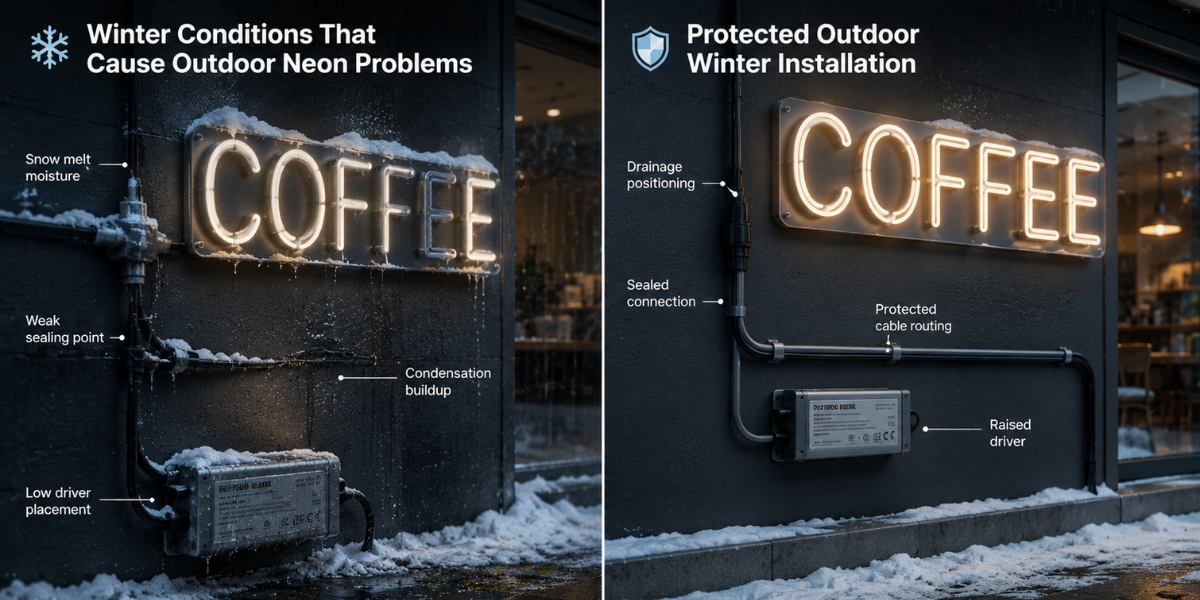
Neon-Schilder im Freien beginnen nach dem Winter manchmal zu flackern oder abzuschalten, da Schnee, Gefriertemperaturen, eingeschlossene Feuchtigkeit und Kondenswasser unterschiedliche Arten von Belastungen auf Steckverbinder, Dichtungspunkte und elektrische Komponenten als normaler Regen belasten.
Viele Neonschilder im Freien überleben starken Regen ohne offensichtliche Probleme und zeigen dann Probleme nach dem Winter. Ein Grund ist, dass sich Schnee im Freien ganz anders verhält als Regenwasser.
Regenwasser läuft in der Regel relativ schnell von den Oberflächen ab, während Schnee oft viel länger um die Stecker und Montagebereiche bleibt.
Im Winter kann sich Schnee sammeln:
- Kabelausgänge
- Befestigungsclips
- Verbindungsverbindungen
- Netzteilabdeckungen
- Lücken hinter dem Schild
Wenn die Temperaturen tagsüber steigen, wird der schmelzende Schnee langsam in Wasser und kann in kleine Öffnungen um schwächere Dichtungspunkte gelangen. Später in der Nacht kann die eingeschlossene Feuchtigkeit wieder einfrieren.
Wiederholte Einfrier-Tau-Zyklen erhöhen häufig den Stress in gefährdeten Verbindungsbereichen.
Wasser dehnt sich im Tiefkühlbereich leicht aus. Wenn die Feuchtigkeit bereits einen schwachen Stecker oder eine Kabelverbindung erreicht hat, kann das wiederholte Einfrieren und Auftauen die Abdichtung im Laufe der Zeit allmählich abschwächen. Ein Zeichen kann im Winter weiterlaufen und dann Wochen später Probleme zeigen, da sich langsam Korrosion um die inneren Verbindungen herum entwickelt.
Dies ist einer der Gründe, warum einige Ausfälle im Freien im Frühjahr „zufällig“ erscheinen, obwohl in den kälteren Monaten möglicherweise feuchtigkeitsbedingte Schäden eingetreten sind.
Kaltes Wetter schafft auch ein weiteres Problem, das viele Käufer selten in Betracht ziehen: Kondensation.
Beispielsweise kann ein Schildschrank vor direktem Regen geschützt bleiben und dabei Feuchtigkeit im Inneren einfangen. Bei Temperaturänderungen kann sich die wärmere Luft im Gehäuse um kühlere Metalloberflächen und elektrische Komponenten zu Kondensation verwandeln.
Feuchtigkeit baut sich häufig um:
- Fahrer
- Kabelverbindungen
- Metallstifte
- Lötstellen
Auch ohne sichtbare Leckagen kann die eingeschlossene Feuchtigkeit im Laufe der Zeit allmählich die Elektronik beeinträchtigen.
Ein einfaches Bild, das sich in einem versiegelten Schild im Freien bildet, würde dies deutlicher erklären als ein hochtechnisches Diagramm.
Kommerzielle Neonsysteme im Freien werden häufig mit stärkerer Aufmerksamkeit für Drainage, Belüftung und Feuchtigkeitsmanagement entwickelt. Anstatt jeden Bereich vollständig luftdicht abzudichten, ermöglichen einige Installationen einen kontrollierten Luftstrom, so dass eingeschlossene Feuchtigkeit natürlicher entweichen kann.
Kleine Installationsdetails können in kälteren Umgebungen einen spürbaren Unterschied machen:
- Anschlüsse nach unten zeigen oft Wasser schneller ablassen
- Erhabene Fahrer können weiter von der Schneeschmelze entfernt bleiben
- Die Belüftung kann eingeschlossene Kondensation reduzieren
- Das Materialverhalten kann sich bei Gefriertemperaturen je nach Neonprofil und Umgebungsexposition unterschiedlich ändern
| Winterzustand | Was passiert oft mit schlecht geschützten Zeichen |
|---|---|
| Schnee sitzt um Stecker | Feuchtigkeit erreicht langsam schwache Dichtpunkte |
| Tag/Nacht-Gefrierzyklus | Gefrorene Feuchtigkeit dehnt sich in kleinen Lücken aus |
| Kondenswasser in den Schildkästen eingeschlossen | Korrosion entwickelt sich um die Elektronik |
| Einige Schläuche bei eisigem Wetter | Materialverhalten kann sich allmählich ändern |
| Stehendes Wasser nach Schneeschmelze | Treiber und Kabelverbindungen bleiben länger nass |
Die Winterbelichtung ist auch ein Grund, warum die langfristige Leistung im Freien allein von mehr als wasserdichten Bewertungen abhängt. Materialauswahl, Anschlussdichtung, Entwässerungsplanung und Installationsqualität wirken sich auf die Reaktion eines Neonsystems auf kaltes Wetter im Laufe der Zeit aus.
Häufige Fehler im Freien, die Wasserschäden verursachen
Viele Neon-Wasserprobleme im Freien beginnen während der Installation und nicht vom Neon-Schlauch selbst. Auch wenn ein Neon-System für den Außenbereich ausgelegt ist, können die Steckerpositionierung, Drainage, Kabelführung und die Platzierung des Treibers die langfristige Zuverlässigkeit beeinträchtigen.
Ein häufiger Fehler ist, dass die Anschlüsse nach oben zeigen. Nach starkem Regen kann sich Wasser langsam um die Dichtstellen sammeln, anstatt natürlich abzulaufen.
Schlechte Entwässerung hinter dem Schild verursacht ein weiteres Problem. Wenn Wasser zwischen der Wandoberfläche und dem Schild zurückfängt, kann nach Stürmen Feuchtigkeit um die Stecker und Kabelaustritte bleiben.
In Innenräumen werden manchmal auch Innennetzteile verwendet, um die Installationskosten zu senken. Das Schild kann anfänglich noch funktionieren, aber Feuchtigkeit und Kondensation können die Elektronik im Laufe der Zeit allmählich beeinträchtigen.
Freiliegende Kabelverbindungen verursachen ähnliche Risiken. Selbst kleine Lücken um Drahtverbindungen können während wiederholter Regenexposition allmählich Feuchtigkeit eindringen lassen.
Auch die Platzierung des Fahrers ist wichtig. Zu nahe am Boden montierte Fahrer bleiben oft länger feucht, da sich Regenwasser und Schneeschmelze natürlich nahe am Boden der Außenwände ansammeln.
| Installationsfehler | Was passiert normalerweise später |
|---|---|
| Stecker nach oben | Wasser sammelt sich um Siegelpunkte |
| Keine Entwässerung hinter dem Schild | Feuchtigkeit bleibt nach Regen eingeschlossen |
| Indoor-Fahrer im Freien | Feuchtigkeit wirkt sich allmählich auf die Elektronik aus |
| Freiliegende Kabelverbindungen | Feuchtigkeit erreicht elektrische Verbindungen |
| Fahrer in Bodennähe montiert | Regenwasser und Schneeschmelze verbleiben rund um das Gehäuse |
Diese Probleme sind ein Grund, warum kommerzielle Outdoor-Neon-Installationen häufig die Verbindungsrichtung, die Entwässerungsplanung und die Positionierung des Fahrers im Vergleich zu temporären Displays oder dekorativen Innenbeschilderungen genauer beachten.
Wie kommerzielle Neonschilder im Freien anders gebaut werden
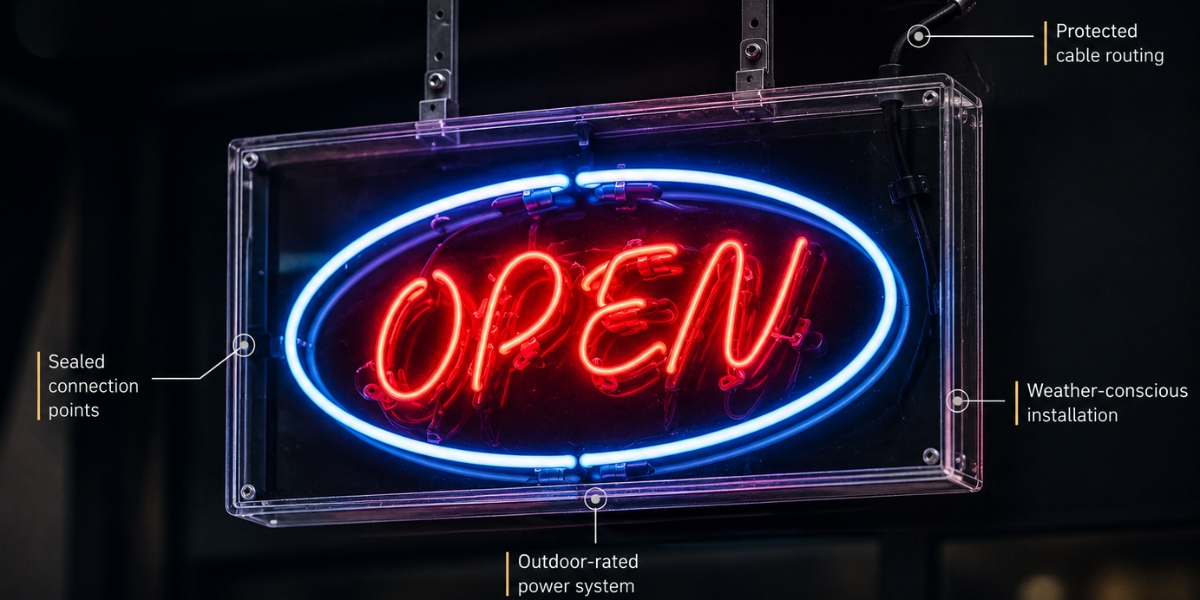
Kommerzielle Outdoor-Neonsysteme werden häufig mit stärkerer Berücksichtigung der wasserdichten Abdichtung, Entwässerung, des Fahrerschutzes und der langfristigen Umweltbelastung als dekorative Innenbeschilderung entwickelt. Außenanlagen können über längere Zeiträume Regen, Feuchtigkeit, Sonnenlicht, Temperaturänderungen und Winterwetter ausgesetzt bleiben, was die langfristige Zuverlässigkeit beeinträchtigen kann.
Aus diesem Grund konzentrieren sich viele kommerzielle Outdoor-Projekte nicht nur auf das Aussehen, sondern auch auf die Art und Weise, wie das gesamte System mit der Zeit mit Feuchtigkeit, Entwässerung und Umweltstress umgeht.
Die Verbinderdichtung wird häufig mehr Aufmerksamkeit geschenkt, die Kabelführung ist normalerweise geplant, um die direkte Wasserexposition zu verringern, und Fahrer mit Außenbewertung werden dort positioniert, wo sich Feuchtigkeit weniger ansammelt. Installateure können auch genauer auf die Entwässerung hinter dem Schild achten, da eingeschlossenes Wasser allmählich Probleme bei der Stecker und Netzteile verursachen kann.
Die Materialauswahl kann auch Einfluss darauf haben, wie Außensysteme im Zeitalter alteren. Einige dekorative Neonschilder verwenden PVC-Schläuche, da dies die Produktionskosten senken kann, während einige Außensysteme Silikon verwenden, wo Flexibilität bei Temperaturänderungen und Umweltbewegungen wichtiger wird. Die langfristige Leistung im Freien hängt jedoch immer noch stark von der Profilart, der UV-Belastung, der Dichtungsqualität und dem Installationsdesign ab.
Dies kann sich bei größeren Fassadenschildern, bei denen sich Neon um Kanalbuchstaben, Aluminiumstrukturen und Logoformen biegt, deutlicher bemerkbar machen. Im Laufe der Zeit können Materialflexibilität und Umweltbelastung sowohl das Aussehen als auch die Dichtungsleistung beeinträchtigen.
Kommerzielle Outdoor-Projekte erwägen häufig einen stärkeren wasserdichten Schutz, wenn Installationen wiederholtem Regen, Feuchtigkeit oder Schneebelichtung ausgesetzt sind. Die langfristige Zuverlässigkeit hängt jedoch von mehr als nur von IP-Bewertungen ab. Die Verbinderdichtung, die Entwässerungsplanung, die Kabelführung und die Platzierung des Fahrers wirken sich auf die Leistung eines Neon-Outline-Systems aus.
Gewerbliche Neonsysteme im Freien werden im Allgemeinen mit längerfristigen Umweltexpositionen und nicht nur am Installationstag konzipiert.
Was sollten Käufer überprüfen, bevor sie sich für ein Neonschild im Freien entscheiden?
Bevor Sie sich für ein Neonschild im Freien entscheiden, sollten Käufer über Helligkeit und Aussehen hinaus schauen. Die langfristige Zuverlässigkeit im Freien hängt häufig mehr von der wasserdichten Abdichtung, der Installationsumgebung, dem Schlauchmaterial, dem Fahrerschutz und der Entwässerungsplanung ab als auf den Produktfotos.
Die meisten Neonschilder im Freien sehen online ähnlich aus, aber die Leistung im Freien kann je nach Umwelteinwirkung und Installationsqualität erheblich variieren.
Die IP-Bewertung sollte der Installationsumgebung entsprechen. Ein Schild unter einer überdachten Ladenfront weist sehr unterschiedliche Bedingungen auf als ein Schild, das an einer vollständig freiliegenden Straßenfassade installiert ist. Bei exponierten Außenbedingungen wird häufig ein stärkerer wasserdichter Schutz in Betracht gezogen, obwohl die langfristige Leistung immer noch stark von der Dichtungsqualität, der Drainage und der Installationsmethode abhängt.
Schlauchmaterial kann auch beeinflussen, wie ein Zeichen im Freien altert. Einige Materialien können nach langer UV-Exposition, insbesondere bei direkter Sonneneinstrahlung, allmählich härter werden oder sichtbare Alterung aufweisen. Das Materialverhalten hängt auch vom spezifischen Neonprofil, den Umgebungsbedingungen und der Installationsumgebung ab.
Die Verbinderdichtung ist eines der wichtigsten Details, die überprüft werden müssen. Schwache Kabelverbindungen sind ein häufiger Grund, warum Neon-Schilder im Freien nach dem Regen flackern. Richtig abgedichtete Steckverbinder reduzieren die Wahrscheinlichkeit, dass Feuchtigkeit allmählich an die elektrischen Anschlusspunkte gelangt.
Die Stromversorgung sollte für Außenbedingungen geeignet sein. Viele Probleme im Freien beginnen, wenn Innenfahrer ohne ausreichenden Schutz vor Feuchtigkeit oder Kondensation draußen installiert werden.
Die Platzierung des Fahrers ist genauso wichtig wie die Fahrerqualität. Selbst Fahrer mit Außenbereich können Probleme entwickeln, wenn sie zu nahe am stehenden Wasser oder in feuchten, geschlossenen Räumen ohne Luftstrom installiert sind.
Auch die Entwässerung hinter dem Schild sollte berücksichtigt werden. Viele kommerzielle Außenanlagen lassen Wasser auf natürliche Weise abfließen, anstatt Feuchtigkeit hinter der Struktur einzufangen.
| Was Käufer überprüfen sollten | Warum es draußen wichtig ist |
|---|---|
| IP-Einstufung | Beeinflusst, wie viel Umweltfeuchtigkeit das System handhabt |
| Schlauchmaterial | Materialalterung kann je nach UV-Exposition und Umgebungsbedingungen variieren |
| Anschlussabdichtung | Hilft, Feuchtigkeit zu reduzieren, die elektrische Verbindungen erreicht |
| Fahrer im Freien | Schützt die Elektronik vor Feuchtigkeit und Wetterexposition |
| Entwässerung um das Schild | Reduziert den langfristigen Feuchtigkeitsaufbau hinter der Installation |
Ein Nahvergleich zwischen einem versiegelten Außenstecker und einem kostengünstigen freiliegenden Stecker würde hier natürlich passen, da viele Käufer nie sehen, wo normalerweise Neonfehler im Freien beginnen.
Viele gewerbliche Käufer vergleichen wasserdichte Dichtung, Schlauchverhalten, Steckerschutz und Fahrerplatzierung, bevor sie ein System für langfristige Außeninstallationen auswählen.
Für Leser, die größere Außenbeleuchtungsprojekte planen, unser Leitfaden für So wählen Sie die besten wasserdichten LED-Streifenleuchten für Outdoor-Projekte aus Deckt zusätzliche Überlegungen wie wasserdichte Bewertungen, Installationsumgebungen und Auswahl des Außenbeleuchtungssystems ab.
In den meisten Neon-Outdoor-Projekten hängt die langfristige Zuverlässigkeit weniger von der Helligkeit ab, sondern mehr davon, wie gut das gesamte System Feuchtigkeit, Wetterexposition und saisonale Temperaturänderungen im Laufe der Zeit verwaltet.
Abschluss
LED-Neonschilder im Freien versagen nicht immer, weil die LEDs nicht mehr funktionieren. In vielen Fällen beginnen langfristige Probleme im Freien viel früher mit schwachen Steckverbindern, eingeschlossener Feuchtigkeit, alternden Materialien, schlecht geschützten Netzteilen oder installationsbezogenen Problemen.
Die Outdoor-Leistung hängt von mehr als wasserdichten Ansprüchen allein ab. Die Anschlussabdichtung, die Entwässerungsplanung, der Fahrerschutz, die Umweltbelastung und die Installationsqualität wirken sich auf die Reaktion eines Neonsystems auf Regen, Feuchtigkeit, UV-Exposition, Kondensation und saisonale Wetteränderungen im Laufe der Zeit aus.
Bei langfristigen Outdoor-Projekten ist es oft wichtiger als Helligkeitsspezifikationen zu verstehen, wie das komplette System zusammenarbeitet.
FAQs
Verwandte Artikel