Español
  English
  简体中文
简体中文  Deutsch
  Français
  Italiano
  日本語
日本語  한국어
한국어  Polski
  Português
  Русский
  Türkçe
  Nederlands
  Tiếng Việt
  ไทย
ไทย 
En la industria de la señalización comercial, el elegante y de luz LED Neon continuamente iluminado se ha convertido en una opción estándar para los escaparates, los lugares de hospitalidad y las fachadas de los edificios. Muchas instalaciones comerciales de neón LED para exteriores fallan no por la propia tira de neón, sino porque la fuente de alimentación está desatada, está mal protegida o está instalada incorrectamente.
Si bien los contratistas a menudo invierten mucho en neón de silicona LED premium, la fuente de alimentación se trata con frecuencia como un componente secundario, aunque finalmente determina la estabilidad, la eficiencia y la vida útil del sistema. Una fuente de alimentación LED mal seleccionada puede causar parpadeo, cambio de color, falla prematura e incluso peligros de seguridad, todo lo cual erosiona la confianza del cliente y resulta en una costosa retrabajo.
Esta guía está escrita específicamente para gerentes de proyectos, ingenieros de detalles e instaladores de señalización, ayudándoles a obtener los detalles técnicos la primera vez. Exploraremos el papel crítico de los conductores, las diferencias prácticas entre las clasificaciones IP67 y las interiores, el impacto real de la caída de voltaje, los límites de la distancia de transmisión de cables, una comparación directa entre las fuentes de alimentación de Meanwell y las técnicas de cableado profesional.
Al final de este artículo, sabrá cómo hacer la selección correcta para el letrero de neón de grado comercial Fuentes de alimentación, protegiendo tanto su señalización como su reputación en la industria.
Por qué fuente de alimentaciónS son críticos para los letreros de neón al aire libre
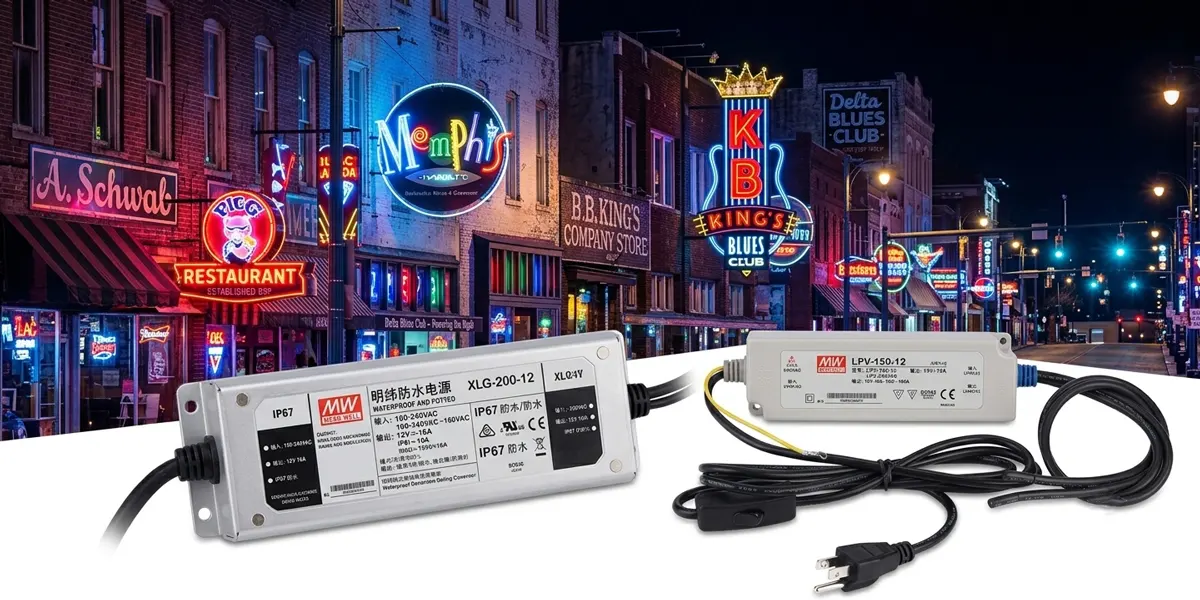
Cada instalación de letreros de neón LED requiere una fuente de alimentación LED, a menudo llamada controlador LED, o en la industria tradicional de neón, un transformador LED de letreros de neón para exteriores. Pero a diferencia de los viejos transformadores magnéticos que impulsaban el neón del tubo de vidrio a miles de voltios, el LED Neon de hoy funciona con corriente continua de bajo voltaje, generalmente de 12V o 24V. La tarea del conductor LED es convertir la electricidad de la red de CA en una salida de CC estable y regulada con precisión que coincida con los requisitos exactos de voltaje y corriente de la tira de silicona de neón.
Un conductor de calidad hace mucho más que simplemente hacer que el letrero se "ilumine". DEBE:
- Mantenga el voltaje constante bajo condiciones de carga y temperatura variables.
- Filtrar la ondulación de CA: la ondulación hace un parpadeo imperceptible a simple vista, lo que provoca fatiga visual y afecta la fotografía de la cámara.
- Proporcionar protección contra sobretensiones, cortocircuitos y sobrecalentamiento.
- Maximice la vida útil de los fósforos LED, manteniendo la temperatura del color y la consistencia de brillo.
Cuando falla una fuente de alimentación LED, a menudo se lleva la tira de neón protegida. Reemplazar ambos componentes simultáneamente en un letrero de fachada sellado puede costar diez veces el precio del conductor solo. Para proyectos comerciales donde el tiempo de inactividad de la señalización significa pérdida de ingresos, el conductor LED no es un consumible, es una inversión en la confiabilidad del sistema a largo plazo.
Fuentes de alimentación IP67 vs interiores: comprensión de la protección del medio ambiente
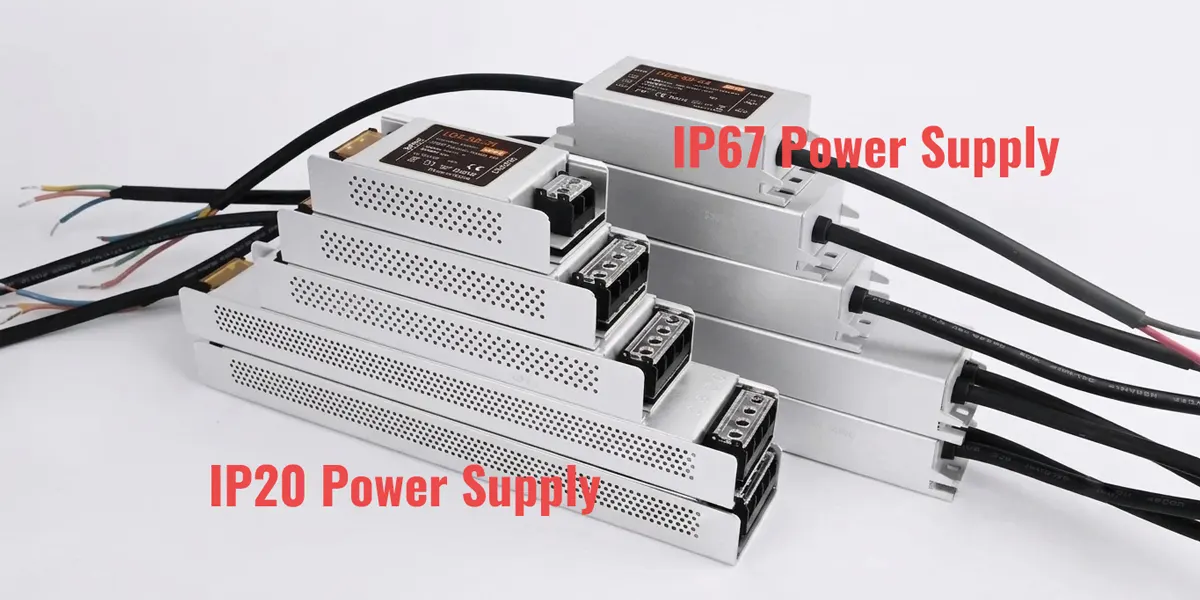
El error de selección más grave en proyectos de neón al aire libre es usar una fuente de alimentación clasificada solo para entornos interiores. El código IP (Protección de Ingreso) define la protección de una carcasa contra el polvo y la humedad. Para aplicaciones de suministro de energía de letrero de neón para exteriores, esta clasificación es un requisito difícil no negociable.
| Clasificación IP | Protección contra el polvo | Protección del agua | idoneidad al aire libre | Aplicación típica |
| IP20 | Sin protección | Sin protección | Solo en interiores | Gabinetes de letreros secos interiores, salas de control |
| IP65 | hermético | Chorros de agua desde cualquier dirección | Limitado al aire libre (refugiado) | Bajo marquesinas, interiores bien sellados |
| IP67 | hermético | Inmersión hasta 1m de profundidad durante 30 minutos | Exposición completa al aire libre, directa | Señales de fachada, instalaciones a nivel del suelo, zonas costeras |
Una fuente de alimentación LED IP67 bloquea completamente la entrada de polvo y puede soportar la inmersión a corto plazo en agua. Esto significa que la lluvia intensa, la nieve derretida y el lavado a alta presión no dañarán su electrónica interna. Una de las preguntas más comunes de los contratistas e ingenieros de proyectos es: ¿Puede funcionar una fuente de alimentación IP65 si se coloca en un recinto sellado? Si bien esto puede funcionar, teóricamente, la condensación y el ciclo de temperatura a menudo hacen que el recinto "respire", y gradualmente la humedad en el interior. Una fuente de alimentación LED con clasificación IP67 mantiene la integridad hermética incluso cuando se enfrenta a condensación. Para proyectos comerciales de misión crítica, el enfoque más seguro es seleccionar IP67 desde el principio en lugar de arriesgarse.
Al buscar componentes de transformadores de neón para exteriores, tenga en cuenta que el término moderno de la industria es "suministro de energía LED de voltaje constante IP67". Sin embargo, los clientes familiarizados con el neón tradicional a menudo confunden el término “transformador”. En SignLiteled, nuestros kits de neón de silicona para exteriores están equipados de manera uniforme con fuentes de alimentación IP67 que cumplen con los requisitos de UL y CE, lo que garantiza que no haya ambigüedad en los procesos de permisos e inspección.
Caída de voltaje: el asesino de señales silenciosas
La caída de voltaje se refiere a la atenuación de voltaje a medida que la corriente viaja a lo largo de un conductor. En los sistemas de corriente continua de bajo voltaje, este efecto es significativo y, a menudo, se subestima. Una fuente de alimentación puede generar 24 V perfectos en sus terminales, pero después de viajar a través de un cable de tamaño insuficiente para 50 pies, la franja de neón puede recibir solo 20 V. El resultado es inconfundible: el extremo más lejano de la señal se atenúa, la luz blanca se desplaza hacia el amarillo y ciertas áreas pueden oscurecerse por completo.
Según la ley de Ohm, la caída de voltaje es igual a la corriente multiplicada por la resistencia. Cuanto más largo sea el cable, mayor será la resistencia. Este efecto es especialmente significativo en sistemas de 12 V porque, para la misma potencia de salida, la corriente es aproximadamente el doble de la de un sistema de 24 V. Dado que la caída de voltaje está directamente relacionada con la corriente, un sistema de 24 V lleva menos corriente, lo que resulta en una caída de voltaje significativamente menor y permite trabas de cable mucho más largas en las mismas condiciones de instalación. Esta es una de las principales razones por las que la mayoría de los proyectos comerciales de neón para exteriores se diseñan en torno a sistemas de 24 V.
Efectos visuales de la caída de voltaje en tiras de neón de larga distancia:
- primeros pies: Brillo completo, color correcto.
- sección media: Ligera atenuación, blanco cálido se vuelve lechoso.
- otro extremo: Atenuación significativa del brillo, las tiras de luz blanca pueden mostrar tonos rosados (los chips LED azules no se iluminan correctamente).
- Para señalización premium: Los ingenieros deben mantener la caída de voltaje del lado de CC dentro de los 31 Tp3. Para los signos de fachada de marca de alto significado de marca crítica por colores, el límite superior recomendado es 1%.
Selección de distancia de cable y calibre de cable
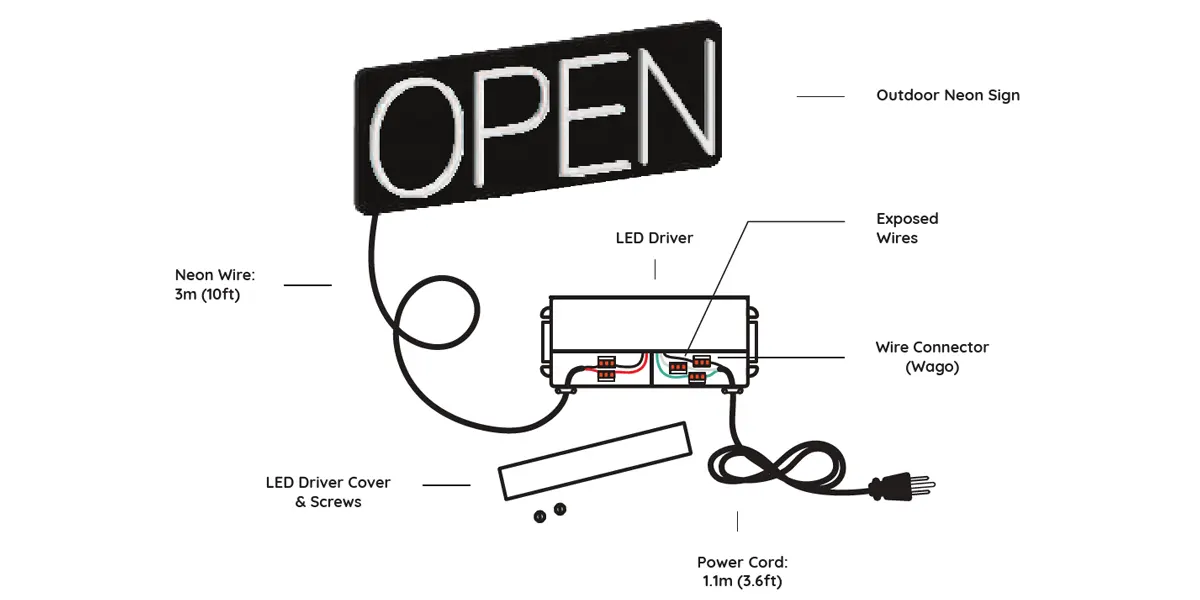
Elegir el calibre de cable correcto entre la fuente de alimentación IP67 y el letrero de neón es el paso más práctico para evitar la caída de voltaje. La siguiente tabla ofrece longitudes de cables máximas conservadoras para un bucle de CC de 24 V a una caída de voltaje de 5% (aceptable para señalización comercial general). Para aplicaciones críticas, reduzca la distancia en 40% para lograr una caída de voltaje de 3%.
máximo One-Wsí Ccompetente DIstance (pies) a 24 V CC y 5% Vvoltaje Djuego
| Carga (vatios) | Corriente (Amperios) | 18 AWG | 16 AWG | 14 AWG | 12 aug |
| 50W | 2.1a | 35 pies | 55 pies | 90 pies | 140 pies |
| 100W | 4.2a | 17 pies | 28 pies | 45 pies | 70 pies |
| 150W | 6.3a | 12 pies | 18 pies | 30 pies | 47 pies |
| 200W | 8.3A | 9 pies | 14 pies | 22 pies | 35 pies |
Cuando las distancias de transmisión deben superar estas longitudes, considere las siguientes soluciones:
- Reubique la fuente de alimentación más cerca del letrero y extienda el cable de suministro de CA (dentro de distancias cortas para proyectos comerciales, la caída de voltaje de CA es insignificante).
- Utilice varias fuentes de alimentación más pequeñas distribuidas a lo largo de la ruta de la señal.
- Para distancias ultra largas, use un cable de 10 AWG o más grueso.
Durante la fase de diseño, coloque siempre la fuente de alimentación de letrero de neón lo más cerca posible del letrero. Esto reduce simultáneamente los costos de material y las pérdidas eléctricas. Para las instalaciones de fachadas, SignLiteled suele recomendar instalar la caja de conexiones de la fuente de alimentación detrás de un pilar o en una sala de equipos cercana, y luego pasar a través de la pared con una corriente continua de gran calibre grande.
La longitud real del cable admisible depende del material del conductor, la temperatura ambiente, el método de instalación y la caída de voltaje máxima aceptable para la aplicación específica. Siempre verifique los cálculos con las especificaciones del fabricante del cable y los códigos eléctricos aplicables.
Fuentes de alimentación de Meanwell vs genéricas: por qué importa la marca
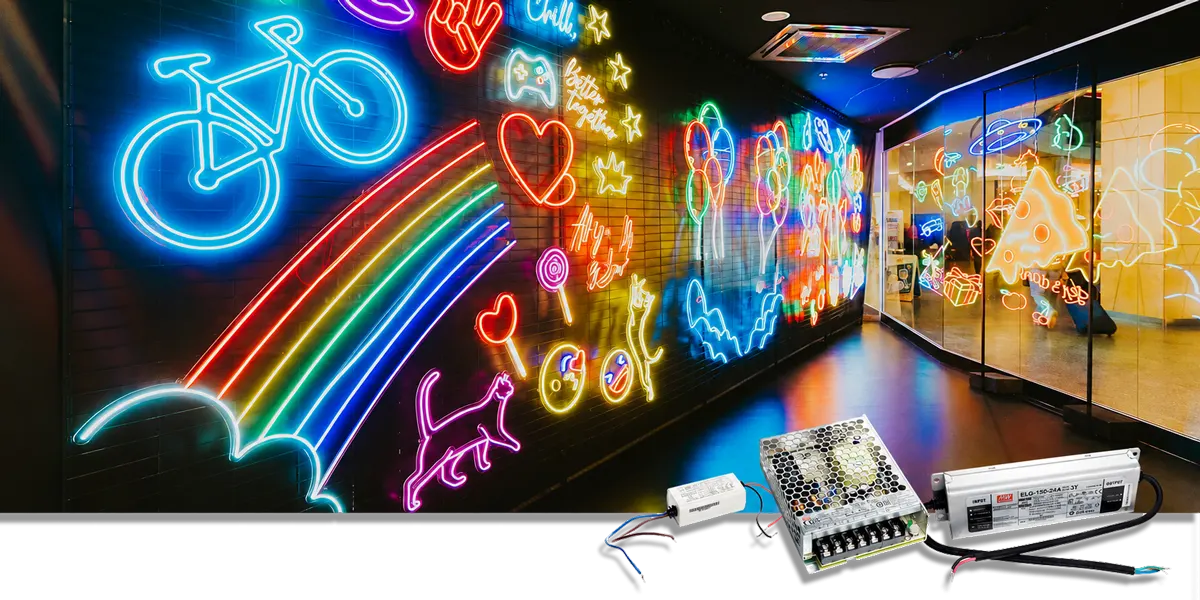
El mercado de la fuente de alimentación está inundado de unidades de bajo costo y sin marca que reclaman clasificaciones IP67 y alta eficiencia. En la superficie, parecen económicos. Pero bajo la carga del mundo real y la prueba del tiempo, la brecha es marcada.
| Característica | Serie HLG/ELG de Meanwell | Controlador IP67 genérico típico |
| Eficacia | Hasta 95% | 80-85% |
| Vida útil (MTBF) | 50.000+ horas a plena carga | No verificado, a menudo <10.000 horas |
| Ondulación y ruido | <150MVP-P | A menudo >500MVP-P, causando parpadeo |
| Protección contra sobretensiones | 4–6 kV (línea a tierra) | A menudo nada o mínimo |
| Certificaciones de seguridad | UL reconocido, CE, ENEC | Marcas falsificadas comunes |
| Garantía | 5–7 años | Ninguno o 1 año (inaplicable) |
| Gestión térmica | Compuesto para macetas con conductividad térmica | Maceta barata que atrapa el calor |
Las fuentes de alimentación LED Meanwell IP67 utilizan componentes de alta calidad, corrección activa del factor de potencia (PFC) y su renombrado diseño térmico para macetas disipa el calor a través de la carcasa. Las fuentes de alimentación genéricas de menor costo pueden utilizar componentes electrónicos de menor calidad, protección de circuito simplificada y una gestión térmica menos eficaz. Con el tiempo, estos compromisos de diseño pueden aumentar el riesgo de una salida inestable, falla prematura o una confiabilidad reducida a largo plazo, particularmente en entornos exteriores exigentes.
En proyectos comerciales, el verdadero costo de una falla del conductor rara vez es el costo de reemplazo del propio conductor. La mano de obra, el alquiler de equipos, la interrupción del servicio y el mantenimiento de emergencia a menudo superan con creces los ahorros iniciales logrados al seleccionar una fuente de alimentación de menor costo. En SignLiteled, todos nuestros kits para exteriores vienen de serie con fuentes de alimentación Meanwell IP67. Visite nuestro Serie de tiras de neón LED Para ver los kits preequipados con potencia de Meanwell genuina, exactamente igual a la longitud y el voltaje de la tira.
Consejos comerciales de cableado y mejores prácticas de instalación
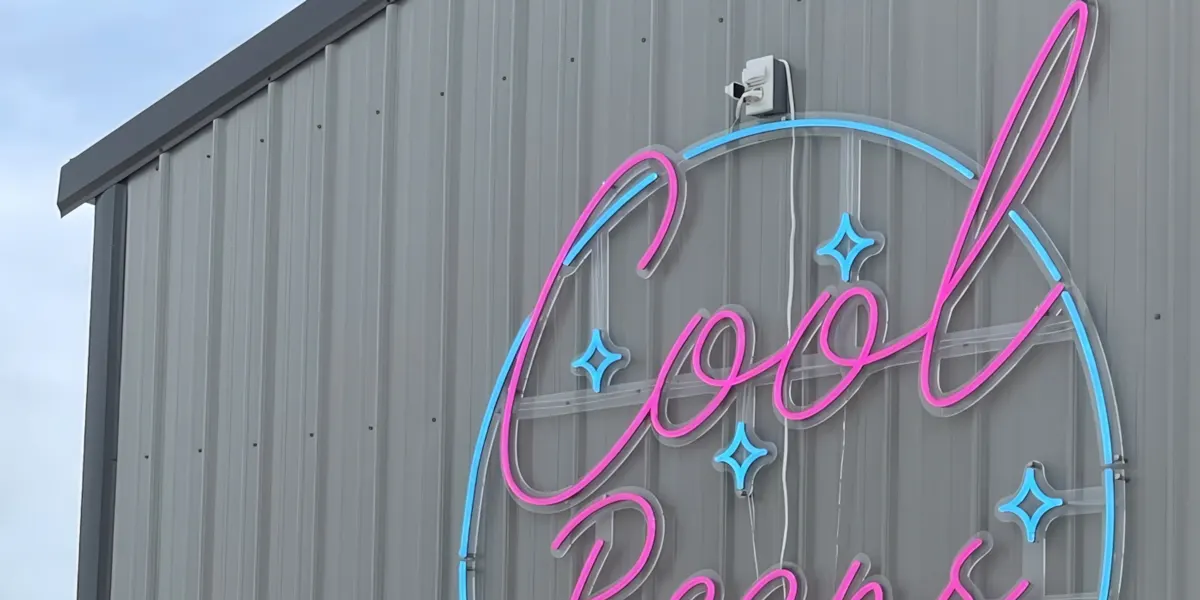
Incluso el mejor conductor y la tira de neón fallarán si el cableado no sigue los estándares eléctricos comerciales. Estos son nuestros requisitos estrictos para las instalaciones de signos de fachada:
a) Siga la regla de carga 80%
La carga continua de una fuente de alimentación nunca debe exceder 80% de su salida nominal. El funcionamiento por debajo de 80% de la capacidad nominal también permite al conductor soportar mejor las temperaturas ambientales altas, sobrecargas temporales y el envejecimiento de componentes a largo plazo, lo que resulta en una mejora de la fiabilidad general. Una fuente de alimentación de 150 W puede transportar como máximo 120 W de tira de neón. Este margen prolonga la vida del conductor, reduce el calor y deja el amortiguador térmico para los días calurosos de verano.
b) Use cajas de conexiones herméticas a prueba de líquidos y cajas de conexiones impermeables
Todas las conexiones de CA deben estar encapsuladas en cajas de conexiones con clasificación NEMA con accesorios de conductos estancos al líquido. Los circuitos de señalización exterior deben estar equipados con interruptores de circuito de falla a tierra (GFCI) según el Código Eléctrico Nacional (NEC) y equivalentes internacionales.
c) Implementar la protección contra sobretensiones
Las amenazas provienen no solo de los rayos, sino también de los transitorios de conmutación de red que pueden destruir las fuentes de alimentación LED. Instale dispositivos de protección contra sobretensiones tipo 2 en el panel de distribución de letreros. En áreas propensas a la costa o a las tormentas, agregue protección contra sobretensiones independiente en cada conductor.
d) polaridad y terminación
Las tiras de neón LED son sensibles a la polaridad. La polaridad inversa generalmente no dañará las tiras de calidad, pero hará que no se enciendan. Utilice conectores sin soldadura con clasificación IP67, o para instalaciones permanentes, soldadura de estaño y selle con tubos termorretráctiles forrados con adhesivo. Las tuercas de alambre en espiral están estrictamente prohibidas en aplicaciones al aire libre.
e) Disipación de calor
Las fuentes de alimentación LED IP67 están diseñadas para disipar el calor a través de su carcasa de metal o resina al entorno circundante. Es esencial una ventilación adecuada, incluso en recintos sellados.
Cómo seleccionar y hacer coincidir correctamente una fuente de alimentación
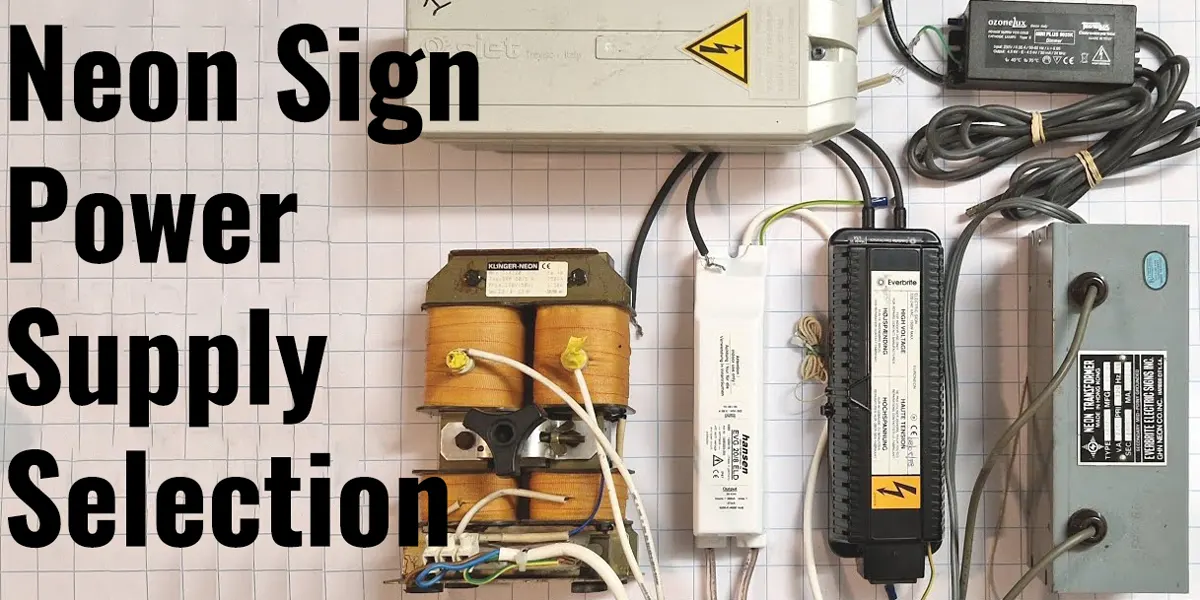
Seleccionar la fuente de alimentación correcta implica un enfoque sistemático:
1. Calcular la carga total. Ejemplo: tira de 40 pies a 5W por pie = 200W.
2. Determine el voltaje del sistema. Para la mayoría de las aplicaciones comerciales, se prefiere 24 V sobre 12 V para reducir la caída de corriente y voltaje.
3. Agregue el margen 20%. 200W × 1.2 = 240W, la capacidad mínima del conductor.
4. Seleccione un controlador de voltaje constante de 24 V con una potencia nominal de no menos de 240 W. En este caso, el Meanwell HLG-240H-24A es una combinación perfecta.
5. Verifique la corriente: 240 W / 24 V = 10 A. Asegúrese de que los cables y conectores seleccionados estén clasificados para al menos 10 A con margen de seguridad.
6. Para señales grandes, considere dividir la carga entre dos o más conductores más pequeños en lugar de usar una sola unidad gigante. Esto reduce el riesgo de un solo punto de falla, minimiza las largas corrientes de CC de alta corriente y permite una atenuación de zonas más fina cuando es necesario.
Integración de controles inteligentes y atenuación
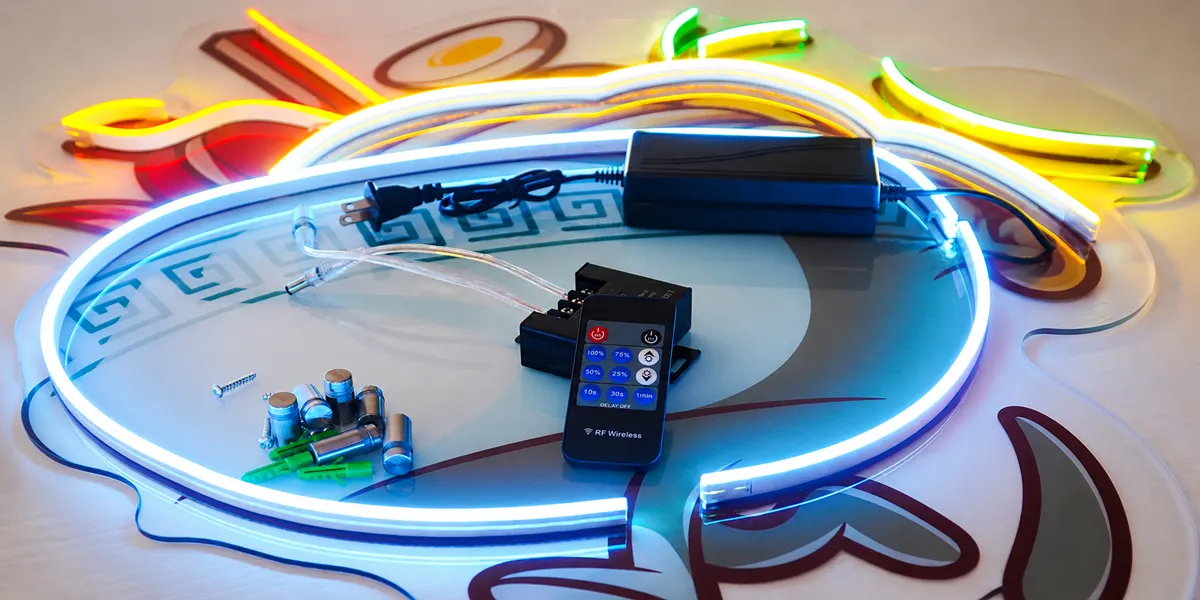
Los proyectos de signos comerciales requieren cada vez más capacidad de atenuación para el ajuste de brillo de día y noche o secuencias dinámicas de fachada. No todas las fuentes de alimentación LED IP67 admiten atenuación, e incluso cuando lo hacen, el método de control debe coincidir con la infraestructura del sitio.
Atenuación de 0-10 V: El protocolo analógico más común en iluminación comercial. Un par de líneas de control de bajo voltaje se ejecuta desde el sistema de automatización de atenuación o de edificios hasta el controlador. Los controladores IP67 de tipo "B" de Meanwell (por ejemplo, HLG-240H-24B) aceptan señales de 0-10V.
Regulación PWM: Se utiliza para un control digital preciso, a menudo emparejado con decodificadores DMX. Requiere un controlador con capacidad de entrada PWM.
dalí: Un protocolo de direccionamiento digital común en proyectos comerciales europeos, con controladores compatibles con DALI dedicados.
Cuando se requiere atenuación, determine la interfaz de atenuación del conductor antes de tiempo. La capacidad de atenuación de reacondicionamiento después de la instalación aumenta significativamente los costos. SignLiteled ofrece soluciones de suministro de energía de letreros de neón para exteriores regulables y puede preintegrar fuentes de alimentación Meanwell de acuerdo con sus estándares de control.
Conclusión
La señalización de neón comercial para exteriores es una inversión a largo plazo diseñada para mostrar la calidad de la marca durante todo el día. Su fuente de alimentación debe soportar la lluvia, altas temperaturas y ruido eléctrico, entregando continuamente voltaje de CC estable y puro. Los principios básicos son claros:
- Cualquier escenario de exposición al aire libre requiere una fuente de alimentación LED IP67, no una unidad interior encerrada en un gabinete temporal.
- Al diseñar instalaciones de suministro de energía de letrero de neón, minimizar la longitud del cable de CC para reducir la caída de voltaje.
- Los letreros de gran tramo ancho comercial deben usar sistemas de 24 V para reducir la corriente y mantener un brillo uniforme.
- Invierta en Meanwell o conductores certificados equivalentes para garantizar la eficiencia, la seguridad y el rendimiento del ciclo de vida.
- Siga los estándares de cableado comercial, observe estrictamente la regla de carga 80% y proteja el sistema de daños por sobretensión.
En SignLiteled, vemos cada proyecto como un desafío de ingeniería, no solo una venta de productos. Ya sea que necesite tiras de neón estándar o una solución de fachada totalmente personalizada con potencia y controles integrados, nuestro equipo proporciona documentación técnica completa, diagramas de cableado y soporte remoto para su equipo de instalación.
cada Señal de neón al aire libre El proyecto tiene requisitos eléctricos únicos. Seleccionar la fuente de alimentación correcta, el tamaño del cable, el método de protección y el diseño del cableado en la etapa de diseño puede mejorar significativamente la fiabilidad del sistema al tiempo que reduce los costos de mantenimiento futuros. Si necesita ayuda con el tamaño de la fuente de alimentación LED, los cálculos de la caída de voltaje o el diseño completo del sistema de letreros de neón para exteriores, nuestro equipo de ingeniería está disponible para proporcionar recomendaciones técnicas adaptadas a su proyecto.
Preguntas frecuentes
Publicaciones relacionadas