English
  简体中文
简体中文  Deutsch
  Español
  Français
  Italiano
  日本語
日本語  한국어
한국어  Polski
  Português
  Русский
  Türkçe
  Nederlands
  Tiếng Việt
  ไทย
ไทย 
In the commercial signage industry, sleek, continuously illuminated LED neon has become a standard choice for storefronts, hospitality venues, and building facades. Many commercial outdoor LED neon installations fail not because of the neon strip itself, but because the power supply is undersized, improperly protected, or incorrectly installed.
While contractors often invest heavily in premium silicone LED neon, the power supply is frequently treated as a secondary component—even though it ultimately determines the system’s stability, efficiency, and service life. A poorly selected LED power supply can cause flickering, color shift, premature failure, and even safety hazards—all of which erode client trust and result in costly rework.
This guide is written specifically for project managers, detailing engineers, and signage installers, helping them get the technical details right the first time. We will explore the critical role of drivers, the practical differences between IP67 and indoor ratings, the real impact of voltage drop, the limits of cable transmission distance, a direct comparison between Meanwell and generic power supplies, and professional wiring techniques.
By the end of this article, you will know how to make the correct selection for commercial-grade neon sign power supplies, protecting both your signage and your industry reputation.
Why Power Supplies Are Critical for Outdoor Neon Signs
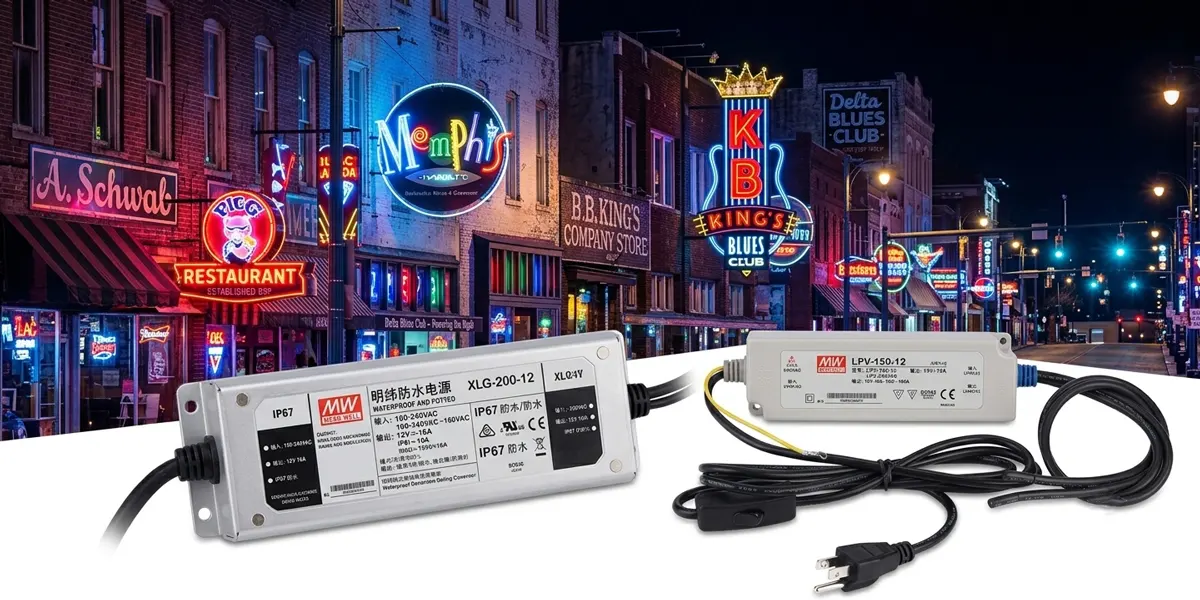
Every LED neon signs installation requires a LED power supply—often called a LED driver, or in the traditional neon industry, an outdoor neon signs LED transformer. But unlike the old magnetic transformers that drove glass tube neon at thousands of volts, today’s LED neon operates on low-voltage direct current, typically 12V or 24V. The LED driver’s task is to convert AC mains electricity into a stable, precisely regulated DC output that matches the exact voltage and current requirements of the silicone neon strip.
A quality driver does far more than simply make the sign “light up.” It must:
- Maintain constant voltage under varying load and temperature conditions.
- Filter out AC ripple—ripple causes imperceptible flicker to the naked eye, leading to visual fatigue and affecting camera photography.
- Provide surge, short-circuit, and overheating protection.
- Maximize the lifespan of LED phosphors, maintaining color temperature and brightness consistency.
When a LED power supply fails, it often takes the protected neon strip with it. Replacing both components simultaneously on a sealed facade sign can cost ten times the price of the driver alone. For commercial projects where signage downtime means lost revenue, the LED driver is not a consumable—it is an investment in long-term system reliability.
IP67 vs Indoor Power Supplies: Understanding Environmental Protection
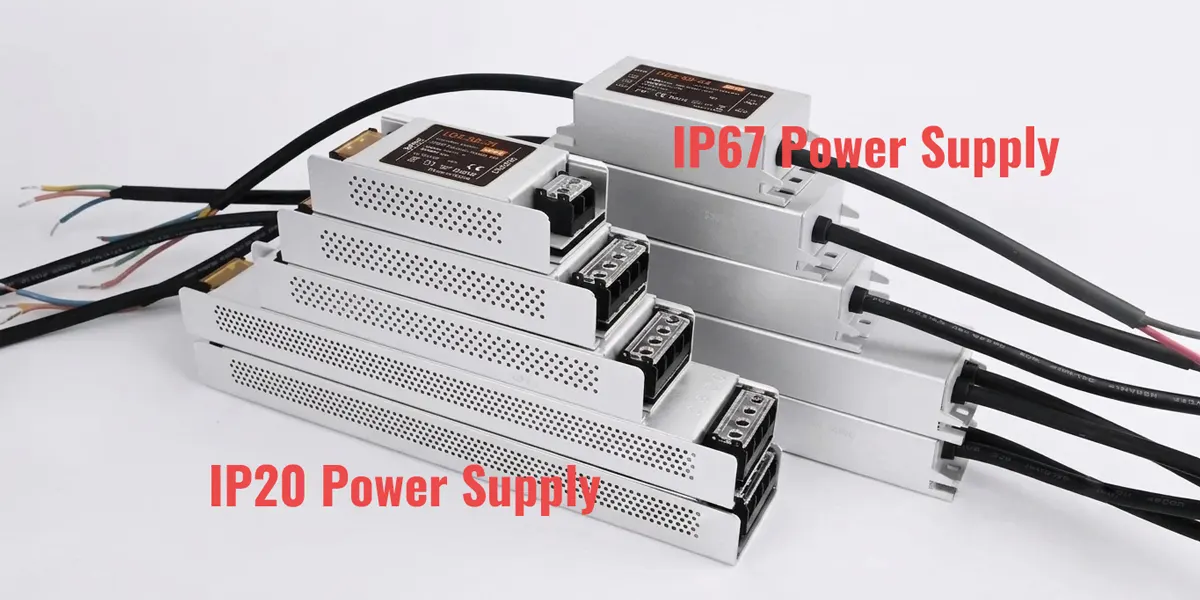
The most serious selection mistake in outdoor neon projects is using a power supply rated only for indoor environments. The IP (Ingress Protection) code defines a housing’s protection against dust and moisture. For outdoor neon sign power supply applications, this rating is a non-negotiable hard requirement.
| IP Rating | Dust Protection | Water Protection | Outdoor Suitability | Typical Application |
| IP20 | No protection | No protection | Indoor only | Inside dry sign cabinets, control rooms |
| IP65 | Dust-tight | Water jets from any direction | Limited outdoor (sheltered) | Under canopies, inside well-sealed enclosures |
| IP67 | Dust-tight | Immersion up to 1m depth for 30 minutes | Full outdoor, direct exposure | Facade signs, ground-level installations, coastal areas |
An IP67 LED power supply completely blocks dust ingress and can withstand short-term immersion in water. This means heavy rain, melting snow, and high-pressure washing will not damage its internal electronics. One of the most common questions from contractors and project engineers is: Can an IP65 power supply work if placed in a sealed enclosure? While this may theoretically work, condensation and temperature cycling often cause the enclosure to “breathe,” gradually drawing moisture inside. An IP67-rated LED power supply maintains watertight integrity even when faced with condensation. For mission-critical commercial projects, the safest approach is to select IP67 from the start rather than taking chances.
When sourcing outdoor neon transformer components, note that the modern industry term is “IP67 constant voltage LED power supply.” However, clients familiar with traditional neon often confuse the term “transformer.” At SignliteLED, our outdoor silicone neon kits are uniformly equipped with IP67 power supplies meeting UL and CE requirements, ensuring no ambiguity in permitting and inspection processes.
Voltage Drop: The Silent Sign Killer
Voltage drop refers to the attenuation of voltage as current travels along a conductor. In low-voltage DC systems, this effect is significant and often underestimated. A power supply may output a perfect 24V at its terminals, but after traveling through undersized cable for 50 feet, the neon strip may receive only 20V. The result is unmistakable: the far end of the sign dims, white light shifts toward yellow, and certain areas may go completely dark.
According to Ohm’s Law, voltage drop equals current multiplied by resistance. The longer the cable, the greater the resistance. This effect is especially significant in 12V systems because, for the same power output, the current is approximately twice that of a 24V system. Since voltage drop is directly related to current, a 24V system carries less current, resulting in significantly lower voltage drop and allowing much longer cable runs under the same installation conditions. This is one of the primary reasons why most commercial outdoor neon projects are designed around 24V systems.
Visual effects of voltage drop on long-distance neon strips:
- First few feet: Full brightness, correct color.
- Middle section: Slight dimming, warm white turns milky.
- Far end: Significant brightness attenuation, white light strips may show pinkish tones (blue LED chips fail to illuminate properly).
- For premium signage: Engineers should keep DC-side voltage drop within 3%. For color-critical, brand-high-significance facade signs, the recommended upper limit is 1%.
Cable Distance and Wire Gauge Selection
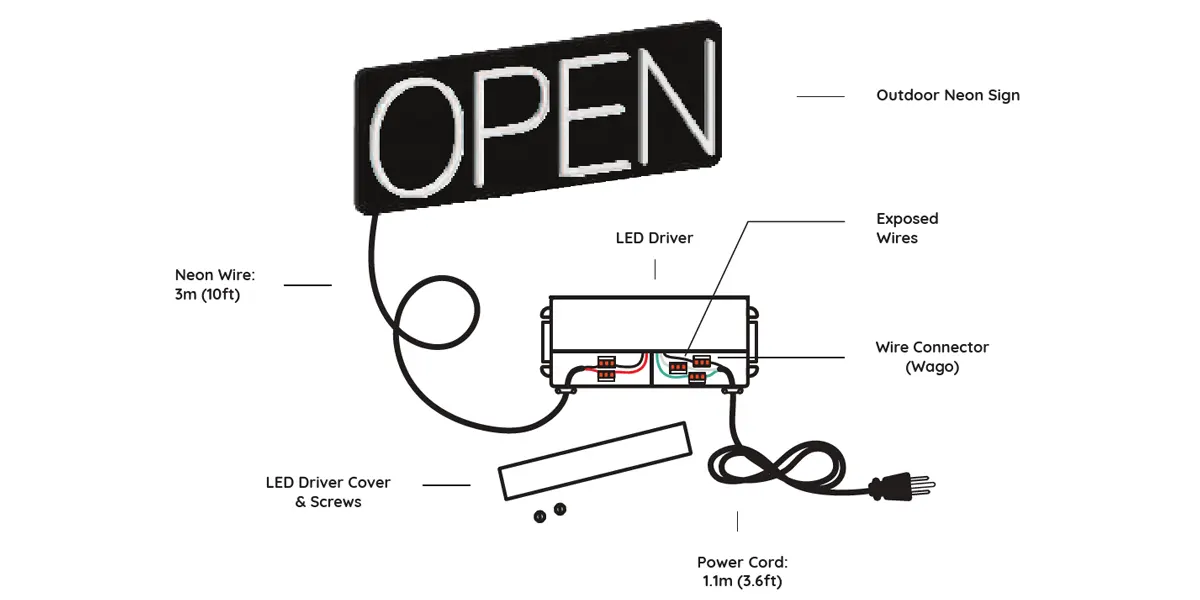
Choosing the correct wire gauge between the IP67 power supply and the neon sign is the most practical step in preventing voltage drop. The table below gives conservative maximum cable lengths for a 24V DC loop at 5% voltage drop (acceptable for general commercial signage). For critical applications, reduce the distance by 40% to achieve 3% voltage drop.
Maximum One-Way Cable Distance (feet) at 24V DC and 5% Voltage Drop
| Load (Watts) | Current (Amps) | 18 AWG | 16 AWG | 14 AWG | 12 AWG |
| 50W | 2.1A | 35 ft | 55 ft | 90 ft | 140 ft |
| 100W | 4.2A | 17 ft | 28 ft | 45 ft | 70 ft |
| 150W | 6.3A | 12 ft | 18 ft | 30 ft | 47 ft |
| 200W | 8.3A | 9 ft | 14 ft | 22 ft | 35 ft |
When transmission distances must exceed these lengths, consider the following solutions:
- Relocate the power supply closer to the sign and extend the AC supply cable (within short distances for commercial projects, AC voltage drop is negligible).
- Use multiple smaller power supplies distributed along the sign path.
- For ultra-long distances, use 10 AWG or thicker cable.
During the design phase, always place the neon sign power supply as physically close to the sign as possible. This simultaneously reduces material costs and electrical losses. For facade installations, SignliteLED typically recommends installing the power supply junction box behind a pillar or in a nearby equipment room, then passing through the wall with shorter, large-gauge DC leads to the sign.
Actual allowable cable length depends on conductor material, ambient temperature, installation method, and the maximum voltage drop acceptable for the specific application. Always verify calculations against the cable manufacturer’s specifications and applicable electrical codes.
Meanwell vs Generic Power Supplies: Why Brand Matters
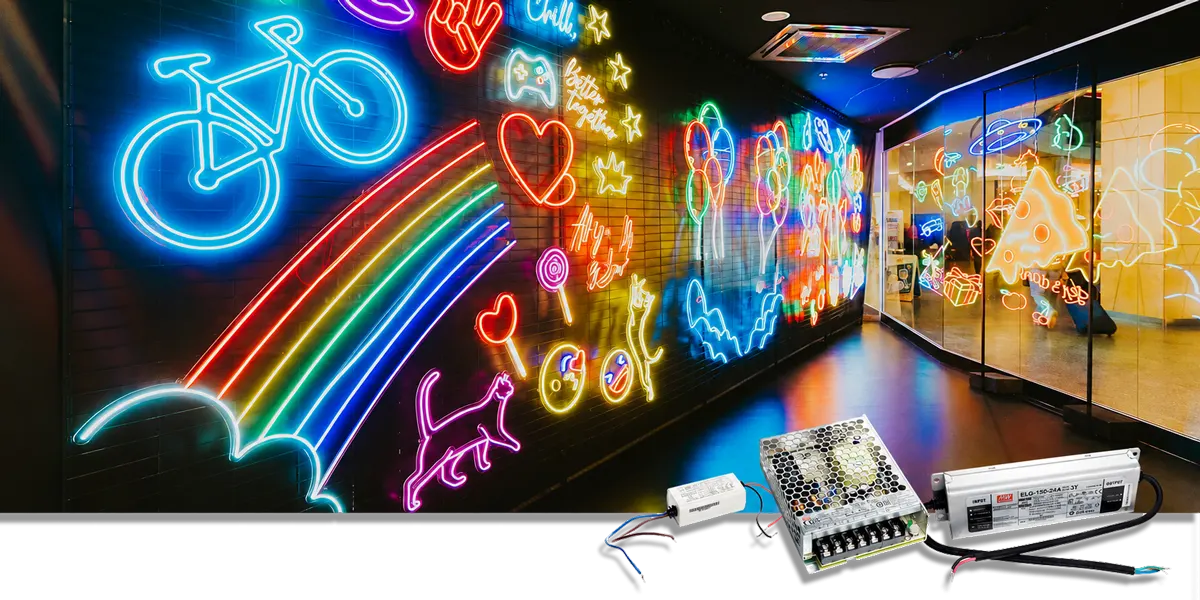
The power supply market is flooded with low-cost, unbranded units claiming IP67 ratings and high efficiency. On the surface, they seem economical. But under real-world load and the test of time, the gap is stark.
| Feature | Meanwell HLG/ELG Series | Typical Generic IP67 Driver |
| Efficiency | Up to 95% | 80–85% |
| Lifetime (MTBF) | 50,000+ hours at full load | Unverified, often <10,000 hours |
| Ripple & Noise | <150mVp-p | Often >500mVp-p, causing flicker |
| Surge Protection | 4–6kV (line-to-ground) | Often none or minimal |
| Safety Certifications | UL Recognized, CE, ENEC | Falsified marks common |
| Warranty | 5–7 years | None or 1 year (unenforceable) |
| Thermal Management | Potting compound with thermal conductivity | Cheap potting that traps heat |
Meanwell IP67 LED power supplies use high-quality components, active power factor correction (PFC), and their renowned potting thermal design truly dissipates heat through the housing. Lower-cost generic power supplies may use lower-grade electronic components, simplified circuit protection, and less effective thermal management. Over time, these design compromises can increase the risk of unstable output, premature failure, or reduced long-term reliability, particularly in demanding outdoor environments.
In commercial projects, the true cost of a driver failure is rarely the replacement cost of the driver itself. Labor, equipment rental, service interruption, and emergency maintenance often far exceed the initial savings achieved by selecting a lower-cost power supply. At SignliteLED, all our outdoor kits come standard with Meanwell IP67 power supplies. Visit our neon LED strip series to view kits pre-equipped with genuine Meanwell power, precisely matched to strip length and voltage.
Commercial Wiring Tips & Installation Best Practices
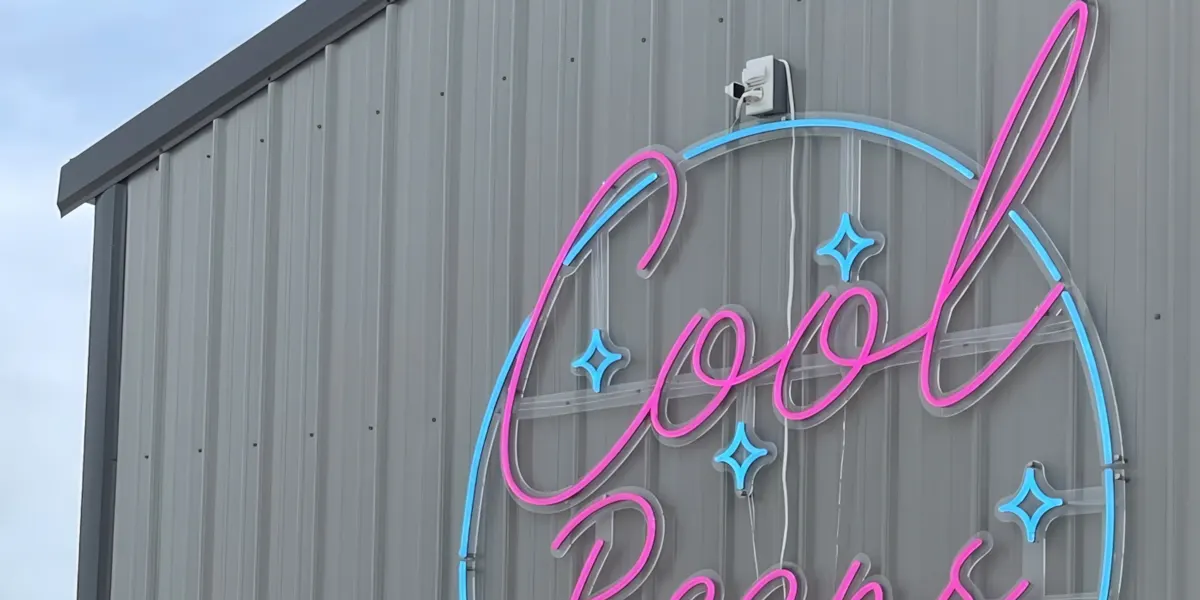
Even the best driver and neon strip will fail if wiring does not follow commercial electrical standards. Here are our hard requirements for facade sign installations:
a) Follow the 80% Load Rule
A power supply’s continuous load must never exceed 80% of its rated output. Operating below 80% of the rated capacity also allows the driver to better withstand high ambient temperatures, temporary overloads, and long-term component aging, resulting in improved overall reliability. A 150W power supply can carry at most 120W of neon strip. This margin extends driver life, reduces heat, and leaves thermal buffer for hot summer days.
b) Use Liquid-Tight Conduit and Waterproof Junction Boxes
All AC connections must be encapsulated in NEMA-rated junction boxes with liquid-tight conduit fittings. Outdoor sign circuits must be equipped with ground fault circuit interrupters (GFCI) per the National Electrical Code (NEC) and international equivalents.
c) Implement Surge Protection
Threats come not only from lightning but also from grid switching transients that can destroy LED power supplies. Install Type 2 surge protection devices at the sign distribution panel. In coastal or thunderstorm-prone areas, add independent surge protection at each driver.
d) Polarity and Termination
LED neon strips are polarity-sensitive. Reversed polarity typically won’t damage quality strips but will cause them to not light. Use IP67-rated solderless connectors, or for permanent installations, tin-solder and seal with adhesive-lined heat shrink tubing. Spiral wire nuts are strictly prohibited in outdoor applications.
e) Heat Dissipation
IP67 LED power supplies are designed to dissipate heat through their metal or resin housing to the surrounding environment. Proper ventilation—even in sealed enclosures—is essential.
How to Correctly Select and Match a Power Supply
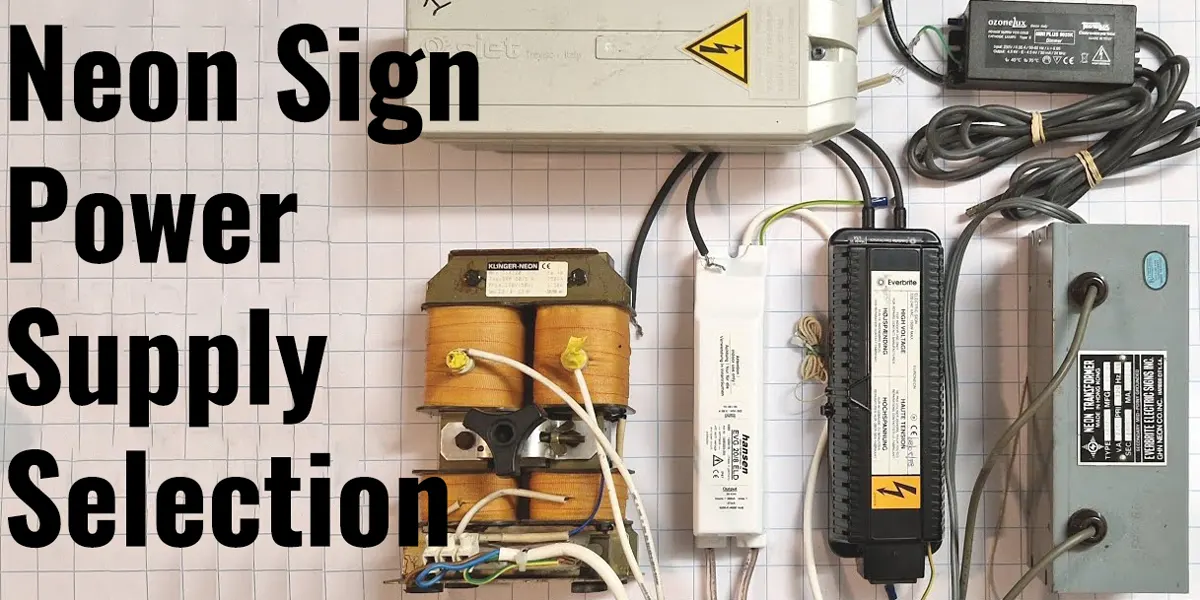
Selecting the right power supply involves a systematic approach:
1. Calculate total load. Example: 40-foot strip at 5W per foot = 200W.
2. Determine system voltage. For most commercial applications, 24V is preferred over 12V to reduce current and voltage drop.
3. Add 20% margin. 200W × 1.2 = 240W, the minimum driver capacity.
4. Select a 24V constant voltage driver rated at no less than 240W. In this case, the Meanwell HLG-240H-24A is a perfect match.
5. Verify current: 240W / 24V = 10A. Ensure selected cables and connectors are rated for at least 10A with safety margin.
6. For large signs, consider splitting the load across two or more smaller drivers rather than using a single giant unit. This reduces single-point-of-failure risk, minimizes long high-current DC runs, and enables finer zone dimming when needed.
Integrating Smart Controls and Dimming
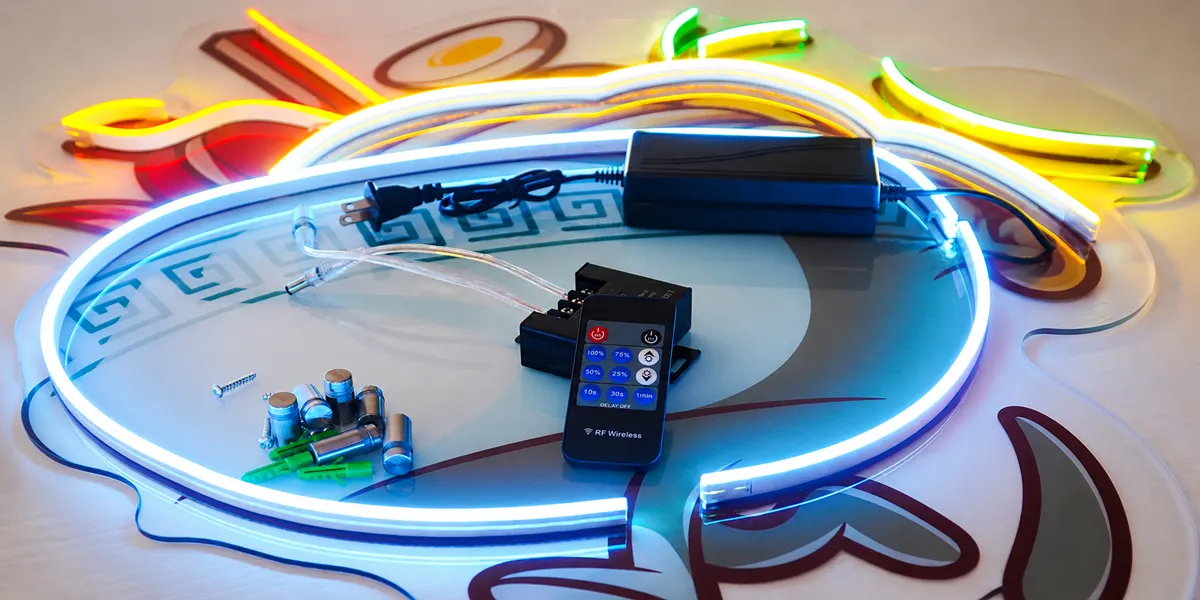
Commercial sign projects increasingly require dimming capability for day-night brightness adjustment or dynamic facade sequences. Not all IP67 LED power supplies support dimming, and even when they do, the control method must match the site infrastructure.
0-10V Dimming: The most common analog protocol in commercial lighting. A pair of low-voltage control lines runs from the dimmer or building automation system to the driver. Meanwell “B” type IP67 drivers (e.g., HLG-240H-24B) accept 0-10V signals.
PWM Dimming: Used for precise digital control, often paired with DMX decoders. Requires a driver with PWM input capability.
DALI: A digital addressing protocol common in European commercial projects, with dedicated DALI-compatible drivers available.
When dimming is required, determine the driver’s dimming interface early. Retrofitting dimming capability after installation significantly increases costs. SignliteLED offers dimmable outdoor neon signs power supply solutions and can pre-integrate Meanwell power supplies according to your control standards.
Conclusion
Commercial outdoor neon signage is a long-term investment designed to showcase brand quality around the clock. Its power supply must endure rain, high temperatures, and electrical noise, continuously delivering pure, stable DC voltage. The core principles are clear:
- Any outdoor exposure scenario requires a true IP67 LED power supply, not an indoor unit stuffed into a temporary enclosure.
- When designing neon sign power supply installations, minimize DC cable length to reduce voltage drop.
- Commercial-grade wide-span signs should use 24V systems to lower current and maintain uniform brightness.
- Invest in Meanwell or equivalent certified drivers to ensure efficiency, safety, and lifecycle performance.
- Follow commercial wiring standards, strictly observe the 80% load rule, and protect the system from surge damage.
At SignliteLED, we view every project as an engineering challenge, not just a product sale. Whether you need standard neon strips or a fully customized facade solution with integrated power and controls, our team provides complete technical documentation, wiring diagrams, and remote support for your installation team.
Every outdoor neon sign project has unique electrical requirements. Selecting the correct power supply, cable size, protection method, and wiring layout at the design stage can significantly improve system reliability while reducing future maintenance costs. If you need assistance with LED power supply sizing, voltage drop calculations, or complete outdoor neon signs system design, our engineering team is available to provide technical recommendations tailored to your project.
FAQs
Related Posts