English
  简体中文
简体中文  Deutsch
  Español
  Français
  Italiano
  日本語
日本語  한국어
한국어  Polski
  Português
  Русский
  Türkçe
  Nederlands
  Tiếng Việt
  ไทย
ไทย 
Waterproof LED strip lights are built for demanding environments, from outdoor signage and landscape lighting to poolside and marine projects. But in many installations, failure starts at the connection point—not the LED strip itself. Cut ends, cable entries, connector housings, copper pad contacts, and junction boxes are often where water ingress, corrosion, or loose connections begin.
Even when using IP67 or IP68 LED strip lights, outdoor lighting projects can still fail at the connection points. Loose seals, exposed cut ends, mismatched connectors, or weak cable entries may lead to water ingress, corrosion, flickering, voltage drop, or short circuits.
That is why choosing the right waterproof connector matters just as much as choosing the right LED strip. This guide will help you select waterproof LED strip connectors based on application, IP rating, PCB width, pin count, current rating, strip type, and installation environment.
For a deeper explanation of waterproof LED strip ratings, see SignliteLED’s IP rating guide.
Best Waterproof Connector by Application
For most outdoor LED strip light projects, an IP65 or IP67 waterproof strip-to-wire connector is the most practical choice. For harsher wet environments, poolside areas, marine lighting, or installations exposed to standing water, consider IP68 cable waterproof connectors, gel-filled connectors, or a fully sealed junction box system.
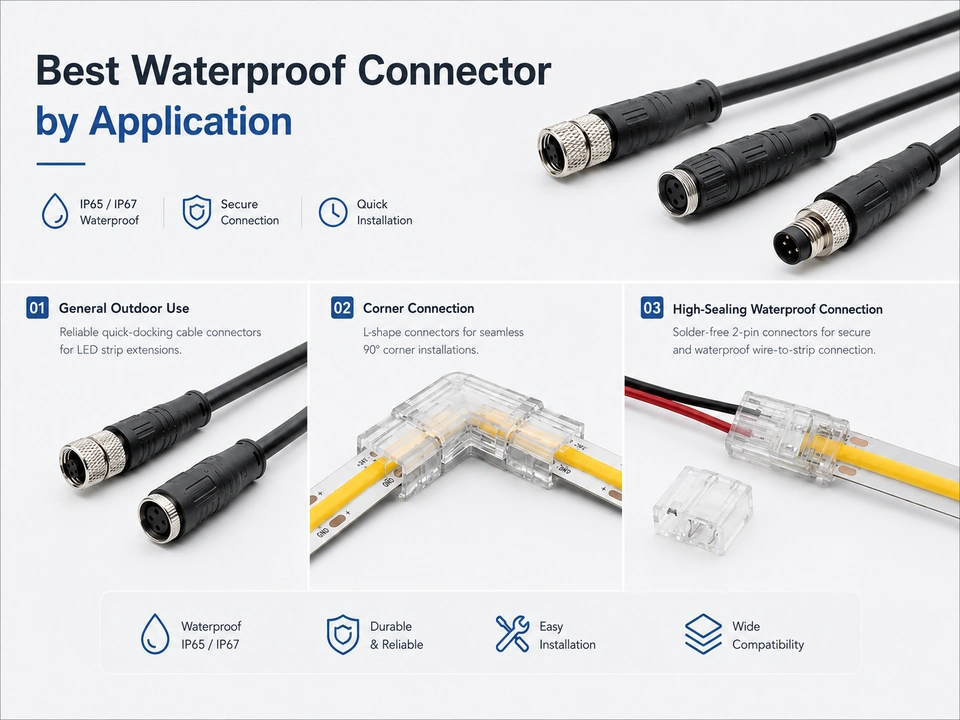
| Application | Recommended Connector | Reason |
| Indoor COB LED strip | Solderless clip connector | Fast installation in dry environments |
| Outdoor COB LED strip | IP65/IP67 waterproof connector | Balances solderless installation with outdoor moisture protection |
| Landscape lighting | IP67 waterproof connector + junction box | Suitable for garden paths, steps, patios, soil moisture, and irrigation exposure |
| Facade lighting | Waterproof strip-to-wire connector or M-series plug | Easier power injection, controller connection, and maintenance |
| Signage | Waterproof connector + serviceable junction box | Makes strip replacement and power-zone maintenance easier |
| Poolside lighting | IP67/IP68 connector with protected junction box | Handles splash, humidity, and cleaning water; distinguish poolside from underwater use |
| Marine environment | IP68 or gel-filled waterproof connector | Better suited for humidity, salt spray, vibration, and corrosion risk |
For product selection, SignliteLED’s LED Connector & Leading Wires page is the main connector category to review.
Recommended Product Family Selection Table
| Strip / Project Type | Recommended Connector Family | PCB Width | Pin Count | IP Rating | Best Use |
| Single-color indoor strip | 2-pin solderless clip connector | 5/8/10/12mm | 2-pin | IP20 | Cabinets, shelves, retail displays |
| Single-color outdoor strip | Waterproof strip-to-wire connector | 8/10/12mm | 2-pin | IP65/IP67 | Patios, facades, signage, landscape zones |
| COB LED strip | COB-compatible solderless or waterproof connector | 8/10mm typical | 2-pin or more | IP20/IP65/IP67 | Dotless indoor or outdoor linear lighting |
| CCT strip | 3-pin strip-to-wire connector | 10/12mm typical | 3-pin | IP20/IP65/IP67 | Tunable white architectural lighting |
| RGB strip | 4-pin RGB waterproof connector | 10/12mm typical | 4-pin | IP65/IP67 | Signage, accent lighting, color-changing projects |
| RGBW strip | 5-pin waterproof connector | 12mm typical | 5-pin | IP65/IP67 | Premium color + white installations |
| Marine or high-humidity project | IP68 cable connector or gel-filled connector | Wire-to-wire or enclosure-based | As required | IP68 | Coastal, marine, water feature, or high-risk wet locations |
Why Connectors Matter More Than Most Installers Realize
An LED strip lighting system is not just the strip itself. It also includes the power supply, controller, dimmer, extension wire, connector, junction box, cable gland, end cap, sealant, and mounting hardware. If one part is poorly matched, the whole system may become unreliable.
Connectors play a key role because they handle both electrical connection and mechanical protection. They must transfer current, hold the copper pads securely, seal cable entries, and withstand moisture, movement, and temperature changes. In outdoor projects, they may also face rain, UV exposure, dust, irrigation water, vibration, or salt air.
Even a high IP-rated LED strip can fail if the connector is indoor-rated, undersized, poorly sealed, or used with the wrong wire gauge. Common issues include flickering, voltage drop, heat buildup, corrosion, short circuits, and complete failure.
Browse SignliteLED’s LED Strip Connector category for common COB, SMD, waterproof plug, and leading wire options.
Types of Waterproof LED Strip Connectors
Waterproof LED strip connectors protect the connection point from moisture, dust, splash, and cleaning water while keeping stable electrical contact. They are especially important for outdoor or damp-location LED strip projects, where cut ends, copper pads, and cable entries are more likely to fail if they are not properly sealed.
Choosing the right waterproof connector helps reduce soldering work, speed up installation, and make future maintenance easier.
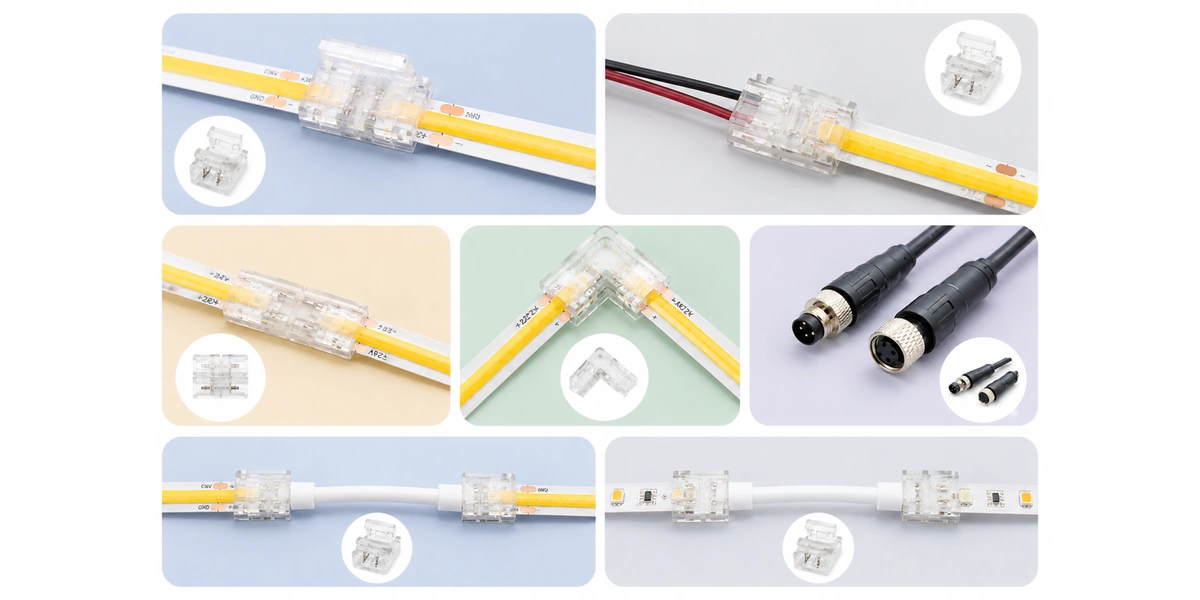
Strip-to-Wire Waterproof Connectors
Strip to wire waterproof LED strip connectors are used to connect an LED strip to a power supply, controller, dimmer, extension cable, or junction box. They are commonly used at the beginning of a strip run or at a power injection point.
SignliteLED’s strip to wire waterproof connectors provide a cleaner and faster way to connect COB or SMD LED strips to external wiring without soldering. They are suitable for outdoor signage, landscape lighting, façade lighting, cabinet lighting, and other applications where the wiring point needs moisture protection.
This type is the right choice when the LED strip needs to connect with power or control wiring.
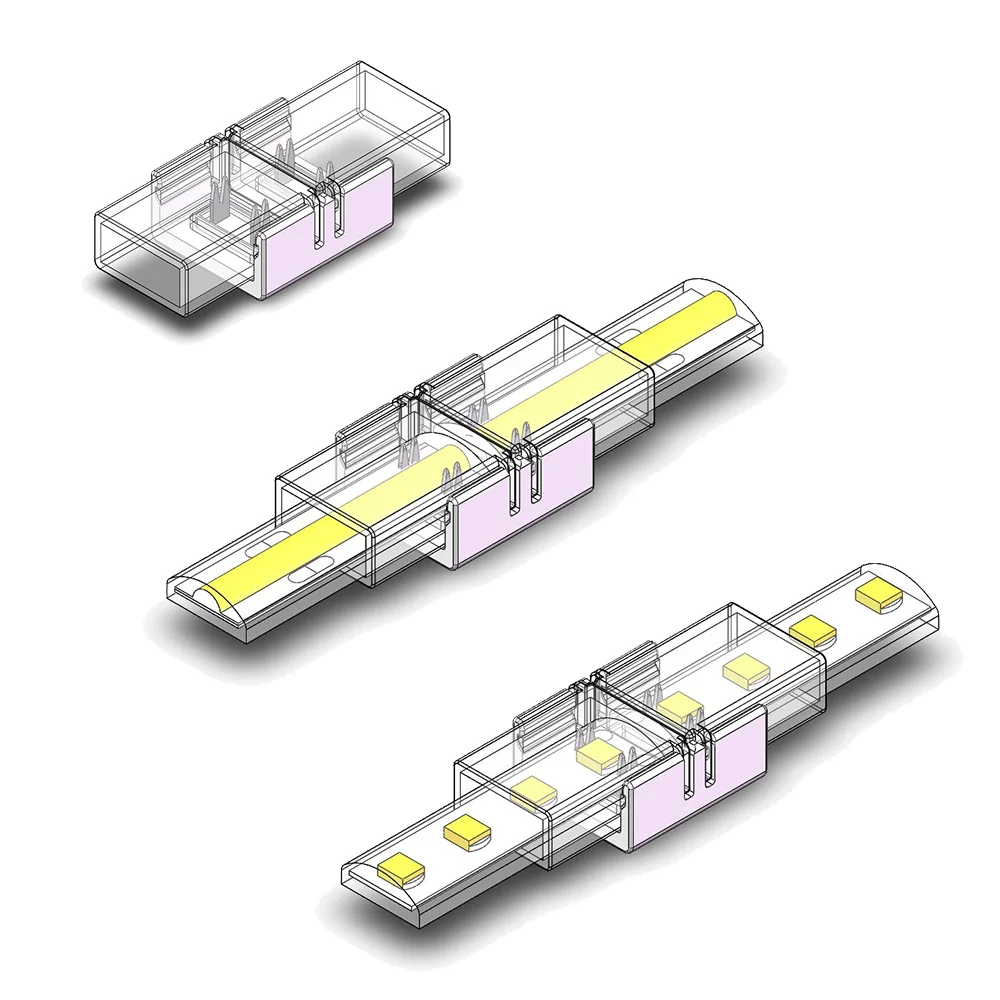
Strip to Wire Waterproof LED Strip Connectors
Model: WC-XMM-B-IP65(X PIN)
Mini puncture: board to wire connection, single end outlet 150mm
Wire:
2PIN-20AWG wire (color: red+/black-)
3PIN-22AWG wire (color: red+/white-/yellow-)
4PIN-22AWG wire (color: black+/green-/red-/blue-)
Suitable for: COB/SMD LED strip light
Suitable PCB width: 8mm-2PIN/10mm-3PIN/12mm-4PIN
Waterproof optional: IP65
Optional PIN:
2PIN LED strip connector for single color LED strip
3PIN LED strip connector for dual color LED strip
4PIN LED strip connector for RGB LED strip
Maximum current: 4A/6A
MOQ: 100pcs
Price: 2PIN: $0.54; 3PIN: $0.58; 4PIN: $0.64
Strip-to-Strip Waterproof Connectors
Strip to strip waterproof LED strip connectors are used to connect two LED strip sections directly end to end. They are suitable for straight-line extensions, damaged section replacement, or continuous LED strip layouts where no extra wire is needed.
SignliteLED’s strip to strip waterproof connectors are designed for COB and SMD LED strips. They are available in 2PIN, 3PIN, and 4PIN versions, making them suitable for single-color, dual-color, and RGB LED strip projects.
This type is the best choice when the LED strip needs to continue in a straight line while keeping the joint better protected than a standard indoor connector.
Strip to Strip Waterproof LED Strip Connectors
Model: WC-XMM-A-IP65(X PIN)
Mini puncture: board to board connection
Suitable for: COB/SMD LED strip light
Suitable PCB width: 8mm-2PIN, 10mm-3PIN, 12mm-4PIN
Waterproof optional: IP65
Optional PIN:
2PIN LED strip connector for single color LED strip
3PIN LED strip connector for dual color LED strip
4PIN LED strip connector for RGB LED strip
Maximum current: 6A
MOQ: 100pcs
Price: 2PIN: $0.27; 3PIN: $0.29; 4PIN: $0.32
Corner Connectors
Corner connectors are used when LED strip lights need to turn a corner, especially in 90-degree layouts. They are commonly used in cabinets, ceiling coves, display cases, retail fixtures, signage outlines, and architectural lighting. Compared with sharply bending the LED strip or forcing a cable loop into a tight space, corner connectors help create a cleaner and more stable corner transition.
For corner installations, SignliteLED offers L-shaped corner connector products in its LED strip connector range, including L-shaped connectors for COB LED strips and L-type connector options for SMD or RGB LED strip layouts. When selecting these products, make sure the connector matches the strip’s PCB width, pin count, and strip type.
Strip to Strip With Wire Waterproof LED Strip Connectors
Strip to strip with wire waterproof LED strip connectors are used to connect two LED strip sections with a short wire between them. They are useful when the strip layout needs to cross a gap, turn around an obstacle, or connect two sections that cannot be joined directly.
SignliteLED’s strip to strip with wire waterproof connectors are suitable for COB and SMD LED strips. The short wire connection gives the installation more flexibility and helps avoid sharp bending of the LED strip.
This type is the right choice for corners, gaps, cabinet separations, signage layouts, and other non-straight installations.
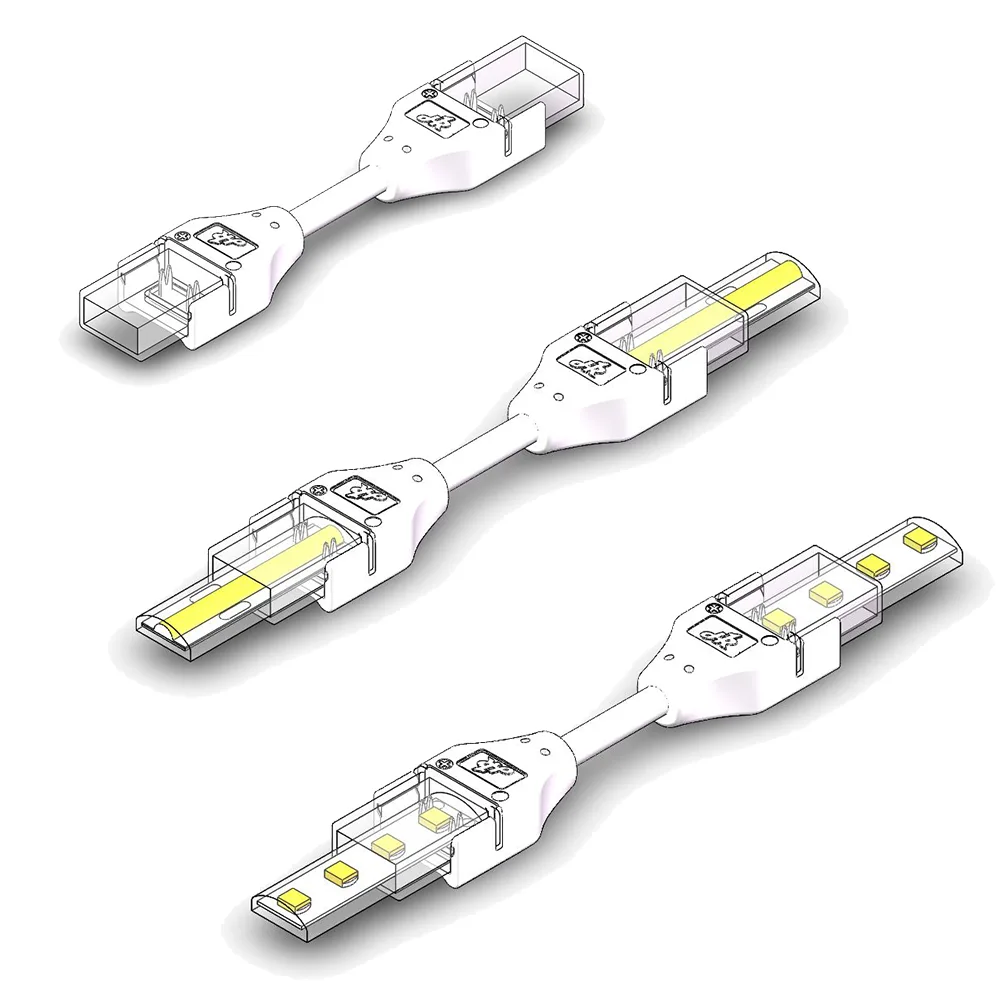
Strip to Strip With Wire Waterproof LED Strip Connectors
Model: WC-XMM-C-IP65(X PIN)
Mini puncture: board to board with wire connection, wire length 150mm
Wire:
2PIN-20AWG wire (color: red+/black-)
3PIN-22AWG wire (color: red+/white-/yellow-)
4PIN-22AWG wire (color: black+/green-/red-/blue-)
Suitable for: COB/SMD LED strip light
Suitable PCB width: 8mm-2PIN/10mm-3PIN/12mm-4PIN
Waterproof optional: IP65
Optional PIN:
2PIN LED strip connector for single color LED strip
3PIN LED strip connector for dual color LED strip
4PIN LED strip connector for RGB LED strip
Maximum current: 4A/6A
MOQ: 100pcs
Price: 2PIN: $0.79; 3PIN: $0.89; 4PIN: $1.04
Choosing Connectors for COB LED Strips
COB LED strips require special attention because their structure is different from many traditional SMD LED strips. COB stands for chips on board, meaning the LED chips are mounted directly on the PCB and covered by a phosphor or encapsulation layer. This creates a smooth, dotless lighting effect, but it also makes connector alignment more important.
Unique Challenges of COB Strips
COB LED strips often have a continuous light-emitting surface. On waterproof COB strips, the copper pads may be covered by silicone or another protective layer. If the installer cuts the strip incorrectly, removes too much coating, leaves residue on the pad, or fails to align the connector contact with the copper pad, the connection can become unstable.
A COB connector must match the strip’s PCB width, pad layout, pin count, and waterproof structure. A connector that fits a standard SMD strip may not automatically work with a COB strip.
Cutting Point Considerations
Always cut LED strip lights only at the marked cut points. Cutting outside the designed cut line can break the circuit path, reduce the copper pad contact area, or make reconnection difficult.
For waterproof LED strips, cutting exposes the sealed structure. The cut end must be resealed with the correct method, such as a matching end cap, silicone sealant, heat shrink tube, or a properly rated waterproof connector. On waterproof strips, the copper pads may sit under silicone, so the cut line must be aligned carefully through the coating. For step-by-step cutting guidance, see SignliteLED’s cutting guide.
Connector Compatibility Checklist for COB and SMD Strips
Before ordering connectors, confirm these key compatibility points.
| Check Item | What to Confirm |
| PCB width | Common widths include 8mm, 10mm, and 12mm; the connector must match the strip width |
| Pin count | 2-pin for single color, 3-pin for CCT, 4-pin for RGB, 5-pin for RGBW, 6-pin for RGBCCT |
| Voltage | Common options include 12V and 24V; some projects may use 5V, 48V, or high-voltage strips |
| Current rating | The connector’s rated current should be higher than the actual load |
| Waterproof rating | IP20 for indoor use; IP65/IP67/IP68 for different outdoor or wet environments |
| Connector type | Strip-to-strip, strip-to-wire, corner, extension, plug, or junction connector |
IP65 vs IP67 vs IP68 Connectors
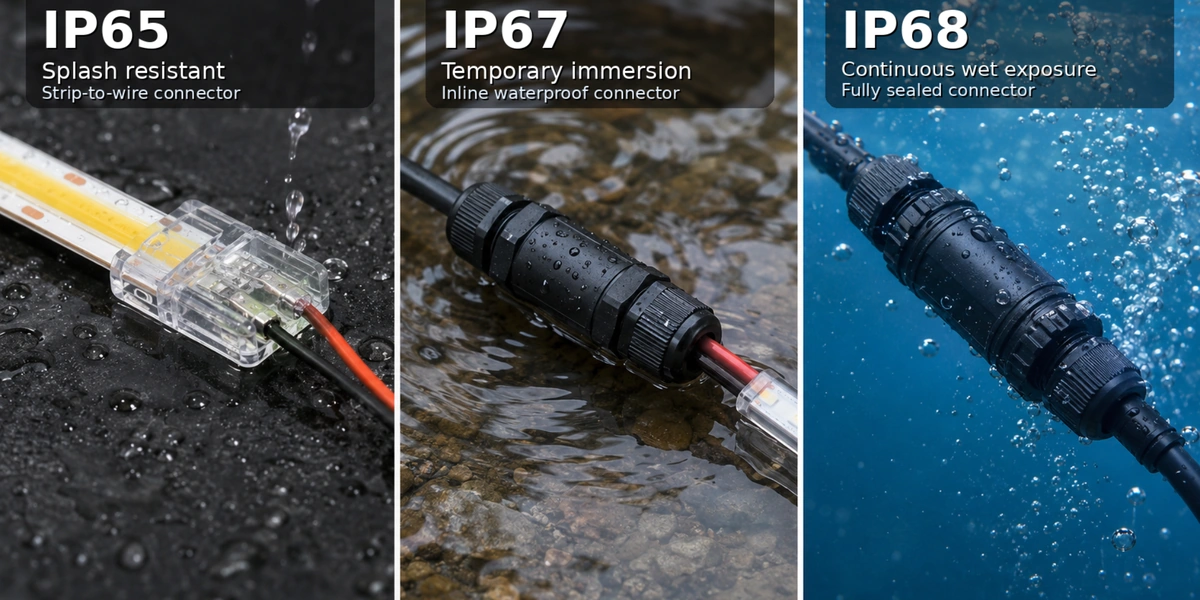
IP ratings help describe how well an enclosure resists dust and liquid ingress. The first digit refers to protection against solid objects, while the second digit refers to liquid protection. For LED strip connectors, the IP rating should be considered together with the actual installation environment, not treated as a marketing label.
| Rating | Protection Level | Recommended Use |
| IP20 | Non-waterproof or basic indoor protection | Dry indoor spaces such as cabinets, display cases, bedrooms, and ceiling coves |
| IP65 | Dust protection and resistance to splashing or low-pressure water jets | Under eaves, kitchens, bathrooms, covered patios, and light outdoor exposure |
| IP67 | Dust protection and temporary water immersion resistance | Gardens, landscape lighting, exterior walls, damp outdoor areas, and heavy rain exposure |
| IP68 | Higher waterproof protection for continuous or more demanding water exposure | Water features, marine lighting, fountains, special wet environments, and manufacturer-specified submerged use |
The best waterproof connector is not always the one with the highest IP rating. For covered patios or protected facades, IP65 or IP67 often provides the right balance of protection, cost, and easy maintenance. For poolside, coastal, marine, fountain, or high-humidity areas, IP68 or gel-filled connectors may be a better choice.
“Near water” is different from “underwater.” Poolside lighting may only need splash and humidity protection if installed in a protected junction box, while underwater lighting must use products specifically rated for submerged use under the manufacturer’s stated conditions.
Waterproof Connectors vs Soldering
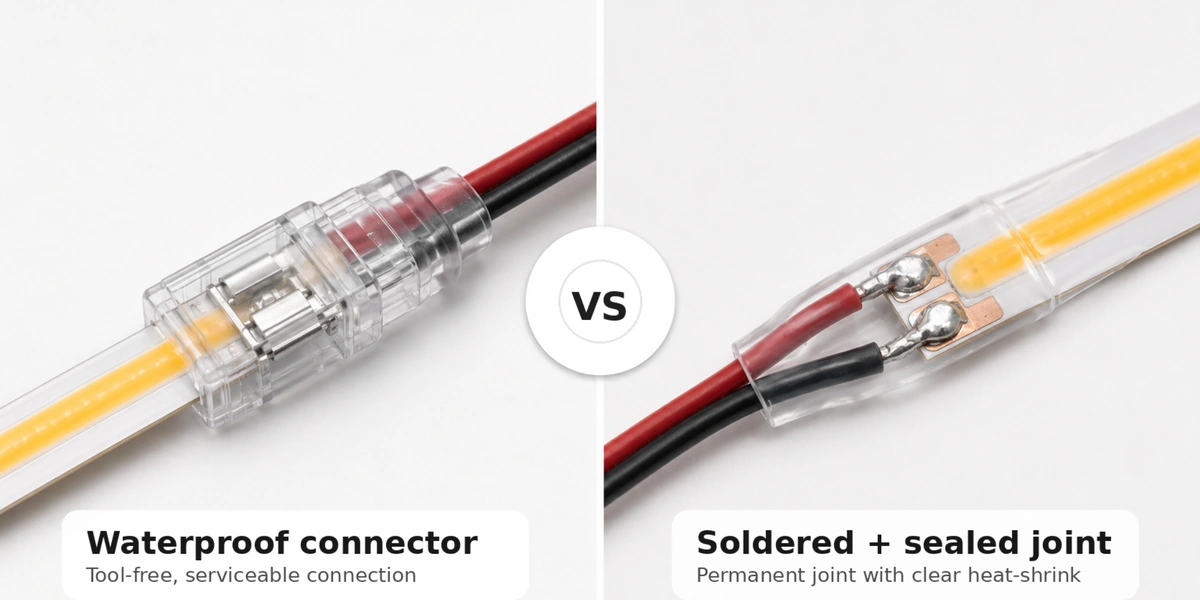
Waterproof connectors and soldering both have a place in LED strip installations. The better choice depends on project size, current load, maintenance expectations, installation environment, and installer skill.
| Factor | Waterproof Connector | Soldering |
| Installation speed | Fast, suitable for field installation | Slower, requires tools and skill |
| Electrical stability | Depends on contact pressure and connector quality | Usually more stable, especially for high-current or permanent projects |
| Waterproof reliability | Depends on IP rating, sealing ring, cable entry, and installation quality | Depends on solder joint protection, heat shrink tubing, and sealant |
| Maintenance | Easy to disconnect, replace, and troubleshoot | Harder to remove; better for permanent connections |
| Cost | Higher material cost but can reduce labor time | Lower material cost but higher labor and rework cost |
| Best for | Fast installation, modular systems, maintenance-friendly projects | Permanent installations, high-current runs, and compact high-reliability connections |
Choose waterproof connectors when speed, serviceability, modular installation, or future replacement matters. Choose soldering when the connection must be compact, permanent, and electrically robust.
For demanding outdoor projects, the strongest approach is not simply “connector or soldering.” It is correct sealing. A poor solder joint without heat shrink tubing or sealant can fail outdoors. A low-quality connector without strain relief can also fail. The connection method and waterproofing method must work together.
For connector wiring guidance, see SignliteLED’s step-by-step wiring guide.
Common Waterproof Connector Failures
Even when a connector is rated for outdoor use, installation mistakes can still cause failure. These are the most common problems to avoid.
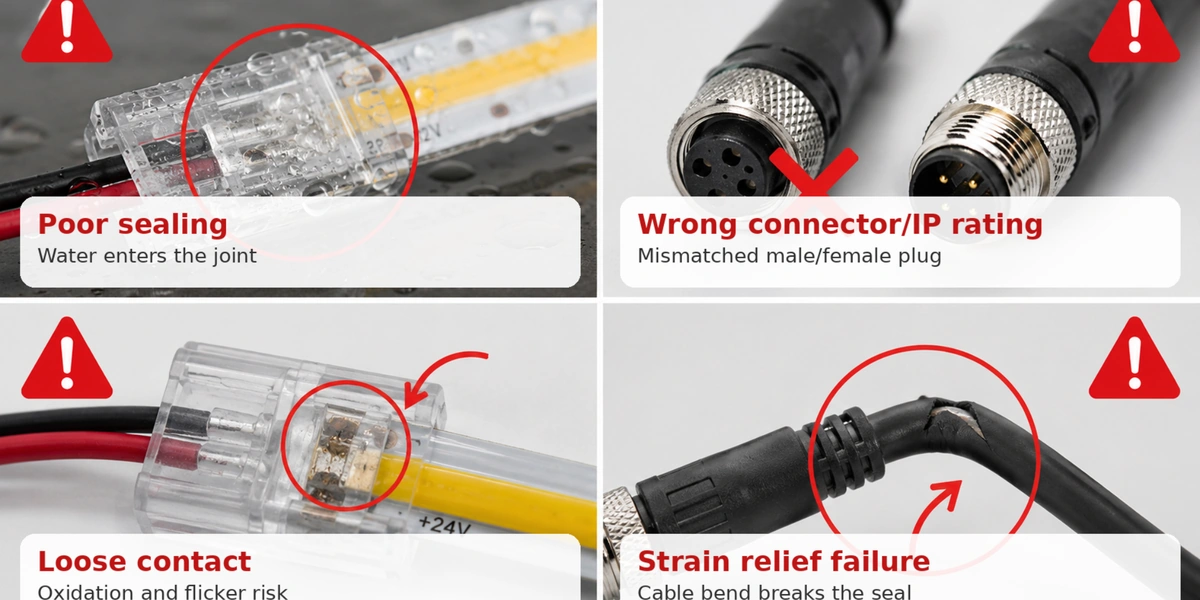
Poor Sealing
Loose housings, misplaced gaskets, exposed cut ends, or poorly sealed cable entries can allow water to enter the connection. This may lead to corrosion, flickering, short circuits, or complete failure.
To avoid this, make sure the connector is fully locked, the sealing ring is properly compressed, and all cut ends are resealed with the correct end cap, silicone sealant, heat shrink tubing, or manufacturer-recommended sealing method.
Wrong Connector or IP Rating
A waterproof LED strip is only as reliable as the weakest exposed part of the system. If the strip is IP67 but the connector, power supply, controller, or junction box is only IP20, the installation is not suitable for wet outdoor use.
Always match the connector’s IP rating, PCB width, pin count, voltage, current rating, and wire gauge with the LED strip and installation environment.
Weak Electrical Contact
Poor copper pad alignment, insufficient contact pressure, wrong wire size, or improper crimping can cause high resistance. This may result in voltage drop, heat buildup, unstable power, or LED strip flickering.
Before final sealing, check that the strip is inserted correctly, the copper pads are clean, the wire is firmly fixed, and the connector is rated for the actual load.
Cable Movement and Strain
Outdoor lighting projects often face wind, vibration, cleaning, maintenance, or accidental pulling. If cable tension is transferred directly to the connector or copper pads, the connection can loosen over time.
Use cable glands, clips, cable ties, junction boxes, or mounting hardware to provide strain relief and keep the connector from carrying mechanical load.
UV and Environmental Damage
For outdoor projects, connectors should be kept away from direct ground contact and protected inside waterproof junction boxes whenever possible. In harsh environments such as coastal areas, gardens, or locations exposed to strong sunlight, choose UV-resistant housings, corrosion-resistant contacts, and properly sealed cable entries to improve long-term reliability.
If you are still selecting the right strip for outdoor use, SignliteLED’s outdoor waterproof strip guide can help you match the strip, connector, and installation environment more accurately.
Installation Best Practices
● Use waterproof junction boxes and cable glands. Place outdoor connections inside a waterproof junction box, and use cable glands at cable entry points to reduce water ingress.
● Reseal every cut end. After cutting a waterproof LED strip, reseal the end with a matching end cap, silicone sealant, heat shrink tubing, or the manufacturer’s recommended method.
● Keep metal contacts clean. Silicone can help seal the outer area, but it should not cover the copper pads or connector pins, as this can affect electrical contact.
● Add strain relief. Secure the cable so pulling force does not stress the connector, copper pad, or solder joint.
● Check compatibility before installation. Make sure the LED strip, connector, power supply, controller, cable gland, and junction box all match the required IP rating, voltage, current, PCB width, and pin count.
Connector Selection Checklist
| Checklist Item | What to Confirm |
| LED strip type | COB / SMD / RGB / RGBW / CCT / RGBCCT |
| PCB width | 5mm / 8mm / 10mm / 12mm / 15mm; must match connector |
| Pin count | 2-pin / 3-pin / 4-pin / 5-pin / 6-pin |
| Voltage | 5V / 12V / 24V / 48V / 110V / 220V |
| Current rating | Connector current rating must be higher than the actual load |
| IP rating | IP20 for indoor use, IP65/IP67 for outdoor use, IP68 for high-risk or submerged environments |
| Connector type | Strip-to-strip / strip-to-wire / corner/extension / plug |
| Installation environment | Indoor, outdoor, landscape, poolside, marine, facade, signage |
| Maintenance needs | Confirm whether the connection must be removable or permanent |
| Sealing method | End cap, silicone, junction box, cable gland, heat shrink tube |
Conclusion
Choosing the best waterproof connector for LED strip lights is not just about selecting the highest IP rating. The right connector depends on the LED strip type, COB or SMD structure, PCB width, pin count, voltage, current rating, installation environment, and maintenance requirements.
For indoor dry projects, solderless clip connectors can be fast and convenient. For most outdoor LED strip projects, IP65 or IP67 waterproof strip-to-wire connectors offer a practical balance of protection and serviceability. For marine, poolside, high-humidity, or submerged environments, IP68 or gel-filled waterproof connectors may be required.
The most reliable outdoor installations combine the right connector with the right sealing method: cable glands, waterproof junction boxes, sealed cut ends, strain relief, and matching IP-rated power components.
Need waterproof LED strip connectors for your project? Explore SignliteLED’s custom leading wire solutions for indoor and outdoor LED strip lighting projects.
FAQ
Related Posts