English
  简体中文
简体中文  Deutsch
  Español
  Français
  Italiano
  日本語
日本語  한국어
한국어  Polski
  Português
  Русский
  Türkçe
  Nederlands
  Tiếng Việt
  ไทย
ไทย 
Quick Answer
Most LED strip lights can only be cut at designated cutting points. Free-cut LED strip lights eliminate this limitation by allowing flexible cutting at almost any position while maintaining stable performance. When combined with solder-free connectors, they enable faster, easier, and more flexible installation for modern lighting projects.
Introduction
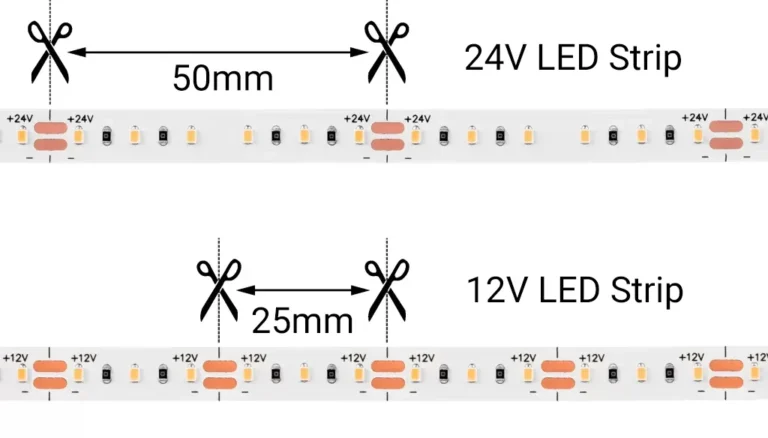
Most traditional LED strip lights can only be cut at fixed intervals. If the strip is cut outside these designated points, it may cause circuit damage, uneven lighting, or even complete failure of the remaining strip.
This limitation often leads to installation challenges in real-world applications such as cabinets, display shelves, signage, and architectural lighting, where precise length adjustment is required.
To solve this problem, Free-Cut LED strip technology was developed. It provides greater flexibility in cutting positions and, when combined with solder-free connectors, significantly improves installation efficiency and reduces on-site labor complexity.
Today, Free-Cut LED strip lights are widely adopted not only for installation convenience but also for their high efficiency, stable performance, and suitability for modern lighting design systems.
What Is a Free-Cut LED Strip Light?
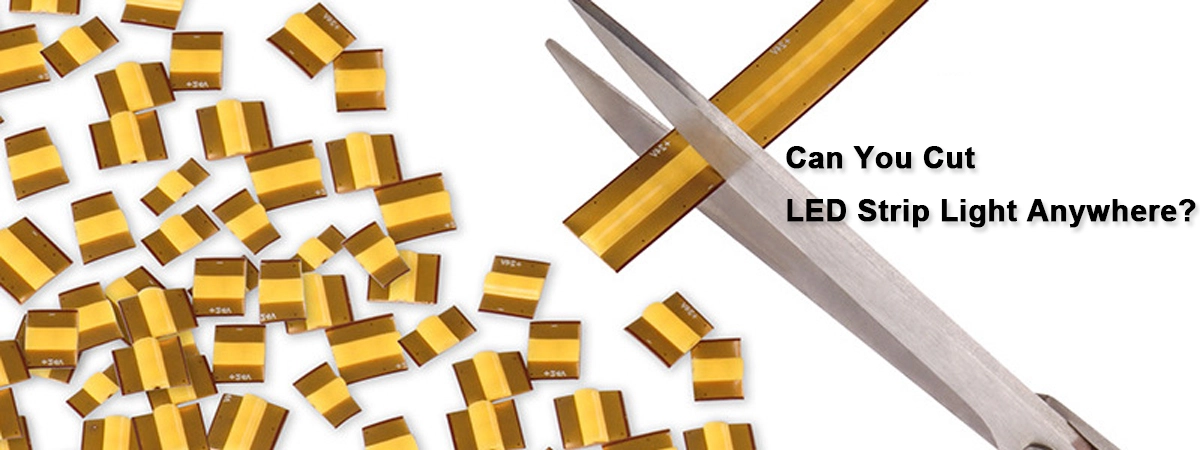
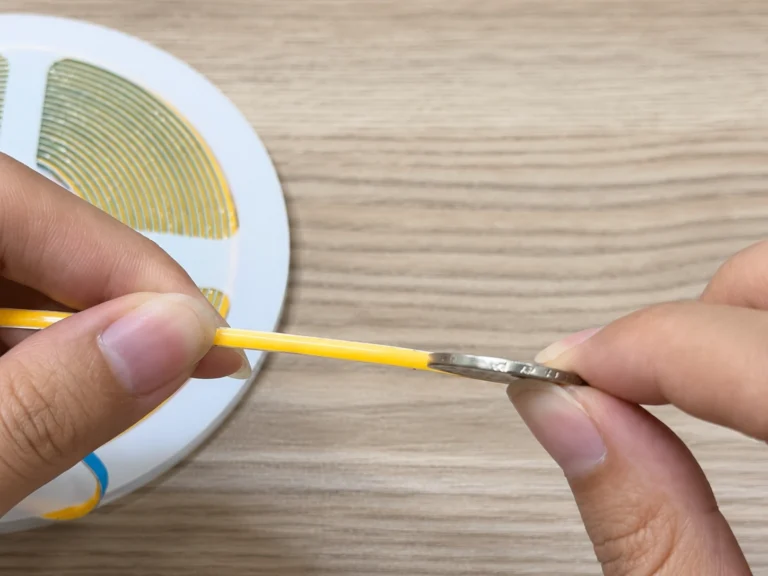
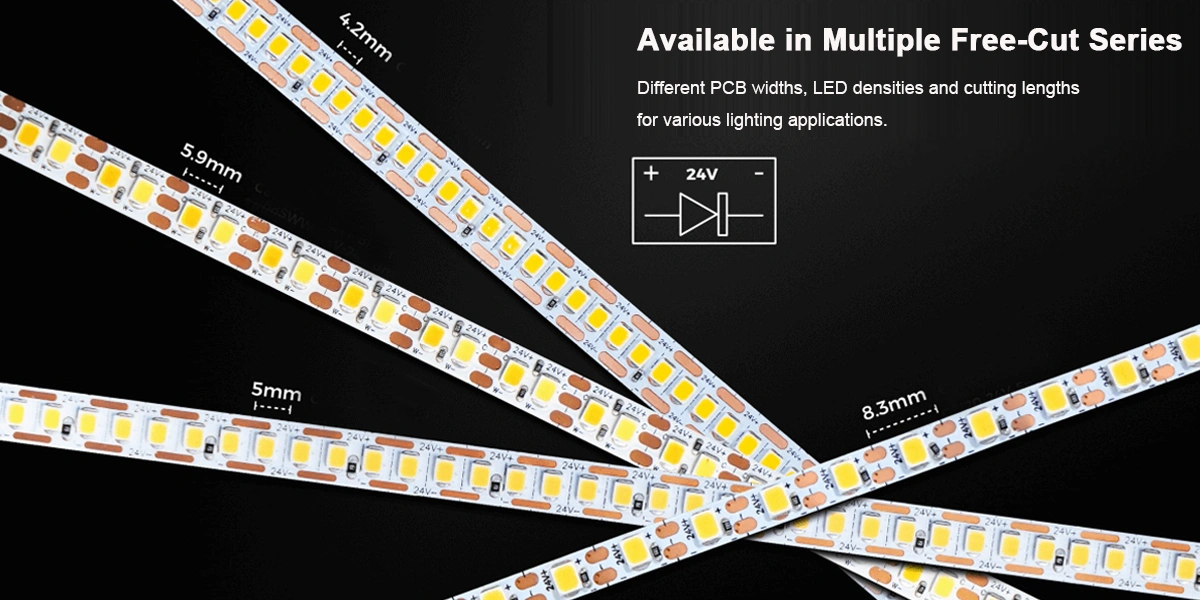
A Free-Cut LED strip light is a type of flexible lighting solution designed with an optimized circuit structure that allows the strip to be cut at flexible positions beyond traditional fixed cutting points. Unlike traditional LED strip lights that can only be cut at designated cutting marks, Free-Cut LED strip lights allow much greater flexibility. If you’re unsure how conventional LED strips should be cut safely, read our guide on How to Cut LED Strip Lights before exploring the advantages of Free-Cut technology.
This is achieved through an improved circuit layout that distributes current more evenly along the strip, reducing dependency on fixed segmentation points. As a result, installers gain significantly greater freedom when adjusting strip lengths for real-world applications such as cabinet lighting, retail shelving, display cases, furniture integration, and architectural linear lighting.
In practical use, Free-Cut LED strip lights help solve one of the most common installation challenges—length mismatch between design requirements and standard cutting intervals. Instead of being restricted by predefined cut marks, installers can achieve more precise fitting, minimize unused strip sections, and improve overall installation efficiency.
When combined with solder-free connector systems, Free-Cut LED strip lights further simplify the installation process by eliminating the need for soldering between segments. This makes the system more suitable for fast-paced commercial projects where installation speed, consistency, and labor efficiency are critical.
In addition to installation flexibility, many Free-Cut LED strip products also support high luminous efficacy up to 150 lm/W, stable color performance, and long operating life, making them suitable for both functional and decorative lighting applications across commercial and architectural environments.
As lighting systems become more design-driven and installation-sensitive, these structural constraints highlight the need for more adaptable solutions that reduce dependency on fixed cut points and manual soldering processes.
Free-Cut LED Strip vs Standard LED Strip
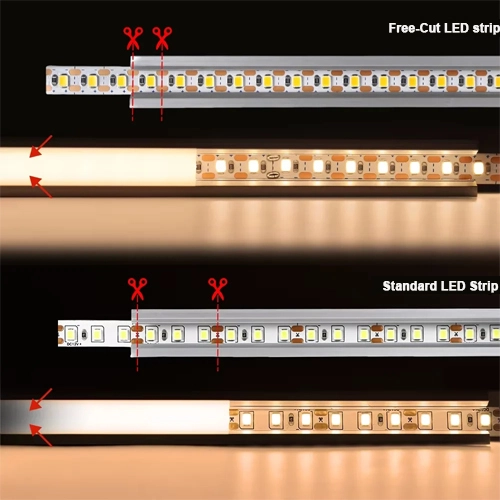
The main differences between Free-Cut LED strip lights and traditional LED strips lie in cutting flexibility, installation method, and overall installation efficiency.
Cutting Flexibility
Standard LED Strip can only be cut at predefined intervals marked on the PCB. Cutting outside these points may damage the circuit or disable part of the strip.
Free-Cut LED strips allow more flexible cutting positions, making it easier to match exact installation requirements and reduce material waste.
Installation Method
Standard LED strips often require soldering when connecting multiple sections, which adds extra labor and increases installation complexity.
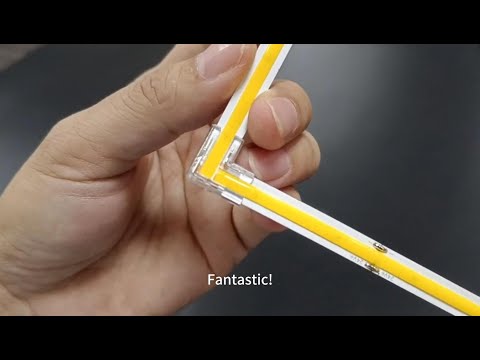
Free-Cut LED strips are designed for solder-free connector systems, enabling quick plug-in installation without welding tools.
Installation Efficiency
Standard LED strips may lead to extra trimming, wasted segments, or rework when lengths do not match the project design.
Free-Cut systems significantly reduce these issues by improving length adaptability and simplifying on-site installation.
Design Flexibility
Standard LED strips are more suitable for standard layouts with predictable dimensions.
Free-Cut LED strips are better suited for custom lighting applications such as cabinetry, retail displays, furniture lighting, and architectural linear lighting.
Comparison Table
| Feature | Standard LED Strip | Free-Cut LED Strip |
| Cutting Method | Fixed cutting points only | Flexible cutting positions |
| Installation | Requires soldering | Solder-free connector compatible |
| Installation Time | Longer | Shorter |
| Material Waste | Higher | Lower |
| Installation Accuracy | Limited by cut marks | High precision fitting |
| Design Flexibility | Standard layouts | Custom lighting projects |
How Free-Cut LED Strip Lights and Solder-Free Connectors Simplify Installation
Modern lighting projects demand more than just high-quality illumination—they also require faster installation, greater flexibility, and lower labor costs. This is where Free-Cut LED strip lights and solder-free connectors work together to create a more efficient installation system.
With standard LED strips, installers must locate the nearest cutting mark, trim the strip, prepare wires, solder each connection, and then test the circuit before installation. Every additional joint increases installation time and introduces another potential failure point.
A Free-Cut LED strip eliminates the limitation of fixed cutting intervals, allowing installers to cut the strip to the exact length required. When paired with a solder-free connector, the cut section can be connected in seconds without soldering, reducing both installation complexity and the need for specialized tools.
This combination not only improves installation speed but also delivers more consistent connection quality, minimizes material waste, and simplifies future maintenance. For projects involving cabinet lighting, retail shelving, furniture lighting, display cases, or architectural linear lighting, it provides a practical solution for achieving precise layouts while improving overall project efficiency.
Key Benefits
- Flexible cutting for accurate length adjustment
- Tool-free installation with solder-free connectors
- Reduced material waste compared with fixed-cut LED strips
- Lower labor costs by minimizing installation steps
- Consistent electrical connections without manual soldering
- Easier maintenance and replacement during future upgrades
Free-Cut LED Strip Lights: Specifications & Product Series Overview
The Free-Cut LED strip lighting system is designed as a scalable product family, developed to meet different requirements in brightness, energy efficiency, and installation environments. Instead of a single fixed specification, it offers multiple series options to support both standard and high-performance lighting projects.
Each series is differentiated by LED density, power consumption, luminous efficiency, and application scenarios, allowing users to select the most suitable configuration based on project needs.
Product Series Structure
The Free-Cut LED strip lights are categorized into three main performance levels:
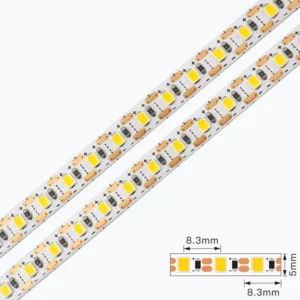
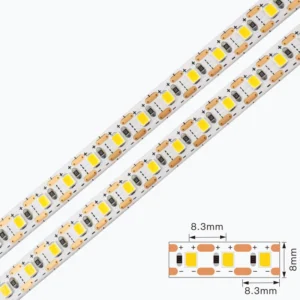
Standard Efficiency Series (120 LED/m class)
Designed for cost-effective general lighting applications, this series provides a balanced combination of brightness and energy consumption.
- LED density: 120 LED/m
- Power range: 5–9W/m
- Key feature: energy-efficient general lighting solution
- Applications: residential lighting, basic ceiling lighting, indirect lighting
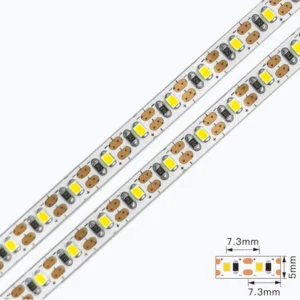
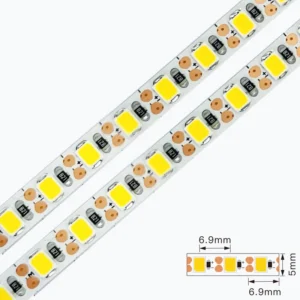
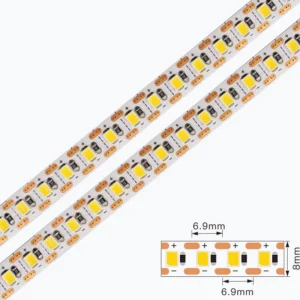
High Brightness Series (136–168 LED/m class)
This series is optimized for higher luminous output and improved visual uniformity, making it suitable for commercial lighting environments.
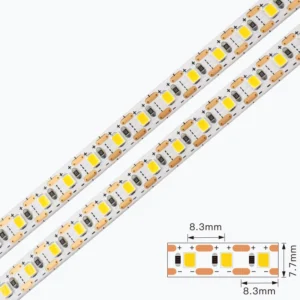
- LED density: 136–168 LED/m
- Power range: 6–10W/m
- Key feature: enhanced brightness with improved light consistency
- Applications: cabinet lighting, retail shelving, display lighting, hospitality environments
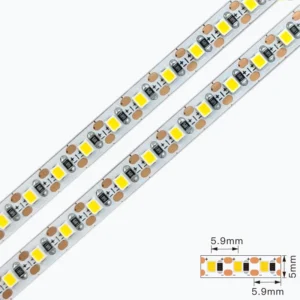
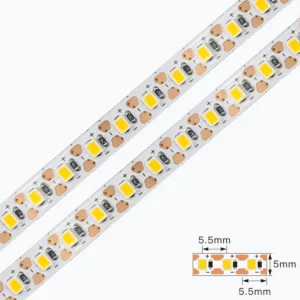
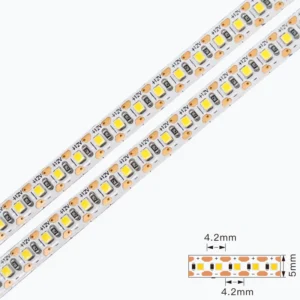
Ultra High Density Series (180–240 LED/m class)
Designed for premium architectural and decorative lighting projects, this series delivers smoother light output with minimal hotspots.
- LED density: 180–240 LED/m
- Power range: 10–12W/m
- Key feature: ultra-smooth lighting effect with high visual comfort
- Applications: architectural lighting, high-end interior design, luxury commercial spaces
How to Choose the Right Free-Cut LED Strip Series
Selecting the right Free-Cut LED strip depends on the balance between brightness requirements, energy efficiency, and application environment.
- For cost-sensitive general lighting projects, the Standard Efficiency Series (120 LED/m) provides a reliable and energy-efficient solution.
- For commercial environments requiring higher brightness and better visual performance, the High Brightness Series (136–168 LED/m) is recommended.
- For premium architectural and decorative lighting projects, the Ultra High Density Series (180–240 LED/m) delivers the smoothest and most visually comfortable lighting effect.
By matching the correct series with the project requirements, users can achieve optimal performance in both lighting quality and energy efficiency.
| Series | LED type | LED qty | PCB width | Input Voltage | Power | CRI | Lumen | Color Temperature |
| 2835-120D-5mm-6.5W | 2835 SMD | 120pcs/m | 5mm | DC5V/12V/DC24V | 6.5W/m | Ra90/ 97 | 650lm/m | 3000K/4000K/6500K |
| 2835-120-7.7mm-5W | 2835 SMD | 120pcs/m | 7.7mm | DC5V/12V/DC24V | 5W/m | Ra90 | 623lm/m | 3000K/4000K/6500K |
| 2835-120-8mm-8.5W | 2835 SMD | 120pcs/m | 8mm | DC5V/12V/DC24V | 8.5W/m | Ra90 | 960lm/m | 3000K/4000K/6500K |
| 2016-136D-5mm-6.5W | 2016 SMD | 136pcs/m | 5mm | DC5V/12V/DC24V | 6.5W/m | Ra90 | 580lm/m | 3000K/4000K/6500K |
| 2835-144D-5mm-7.5W | 2835 SMD | 144pcs/m | 5mm | DC5V/12V/DC24V | 7.5W/m | Ra90 | 720lm/m | 3000K/4000K/6500K |
| 2835-144D-8mm-8.3W | 2835 SMD | 144pcs/m | 8mm | DC5V/12V/DC24V | 8.3W/m | Ra90 | 895lm/m | 3000K/4000K/6500K |
| 2025-168D-5mm-7W | 2025 SMD | 168pcs/m | 5mm | DC5V/12V/DC24V | 7W/m | Ra90 | 660lm/m | 3000K/4000K/6500K |
| 2025-180D-5mm-6W | 2025 SMD | 180pcs/m | 5mm | DC5V/12V/DC24V | 6W/m | Ra90 | 780lm/m | 3000K/4000K/6500K |
| 1515-240D-5mm-6W | 1515 SMD | 240pcs/m | 5mm | DC5V/12V/DC24V | 7W/m | Ra90 | 718lm/m | 3000K/4000K/6500K |
Applications of Free-Cut LED Strip Lights
Free-Cut LED strip lights are widely used in modern lighting projects due to their flexibility, high efficiency, and easy installation. The ability to cut the strip at flexible positions and install it with solder-free connectors makes it suitable for a wide range of commercial and architectural applications.
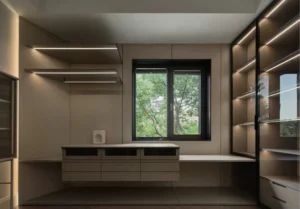
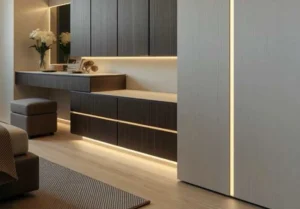
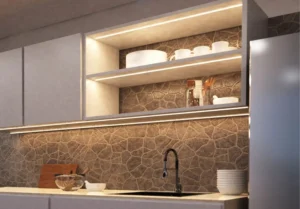
Cabinet & Furniture Lighting
Free-Cut LED strips are ideal for cabinet and furniture integration where precise length adjustment is required. Their flexible cutting capability allows installers to achieve a perfect fit inside cabinets, shelves, and custom furniture structures.
Typical use cases include:
- Kitchen cabinet lighting
- Wardrobe interior lighting
- Display shelves and showcases
- Custom furniture lighting design
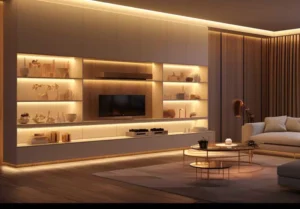
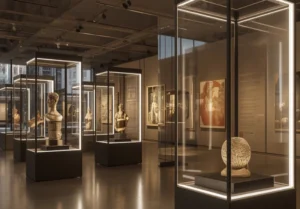
Retail & Display Lighting
In retail environments, lighting plays a critical role in product presentation. Free-Cut LED strips provide high uniformity and easy installation, making them suitable for shelving and display systems.
Key applications:
- Retail shelving illumination
- Product display cases
- Supermarket shelf lighting
- Brand showroom lighting
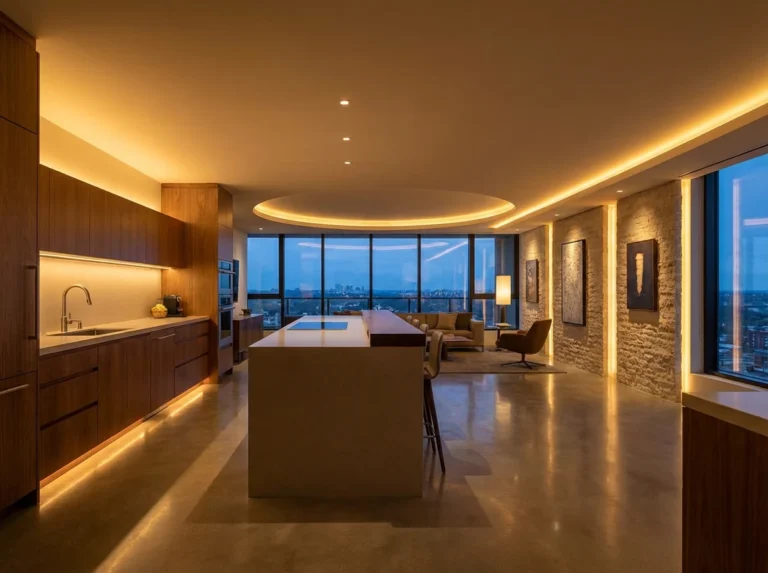
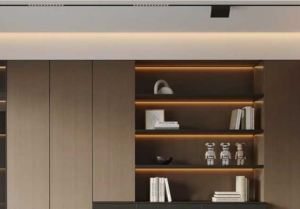
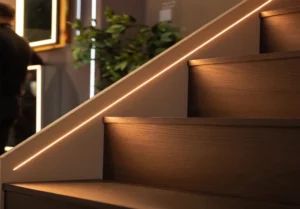
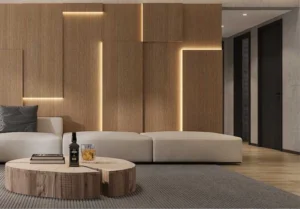
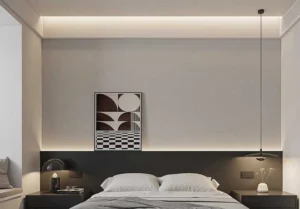
Architectural Linear Lighting
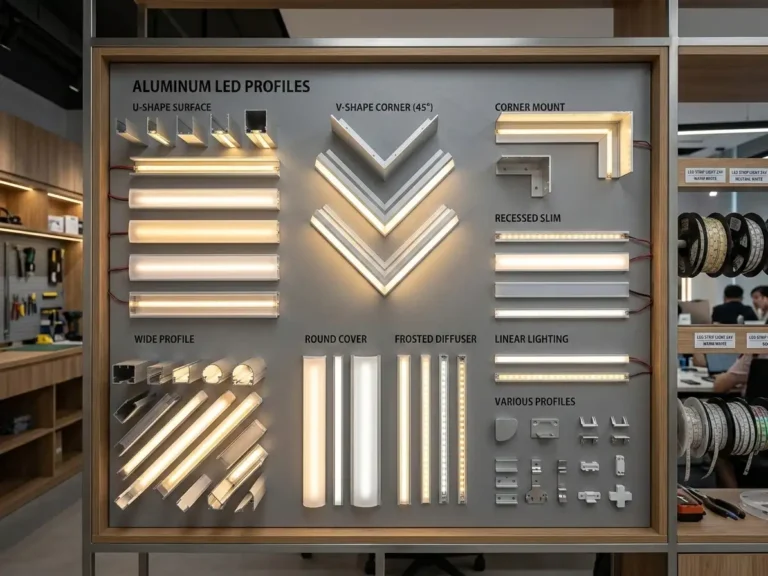
Free-Cut LED strip lights are widely used in architectural lighting designs where continuous and seamless light lines are required. Their compatibility with aluminum profiles allows for clean and modern lighting effects.
Applications include:
- Ceiling cove lighting
- Wall washing effects
- Corridor and hallway lighting
- Architectural contour lighting
Commercial & Hospitality Lighting
For commercial spaces such as hotels, restaurants, and offices, Free-Cut LED strips provide both functional and decorative lighting with high energy efficiency and design flexibility.
Applications include:
- Hotel interior lighting
- Restaurant ambient lighting
- Office indirect lighting
- Reception area accent lighting
Global Market Trends, Application Growth & Technology Shifts in Free-Cut LED Strip Lighting (2026 Outlook)
The LED strip lighting industry is entering a new phase of development driven by higher energy efficiency standards, flexible installation demand, and system-based lighting solutions. In 2026, Free-Cut LED strip lights are expected to play a more important role in both commercial and architectural lighting projects.
Instead of focusing only on unit price, the market is shifting toward a total project value approach, where installation efficiency, energy consumption, and long-term maintenance costs are all key decision factors.
Global Market Trends (Demand-Driven Growth)
The demand for Free-Cut LED strip lights is growing across multiple regions, driven by different market forces:
🇪🇺 Europe – Energy Regulation Driven Market
The European market is strongly influenced by energy efficiency regulations such as the ErP directive. This is accelerating demand for high-efficiency LED strip solutions with higher luminous efficacy (150 lm/W and above) and lower energy consumption.
Typical applications include:
- Commercial retrofit lighting
- Office energy upgrade projects
- Sustainable building lighting systems
🇺🇸 North America – Commercial Upgrade & Smart Lighting Trend
In North America, demand is mainly driven by commercial renovation and smart lighting upgrades. Businesses are increasingly adopting flexible LED strip systems to improve visual presentation and reduce operational costs.
Key applications:
- Retail store lighting upgrades
- Hospitality interior lighting
- Smart building integration projects
Asia-Pacific – Large-Scale Application & Cost Efficiency Market
The Asia-Pacific region continues to expand due to large-scale construction and manufacturing demand. Cost-performance balance remains important, but high-efficiency lighting solutions are gaining traction.
Key applications:
- Commercial building projects
- OEM lighting production
- Retail and infrastructure development
Application-Driven Market Trends
Beyond regional demand, Free-Cut LED strip lights are also expanding in specific application sectors:
- Retail and product display lighting upgrades
- Architectural linear lighting systems
- Furniture and cabinet integrated lighting
- Hospitality and commercial interior lighting
A common trend across all applications is the increasing demand for: clean linear lighting, faster installation, and reduced labor cost
Technology Upgrade Trends
The market is also being reshaped by continuous technological improvements:
- Efficiency upgrade: from 100 lm/W → 150 lm/W → 200 lm/W
- Installation evolution: from soldered → solder-free systems
- Flexibility improvement: from fixed-cut → Free-Cut design
- System integration: from single component → complete lighting system
These upgrades are transforming LED strip lighting from a basic component into a system-level lighting solution.
Pricing Factors (Cost Structure Instead of Fixed Price)
Instead of fixed pricing, Free-Cut LED strip lights are influenced by multiple technical and system-level factors:
- LED efficiency (lm/W performance level)
- LED density (120–240 LED/m)
- CRI level (CRI 80+ vs CRI 90+)
- PCB structure and thermal management
- Free-Cut manufacturing design complexity
- Waterproof rating (IP20 / IP65 / IP67)
- Compatibility with solder-free connector systems
These factors directly affect production cost, performance stability, and installation efficiency.
Market Pricing Logic Shift (System-Level Cost Evolution)
A major transformation is taking place in the LED strip lighting industry: the way projects are evaluated is shifting from simple product-based pricing to a more comprehensive system-level cost structure.
Traditionally, LED strip lighting purchasing decisions were mainly driven by unit price per meter. However, this approach no longer reflects the real cost of a lighting project.
Today, more engineers, designers, and project contractors evaluate lighting solutions based on total lifecycle cost, including:
- Installation labor cost
- Energy consumption over long-term operation
- Maintenance and replacement frequency
- Installation efficiency and project execution time
As a result, high-efficiency and easy-installation systems such as Free-Cut LED strip lights are gaining stronger market preference.
This represents a clear industry shift:
- From product-centric pricing (cost per meter)
- To system-level value evaluation (total project cost efficiency)
In this new pricing logic, factors such as installation time reduction, solder-free connection systems, and high luminous efficiency (up to 150 lm/W) have become as important as the product itself.
The following table summarizes the key global demand drivers, application trends, and pricing structure changes shaping the Free-Cut LED strip market in 2026.
Regional Demand Drivers, Application Growth & Pricing Structure Summary (2026)
| Category | Key Trend | Impact on Free-Cut LED Strip Lights |
| Europe Market | Energy efficiency regulations (ErP) | Higher demand for high lm/W (150–200 lm/W) products |
| North America | Commercial retrofit & smart lighting | Growth in flexible, fast-install systems |
| Asia-Pacific | Large-scale commercial expansion | Demand for cost-performance LED strip systems |
| Application Trend | Retail, architectural, furniture lighting | Shift toward linear & integrated lighting design |
| Technology Trend | Free-Cut + solder-free systems | Faster installation & reduced labor cost |
| Pricing Logic | From product price → system cost | Focus on total project cost optimization |
FAQ
Conclusion
Free-Cut LED strip lights represent a significant evolution in modern lighting technology, combining flexible cutting design, solder-free installation compatibility, and high energy efficiency performance.
With luminous efficacy reaching up to 150 lm/W or higher in selected models, this system provides a strong balance between energy savings, lighting quality, and installation efficiency.
Unlike traditional LED strips that focus mainly on product specifications, Free-Cut LED strip lighting is evolving from a standalone lighting component into an integrated lighting system designed for performance, efficiency, and installation optimization.
As the lighting industry continues shifting toward smarter and more efficient solutions, Free-Cut LED strip lights are becoming a preferred choice for retail, architectural, and commercial lighting projects.
Contact us for technical specifications, project consultation, or customized Free-Cut LED strip lighting solutions tailored to your application needs.
Written by Elaine Zhu
General Manager at SignliteLEDTechnically reviewed by Jason Chen
R&D Leader, SignliteLED
Email: info@signliteled.com
Related Posts