English
  简体中文
简体中文  Deutsch
  Español
  Français
  Italiano
  日本語
日本語  한국어
한국어  Polski
  Português
  Русский
  Türkçe
  Nederlands
  Tiếng Việt
  ไทย
ไทย 
Introduction: COB LED Strip Trends 2026–2028
COB LED strips trends for 2026–2028 highlight the key technological advancements, market shifts, and practical applications shaping the future of professional and architectural lighting. Buyers and designers are increasingly seeking high CRI COB LED strips with tight color consistency (SDCM ≤2), superior energy efficiency, and seamless smart lighting integration. These solutions ensure visually stunning, uniform illumination while reducing energy costs, simplifying installation, and enhancing ROI for commercial, hospitality, and high-end residential projects.
Understanding these trends allows lighting professionals to make informed decisions about product selection, system design, and long-term investment in sustainable, high-performance lighting solutions. As COB technology continues to evolve, it is becoming a mainstream choice for projects where color fidelity, continuous illumination, and intelligent control are critical.
What is a COB LED strip?
A COB (Chip-on-Board) LED strip is a type of flexible linear lighting where multiple LED chips are mounted directly onto a single printed circuit board (PCB), forming a continuous light-emitting surface. Unlike traditional SMD LED strips, COB strips produce dot-free illumination with high color fidelity (CRI ≥95), tight color consistency (SDCM ≤2), and enhanced energy efficiency. Their design also improves thermal management, prolonging lifespan and reducing heat-related performance issues. COB LED strips are widely used in commercial, architectural, retail, hospitality, and high-end residential projects where uniform, visually pleasing lighting and seamless integration with smart controls are essential.
Quick Summary
COB LED strips are rapidly becoming the mainstream solution for commercial and architectural lighting.
Key trends (2015–2028):
- CRI increasing from 80 → ≥95
- Luminous efficacy improving from 100–120 → 140–150 lm/W
- Color consistency improving (SDCM ≤2)
- Advanced packaging technologies (CSP, SCOB, SOB)
- Growing integration with smart lighting systems (DALI, Zigbee, IoT)
- Expanding applications in retail, hospitality, and architectural lighting
Key Industry Data Table
| Year Range | CRI | Luminous Efficacy (lm/W) | SDCM | LED Density | Key Applications |
| 2015–2017 | 80–90 | 100–125 | ≤5 | Medium | Accent lighting, decorative COB LED strips |
| 2018–2020 | 90–95 | 130–140 | ≤3 | High | Retail displays, hotel interiors, museums, galleries |
| 2021–2023 | ≥95 | 140–150 | ≤2 | High | Architectural facades, premium retail, hospitality |
| 2024–2025 | ≥95 | 140–150 | ≤2 | High | Commercial & architectural projects, smart lighting integration |
| 2026–2028 | 95–98 | 140–150+ | ≤2 | High | Luxury retail, museums, smart offices, facades, high-end residential |
Key Takeaways / Summary Statement
“The COB LED strip market is increasingly driven by high-CRI, energy-efficient, and smart-integrated solutions, with Asia-Pacific leading production and Europe/North America emphasizing quality and color consistency.”
Supporting Bullets:
- COB LED strips are the mainstream solution for commercial and architectural lighting.
- High CRI & color consistency: CRI ≥95, SDCM ≤2 for visually uniform illumination.
- Improved efficacy: 140–150 lm/W, reducing energy costs and enhancing ROI.
- Advanced packaging: COB, CSP, SCOB for higher LED density and thermal performance.
- Smart system integration: compatible with DALI, Zigbee, Wi-Fi, and IoT platforms.
- Key applications: retail, hospitality, museums, galleries, and high-end residential.
- Regional production insights: Asia leads global capacity; Europe & North America emphasize high quality.
Quick Answer: Key COB LED Strip Trends
The main COB LED strip trends shaping the lighting industry include:
- Expanding applications – retail, hospitality, architectural, and high-end residential lighting.
- Higher luminous efficacy – reaching 140–150 lm/W for improved energy efficiency.
- Higher color quality – CRI ≥95 and tighter color consistency (SDCM ≤2).
- Advanced packaging technologies – such as CSP, SCOB, and SOB.
- Integration with smart lighting systems – DALI, Zigbee, Bluetooth Mesh, IoT platforms.
Industry Insight
COB LED strips are gradually replacing traditional SMD LED strips in high-end commercial lighting. Their continuous dot-free illumination, higher CRI, and improved thermal management make them ideal for:
- Retail displays
- Museums and art galleries
- Architectural facades
With smart lighting integration becoming standard, COB technology is expected to dominate linear lighting applications by 2028, providing both visual excellence and energy efficiency.
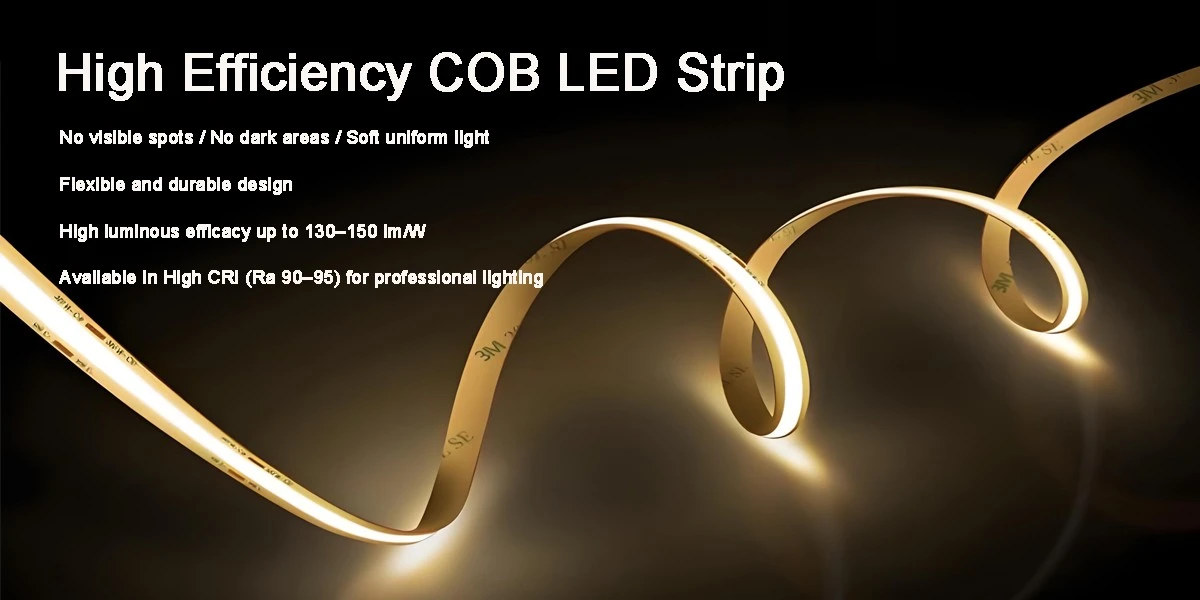
Top 5 COB LED Strip Trends
As COB technology matures, several key trends are shaping the future of COB LED strip lighting. These trends reflect improvements in efficiency, color performance, and application flexibility.
Higher Color Rendering and Precision
High color rendering has become one of the most important performance indicators for COB LED strips. Many modern COB strips now offer CRI ≥95, allowing them to reproduce colors more accurately and naturally.
In addition, tighter color consistency such as SDCM ≤2 or ≤3 is increasingly required for professional lighting projects.
Typical applications include:
- Retail displays
- Museums and galleries
- Hospitality lighting
- Premium residential interiors
Continuous Improvements in Luminous Efficiency
Another major trend is the steady increase in luminous efficacy.
Modern COB LED strips can now reach 140–150 lumens per watt, which significantly improves energy efficiency compared with earlier generations.
Higher efficacy helps lighting designers:
- reduce energy consumption
- meet sustainability targets
- lower operating costs for commercial buildings
Packaging Technology Innovation (CSP, SCOB, SOB)
Table: LED packaging technology is evolving quickly, introducing new solutions that enhance performance and reliability.
| Technology | Key Advantage | Typical Use |
| COB | Mature technology with uniform light output | General commercial lighting |
| CSP | High-density chip packaging | Precision lighting |
| SCOB | Improved heat dissipation | Industrial or high-power lighting |
| SOB | Ultra-uniform lighting effect | High-end architectural projects |
These packaging innovations help manufacturers push the limits of brightness, reliability, and design flexibility.
Integration with Smart Lighting Systems
Smart lighting is becoming a standard requirement in many modern buildings.
COB LED strips are increasingly designed to work with intelligent control systems, such as:
- DALI
- Zigbee
- Bluetooth Mesh
- IoT-based lighting platforms
This allows lighting systems to support automation, dimming, and adaptive lighting strategies.
Expansion into High-End Lighting Applications
Originally used mainly for decorative lighting, COB LED strips are now widely adopted in high-end lighting projects.
Common applications include:
- retail lighting
- hotel and hospitality lighting
- architectural lighting
- premium residential interiors
Thanks to their uniform light output and high color quality, COB strips are gradually becoming a preferred solution for projects that require seamless illumination.
Historical Development (2015–2017)
During 2015–2017, COB (Chip-on-Board) LED strips began gaining traction as an innovative alternative to traditional SMD strips. Early adopters were attracted to their higher color uniformity, better thermal management, and simplified installation for medium-scale commercial and architectural projects.
Performance Highlights:
- CRI values ranged from 80–90, sufficient for general lighting but below the professional-grade standard.
- Efficiency was around 100–125 lm/W, improving steadily as COB manufacturing matured.
- LED density and linear packaging reduced “hot spots,” offering smoother illumination.
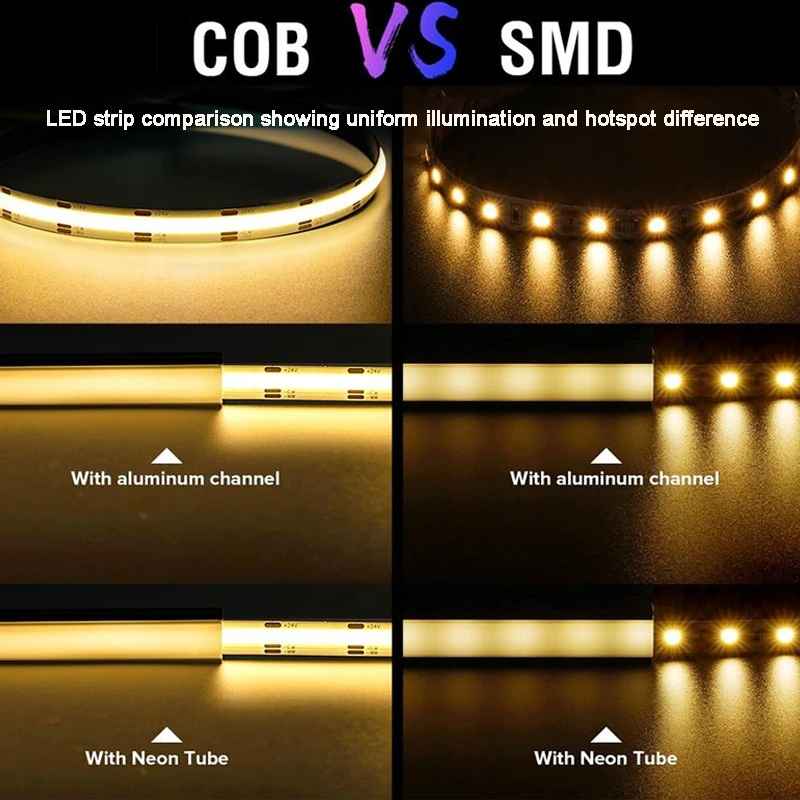
For a deeper comparison, see our guide on SMD vs COB LED strips to understand how COB technology differed from SMD in early development.
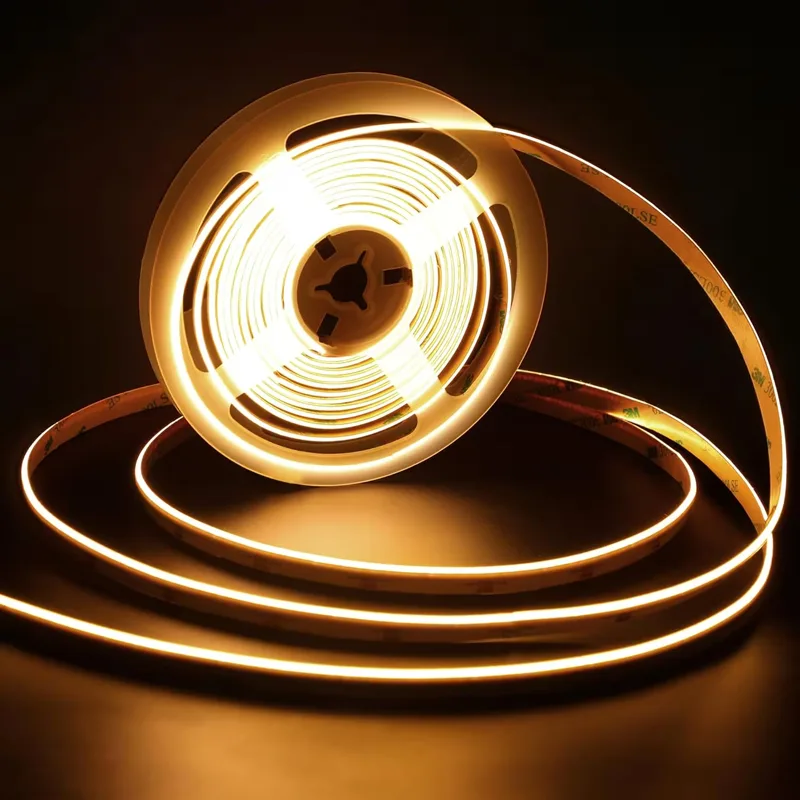
Side-Emitting COB LED Strip Light
Model: FYX08S480C
LED QTY per Meter: 480chips (Sanan)
PCB Width: 8mm
Color Option: 2700K/3000K/4000K/6500K
CRI: >90
Input Voltage: DC24V
Power per Meter: 10W
Efficiency: 90–110 lumen/watt
IP Grade: IP20
Warranty: 3 years
Adoption Boom (2018–2020)
From 2018 to 2020, COB LED strips saw a rapid increase in adoption, driven by improvements in CRI, efficiency, and thermal management. This period marked a shift from experimental use to mainstream commercial and architectural projects.
Key Developments:
- High CRI & Color Fidelity: CRI values climbed to 90–95, meeting the needs of retail, hospitality, and design-focused spaces.
- Efficiency Improvements: Lumens per watt increased to 130–140 lm/W, enabling brighter installations without extra energy costs.
- Enhanced LED Density: High-density COB strips offered dot-free, seamless lighting, critical for accent walls, galleries, and display cases.
- Broader Applications: COB began replacing SMD strips in both new installations and retrofits, especially in spaces requiring consistent color rendering.
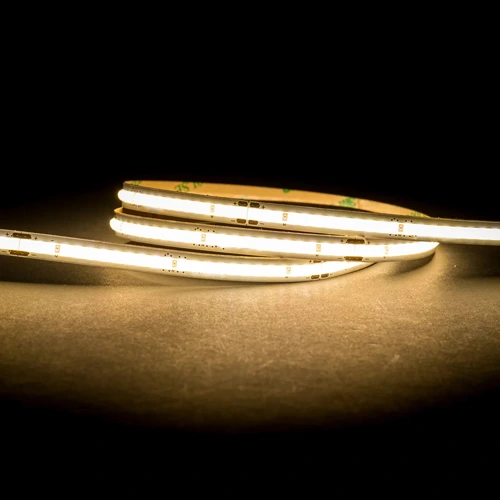
Mono CSP LED Strip Light
Main Model: FYX08C320C
LED QTY per Meter Option: 320/480
PCB Width Option: 8mm
Color Option: 2700K/3000K/4000K/6500K/Red/Green/Blue/Customized
CRI: >90
Input Voltage: DC24V
Power per Meter: 10W/14W
Efficiency: 100–130 lumen/watt
IP Grade Option: IP20/IP54/IP65/IP67/IP68
Warranty: 3 years
Smart Integration & High-End Market Expansion (2021–2023)
During this period, COB LED strips saw accelerated adoption in commercial and architectural projects due to smart lighting integration and high-end market growth. Key developments include:
Smart Control Integration
- IoT-enabled COB LED strips, compatible with DALI, Zigbee, and Wi-Fi systems, became standard in modern offices, retail, and hospitality.
- Allows for automated dimming, color tuning, and scheduling, improving energy efficiency and user experience.
- Application Example: Luxury hotels and retail stores implement dynamic lighting scenes to enhance customer engagement.
Expansion in High-End Commercial Applications
- COB LED strips replaced SMD in architectural facades, art galleries, museums, and premium retail.
- High CRI (≥95) and low SDCM (≤2) became critical specifications for accurate color rendering and uniform light output.
- Energy efficiency improved, achieving 140–150 lm/W, which became a strong selling point for premium projects.
Market Impact
- COB LED strips gained a larger market share due to uniform light distribution and high color fidelity.
- Buyers increasingly focused on performance metrics: CRI, R9, SDCM, voltage, and compatibility with smart controls.
Table 3: High-End COB LED Performance (2021–2023): Smart Integration & Premium Applications
| Feature | Typical Value | Notes / Applications |
| CRI | ≥95 | Accurate color for retail, hospitality, galleries |
| R9 | ≥90 | Essential for red tones in food, fabrics, skin |
| SDCM | ≤2 | Minimal color shift across batches |
| Efficiency | 140–150 lm/W | Energy savings for commercial spaces |
| Smart Control | DALI, Zigbee, Wi-Fi | Automated and scene-based lighting |
Notes:
- Smart-enabled COB strips became the default choice for high-end commercial and architectural projects.
- Buyers prioritize color fidelity, energy efficiency, and compatibility with automated systems.
Current Market Landscape (2024–2025)
As COB LED strips continue to gain traction, the 2024–2025 market shows clear regional patterns in adoption, application, and supply chain dynamics. High-end commercial and architectural projects dominate demand, with buyers increasingly prioritizing high CRI (≥95), efficiency, and uniform light distribution.
Table: Regional Market Distribution & Core Insights
| Region | Share | Core Demand | Key Applications | Supply Chain Notes |
| Asia-Pacific | 40–45% | High CRI, High Efficacy, Flexibility | Commercial complexes, smart homes, export-driven | China leads in production capacity; Korea & Japan focus on high-quality solutions |
| Europe | 25–28% | High CRI, Low SDCM | Museums, art installations, healthcare | Strict regulations push for color consistency and reliability |
| North America | 22–25% | High Efficacy, Integration | Retail chains, smart buildings | High import reliance; end-users adopt advanced solutions quickly |
| Middle East & Africa | 8% | Cost-performance balance | Luxury hotels, commercial infrastructure | Emerging demand with fast growth potential |
| Latin America | 7% | Balanced performance | Infrastructure, commercial projects | Local adoption rising; supply chain improving |
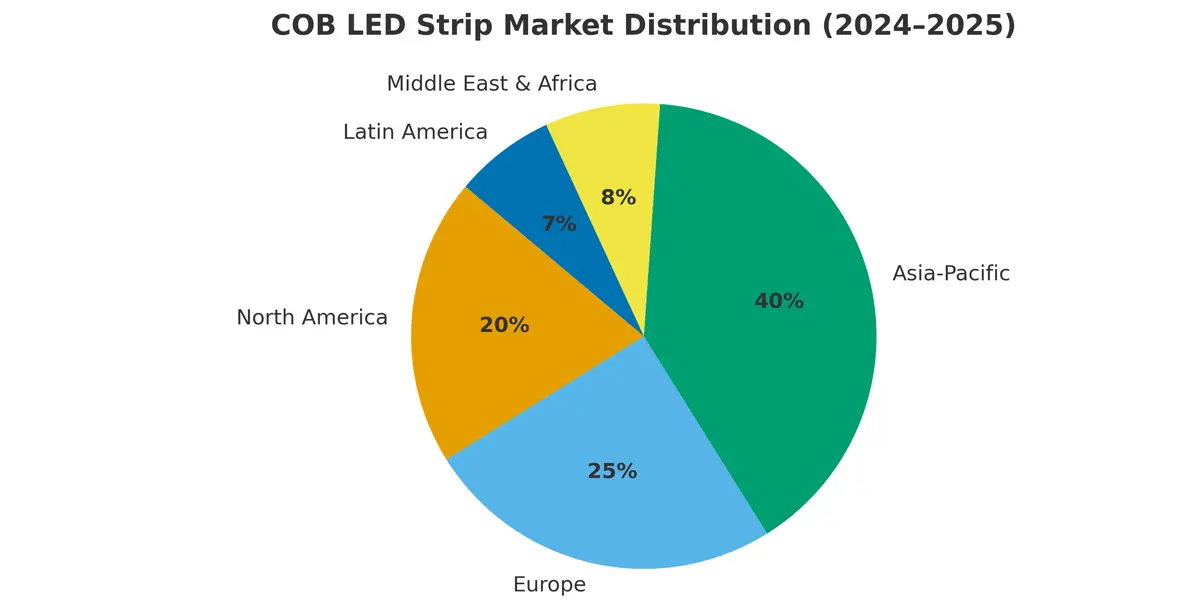
Visual Insight:
The regional market distribution is illustrated in the pie chart below. Asia-Pacific leads with ~40% share, followed by Europe (25%) and North America (20%), while other regions account for 15% combined.
Industry Insight:
Buyers should focus on high CRI COB LED strips in regions with stricter quality standards (Europe, North America) while considering cost-performance balance in emerging markets (Middle East, Latin America). Integration with smart lighting and high-density COB formats ensures both visual excellence and energy efficiency across all applications.
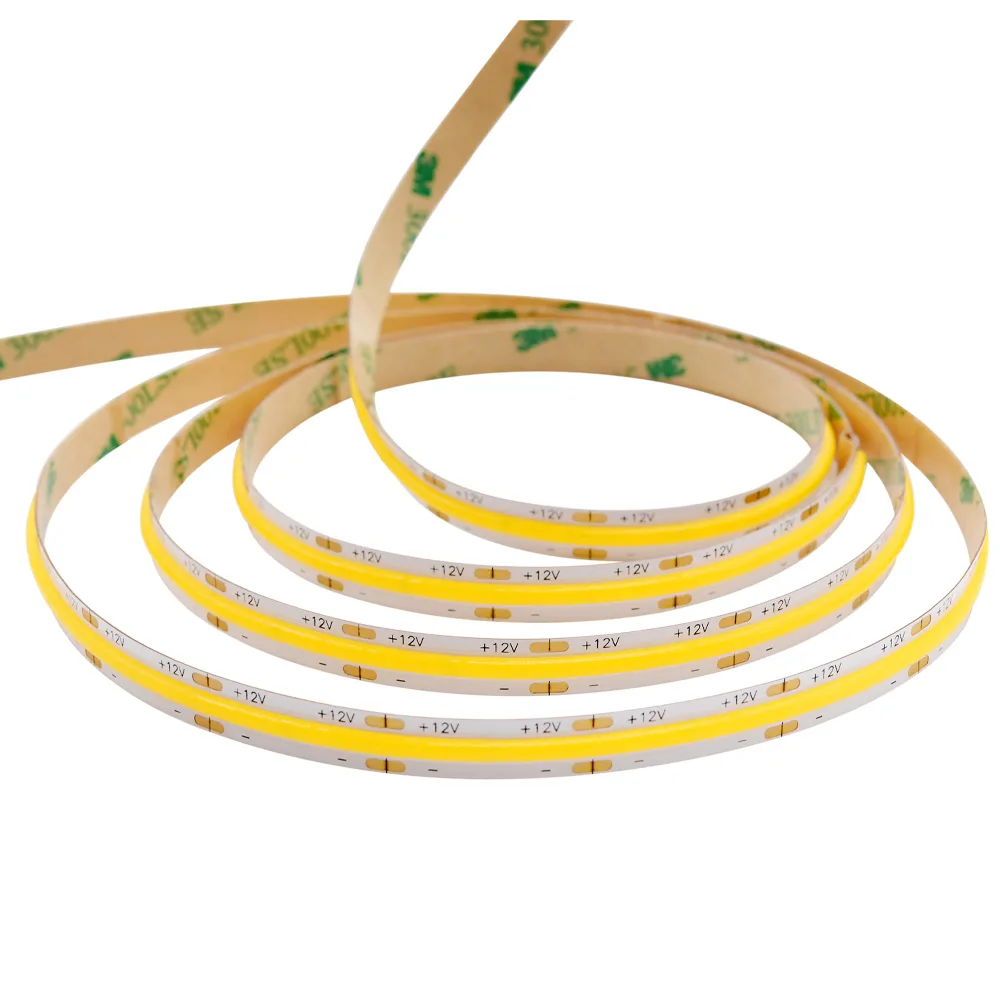
Single Color COB LED Strip Light
Main Model: FYX08T480C
LED Chip QTY per Meter: 320/384/480/528chips (Sanan)
CRI: >90
PCB Width: 8mm/10mm
Color Temperature: 2700K/3000K/4000K/6500K
Input Voltage: DC12V/DC24V
Power per Meter: 8W/10W/11W/14W
Efficiency: 130-150lm/W
IP Grade: IP20/IP54/IP65/IP67/IP68
Warranty: 3 years
Future Outlook (2026–2028)
Looking ahead to 2026–2028, COB LED strip technology is expected to further strengthen its position in professional and architectural lighting markets. As lighting projects demand better color fidelity, smarter control systems, and higher energy efficiency, COB packaging continues to evolve with improved density, thermal management, and integration capabilities.
Several key technological and market trends are expected to shape the next phase of COB LED strip development.
Table: Key Technology and Market Trends (2026–2028)
| Trend | Description | Typical Applications |
| Ultra-High Color Accuracy | CRI levels approaching 98 and higher R9 values for precise color rendering | Retail displays, museums, luxury hospitality |
| Higher Efficiency | Continued improvement in luminous efficacy, targeting 150 lm/W or higher | Commercial buildings, large-scale installations |
| Advanced Packaging | Adoption of technologies such as CSP, SCOB, and next-generation COB formats | Industrial lighting, architectural lighting |
| Smart Lighting Integration | Increasing compatibility with DALI, Zigbee, Bluetooth, and IoT lighting systems | Offices, smart homes, commercial automation |
| Flexible Customization | Greater demand for customized color temperatures, lengths, and control systems | OEM lighting brands and project-based solutions |
Expected Application Expansion
COB LED strips are expected to expand further into sectors that require high visual comfort and seamless lighting lines, including:
- High-end retail environments
- Museums and art galleries
- Hospitality and luxury hotels
- Smart office spaces
- Architectural façade lighting
Compared with earlier LED strip technologies, COB solutions provide continuous illumination without visible LED dots, which remains a critical advantage for modern minimalist lighting designs.
Industry Insight
Between 2026 and 2028, the market is likely to focus not only on performance improvements but also on system integration and customization. Buyers will increasingly evaluate COB LED strips based on:
- Color rendering performance (CRI and R9)
- Consistency across batches (SDCM levels)
- Compatibility with smart lighting protocols
- Long-term reliability and thermal management
Manufacturers that combine high-performance COB packaging with flexible OEM/ODM customization are expected to capture the majority of professional lighting projects.
Professional Selection & Application Guide
As COB LED technology reaches peak performance, selecting the right product requires looking beyond basic lumens. This guide provides a strategic framework for high-end project specifications.
Table: Recommended COB LED Specifications (2026–2028): Professional Selection Guide
| Application Segment | Ideal CRI / Rf | Efficacy (lm/W) | Control Protocol | Key Technical Requirement |
| Luxury Retail | CRI 98 / Rf 95+ | 130–140 | DALI-2 / Matter | High R9 fidelity for fabrics and merchandise |
| Museums & Art | CRI 99 / SDCM ≤1 | 120–130 | Casambi / Bluetooth | Zero UV emission & deep dimming |
| Smart Offices | CRI 90–95 | 150+ | Zigbee / IoT | Human-Centric Lighting (HCL) |
| Outdoor Facades | CRI 85+ | 140+ | DMX512 | IP67/68 Silicone Extrusion for weather resistance |
| Residential High-End | CRI 95 / R9 >90 | 130–145 | Wi-Fi / Thread | Tunable White (2700K–6500K) |
Notes:
- Focus on thermal management (3oz Copper PCB), color fidelity beyond CRI (TM-30-18 Rf/Rg), and deep dimming resolution.
- Prioritize system interoperability with Matter or Thread protocols for smart building ecosystems.
Frequently Asked Questions
Conclusion
From 2015’s early experimental stages to the 2028 vision of fully integrated IoT lighting, COB LED technology has redefined architectural illumination. By prioritizing high color fidelity (CRI 95+), extreme energy efficiency, and smart connectivity, designers can create spaces that are not only visually stunning but also sustainable and future-proof. Choosing a manufacturer that offers both technical excellence and OEM/ODM flexibility remains the most strategic move for global lighting buyers.

Related Posts