English
  简体中文
简体中文  Deutsch
  Español
  Français
  Italiano
  日本語
日本語  한국어
한국어  Polski
  Português
  Русский
  Türkçe
  Nederlands
  Tiếng Việt
  ไทย
ไทย 
Quick Answer: What Is the Best LED Chip for LED Strip Lights?
The best LED chip for most applications is SMD 2835.
It delivers the highest efficiency, compact size, and is used in over 70% of commercial LED strip projects due to its superior lumen-per-watt performance.
For specific use cases:
- SMD 5050 → best for RGB and color-changing strips
- COB LED → best for dot-free, continuous lighting
- SMD 5630 → best for high-output, high-power applications
- SMD 2216 → best for ultra-narrow or high-density designs
At our factory, over 70% of commercial LED strip orders specify SMD 2835 — primarily because it achieves higher brightness within the same PCB width compared to larger packages like 5050.
LED Chip Comparison (Extended Table)
| Chip | Size (mm) | Structure | Brightness | Efficiency | Dotting | Bracket | Recommended Density | Best For |
| 2835 | 2.8×3.5 | Single | High | Very High | Minimal | PPA | 120–240 LEDs/m | Commercial / task lighting |
| 5050 | 5.0×5.0 | 3-chip | Med–High | Medium | Visible | PCT | 30–96 LEDs/m | RGB / RGBW strips |
| 3528 | 3.5×2.8 | Single | Low–Med | High | Visible | PPA | 60–120 LEDs/m | Budget / accent lighting |
| 5630 | 5.6×3.0 | Single | Very High | High | Minimal | EMC | 60–120 LEDs/m | High-power applications |
| COB | — | Integrated | High Uniform | Med–High | None | — | Continuous | Architectural lighting |
| 2216 | 2.2×1.6 | Single | Low–Med | High | Minimal | PPA | 120–300 LEDs/m | Narrow / precision installs |
LED Chip Comparison Summary
- 2835 = best overall efficiency and general lighting
- 5050 = required for RGB and color-changing
- COB = best for dot-free linear lighting
- 2216 = ideal for ultra-narrow installations
- 5630 = best for high-output applications
- 3528 = budget and decorative lighting
What Do LED Chip Numbers Actually Mean? (2835, 5050, 3528 Decoded)

The Number = Physical Size in Millimeters
LED chip numbers indicate the physical dimensions (length × width) of the LED package, measured in millimeters.
For example:
- 2835 = 2.8 mm × 3.5 mm
- 5050 = 5.0 mm × 5.0 mm
- 3528 = 3.5 mm × 2.8 mm
- 5630 = 5.6 mm × 3.0 mm
This standardized naming system helps identify footprint, PCB compatibility, and thermal behavior.

Why Chip Size Matters for LED Strip Design
LED chip size affects PCB width, heat dissipation, power capacity, and LED density — which together determine brightness and application suitability.
Comparison Summary
– Larger chips → higher power, better heat dissipation
– Smaller chips → higher density, better uniformity
– Chip size → directly limits PCB width compatibility
What Is the Impact on PCB Width?
Larger chips require wider PCB boards for proper mounting and circuit routing.
· 5050 → typically ≥ 8mm PCB
· 2835 → can fit on 6mm or narrower
How Does Chip Size Affect Heat Dissipation?
→ Larger chips handle higher current
→ Better thermal performance with proper materials
How Does Chip Size Affect Light Output?
· Multi-die chips (like 5050) support RGB and higher current
· Smaller chips (like 2835, 2216) focus on efficiency and density
Key Takeaway:
LED chip numbers indicate size, not performance — and directly affect PCB design, heat dissipation, and application fit.
For a deeper dive into SMD LED technology, see our Complete Guide to SMD LED Strips.
How to Identify an LED Strip Chip Type by Looking at It
Quick Answer
LED strip types can be identified by visual appearance and LED structure.
- If individual LED chips are visible → it is an SMD strip
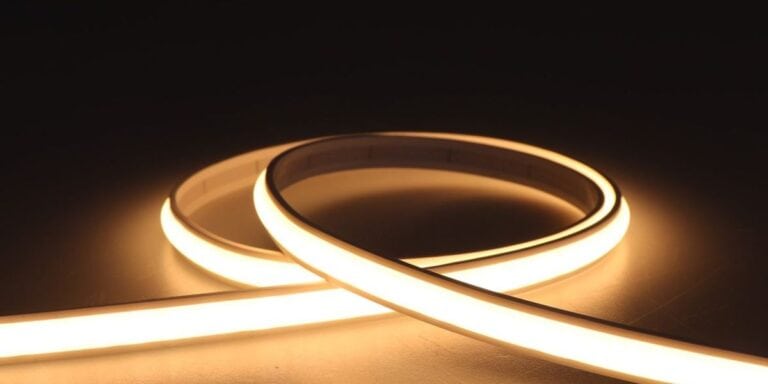
- If the light appears as a continuous line with no visible chips → it is a COB strip
This visual difference is the fastest way to distinguish between the two technologies.
SMD Chips — How to Recognize Individual Packages
SMD (Surface-Mounted Device) LED strips use discrete chip packages, which are easy to identify once you know what to look for:
- Single light point per LED → Typically 2835 or 3528 (single-diode structure)
- Three small light points in one package → 5050 (multi-chip RGB structure)
- Long rectangular package → 5630 (high-power single chip)
Quick identification rule:
If you can clearly see and count individual LED packages, it is an SMD strip.
COB LED Strips — What Makes Them Visually Different
COB (Chip-on-Board) strips look completely different from SMD strips.
- No visible individual LED packages
- A continuous yellow or white phosphor coating layer
- Light appears as a uniform line, not individual dots
Quick identification rule:
If you cannot distinguish individual LEDs and the strip looks like a smooth glowing line, it is a COB strip.
To learn more about COB construction and how it differs from SMD, read The Ultimate Guide to COB LED Strip Lights.
What the PCB Color and Width Tell You
The PCB (printed circuit board) also provides strong clues about the chip type and application:
- White PCB → Better light reflection, common in general lighting
- Black PCB → Reduced glare, used in architectural or high-end designs
- 4mm / 5mm PCB → Typically 2216 or 2835 (ultra-slim designs)
- 8mm PCB → Common for 2835 or 5050
- 10mm / 12mm PCB → Often used for RGB (5050) or high-power strips
At our factory, the most common request for slim aluminum profile installations specifies 5mm or 6mm PCB — which automatically narrows the chip choice to 2835 or 2216.
PCB width is often a constraint, not a choice—it limits which chip can be used.

LED Chip Comparison: 2835 vs 5050 vs COB vs 3528 vs 5630 vs 2216
Choosing the right LED chip requires understanding how each type performs across brightness, efficiency, structure, and application fit. Below is a manufacturer-level comparison that goes beyond typical overviews by including bracket materials and real-world usage scenarios.

For a detailed commercial-focused breakdown, also see: SMD 3528 vs 2835 vs 5050: Which Is Best for Commercial Lighting?
SMD 2835 — The Efficiency Standard
SMD 2835 is the most widely used LED chip in modern strip lighting, especially for white illumination.
- Excellent lumen-per-watt efficiency
- Compact size allows higher LED density
- Works on narrow PCBs (4mm–8mm)
Manufacturing insight:
We typically run 2835 at 0.2W per chip in standard configurations, but in high-density designs with aluminum PCBs, it can be driven up to 0.5W—a level only achievable with tight control over chip binning and thermal design.
SMD 5050 — Built for RGB
5050 chips are designed for color mixing applications, thanks to their internal multi-chip structure.
- Contains 3 diodes in one package (RGB or RGBW)
- Enables full color control
- Higher power consumption than single-chip LEDs
Engineering note:
The 3-chip structure means forward voltage is higher (~3.2–3.4V per diode), making 5050 strips more sensitive to voltage drop over long runs—a key consideration in large installations.
SMD 3528 — The Original Budget Chip
3528 is one of the earliest SMD LED formats and is still used in cost-sensitive applications.
- Lower brightness output
- Good efficiency at low power
- Suitable for decorative or indirect lighting
Today, it is gradually being replaced by 2835 in most professional applications.
SMD 5630 — High-Power Applications
5630 chips are built for maximum brightness and higher current operation.
- Larger emitting surface
- Higher lumen output per LED
- Requires better thermal management
Often used in facade lighting, signage, and industrial environments where output is prioritized over compactness.
COB LED — Dot-Free Architecture
COB (Chip-on-Board) technology integrates multiple LED dies into a continuous light-emitting surface.
- Completely eliminates visible LED dots
- Produces smooth, uniform linear light
- Ideal for premium architectural lighting
For real-world use cases, see 20 Professional Applications of COB LED Strip Lights.

SMD 2216 — Precision Narrow Strips
2216 is designed for ultra-narrow and high-density strip designs.
- Extremely small package size
- Enables very tight LED spacing
- Ideal for slim aluminum profiles and display lighting
Common in jewelry cabinets, showcases, and micro-installations.
Key Takeaway:
Each LED chip is optimized for a specific use case. The right choice depends on balancing efficiency, visual effect (dotting vs. uniform), and physical constraints like PCB width and heat dissipation.
COB vs SMD LED Strip: What Is the Difference?
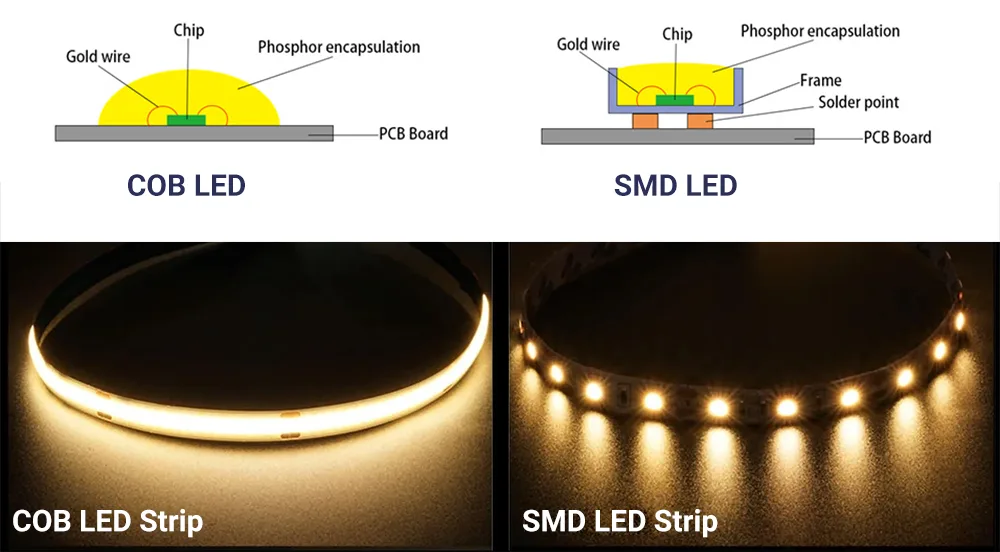
COB LED strips and SMD LED strips differ mainly in light uniformity, structure, flexibility, and maintenance.
COB LED strips use an integrated chip-on-board design, producing a continuous, dot-free light output.
SMD LED strips use individual LED packages, resulting in visible light dots but offering better flexibility and easier repair.
In short:
- COB = better visual quality (dot-free, seamless light)
- SMD = better flexibility and maintenance (modular, repairable)
COB vs SMD Decision Guide
– Choose COB → when visual uniformity is critical
– Choose SMD → when flexibility and maintenance matter
– COB = premium appearance
– SMD = practical and cost-efficient
Key Takeaway:
COB excels in visual quality, while SMD offers advantages in flexibility, repairability, and cost control. The right choice depends on whether your priority is appearance or practicality.
Which LED Chip Should You Choose? (By Application)
Choosing the right LED chip is not about finding the “best” one—it’s about matching the chip to your application requirements.
Quick Answer (Application-Based Selection)
- General lighting → 2835 (best efficiency and balance)
- RGB / color-changing → 5050 (multi-chip structure required)
- Dot-free linear lighting → COB (uniform light output)
- Budget / decorative → 3528 (low cost, lower brightness)
- High brightness / industrial → 5630 (higher power capacity)
- Narrow installation → 2216 (compact size, high density)
The best LED chip is determined by three factors: brightness requirement, visual effect (dot vs. dot-free), and PCB width constraint.
Best LED Chip for Commercial & Residential Lighting: 2835
Definition:
2835 LED chip is a single-diode SMD package optimized for high efficiency and medium-to-high brightness in general lighting.
Why it’s used:
- High lumen-per-watt efficiency
- Supports high LED density (120–240 LEDs/m)
- Compatible with narrow PCBs (4–8mm)
Risk / limitation:
Not suitable for RGB or color-changing applications due to single-diode structure.
Summary:
2835 is the most widely used LED chip for general lighting due to its efficiency, flexibility, and cost-performance balance.
Best LED Chip for RGB & Color-Changing Lighting: 5050
Definition:
5050 LED chip is a multi-diode (typically 3-in-1) SMD package designed for RGB and RGBW color mixing.
Why it’s used:
- Integrates 3 chips in one package
- Enables full RGB / RGBW control
- Compatible with controllers and smart lighting systems
Risk / limitation:
More sensitive to voltage drop over long runs, which can cause uneven color output if power is not properly distributed.
Summary:
5050 is the standard choice for RGB lighting but requires careful power design in large installations.
Best LED Chip for Dot-Free Architectural Lighting: COB
Definition:
COB (Chip-on-Board) LED integrates multiple LED dies into a continuous phosphor-coated surface, producing uniform light output.
Why it’s used:
- Completely eliminates visible LED dots
- Produces seamless linear lighting
- Ideal for visible, design-focused installations
Risk / limitation:
Low repairability—if a section fails, the entire segment typically needs replacement; also more sensitive to bending stress.
Summary:
COB is the best option for dot-free, high-end lighting where visual uniformity is the top priority.
Best LED Chip for Budget & Accent Lighting: 3528
Definition:
3528 LED chip is an early-generation single-diode SMD package designed for low-power, cost-sensitive lighting.
Why it’s used:
- Lower cost compared to newer chips
- Adequate for decorative or indirect lighting
- Simple and stable at low power
Risk / limitation:
Lower brightness and gradually being replaced by 2835 in most professional applications.
Summary:
3528 is suitable for budget projects, but 2835 is now the preferred upgrade in most cases.
Best LED Chip for High-Power & Industrial Lighting: 5630
Definition:
5630 LED chip is a high-power SMD package designed for maximum brightness and higher current operation.
Why it’s used:
- Higher lumen output per LED
- Larger emitting surface
- Suitable for low-density, high-output designs
Risk / limitation:
Requires strong thermal management—overheating can significantly reduce lifespan.
Summary:
5630 is ideal for high-output applications but must be paired with proper heat dissipation design.
Best LED Chip for Narrow & Precision Installations: 2216
Definition:
2216 LED chip is a compact SMD package designed for ultra-narrow PCBs and high-density LED layouts.
Why it’s used:
- Extremely small footprint
- Enables ultra-narrow strips (≤5mm)
- Supports very high LED density
Risk / limitation:
Lower single-LED brightness compared to larger chips, requiring higher density to achieve strong output.
Summary:
2216 is the best choice for narrow installations where space constraints are critical.
Decision Rule
- If you need dot-free lighting → choose COB
- If you need RGB or color control → choose 5050
- If you need general lighting → choose 2835
- If PCB width is limited (<6mm) → choose 2216 or 2835
- If you need maximum brightness per LED → choose 5630
In most real-world projects, the decision narrows down to:
- 2835 → standard lighting
- 5050 → color lighting
- COB → premium visual effect
LED Chip Selection Checklist
Quick Answer
The right LED chip is determined by three factors:
brightness requirement, visual effect (dot vs. dot-free), and PCB width constraint.
Checklist
- What brightness level do you need?
→ High brightness: 2835 / 5630
→ Decorative: 3528 / 2216 - Do you need RGB or color-changing?
→ Yes: 5050 required - Do you need dot-free lighting?
→ Yes: COB
→ No: SMD is more cost-effective - What PCB width is available?
→ ≤5mm: 2216 / 2835
→ 6–8mm: 2835 (standard)
→ ≥10mm: 5050 / high-power - Is flexibility required?
→ Tight curves: SMD
→ Straight lines: COB or SMD - What voltage system are you using?
→ 12V: short runs
→ 24V: long runs - What is the operating environment?
→ High heat / outdoor: 5630 + EMC
→ Indoor: 2835 standard
Key Takeaway
Most LED strip selection decisions can be made quickly by defining constraints first — not by starting with the chip type.
Technical Parameters Only Manufacturers Talk About
Quick Answer
The long-term performance of LED strips is not determined by chip type alone, but by three key factors:
material quality, chip binning, and drive current control.
These parameters affect color consistency, heat resistance, and lifespan — even when two strips use the same LED chip.
Comparison Summary
- Bracket material = affects heat resistance and durability
- Chip binning = affects color consistency and uniformity
- Drive current = affects brightness vs. lifespan trade-off

What Is LED Bracket Material and Why Does It Matter?
LED bracket material determines how well the strip handles heat and mechanical stress.
- PPA → flexible, standard for most LED strips
- PCT → higher heat resistance, used in RGB chips
- EMC → highest durability, used in high-power and outdoor applications
In practice:
Flexible LED strips require materials like PPA to prevent cracking during bending, while high-power applications rely on EMC for thermal stability.
What Is Chip Binning and How Does It Affect Lighting?
Chip binning refers to how LEDs are sorted based on color and brightness during manufacturing.
- Tight binning (e.g. 3-step SDCM) → consistent color across the strip
- Loose binning → visible color variation between LEDs or batches
Why it matters:
Poor binning can cause noticeable color differences, even if all strips are labeled with the same color temperature (e.g. 3000K).
How Does Drive Current Affect LED Lifespan?
The actual current used to drive an LED chip directly impacts its performance.
- Higher current → higher brightness, shorter lifespan
- Lower current → lower brightness, longer lifespan
Industry reality:
Overdriving LEDs can increase brightness short-term but significantly reduces long-term reliability.
Manufacturing Insight
At our factory, LED chips are typically driven at 75%–85% of their rated current to balance brightness and lifespan — a standard approach for achieving stable long-term performance.
Final LED Chip Selection Summary
– 2835 → standard lighting
– 5050 → RGB lighting
– COB → premium dot-free lighting
– 2216 → narrow installations
– 5630 → high-power output
The best LED chip is determined by application constraints — not by chip type alone.
Related Posts